REVIEW 4 major objections 5 minor 13 references
TweakLLM: A Routing Architecture for Dynamic Tailoring of Cached Responses
T0 review · 4 major / 5 minor · reviewed 2026-08-06 · deepseek-v4-flash
Pith's one-line read TweakLLM is a two-tier routing architecture that keeps cached LLM responses usable by having a small model rewrite them for each new prompt, matching frontier-model quality while cutting inference cost.
desk verdict A genuinely sensible caching architecture, but the headline cost-quality claim is not demonstrated at a single operating point; worth a serious look with major revision. read the letter →
The pith
A machine-rendered reading of the paper's core claim, the machinery that carries it, and where it could break.
The reading
What carries the argument
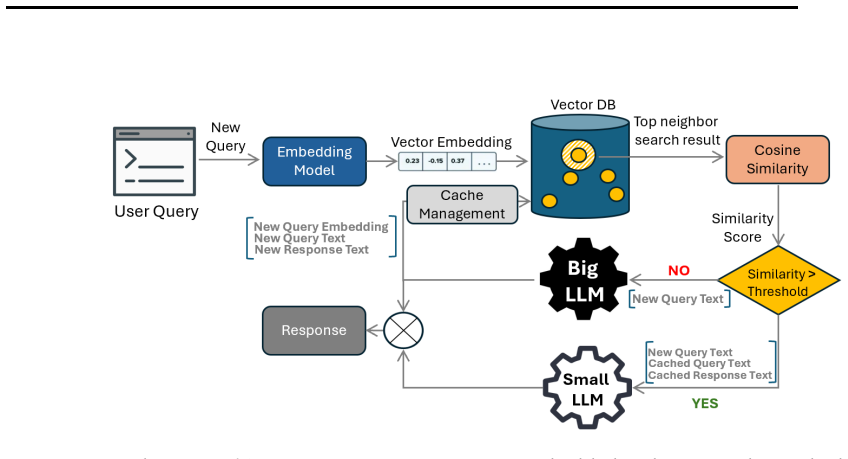
The load-bearing component is the tweaking step: a small instruction-following LLM (Llama 3.1 8B) is prompted with the new query, the cached query, and the cached response, and is told to tailor the cached response for relevance, accuracy, and clarity without mentioning the cached question. This step sits between a vector-database lookup (Milvus with all-MiniLM-L6-v2 embeddings and a cosine threshold of 0.7) and response delivery. It does the work that semantic similarity cannot: correcting swapped intent, flipped polarity, or changed details that survive embedding-based matching. The two-tier routing is what allows the system to keep the frontier model's quality while using the small model only for the final adaptation.
What would settle it
Run TweakLLM end-to-end on the Question Pairs cache-hit subset that pure similarity search misroutes: the roughly 10% of pairs above 0.7 that human annotators label non-duplicates. If human raters or an independent judge find the tweaked responses satisfactory on those pairs, the quality-equivalence claim holds; if they fail at a rate close to the false-positive rate, the tweak step has not actually recovered the missing information.
Extended reading notes
Core claim
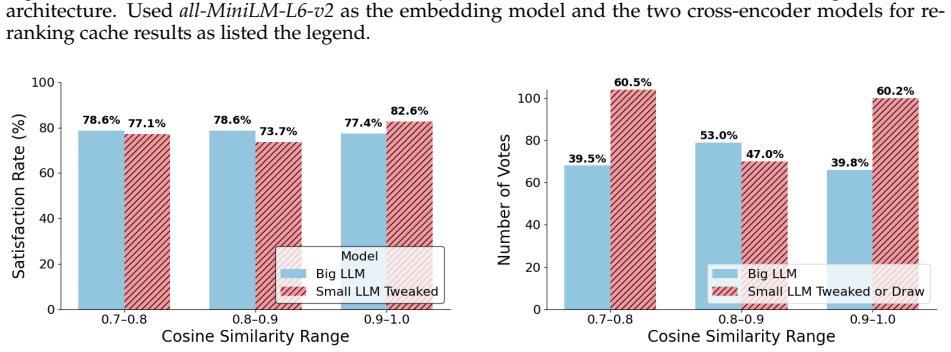
The central discovery is that the blocker to LLM response caching is not cache hit rate but response relevance, and that a small LLM can remove that blocker. The paper shows that semantic similarity alone misroutes about 10% of near-duplicate question pairs at a 0.7 cosine threshold and that pushing precision to 0.97 collapses recall to about 0.2. TweakLLM's response is to keep the threshold and add a refinement step: the cached response and the new prompt are given to Llama 3.1 8B, which revises the cached answer to fit the new prompt. In user studies, satisfaction with the tweaked responses tracks the frontier model's across similarity bands and even exceeds it in the highest band; in a three-agent LLM debate, tweaked responses are judged equal or better with increasing frequency as similarity rises. The paper interprets this as evidence that the tweak step, not the embedding search, is what makes cache reuse safe.
Load-bearing premise
The architecture assumes that a cached answer found by semantic similarity is close enough to the new question that a small LLM can edit it into a correct answer rather than needing information the cached answer lacks.
Editorial extensions
If this is right
- If the quality-equivalence claim holds, providers can serve a majority of repeated traffic without calling the frontier model: 68% of LMSYS queries and 40% of WildChat queries exceed a 0.8 cosine threshold in the paper's split.
- User satisfaction with tweaked responses is comparable to direct frontier-model responses across the 0.7–1.0 similarity range, and higher in the 0.9–1.0 band, so near-duplicate queries are the safest cache-reuse candidates.
- Because the tweak step is the safety net, the system can hold the threshold at a level where pure semantic caching has roughly 10% false positives and still return acceptable answers, expanding the usable cache space.
- Any deployment can tune the cosine threshold to trade cost savings against tweak burden; exact-match hits can skip tweaking entirely to save further compute.
Reading between the lines
- A natural extension the paper leaves open: lowering the threshold below 0.7 and measuring whether tweak quality still holds, which would directly map the cost-quality frontier for production tuning.
- The same rewrite step could be applied to retrieved passages in retrieval-augmented generation, not only to cached chatbot answers; the paper does not discuss RAG, but the mechanism is the same.
- Because the same model family (GPT-4o) serves as both the frontier generator and the debate judge, an independent check with a different judge model would separate TweakLLM's effect from referee bias; the paper lists referee diversification only as future work.
Editorial analysis
A structured set of objections, weighed in public.
Referee Report
Summary. The paper proposes TweakLLM, a two-tier caching architecture for LLM serving. An incoming query is embedded and compared against cached query-response pairs; if the top cosine similarity exceeds a threshold, a small LLM (Llama-3.1-8B) rewrites the cached response to fit the new query; otherwise the query is sent to a large LLM (GPT-4o). The authors evaluate the approach on the Quora Question Pairs dataset, LMSYS-Chat-1M, and WildChat-1M, using a user study and a three-persona GPT-4o debate pipeline as quality metrics. They report that at a cosine threshold of 0.8, the architecture reduces inference cost to 35% of the GPT-4o baseline on LMSYS and 61% on WildChat, while user satisfaction and LLM-judge verdicts are claimed to be comparable to direct GPT-4o generation on cache-hit subsets.
Significance. If the central claim were demonstrated at a single operating point, TweakLLM would be a practically useful contribution: it combines semantic caching with a cheap refinement model and is evaluated on large real-world conversation datasets. The paper includes several methodological strengths: the implementation is open-source, the evaluation uses both human judgments and a multi-agent LLM debate with a control condition (small-model direct generation), and the precision-recall analysis of standalone semantic caching is informative. However, the headline cost savings and the quality-comparability claim are never established at the same threshold. The cost numbers use a cosine threshold of 0.8, while the quality evidence is reported only in similarity bands and, at 0.8-0.9 on LMSYS, the paper's own judge rates only 37.7% of tweaked responses as better or equal to the GPT-4o baseline. The user study is conducted only on Quora pairs at threshold 0.7 and is not connected to the cost-claim operating point. These gaps are load-bearing and must be addressed before the central claims can be accepted.
major comments (4)
- [§5.2.2 and §5.2.3, Figures 7-9] The cost claim in §5.2.3 uses a cosine threshold of 0.8 (68% cache hits on LMSYS, 40% on WildChat), but the quality evidence in §5.2.2 is reported per similarity band and not aggregated at the same threshold. On LMSYS, the LLM-debate judge rates only 37.7% of tweaked responses as better-or-equal in the 0.8-0.9 band (Figure 7), which is the band immediately above the cost-claim threshold. The paper never reports an aggregate quality metric over the cache-hit population at threshold 0.8. Consequently, the abstract's claim that TweakLLM 'maintains response quality comparable to frontier models while significantly improving cache effectiveness' is not demonstrated at any single operating point. Please report quality metrics (judge verdicts, and ideally user-study ratings) for the exact threshold used in the cost analysis, or restate the cost claim at a threshold where quality is actually measured.
- [§4.2.2 and Figures 3-4] The user study, which is the only independent (human) quality evidence, is restricted to the Quora Question Pairs dataset and uses a similarity threshold of 0.7. It does not include any LMSYS or WildChat queries, and it does not cover the 0.8 threshold used for the cost analysis. Quora Question Pairs consists of curated near-duplicate questions, whereas LMSYS and WildChat are free-form and much more diverse; the gating behavior of the cache at 0.8 on these real-world datasets is therefore not validated by the user study. The satisfaction and side-by-side results in Figures 3 and 4 cannot rescue the quality claim at the cost-claim operating point.
- [§5.2.2, Appendix B, and §6.2] The LLM-as-evaluator pipeline uses GPT-4o as the judge, and GPT-4o is also the Big LLM that generated the cached responses from which the tweaked responses are derived. This self-referential setup creates a risk of systematic bias: the judge may favor responses that resemble its own style, which the tweaked responses inherit from the cached GPT-4o outputs. The paper acknowledges in §6.2 that 'our automated evaluations rely solely on GPT-4o-based referees,' but the limitation is more than a future-work item; it directly affects the interpretation of Figures 5 and 7. A sensitivity analysis using an independent judge (e.g., a different model family) or a human-evaluated subset of LMSYS at the cost-claim threshold would substantially strengthen the evidence.
- [§4.2.2 and §5.2.1] The user study methodology has several reporting gaps that affect the strength of the quality claim. The sample is a convenience sample of university and A-Level students; responses under 45 seconds are excluded based on an author pilot estimate, and no inter-rater reliability or confidence intervals are reported. Figures 3 and 4 show aggregate percentages without error bars or per-band sample sizes, so it is impossible to assess whether the observed differences (e.g., 82.6% vs. 77.4% satisfaction in the 0.9-1.0 band) are statistically meaningful. Please provide per-band counts, confidence intervals, and a justification for the time cutoff.
minor comments (5)
- [Section 1, 'Paper Organization'] The organization paragraph says 'Section 6.2 concludes the paper,' but Section 6.2 is 'Limitations and Future Directions' and the actual conclusion is Section 7.
- [Figures 8 and 9 captions] The captions contain a typo: 'insering' should be 'inserting'.
- [Section 2, Related Work] The sentence 'they provide GPT4o-mini the test query...' contains a duplicated 'the' ('the the test query') and should be reworded for clarity.
- [Section 5.2.3] The cost analysis assumes a 25x API price difference per output token between GPT-4o and Llama-3.1-8B, but the paper does not state the assumed input/output token mix or the specific pricing used; this should be documented so the cost figure is reproducible.
- [Table 1] The 'Query Preprocessing' entry states that 'answer briefly' is appended to all queries, but the paper does not discuss how this affects the comparability of user-study or judge evaluations against baseline responses that may use the same preprocessing; a brief justification would be helpful.
Circularity Check
No significant circularity: the paper's claims rest on measured hit rates, price ratios, user studies, and LLM-judge comparisons, not on definitions or self-citations that force the results.
full rationale
TweakLLM is an empirical systems paper with no formal derivation chain that could reduce to its own inputs. The cost estimate in Section 5.2.3 is direct arithmetic from measured cache-hit fractions (Figures 8, 9) and a stated 25x per-output-token price ratio; the resulting 35% and 61% figures are computed, not assumed. The quality claims are supported by a user study (Section 5.2.1) and by a multi-agent LLM-judge protocol (Section 5.2.2), neither of which defines 'quality' as 'similarity to the cached Big LLM response' by construction. The GPT-4o judge is also the Big LLM that produced the cached responses, but the paper includes a control (Figure 6) showing that the same judge rates Small-LLM-direct responses as clearly inferior, so the judge is not merely rubber-stamping outputs derived from its own generations; the user study provides independent external evidence. The paper explicitly acknowledges the evaluator limitation in Section 6.2 ('our automated evaluations rely solely on GPT-4o-based referees'), which is a transparency statement rather than a circular step. The skeptic's observation that the cost claim uses threshold 0.8 while the quality bands show only 37.7% of tweaked responses judged better-or-equal in the 0.8-0.9 range is an internal-consistency or correctness concern about whether the headline operating point is demonstrated, not a circularity: the cost and quality numbers are measured independently and would be equally meaningful whether or not they align. No parameter is fitted to a subset and then reported as a prediction, no self-citation is load-bearing, and no uniqueness theorem or ansatz is imported from the authors' prior work. Verdict: no significant circularity.
Assumptions & free parameters
free parameters (2)
- Cosine similarity threshold =
0.7
- Survey completion time cutoff =
45 seconds
assumptions (4)
- domain assumption Cosine similarity between all-MiniLM-L6-v2 embeddings is a sufficient gate for retrieving a tweakable cached response.
- domain assumption A GPT-4o multi-agent debate provides unbiased assessments of response quality when responses are blinded.
- domain assumption The 25x per-output-token price difference between GPT-4o and Llama 3.1 8B captures the relevant cost trade-off.
- ad hoc to paper Appending 'answer briefly' to every query does not change relative response quality.
Cite this review
Pith. "Pith review of TweakLLM: A Routing Architecture for Dynamic Tailoring of Cached Responses." pith.science (2026). https://pith.science/paper/T5B5DR2L
@misc{pith2026250723674,
  author       = {Pith},
  title        = {Pith review of: TweakLLM: A Routing Architecture for Dynamic Tailoring of Cached Responses},
  year         = {2026},
  howpublished = {\url{https://pith.science/paper/T5B5DR2L}},
  note         = {Machine review of arXiv:2507.23674}
}
read the original abstract
Large Language Models (LLMs) process millions of queries daily, making efficient response caching a compelling optimization for reducing cost and latency. However, preserving relevance to user queries using this approach proves difficult due to the personalized nature of chatbot interactions and the limited accuracy of semantic similarity search. To address this, we present TweakLLM, a novel routing architecture that employs a lightweight LLM to dynamically adapt cached responses to incoming prompts. Through comprehensive evaluation, including user studies with side-by-side comparisons, satisfaction voting, as well as multi-agent LLM debates, we demonstrate that TweakLLM maintains response quality comparable to frontier models while significantly improving cache effectiveness. Our results across real-world datasets highlight TweakLLM as a scalable, resource-efficient caching solution for high-volume LLM deployments without compromising user experience.
Figures

Figures from the paper (3 more)


Reference graph
Works this paper leans on
-
[3]
URL https: //arxiv.org/abs/2308.07201. cross encoder. quora-distilroberta-base. URL https://huggingface.co/cross-encoder/quora- distilroberta-base. Accessed: 2025-03-29. GPTCache. albert-duplicate-onnx. URL https://huggingface.co/GPTCache/albert-duplicate- onnx. Accessed: 2025-03-29. Meta AI. meta-llama/llama-3.1-8b-instruct,
arXiv 2025
-
[4]
URL https://huggingface.co/meta-llama/ Llama-3.1-8B-Instruct . Accessed: 2025-03-27. Microsoft. Fine-tuning small language models for function calling: A comprehensive guide,
work page 2025
-
[5]
URL https://techcommunity.microsoft.com/blog/machinelearningblog/fine-tuning- small-language-models-for-function-calling-a-comprehensive-guide/4362539 . Ac- cessed: 2025-03-27. 10 Microsoft Corporation. Fy23 annual report. Technical report, Microsoft Investor Relations,
-
[7]
Quora. Question pairs dataset. URL https://www.kaggle.com/datasets/quora/question- pairs-dataset. Accessed: 2025-03-27. Sajal Regmi and Chetan Phakami Pun. Gpt semantic cache: Reducing llm costs and latency via semantic embedding caching,
work page 2025
-
[8]
URL https://arxiv.org/abs/2411.05276. Sentence Transformers. all-minilm-l6-v2. URL https://huggingface.co/sentence-transformers/ all-MiniLM-L6-v2 . Accessed: 2025-03-27. Hugo Touvron, Louis Martin, Kevin Stone, Peter Albert, Amjad Almahairi, Yasmine Babaei, Nikolay Bashlykov, Soumya Batra, Prajjwal Bhargava, Shruti Bhosale, et al. Llama 2: Open foundation...
arXiv 2025
-
[9]
URL https://arxiv.org/abs/2411.03350. Jianguo Wang, Xiaomeng Yi, Rentong Guo, Hai Jin, Peng Xu, Shengjun Li, Xiangyu Wang, Xiangzhou Guo, Chengming Li, Xiaohai Xu, Kun Yu, Yuxing Yuan, Yinghao Zou, Jiquan Long, Yudong Cai, Zhenxiang Li, Zhifeng Zhang, Yihua Mo, Jun Gu, Ruiyi Jiang, Yi Wei, and Charles Xie. Milvus: A purpose-built vector data management sy...
arXiv 2021
-
[11]
URL https://arxiv.org/abs/2405.01470. Lianmin Zheng, Wei-Lin Chiang, Ying Sheng, Siyuan Zhuang, Zhanghao Wu, Yonghao Zhuang, Zi Lin, Zhuohan Li, Dacheng Li, Eric P . Xing, Hao Zhang, Joseph E. Gonzalez, and Ion Stoica. Judging llm-as-a- judge with mt-bench and chatbot arena,
-
[12]
URL https://arxiv.org/abs/2306.05685. Lianmin Zheng, Wei-Lin Chiang, Ying Sheng, Tianle Li, Siyuan Zhuang, Zhanghao Wu, Yonghao Zhuang, Zhuohan Li, Zi Lin, Eric P . Xing, Joseph E. Gonzalez, Ion Stoica, and Hao Zhang. Lmsys-chat-1m: A large-scale real-world llm conversation dataset,
Show all 13 references
-
[13]
11 A Small LLM’s tweaking prompt Instructions: You are playing a crucial part in a larger caching architecture for serving user queries
URL https://arxiv.org/abs/2309.11998. 11 A Small LLM’s tweaking prompt Instructions: You are playing a crucial part in a larger caching architecture for serving user queries. The architecture is designed as such: A large language model (LLM) generates responses to user queries...
-
[2021]
ISBN 9781450383431
Association for Computing Machinery. ISBN 9781450383431. doi: 10.1145/3448016.3457550. URL https://doi.org/10.1145/3448016.3457550. Wenting Zhao, Xiang Ren, Jack Hessel, Claire Cardie, Yejin Choi, and Yuntian Deng. Wildchat: 1m chatgpt interaction logs in the wild,
-
[2023]
doi: 10.18653/v1/2023
Association for Computational Linguistics. doi: 10.18653/v1/2023. nlposs-1.24. URL https://aclanthology.org/2023.nlposs-1.24/. T. Brown, B. Mann, N. Ryder, M. Subbiah, J. Kaplan, P . Dhariwal, A. Neelakantan, P . Shyam, G. Sastry, A. Askell, et al. Gpt-4 technical report. arXi...
2023 arXiv
-
[2024]
Accessed: 2025-03-27
URL https://aws.amazon.com/blogs/machine-learning/build- a-read-through-semantic-cache-with-amazon-opensearch-serverless-and-amazon- bedrock/. Accessed: 2025-03-27. Fu Bang. GPTCache: An open-source semantic cache for LLM applications enabling faster answers and cost savings. ...
2025
-
[2025]
URL https: //arxiv.org/abs/2406.18665. OpenAI. gpt-4o-2024-08-06,
2024 arXiv
Reviewed August 6, 2026 · model on record in the stance chip above.
Discussion (0). Sign in to comment.