REVIEW 4 major objections 5 minor 75 references
RAGNet: Large-scale Reasoning-based Affordance Segmentation Benchmark towards General Grasping
T0 review · 4 major / 5 minor · reviewed 2026-08-06 · deepseek-v4-flash
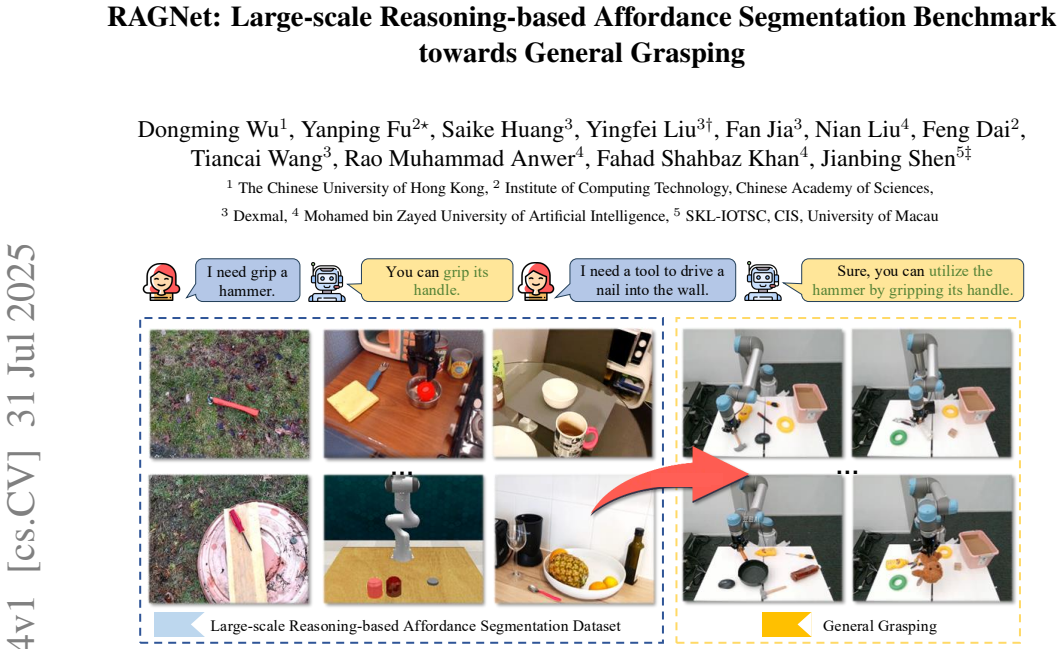
Pith's one-line read RAGNet adds 273k multi-domain images and 26k reasoning instructions to affordance learning, and AffordanceNet, trained on it, claims zero-shot grasp-region segmentation and 70 percent real-robot grasping success.
desk verdict The dataset is a real resource, but the label pipeline needs an audit before the generalization claims hold. read the letter →
The pith
A machine-rendered reading of the paper's core claim, the machinery that carries it, and where it could break.
The reading
What carries the argument
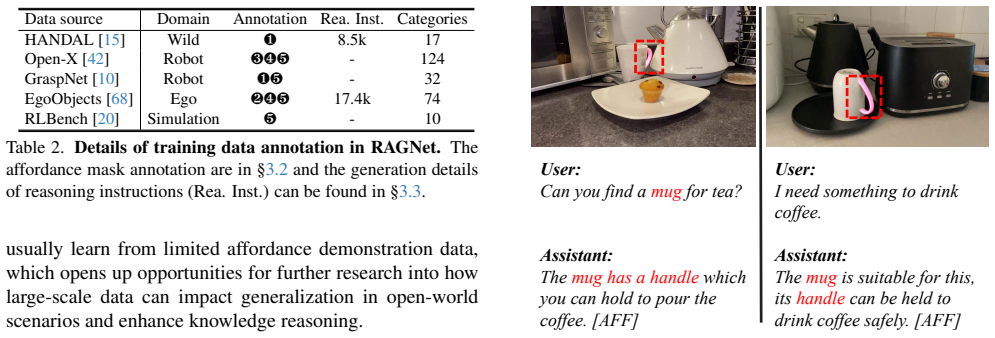
The load-bearing object is the RAGNet benchmark itself, built by pooling images from four embodied domains and annotating graspable affordance regions with a priority-ordered tool suite: original masks where available, an interactive segmentation model on handle-free objects, a dense-prediction model plus segmenter for language-annotated robot data, a part-level detector plus segmenter for handles, and human annotation only when automatic tools fail. On top of that, the instruction set is engineered to force reasoning: 'easy' instructions name the object, 'hard' instructions describe only function and intention, and 26,000 such instructions are generated synthetically. The model side is carried by the <AFF> token, a special output token distinct from the generic segmentation token, which funnels the language-conditioned mask embedding toward affordance-specific regions, with a pose generator projecting the resulting mask through camera intrinsics and extrinsics to produce 3D grasp poses.
What would settle it
A concrete check is to sample images from each automatic annotation path, have independent human annotators draw affordance masks on them, and compute per-tool agreement; if the automatic outputs match human labels on only a minority of instances, the benchmark's ground truth fails and the reported zero-shot gains need to be re-measured on a human-only training subset.
Extended reading notes
Core claim
On the paper's own terms, the central discovery is that dataset scale and instruction difficulty together unlock open-world affordance grounding: RAGNet's combination of many object categories, multiple visual domains, and 'hard' instructions that omit category names teaches a VLM to locate the functional part of an object—handle, body, or door—from a description of what the user wants done. The paper demonstrates this with AffordanceNet, whose AffordanceVLM component is built on a reasoning-segmentation architecture, augmented with a dedicated <AFF> token and an embodied-robot system prompt, and whose pose generator projects the affordance mask into 3D to close the loop with a physical gripper. The claimed payoff is that the system generalizes zero-shot to unseen object categories and unseen image domains, and transfers to real-robot manipulation on objects and scenes not present in training, outperforming standard grasping and affordance-segmentation baselines.
Load-bearing premise
The load-bearing premise is that RAGNet's automatically generated affordance masks are accurate enough to serve as training ground truth, since the paper reports no human quality audit or inter-annotator agreement for the large fraction of masks produced by automatic tools, and if those masks are systematically wrong the model learns their errors and the comparison against the same tools becomes partly circular.
Editorial extensions
If this is right
- If the benchmark's masks are reliable, the released 273k-image corpus becomes a reusable training resource for any affordance-segmentation method, not just the proposed model.
- Zero-shot category generalization means a robot can be asked for a category it has never seen and still localize a graspable region, so instruction-driven grasping scales to novel household objects.
- The hard-instruction format shows that functional descriptions can substitute for category names in grounding, which matters for more natural human-robot dialogue.
- The same affordance map can be plugged into generic grasp-pose generators, decoupling semantic understanding from low-level manipulation planning.
- Real-robot success at 70 percent average across ten tasks, with zero demonstration from that scene, is the concrete evidence that dataset scale transfers to physical action.
Reading between the lines
- Editorial inference: Because the instruction set deliberately removes category names, a natural extension is to vary the described function for the same object (a mug to drink coffee versus a mug to scoop flour) and test whether the model shifts the grasp region accordingly; that would separate true functional reasoning from scene-context guessing.
- Editorial inference: The annotation pipeline's reliance on automatic tools suggests a cheap scaling path: re-run the same tool suite on additional video corpora to expand RAGNet beyond 273k images, with human cleanup reserved for the failure cases.
- Editorial inference: The reported robot-grasping numbers come from ten trials per task on a single scene; repeating the protocol across multiple scenes, object instances, and viewpoints would tell whether the 70 percent average is robust or an artifact of the particular arrangement.
- Editorial inference: Training on a human-annotated-only subset and comparing zero-shot performance with the full pseudo-labeled training would identify how much of the generalization gain comes from the automatic labels themselves.
Editorial analysis
A structured set of objections, weighed in public.
Referee Report
Summary. The paper introduces RAGNet, a large-scale reasoning-based affordance segmentation benchmark containing 273k images across 180 categories and 26k reasoning instructions, drawn from wild, robot, ego-centric, and simulation domains. The authors also present AffordanceNet, a two-stage framework comprising AffordanceVLM (a LISA-based VLM fine-tuned on RAGNet with a dedicated <AFF> token) and a pose generator that converts predicted 2D affordance masks plus depth into 3D grasp poses. Experiments cover affordance segmentation on HANDAL, GraspNet, and 3DOI, real-robot grasping with a UR5, and RLBench simulation, reporting improvements over generalist MLLMs and foundation-model baselines.
Significance. If the annotations are reliable, RAGNet would be a substantial training resource for grasp-oriented affordance perception, with a scale and diversity (multiple domains, 180 categories, reasoning instructions without category names) that goes beyond existing benchmarks. The proposed AffordanceNet shows strong quantitative results on the evaluated benchmarks, and the authors have committed to releasing data and code, which supports reproducibility. The paper also contains useful zero-shot and out-of-domain evaluations. However, the absence of a ground-truth quality audit for the automatically generated masks and the limited statistical power of the robot experiments leave the strongest generalization claims not fully established.
major comments (4)
- [§3.2, Table 11] The ground-truth affordance masks in RAGNet are largely produced by automatic tools (SAM2, Florence2+SAM2, VLPart+SAM2), with human annotation used only when automatic tools fail, yet no quality audit is reported. This is load-bearing because the dataset is claimed to be 'carefully annotated' and because AffordanceNet is trained on these masks; systematic errors in the pseudo-labels would be inherited by the model and would undermine the benchmark's validity. The authors should provide per-tool precision/recall or IoU against a human-annotated subset, report inter-annotator agreement, and state the percentage of images annotated by each tool. It should also be noted that the HANDAL validation set uses the original HANDAL masks, so the comparison with VLPart+SAM2 on HANDAL is not directly circular; however, the lack of audit remains a serious gap.
- [§3.4, Table 3] The zero-shot evaluation on 'GraspNet novel' is ambiguous because GraspNet is one of the training sources in Table 2. The paper must specify which GraspNet categories are held out from training and confirm that the validation images do not overlap with the training set; otherwise the zero-shot claim is unsupported. Similarly, the relationship between HANDAL and HANDAL† should be clarified: the text says HANDAL† is a random subset of HANDAL, but the former is used for both in-domain and reasoning-based evaluation in different rows of Table 3, so the reader cannot tell which images are seen during training.
- [§6.1, Table 7] The real-robot results are based on 10 trials per task, and the paper reports only average success rates without confidence intervals or significance testing. Given the small sample size, the difference between AffordanceNet (70%) and GraspNet (32%) could be driven by a few trials; for example, the wok success rates are 70% vs 60%, within sampling error. The authors should report confidence intervals (e.g., Wilson interval) and ideally increase the number of trials, or temper the claim of superior open-world generalization. Table 8 ablations are also limited to five tasks and should be accompanied by uncertainty estimates.
- [§5.1, Table 5] The ablation in Table 5 cumulatively adds data sources, but the final row 'Ours' includes additional task-specific modifications (system prompt and <AFF> token), making it impossible to attribute the improvement to the dataset alone. The authors should present a proper ablation that isolates the effect of each component: the system prompt, the <AFF> token, and each data source independently, with the same training budget and evaluation protocol.
minor comments (5)
- [§5.1, Table 4] The caption of Table 4 contains a typo: 'categoty' should be 'category'. The related work section also refers to 'HANDANL' instead of 'HANDAL', and Table 7's caption has 'A verage' with an extra space.
- [§4.2, Eq. (1)] Equation (1) is missing a word: 'd is the along the axis' should be 'd is the depth along the axis'. Also, using K and T as 4×4 matrices is nonstandard; clarifying the coordinate convention would improve reproducibility.
- [§3.3, Tables 12-13] The GPT-4 prompts in Tables 12 and 13 contain inconsistencies: the system prompt for easy instructions requires both <1> and <2> to include the category name, but the example for 'screwdriver' generates <1> without the name; the authors should report the exact prompts used and ensure they match the described protocol.
- [§3.1, Table 2] The paper claims 180 categories, but the category lists in Tables 2 and 11 sum to fewer than 180 (HANDAL 17, Open-X ~124, GraspNet 32, EgoObjects 74, RLBench 10). Clarify whether the count refers to unique categories after merging or to something else.
- [Supplementary, Fig. 9] The supplementary states that 'the highlighted words are category names at most times,' but no highlighting appears in Figure 9; consider adding visual cues or clarifying the instruction generation.
Circularity Check
No circular derivation: benchmark and model claims rest on external zero-shot and real-robot evaluations; auto-labeling overlap is a quality risk, not a circular step.
full rationale
The paper's central contribution is a dataset and a trained model rather than a mathematical derivation, so the usual circularity patterns (self-definitional identities, fitted parameters renamed as predictions, load-bearing self-citations) do not apply in an obvious way. I checked the claimed derivation chain: the annotation pipeline in Sec. 3.2 and Table 11 uses existing masks, SAM2, Florence2+SAM2, VLPart+SAM2, and human annotation to produce training labels, but no evaluation metric is defined as the same function of those labels by construction. The zero-shot generalization claims are supported by GraspNet-novel categories, the 3DOI unseen-domain set, real-robot grasping in an unseen scene, and RLBench simulation tasks, all of which lie outside the training sources. HANDAL and GraspNet-seen are explicitly marked as seen validation sets in Table 3, so evaluating on them is a standard supervised benchmark rather than a disguised prediction. The overlap between the VLPart+SAM2 baseline and the use of VLPart+SAM2 to label some EgoObjects handle categories is a legitimate correctness and comparison concern, but it does not make the model's predictions statistically forced on the HANDAL evaluation, whose masks come from the original HANDAL annotations. The absence of inter-annotator agreement or per-tool error analysis is a data-quality limitation, not an instance of the paper's conclusions reducing to its inputs. No load-bearing premise is justified only by a self-citation, and no equation in the paper defines an output as a fitted input. Therefore, no specific circular step is established.
Assumptions & free parameters
free parameters (1)
- Data sampling ratios =
3:1:1:1:9:3 (Table 10)
assumptions (3)
- domain assumption The graspable affordance of an object is fully represented by either the full object mask for handle-free objects or the handle region for handled objects.
- domain assumption Automatic annotations from SAM2, Florence2 plus SAM2, and VLPart plus SAM2 are accurate enough to serve as training ground truth.
- domain assumption GPT-4 generated reasoning instructions are valid proxies for natural human instructions for grasping.
Cite this review
Pith. "Pith review of RAGNet: Large-scale Reasoning-based Affordance Segmentation Benchmark towards General Grasping." pith.science (2026). https://pith.science/paper/LCHEUUNB
@misc{pith2026250723734,
  author       = {Pith},
  title        = {Pith review of: RAGNet: Large-scale Reasoning-based Affordance Segmentation Benchmark towards General Grasping},
  year         = {2026},
  howpublished = {\url{https://pith.science/paper/LCHEUUNB}},
  note         = {Machine review of arXiv:2507.23734}
}
read the original abstract
General robotic grasping systems require accurate object affordance perception in diverse open-world scenarios following human instructions. However, current studies suffer from the problem of lacking reasoning-based large-scale affordance prediction data, leading to considerable concern about open-world effectiveness. To address this limitation, we build a large-scale grasping-oriented affordance segmentation benchmark with human-like instructions, named RAGNet. It contains 273k images, 180 categories, and 26k reasoning instructions. The images cover diverse embodied data domains, such as wild, robot, ego-centric, and even simulation data. They are carefully annotated with an affordance map, while the difficulty of language instructions is largely increased by removing their category name and only providing functional descriptions. Furthermore, we propose a comprehensive affordance-based grasping framework, named AffordanceNet, which consists of a VLM pre-trained on our massive affordance data and a grasping network that conditions an affordance map to grasp the target. Extensive experiments on affordance segmentation benchmarks and real-robot manipulation tasks show that our model has a powerful open-world generalization ability. Our data and code is available at https://github.com/wudongming97/AffordanceNet.
Figures

Figures from the paper (7 more)


Reference graph
Works this paper leans on
-
[1]
CVGIP: Image Understanding, 1994
Function-based generic recognition for multiple object cate- gories. CVGIP: Image Understanding, 1994. 3
work page 1994
-
[2]
Josh Achiam, Steven Adler, Sandhini Agarwal, Lama Ah- mad, Ilge Akkaya, Florencia Leoni Aleman, Diogo Almeida, Janko Altenschmidt, Sam Altman, Shyamal Anadkat, et al. Gpt-4 technical report. arXiv preprint arXiv:2303.08774 ,
-
[3]
Affordances from human videos as a versa- tile representation for robotics
Shikhar Bahl, Russell Mendonca, Lili Chen, Unnat Jain, and Deepak Pathak. Affordances from human videos as a versa- tile representation for robotics. In CVPR, 2023. 1
work page 2023
-
[4]
Rt-1: Robotics transformer for real-world control at scale
Anthony Brohan, Noah Brown, Justice Carbajal, Yevgen Chebotar, Joseph Dabis, Chelsea Finn, Keerthana Gopalakr- ishnan, Karol Hausman, Alex Herzog, Jasmine Hsu, et al. Rt-1: Robotics transformer for real-world control at scale. arXiv preprint arXiv:2212.06817, 2022. 2
arXiv 2022
-
[5]
Coco- stuff: Thing and stuff classes in context
Holger Caesar, Jasper Uijlings, and Vittorio Ferrari. Coco- stuff: Thing and stuff classes in context. In CVPR, 2018. 1
work page 2018
-
[6]
Affordance grounding from demonstration video to target image
Joya Chen, Difei Gao, Kevin Qinghong Lin, and Mike Zheng Shou. Affordance grounding from demonstration video to target image. In CVPR, 2023. 3
work page 2023
-
[7]
Learning to act properly: Predicting and explaining affordances from images
Ching-Yao Chuang, Jiaman Li, Antonio Torralba, and Sanja Fidler. Learning to act properly: Predicting and explaining affordances from images. In CVPR, 2018. 3
work page 2018
-
[8]
Rescaling egocentric vision: Collection, pipeline and chal- lenges for epic-kitchens-100
Dima Damen, Hazel Doughty, Giovanni Maria Farinella, Antonino Furnari, Evangelos Kazakos, Jian Ma, Davide Moltisanti, Jonathan Munro, Toby Perrett, Will Price, et al. Rescaling egocentric vision: Collection, pipeline and chal- lenges for epic-kitchens-100. IJCV, 2022. 2, 5
work page 2022
Show all 75 references
-
[9]
Affordancenet: An end-to-end deep learning approach for object affordance detection
Thanh-Toan Do, Anh Nguyen, and Ian Reid. Affordancenet: An end-to-end deep learning approach for object affordance detection. In ICRA, 2018. 3
2018
-
[10]
Graspnet-1billion: A large-scale benchmark for general ob- ject grasping
Hao-Shu Fang, Chenxi Wang, Minghao Gou, and Cewu Lu. Graspnet-1billion: A large-scale benchmark for general ob- ject grasping. In CVPR, 2020. 4, 5, 7, 8, 1
2020
-
[11]
Demo2vec: Reasoning object affordances from online videos
Kuan Fang, Te-Lin Wu, Daniel Yang, Silvio Savarese, and Joseph J Lim. Demo2vec: Reasoning object affordances from online videos. In CVPR, 2018. 3
2018
-
[12]
Learning visual at- tributes
Vittorio Ferrari and Andrew Zisserman. Learning visual at- tributes. NeurIPS, 2007. 3
2007
-
[13]
The ecological approach to visual percep- tion: classic edition
James J Gibson. The ecological approach to visual percep- tion: classic edition. Psychology press, 2014. 3
2014
-
[14]
Ego4d: Around the world in 3,000 hours of egocentric video
Kristen Grauman, Andrew Westbury, Eugene Byrne, Zachary Chavis, Antonino Furnari, Rohit Girdhar, Jackson Hamburger, Hao Jiang, Miao Liu, Xingyu Liu, et al. Ego4d: Around the world in 3,000 hours of egocentric video. In CVPR, 2022. 2
2022
-
[15]
HAN- DAL: A dataset of real-world manipulable object categories with pose annotations, affordances, and reconstructions
Andrew Guo, Bowen Wen, Jianhe Yuan, Jonathan Tremblay, Stephen Tyree, Jeffrey Smith, and Stan Birchfield. HAN- DAL: A dataset of real-world manipulable object categories with pose annotations, affordances, and reconstructions. In IROS, 2023. 2, 3, 4, 5, 1
2023
-
[16]
Copa: General robotic manipulation through spatial constraints of parts with foundation models
Haoxu Huang, Fanqi Lin, Yingdong Hu, Shengjie Wang, and Yang Gao. Copa: General robotic manipulation through spatial constraints of parts with foundation models. arXiv preprint arXiv:2403.08248, 2024. 1
2024 arXiv
-
[17]
Manipvqa: Injecting robotic affordance and physi- cally grounded information into multi-modal large language models
Siyuan Huang, Iaroslav Ponomarenko, Zhengkai Jiang, Xi- aoqi Li, Xiaobin Hu, Peng Gao, Hongsheng Li, and Hao Dong. Manipvqa: Injecting robotic affordance and physi- cally grounded information into multi-modal large language models. In IROS, 2024. 2, 3, 5
2024
-
[18]
V oxposer: Composable 3d value maps for robotic manipulation with language models
Wenlong Huang, Chen Wang, Ruohan Zhang, Yunzhu Li, Jiajun Wu, and Li Fei-Fei. V oxposer: Composable 3d value maps for robotic manipulation with language models. arXiv preprint arXiv:2307.05973, 2023. 1
2023 arXiv
-
[19]
Rekep: Spatio-temporal reasoning of rela- tional keypoint constraints for robotic manipulation
Wenlong Huang, Chen Wang, Yunzhu Li, Ruohan Zhang, and Li Fei-Fei. Rekep: Spatio-temporal reasoning of rela- tional keypoint constraints for robotic manipulation. arXiv preprint arXiv:2409.01652, 2024. 1
2024 arXiv
-
[20]
Rlbench: The robot learning benchmark & learning environment
Stephen James, Zicong Ma, David Rovick Arrojo, and An- drew J Davison. Rlbench: The robot learning benchmark & learning environment. IEEE Robotics and Automation Let- ters, 2020. 4, 8
2020
-
[21]
Affordpose: A large-scale dataset of hand-object inter- actions with affordance-driven hand pose
Juntao Jian, Xiuping Liu, Manyi Li, Ruizhen Hu, and Jian Liu. Affordpose: A large-scale dataset of hand-object inter- actions with affordance-driven hand pose. In ICCV, 2023. 1
2023
-
[22]
Robo-abc: Affordance gener- alization beyond categories via semantic correspondence for robot manipulation
Yuanchen Ju, Kaizhe Hu, Guowei Zhang, Gu Zhang, Min- grun Jiang, and Huazhe Xu. Robo-abc: Affordance gener- alization beyond categories via semantic correspondence for robot manipulation. In ECCV, 2024. 3
2024
-
[23]
Hotr: End-to-end human-object in- teraction detection with transformers
Bumsoo Kim, Junhyun Lee, Jaewoo Kang, Eun-Sol Kim, and Hyunwoo J Kim. Hotr: End-to-end human-object in- teraction detection with transformers. In CVPR, 2021. 1
2021
-
[24]
Segment any- thing
Alexander Kirillov, Eric Mintun, Nikhila Ravi, Hanzi Mao, Chloe Rolland, Laura Gustafson, Tete Xiao, Spencer White- head, Alexander C Berg, Wan-Yen Lo, et al. Segment any- thing. In ICCV, 2023. 5
2023
-
[25]
Vi- sual object-action recognition: Inferring object affordances from human demonstration
Hedvig Kjellstr ¨om, Javier Romero, and Danica Kragi ´c. Vi- sual object-action recognition: Inferring object affordances from human demonstration. Computer Vision and Image Un- derstanding, 2011. 3
2011
-
[26]
Lisa: Reasoning segmenta- tion via large language model
Xin Lai, Zhuotao Tian, Yukang Chen, Yanwei Li, Yuhui Yuan, Shu Liu, and Jiaya Jia. Lisa: Reasoning segmenta- tion via large language model. In CVPR, 2024. 2, 5, 6, 8, 1
2024
-
[27]
Locate: Localize and transfer object parts for weakly super- vised affordance grounding
Gen Li, Varun Jampani, Deqing Sun, and Laura Sevilla-Lara. Locate: Localize and transfer object parts for weakly super- vised affordance grounding. In CVPR, 2023. 3
2023
-
[28]
One-shot open affordance learning with foundation models
Gen Li, Deqing Sun, Laura Sevilla-Lara, and Varun Jampani. One-shot open affordance learning with foundation models. In CVPR, 2024. 2, 3
2024
-
[29]
Learning precise affordances from egocentric videos for robotic manipulation
Gen Li, Nikolaos Tsagkas, Jifei Song, Ruaridh Mon- Williams, Sethu Vijayakumar, Kun Shao, and Laura Sevilla- Lara. Learning precise affordances from egocentric videos for robotic manipulation. arXiv preprint arXiv:2408.10123,
-
[30]
Blip-2: Bootstrapping language-image pre-training with frozen image encoders and large language models
Junnan Li, Dongxu Li, Silvio Savarese, and Steven Hoi. Blip-2: Bootstrapping language-image pre-training with frozen image encoders and large language models. In ICML,
-
[31]
Manipllm: Embodied multimodal large language model for object-centric robotic manipulation
Xiaoqi Li, Mingxu Zhang, Yiran Geng, Haoran Geng, Yux- ing Long, Yan Shen, Renrui Zhang, Jiaming Liu, and Hao Dong. Manipllm: Embodied multimodal large language model for object-centric robotic manipulation. In CVPR,
-
[32]
Laso: Language-guided affordance seg- mentation on 3d object
Yicong Li, Na Zhao, Junbin Xiao, Chun Feng, Xiang Wang, and Tat-seng Chua. Laso: Language-guided affordance seg- mentation on 3d object. In CVPR, 2024. 3
2024
-
[33]
Visual instruction tuning
Haotian Liu, Chunyuan Li, Qingyang Wu, and Yong Jae Lee. Visual instruction tuning. NeurIPS, 2024. 2, 1
2024
-
[34]
Grounding dino: Marrying dino with grounded pre-training for open-set object detection
Shilong Liu, Zhaoyang Zeng, Tianhe Ren, Feng Li, Hao Zhang, Jie Yang, Qing Jiang, Chunyuan Li, Jianwei Yang, Hang Su, et al. Grounding dino: Marrying dino with grounded pre-training for open-set object detection. arXiv preprint arXiv:2303.05499, 2023. 6
2023 arXiv
-
[35]
Learning to seg- ment affordances
Timo Luddecke and Florentin Worgotter. Learning to seg- ment affordances. In ICCV Workshops, 2017. 3
2017
-
[36]
Learning affordance grounding from exocen- tric images
Hongchen Luo, Wei Zhai, Jing Zhang, Yang Cao, and Dacheng Tao. Learning affordance grounding from exocen- tric images. In CVPR, 2022. 2, 3
2022
-
[37]
Leverage interactive affinity for affordance learning
Hongchen Luo, Wei Zhai, Jing Zhang, Yang Cao, and Dacheng Tao. Leverage interactive affinity for affordance learning. In CVPR, 2023. 3
2023
-
[38]
Affordance detection of tool parts from geomet- ric features
Austin Myers, Ching L Teo, Cornelia Ferm ¨uller, and Yiannis Aloimonos. Affordance detection of tool parts from geomet- ric features. In ICRA, 2015. 2, 3
2015
-
[39]
Pivot: Iterative visual prompt- ing elicits actionable knowledge for vlms
Soroush Nasiriany, Fei Xia, Wenhao Yu, Ted Xiao, Jacky Liang, Ishita Dasgupta, Annie Xie, Danny Driess, Ayzaan Wahid, Zhuo Xu, et al. Pivot: Iterative visual prompt- ing elicits actionable knowledge for vlms. arXiv preprint arXiv:2402.07872, 2024. 1
2024 arXiv
-
[40]
Object-based affordances detection with convolutional neural networks and dense conditional random fields
Anh Nguyen, Dimitrios Kanoulas, Darwin G Caldwell, and Nikos G Tsagarakis. Object-based affordances detection with convolutional neural networks and dense conditional random fields. In IROS, 2017. 3
2017
-
[41]
Llarva: Vision-action instruction tuning enhances robot learning
Dantong Niu, Yuvan Sharma, Giscard Biamby, Jerome Quenum, Yutong Bai, Baifeng Shi, Trevor Darrell, and Roei Herzig. Llarva: Vision-action instruction tuning enhances robot learning. arXiv preprint arXiv:2406.11815, 2024. 8
2024 arXiv
-
[42]
Open x-embodiment: Robotic learning datasets and rt-x models
Abby O’Neill, Abdul Rehman, Abhinav Gupta, Abhiram Maddukuri, Abhishek Gupta, Abhishek Padalkar, Abraham Lee, Acorn Pooley, Agrim Gupta, Ajay Mandlekar, et al. Open x-embodiment: Robotic learning datasets and rt-x models. arXiv preprint arXiv:2310.08864, 2023. 2, 4, 1
-
[43]
Understanding 3d object interaction from a single image
Shengyi Qian and David F Fouhey. Understanding 3d object interaction from a single image. In ICCV, 2023. 2, 3, 5
2023
-
[44]
Understanding 3d object articulation in in- ternet videos
Shengyi Qian, Linyi Jin, Chris Rockwell, Siyi Chen, and David F Fouhey. Understanding 3d object articulation in in- ternet videos. In CVPR, 2022. 5
2022
-
[45]
Affordancellm: Grounding affordance from vision language models
Shengyi Qian, Weifeng Chen, Min Bai, Xiong Zhou, Zhuowen Tu, and Li Erran Li. Affordancellm: Grounding affordance from vision language models. In CVPR, 2024. 2, 3, 5
2024
-
[46]
Learn- ing transferable visual models from natural language super- vision
Alec Radford, Jong Wook Kim, Chris Hallacy, Aditya Ramesh, Gabriel Goh, Sandhini Agarwal, Girish Sastry, Amanda Askell, Pamela Mishkin, Jack Clark, et al. Learn- ing transferable visual models from natural language super- vision. In ICML, 2021. 5
2021
-
[47]
Paco: Parts and attributes of common objects
Vignesh Ramanathan, Anmol Kalia, Vladan Petrovic, Yi Wen, Baixue Zheng, Baishan Guo, Rui Wang, Aaron Mar- quez, Rama Kovvuri, Abhishek Kadian, et al. Paco: Parts and attributes of common objects. In CVPR, 2023. 2, 1
2023
-
[48]
Glamm: Pixel grounding large multimodal model
Hanoona Rasheed, Muhammad Maaz, Sahal Shaji, Abdel- rahman Shaker, Salman Khan, Hisham Cholakkal, Rao M Anwer, Eric Xing, Ming-Hsuan Yang, and Fahad S Khan. Glamm: Pixel grounding large multimodal model. In CVPR,
-
[49]
Language embedded radiance fields for zero-shot task- oriented grasping
Adam Rashid, Satvik Sharma, Chung Min Kim, Justin Kerr, Lawrence Yunliang Chen, Angjoo Kanazawa, and Ken Gold- berg. Language embedded radiance fields for zero-shot task- oriented grasping. In CoRL, 2023. 3
2023
-
[50]
Sam 2: Segment anything in images and videos
Nikhila Ravi, Valentin Gabeur, Yuan-Ting Hu, Ronghang Hu, Chaitanya Ryali, Tengyu Ma, Haitham Khedr, Roman R¨adle, Chloe Rolland, Laura Gustafson, et al. Sam 2: Segment anything in images and videos. arXiv preprint arXiv:2408.00714, 2024. 4, 6, 1
2024 arXiv
-
[51]
Weakly supervised affordance detection
Johann Sawatzky, Abhilash Srikantha, and Juergen Gall. Weakly supervised affordance detection. In CVPR, 2017. 3
2017
-
[52]
Understanding human hands in contact at internet scale
Dandan Shan, Jiaqi Geng, Michelle Shu, and David F Fouhey. Understanding human hands in contact at internet scale. In CVPR, 2020. 1
2020
-
[53]
Cliport: What and where pathways for robotic manipulation
Mohit Shridhar, Lucas Manuelli, and Dieter Fox. Cliport: What and where pathways for robotic manipulation. In CoRL, 2022. 1
2022
-
[54]
Going denser with open-vocabulary part segmentation
Peize Sun, Shoufa Chen, Chenchen Zhu, Fanyi Xiao, Ping Luo, Saining Xie, and Zhicheng Yan. Going denser with open-vocabulary part segmentation. In ICCV, 2023. 2, 4, 6, 8, 1
2023
-
[55]
Grasp-anything: Large-scale grasp dataset from foundation models
An Dinh Vuong, Minh Nhat Vu, Hieu Le, Baoru Huang, Binh Huynh, Thieu V o, Andreas Kugi, and Anh Nguyen. Grasp-anything: Large-scale grasp dataset from foundation models. arXiv preprint arXiv:2309.09818, 2023. 3
2023 arXiv
-
[56]
Language- driven grasp detection
An Dinh Vuong, Minh Nhat Vu, Baoru Huang, Nghia Nguyen, Hieu Le, Thieu V o, and Anh Nguyen. Language- driven grasp detection. In CVPR, 2024. 3
2024
-
[57]
Bridgedata v2: A dataset for robot learning at scale
Homer Rich Walke, Kevin Black, Tony Z Zhao, Quan Vuong, Chongyi Zheng, Philippe Hansen-Estruch, An- dre Wang He, Vivek Myers, Moo Jin Kim, Max Du, et al. Bridgedata v2: A dataset for robot learning at scale. In CoRL, 2023. 2
2023
-
[58]
An interactive navigation method with effect-oriented affordance
Xiaohan Wang, Yuehu Liu, Xinhang Song, Yuyi Liu, Six- ian Zhang, and Shuqiang Jiang. An interactive navigation method with effect-oriented affordance. In CVPR, 2024. 1
2024
-
[59]
Move as you say interact as you can: Language-guided human motion generation with scene af- fordance
Zan Wang, Yixin Chen, Baoxiong Jia, Puhao Li, Jinlu Zhang, Jingze Zhang, Tengyu Liu, Yixin Zhu, Wei Liang, and Siyuan Huang. Move as you say interact as you can: Language-guided human motion generation with scene af- fordance. In CVPR, 2024. 1
2024
-
[60]
Florence-2: Advancing a unified representation for a variety of vision tasks
Bin Xiao, Haiping Wu, Weijian Xu, Xiyang Dai, Houdong Hu, Yumao Lu, Michael Zeng, Ce Liu, and Lu Yuan. Florence-2: Advancing a unified representation for a variety of vision tasks. In CVPR, 2024. 4, 6, 1
2024
-
[61]
Naturalvlm: Leveraging fine-grained natural language for affordance-guided visual manipulation
Ran Xu, Yan Shen, Xiaoqi Li, Ruihai Wu, and Hao Dong. Naturalvlm: Leveraging fine-grained natural language for affordance-guided visual manipulation. arXiv preprint arXiv:2403.08355, 2024. 2, 3
2024 arXiv
-
[62]
Grounding 3d object affordance from 2d interactions in images
Yuhang Yang, Wei Zhai, Hongchen Luo, Yang Cao, Jiebo Luo, and Zheng-Jun Zha. Grounding 3d object affordance from 2d interactions in images. In ICCV, 2023. 3
2023
-
[63]
Modeling context in referring expres- sions
Licheng Yu, Patrick Poirson, Shan Yang, Alexander C Berg, and Tamara L Berg. Modeling context in referring expres- sions. In ECCV, 2016. 1
2016
-
[64]
Uniaff: A unified representation of affor- dances for tool usage and articulation with vision-language models
Qiaojun Yu, Siyuan Huang, Xibin Yuan, Zhengkai Jiang, Ce Hao, Xin Li, Haonan Chang, Junbo Wang, Liu Liu, Hong- sheng Li, et al. Uniaff: A unified representation of affor- dances for tool usage and articulation with vision-language models. arXiv preprint arXiv:2409.20551, 2024. 2, 3
2024 arXiv
-
[65]
Taskonomy: Disentangling task transfer learning
Amir R Zamir, Alexander Sax, William Shen, Leonidas J Guibas, Jitendra Malik, and Silvio Savarese. Taskonomy: Disentangling task transfer learning. In CVPR, 2018. 5
2018
-
[66]
Judging llm-as-a-judge with mt-bench and chatbot arena
Lianmin Zheng, Wei-Lin Chiang, Ying Sheng, Siyuan Zhuang, Zhanghao Wu, Yonghao Zhuang, Zi Lin, Zhuohan Li, Dacheng Li, Eric Xing, et al. Judging llm-as-a-judge with mt-bench and chatbot arena. NeurIPS, 2023. 5
2023
-
[67]
Scene parsing through ade20k dataset
Bolei Zhou, Hang Zhao, Xavier Puig, Sanja Fidler, Adela Barriuso, and Antonio Torralba. Scene parsing through ade20k dataset. In CVPR, 2017. 1
2017
-
[68]
Egoobjects: A large-scale egocentric dataset for fine-grained object understanding
Chenchen Zhu, Fanyi Xiao, Andr ´es Alvarado, Yasmine Babaei, Jiabo Hu, Hichem El-Mohri, Sean Culatana, Roshan Sumbaly, and Zhicheng Yan. Egoobjects: A large-scale egocentric dataset for fine-grained object understanding. In ICCV, 2023. 4, 1 RAGNet: Large-scale Reasoning-based ...
2023
-
[69]
From these data, we emphasize grasping-oriented objects, encompassing both those with handles and those without
Details of Data Annotation As the original data sources, such as HANDAL [15], Open- X [42], EgoObjects [68], GraspNet [10], provide original annotation information (e.g., ground-truth boxes or masks), we make full use of them for minimal human intervention. From these data, we...
-
[70]
Affordance Annotation Examples Since our benchmark RAGNet includes a significant num- ber of grasping-oriented objects from various domains (like robot, wild, and ego-centric domains), we highlight this as- pect by showcasing additional examples of affordance seg- mentation an...
-
[71]
microwave, open the door
Reasoning-based Affordance Examples More reasoning-based affordance segmentation examples are shown in Fig. 10. It contains two types of instructions, easy instructions and hard instructions. As seen, the easy instructions include the target object name, while the hard ones on...
-
[72]
Implementation Details of AffordanceNet Beyond our reasoning-based affordance segmentation data, we also incorporate a variety of generic segmentation datasets into our training. This diverse generic set includes data for semantic segmentation (e.g., ADE20k [67], COCO- Stuff [...
-
[73]
More Results on Visual Affordance We provide more visualization results of affordance seg- mentation from our AffordanceVLM model in Fig. 10. The testing images are selected from multiple validation sets, such as GraspNet Novel, 3DOI, and HANDAL. We employ template-based, easy...
-
[74]
Open the top drawer
More Results on Real Robot Beyond the evaluation tasks in our main manuscript, such as grasping can, pen, screwdriver, hammer, and wok, we also evaluate the open-world generalization capabilities of our model by utilizing a broader range of instructions en- compassing various ...
-
[75]
open the top drawer,
More Results on RLBench We present several visualization results from the simulation task RLBench in Figure 7. The top video demonstrates the task “open the top drawer,” while the bottom video illus- trates “close the green jar”. As shown, our model success- fully completes bo...
Reviewed August 6, 2026 · model on record in the stance chip above.
Discussion (0). Sign in to comment.