REVIEW 4 major objections 5 minor 109 references
Graph Lineages and Skeletal Graph Products
T0 review · 4 major / 5 minor · reviewed 2026-08-06 · deepseek-v4-flash
Pith's one-line read The paper introduces graph lineages—hierarchical graph families with roughly exponential growth—and defines skeletal box and cross products whose exponential growth base is the maximum of the factor bases rather than their product, making…
desk verdict Skeletal graph products with a clean max-base cost bound; the construction is real, but the claimed right-inverse from graph sequences to graded graphs is unproved. read the letter →
The pith
A machine-rendered reading of the paper's core claim, the machinery that carries it, and where it could break.
The reading
What carries the argument
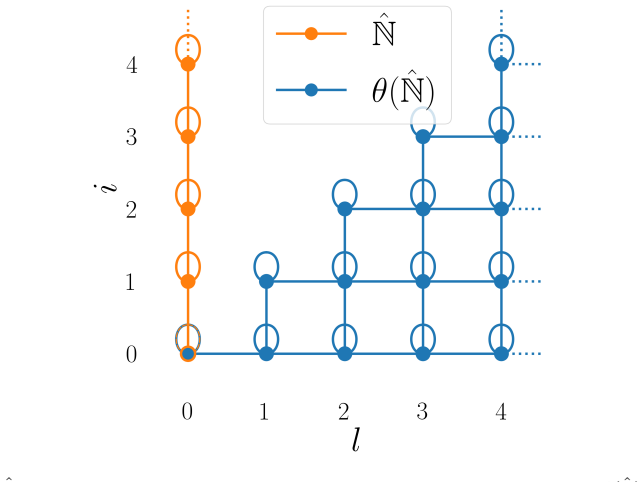
The load-bearing object is the graded graph: a graph $G$ equipped with a graph homomorphism $\varphi_G: G \to \hat{\mathbb{N}}$, where $\hat{\mathbb{N}}$ is the graph of nonnegative integers with successor edges and self-loops; the map assigns each vertex a level number and restricts edges to level differences $0$ or $\pm1$. A graph lineage is a graded graph whose same-level and inter-level parts both obey the exponential growth bound. The skeletal box and cross products are defined by universal double-pullback diagrams built from the templates $\hat{\mathbb{N}} \hat{\Box} \hat{\mathbb{N}}$ and $\hat{\mathbb{N}} \hat{\times} \hat{\mathbb{N}}$ with additive level numbers $l=l_1+l_2$; the products keep only edges satisfying $|\Delta l|\le 1$, encode inter-level edges through the $0/1$ sparsity structure $S$ of prolongation maps, and compute level-$L$ cardinalities by the convolution sum $\sum_{m=0}^{l} O(b_1^{m(1+\epsilon)})O(b_2^{(l-m)(1+\epsilon)})=O((l+1)\max(b_1,b_2)^{l(1+\epsilon)})$, which is absorbed into $O(\max(b_1,b_2)^{l(1+\epsilon)})$. That convolution identity carries the cost argument.
What would settle it
A concrete check: compute the vertex counts at levels L=1,...,10 for the skeletal box and cross products of two explicit lineages with bases b1<b2; if the exponential base of those counts exceeds max(b1,b2), Proposition 4 fails. Alternatively, exhibit a hierarchical graph sequence for which the minimizing prolongation matrices never attain their infimum over the allowed compact matrix manifold, which would break the right-inverse map that gives every lineage its inter-level halo.
Extended reading notes
Core claim
The central discovery is Proposition 4: the graded graph $G_1 \hat{\Box} G_2$ is again a graph lineage whenever $G_1$ and $G_2$ are, and the same holds for the skeletal cross product $G_1 \hat{\times} G_2$; the growth base of the product is $\max(b_1,b_2)$, not the product $b_1b_2$. The construction builds each level $L$ of the product from pairs of levels $(l_1,l_2)$ with $l_1+l_2=L$, keeps only edges with $|\Delta l|\le 1$, and records inter-level connectivity through Kronecker products of prolongation sparsity structures $S$. The paper proves existence and universality of these products by double-pullback diagrams (Propositions 2 and 3), shows the skeletal box product is exactly associative while the skeletal cross product is commutative and near-associative with edge-inclusion bounds, and derives unary operators (thickening, escalation to frontiers) that preserve the growth class. It then shows that a CNN built from a skeletal box-cross product of a spatial grid lineage and a feature-map lineage trains to accuracies comparable to a standard CNN, and that a recursive skeletal multigrid algorithm outperforms classical geometric multigrid on two two-dimensional boundary value problems. The authors also exhibit a continuous analog of the skeletal product in the Poincaré half-plane and define skeletal function spaces via frontiers.
Load-bearing premise
The construction assumes that optimal fine-to-coarse transfer matrices between successive levels always exist and attain their optimum, so that every growing graph family can be given the inter-level edges on which the skeletal products are built.
Editorial extensions
If this is right
- Repeated skeletal products $\hat{\times}_{i=1}^n G_i$ and $\hat{\Box}_{i=1}^n G_i$ grow with base $\max_i b_i$ instead of $\prod_i b_i$, so combining many hierarchical spaces stays affordable.
- The skeletal box product is exactly associative, so unparenthesized $n$-way box products are unambiguous; the skeletal cross product is commutative up to isomorphism, and its $n$-way version satisfies edge-subset bounds relative to any parenthesization.
- A convolutional network assembled from a skeletal box-cross product of a spatial grid lineage and a feature-map lineage reaches accuracies comparable to a standard CNN on both tested image-classification benchmarks, with similar training cost.
- A recursive multigrid solver that coarsens along one skeletal product factor at a time outperforms classical multigrid and Gauss-Seidel on the two tested boundary value problems at equal work.
- Thickening and escalation to frontier graphs preserve the $O(b^{l(1+\epsilon)})$ growth class, so pyramid and adaptive-grid constructions remain inside the lineage formalism.
Reading between the lines
- Editorial inference: the level constraint $\lceil(l_1^p+l_2^p)^{1/p}\rceil=L$ interpolates between skeletal product ($p=1$), ordinary product ($p\to\infty$), and discrete sum ($p\to0^+$), suggesting a tunable family of fractional hierarchy products that the paper mentions but does not develop.
- Editorial inference: if the cost bound transfers to the skeletal function-space construction, functions between graph lineages could become practical compositional building blocks whose domain cost is charged per frontier volume; the paper sketches the construction but does not test it experimentally.
- Editorial inference: the Poincaré half-plane example suggests that skeletal products of scale-space lineages converge to hyperbolic products under a logarithmic-coordinate rotation; a general continuum-limit theorem would make this precise and is not proved here.
- Editorial inference: the recursive skeletal multigrid results imply a testable prediction—skeletal multigrid should be most effective when error modes are aligned with the factor directions of the product, and the levelwise variant should suffer when they are not, matching the paper's semi-coarsening intuition.
Editorial analysis
A structured set of objections, weighed in public.
Referee Report
Summary. The paper introduces 'graph lineages' as graded graphs with exponentially growing levels and inter-level bipartite connections, and develops a category-theoretic framework in which 'skeletal' versions of the standard graph cross product and box product are defined by universal diagrams. It proves existence of the skeletal products (Propositions 2 and 3), derives component-form adjacency formulas, shows that skeletal products preserve the lineage growth bound with base equal to the maximum of the factors (Proposition 4), and analyzes near-associativity of the n-ary cross product. Additional constructions include thickening, continuous analogs, and a function-space construction, with applications to convolutional neural network architectures and multigrid solvers, supported by code and experiments.
Significance. If the central constructions are sound, the paper offers an appealing algebraic type theory for hierarchical graph architectures in which the vertex- and edge-count growth base of a product is max(b1, b2) rather than b1*b2, a genuine improvement for iterated products. The paper is commendably concrete: it gives explicit component-notation formulas, proves existence of the proposed universal objects, and ships reproducible code for the CNN and multigrid experiments. The applications demonstrate practical viability even though the empirical gains over standard baselines are modest. However, the claimed scope is wider than what is proven: the route from arbitrary graph sequences to the graded graphs used by the skeletal products is asserted rather than proved, and the function-space section is explicitly acknowledged by the authors as incomplete.
major comments (4)
- [§4.1] The asserted right-inverse map from graph sequences to graded graphs is not proven. The sentence 'So long as prolongation maps are optimized over compact manifolds of matrices, such as orthogonal matrices of a given structure, then inf is min and there is a right-inverse map from graph sequences to graded graphs as well' assumes that the admissible set with a prescribed sparsity pattern of O(b^l) nonzeros is compact and nonempty, but this is not established for sparse orthogonal prolongations, nor is it shown that the DR-minimizer yields a halo with a lineage-compatible growth bound. Since Section 4.1 presents this as the construction of Gd(G) from an arbitrary graph lineage, the framework's scope is narrower than claimed unless the assertion is proved or the definitions are restricted to graded graphs with given halo structures.
- [§5.5 (Eq. 29)] The skeletal function-space construction is explicitly incomplete. Immediately after Eq. (29) the paper states that the construction 'isn’t yet quite as algebraically self-sufficient as it looks,' and the subsequent paragraph adds edge conditions informally without giving a complete component definition, a proof that the resulting object is a graded graph or lineage, or a verification of the claimed properties. Because the abstract and conclusions present function types as one of the derived skeletal constructors, this section must either be completed or clearly labeled as an outline/conjecture rather than a derived operation.
- [§4.5 (after Eq. 24)] The skeletal box product is disconnected within each grade, as the paper itself notes. Eq. (23) only connects vertices with the same pair (l1, l2), so there are no intra-level edges between different decompositions of the same total level L. This is a material difference from the ordinary box product, and it weakens the asserted suitability of the skeletal box product for process-model or Laplacian-based approximation, since diffusion cannot propagate between the components of a level. The suggested remedies (thickening, two-hop truncation, box-cross union) are not analyzed for lineage preservation or cost, so the process-model claim needs either a reconnection construction or a qualification.
- [§4.4.2] The treatment of the n-ary skeletal cross product is only a partial algebraic characterization. Equations (14)-(19) define an unparenthesized product as an edge superset of certain parenthesizations and an alternative operator as an edge subset, but the section does not provide a universal property or a proof that these edge-inclusion inequalities hold for all parenthesizations and permutations. Since the paper advertises 'similar but not identical algebraic and category-theoretic properties,' the n-ary product deserves either a precise universal characterization or a proof of the stated inclusions, rather than an assertion.
minor comments (5)
- [§4.5 (Figure 10)] The text after Eq. (24) refers to Figure 10 as 'an example of a skeletal cross product,' but the figure caption and the adjacency-matrix discussion indicate that Figure 10 illustrates the skeletal box product; the caption or the text should be corrected.
- [Throughout] There are several typographical errors, including 'propoerties' in Section 1, 'Chararistics' in Table 2, 'Osterlee' in Section 5.3.1, and 'skeleton convolutional neural network' in the Figure 16 caption.
- [§2.2.1 and §4.1] The notation is confusing because the same symbol G is used both for a graph lineage and for its associated graded graph, and the phrase 'G 7→ G' is ambiguous; a distinct symbol for the graded graph, such as Gd(G), should be used consistently.
- [§4.6 Eq. (25)] The absorption of the factor (l+1) into the epsilon in the O(max(b1,b2)^{l(1+epsilon)}) bound is valid only for b > 1, while the definition of graph lineage allows b = 1; Proposition 4 should either exclude the b = 1 edge case or state the bound with an explicit polylogarithmic factor.
- [Supplemental S2] The large block-matrix displays in Sections S2.1 and S2.2 are extremely wide and difficult to read; they should be reformatted or replaced with a concise block-level description of which blocks are retained after the level-number truncation.
Circularity Check
No significant circularity; Proposition 4 is a direct counting argument from explicit skeletal-product definitions.
full rationale
The claimed preservation result (Proposition 4, Section 4.6) is derived, not assumed: the skeletal box/cross products are defined by explicit component formulas with vertex levels l1 + l2 (Eqs. 12–13 and 23–24), and the proof computes |phi^{-1}(l)| = sum_{m=0}^l O(b1^{m(1+epsilon)}) O(b2^{(l-m)(1+epsilon)}) = O(max(b1,b2)^{l(1+epsilon)}), with the edge count handled by a similar summation. No fitted parameter or benchmark value enters this argument. Section 2.2.1 adopts the graph-lineage terminology from the authors' prior work [87], but that self-citation supplies only the definition of the growth bound and the background DR distance measure; it is not the evidence for the product-preservation theorem. Section 4.1's asserted right-inverse from graph sequences to graded graphs via optimized prolongations is unproven, and Section 5.5 explicitly concedes that Eq. (29) "isn't yet quite as algebraically self-sufficient as it looks"; these are acknowledged limitations and assumption gaps rather than circular reductions, because the product algebra and its cost bound do not depend on those gaps being closed for arbitrary input sequences. The empirical CNN comparison in Section 5.2 benchmarks an independently implemented model against MNIST and Fashion MNIST and involves no fitted prediction that was then presented as a derived result. No specific equation or fitted parameter reduces to the paper's own inputs by construction, so the derivation chain is self-contained for the central claim.
Assumptions & free parameters
assumptions (4)
- domain assumption Graph lineages are defined by the growth bound O(b^{l^{1+epsilon}}) and by prolongation maps P optimizing a graph-graph distance DR as in [87].
- standard math Graded graphs are objects of the slice category of graphs over the infinite graph N with level-preserving graph homomorphisms.
- ad hoc to paper The 'double pullback' diagram (Diagram 6) is a valid universal definition for the skeletal cross product, and its universality transfers from the ordinary product.
- domain assumption Optimal prolongation matrices over compact matrix manifolds exist and give a right-inverse map from graph sequences to graded graphs.
Cite this review
Pith. "Pith review of Graph Lineages and Skeletal Graph Products." pith.science (2026). https://pith.science/paper/LRYHEKGG
@misc{pith2026250800197,
  author       = {Pith},
  title        = {Pith review of: Graph Lineages and Skeletal Graph Products},
  year         = {2026},
  howpublished = {\url{https://pith.science/paper/LRYHEKGG}},
  note         = {Machine review of arXiv:2508.00197}
}
read the original abstract
Graphs, and sequences of growing graphs, can be used to specify the architecture of mathematical models in many fields including machine learning and computational science. Here we define structured graph "lineages" (ordered by level number) that grow in a hierarchical fashion, so that: (1) the number of graph vertices and edges increases exponentially in level number; (2) bipartite graphs connect successive levels within a graph lineage and, as in multigrid methods, can constrain matrices relating successive levels; (3) using prolongation maps within a graph lineage, process-derived distance measures between graphs at successive levels can be defined; (4) a category of "graded graphs" can be defined, and using it low-cost "skeletal" variants of standard algebraic graph operations and type constructors (cross product, box product, disjoint sum, and function types) can be derived for graded graphs and hence hierarchical graph lineages; (5) these skeletal binary operators have similar but not identical algebraic and category-theoretic properties to their standard counterparts; (6) graph lineages and their skeletal product constructors can approach continuum limit objects. Additional space-efficient unary operators on graded graphs are also derived: thickening, which creates a graph lineage of multiscale graphs, and escalation to a graph lineage of search frontiers (useful as a generalization of adaptive grids and in defining "skeletal" functions). The result is an algebraic type theory for graded graphs and (hierarchical) graph lineages. The approach is expected to be well suited to defining hierarchical model architectures - "hierarchitectures" - and local sampling, search, or optimization algorithms on them. We demonstrate such application to deep neural networks (including visual and feature scale spaces) and to multigrid numerical methods.
Figures


Figures from the paper (11 more)






Reference graph
Works this paper leans on
-
[1]
E. H. A DELSON , C. H. A NDERSON , J. R. B ERGEN , P. J. B URT, AND J. M. O GDEN , Pyramid methods in image processing, RCA engineer, 29 (1984), pp. 33–41
1984
-
[2]
A LVAREZ-PICALLO , D
M. A LVAREZ-PICALLO , D. G HICA , D. S PRUNGER , AND F. ZANASI , Functorial String Diagrams for Reverse- Mode Automatic Differentiation, in 31st EACSL Annual Conference on Computer Science Logic (CSL 2023), B. Klin and E. Pimentel, eds., Leibniz International Proceedings in Informatics (LIPIcs), 252, Schloss Dagstuhl – Leibniz-Zentrum f¨ur Informatik, Dag...
2023
-
[3]
C. P. S. A RAUJO , Novel neural network models for computing homothetic invariances: An image algebra notation, Journal of Mathematical Imaging and Vision, 7 (1997), pp. 69–83
1997
-
[4]
A WODEY , Category theory, OUP Oxford, 2010
S. A WODEY , Category theory, OUP Oxford, 2010
2010
-
[5]
B ABAUD , A
J. B ABAUD , A. P. WITKIN , M. BAUDIN , AND R. O. D UDA, Uniqueness of the gaussian kernel for scale-space filtering, IEEE transactions on pattern analysis and machine intelligence, (1986), pp. 26–33
1986
-
[6]
B AD´IAS AND A
A. B AD´IAS AND A. G. B ANERJEE , Neural network layer algebra: A framework to measure capacity and com- pression in deep learning, IEEE Transactions on Neural Networks and Learning Systems, 35 (2024), pp. 10380– 10393
2024
-
[7]
D. H. B ALLARD , Generalizing the Hough transform to detect arbitrary shapes, Pattern recognition, 13 (1981), pp. 111–122
1981
-
[8]
R. E. B ANK , T. F. D UPONT , AND H. Y SERENTANT , The hierarchical basis multigrid method , Numerische Mathematik, 52 (1988), pp. 427–458
1988
Show all 109 references
-
[9]
A. G. B AYDIN , B. A. P EARLMUTTER , A. A. R ADUL , AND J. M. S ISKIND , Automatic differentiation in machine learning: a survey, Journal of Machine Learning Research, 18 (2018), pp. 1–43. http://jmlr.org/papers/v18/17-468.html
2018
-
[10]
E. J. B EKKERS , B-spline cnns on lie groups, in International Conference on Learning Representations, 2020
2020
-
[11]
B RADLEY , J
T.-D. B RADLEY , J. L. G ASTALDI , AND J. TERILLA , The structure of meaning in language: parallel narratives in linear algebra and category theory, Notices of the American Mathematical Society, 71 (2023)
2023
-
[12]
B RANDT , Guide to multigrid development , in Multigrid Methods: Proceedings of the Conference Held at K¨oln-Porz, November 23–27, 1981, Springer, 2006, pp
A. B RANDT , Guide to multigrid development , in Multigrid Methods: Proceedings of the Conference Held at K¨oln-Porz, November 23–27, 1981, Springer, 2006, pp. 220–312
1981
-
[13]
C ARLSSON AND R
G. C ARLSSON AND R. B. G ABRIELSSON , Topological approaches to deep learning , in Topological Data Analysis: The Abel Symposium 2018, Springer, 2020, pp. 119–146
2018
-
[14]
C HEN , C
X. C HEN , C. G ONG , Q. WAN, L. D ENG , Y. WAN, Y. LIU, B. C HEN , AND J. L IU, Transfer learning for deep neural network-based partial differential equations solving, Advances in Aerodynamics, 3 (2021), p. 36
2021
-
[15]
C HEN , B
Y. C HEN , B. D ONG , AND J. X U, Meta-mgnet: Meta multigrid networks for solving parameterized partial differential equations, Journal of computational physics, 455 (2022), p. 110996
2022
-
[16]
G. S. C RUTTWELL , B. G AVRANOVI ´C, N. G HANI , P. W ILSON , AND F. ZANASI , Categorical foundations of gradient-based learning, in European Symposium on Programming, Springer International Publishing Cham, 2022, pp. 1–28
2022
-
[17]
D’A MOUR , K
A. D’A MOUR , K. H ELLER , D. M OLDOVAN , B. A DLAM , B. A LIPANAHI , A. B EUTEL , C. C HEN , J. D EATON , J. E ISENSTEIN , M. D. H OFFMAN , ET AL ., Underspecification presents challenges for credibility in modern machine learning, Journal of Machine Learning Research, 23 (20...
2022
-
[18]
D ANIELY, R
A. D ANIELY, R. F ROSTIG , AND Y. SINGER , Toward deeper understanding of neural networks: The power of initialization and a dual view on expressivity, in Advances in Neural Information Processing Systems, D. Lee, M. Sugiyama, U. Luxburg, I. Guyon, and R. Garnett, eds., Curran...
2016
-
[19]
D ENG , J
B. D ENG , J. Y AN, AND D. L IN, Peephole: Predicting network performance before training , arXiv preprint arXiv:1712.03351, (2017)
2017 arXiv
-
[20]
D ENG, The mnist database of handwritten digit images for machine learning research [best of the web] , IEEE signal processing magazine, 29 (2012), pp
L. D ENG, The mnist database of handwritten digit images for machine learning research [best of the web] , IEEE signal processing magazine, 29 (2012), pp. 141–142
2012
-
[21]
R. O. D UDA AND P. E. H ART, Use of the Hough transformation to detect lines and curves in pictures , Com- munications of the ACM, 15 (1972), pp. 11–15
1972
-
[22]
E LSKEN , J
T. E LSKEN , J. H. M ETZEN , AND F. H UTTER , Neural architecture search: A survey , Journal of Machine Learning Research, 20 (2019), pp. 1–21
2019
-
[23]
F ABREGAT -HERN ´ANDEZ , J
A. F ABREGAT -HERN ´ANDEZ , J. PALANCA , AND V. BOTTI , Exploring explainable ai: category theory insights into machine learning algorithms, Machine Learning: Science and Technology, 4 (2023), p. 045061
2023
-
[24]
P. F. F ELZENSZWALB AND J. D. S CHWARTZ , Hierarchical matching of deformable shapes , in 2007 IEEE conference on computer vision and pattern recognition, IEEE, 2007, pp. 1–8
2007
-
[25]
F EURER , A
M. F EURER , A. K LEIN , K. E GGENSPERGER , J. S PRINGENBERG , M. B LUM , AND F. H UTTER , Efficient and robust automated machine learning , in Advances in Neural Information Processing Systems, C. Cortes, N. Lawrence, D. Lee, M. Sugiyama, and R. Garnett, eds., Curran Associat...
2015
-
[26]
F IEDLER , Algebraic connectivity of graphs, Czechoslovak mathematical journal, 23 (1973), pp
M. F IEDLER , Algebraic connectivity of graphs, Czechoslovak mathematical journal, 23 (1973), pp. 298–305
1973
-
[27]
F LINKOW , B
T. F LINKOW , B. A. P EARLMUTTER , AND R. M ONAHAN , Towards correct-by-construction machine-learnt models, in 19th International Conference on Integrated Formal Methods (iFM), 2024
2024
-
[28]
F OLTZ, C
F. F OLTZ, C. L AIR , AND G. M. K ELLY, Algebraic categories with few monoidal biclosed structures or none, Journal of Pure and Applied Algebra, 17 (1980), pp. 171–177
1980
-
[29]
F UKUSHIMA , Neocognitron: A hierarchical neural network capable of visual pattern recognition , Neural networks, 1 (1988), pp
K. F UKUSHIMA , Neocognitron: A hierarchical neural network capable of visual pattern recognition , Neural networks, 1 (1988), pp. 119–130
1988
-
[30]
G AVRANOVI ´C, P
B. G AVRANOVI ´C, P. L ESSARD , A. J. D UDZIK , T. VON GLEHN , J. G. M. A RA ´UJO , AND P. VELI ˇCKOVI ´C, Position: Categorical deep learning is an algebraic theory of all architectures, in Forty-first International Con- ference on Machine Learning, 2024
2024
-
[31]
G ONG , M
S. G ONG , M. B AHRI , M. M. B RONSTEIN , AND S. Z AFEIRIOU , Geometrically principled connections in graph neural networks, in Proceedings of the IEEE/CVF Conference on Computer Vision and Pattern Recog- nition (CVPR), June 2020
2020
-
[32]
G RUNDMANN , V
M. G RUNDMANN , V. K WATRA, M. H AN, AND I. E SSA, Efficient hierarchical graph-based video segmen- tation, in 2010 ieee computer society conference on computer vision and pattern recognition, IEEE, 2010, pp. 2141–2148
2010
-
[33]
K. G UO, Y. H U, Y. S UN, S. Q IAN , J. G AO, AND B. Y IN, Hierarchical graph convolution network for traffic forecasting, in Proceedings of the AAAI conference on artificial intelligence, 2021, pp. 151–159
2021
-
[34]
H ARTMANN , M
D. H ARTMANN , M. M EINKE , AND W. SCHR ¨ODER , An adaptive multilevel multigrid formulation for cartesian hierarchical grid methods, Computers & Fluids, 37 (2008), pp. 1103–1125
2008
-
[35]
K. H E, X. Z HANG , S. R EN, AND J. S UN, Deep residual learning for image recognition, in Proceedings of the IEEE conference on computer vision and pattern recognition, 2016, pp. 770–778. 36
2016
-
[36]
H UANG , R
R. H UANG , R. L I, AND Y. XI, Learning optimal multigrid smoothers via neural networks , SIAM Journal on Scientific Computing, 45 (2022), pp. S199–S225
2022
-
[37]
I LLINGWORTH AND J
J. I LLINGWORTH AND J. K ITTLER , The adaptive Hough transform , IEEE Transactions on Pattern Analysis and Machine Intelligence, (1987), pp. 690–698
1987
-
[38]
, A survey of the Hough transform, Computer vision, graphics, and image processing, 44 (1988), pp. 87– 116
1988
-
[39]
I MRICH AND S
W. I MRICH AND S. K LAVZAR , Product graphs, structure and recognition, John Wiley & Sons, 2000
2000
-
[40]
I STRATE , F
R. I STRATE , F. S CHEIDEGGER , G. M ARIANI , D. N IKOLOPOULOS , C. B EKAS , AND A. C. I. M ALOSSI , Tapas: Train-less accuracy predictor for architecture search, in Proceedings of the AAAI conference on artifi- cial intelligence, 2019, pp. 3927–3934
2019
-
[41]
E. C. J ACKSON , J. A. H UGHES , M. D ALEY, AND M. W INTER , An algebraic generalization for graph and tensor-based neural networks, in 2017 IEEE Conference on Computational Intelligence in Bioinformatics and Computational Biology (CIBCB), IEEE, 2017, pp. 1–8
2017
-
[42]
J ANSSON AND T
Y. J ANSSON AND T. L INDEBERG , Scale-invariant scale-channel networks: Deep networks that generalise to previously unseen scales, Journal of Mathematical Imaging and Vision, 64 (2022), pp. 506–536
2022
-
[43]
J IN AND S
Y. J IN AND S. G EMAN , Context and hierarchy in a probabilistic image model, in 2006 IEEE computer society conference on computer vision and pattern recognition (CVPR’06), IEEE, 2006, pp. 2145–2152
2006
-
[44]
J OYCE AND J
J. J OYCE AND J. V ERSCHELDE , Algebraic representations for faster predictions in convolutional neural net- works, in International Workshop on Computer Algebra in Scientific Computing, Springer, 2024, pp. 161–177
2024
-
[45]
K ALOGEROPOULOS , G
I. K ALOGEROPOULOS , G. B OURITSAS , AND Y. PANAGAKIS , Scale equivariant graph metanetworks, in The Thirty-eighth Annual Conference on Neural Information Processing Systems, 2024
2024
-
[46]
K ANG , D
D. K ANG , D. R AGHAVAN, P. BAILIS , AND M. Z AHARIA , Model assertions for monitoring and improving ml models, Proceedings of Machine Learning and Systems, 2 (2020), pp. 481–496
2020
-
[47]
T.-W. K E, M. M AIRE , AND S. X. Y U, Multigrid neural architectures, in Proceedings of the IEEE Conference on Computer Vision and Pattern Recognition, 2017, pp. 6665–6673
2017
-
[48]
D. P. K INGMA AND J. B A, Adam: A method for stochastic optimization , arXiv preprint arXiv:1412.6980, (2014)
2014 arXiv
-
[49]
K IRSCH , J
L. K IRSCH , J. K UNZE , AND D. B ARBER , Modular networks: Learning to decompose neural computation , in Advances in Neural Information Processing Systems, S. Bengio, H. Wallach, H. Larochelle, K. Grauman, N. Cesa-Bianchi, and R. Garnett, eds., Curran Associates, Inc., 2018
2018
-
[50]
K NAUER AND K
U. K NAUER AND K. K NAUER , Algebraic Graph Theory, Walter de Gruyter GmbH, 2019
2019
-
[51]
K RIZHEVSKY , I
A. K RIZHEVSKY , I. S UTSKEVER , AND G. E. H INTON , Imagenet classification with deep convolutional neu- ral networks, in Advances in Neural Information Processing Systems, F. Pereira, C. Burges, L. Bottou, and K. Weinberger, eds., Curran Associates, Inc., 2012
2012
-
[52]
L ECUN, Y
Y. L ECUN, Y. BENGIO , AND G. H INTON , Deep learning, nature, 521 (2015), pp. 436–444
2015
-
[53]
L EHNER AND T
C. L EHNER AND T. W ETTIG , Gauge-equivariant neural networks as preconditioners in lattice qcd , Physical Review D, 108 (2023), p. 034503
2023
-
[54]
T. L EI, W. J IN, R. B ARZILAY , AND T. JAAKKOLA , Deriving neural architectures from sequence and graph kernels, in Proceedings of the 34th International Conference on Machine Learning, D. Precup and Y . W. Teh, eds., Proceedings of Machine Learning Research, 70, PMLR, 06–11 ...
2017
-
[55]
J. L I, Y. RONG , H. C HENG , H. M ENG , W. HUANG , AND J. H UANG , Semi-supervised graph classification: A hierarchical graph perspective, in The World Wide Web Conference, 2019, pp. 972–982
2019
-
[56]
L IANG , S
S. L IANG , S. W. J IANG , J. H ARLIM , AND H. Y ANG, Solving pdes on unknown manifolds with machine learning, Applied and Computational Harmonic Analysis, 71 (2024), p. 101652
2024
-
[57]
D. L IM, H. M ARON , M. T. L AW, J. L ORRAINE , AND J. L UCAS , Graph metanetworks for processing diverse neural architectures, in The Twelfth International Conference on Learning Representations, 2023
2023
-
[58]
L INDEBERG , Scale-space theory in computer vision, Springer Science & Business Media, 2013
T. L INDEBERG , Scale-space theory in computer vision, Springer Science & Business Media, 2013
2013
-
[59]
C. L IU, B. Z OPH , M. N EUMANN , J. S HLENS , W. H UA, L.-J. L I, L. F EI-FEI, A. Y UILLE , J. H UANG , AND K. M URPHY , Progressive neural architecture search, in Proceedings of the European conference on computer vision (ECCV), 2018, pp. 19–34
2018
-
[60]
S. L IU, L. G ILES , AND A. O RORBIA , Learning a hierarchical latent-variable model of 3d shapes , in 2018 international conference on 3D vision (3DV), IEEE, 2018, pp. 542–551
2018
-
[61]
Y. L IU, C. P ONCE , S. L. B RUNTON , AND J. N. K UTZ, Multiresolution convolutional autoencoders, Journal of Computational Physics, 474 (2023), p. 111801
2023
-
[62]
L OV ´ASZ, Large networks and graph limits, volume 60 of american mathematical society colloquium publi- cations, American Mathematical Society, Providence, RI, 22 (2012)
L. L OV ´ASZ, Large networks and graph limits, volume 60 of american mathematical society colloquium publi- cations, American Mathematical Society, Providence, RI, 22 (2012)
2012
-
[63]
I. L UZ, M. G ALUN , H. M ARON , R. BASRI , AND I. YAVNEH, Learning algebraic multigrid using graph neural networks, in International Conference on Machine Learning, PMLR, 2020, pp. 6489–6499
2020
-
[64]
M ADAN , T
S. M ADAN , T. H ENRY, J. D OZIER , H. H O, N. B HANDARI , T. S ASAKI , F. D URAND , H. P FISTER , AND X. B OIX, When and how convolutional neural networks generalize to out-of-distribution category–viewpoint combinations, Nature Machine Intelligence, 4 (2022), pp. 146–153
2022
-
[65]
M ARGENSTERN , An application of grossone to the study of a family of tilings of the hyperbolic plane , Applied Mathematics and Computation, 218 (2012), pp
M. M ARGENSTERN , An application of grossone to the study of a family of tilings of the hyperbolic plane , Applied Mathematics and Computation, 218 (2012), pp. 8005–8018. https://www.sciencedirect.com/science/article/pii/S0096300311005698, https://doi.org/10.1016/j.amc.2011.04.014
2012 doi
-
[66]
M ARON , H
H. M ARON , H. B EN-H AMU , N. S HAMIR , AND Y. L IPMAN , Invariant and equivariant graph networks , in International Conference on Learning Representations, 2019
2019
-
[67]
M CGREIVY AND A
N. M CGREIVY AND A. HAKIM , Weak baselines and reporting biases lead to overoptimism in machine learning for fluid-related partial differential equations, Nature machine intelligence, 6 (2024), pp. 1256–1269
2024
-
[68]
M ELLOR , J
J. M ELLOR , J. T URNER , A. S TORKEY , AND E. J. C ROWLEY , Neural architecture search without training, in International conference on machine learning, PMLR, 2021, pp. 7588–7598
2021
-
[69]
M EMIN AND P
E. M EMIN AND P. P EREZ , A multigrid approach for hierarchical motion estimation , in Sixth International Conference on Computer Vision (IEEE Cat. No. 98CH36271), IEEE, 1998, pp. 933–938
1998
-
[70]
M JOLSNESS , G
E. M JOLSNESS , G. G INDI , AND P. ANANDAN , Neural networks for model matching and perceptual organi- zation, Advances in Neural Information Processing Systems, 1 (1988)
1988
-
[71]
E. D. M JOLSNESS , Neural Networks, Pattern Recognition, and Fingerprint Hallucination, Ph.D. thesis, Cali- fornia Institute of Technology, 1986
1986
-
[72]
https://ncatlab.org/nlab/show/funny+tensor+ product, May 2025
NLAB AUTHORS , funny tensor product . https://ncatlab.org/nlab/show/funny+tensor+ product, May 2025. Revision 12
2025
-
[73]
O LAH AND S
C. O LAH AND S. C ARTER , Research debt, Distill, 2 (2017), p. e5. 38
2017
-
[74]
C. W. O OSTERLEE AND P. W ESSELING , On the robustness of a multiple semi-coarsened grid method , Zeitschrift Fur Angewandte Mathematik Und Mechanik, 75 (1995), pp. 251–251
1995
-
[75]
P AREKH , J
R. P AREKH , J. Y ANG , AND V. HONAVAR, Constructive neural-network learning algorithms for pattern clas- sification, IEEE Transactions on Neural Networks, 11 (2000), pp. 436–451
2000
-
[76]
P ASZKE , S
A. P ASZKE , S. G ROSS , F. M ASSA , A. L ERER , J. B RADBURY , G. C HANAN , T. K ILLEEN , Z. L IN, N. G IMELSHEIN , L. A NTIGA , ET AL ., Pytorch: An imperative style, high-performance deep learning library, in Advances in Neural Information Processing Systems 32, 2019, pp. 8024–8035
2019
-
[77]
P ERERA AND V
R. P ERERA AND V. AGRAWAL, Multiscale graph neural networks with adaptive mesh refinement for accelerat- ing mesh-based simulations, Computer Methods in Applied Mechanics and Engineering, 429 (2024), p. 117152
2024
-
[78]
P ERRET , G
B. P ERRET , G. C HIERCHIA , J. C OUSTY , S. J. F. G UIMARAES , Y. K ENMOCHI , AND L. N AJMAN , Higra: Hierarchical graph analysis, SoftwareX, 10 (2019), p. 100335
2019
-
[79]
P HAM , M
H. P HAM , M. G UAN, B. Z OPH , Q. L E, AND J. D EAN, Efficient neural architecture search via parameters sharing, in International conference on machine learning, PMLR, 2018, pp. 4095–4104
2018
-
[80]
P INEAU , P
J. P INEAU , P. V INCENT -L AMARRE , K. S INHA , V. L ARIVI `ERE , A. B EYGELZIMER , F. D’A LCH ´E BUC, E. F OX, AND H. L AROCHELLE , Improving reproducibility in machine learning research (a report from the neurips 2019 reproducibility program), Journal of machine learning re...
2021
-
[81]
R AFF, A step toward quantifying independently reproducible machine learning research, Advances in Neural Information Processing Systems, 32 (2019)
E. R AFF, A step toward quantifying independently reproducible machine learning research, Advances in Neural Information Processing Systems, 32 (2019)
2019
-
[82]
R EED , A
S. R EED , A. O ORD , N. K ALCHBRENNER , S. G. C OLMENAREJO , Z. W ANG , Y. C HEN , D. B ELOV, AND N. F REITAS , Parallel multiscale autoregressive density estimation , in International conference on machine learning, PMLR, 2017, pp. 2912–2921
2017
-
[83]
R ITTER , D
S. R ITTER , D. G. T. B ARRETT , A. S ANTORO , AND M. M. B OTVINICK , Cognitive psychology for deep neural networks: A shape bias case study , in Proceedings of the 34th International Conference on Machine Learning, D. Precup and Y . W. Teh, eds., Proceedings of Machine Learni...
2017
-
[84]
R ONNEBERGER , P
O. R ONNEBERGER , P. FISCHER , AND T. BROX, U-net: Convolutional networks for biomedical image segmen- tation, in International Conference on Medical image computing and computer-assisted intervention, Springer, 2015, pp. 234–241
2015
-
[85]
S ALEHIN , M
I. S ALEHIN , M. S. I SLAM , P. S AHA , S. N OMAN , A. T UNI , M. M. H ASAN , AND M. A. B ATEN, Automl: A systematic review on automated machine learning with neural architecture search, Journal of Information and Intelligence, 2 (2024), pp. 52–81
2024
-
[86]
C. B. S COTT AND E. M JOLSNESS , Graph prolongation convolutional networks: explicitly multiscale machine learning on graphs with applications to modeling of cytoskeleton, Machine Learning: Science and Technology, 2 (2020), p. 015009
2020
-
[87]
C. B. S COTT AND E. M JOLSNESS , Graph Diffusion Distance: Properties and Efficient Computation , PLoS ONE, 16 (2021), p. e0249624
2021
-
[88]
S PORRING , M
J. S PORRING , M. N IELSEN , L. F LORACK , AND P. JOHANSEN , Gaussian scale-space theory, Springer Science & Business Media, 2013
2013
-
[89]
S RIVASTAVA, B
M. S RIVASTAVA, B. N USHI , E. K AMAR , S. S HAH , AND E. H ORVITZ , An empirical analysis of backward compatibility in machine learning systems, in Proceedings of the 26th ACM SIGKDD International Conference on Knowledge Discovery & Data Mining, 2020, pp. 3272–3280. 39
2020
-
[90]
S T ¨UBEN , A review of algebraic multigrid, Numerical Analysis: Historical Developments in the 20th Century, (2001), pp
K. S T ¨UBEN , A review of algebraic multigrid, Numerical Analysis: Historical Developments in the 20th Century, (2001), pp. 331–359
2001
-
[91]
T IAN , Y
K. T IAN , Y. J IANG , Z. Y UAN, B. P ENG , AND L. W ANG, Visual autoregressive modeling: Scalable image generation via next-scale prediction, Advances in neural information processing systems, 37 (2024), pp. 84839– 84865
2024
-
[92]
T ROTTENBERG , C
U. T ROTTENBERG , C. W. O OSTERLEE , AND A. S CHULLER , Multigrid methods, Academic press, 2001
2001
-
[93]
V OULODIMOS , N
A. V OULODIMOS , N. D OULAMIS , A. D OULAMIS , AND E. P ROTOPAPADAKIS , Deep learning for computer vision: A brief review, Computational intelligence and neuroscience, 2018 (2018), p. 7068349
2018
-
[94]
W ATANABE , Algebraic analysis for nonidentifiable learning machines , Neural Computation, 13 (2001), pp
S. W ATANABE , Algebraic analysis for nonidentifiable learning machines , Neural Computation, 13 (2001), pp. 899–933
2001
-
[95]
W EBER , Free products of higher operad algebras, Theory and applications of categories, 28 (2013), pp
M. W EBER , Free products of higher operad algebras, Theory and applications of categories, 28 (2013), pp. 24– 65
2013
-
[96]
W ESSELING , Introduction to multigrid methods, Tech
P. W ESSELING , Introduction to multigrid methods, Tech. Report, Institute for Computer Applications in Sci- ence and Engineering, 1995
1995
-
[97]
W ORRALL AND M
D. W ORRALL AND M. W ELLING , Deep scale-spaces: Equivariance over scale, Advances in Neural Informa- tion Processing Systems, 32 (2019)
2019
-
[98]
X IAO, K
H. X IAO, K. R ASUL , AND R. V OLLGRAF , Fashion-mnist: a novel image dataset for benchmarking machine learning algorithms, arXiv preprint arXiv:1708.07747, (2017)
2017 arXiv
-
[99]
X U AND Y
T. X U AND Y. M ARUYAMA , Neural string diagrams: a universal modelling language for categorical deep learning, in Artificial General Intelligence: 14th International Conference, AGI 2021, Palo Alto, CA, USA, October 15–18, 2021, Proceedings 14, Springer, 2022, pp. 306–315
2021
-
[100]
Y ANG , T
J. Y ANG , T. D ZANIC , B. P ETERSEN , J. K UDO , K. M ITTAL , V. TOMOV, J.-S. C AMIER , T. Z HAO, H. Z HA, T. KOLEV, ET AL ., Reinforcement learning for adaptive mesh refinement, in International conference on artifi- cial intelligence and statistics, PMLR, 2023, pp. 5997–6014
2023
-
[101]
Y ANG , Y
Z. Y ANG , Y. D ONG , X. D ENG , AND L. Z HANG , Amgnet: multi-scale graph neural networks for flow field prediction, Connection Science, 34 (2022), pp. 2500–2519
2022
-
[102]
Y EHUDAI , E
G. Y EHUDAI , E. F ETAYA, E. M EIROM , G. C HECHIK , AND H. M ARON , From local structures to size general- ization in graph neural networks, in International Conference on Machine Learning, PMLR, 2021, pp. 11975– 11986
2021
-
[103]
Y ING , J
Z. Y ING , J. Y OU, C. M ORRIS , X. R EN, W. H AMILTON , AND J. L ESKOVEC , Hierarchical graph representa- tion learning with differentiable pooling, Advances in neural information processing systems, 31 (2018)
2018
-
[104]
J. Y OU, J. L ESKOVEC , K. H E, AND S. X IE, Graph structure of neural networks, in Proceedings of the 37th International Conference on Machine Learning, H. D. III and A. Singh, eds., Proceedings of Machine Learning Research, 119, PMLR, 13–18 Jul 2020, pp. 10881–10891
2020
-
[105]
Z HANG , A
E. Z HANG , A. K AHANA , A. K OPANI ˇC ´AKOV ´A, E. T URKEL , R. R ANADE , J. P ATHAK , AND G. E. K ARNI - ADAKIS , Blending neural operators and relaxation methods in pde numerical solvers, Nature Machine Intelli- gence, 6 (2024), pp. 1303–1313
2024
-
[106]
Z HANG , Q
Z. Z HANG , Q. L IU, Q. H U, AND C.-K. L EE, Hierarchical graph transformer with adaptive node sampling , Advances in Neural Information Processing Systems, 35 (2022), pp. 21171–21183. 40
2022
-
[107]
W. Z HU, Q. Q IU, R. C ALDERBANK , G. S APIRO , AND X. C HENG , Scaling-translation-equivariant networks with decomposed convolutional filters, Journal of Machine Learning Research, 23 (2022), pp. 1–45. http://jmlr.org/papers/v23/20-099.html
2022
-
[108]
Z OPH AND Q
B. Z OPH AND Q. L E, Neural architecture search with reinforcement learning, in International Conference on Learning Representations, 2016
2016
-
[109]
Z WEIG AND J
A. Z WEIG AND J. B RUNA, A functional perspective on learning symmetric functions with neural networks, in International Conference on Machine Learning, PMLR, 2021, pp. 13023–13032. 41
2021
Reviewed August 6, 2026 · model on record in the stance chip above.
Discussion (0). Continue with ORCID to comment.