REVIEW 2 major objections 3 minor 31 references
A control scheme for collaborative object transportation between a human and a quadruped robot using the MIGHTY suction cup
T0 review · 2 major / 3 minor · reviewed 2026-08-06 · deepseek-v4-flash
Pith's one-line read Quadruped and human carry objects with a suction cup that never detaches.
desk verdict Real integration work, but the passivity proof for no-detachment has a genuine gap and the experiments are single-shot. read the letter →
The pith
A machine-rendered reading of the paper's core claim, the machinery that carries it, and where it could break.
The reading
What carries the argument
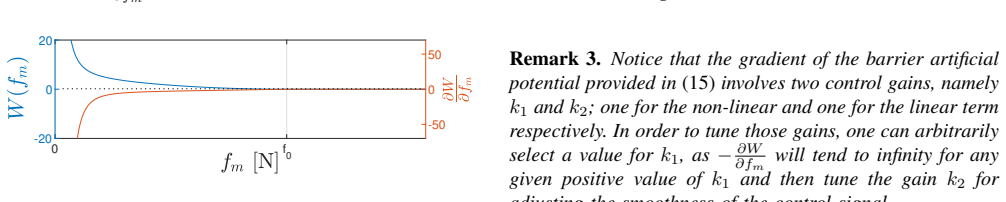
The load-bearing device is the barrier artificial potential $W(f_m)$ with $f_m = h(f_s) - f_{\min}$, where $h$ is the exponential smooth minimum (12) of the four chamber forces. The control applies the gradient of $W$ with respect to the robot's rotation angle $\theta$ as an extra torque around the $z$-axis, $F_v = [0,0,-\partial W/\partial \theta]^\top$. Because $h$ is always at most the true minimum, keeping $f_m > 0$ guarantees the holding criterion $\min(f_s) > f_{\min}$. The passivity argument uses the storage function $L = \tfrac{1}{2} x_2^\top M_d x_2 + \tfrac{1}{2} m_\theta x_3^2 + W$ and the completing-the-squares bound (22) to show $W$ stays bounded when the input energy is bounded.
What would settle it
Set up a carrying task in which the human pulls the object straight away from the suction cup (normal to the cup face) without rotating the robot, while the controller is operating with the barrier potential enabled. If the object detaches in continuous time or if the measured storage function $L$ grows without bound despite bounded input energy, the theorem's guarantee is falsified. Equivalently, measure $dW/dt$ directly during such a pull and compare it with $(\partial W/\partial \theta)\dot{\theta}$; a large discrepancy shows the proof's key approximation is violated.
Extended reading notes
Core claim
The central claim is that the closed-loop admittance system (17), which includes the variable damping law (6) and the barrier-potential torque (9), is passive with respect to the velocity and the human-applied input, and that as a consequence the minimum estimated chamber force never falls below the detachment threshold $f_{\min}$. The proof uses the storage function $L$ equal to the kinetic energy of the target admittance model plus the barrier potential $W$; passivity bounds $L$ by the input energy, and since $W$ grows without bound as the smooth-minimum margin $f_m = h(f_s) - f_{\min}$ approaches zero, the bound on $L$ keeps $f_m$ positive and the object attached.
Load-bearing premise
The proof that the no-detachment guarantee holds assumes that the barrier potential $W$ changes almost entirely through the robot's rotation angle $\theta$, so that the time derivative of $W$ can be replaced by $(\partial W/\partial \theta)\dot{\theta}$; in reality the human's applied force directly changes the four chamber forces and therefore $W$, and if that direct effect dominates, the passivity inequality and the boundedness of $W$ no longer follow.
Editorial extensions
If this is right
- In continuous time, with bounded-energy human input, the object will never detach from the suction cup because the smooth-minimum margin $f_m$ stays positive (Theorem 1).
- The variable damping factor increases when the human pushes against the motion, making the system easy to stop, and decreases when the human drives forward, lowering the energy cost.
- Because $h(f_s) \leq \min(f_s)$, the controller acts earlier than the actual detachment boundary, giving a safety margin that can be tuned with gains $k_1$ and $k_2$.
- The suction cup's four chamber pressures are enough to estimate the interaction force/torque, so the scheme needs no additional sensor hardware.
Reading between the lines
- In the paper's proof, the approximation $dW/dt \approx (\partial W/\partial \theta)\, \dot{\theta}$ is the argument's linchpin; a rigorous check of when human forcing makes the other terms non-negligible would determine how broadly the no-detachment guarantee applies.
- Since the barrier control signal only produces a torque about the $z$-axis, a threat of detachment caused by a straight pull away from the cup might not be fully counteracted; a translational barrier component would be a natural extension.
- The 10 Hz force-sensor rate leaves a gap between the continuous-time guarantee and the discrete-time implementation; the authors note this, and it suggests a testable prediction that higher sampling rates shrink the detachment risk.
Editorial analysis
A structured set of objections, weighed in public.
Referee Report
Summary. The paper proposes an admittance-control scheme for a quadruped robot (Unitree Go1) carrying an object with the MIGHTY suction cup, which simultaneously grasps the object and serves as a force/torque sensor. The controller combines a power-based variable damping term, adapted from prior work, with a barrier artificial potential that adds a torque around the vertical axis in order to prevent detachment of the object. The authors state a passivity theorem and a continuous-time no-detachment guarantee, and they report two experiments: one in which the robot walks along an arc with and without the barrier potential, and one in which the object is translated with constant low, constant high, and variable damping.
Significance. If the theorem and experiments were fully substantiated, the work would be a useful step toward practical physical human-robot collaboration with legged robots: it integrates a sensing-and-grasping suction cup with a variable-admittance controller, and it openly provides the code and hardware details. The algebraic passivity argument in Theorem 1 is clean and easy to follow, and the comparison of BAP-enabled versus BAP-disabled behavior, plus the two-level damping comparison, targets the right questions. However, the central safety guarantee currently rests on an unproven derivative approximation, and the experimental evaluation is a single-trial demonstration without statistical support. The significance is therefore conditional on repairing the proof (or weakening the claim) and on strengthening the experimental evidence.
major comments (2)
- [Theorem 1 / Eqs. (18)-(22)] The proof of Argument 2 assumes dW/dt ≈ (∂W/∂x1) ẋ1 immediately after Eq. (18), and this assumption is load-bearing. The cancellation that turns Eq. (20) into the passivity inequality and the subsequent boundedness of L in Eq. (22) require the exact identity ∂W/∂θ = (∂W/∂fs)(∂fs/∂θ) with ∂fs/∂θ given by Eq. (16). But fs is the measured four-chamber force vector, which is directly affected by the human-applied wrench and by load redistribution; it is not a function of the state x in Eq. (17). Its time derivative contains terms that are independent of θdot (for example, a sustained human push can change the chamber forces at constant θ). In that case Eq. (20) has uncompensated terms, L can grow, and the inference min(fs) > fmin for all t is not established. Because W depends on the input u, L is not a storage function of the state alone, so the passivity statement is not well-posed as written. Remark 4 restricts the claim in discrete time, but the continuous-time guarantee in Theorem 1 remains unsupported unless the approximation is replaced by a justified exact model or a new assumption is introduced.
- [Section V / Figs. 7-9] The experimental evaluation is based on a single trial per condition with one human operator and no error bars or statistical comparisons. The claimed reduction of both cognitive and physical load (contribution 3 and the conclusion) is therefore not substantiated by the data. In particular, the '2.6 times higher' energy result in Fig. 9b is a single-run ratio, and cognitive load is inferred qualitatively from the presence or absence of oscillatory motion rather than measured. The detachment experiment also compares a single BAP-enabled trajectory with a single BAP-disabled trajectory; given that the paper makes a safety-critical guarantee, repeated trials with varied human behavior are needed.
minor comments (3)
- [Eq. (7), Sec. IV] The symbols ζ and ζ are visually nearly identical; please rename the minimum and maximum damping gains (e.g., ζ_min and ζ_max) to make Eq. (7) and the experimental parameter values unambiguous.
- [Sec. III, Eq. (1)] The vacuum pressure is stated as '400 mPa' (0.4 Pa), which is implausible for suction holding; this is likely a typo for 400 mbar and should be corrected.
- [Fig. 7 and Fig. 9] The axes of Figures 7 and 9 are not labeled and the legends do not identify which curve corresponds to which chamber or which damping condition; please add units and legends.
Circularity Check
No significant circularity: self-citations are method sources, not forced premises; the barrier-potential proof is a standard Lyapunov argument, with only an unvalidated derivative approximation as a correctness risk.
full rationale
The derivation chain is not circular. The variable-damping admittance law is adopted from prior work [3], the MIGHTY suction-cup sensing from [29], and the detachment threshold fmin from [30]; these are method/hardware sources with independent experimental grounding, and none is used as an axiom that forces the paper's conclusions. The barrier function W in (10) is defined in terms of the measured chamber forces and fmin, and the no-detachment guarantee in Theorem 1 is obtained by proving that W is bounded via the passivity inequality (20)-(22); this is a standard barrier/Lyapunov implication, not an equality between conclusion and definition. The proof does rely on an explicit approximation, dW/dt ≈ ∂W/∂x1 ẋ1 after (18), and if that approximation fails when human-induced chamber-force changes do not track θ_dot, inequality (20) and the boundedness of W may fail; that is a proof-validity risk, not a circularity, because W is not defined so that the conclusion holds by construction and the calibration constants plus fmin are measured independently. Remark 4 also concedes discretization limits, which narrows the continuous-time guarantee but does not make it circular. The heavy self-citation to [3], [29], [30], [31] is contextual reliance on prior same-group work, not an imported uniqueness theorem or a fitted-input-called-prediction step.
Assumptions & free parameters
free parameters (6)
- sensor calibration parameters a_i, b_i, c =
not reported numerically
- barrier potential gains k1, k2 =
k1 = 10, k2 = 1
- barrier activation threshold f0 =
20 N
- detachment force bound fmin =
-48 N
- force-angle model parameters beta and kappa =
beta = 0.04 m, kappa = 20.0 N/m
- admittance and variable damping parameters Md, mtheta, D1, dtheta, zeta_min, zeta_max, lambda =
Md = 13I2 kg, mtheta = 1.5 kgm^2, Dd = diag(20,20,5), zeta_min=0.1, zeta_max=1, lambda=3; in translation experiment…
assumptions (5)
- domain assumption The quadruped's low-level controller accepts task-space velocity commands and compensates gravitational loads on the z-axis.
- domain assumption The force estimation model (1)-(2) is accurate after calibration.
- domain assumption The barrier potential W varies predominantly with the robot's rotation angle theta, so dW/dt is approximately (dW/dtheta) * dtheta/dt.
- ad hoc to paper The relationship between chamber force changes and rotation angle is given by Eq. (16) with the sign pattern [-beta*kappa, beta*kappa, beta*kappa, -beta*kappa].
- domain assumption The human input u has bounded energy over the time horizon.
Cite this review
Pith. "Pith review of A control scheme for collaborative object transportation between a human and a quadruped robot using the MIGHTY suction cup." pith.science (2026). https://pith.science/paper/S6AI2VKT
@misc{pith2026250800584,
  author       = {Pith},
  title        = {Pith review of: A control scheme for collaborative object transportation between a human and a quadruped robot using the MIGHTY suction cup},
  year         = {2026},
  howpublished = {\url{https://pith.science/paper/S6AI2VKT}},
  note         = {Machine review of arXiv:2508.00584}
}
read the original abstract
In this work, a control scheme for human-robot collaborative object transportation is proposed, considering a quadruped robot equipped with the MIGHTY suction cup that serves both as a gripper for holding the object and a force/torque sensor. The proposed control scheme is based on the notion of admittance control, and incorporates a variable damping term aiming towards increasing the controllability of the human and, at the same time, decreasing her/his effort. Furthermore, to ensure that the object is not detached from the suction cup during the collaboration, an additional control signal is proposed, which is based on a barrier artificial potential. The proposed control scheme is proven to be passive and its performance is demonstrated through experimental evaluations conducted using the Unitree Go1 robot equipped with the MIGHTY suction cup.
Figures


Figures from the paper (5 more)



Reference graph
Works this paper leans on
-
[1]
Human–robot collaboration for safe object transportation using force feedback,
J. E. Solanes, L. Gracia, P. Mu ˜noz-Benavent, J. Valls Miro, M. G. Carmichael, and J. Tornero, “Human–robot collaboration for safe object transportation using force feedback,” Robotics and Autonomous Systems, vol. 107, pp. 196–208, 2018
work page 2018
-
[2]
A. Sidiropoulos, F. Dimeas, D. Papageorgiou, T. Prapavesis Semet- zidis, Z. Doulgeri, A. Zanella, F. Grella, K. Sagar, M. Jilich, A. Albini, G. Cannata, and M. Zoppi, “Safe and effective collaboration with a high-payload robot: A framework integrating novel hardware and software modules,” IEEE Robotics & Automation Magazine , pp. 2– 11, 2023
work page 2023
-
[3]
A variable admittance controller for human-robot manipulation of large inertia objects,
A. Sidiropoulos, T. Kastritsi, D. Papageorgiou, and Z. Doulgeri, “A variable admittance controller for human-robot manipulation of large inertia objects,” in 2021 30th IEEE International Conference on Robot & Human Interactive Communication (RO-MAN) , pp. 509–514, 2021
work page 2021
-
[4]
H. Hua, Z. Liao, Y . Liu, X. Wu, J. Zhao, and J. Song, “Compliant human–robot object transfer based on modular 3-axis force sensor for collaborative manufacturing,”ISA Transactions, vol. 141, pp. 482–495, 2023
work page 2023
-
[5]
T. Kastritsi and A. Ajoudani, “A passive power-based control strategy for phri tasks with omni-directional robotic mobile platforms,” IEEE Robotics and Automation Letters , vol. 9, no. 8, pp. 6959–6966, 2024
work page 2024
-
[6]
D. Sirintuna, T. Kastritsi, I. Ozdamar, J. M. Gandarias, and A. Ajoudani, “Enhancing human–robot collaborative transportation through obstacle-aware vibrotactile warning and virtual fixtures,” Robotics and Autonomous Systems , vol. 178, p. 104725, 2024
work page 2024
-
[7]
Human-robot collaborative control for handling and transfer objects,
G. P. Moreno, N. D. De la Cruz, J. S. Ortiz, and V . H. Andaluz, “Human-robot collaborative control for handling and transfer objects,” in Applied Technologies (M. Botto-Tobar, S. Montes Le ´on, O. Cama- cho, D. Ch ´avez, P. Torres-Carri ´on, and M. Zambrano Vizuete, eds.), (Cham), pp. 96–110, Springer International Publishing, 2021
work page 2021
-
[8]
M. D. Kennedy III, Modeling and control for robotic assistants: Single and multi-robot manipulation. PhD thesis, University of Pennsylvania, 2019
work page 2019
Show all 31 references
-
[9]
Mapping human inten- tions to robot motions via physical interaction through a jointly-held object,
Y . Karayiannidis, C. Smith, and D. Kragic, “Mapping human inten- tions to robot motions via physical interaction through a jointly-held object,” in The 23rd IEEE International Symposium on Robot and Human Interactive Communication , pp. 391–397, 2014
2014
-
[10]
D. J. Agravante, Human-humanoid collaborative object transportation. Theses, Universit´e Montpellier, Dec. 2015
2015
-
[11]
Human-humanoid collaborative carrying,
D. J. Agravante, A. Cherubini, A. Sherikov, P.-B. Wieber, and A. Kheddar, “Human-humanoid collaborative carrying,” IEEE Trans- actions on Robotics , vol. 35, no. 4, pp. 833–846, 2019
2019
-
[12]
A new approach on hu- man–robot collaboration with humanoid robot rh-2,
C. A. Monje, P. Pierro, and C. Balaguer, “A new approach on hu- man–robot collaboration with humanoid robot rh-2,” Robotica, vol. 29, no. 6, p. 949–957, 2011
2011
-
[13]
Adaptive cooperative control for human-robot load manipulation,
C. R. d. Cos and D. V . Dimarogonas, “Adaptive cooperative control for human-robot load manipulation,” IEEE Robotics and Automation Letters, vol. 7, no. 2, pp. 5623–5630, 2022
2022
-
[14]
Human-robot collaborative object transfer using human motion prediction based on dynamic movement primitives,
A. Sidiropoulos, Y . Karayiannidis, and Z. Doulgeri, “Human-robot collaborative object transfer using human motion prediction based on dynamic movement primitives,” in 2019 18th European Control Conference (ECC), pp. 2583–2588, 2019
2019
-
[15]
Human-robot collaborative object transfer using human motion prediction based on cartesian pose dynamic movement primitives,
A. Sidiropoulos, Y . Karayiannidis, and Z. Doulgeri, “Human-robot collaborative object transfer using human motion prediction based on cartesian pose dynamic movement primitives,” in 2021 IEEE Inter- national Conference on Robotics and Automation (ICRA) , pp. 3758– 3764, 2021
2021
-
[16]
Anymal - a highly mobile and dynamic quadrupedal robot,
M. Hutter, C. Gehring, D. Jud, A. Lauber, C. D. Bellicoso, V . Tsounis, J. Hwangbo, K. Bodie, P. Fankhauser, M. Bloesch, R. Diethelm, S. Bachmann, A. Melzer, and M. Hoepflinger, “Anymal - a highly mobile and dynamic quadrupedal robot,” in 2016 IEEE/RSJ Interna- tional Conferen...
2016
-
[17]
Learning quadrupedal locomotion over challenging terrain,
J. Lee, J. Hwangbo, L. Wellhausen, V . Koltun, and M. Hutter, “Learning quadrupedal locomotion over challenging terrain,” Science Robotics, vol. 5, no. 47, p. eabc5986, 2020
2020
-
[18]
Control of dynamic gaits for a quadrupedal robot,
C. Gehring, S. Coros, M. Hutter, M. Bloesch, M. A. Hoepflinger, and R. Siegwart, “Control of dynamic gaits for a quadrupedal robot,” in 2013 IEEE International Conference on Robotics and Automation , pp. 3287–3292, 2013
2013
-
[19]
Contact planning for the anymal quadruped robot using an acyclic reachability- based planner,
M. Geisert, T. Yates, A. Orgen, P. Fernbach, and I. Havoutis, “Contact planning for the anymal quadruped robot using an acyclic reachability- based planner,” in Towards Autonomous Robotic Systems (K. Althoe- fer, J. Konstantinova, and K. Zhang, eds.), (Cham), pp. 275–287, Spri...
2019
-
[20]
Two-layer adaptive trajectory tracking controller for quadruped robots on slippery terrains,
D.-E. Argiropoulos, D. Papageorgiou, M. Maravgakis, D. Drosakis, and P. Trahanias, “Two-layer adaptive trajectory tracking controller for quadruped robots on slippery terrains,” in 2023 IEEE-RAS 22nd International Conference on Humanoid Robots (Humanoids) , pp. 1–8, 2023
2023
-
[21]
Probabilistic contact state estimation for legged robots using inertial information,
M. Maravgakis, D.-E. Argiropoulos, S. Piperakis, and P. Trahanias, “Probabilistic contact state estimation for legged robots using inertial information,” in 2023 IEEE International Conference on Robotics and Automation (ICRA), pp. 12163–12169, 2023
2023
-
[22]
Modeling and optimal control of rescue quadruped robot with high payload,
N. Hu, S. Li, D. Huang, and F. Gao, “Modeling and optimal control of rescue quadruped robot with high payload,” in Mechanism and Ma- chine Science (X. Zhang, N. Wang, and Y . Huang, eds.), (Singapore), pp. 521–535, Springer Singapore, 2017
2017
-
[23]
Development of quadruped robot for inspection of underground pipelines in nuclear power plants,
Y . Jang, W. Seol, K. Lee, K.-S. Kim, and S. Kim, “Development of quadruped robot for inspection of underground pipelines in nuclear power plants,” Electronics Letters, vol. 58, no. 6, pp. 234–236, 2022
2022
-
[24]
Vision aided dynamic exploration of unstructured terrain with a small-scale quadruped robot,
D. Kim, D. Carballo, J. Di Carlo, B. Katz, G. Bledt, B. Lim, and S. Kim, “Vision aided dynamic exploration of unstructured terrain with a small-scale quadruped robot,” in 2020 IEEE International Conference on Robotics and Automation (ICRA) , pp. 2464–2470, 2020
2020
-
[25]
Quadruped guidance robot for the visually impaired: A comfort-based approach,
Y . Chen, Z. Xu, Z. Jian, G. Tang, L. Yang, A. Xiao, X. Wang, and B. Liang, “Quadruped guidance robot for the visually impaired: A comfort-based approach,” in 2023 IEEE International Conference on Robotics and Automation (ICRA) , pp. 12078–12084, 2023
2023
-
[26]
Robotic guide dog: Leading a human with leash-guided hybrid physical in- teraction,
A. Xiao, W. Tong, L. Yang, J. Zeng, Z. Li, and K. Sreenath, “Robotic guide dog: Leading a human with leash-guided hybrid physical in- teraction,” in 2021 IEEE International Conference on Robotics and Automation (ICRA), pp. 11470–11476, 2021
2021
-
[27]
Gaze-guided semi-autonomous quadruped robot for enhanced assisted living,
P. Joseph, D. Plozza, L. Pascarella, and M. Magno, “Gaze-guided semi-autonomous quadruped robot for enhanced assisted living,” in 2024 IEEE Sensors Applications Symposium (SAS) , pp. 1–6, 2024
2024
-
[28]
Adaptive interactive control of human and quadruped robot load motion,
S. Gu, F. Meng, B. Liu, X. Chen, Z. Yu, and Q. Huang, “Adaptive interactive control of human and quadruped robot load motion,” IEEE/ASME Transactions on Mechatronics , pp. 1–12, 2024
2024
-
[29]
Mighty: Multi-functional suction cup for object gripping and surface attach- ment,
E. Papadakis, M. Sigalas, M. Vangos, and P. Trahanias, “Mighty: Multi-functional suction cup for object gripping and surface attach- ment,” in 2023 IEEE/RSJ International Conference on Intelligent Robots and Systems (IROS) , pp. 1–8, 2023
2023
-
[30]
The gem- c controller for load compensation in object manipulation,
E. Papadakis, M. Sigalas, M. Vangos, and P. Trahanias, “The gem- c controller for load compensation in object manipulation,” in 2024 IEEE International Conference on Robotics and Automation (ICRA) , pp. 13904–13909, 2024
2024
-
[31]
On the stability of robot kinesthetic guidance in the presence of active constraints,
T. Kastritsi, D. Papageorgiou, and Z. Doulgeri, “On the stability of robot kinesthetic guidance in the presence of active constraints,” in 2018 European Control Conference (ECC) , pp. 622–627, 2018
2018
Reviewed August 6, 2026 · model on record in the stance chip above.
Discussion (0). Sign in to comment.