REVIEW 4 major objections 5 minor 93 references
Cooperative Perception: A Resource-Efficient Framework for Multi-Drone 3D Scene Reconstruction Using Federated Diffusion and NeRF
T0 review · 4 major / 5 minor · reviewed 2026-08-06 · deepseek-v4-flash
Pith's one-line read A drone swarm can rebuild a shared 3D scene from text and poses alone
desk verdict A coherent research proposal that makes concrete performance claims it doesn't back up—the multi-view consistency of hallucinated images is the load-bearing premise and it's just asserted. read the letter →
The pith
A machine-rendered reading of the paper's core claim, the machinery that carries it, and where it could break.
The reading
What carries the argument
The central object is a 3D-aware generative prior: a diffusion model $\theta$ that takes fused semantics and a pose $p$ as a conditioning vector $c_p=(S_{\text{fused}}, p)$ and outputs an image $I_p=\text{GenerateImage}(\theta,c_p)$. Pose-conditioning adapters are the intended guarantee that the hallucinated images are multi-view consistent. The NeRF stage then integrates the hallucinated colors through the volume-rendering equation $C(r)=\int_{t_n}^{t_f} T(t)\,\sigma(r(t))\,c(r(t),d)\,dt$, treating those colors as regression targets; federated averaging is the machinery that keeps the shared diffusion model aligned across drones without centralizing raw data.
What would settle it
Render two or more views of the same region from one text prompt at nearby camera poses, fit a NeRF to them, and check multi-view consistency with epipolar constraints or reprojection error; if the synthesized views are not geometrically consistent, the hallucinated images cannot serve as ground truth for reconstruction.
Extended reading notes
Core claim
The paper's central claim is that the cooperative-perception trilemma can be dissolved by inverting where generation happens: instead of shipping observations to a fusion node, agents ship only descriptions, and the target agent generates the missing appearances. Concretely, the framework claims that a shared diffusion model, trained jointly via federated averaging, can be conditioned on fused text semantics and reference poses to produce multi-view-consistent photorealistic images, and that these hallucinated views are reliable enough to supervise a NeRF update. The paper presents the architecture and an algorithmic walkthrough, positioning validation as future simulation and testbed deployment.
Load-bearing premise
The entire pipeline rests on the assumption that a diffusion model conditioned on sparse text semantics and 6-DoF poses can generate photorealistic images that are consistent across different viewpoints, because those generated images are the only ground-truth supervision for the NeRF.
Editorial extensions
If this is right
- Communication drops from megabyte-scale raw images or feature grids to under 1 MB per exchange, since only text semantics and pose matrices are transmitted.
- Source drones need only run lightweight extraction with detectors like YOLOv12, while the expensive diffusion generation runs on the requesting drone, easing onboard compute limits.
- A shared diffusion prior trained by federated learning can generalize to unseen zones without any drone exposing raw sensor data.
- The same hallucination-plus-NeRF loop extends to 4D by conditioning on dynamic poses, supporting real-time updates in changing scenes.
- The framework positions itself as more bandwidth-efficient than feature-sharing methods and more privacy-preserving than raw-data sharing.
Reading between the lines
- A decisive test of the framework is whether pose-conditioned text-to-image diffusion actually yields multi-view-consistent images; without that, the NeRF supervision is invalid, and the scheme reduces to late fusion with extra compute.
- If pose consistency holds, the same mechanism should transfer to 3D Gaussian Splatting, where hallucinated views could supervise a splatting model at higher frame rates.
- A natural first validation is a small simulator with two or three camera viewpoints on a static scene, measuring NeRF reconstruction quality against a baseline that shares raw images.
- The privacy claim assumes the semantics themselves are non-sensitive; if text descriptions leak locations or object identities, federated learning does not prevent information disclosure through prompts.
Editorial analysis
A structured set of objections, weighed in public.
Referee Report
Summary. This manuscript proposes a multi-drone cooperative-perception framework in which source drones transmit only compact semantic descriptions (extracted by YOLOv12/CLIP) and 6-DoF poses to a target drone, which then uses a federated, pose-conditioned diffusion model to hallucinate images of unobserved areas and trains a local NeRF on those hallucinated images. The paper provides background equations for NeRF rendering, diffusion models, FedAvg, and Slepian-Wolf/Wyner-Ziv coding, a cooperative mechanism with pseudo-code, and a large set of proposed extensions. It claims low bandwidth (<1 MB per exchange), millisecond latency, and over 90% overhead reduction. No experiments, simulations, or real-world measurements are reported.
Significance. If the central assumption that text semantics plus poses suffice to generate multi-view-consistent photorealistic views were true, the approach could substantially reduce communication costs in drone-swarm 3D reconstruction and would connect semantic communication, federated generative models, and NeRF in a novel way. The paper states a clear problem trilemma and describes a coherent pipeline, and the background material on NeRF, diffusion, and source coding is standard and correctly presented. However, no quantitative validation or formal analysis is provided, and the core generation-consistency premise is only asserted. The potential significance is therefore conditional on an unverified premise; the manuscript as it stands is a proposal rather than a demonstrated framework.
major comments (4)
- [Section 3.2, Phase 3] The claim that pose conditioning via ControlNet makes generated images 'multi-view consistent and suitable for reconstructing a coherent 3D scene with NeRF' is the load-bearing premise of the entire pipeline, but no evidence, derivation, or suitable consistency result is provided. Text- or pose-conditioned diffusion models are known not to preserve exact cross-view consistency by themselves; Section 5 acknowledges 'hallucination inconsistency' only as a 'potential issue' to be mitigated, with no concrete mechanism. If this premise fails, Phase 4 does not reconstruct a coherent scene, so the central contribution is unsupported.
- [Section 7 and Table 1] The resource-efficiency claims are quantitative but are not derived or measured anywhere in the paper: 'low bandwidth (<1 MB per exchange)', 'milliseconds over Wi-Fi/5G', and 'reducing overhead by over 90%' (also Section 6.5) appear as assertions. Table 1 lists rows for raw sharing, NeRF latent sharing, and the proposed method without any source, definition, or measurement supporting the stated bandwidth, compute-load, or privacy levels. These numbers are essential to the claimed contribution over prior work.
- [Section 3.2, Phase 4] The NeRF update uses hallucinated images as ground-truth colors C(r) in the photometric loss without modeling the uncertainty or error of the generated pseudo-labels. This is not a harmless simplification: any inconsistency or hallucination error is treated as true geometry by the radiance-field optimization, biasing the reconstruction. The paper should either provide a mechanism to weight, validate, or filter generated images, or demonstrate on a benchmark that NeRF trained on such pseudo-ground truth converges to an accurate scene.
- [Abstract, Section 5, Section 7] The paper's own statements that the approach 'can be validated through simulations and potential real-world deployment' and that validation is part of future work confirm that the framework has not been evaluated. The absence of any experiment, dataset, or ablation means that even the intended modular consistency between semantic extraction, hallucination, NeRF training, and FL aggregation is not demonstrated. This is a load-bearing gap because each phase's output is assumed to be adequate for the next phase without any supporting measurement.
minor comments (5)
- [Section 6.5] The sentence fragment 'achieving 90' is cut off; it should state the target reduction or complete the sentence.
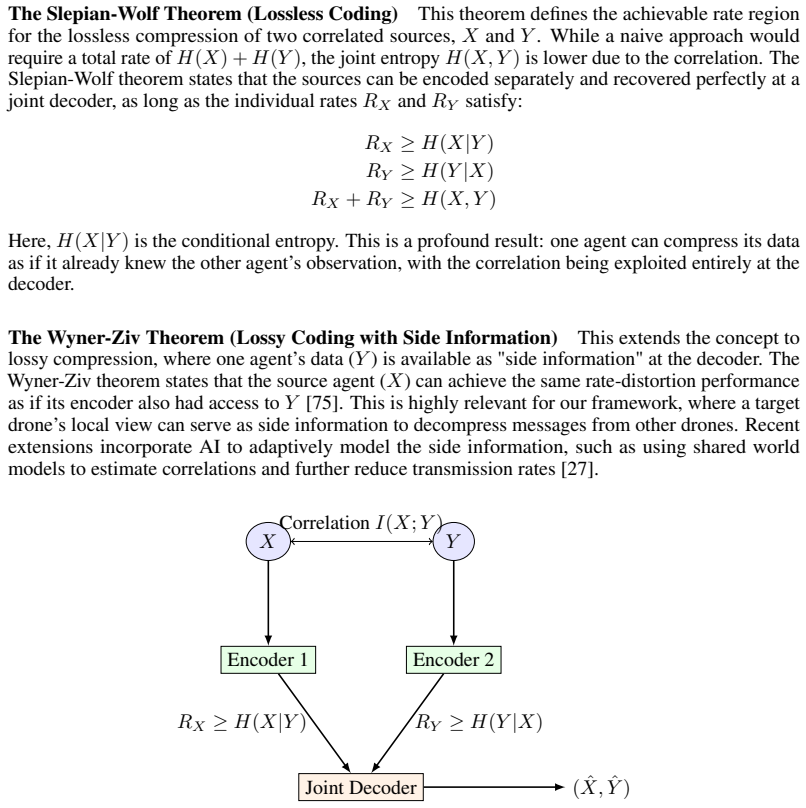
- [Section 2.4] Multiterminal coding and Figure 1 are introduced, but the paper never explains how the Slepian-Wolf/Wyner-Ziv rate regions constrain or guide the proposed semantic-exchange protocol; either make this connection explicit or remove the material.
- [Table 1] The terms 'NeRF Latent Sharing' and 'Compute Load' are not formally defined, and the row for the proposed method is not tied to any measurement; the comparison is therefore illustrative rather than substantive.
- [References] Reference formatting is inconsistent: reference [10] duplicates [7], several entries are arXiv preprints without version identifiers, and some in-text citation numbers appear to point to tangentially related works.
- [Abstract and Section 1] Promotional language such as 'disruptive advancement' and 'profound result' (Section 2.4) should be replaced with neutral technical statements, especially given that the claimed results are not demonstrated.
Circularity Check
No internal circularity: the framework's claims are unsupported assumptions, not derivations that reduce to their inputs.
full rationale
The paper is a proposal that assembles existing techniques (diffusion, NeRF, federated learning, semantic compression) rather than deriving a result from fitted parameters. The load-bearing premise that pose-conditioned diffusion hallucination produces multi-view-consistent images is asserted and attributed to external prior work (ControlNet [85], DreamFusion [54]), not derived within the paper and not used to define the conclusion by construction. The NeRF training loss in Phase 4 uses hallucinated images as ground truth, but this is an unverified modeling choice, not a circular step: the paper does not claim to predict those hallucinated images from the NeRF, nor does it fit a parameter to one quantity and then report that same quantity as a prediction. No equations in the paper equate a predicted output with an input by definition. There are no author self-citations at all, and no uniqueness theorem imported from the author's prior work. Claims such as '<1 MB per exchange', 'milliseconds over Wi-Fi/5G', and '90% reduction' are asserted without derivation or simulation, making them unsupported, but unsupported claims are not circular. The only substantive weakness is that the central hallucination-consistency assumption is unvalidated against external benchmarks, which is a correctness/feasibility risk, not a circularity. Accordingly, the circularity score is 0.
Assumptions & free parameters
free parameters (4)
- Semantic payload size estimate =
kB-size embeddings; <1 MB per exchange
- Guidance weight w =
not specified
- Discrepancy threshold tau =
not specified
- Latent embedding dimension =
512 dimensions, about 2 KB
assumptions (5)
- standard math The standard volume rendering integral accurately models image formation for NeRF training.
- domain assumption Diffusion models can be trained in a federated manner and serve as a shared generative prior.
- ad hoc to paper Text/embedding semantics and 6-DoF poses contain enough information to reconstruct photorealistic, multi-view-consistent images of unobserved areas.
- domain assumption GPS/IMU provide a globally aligned shared coordinate frame for poses across drones.
- domain assumption The wireless channel supports low-latency, reliable transmission of small semantic packets.
Cite this review
Pith. "Pith review of Cooperative Perception: A Resource-Efficient Framework for Multi-Drone 3D Scene Reconstruction Using Federated Diffusion and NeRF." pith.science (2026). https://pith.science/paper/5ZPMIXUJ
@misc{pith2026250800967,
  author       = {Pith},
  title        = {Pith review of: Cooperative Perception: A Resource-Efficient Framework for Multi-Drone 3D Scene Reconstruction Using Federated Diffusion and NeRF},
  year         = {2026},
  howpublished = {\url{https://pith.science/paper/5ZPMIXUJ}},
  note         = {Machine review of arXiv:2508.00967}
}
read the original abstract
The proposal introduces an innovative drone swarm perception system that aims to solve problems related to computational limitations and low-bandwidth communication, and real-time scene reconstruction. The framework enables efficient multi-agent 3D/4D scene synthesis through federated learning of shared diffusion model and YOLOv12 lightweight semantic extraction and local NeRF updates while maintaining privacy and scalability. The framework redesigns generative diffusion models for joint scene reconstruction, and improves cooperative scene understanding, while adding semantic-aware compression protocols. The approach can be validated through simulations and potential real-world deployment on drone testbeds, positioning it as a disruptive advancement in multi-agent AI for autonomous systems.
Figures


Reference graph
Works this paper leans on
-
[1]
A Survey on 3D Object Detection Methods for Autonomous Driving Applications
Eduardo Arnold et al. A Survey on 3D Object Detection Methods for Autonomous Driving Applications. IEEE Transactions on Intelligent Transportation Systems, vol. 20, no. 10, pp. 3782–3795, 2019
2019
-
[2]
Avrahami et al
O. Avrahami et al. Blended Diffusion for Text-driven Editing of Natural Images. Proceedings of CVPR, 2022
2022
-
[3]
Badue et al
C. Badue et al. Self-driving cars: A survey. Expert Systems with Applications , vol. 165, p. 113816, 2021
2021
-
[4]
Rethinking Lossy Compression: The Rate-Distortion- Perception Tradeoff
Yochai Blau and Tomer Michaeli. Rethinking Lossy Compression: The Rate-Distortion- Perception Tradeoff. Proceedings of the 36th International Conference on Machine Learning (ICML), 2019
2019
-
[5]
Caesar et al
H. Caesar et al. nuScenes: A multimodal dataset for autonomous driving. Proc. IEEE Conf. on Computer Vision and Pattern Recognition (CVPR), pp. 11621–11631, 2020
2020
-
[6]
Cooper: Cooperative Perception for Connected Autonomous Vehicles based on 3D Point Clouds
Qi Chen et al. Cooper: Cooperative Perception for Connected Autonomous Vehicles based on 3D Point Clouds. Proceedings of the 39th IEEE International Conference on Distributed Computing Systems (ICDCS), pp. 514–524, 2019
2019
-
[8]
GaussianDreamer: Fast Generation from Text to 3D Gaussians by Bridging 2D and 3D Diffusion Models
Taoran Yi et al. GaussianDreamer: Fast Generation from Text to 3D Gaussians by Bridging 2D and 3D Diffusion Models. arXiv preprint arXiv:2310.08529, 2023
arXiv 2023
-
[9]
Phoenix: A Federated Generative Diffusion Model
Fiona Victoria Stanley Jothiraj and Afra Mashhadi. Phoenix: A Federated Generative Diffusion Model. arXiv preprint arXiv:2306.04098, 2023
arXiv 2023
Show all 93 references
-
[10]
V2X Cooperative Perception for Autonomous Driving: A Survey
Runsheng Xu et al. V2X Cooperative Perception for Autonomous Driving: A Survey. arXiv preprint arXiv:2310.03525, 2023
2023 arXiv
-
[11]
Federated Learning for Diffusion Models
Zihao Peng et al. Federated Learning for Diffusion Models. arXiv preprint arXiv:2503.06426, 2025
2025 arXiv
-
[12]
CoBEVT: Cooperative Bird’s Eye View Semantic Segmentation with Sparse Transformers
Runsheng Xu et al. CoBEVT: Cooperative Bird’s Eye View Semantic Segmentation with Sparse Transformers. Conference on Robot Learning (CoRL), 2022. 12
2022
-
[13]
Deng et al
K. Deng et al. Depth-supervised NeRF: Fewer views and faster training for free. Proc. IEEE Conf. on Computer Vision and Pattern Recognition (CVPR), pp. 12882–12891, 2022
2022
-
[14]
Dorri et al
A. Dorri et al. Multi-agent systems: A survey. IEEE Access, vol. 6, pp. 28573–28593, 2018
2018
-
[15]
Fridovich-Keil et al
S. Fridovich-Keil et al. Plenoxels: Radiance fields without neural networks. Proc. IEEE Conf. on Computer Vision and Pattern Recognition (CVPR), pp. 5501–5510, 2022
2022
-
[16]
K. Friston. The free-energy principle: a rough guide to the brain? Trends in Cognitive Sciences, vol. 13, no. 7, pp. 293–301, 2009
2009
-
[17]
DecentNeRFs: Decentralized Neural Radiance Fields from Crowdsourced Images
Zaid Tasneem et al. DecentNeRFs: Decentralized Neural Radiance Fields from Crowdsourced Images. arXiv preprint arXiv:2403.13199, 2024
2024 arXiv
-
[18]
Gossmann et al
M. Gossmann et al. Federated Learning with Variational Autoencoders. OpenReview, 2022
2022
-
[19]
Gu et al
G. Gu et al. ManiSkill2: A unified benchmark for generalizable manipulation skills. Proc. Int. Conf. on Learning Representations (ICLR), 2023
2023
-
[20]
Deep Reinforcement Learning for Intelligent Transportation Systems: A Survey
Ammar Haydari and Yasin Yilmaz. Deep Reinforcement Learning for Intelligent Transportation Systems: A Survey. IEEE Transactions on Intelligent Transportation Systems, vol. 23, no. 1, pp. 11–32, 2020
2020
-
[21]
Ho et al
J. Ho et al. Denoising Diffusion Probabilistic Models. Advances in Neural Information Processing Systems 33 (NeurIPS), 2020
2020
-
[22]
Ho and T
J. Ho and T. Salimans. Classifier-Free Diffusion Guidance. NeurIPS Workshop, 2022
2022
-
[23]
Hu et al
Y . Hu et al. Where2comm: Communication-efficient collaborative perception via spatial confidence maps. Proc. Neural Information Processing Systems (NeurIPS), pp. 1287–1300, 2022
2022
-
[24]
Hu et al
Y . Hu et al. When2com: A Communication-Efficient Collaborative Perception Framework via Feature-based Scheduling. Proc. IEEE Int. Conf. on Robotics and Automation (ICRA), 2023
2023
-
[25]
Huang and Z
Y . Huang and Z. Liu. Bridging the gap between single and multi-agent perception.Proc. Int. Conf. on Machine Learning (ICML), 2023
2023
-
[26]
Jiang et al
Y . Jiang et al. MotionDiffuser: Controllable Multi-Agent Motion Prediction Using Diffusion. Proceedings of CVPR, 2023
2023
-
[27]
An Information-Theoretic Approach to Collaborative Integrated Sensing and Communication for Mutual Information-Based Sensing Metric
Mehrasa Ahmadipour et al. An Information-Theoretic Approach to Collaborative Integrated Sensing and Communication for Mutual Information-Based Sensing Metric. arXiv preprint arXiv:2306.05855, 2023
2023 arXiv
-
[28]
P. Kanerva. Hyperdimensional computing: An introduction to computing in distributed rep- resentation with high-dimensional random vectors. Cognitive Computation, vol. 1, no. 2, pp. 139–159, 2009
2009
-
[29]
A Survey on Intermediate Fusion Methods for Collaborative Perception Categorized by Real World Challenges
Melih Yazgan et al. A Survey on Intermediate Fusion Methods for Collaborative Perception Categorized by Real World Challenges. arXiv preprint arXiv:2404.16139, 2024
2024 arXiv
-
[30]
Kerbl et al
B. Kerbl et al. 3D Gaussian Splatting for Real-Time Radiance Field Rendering. ACM Transac- tions on Graphics, vol. 42, no. 4, p. 139, 2023
2023
-
[31]
D. P. Kingma and M. Welling. Auto-Encoding Variational Bayes. arXiv preprint arXiv:1312.6114, 2013
2013 arXiv
-
[32]
Koneˇcný et al
J. Koneˇcný et al. Federated learning: Strategies for improving communication efficiency. arXiv preprint arXiv:1610.05492, 2016
2016 arXiv
-
[33]
Multi-modal Sensor Fusion for Auto Driving Perception: A Survey
Keli Huang et al. Multi-modal Sensor Fusion for Auto Driving Perception: A Survey. arXiv preprint arXiv:2202.02703, 2022
2022 arXiv
-
[34]
Lan et al
P. Lan et al. Generative AI-enabled Semantic Communication. IEEE Network, 2024
2024
-
[35]
Li et al
Y . Li et al. Learning to communicate for multi-agent reinforcement learning.Proc. Int. Conf. on Learning Representations (ICLR), 2021
2021
-
[36]
Li et al
Y . Li et al. F-cooper: Feature-based cooperative perception for autonomous driving.Proc. IEEE Int. Conf. on Robotics and Automation (ICRA), pp. 10488–10494, 2021
2021
-
[37]
Li et al
Y . Li et al. DeepFusion: Lidar-camera deep fusion for 3D object detection.Proc. IEEE Conf. on Computer Vision and Pattern Recognition (CVPR), pp. 17214–17223, 2022. 13
2022
-
[38]
READ: Large-Scale Neural Scene Rendering for Autonomous Driving
Zhuopeng Li et al. READ: Large-Scale Neural Scene Rendering for Autonomous Driving. arXiv preprint arXiv:2205.05509, 2022
2022 arXiv
-
[39]
Dynamic Neural Radiance Fields for Monocular 4D Facial Avatar Reconstruc- tion
Guy Gafni et al. Dynamic Neural Radiance Fields for Monocular 4D Facial Avatar Reconstruc- tion. arXiv preprint arXiv:2012.03065, 2020
2012 arXiv
-
[40]
Li et al
Y . Li et al. Learning to schedule communication for multi-agent reinforcement learning.Proc. Int. Conf. on Autonomous Agents and Multiagent Systems (AAMAS), 2023
2023
-
[41]
Li et al
R. Li et al. V2X-ViT: A vision transformer for vehicle-to-everything cooperative perception. Proc. IEEE Int. Conf. on Computer Vision (ICCV), pp. 1234–1244, 2023
2023
-
[42]
FedPhD: Federated Pruning with Hierarchical Learning of Diffusion Models
Qiyuan Wang. FedPhD: Federated Pruning with Hierarchical Learning of Diffusion Models. arXiv preprint arXiv:2507.06449, 2025
2025 arXiv
-
[43]
Is Intermediate Fusion All You Need for UA V-based Collaborative Perception? arXiv preprint arXiv:2504.21774, 2025
Jiuwu Hao. Is Intermediate Fusion All You Need for UA V-based Collaborative Perception? arXiv preprint arXiv:2504.21774, 2025
2025 arXiv
-
[44]
Towards Vehicle-to-Everything Autonomous Driving: A Survey on Collaborative Perception
Si Liu and Chendong Shao and Shunli Ren and Peng Wu and Yiming Li and Yiheng Li and Yuqi Wang and Yuanhang Yang and Yuexin Ma. Towards Vehicle-to-Everything Autonomous Driving: A Survey on Collaborative Perception. arXiv preprint arXiv:2305.02216, 2024
2024 arXiv
-
[45]
Liu et al
J. Liu et al. Who2com: A learnable communication protocol for multi-agent systems. Proc. Int. Conf. on Machine Learning (ICML), pp. 6237–6247, 2020
2020
-
[46]
Gregory et al
Nicholas M. Gregory et al. Topology-Aware Resilient Communication for UA V Swarms in Contested Environments. arXiv preprint arXiv:2103.09771, 2021
2021 arXiv
-
[47]
V2X-Real: a Large-Scale Dataset for Vehicle-to-Everything Cooperative Perception
Yifan Lu et al. V2X-Real: a Large-Scale Dataset for Vehicle-to-Everything Cooperative Perception. arXiv preprint arXiv:2403.16034, 2024
2024 arXiv
-
[48]
Mao et al
J. Mao et al. The neuro-symbolic concept learner: Interpreting scenes, words, and sentences from natural supervision. International Conference on Learning Representations, 2019
2019
-
[49]
McMahan et al
B. McMahan et al. Communication-Efficient Learning of Deep Networks from Decentralized Data. Proceedings of the 20th International Conference on Artificial Intelligence and Statistics (AISTATS), 2017
2017
-
[50]
Mildenhall et al
B. Mildenhall et al. NeRF: Representing Scenes as Neural Radiance Fields for View Synthesis. Proceedings of the European Conference on Computer Vision (ECCV), 2020
2020
-
[51]
Müller et al
T. Müller et al. Instant Neural Graphics Primitives with a Multiresolution Hash Encoding. ACM Transactions on Graphics, vol. 41, no. 4, p. 102, 2022
2022
-
[52]
SemHARQ: Semantic-Aware HARQ for Multi-task Semantic Communica- tions
Jiangjing Hu et al. SemHARQ: Semantic-Aware HARQ for Multi-task Semantic Communica- tions. arXiv preprint arXiv:2404.08490, 2024
2024 arXiv
-
[53]
van den Oord et al
A. van den Oord et al. Neural discrete representation learning. Advances in Neural Information Processing Systems 30 (NIPS), 2017
2017
-
[54]
Poole et al
B. Poole et al. DreamFusion: Text-to-3D using 2D diffusion. Proc. Int. Conf. on Learning Representations (ICLR), 2023
2023
-
[55]
Qin et al
W. Qin et al. Hoper: A hierarchical cooperative perception framework for autonomous driving. Proc. IEEE Int. Conf. on Robotics and Automation (ICRA), pp. 12456–12462, 2021
2021
-
[56]
Semantic Communications: Principles and Challenges
Zhijin Qin et al. Semantic Communications: Principles and Challenges. arXiv preprint arXiv:2201.01389, 2021
2021 arXiv
-
[57]
Radford et al
A. Radford et al. Learning Transferable Visual Models From Natural Language Supervision. Proceedings of the 38th International Conference on Machine Learning (ICML), 2021
2021
-
[58]
Rashid et al
T. Rashid et al. Weighted QMIX: Expanding monotonic value function factorisation for deep multi-agent reinforcement learning. Advances in Neural Information Processing Systems, 2020
2020
-
[59]
Reiser et al
C. Reiser et al. MERF: Memory-efficient radiance fields for real-time rendering of large scenes. ACM Trans. on Graphics, vol. 42, no. 6, p. 195, 2023
2023
-
[60]
Rombach et al
R. Rombach et al. High-Resolution Image Synthesis with Latent Diffusion Models.Proceedings of the IEEE/CVF Conference on Computer Vision and Pattern Recognition (CVPR), 2022
2022
-
[61]
Sem2NeRF: Converting Single-View Semantic Masks to Neural Radiance Fields
Yuedong Chen et al. Sem2NeRF: Converting Single-View Semantic Masks to Neural Radiance Fields. Proceedings of the European Conference on Computer Vision (ECCV), 2022. 14
2022
-
[62]
Schick et al
T. Schick et al. Toolformer: Language Models Can Teach Themselves to Use Tools.Transactions on Machine Learning Research, 2024
2024
-
[63]
C. E. Shannon. A Mathematical Theory of Communication. Bell System Technical Journal, vol. 27, no. 3, pp. 379–423, 1948
1948
-
[64]
M. F. Siddiqui et al. FedNeRF: Federated learning of neural radiance fields. Proc. Int. Conf. on 3D Vision (3DV), pp. 637–646, 2022
2022
-
[65]
Slepian and J
D. Slepian and J. Wolf. Noiseless coding of correlated information sources. IEEE Transactions on Information Theory, vol. 19, no. 4, pp. 471–480, 1973
1973
-
[66]
Sucar et al
E. Sucar et al. iMAP: Implicit mapping and positioning in real-time. Proc. IEEE Int. Conf. on Computer Vision (ICCV), pp. 6229–6238, 2021
2021
-
[67]
Sun et al
P. Sun et al. Scalability in perception for autonomous driving: Waymo open dataset.Proc. IEEE Conf. on Computer Vision and Pattern Recognition (CVPR), pp. 2446–2454, 2020
2020
-
[68]
Tian et al
Y . Tian et al. YOLOv12: Attention-Centric Real-Time Object Detectors. arXiv preprint arXiv:2502.12524, 2025
2025 arXiv
-
[69]
S-NeRF: Neural Radiance Fields for Street Views
Zihao Huang et al. S-NeRF: Neural Radiance Fields for Street Views. Proceedings of the International Conference on Learning Representations (ICLR), 2023
2023
-
[70]
Varghese and S
Z. Varghese and S. K. Boone. A survey of multi-agent deep reinforcement learning for autonomous driving. Dynamics and Control, vol. 31, no. 4, pp. 547–562, 2021
2021
-
[71]
Vaswani et al
A. Vaswani et al. Attention is all you need. Advances in Neural Information Processing Systems 30 (NIPS), 2017
2017
-
[72]
Wang et al
R. Wang et al. V2VNet: Vehicle-to-vehicle communication for joint perception and prediction. Proc. European Conf. on Computer Vision (ECCV), pp. 605–621, 2020
2020
-
[73]
Wang et al
Y . Wang et al. V2V-communication-aided collaborative perception for connected and au- tonomous vehicles: A survey. IEEE Trans. on Intelligent Transportation Systems, 2024
2024
-
[74]
4D Gaussian Splatting for Real-Time Dynamic Scene Rendering
Guanjun Wu and Taoran Yi and Jiemin Fang and Lingxi Xie and Xiaopeng Zhang and Wei Wei and Wenyu Liu and Qi Tian and Xinggang Wang. 4D Gaussian Splatting for Real-Time Dynamic Scene Rendering. arXiv preprint arXiv:2310.08528, 2024
-
[75]
A. D. Wyner and J. Ziv. The rate-distortion function for source coding with side information at the decoder. IEEE Transactions on Information Theory, vol. 22, no. 1, pp. 1–10, 1976
1976
-
[76]
ColNeRF: Collaboration for Generalizable Sparse Input Neural Radiance Field
Yifan Chen and Boyang Xue and Hanrui Zhao and Shuai Liu and Yange Cui and Xiaokang Yang. ColNeRF: Collaboration for Generalizable Sparse Input Neural Radiance Field. arXiv preprint arXiv:2312.09095, 2023
2023 arXiv
-
[77]
Xu et al
Q. Xu et al. OPV2V: An Open-source Platform for V2V Cooperative Perception. Proc. IEEE Int. Conf. on Robotics and Automation (ICRA), 2022
2022
-
[78]
OpenCOOD: An Open-Source Toolbox for Deep Learning in Cooperative Driving
Runsheng Xu et al. OpenCOOD: An Open-Source Toolbox for Deep Learning in Cooperative Driving. arXiv preprint arXiv:2011.00259, 2022
2011 arXiv
-
[79]
Yan et al
Z. Yan et al. Co-SLAM: Joint Coordinate and Sparse Parametric Encodings for Collaborative SLAM. Proc. IEEE Conf. on Computer Vision and Pattern Recognition (CVPR), 2023
2023
-
[80]
No Redundancy, No Stall: Lightweight Streaming 3D Gaussian Splatting for Real-time Rendering
Linye Wei. No Redundancy, No Stall: Lightweight Streaming 3D Gaussian Splatting for Real-time Rendering. arXiv preprint arXiv:2507.21572, 2025
2025 arXiv
-
[81]
Yoon et al
Y . Yoon et al. A survey on vision-based cooperative perception for autonomous driving.IEEE Trans. on Intelligent Transportation Systems, 2023
2023
-
[82]
Yu et al
H. Yu et al. DAIR-V2X: A large-scale V2X dataset for autonomous driving. Proc. IEEE Conf. on Computer Vision and Pattern Recognition (CVPR), pp. 21363–21372, 2022
2022
-
[83]
Zhang et al
R. Zhang et al. The Unreasonable Effectiveness of Deep Features as a Perceptual Metric. Proceedings of CVPR, 2018
2018
-
[84]
Zhang et al
K. Zhang et al. Multi-agent reinforcement learning: A selective overview of theories and algorithms. Handbook of Reinforcement Learning and Control, 2021
2021
-
[85]
Zhang and M
L. Zhang and M. Agrawala. Adding Conditional Control to Text-to-Image Diffusion Models. Proceedings of the IEEE/CVF International Conference on Computer Vision (ICCV), 2023. 15
2023
-
[86]
Zhang et al
K. Zhang et al. Deep reinforcement learning for multi-agent systems: A survey. IEEE/CAA Journal of Automatica Sinica, vol. 10, no. 10, pp. 1–21, 2023
2023
-
[87]
Zhang et al
Y . Zhang et al. FedDiff: Federated Denoising Diffusion Models for Privacy-Preserving Image Generation. Proc. IEEE Int. Conf. on Computer Vision (ICCV), 2023
2023
-
[88]
Zhang et al
Z. Zhang et al. Task-Oriented and Semantic-Aware Communication for Multi-Agent Systems. IEEE Trans. on Wireless Communications, 2023
2023
-
[89]
NeRF-Det: Learning Geometry-Aware V olumetric Representation for Multi- View 3D Object Detection
Chenfeng Xu et al. NeRF-Det: Learning Geometry-Aware V olumetric Representation for Multi- View 3D Object Detection. Proceedings of the IEEE International Conference on Computer Vision (ICCV), 2023
2023
-
[90]
Distributed NeRF Learning for Collaborative Multi-Robot Perception
Hongrui Zhao et al. Distributed NeRF Learning for Collaborative Multi-Robot Perception. arXiv preprint arXiv:2409.20289, 2024
2024 arXiv
-
[91]
Fed3DGS: Scalable 3D Gaussian Splatting with Federated Learning
Teppei Suzuki. Fed3DGS: Scalable 3D Gaussian Splatting with Federated Learning. arXiv preprint arXiv:2403.11460, 2024
2024 arXiv
-
[92]
Z. Huang. CoDiff: Conditional Diffusion Model for Collaborative 3D Object Detection. arXiv preprint arXiv:2502.14891, 2025
2025 arXiv
-
[93]
Zhu et al
Z. Zhu et al. NICE-SLAM: Neural implicit scalable encoding for slam. Proc. IEEE Conf. on Computer Vision and Pattern Recognition (CVPR), pp. 12786–12796, 2022
2022
-
[94]
Zhu et al
F. Zhu et al. Urban-NeRF: A large-scale urban scene representation. Proc. IEEE Int. Conf. on Computer Vision (ICCV), pp. 17760–17770, 2023. 16
2023
Reviewed August 6, 2026 · model on record in the stance chip above.
Discussion (0). Sign in to comment.