REVIEW 4 major objections 9 minor 36 references
Large-Scale Model Enabled Semantic Communication Based on Robust Knowledge Distillation
T0 review · 4 major / 9 minor · reviewed 2026-08-06 · deepseek-v4-flash
Pith's one-line read A compact semantic encoder distilled from a large vision model keeps 95.9% of its accuracy while cutting parameters by 94%.
desk verdict Useful framework, but the robust-distillation claim needs an ablation that isolates RKD from the CAT codec. read the letter →
The pith
A machine-rendered reading of the paper's core claim, the machinery that carries it, and where it could break.
The reading
What carries the argument
KDL-DARTS extends differentiable architecture search by optimizing continuous operation weights with a bilevel objective that includes a knowledge-distillation loss and a parameter-count penalty $\beta^{(l,j)} = \exp(|o^{(l,j)}|/T_\beta)/\sum_k \exp(|o^{(l,k)}|/T_\beta)$; the gradient of the penalty is $\beta^{(l,j)}$ itself, which suppresses expensive operations during search, and the final architecture is selected by the combined metric $\alpha^{(l,j)}(1-\beta^{(l,j)})$. The two-stage robust distillation first minimizes an MSE loss between teacher and student features, then jointly trains the student encoder, the channel encoder/decoder, and the semantic decoder with a combined loss of distillation, reconstruction, and task terms. The channel-aware transformer (CAT) block is a transformer encoder whose feed-forward output is smaller than its input, with SNR-derived features concatenated to compensate for the dimension reduction; a compression-ratio hyperparameter controls how aggressively the semantic feature is squeezed into transmitted symbols.
What would settle it
Replace the CAT codec with a standard transformer codec of identical parameter count and retrain stage two; if classification accuracy at $-10$ dB drops by a large margin, CAT's SNR-aware fusion is what provides the resilience, but if it does not, the gain is attributable to the distilled encoder itself. Alternatively, widen the KDL-DARTS search space to include variable channel widths and operation types; if a different architecture with no more parameters beats RKD-SC's encoder on the same datasets, the 94% parameter reduction claim is an artifact of a too-narrow search space.
Extended reading notes
Core claim
On its own terms, the central discovery is that a small encoder found by KDL-DARTS, distilled in two stages, and paired with the CAT codec reproduces most of a ViT-B/16 teacher's semantic performance on image classification over noisy channels while removing roughly 94% of the parameters. At high SNR the student reaches 95.86% of the teacher's accuracy on CIFAR10; at low SNR ($-10$ dB) the student beats the teacher by over 83.12% on the same dataset, with similar qualitative trends on CIFAR100 and ImageNet. The paper reads this as evidence that knowledge distillation and architecture search can transfer large-scale-model capabilities into a compact semantic encoder, and that the CAT block trained under diverse channel conditions with variable-length outputs supplies the extra low-SNR resilience.
Load-bearing premise
The load-bearing premise is that the optimal compact encoder lies inside a search space that varies only the number of Bottleneck blocks per layer, with all channel widths, the stem, and the attention-pooling head fixed.
Editorial extensions
If this is right
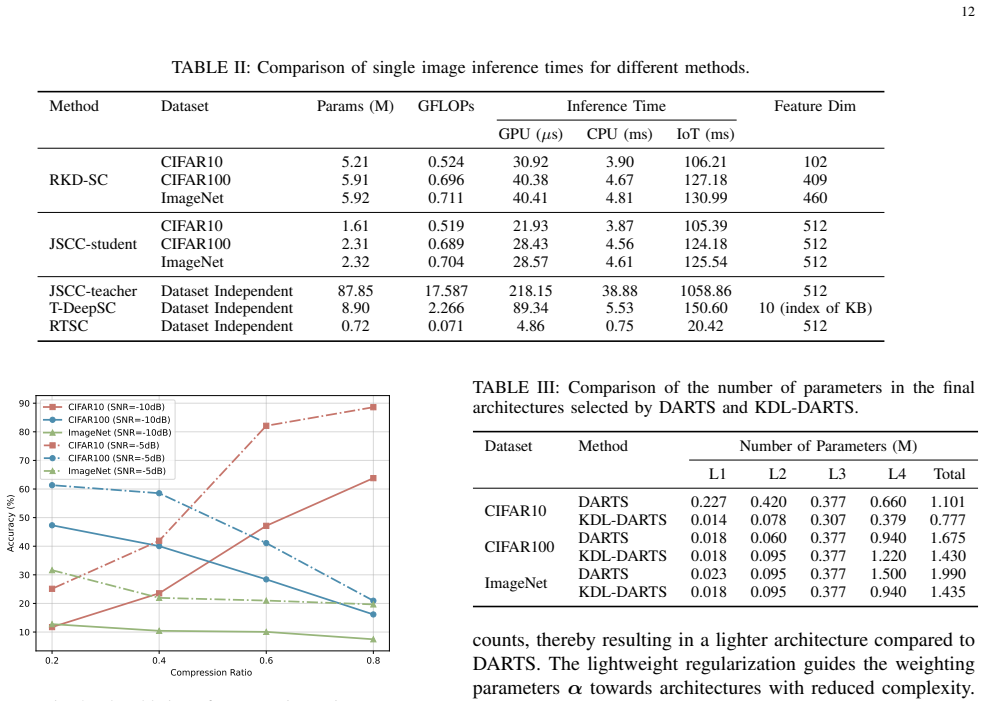
- On a Raspberry-Pi-class device, the RKD-SC encoder is estimated to encode an image in about 106–131 ms depending on dataset, versus about 1059 ms for the ViT teacher, keeping real-time feasibility.
- The framework lowers transmitted feature dimension from 512 to 102–460 across the three datasets, cutting bandwidth use while preserving accuracy.
- Because the student outperforms the teacher at low SNR, the paper implies that a distilled compact encoder plus CAT can be more noise-tolerant than the large model it was distilled from, not just lighter.
- The same search-then-distill pipeline is dataset-agnostic in design and was demonstrated on three classification benchmarks of different difficulty.
- KDL-DARTS with the complexity penalty selects shallower or narrower deep layers than plain DARTS, yielding 14.5%–29.4% fewer parameters while improving accuracy in the searched setting.
Reading between the lines
- If the low-SNR gain is robust across channels, then the practical recipe for LSM-based edge communication may be to deliberately distill into a feature space much smaller than the teacher's, because CAT's SNR conditioning appears more effective on compact features (CIFAR10's best result came at the highest compression ratio of 0.8).
- The same two-stage distillation could transfer to non-classification tasks such as retrieval or captioning, as long as a teacher feature space and a task loss are defined; the paper only shows image classification, so that extension is untested.
- The reported sensitivity of the compression ratio per dataset is worth exploring further: performance moves in opposite directions with compression ratio on CIFAR10 versus CIFAR100/ImageNet, hinting at an adaptive compression-ratio scheduler as a follow-up.
- The search space's restriction to Bottleneck-block counts means the 94% parameter reduction is a statement about that space; other lightweight blocks (e.g., inverted residuals or attention-only cells) might yield even smaller encoders or better accuracy-complexity trade-offs.
Editorial analysis
A structured set of objections, weighed in public.
Referee Report
Summary. This manuscript proposes RKD-SC, a semantic communication framework for image classification that combines a knowledge-distillation-aware differentiable architecture search (KDL-DARTS), a two-stage robust knowledge distillation procedure (RKD), and a channel-aware transformer (CAT) codec. The teacher is ViT-B/16; the student is a compact residual encoder found by KDL-DARTS. The paper reports that RKD-SC preserves roughly 93--96% of teacher accuracy at 25 dB across CIFAR10, CIFAR100, and Tiny-ImageNet while reducing parameters by about 93--94%, and that it outperforms the teacher at low SNR, e.g., by over 83% at -10 dB on CIFAR10. Experiments also compare against DARTS, T-DeepSC, RTSC, and two JSCC baselines under AWGN and Rayleigh channels.
Significance. If the central claims hold, the paper would provide a practical route to deploying large-scale-model semantic encoders on resource-constrained transmitters, which is a timely and relevant objective for 6G-oriented semantic communication. The strengths include a broad experimental evaluation across three datasets and two channel models, a clearly specified architecture search with an explicit complexity penalty, and a concrete report of parameter counts and inference times. The paper does not provide machine-checked proofs or released code, but the algorithmic descriptions are sufficiently detailed for replication. The main significance hinges on whether the robustness gains are attributable to the proposed RKD mechanism rather than to the CAT codec alone, and on whether the reported quantitative advantages are statistically reliable.
major comments (4)
- [IV-B and Eq. (26)] The central claim that the two-stage RKD algorithm transfers robustness is not isolated from the CAT codec. Stage two jointly trains encoder, CAT, and decoder with the combined loss in Eq. (26), which includes task loss and reconstruction loss under SNR 5-20 dB. The paper never compares RKD-SC to a control in which stage one is standard KD and stage two uses the same CAT but omits the noisy-feature KD term (or to a variant trained from scratch on task loss only). The compression-ratio ablation in Fig. 8 shows that the CAT module alone can move CIFAR10 accuracy at -10 dB from 11.73% to 63.80%, so the CAT is a dominant robustness mechanism. Without an ablation that removes or perturbs the RKD-specific loss terms while keeping CAT fixed, the paper's attribution of low-SNR robustness to 'robust knowledge distillation' is not established.
- [III-A and Table I] The search space of KDL-DARTS is restricted to the number of Bottleneck blocks k in {1,...,5} per layer, with fixed stem, channel widths, stride pattern, and attention-pooling head. Thus the claim of identifying 'optimal compact model architectures' in Eq. (8) and the abstract is conditional on this specific subspace. The comparison against DARTS within the same space is a valid algorithmic test, but the paper should temper the optimality language or extend the search space to include channel widths and operation types. Without this, the 93--94% parameter reduction relative to ViT-B/16 is a statement about this particular search space, not about compact encoders generally.
- [IV-B and Figs. 6-8] All reported accuracies and parameter counts appear to come from a single run or a single architecture selection; no error bars, seed counts, or significance tests are reported. Some claimed margins are modest, such as the 3.41% improvement over JSCC-student on CIFAR10 in Fig. 6(a). Without multiple independent runs, the reader cannot assess whether the differences are stable or due to initialization and search stochasticity. The authors should provide at least three seeds for the main comparisons and report mean and variance, or apply a paired significance test.
- [Table II and footnote 2] The claimed IoT inference times (e.g., 106.21 ms for CIFAR10) are obtained by linearly scaling CPU inference time by the ratio of peak GFLOPS (871.49/32) between the server CPU and a Raspberry Pi 4 B. Linear GFLOPS scaling is not a valid proxy for real inference latency, because memory bandwidth, cache behavior, SIMD support, and software stacks differ substantially. This makes the 'real-time inference capability' claim unsupported as stated. The authors should either measure latency on the actual IoT device or clearly label the numbers as rough order-of-magnitude estimates and remove the real-time claim.
minor comments (9)
- [Eq. (7)] There is a stray '=' at the end of the displayed equation after 'R(a_i^(k), θ_si) = η P(...) − ζ Ω(...) =', which should be removed.
- [Introduction, first paragraph] There are typographical errors such as 'A number of recen‘t works' and 'cliff effec' that should be corrected.
- [Eq. (13)] The notation 'α(l) ⊊ α' is inappropriate because α(l) is a vector component subset, not a proper subset of the scalar set α. The intended membership should be clarified, e.g., α(l) ∈ α or α(l) is the l-th row of α.
- [Eqs. (24) and (26)] LKD in Eq. (24) is defined as an average over the entire dataset, but Eq. (26) applies LKD to a single sample's noisy feature ~h_i. Please clarify that the per-sample loss is ℓKD as defined in Eq. (23), or redefine the notation consistently.
- [Eq. (27) and surrounding text] The constraint 's.t. D = Di' is unclear, and the text immediately after Eq. (27) repeats 'the i-th semantic encoder' twice. These should be cleaned up.
- [References] Reference [35] is cited as the origin of ViT, but it is the CLIP paper by Radford et al. The actual Vision Transformer paper (Dosovitskiy et al., 2021) should be cited for the ViT-B/16 architecture, or the citation should be corrected.
- [Fig. 6 and text] The dataset called 'ImageNet' in the text and figures is actually Tiny-ImageNet (a subset of ImageNet). The naming should be consistent to avoid confusion.
- [Table II] The 'Feature Dim' entry for T-DeepSC, '10 (index of KB)', is unclear; please explain what is meant or rephrase.
- [Section IV-A and Fig. 8] The compression ratios 0.8, 0.2, and 0.1 are stated for the three datasets, and Fig. 8 sweeps the ratio. However, no ablation shows how the final ratios were selected or how sensitive the conclusions are to the ratio choice; please provide a brief justification.
Circularity Check
No significant circularity: the reported RKD-SC gains are empirical outcomes measured by task accuracy, not quantities forced by the training losses or by self-citation.
full rationale
The paper's derivation chain is self-contained with respect to its central empirical claims. The distillation loss in Eq. (23) defines a training objective, but the headline numbers (95.86% teacher-performance preservation at 25 dB, 83.12% gain at -10 dB) are measured as task accuracy on test data against external baselines, not as the distillation loss itself. Stage two in Eq. (26) jointly optimizes KD, reconstruction, and task losses, so the low-SNR robustness results are an empirical property of the trained system, not an identity derived from the loss definition. KDL-DARTS does explicitly penalize parameter count through Eq. (17)-(19), so the reported parameter reduction is partly a designed objective; however, the paper also reports independent accuracy gains over DARTS and compares against JSCC-student, JSCC-teacher, T-DeepSC, and RTSC, which gives external falsifiability. The only self-citation is the footnote to the authors' GLOBECOM 2024 preliminary version, and it is a provenance note, not load-bearing evidence for any uniqueness, architecture choice, or fitted result. No fitted parameter is renamed as a prediction, no uniqueness theorem is imported from the authors' prior work, and no known result is repackaged as a derivation. The search-space limitation (fixed widths, depth-only choices) and the absence of an ablation that isolates RKD from CAT are legitimate experimental concerns, but they are not circularity: a missing control does not make the reported result equal to its input by construction.
Assumptions & free parameters
free parameters (5)
- lambda_J complexity regularization weight =
0.05
- Stage-two loss weights lambda_KD, lambda_RE, lambda_task =
not reported
- Per-dataset CAT compression ratio =
0.8 for CIFAR10, 0.2 for CIFAR100, 0.1 for ImageNet
- Training SNR range =
5 to 20 dB
- Architecture-selection temperatures T_alpha and T_beta =
1.0 and 2.0
assumptions (4)
- domain assumption Mean squared error between student features and ViT-B/16 teacher features is an adequate knowledge-transfer objective for image-classification semantics.
- ad hoc to paper The optimal compact encoder lies in the restricted search space that varies only the number of residual blocks per stage.
- domain assumption The physical channel is accurately modeled by a scalar gain H with AWGN, and the receiver knows the SNR for conditioning.
- ad hoc to paper IoT inference time can be estimated by linearly scaling CPU inference time by the ratio of peak GFLOPS.
invented entities (1)
-
Channel-Aware Transformer (CAT) block
Cite this review
Pith. "Pith review of Large-Scale Model Enabled Semantic Communication Based on Robust Knowledge Distillation." pith.science (2026). https://pith.science/paper/FGEFJTZ7
@misc{pith2026250802148,
  author       = {Pith},
  title        = {Pith review of: Large-Scale Model Enabled Semantic Communication Based on Robust Knowledge Distillation},
  year         = {2026},
  howpublished = {\url{https://pith.science/paper/FGEFJTZ7}},
  note         = {Machine review of arXiv:2508.02148}
}
read the original abstract
Large-scale models (LSMs) can be an effective framework for semantic representation and understanding, thereby providing a suitable tool for designing semantic communication (SC) systems. However, their direct deployment is often hindered by high computational complexity and resource requirements. In this paper, a novel robust knowledge distillation based semantic communication (RKD-SC) framework is proposed to enable efficient and \textcolor{black}{channel-noise-robust} LSM-powered SC. The framework addresses two key challenges: determining optimal compact model architectures and effectively transferring knowledge while maintaining robustness against channel noise. First, a knowledge distillation-based lightweight differentiable architecture search (KDL-DARTS) algorithm is proposed. This algorithm integrates knowledge distillation loss and a complexity penalty into the neural architecture search process to identify high-performance, lightweight semantic encoder architectures. Second, a novel two-stage robust knowledge distillation (RKD) algorithm is developed to transfer semantic capabilities from an LSM (teacher) to a compact encoder (student) and subsequently enhance system robustness. To further improve resilience to channel impairments, a channel-aware transformer (CAT) block is introduced as the channel codec, trained under diverse channel conditions with variable-length outputs. Extensive simulations on image classification tasks demonstrate that the RKD-SC framework significantly reduces model parameters while preserving a high degree of the teacher model's performance and exhibiting superior robustness compared to existing methods.
Figures


Figures from the paper (5 more)


Reference graph
Works this paper leans on
-
[1]
A unified multi- task semantic communication system for multimodal data,
G. Zhang, Q. Hu, Z. Qin, Y . Cai, G. Yu, and X. Tao, “A unified multi- task semantic communication system for multimodal data,” IEEE Trans. Commun., vol. 72, no. 7, pp. 4101–4116, July. 2024
work page 2024
-
[2]
Artificial general intelligence (agi)-native wireless systems: A journey beyond 6g,
W. Saad, O. Hashash, C. K. Thomas, C. Chaccour, M. Debbah, N. Man- dayam, and Z. Han, “Artificial general intelligence (agi)-native wireless systems: A journey beyond 6g,” Proc. IEEE, pp. 1–39, March. 2025
work page 2025
-
[3]
Adaptive information bottleneck guided joint source and channel coding for image transmission,
L. Sun, Y . Yang, M. Chen, C. Guo, W. Saad, and H. V . Poor, “Adaptive information bottleneck guided joint source and channel coding for image transmission,” IEEE J. Sel. Areas Commun. , vol. 41, no. 8, pp. 2628– 2644, August. 2023
work page 2023
-
[4]
Ofdm-based digital semantic communication with importance awareness,
C. Liu, C. Guo, Y . Yang, W. Ni, and T. Q. S. Quek, “Ofdm-based digital semantic communication with importance awareness,” IEEE Trans. Commun., vol. 72, no. 10, pp. 6301–6315, October. 2024
work page 2024
-
[5]
Less data, more knowledge: Building next-generation semantic communica- tion networks,
C. Chaccour, W. Saad, M. Debbah, Z. Han, and H. Vincent Poor, “Less data, more knowledge: Building next-generation semantic communica- tion networks,” IEEE Commun. Surveys Tuts , vol. 27, no. 1, pp. 37–76, June. 2025
work page 2025
-
[6]
C. Shannon and W. Weaver, The Mathematical Theory of Communica- tion. University of Illinois Press, 1949
work page 1949
-
[7]
Deep joint source- channel coding for wireless image transmission,
E. Bourtsoulatze, D. B. Kurka, and D. Gündüz, “Deep joint source- channel coding for wireless image transmission,” in ICASSP 2019 - 2019 IEEE International Conference on Acoustics, Speech and Signal Processing (ICASSP), May. 2019, pp. 4774–4778
work page 2019
-
[8]
Scaling laws for neural language models,
J. Kaplan, S. McCandlish, T. Henighan, T. B. Brown, B. Chess, R. Child, S. Gray, A. Radford, J. Wu, and D. Amodei, “Scaling laws for neural language models,” arXiv preprint arXiv:2001.08361 , January. 2020
arXiv 2001
Show all 36 references
-
[9]
Toward intelligent communications: Large model empowered semantic communications,
H. Xie, Z. Qin, X. Tao, and Z. Han, “Toward intelligent communications: Large model empowered semantic communications,” IEEE Communica- tions Magazine , vol. 63, no. 1, pp. 69–75, January. 2025
2025
-
[10]
Large-scale ai in telecom: Charting the roadmap for innovation, scalability, and enhanced digital experiences,
A. Shahid, A. Kliks, A. Al-Tahmeesschi, and et. al, “Large-scale ai in telecom: Charting the roadmap for innovation, scalability, and enhanced digital experiences,” March. 2025. [Online]. Available: arXivpreprintarXiv:2503.04184
2025 arXiv
-
[11]
A survey of large language models,
W. X. Zhao, K. Zhou, J. Li, T. Tang, X. Wang, Y . Hou, Y . Min, B. Zhang, J. Zhang, Z. Dong et al. , “A survey of large language models,” arXiv preprint arXiv:2303.18223, March. 2023
2023 arXiv
-
[12]
Deepseek-r1: Incentivizing reasoning capability in llms via reinforcement learning,
DeepSeek-AI, “Deepseek-r1: Incentivizing reasoning capability in llms via reinforcement learning,” arXiv preprint arXiv:2501.12948 , January. 2025
2025 arXiv
-
[13]
(2025, February.) Grok 3 beta — the age of reasoning agents
xAI. (2025, February.) Grok 3 beta — the age of reasoning agents. [Online]. Available: https://x.ai/blog/grok-3
2025
-
[14]
(2025, January.) Openai o3-mini
OpenAI. (2025, January.) Openai o3-mini. [Online]. Available: https://openai.com/index/openai-o3-mini/
2025
-
[15]
Deep learning for joint source- channel coding of text,
N. Farsad, M. Rao, and A. Goldsmith, “Deep learning for joint source- channel coding of text,” arXiv preprint arXiv:1802.06832 , February. 2018
2018 arXiv
-
[16]
Deep joint source- channel coding for wireless image transmission,
E. Bourtsoulatze, D. Burth Kurka, and D. Gündüz, “Deep joint source- channel coding for wireless image transmission,” IEEE Trans. Cogn. Commun. Netw., vol. 5, no. 3, pp. 567–579, September. 2019
2019
-
[17]
Joint source-channel coding for channel-adaptive digital semantic communications,
J. Park, Y . Oh, S. Kim, and Y .-S. Jeon, “Joint source-channel coding for channel-adaptive digital semantic communications,” IEEE Trans. Cogn. Commun. Netw., vol. 11, no. 1, pp. 75–89, February. 2025
2025
-
[18]
Deep learning enabled semantic communication systems,
H. Xie, Z. Qin, G. Y . Li, and B.-H. Juang, “Deep learning enabled semantic communication systems,” IEEE transactions on signal pro- cessing, vol. 69, pp. 2663–2675, April. 2021
2021
-
[19]
Semantic communication systems for speech transmission,
Z. Weng and Z. Qin, “Semantic communication systems for speech transmission,” IEEE J. Sel. Areas Commun. , vol. 39, no. 8, pp. 2434– 2444, August. 2021
2021
-
[20]
Task-oriented multi-user semantic communications,
H. Xie, Z. Qin, X. Tao, and K. B. Letaief, “Task-oriented multi-user semantic communications,” IEEE J. Sel. Areas Commun. , vol. 40, no. 9, pp. 2584–2597, 2022
2022
-
[21]
Explainable semantic communication for text tasks,
C. Liu, C. Guo, Y . Yang, W. Ni, Y . Zhou, L. Li, and T. Q. S. Quek, “Explainable semantic communication for text tasks,” IEEE Internet Things J., vol. 11, no. 24, pp. 39 820–39 833, December. 2024
2024
-
[22]
Generative ai driven task-oriented adaptive semantic communications,
Y . Fu, W. Cheng, J. Wang, L. Yin, and W. Zhang, “Generative ai driven task-oriented adaptive semantic communications,” arXiv preprint arXiv:2407.11354, July. 2024
2024 arXiv
-
[23]
Large language model enabled semantic communication systems,
Z. Wang, L. Zou, S. Wei, F. Liao, J. Zhuo, H. Mi, and R. Lai, “Large language model enabled semantic communication systems,” arXiv preprint arXiv:2407.14112 , July 2024
2024 arXiv
-
[24]
Large language model-based seman- tic communication system for image transmission,
S. Ribouh and O. Saleem, “Large language model-based seman- tic communication system for image transmission,” arXiv preprint arXiv:2501.12988, January. 2025
2025 arXiv
-
[25]
Semantic importance- aware communications with semantic correction using large language models,
S. Guo, Y . Wang, J. Ye, A. Zhang, and K. Xu, “Semantic importance- aware communications with semantic correction using large language models,” arXiv preprint arXiv:2405.16011 , May. 2024
2024 arXiv
-
[26]
Rethinking generative semantic communication for multi-user systems with large language models,
W. Yang, Z. Xiong, S. Mao, T. Q. S. Quek, P. Zhang, M. Deb- bah, and R. Tafazolli, “Rethinking generative semantic communication for multi-user systems with large language models,” arXiv preprint arXiv:2408.08765, August. 2024
2024 arXiv
-
[27]
Scene understanding enabled semantic communication with open channel coding,
Z. Xiang, F. Yu, Q. Deng, Y . Li, and Z. Wan, “Scene understanding enabled semantic communication with open channel coding,” arXiv preprint arXiv:2501.14520, January. 2025
2025 arXiv
-
[28]
Distilling the knowledge in a neural network,
G. Hinton, O. Vinyals, and J. Dean, “Distilling the knowledge in a neural network,” arXiv preprint arXiv:1503.02531 , March. 2015
2015 arXiv
-
[29]
Large scale model en- abled semantic communications based on robust knowledge distillation,
K. Ding, F. Liu, Y . Yang, M. Chen, and C. Guo, “Large scale model en- abled semantic communications based on robust knowledge distillation,” in GLOBECOM 2024 - 2024 IEEE Global Communications Conference , December. 2024, pp. 5235–5240
2024
-
[30]
Darts: Differentiable architecture search,
H. Liu, K. Simonyan, and Y . Yang, “Darts: Differentiable architecture search,” arXiv preprint arXiv:1806.09055 , June. 2018
2018 arXiv
-
[31]
Attention is all you need,
A. Vaswani, N. Shazeer, N. Parmar, J. Uszkoreit, L. Jones, A. N. Gomez, L. Kaiser, and I. Polosukhin, “Attention is all you need,” arXiv preprint arXiv:1706.03762, June. 2017
2017 arXiv
-
[32]
Learning multiple layers of features from tiny images,
A. Krizhevsky, G. Hinton et al. , “Learning multiple layers of features from tiny images,” University of Toronto Tech. Rep , vol. 1, January. 2009
2009
-
[33]
Imagenet: A large-scale hierarchical image database,
J. Deng, W. Dong, R. Socher, L.-J. Li, K. Li, and L. Fei-Fei, “Imagenet: A large-scale hierarchical image database,” in 2009 IEEE Conference on Computer Vision and Pattern Recognition , 2009, pp. 248–255
2009
-
[34]
Deep residual learning for image recognition,
K. He, X. Zhang, S. Ren, and J. Sun, “Deep residual learning for image recognition,” in Proceedings of the IEEE conference on computer vision and pattern recognition , June. 2016, pp. 770–778
2016
-
[35]
Learning transferable visual models from natural language supervi- sion,
A. Radford, J. W. Kim, C. Hallacy, A. Ramesh, G. Goh, S. Agarwal, G. Sastry, A. Askell, P. Mishkin, J. Clark, G. Krueger, and I. Sutskever, “Learning transferable visual models from natural language supervi- sion,” arXiv preprint arXiv:2103.00020 , March. 2021
2021 arXiv
-
[36]
Demo: Real- time semantic communications with a vision transformer,
H. Yoo, T. Jung, L. Dai, S. Kim, and C.-B. Chae, “Demo: Real- time semantic communications with a vision transformer,” in 2022 IEEE International Conference on Communications Workshops (ICC Workshops), May. 2022, pp. 1–2
2022
Reviewed August 6, 2026 · model on record in the stance chip above.
Discussion (0). Continue with ORCID to comment.