REVIEW 4 major objections 5 minor 67 references
Talking Surveys: How Photorealistic Embodied Conversational Agents Shape Response Quality, Engagement, and Satisfaction
T0 review · 4 major / 5 minor · reviewed 2026-08-06 · deepseek-v4-flash
Pith's one-line read Talking to a photorealistic avatar yields longer, more informative survey answers than typing to a chatbot, in less speaking time.
desk verdict A solid, transparent proof-of-concept showing people talk more and faster to a speech avatar than a text chatbot, but the informativeness claim is confounded with speaking-versus-typing and the abstract oversells it. read the letter →
The pith
A machine-rendered reading of the paper's core claim, the machinery that carries it, and where it could break.
The reading
What carries the argument
The central object is the Virtual Agent Interviewer (VAI), a prototype survey tool that embeds a conversational agent into the survey flow. In the embodied condition the agent is a photorealistic animated video avatar that speaks; in the text condition the same conversation logic runs as a typed chatbot, so the design isolates the addition of embodiment plus speech against the chatbot baseline. The response-quality machinery is a set of measures adapted from conversational-survey research: informativeness as summed word surprisal, that is, the inverse frequency of the response's words, from the wordfreq database, plus human- and LLM-coded specificity, relevance, clarity, self-disclosure, and sentiment. The argument turns on comparing these measures across the two conditions together with temporal engagement metrics such as responding time and transition time.
What would settle it
Have the same participants answer the same open-ended questions under three conditions—typing to a chatbot, speaking to a voice-only agent, and speaking to the animated avatar—and compare word-surprisal informativeness and word counts; if voice-only speech matches the avatar, the central effect is driven by speech rather than embodiment, and the paper's claim would need to be narrowed.
Extended reading notes
Core claim
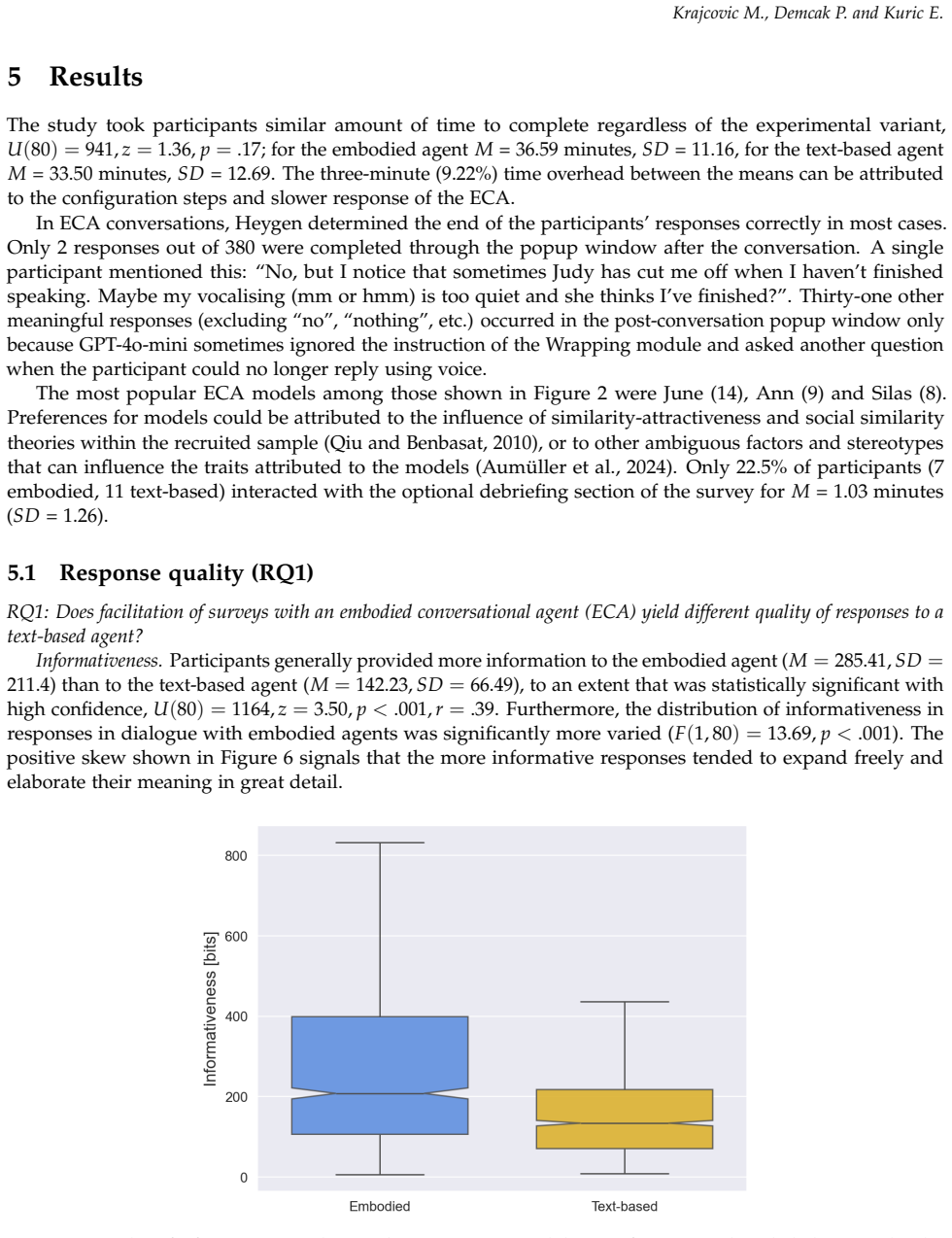
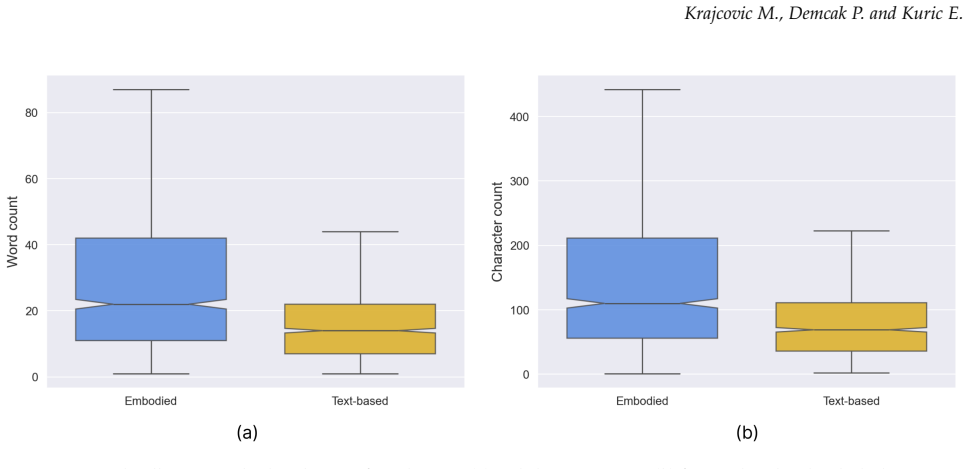
The paper's central claim is that embodied conversational agents can improve the quality and engagement of survey responses without lowering satisfaction. In a between-subjects experiment that held conversation logic constant, participants who spoke to an animated video avatar produced more informative responses ($M=285.41$ vs $M=142.23$, $U(80)=1164$, $z=3.50$, $p<.001$, $r=.39$), used more words ($M=29.32$ vs $M=14.3$, $U(80)=1171$, $z=3.57$, $p<.001$, $r=.40$), and spent less time speaking (responding time $U(80)=531$, $z=2.59$, $p=.010$, $r=.29$) than participants who typed to a text-based chatbot. The authors interpret the steeper time-informativeness slope for the avatar as evidence that speaking to a humanlike agent is a more efficient communication channel, not merely a longer one. They note that spoken answers scored lower on clarity ($r=.63$) and relevance ($r=.26$), which they attribute to the spontaneous, unedited character of speech rather than to worse content. Satisfaction differences were not statistically significant, and the paper presents this as a favorable baseline for embodied agents given the prototype's technical limitations.
Load-bearing premise
The load-bearing premise is that word-surprisal—a count of how rare a word is in English—measures informativeness equally for speech and for typing; if people naturally use rarer words when speaking, the avatar's informativeness advantage could be an artifact of comparing two different communication channels.
Editorial extensions
If this is right
- Unmoderated survey tools could collect more detailed qualitative data from open-ended questions without asking participants to spend more time producing each answer.
- Because the time-informativeness slope was steeper for the avatar, speaking to an embodied agent appears to transmit more information per second than typing to a chatbot.
- Satisfaction being statistically unchanged suggests that adding a photorealistic face to a survey agent does not carry an inherent satisfaction penalty, though preference data show about half of embodied-condition participants would still switch to text.
- The larger and significant effects in the personality survey compared with the marginal effects in the cognitive-failures survey imply that the benefit of embodied agents may depend on question breadth and sensitivity.
- Lower clarity and relevance in spoken responses mean embodied-agent transcripts may require more preprocessing or a visible question prompt to keep answers on target.
Reading between the lines
- A sharper test of embodiment itself would compare the avatar against a voice-only agent with no face; the reported design cannot separate the effect of speech modality from the effect of a humanlike body and face.
- The word-surprisal measure may overstate the informativeness advantage if natural speech systematically draws on rarer vocabulary for the same underlying content; re-analyzing with frequency-matched or lemmatized transcripts would check this.
- If the pattern replicates, a practical design rule follows: reserve embodied agents for broad, identity-relevant open-ended questions and expect smaller gains for narrowly factual or more sensitive items.
- A direct extension would test whether telling participants that a human moderator is watching the avatar changes response length, separating perceived accountability from the visual design itself.
Signed reviews
Editorial analysis
A structured set of objections, weighed in public.
Referee Report
Summary. The paper presents the Virtual Agent Interviewer (VAI), a survey instrument that embeds a photorealistic embodied conversational agent (ECA) with voice interaction, and compares it against a text-based chatbot in a between-subjects experiment with 80 UK participants across two psychometric surveys (BFI-2-S and CFQ). The authors report that the embodied agent produces significantly higher word counts and informativeness, shorter participant responding time, and no difference in satisfaction, and they interpret these results as evidence that ECAs can improve response quality and engagement. The paper includes a mixed-methods analysis with qualitative feedback, and it makes the instrument, code, and data publicly available. The central claim, however, is that embodiment itself drives the improvement, whereas the experimental design bundles voice input, a video avatar, and turn-taking into one condition that is compared to a typing-only chatbot.
Significance. If the causal interpretation were supported, this would be a useful proof-of-concept for bringing ECA-mediated moderation to online surveys, with practical implications for reducing satisficing and improving open-ended response quality. The paper is transparent about many null results and limitations, and the open repository and the detailed description of the instrument are commendable. However, the study's headline inference is not currently supported because the 'informativeness' measure is confounded with response length and with the speech-versus-text channel, and the effect is not robust across the two surveys. These issues reduce the significance of the current findings, although the methodological contribution may still be useful to the community.
major comments (4)
- [§4.6, §5.1, §5.2] The 'informativeness' measure is defined as the sum of per-word surprisal from wordfreq (§4.6). This sum scales with word count, and §5.2 reports that embodied-agent responses contain roughly twice as many words (M=29.32 vs 14.3, r=.40). Consequently, the reported informativeness advantage (r=.39) could simply reflect that participants produce more words when speaking than when typing; it does not establish that the same underlying content is more informative. The paper's own results show that the two channels differ: embodied responses were less clear (r=.63) and slightly less relevant (r=.26), consistent with a speaking-versus-typing channel effect. The authors should re-analyze the data using an information-density measure (e.g., per-word surprisal, or surprisal per 100 characters), or control for word count as a covariate, before claiming an informativeness advantage. A concrete test would be to compare the embodied condition with a voice-only condition that does not have a visible avatar.
- [§5.4] The headline effects on informativeness and word count are not robust across the two surveys: within CFQ, the comparisons are non-significant (informativeness p=.081, word count p=.067), while only BFI-2-S shows significant effects (r=.47). This pattern suggests that the overall significant result may be driven by only one of the two questionnaires, and it limits the abstract's generalization that embodied agents 'contribute significantly to more informative, detailed responses' across surveys. The authors should report a formal survey-by-condition interaction test, and should temper the abstract and conclusions accordingly.
- [§3.1, §4.4] The embodiment manipulation is compounded with response modality: the embodied condition uses voice input plus a video avatar, while the baseline uses typed text input. Thus even the robust word-count difference can be explained by 'people speak more than they type' rather than by the embodied conversational agent per se. The paper partly acknowledges this in the clarity discussion, but it does not treat the modality confound as a threat to the central 'embodiment improves quality' claim. A comparison with an additional condition (e.g., a voice-only non-visual agent, or a text-input condition with an avatar) would be necessary to isolate the contribution of embodiment.
- [§5.1, §5.2, §6.2] The authors report a large number of statistical tests without any correction for multiple comparisons, and the stated RQ framework includes four research questions with several measures each. While the strongest effects (p<.001) would likely survive conservative correction, the overall familywise error rate is not addressed. Reporting corrected p-values or a pre-specified analysis plan would strengthen the reliability of the secondary findings such as self-disclosure and the survey-specific results.
minor comments (5)
- [Abstract] The sentence 'using on AI-driven video generation' contains a grammatical error; it should be 'using AI-driven video generation.'
- [§5.2] The sentence 'Text-based variants' answers tend to be longer' under Figure 9 contradicts the surrounding text, which states that the embodied agent produced significantly more words; this should be corrected to 'Embodied variants' answers tend to be longer.'
- [§2.2] The word 'Colloquilally' is a typo for 'Colloquially.'
- [§4.6] The data-labeling procedure uses GPT-4.1 with majority voting, and the authors report high correlations with manual labels; however, they do not state whether the manual reviewers were blind to the experimental condition, which would be relevant given the large clarity differences between conditions.
- [§5.3] In Table 1 and the surrounding text, there are occasional spacing anomalies (e.g., 'T able' at the top of Table 1); these should be cleaned up for publication.
Circularity Check
No significant circularity: the response-quality measures come from external sources and the central comparison is an empirical contrast, not a fitted or self-referential prediction.
full rationale
The paper's central claim is an empirical between-subjects contrast (embodied agent vs. text chatbot); no parameter is fitted to the outcome and then renamed a prediction. Informativeness is imported from Xiao et al. (2020) and operationalized with the external wordfreq surprisal values (Section 4.6), not derived from the experimental result. The LLM-based coding of specificity, relevance, clarity, self-disclosure and sentiment uses an external model with reported human-correlation checks; it is not trained on the experimental contrast. The few self-citations (Kuric et al., 2024, 2025a, 2025b; Krajcovic et al., 2025) appear in background, motivation and future-work contexts, and none supplies the load-bearing statistical claim. The concern that summed surprisal partly tracks word count across speaking versus typing is a construct-validity or channel-confound issue, not circularity: the measure is not defined in terms of the experimental outcome, and the paper does not fit the measure to the data.
Assumptions & free parameters
free parameters (3)
- Follow-up question selection =
10 of 30 BFI-2-S items; 9 of 25 CFQ items
- Conversation length caps =
3 back-and-forths (Inquiry), 10 (Discussion)
- LLM labeling temperature =
0.2
assumptions (4)
- domain assumption Gricean maxims-based measures (informativeness, specificity, relevance, clarity) capture response quality
- domain assumption wordfreq word-frequency data provides a modality-invariant surprisal baseline
- domain assumption GPT-4.1 majority-vote labels with 3.6% manual correction are accurate
- domain assumption The two questionnaires differ mainly in question breadth and sensitivity, explaining the RQ4 differences
Cite this review
Pith. "Pith review of Talking Surveys: How Photorealistic Embodied Conversational Agents Shape Response Quality, Engagement, and Satisfaction." pith.science (2026). https://pith.science/paper/VZMPDWXR
@misc{pith2026250802376,
  author       = {Pith},
  title        = {Pith review of: Talking Surveys: How Photorealistic Embodied Conversational Agents Shape Response Quality, Engagement, and Satisfaction},
  year         = {2026},
  howpublished = {\url{https://pith.science/paper/VZMPDWXR}},
  note         = {Machine review of arXiv:2508.02376}
}
read the original abstract
Embodied conversational agents (ECAs) are increasingly more realistic and capable of dynamic conversations. In online surveys, anthropomorphic agents could help address issues like careless responding and satisficing, which originate from the lack of personal engagement and perceived accountability. However, there is a lack of understanding of how ECAs in user experience research may affect participant engagement, satisfaction, and the quality of responses. As a proof of concept, we propose an instrument that enables the incorporation of conversations with a virtual avatar into surveys, using on AI-driven video generation, speech recognition, and Large Language Models. In our between-subjects study, 80 participants (UK, stratified random sample of general population) either talked to a voice-based agent with an animated video avatar, or interacted with a chatbot. Across surveys based on two self-reported psychometric tests, 2,265 conversation responses were obtained. Statistical comparison of results indicates that embodied agents can contribute significantly to more informative, detailed responses, as well as higher yet more time-efficient engagement. Furthermore, qualitative analysis provides valuable insights for causes of no significant change to satisfaction, linked to personal preferences, turn-taking delays and Uncanny Valley reactions. These findings support the pursuit and development of new methods toward human-like agents for the transformation of online surveys into more natural interactions resembling in-person interviews.
Figures


Figures from the paper (8 more)






Reference graph
Works this paper leans on
-
[1]
Applying stepped task in remote unmoderated test: A case report
Shushu He. Applying stepped task in remote unmoderated test: A case report. In Constantine Stephanidis, Margherita Antona, and Stavroula Ntoa, editors, HCI International 2021 - Posters, pages 33--40, Cham, 2021. Springer International Publishing. ISBN 978-3-030-78635-9
work page 2021
-
[2]
Steven Schirra, Sasha G Volkov, Shraddhaa Narasimha, and Frank Bentley. Prototypes, platforms and protocols: Identifying common issues with remote, unmoderated studies and their impact on research participants. In Extended Abstracts of the 2023 CHI Conference on Human Factors in Computing Systems, CHI EA '23, pages 1--6, New York, NY, USA, 2023. Associati...
arXiv 2023
-
[3]
M.K. Ward and Adam W. Meade. Applying social psychology to prevent careless responding during online surveys. Applied Psychology, 67 0 (2): 0 231--263, 2018. doi:https://doi.org/10.1111/apps.12118. URL https://iaap-journals.onlinelibrary.wiley.com/doi/abs/10.1111/apps.12118
-
[4]
Soomin Kim, Joonhwan Lee, and Gahgene Gweon. Comparing data from chatbot and web surveys: Effects of platform and conversational style on survey response quality. In Proceedings of the 2019 CHI Conference on Human Factors in Computing Systems, CHI '19, page 1–12, New York, NY, USA, 2019. Association for Computing Machinery. ISBN 9781450359702. doi:10.1145...
arXiv 2019
-
[5]
Pedram Khayyatkhoshnevis, Savanah Tillberg, Eric Latimer, Tim Aubry, Andrew Fisher, and Vijay Mago. Comparison of moderated and unmoderated remote usability sessions for web-based simulation software: A randomized controlled trial. In Masaaki Kurosu, editor, Human-Computer Interaction. Theoretical Approaches and Design Methods, pages 232--251, Cham, 2022....
work page 2022
-
[6]
Embodied conversational agents in clinical psychology: a scoping review
Simon Provoost, Ho Ming Lau, Jeroen Ruwaard, and Heleen Riper. Embodied conversational agents in clinical psychology: a scoping review. Journal of medical Internet research, 19 0 (5): 0 e151, 2017. URL https://doi.org/10.2196/jmir.6553
-
[7]
Ai-mediated communication: Definition, research agenda, and ethical considerations
Jeffrey T Hancock, Mor Naaman, and Karen Levy. Ai-mediated communication: Definition, research agenda, and ethical considerations. Journal of Computer-Mediated Communication, 25 0 (1): 0 89--100, 01 2020. ISSN 1083-6101. doi:10.1093/jcmc/zmz022. URL https://doi.org/10.1093/jcmc/zmz022
-
[8]
Sue Lim, Ralf Schmälzle, and Gary Bente. Artificial social influence via human-embodied ai agent interaction in immersive virtual reality (vr): Effects of similarity-matching during health conversations. Computers in Human Behavior: Artificial Humans, 5: 0 100172, 2025. ISSN 2949-8821. doi:10.1016/j.chbah.2025.100172. URL https://doi.org/10.1016/j.chbah.2...
arXiv 2025
Show all 67 references
-
[9]
Embodied conversational agents in extended reality: A systematic review
Fu-Chia Yang, Pedro Acevedo, Siqi Guo, Minsoo Choi, and Christos Mousas. Embodied conversational agents in extended reality: A systematic review. IEEE Access, 13: 0 79805--79824, 2025. doi:10.1109/ACCESS.2025.3566698
2025
-
[10]
Image-to-video generation via 3d facial dynamics
Xiaoguang Tu, Yingtian Zou, Jian Zhao, Wenjie Ai, Jian Dong, Yuan Yao, Zhikang Wang, Guodong Guo, Zhifeng Li, Wei Liu, and Jiashi Feng. Image-to-video generation via 3d facial dynamics. IEEE Transactions on Circuits and Systems for Video Technology, 32 0 (4): 0 1805--1819, 202...
2022
-
[11]
Effects of a computer's human likeness on disclosure in psychosocial assessments: A randomised trial
Tingting Zhu and Elizabeth Broadbent. Effects of a computer's human likeness on disclosure in psychosocial assessments: A randomised trial. Computers in Human Behavior, 169: 0 108683, 2025. ISSN 0747-5632. doi:https://doi.org/10.1016/j.chb.2025.108683. URL https://www.scienced...
2025
-
[12]
Ziang Xiao, Michelle X. Zhou, Q. Vera Liao, Gloria Mark, Changyan Chi, Wenxi Chen, and Huahai Yang. Tell me about yourself: Using an ai-powered chatbot to conduct conversational surveys with open-ended questions. In ACM Transactions on Computer-Human Interaction (TOCHI), volum...
2020 doi
-
[13]
Democratizing eye-tracking? appearance-based gaze estimation with improved attention branch
Eduard Kuric, Peter Demcak, Jozef Majzel, and Giang Nguyen. Democratizing eye-tracking? appearance-based gaze estimation with improved attention branch. Engineering Applications of Artificial Intelligence, 149: 0 110494, 2025 a . ISSN 0952-1976. doi:10.1016/j.engappai.2025.110494
2025
-
[14]
User Experience and User Experience Design, chapter 2, pages 11--28
Monica Bordegoni, Marina Carulli, and Elena Spadoni. User Experience and User Experience Design, chapter 2, pages 11--28. Springer Nature Switzerland, Cham, 2023. ISBN 978-3-031-39683-0. doi:10.1007/978-3-031-39683-0\_2. URL https://doi.org/10.1007/978-3-031-39683-0\_2
2023 doi
-
[15]
De Bleecker and R
I. De Bleecker and R. Okoroji. Remote Usability Testing: Actionable insights in user behavior across geographies and time zones. Packt Publishing, 2018. ISBN 9781788990639. URL https://books.google.sk/books?id=YbZqDwAAQBAJ
2018
-
[16]
What do usability test moderators say? 'mm hm', 'uh-huh', and beyond
Morten Hertzum and Kristina Bonde Kristoffersen. What do usability test moderators say? 'mm hm', 'uh-huh', and beyond. In Proceedings of the 10th Nordic Conference on Human-Computer Interaction, NordiCHI '18, page 364–375, New York, NY, USA, 2018. Association for Computing Mac...
2018
-
[17]
Krista D. Kleban. Adapting ux research for people living with alzheimer's, dementia, and mci: Improving the ux research process for participants. In Proceedings of the 26th International ACM SIGACCESS Conference on Computers and Accessibility, ASSETS '24, pages 1--6, New York,...
2024
-
[18]
Bias, Matthew Lease, and Rebecca Kuipers
Di Liu, Randolph G. Bias, Matthew Lease, and Rebecca Kuipers. Crowdsourcing for usability testing. Proceedings of the American Society for Information Science and Technology, 49 0 (1): 0 1--10, 2012. doi:https://doi.org/10.1002/meet.14504901100. URL https://asistdl.onlinelibra...
2012 doi
-
[19]
Chi, and Bongwon Suh
Aniket Kittur, Ed H. Chi, and Bongwon Suh. Crowdsourcing user studies with mechanical turk. In Proceedings of the SIGCHI Conference on Human Factors in Computing Systems, CHI '08, page 453–456, New York, NY, USA, 2008. Association for Computing Machinery. ISBN 9781605580111. d...
2008
-
[20]
Web-based versus traditional paper questionnaires: A mixed-mode survey with a nordic perspective
Lena Hohw \"u , Heidi Lyshol, Mika Gissler, Stefan Hrafn Jonsson, Max Petzold, and Carsten Obel. Web-based versus traditional paper questionnaires: A mixed-mode survey with a nordic perspective. J Med Internet Res, 15 0 (8): 0 e173, Aug 2013. ISSN 14388871. doi:10.2196/jmir.25...
2013 doi
-
[21]
Do print and web surveys provide the same results? Computers in Human Behavior, 22 0 (3): 0 334--350, 2006
Hsiu-Mei Huang. Do print and web surveys provide the same results? Computers in Human Behavior, 22 0 (3): 0 334--350, 2006. ISSN 0747-5632. doi:https://doi.org/10.1016/j.chb.2004.09.012. URL https://www.sciencedirect.com/science/article/pii/S0747563204001232
2006 doi
-
[22]
Kristoffersen
Morten Hertzum, Pia Borlund, and Kristina B. Kristoffersen. What do thinking-aloud participants say? a comparison of moderated and unmoderated usability sessions. International Journal of Human–Computer Interaction, 31 0 (9): 0 557--570, 2015. doi:10.1080/10447318.2015.1065691...
2015
-
[23]
What you get is what you see: revisiting the evaluator effect in usability tests
Morten Hertzum, Rolf Molich, and Niels Ebbe Jacobsen. What you get is what you see: revisiting the evaluator effect in usability tests. Behaviour & Information Technology, 33 0 (2): 0 144--162, 2014. doi:10.1080/0144929X.2013.783114. URL https://doi.org/10.1080/0144929X.2013.783114
2014
-
[24]
Ward, Adam W
M.K. Ward, Adam W. Meade, Christopher M. Allred, Gabriel Pappalardo, and J. William Stoughton. Careless response and attrition as sources of bias in online survey assessments of personality traits and performance. Computers in Human Behavior, 76: 0 417--430, 2017. ISSN 0747-56...
2017 doi
-
[25]
Introduction to Chatbots, chapter 1, pages 1--11
Rashid Khan and Anik Das. Introduction to Chatbots, chapter 1, pages 1--11. Apress, Berkeley, CA, 2018. ISBN 978-1-4842-3111-1. doi:10.1007/978-1-4842-3111-1\_1. URL https://doi.org/10.1007/978-1-4842-3111-1\_1
2018 doi
-
[26]
Castro, Oscar Dieste, and Silvia T
Ranci Ren, Mireya Zapata, John W. Castro, Oscar Dieste, and Silvia T. Acuña. Experimentation for chatbot usability evaluation: A secondary study. IEEE Access, 10: 0 12430--12464, 2022. doi:10.1109/ACCESS.2022.3145323
2022
-
[27]
Clarifying the dialogue-level performance of gpt-3.5 and gpt-4 in task-oriented and non-task-oriented dialogue systems
Shinya Iizuka, Shota Mochizuki, Atsumoto Ohashi, Sanae Yamashita, Ao Guo, and Ryuichiro Higashinaka. Clarifying the dialogue-level performance of gpt-3.5 and gpt-4 in task-oriented and non-task-oriented dialogue systems. Proceedings of the AAAI Symposium Series, 2 0 (1): 0 182...
2024 doi
-
[28]
Emotionally intelligent chatbots: A systematic literature review
Ghazala Bilquise, Samar Ibrahim, and Khaled Shaalan. Emotionally intelligent chatbots: A systematic literature review. Human Behavior and Emerging Technologies, 2022 0 (1): 0 9601630, 2022. doi:https://doi.org/10.1155/2022/9601630. URL https://onlinelibrary.wiley.com/doi/abs/1...
2022 doi
-
[29]
Ramalingam, G
Gokul Yenduri, M. Ramalingam, G. Chemmalar Selvi, Y. Supriya, Gautam Srivastava, Praveen Kumar Reddy Maddikunta, G. Deepti Raj, Rutvij H. Jhaveri, B. Prabadevi, Weizheng Wang, Athanasios V. Vasilakos, and Thippa Reddy Gadekallu. Gpt (generative pre-trained transformer)— a comp...
2024
-
[30]
Submitting surveys via a conversational interface: An evaluation of user acceptance and approach effectiveness
Irene Celino and Gloria Re Calegari . Submitting surveys via a conversational interface: An evaluation of user acceptance and approach effectiveness. International Journal of Human-Computer Studies, 139: 0 102410, 2020. ISSN 1071-5819. doi:https://doi.org/10.1016/j.ijhcs.2020....
2020
-
[31]
Conversation-based hybrid ui for the repertory grid technique: A lab experiment into automation of qualitative surveys
Yunxing Liu and Jean-Bernard Martens. Conversation-based hybrid ui for the repertory grid technique: A lab experiment into automation of qualitative surveys. International Journal of Human-Computer Studies, 184: 0 103227, 2024. ISSN 1071-5819. doi:https://doi.org/10.1016/j.ijh...
2024
-
[32]
Unmoderated usability studies evolved: Can gpt ask useful follow-up questions? International Journal of Human–Computer Interaction, 0 0 (0): 0 1--18, 2024
Eduard Kuric, Peter Demcak, and Matus Krajcovic. Unmoderated usability studies evolved: Can gpt ask useful follow-up questions? International Journal of Human–Computer Interaction, 0 0 (0): 0 1--18, 2024. doi:10.1080/10447318.2024.2427978. URL https://doi.org/10.1080/10447318....
2024
-
[33]
Realizing multimodal behavior
Michael Kipp, Alexis Heloir, Marc Schr \"o der, and Patrick Gebhard. Realizing multimodal behavior. In Jan Allbeck, Norman Badler, Timothy Bickmore, Catherine Pelachaud, and Alla Safonova, editors, Intelligent Virtual Agents, pages 57--63, Berlin, Heidelberg, 2010. Springer Be...
2010
-
[34]
Birgit Lugrin, Catherine Pelachaud, and David Traum, editors. The Handbook on Socially Interactive Agents: 20 years of Research on Embodied Conversational Agents, Intelligent Virtual Agents, and Social Robotics Volume 2: Interactivity, Platforms, Application, volume 48. Associ...
2022
-
[35]
for real
Adélaïde Genay, Anatole Lécuyer, and Martin Hachet. Being an avatar “for real”: A survey on virtual embodiment in augmented reality. IEEE Transactions on Visualization and Computer Graphics, 28 0 (12): 0 5071--5090, 2022. doi:10.1109/TVCG.2021.3099290
2022
-
[36]
Me, my avatar, and my sneakers: The effect of avatar customization on the psychological ownership of virtual fashion items
Do Yuon Kim and Ju Yeun Jang. Me, my avatar, and my sneakers: The effect of avatar customization on the psychological ownership of virtual fashion items. Computers in Human Behavior, 168: 0 108653, 2025. ISSN 0747-5632. URL https://doi.org/10.1016/j.chb.2025.108653
2025
-
[37]
Design features of embodied conversational agents in ehealth: a literature review
Silke ter Stal , Lean Leonie Kramer, Monique Tabak, Harm op den Akker , and Hermie Hermens. Design features of embodied conversational agents in ehealth: a literature review. International Journal of Human-Computer Studies, 138: 0 102409, 2020. ISSN 1071-5819. doi:https://doi....
2020
-
[38]
Ying Qu, Chris K. Y. Lo, and Eunsoo Baek. From humanoid to virtual humans: A systematic literature review of avatar marketing. International Journal of Human–Computer Interaction, 0 0 (0): 0 1--20, 2025. doi:10.1080/10447318.2025.2464889. URL https://doi.org/10.1080/10447318.2...
2025
-
[39]
Scarborough, and Erica Robles
Victoria Groom, Clifford Nass, Tina Chen, Alexia Nielsen, James K. Scarborough, and Erica Robles. Evaluating the effects of behavioral realism in embodied agents. International Journal of Human-Computer Studies, 67 0 (10): 0 842--849, 2009. ISSN 1071-5819. doi:https://doi.org/...
2009 doi
-
[40]
Nagayama
Jun'ichiro Seyama and Ruth S. Nagayama. The uncanny valley: Effect of realism on the impression of artificial human faces. Presence, 16 0 (4): 0 337--351, 2007. doi:10.1162/pres.16.4.337
2007 doi
-
[41]
Jens Reinhardt, Luca Hillen, and Katrin Wolf. Embedding conversational agents into ar: Invisible or with a realistic human body? In Proceedings of the Fourteenth International Conference on Tangible, Embedded, and Embodied Interaction, TEI '20, page 299–310, New York, NY, USA,...
2020
-
[42]
Exploring the impact of avatar representations in ai chatbot tutors on learning experiences
Chek Tien Tan, Indriyati Atmosukarto, Budianto Tandianus, Songjia Shen, and Steven Wong. Exploring the impact of avatar representations in ai chatbot tutors on learning experiences. In Proceedings of the 2025 CHI Conference on Human Factors in Computing Systems, CHI '25, pages...
2025
-
[43]
A meta-analysis of the impact of the inclusion and realism of human-like faces on user experiences in interfaces
Nick Yee, Jeremy N Bailenson, and Kathryn Rickertsen. A meta-analysis of the impact of the inclusion and realism of human-like faces on user experiences in interfaces. In Proceedings of the SIGCHI Conference on Human Factors in Computing Systems, CHI '07, page 1–10, New York, ...
2007
-
[44]
A review of evaluation practices of gesture generation in embodied conversational agents
Pieter Wolfert, Nicole Robinson, and Tony Belpaeme. A review of evaluation practices of gesture generation in embodied conversational agents. IEEE Transactions on Human-Machine Systems, 52 0 (3): 0 379--389, 2022. doi:10.1109/THMS.2022.3149173
2022
-
[45]
Development and validation of a virtual agent to screen tobacco and alcohol use disorders
Marc Auriacombe, Sarah Moriceau, Fuschia Serre, Cécile Denis, Jean-Arthur Micoulaud-Franchi, Etienne de Sevin , Emilien Bonhomme, Stéphanie Bioulac, Mélina Fatseas, and Pierre Philip. Development and validation of a virtual agent to screen tobacco and alcohol use disorders. Dr...
2018 doi
-
[46]
Substance use screening using virtual agents: Towards automated screening, brief intervention, and referral to treatment (sbirt)
Timothy Bickmore, Amy Rubin, and Steven Simon. Substance use screening using virtual agents: Towards automated screening, brief intervention, and referral to treatment (sbirt). In Proceedings of the 20th ACM International Conference on Intelligent Virtual Agents, IVA '20, page...
2020
-
[47]
Charting the evolution and future of conversational agents: A research agenda along five waves and new frontiers
Sofia Sch \"o bel, Anuschka Schmitt, Dennis Benner, Mohammed Saqr, Andreas Janson, and Jan Marco Leimeister. Charting the evolution and future of conversational agents: A research agenda along five waves and new frontiers. Information Systems Frontiers, 26 0 (2): 0 729--754, A...
2024 doi
-
[48]
Revolutionising faculty development and continuing medical education through ai-generated videos
Irene Contreras, Samia Hossfeld, Katharine de Boer, Jane Thorley Wiedler, and Monica Ghidinelli. Revolutionising faculty development and continuing medical education through ai-generated videos. Journal of CME, 13 0 (1): 0 2434322, 2024. doi:10.1080/28338073.2024.2434322. URL ...
2024
-
[49]
Badawy, Kitiwat Khamwan, and Daniel Carrion
Mohamed K. Badawy, Kitiwat Khamwan, and Daniel Carrion. A pilot study of generative ai video for patient communication in radiology and nuclear medicine. Health and Technology, 15 0 (2): 0 395--404, Mar 2025. ISSN 2190-7196. doi:10.1007/s12553-025-00945-z. URL https://doi.org/...
2025 doi
-
[50]
The fine line between automation and augmentation in website usability evaluation
Andrea Esposito, Giuseppe Desolda, and Rosa Lanzilotti. The fine line between automation and augmentation in website usability evaluation. Scientific Reports, 14 0 (1): 0 10129, May 2024. ISSN 2045-2322. doi:10.1038/s41598-024-59616-0. URL https://doi.org/10.1038/s41598-024-59616-0
2024 doi
-
[51]
Mayer, Nicoletta Adamo-Villani, Christos Mousas, Minsoo Choi, Luchcha Lam, Magzhan Mukanova, and Klay Hauser
Fangzheng Zhao, Richard E. Mayer, Nicoletta Adamo-Villani, Christos Mousas, Minsoo Choi, Luchcha Lam, Magzhan Mukanova, and Klay Hauser. Recognizing and relating to the race/ethnicity and gender of animated pedagogical agents. Journal of Educational Computing Research, 62 0 (3...
2024 doi
-
[52]
Linking response quality to survey engagement: A combined random scale and latent variable approach
Stephane Hess and Amanda Stathopoulos. Linking response quality to survey engagement: A combined random scale and latent variable approach. Journal of Choice Modelling, 7: 0 1--12, 2013. ISSN 1755-5345. doi:https://doi.org/10.1016/j.jocm.2013.03.005. URL https://www.sciencedir...
2013 doi
-
[53]
Users' motivation to participate in online crowdsourcing platforms
Mokter Hossain. Users' motivation to participate in online crowdsourcing platforms. In 2012 International Conference on Innovation Management and Technology Research, pages 310--315, 2012. doi:10.1109/ICIMTR.2012.6236409
2012
-
[54]
Soto and Oliver P
Christopher J. Soto and Oliver P. John. Short and extra-short forms of the big five inventory–2: The bfi-2-s and bfi-2-xs. Journal of Research in Personality, 68: 0 69--81, 2017. ISSN 0092-6566. doi:https://doi.org/10.1016/j.jrp.2017.02.004. URL https://www.sciencedirect.com/s...
2017 doi
-
[55]
Factor structure and measurement invariance of the cognitive failures questionnaire across the adult life span
Philippe Rast, Daniel Zimprich, Martin Van Boxtel, and Jellemer Jolles. Factor structure and measurement invariance of the cognitive failures questionnaire across the adult life span. Assessment, 16 0 (2): 0 145--158, 2009. doi:10.1177/1073191108324440. URL https://doi.org/10....
2009 doi
-
[56]
Is usability testing valid with prototypes where clickable hotspots are highlighted upon misclick? Journal of Systems and Software, 226: 0 112446, 2025
Matus Krajcovic, Peter Demcak, and Eduard Kuric. Is usability testing valid with prototypes where clickable hotspots are highlighted upon misclick? Journal of Systems and Software, 226: 0 112446, 2025. ISSN 0164-1212. doi:https://doi.org/10.1016/j.jss.2025.112446. URL https://...
2025
-
[57]
Thomas and Scott Clifford
Kyle A. Thomas and Scott Clifford. Validity and mechanical turk: An assessment of exclusion methods and interactive experiments. Computers in Human Behavior, 77: 0 184--197, 2017. ISSN 0747-5632. doi:https://doi.org/10.1016/j.chb.2017.08.038. URL https://www.sciencedirect.com/...
2017 doi
-
[58]
rspeer/wordfreq: v3.0
Robyn Speer. rspeer/wordfreq: v3.0. https://doi.org/10.5281/zenodo.7199437, 2022. v3.0.2
2022 doi
-
[59]
A study of demographic embodiments of product recommendation agents in electronic commerce
Lingyun Qiu and Izak Benbasat. A study of demographic embodiments of product recommendation agents in electronic commerce. International Journal of Human-Computer Studies, 68 0 (10): 0 669--688, 2010. ISSN 1071-5819. doi:https://doi.org/10.1016/j.ijhcs.2010.05.005. URL https:/...
2010 doi
-
[60]
Rethinking feminized service bots: user responses to abstract and gender-ambiguous chatbot avatars in a large-scale interaction study
Anna Aum \"u ller, Andreas Winklbauer, Beatrice Schreibmaier, Bernad Batinic, and Martina Mara. Rethinking feminized service bots: user responses to abstract and gender-ambiguous chatbot avatars in a large-scale interaction study. Personal and Ubiquitous Computing, 28 0 (6): 0...
2024 doi
-
[61]
Face-to-face versus web surveying in a high-internet-coverage population: Differences in response quality
Dirk Heerwegh and Geert Loosveldt. Face-to-face versus web surveying in a high-internet-coverage population: Differences in response quality. Public Opinion Quarterly, 72 0 (5): 0 836--846, 10 2008. ISSN 0033-362X. doi:10.1093/poq/nfn045. URL https://doi.org/10.1093/poq/nfn045
2008 doi
-
[62]
Doherty and Paul Sorenson
Rina A. Doherty and Paul Sorenson. Keeping users in the flow: Mapping system responsiveness with user experience. Procedia Manufacturing, 3: 0 4384--4391, 2015. ISSN 2351-9789. doi:10.1016/j.promfg.2015.07.436. URL https://doi.org/10.1016/j.promfg.2015.07.436. 6th Internationa...
2015 doi
-
[63]
Measuring turn-taking offsets in human-human dialogues
Rebecca Lunsford, Peter Heeman, and Emma Rennie. Measuring turn-taking offsets in human-human dialogues. In Proceedings of the 17th Annual Conference of the International Speech Communication Association, pages 2895--2899, San Francisco, 09 2016. doi:10.21437/Interspeech.2016-1350
2016 doi
-
[64]
Investigating the impact of multimodal feedback on user-perceived latency and immersion with llm-powered embodied conversational agents in virtual reality
Morad Elfleet and Mathieu Chollet. Investigating the impact of multimodal feedback on user-perceived latency and immersion with llm-powered embodied conversational agents in virtual reality. In Proceedings of the 24th ACM International Conference on Intelligent Virtual Agents,...
2024
-
[65]
Naoki Mukawa, Hiroki Sasaki, and Atsushi Kimura. How do verbal/bodily fillers ease embarrassing situations during silences in conversations? In The 23rd IEEE International Symposium on Robot and Human Interactive Communication, pages 30--35, 2014. doi:10.1109/ROMAN.2014.6926226
2014
-
[66]
Can behavioral features reveal lying in an online personality questionnaire? the impact of mouse dynamics and speech
Eduard Kuric, Peter Demcak, Peter Smrecek, and Stefan Benus. Can behavioral features reveal lying in an online personality questionnaire? the impact of mouse dynamics and speech. Computers in Human Behavior Reports, 18: 0 100683, 2025 b . ISSN 2451-9588. doi:10.1016/j.chbr.202...
2025
-
[67]
Modularization is better: Effective code generation with modular prompting, 2025
Ruwei Pan and Hongyu Zhang. Modularization is better: Effective code generation with modular prompting, 2025. URL https://arxiv.org/abs/2503.12483
2025 arXiv
Reviewed August 6, 2026 · model on record in the stance chip above.
Discussion (0). Continue with ORCID to comment.