REVIEW 5 major objections 5 minor 4 cited by
UGOD: Uncertainty-Guided Differentiable Opacity and Soft Dropout for Enhanced Sparse-View 3DGS
T0 review · 5 major / 5 minor · reviewed 2026-08-05 · deepseek-v4-flash
Pith's one-line read Adaptive, uncertainty-weighted rendering suppresses overfitting in sparse-view 3DGS.
desk verdict Plausible uncertainty-guided regularizer for sparse-view 3DGS with modest gains, undercut by an underspecified freeze trigger and no variance estimates. read the letter →
The pith
A machine-rendered reading of the paper's core claim, the machinery that carries it, and where it could break.
The reading
What carries the argument
The load-bearing mechanism is the learned view-dependent uncertainty $u_i=F_{\mathrm{MLP}}(I_i;\Theta)$, where $I_i$ concatenates a multilevel HashGrid encoding of the Gaussian position with the view direction, quaternion rotation and scale. Its two effects are simple transforms: opacity modulation $\tilde{\alpha}_i=\alpha_i(1-u_i)$ soft-gates the splat's blending weight, and uncertainty-guided soft dropout $\omega_i=1-\mathrm{sigmoid}\big((1/\tau)(\mathrm{logit}(u_i)+\mathrm{logit}(q_i))\big)$ with $q_i\sim U(0,1)$, clamped to $[\omega_{\min},\omega_{\max}]=[0.2,0.8]$, maps mid-range uncertainty into a stochastic partial drop while preserving differentiability through the Concrete relaxatio
What would settle it
Train the identical pipeline with $u_i$ replaced by random samples from the same range (or a constant) while keeping the MLP; if the PSNR gain over 3DGS* persists, the uncertainty signal itself is not load-bearing. Alternatively, track the correlation between $u_i$ and per-Gaussian reprojection error on held-out views—if it is not positive, the score is not tracking true unreliability.
Extended reading notes
Core claim
The paper's central claim is that unequal, view-dependent treatment of Gaussians—rather than equal weighting—is what lets sparse-view 3DGS escape overfitting. A small MLP, fed a HashGrid-encoded position plus view direction, rotation and scale, outputs a per-splat uncertainty $u_i\in(0,1)$. Two mechanisms consume $u_i$: opacity modulation $\tilde{\alpha}_i=\alpha_i(1-u_i)$ and a Concrete-relaxation soft dropout clamped to $[0.2,0.8]$, giving final opacity $\bar{\alpha}_i=\tilde{\alpha}_i\tilde{\omega}_i$. Trained with the L1+SSIM loss and frozen when PSNR gain drops below $\epsilon=0.2$, it reaches top or second-top quality on 24-view Mip-NeRF 360 and MVImgNet scenes, e.g. 18.94 vs 18.34 PSN
Load-bearing premise
The scheme rests on the assumption that an uncertainty trained only by the reconstruction loss genuinely identifies which Gaussians are unreliable from a given view, rather than merely adding network capacity or acting as an uncalibrated regularizer.
Editorial extensions
If this is right
- Sparse-view 3DGS can be regularized without external priors: the uncertainty module trains purely on the reconstruction loss, so it plugs into any 3DGS variant.
- Because the weighting is differentiable and view-dependent, it handles splats that are reliable from some angles and unreliable from others, something fixed per-Gaussian pruning cannot do.
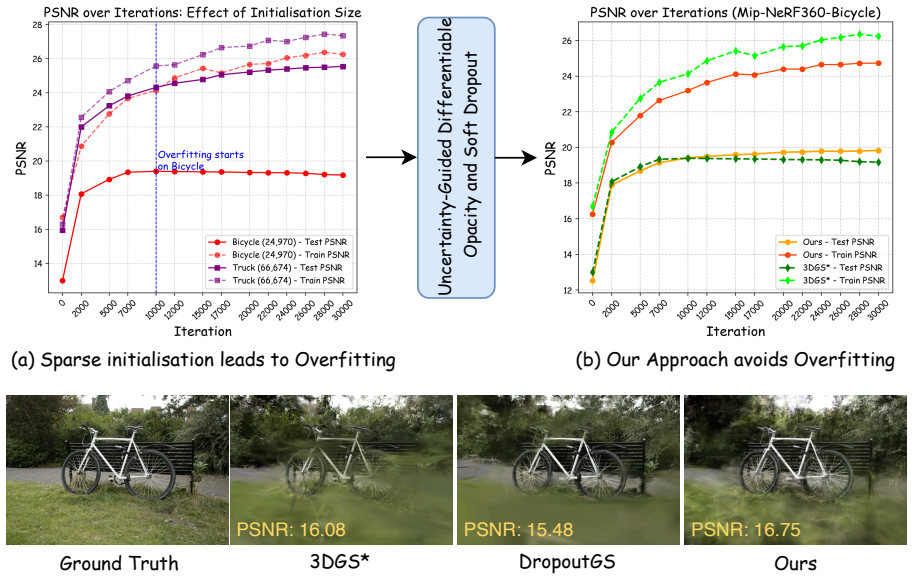
- The regularizer also helps dense view settings: on the bicycle scene the method keeps improving after 20k iterations while 3DGS* begins to degrade.
- Freezing the uncertainty MLP when PSNR stalls stabilizes training, providing a simple early-stopping rule for the regularizer.
- The quality gains come with compactness: the method often matches or beats baselines while using comparable or fewer Gaussians.
Reading between the lines
- The uncertainty score is never validated against an independent notion of Gaussian reliability; replacing $u_i$ with a random or constant input would reveal whether the gains stem from the uncertainty signal or from the added MLP capacity and the freeze schedule.
- The same view-dependent confidence could plausibly drive active view selection or confidence-aware downstream tasks (robot planning, digital twinning), which the paper does not explore.
- Interpreting $\omega_i$ as a relaxed Bernoulli mask suggests annealing the temperature $\tau$ during training to move from soft suppression toward hard pruning, potentially compressing the model further.
Editorial analysis
A structured set of objections, weighed in public.
Referee Report
Summary. The paper proposes UGOD, a sparse-view 3D Gaussian Splatting method that learns a per-Gaussian, view-dependent uncertainty using an MLP with multilevel HashGrid encoding. The predicted uncertainty is used in two ways: (i) to modulate opacity via Eq. (8), and (ii) to compute a continuous soft-dropout probability via a Concrete-distribution-style formula (Eqs. (9)–(11)). Training uses the standard L1 + SSIM reconstruction loss (Eq. (12)), and the uncertainty MLP is frozen once PSNR improvement falls below a threshold. Experiments on MipNeRF 360 and MVImgNet report improved PSNR/SSIM/LPIPS over 3DGS*, DropGaussian, and CoR-GS, while claiming comparable or lower Gaussian counts.
Significance. If the reported gains are robust and the uncertainty mechanism is genuinely responsible for them, the paper would make a useful contribution: a lightweight, fully differentiable regularizer that improves sparse-view 3DGS without external priors. The method is simple to integrate into the standard 3DGS pipeline. The authors provide per-scene quantitative results in the appendix, which is helpful. However, the current evidence is not yet convincing because of an unspecified training-protocol detail that could invalidate the comparisons, a lack of ablations isolating the uncertainty mechanism, and the absence of variance or sensitivity analysis for several ad-hoc hyperparameters.
major comments (5)
- [Algorithm 1 (lines 5–6) and '3DGS Training Loss'] The freeze criterion 'PSNR improvement ΔPSNR < ϵ' is never defined. The data split is '24 views for training and the rest for testing' with no validation set. If ΔPSNR is computed on held-out test views, the method selects the freeze point using test information, giving it an advantage over baselines in Tables 1/4/5 that is not attributable to the uncertainty mechanism. If it is training PSNR, the statement 'prevent excessive adaptation to the training views' is misleading and the threshold is still ad hoc. Please specify explicitly and, if test PSNR is used, rerun the experiments with a separate validation set or a fixed schedule.
- [Abstract and Table 1] The abstract claims 'higher quality reconstruction with fewer Gaussians in most datasets', but Table 1 contradicts this: on Mip-NeRF360 UGOD uses 878,194 Gaussians vs 669,839 for DropGaussian and 865,395 for CoR-GS; on MVImgNet it uses 1,467,984 vs 972,767 and 1,269,568. Thus UGOD uses more Gaussians than both competing methods in both datasets. The per-scene appendix tables also show several cases where Ours has the largest Gaussian count (e.g., garden and bicycle in Table 4, bench and chair in Table 5). Please correct the claim or report a geometric-mean or relative measure that supports it.
- [Section 'Gaussians Uncertainty Analyse' and Ablation Study] There is no ablation that isolates the two proposed mechanisms. Table 2 only varies the HashGrid encoding configuration; it does not compare against a version without uncertainty-guided opacity modulation, without soft dropout, or with a fixed random dropout. The claim that learned uncertainty, rather than the added MLP capacity or the stochastic dropout regularization, drives improvements is therefore not supported. Please add ablations such as: (a) uncertainty MLP removed (raw opacity), (b) only Eq. (8), (c) only Eqs. (9)–(11) with q_i ~ U(0,1) independent of uncertainty, and (d) full model. Also report calibration of u_i against per-Gaussian contribution to held-out error.
- [Implementation paragraph and Eq. (9)] Several hyperparameters are set per dataset without sensitivity analysis: the soft-dropout temperature τ is 0.2 for Mip-NeRF 360 and 0.1 for MVImgNet; the clamp range [ω_min, ω_max] is fixed at [0.2, 0.8]; and ε = 0.2 is chosen with no discussion. Given that the reported PSNR gains over DropGaussian are 0.2–0.6 dB (Table 1), the results may be sensitive to these choices. Please provide a sensitivity study over τ, the clamp range, and ε on at least one scene, and report performance across multiple random seeds with mean and standard deviation.
- [Eq. (12) and 'Gaussians Uncertainty Learning'] The uncertainty MLP is optimized solely by the same reconstruction loss it modulates, and the paper never validates whether high u_i actually corresponds to Gaussians with high rendering error. The known issue of uncalibrated learned uncertainties applies directly: the MLP may fit the loss without learning a reliable reliability estimate, and the gains might arise from the additional network capacity or the stochasticity of Eq. (9) rather than from uncertainty. The authors should provide a quantitative correlation analysis between u_i and the per-Gaussian influence on test-view error, or otherwise demonstrate that 'uncertainty' is not just a fitted regularizer.
minor comments (5)
- [Throughout] Typos: 'reconstrubtion', 'movitation', 'unceratainty', 'machnisms', 'randmoness'. A careful proofread is needed.
- [Figure 3 and Eq. (9)] The caption uses 'uz = 0.2' and 'uz = 0.8' but the variable is u_i; also the text says 'τ = 0.1' while the Implementation says τ = 0.2 for Mip-NeRF 360. Please harmonize notation and values.
- [Eq. (9)] The formula contains log(q_i / (1 - q_i)); q_i is sampled from U(0,1), so the expression is undefined at exactly 0 or 1. State that q_i is sampled in (0,1) or that the endpoints have measure zero.
- [Table 1 header] The arrow 'Gaussians↓' suggests lower is always better, but the paper's own claim is 'fewer Gaussians in most datasets', not necessarily all. Clarify the target: is compactness a secondary objective or a hard constraint? A Pareto-style reporting would be more informative.
- [Dense Views Study (Table 3)] This experiment is limited to one scene ('bicycle') and reports only 3DGS* as baseline. Since the paper's focus is sparse views, this is acceptable as a sanity check, but state that it is not a comprehensive dense-view comparison.
Circularity Check
No significant circularity: the uncertainty module is a learned differentiable regularizer and all quantitative comparisons are on held-out views; the flagged concerns are correctness risks, not definitional reductions.
full rationale
The paper's derivation chain is self-contained in the required sense. The uncertainty u is produced by an MLP with hash-grid-encoded inputs (Eqs. 4-7), then applied multiplicatively to opacity (Eq. 8) and through a concrete-distribution soft dropout (Eqs. 9-11); the resulting opacity enters the standard alpha-blending equation (Eq. 3). All of these are differentiable transformations jointly optimized by the L1+D-SSIM reconstruction loss (Eq. 12). There is no equation-level identity that makes the claimed output equal to an input by construction: the model is trained on 24 views and evaluated on held-out test views (Table 1), so the central rendering claim is an empirical, externally falsifiable comparison rather than a definitional one. The paper invokes no uniqueness theorem from its own authors, and the key citations (Gal et al. for concrete dropout, Müller et al. for hash encoding) are standard external building blocks. The only self-citations (Guo and Wang 2024; Wang et al. 2024a,c) are contextual and not load-bearing. Two concerns should be flagged, but they are correctness/validity risks rather than circularity: (1) the uncertainty is never calibrated against an independent measure of per-Gaussian error, so 'higher uncertainty indicates less reliable' is an interpretive label, not a validated measurement; (2) Algorithm 1's freeze rule ('if PSNR improvement ΔPSNR < ε then freeze MLP parameters') and the Implementation paragraph ('frozen when the PSNR improvement ΔPSNR falls below the threshold ε = 0.2') do not state whether ΔPSNR is computed on training or held-out views, and no validation split is described ('24 views for training and the rest for testing'). If ΔPSNR were test PSNR, that would constitute test leakage, but the paper does not say so, and the final comparisons are still on novel views. Neither issue reduces a prediction to a fitted parameter by construction, so the circularity score remains 0.
Assumptions & free parameters
free parameters (5)
- Soft dropout temperature tau =
0.2 (Mip-NeRF 360), 0.1 (MVImgNet); methodology also states 0.1
- Clamp range omega_min, omega_max =
0.2, 0.8
- SSIM weight lambda =
0.2
- Freeze threshold epsilon =
0.2
- HashGrid configuration =
L=6, F=4, encoding (P,S,R,V)=(6,0,0,0)
assumptions (6)
- standard math 3D Gaussian Splatting differentiable rasterization (Kerbl et al. 2023)
- standard math Multiresolution HashGrid encoding (Muller et al. 2022)
- standard math Concrete distribution reparameterization for binary dropout (Gal et al. 2017)
- domain assumption 24 input views constitute the sparse-view evaluation setting
- domain assumption PSNR, SSIM, LPIPS are accepted quality metrics
- domain assumption SfM/DUSt3R initialization can be incomplete or noisy
invented entities (1)
-
Per-Gaussian view-dependent uncertainty u_i
Cite this review
Pith. "Pith review of UGOD: Uncertainty-Guided Differentiable Opacity and Soft Dropout for Enhanced Sparse-View 3DGS." pith.science (2026). https://pith.science/paper/37R4QH7F
@misc{pith2026250804968,
  author       = {Pith},
  title        = {Pith review of: UGOD: Uncertainty-Guided Differentiable Opacity and Soft Dropout for Enhanced Sparse-View 3DGS},
  year         = {2026},
  howpublished = {\url{https://pith.science/paper/37R4QH7F}},
  note         = {Machine review of arXiv:2508.04968}
}
read the original abstract
3D Gaussian Splatting (3DGS) has become a competitive approach for novel view synthesis (NVS) due to its advanced rendering efficiency through 3D Gaussian projection and blending. However, Gaussians are treated equally weighted for rendering in most 3DGS methods, making them prone to overfitting, which is particularly the case in sparse-view scenarios. To address this, we investigate how adaptive weighting of Gaussians affects rendering quality, which is characterised by learned uncertainties proposed. This learned uncertainty serves two key purposes: first, it guides the differentiable update of Gaussian opacity while preserving the 3DGS pipeline integrity; second, the uncertainty undergoes soft differentiable dropout regularisation, which strategically transforms the original uncertainty into continuous drop probabilities that govern the final Gaussian projection and blending process for rendering. Extensive experimental results over widely adopted datasets demonstrate that our method outperforms rivals in sparse-view 3D synthesis, achieving higher quality reconstruction with fewer Gaussians in most datasets compared to existing sparse-view approaches, e.g., compared to DropGaussian, our method achieves 3.27\% PSNR improvements on the MipNeRF 360 dataset.
Figures


Figures from the paper (2 more)


Forward citations
Cited by 4 Pith papers
-
PairDropGS: Paired Dropout-Induced Consistency Regularization for Sparse-View Gaussian Splatting
PairDropGS applies paired dropout-induced low-frequency consistency regularization and progressive scheduling to improve stability and quality in sparse-view 3D Gaussian Splatting over prior dropout methods.
-
PairDropGS: Paired Dropout-Induced Consistency Regularization for Sparse-View Gaussian Splatting
PairDropGS uses paired dropout with low-frequency consistency regularization and progressive scheduling to stabilize and improve sparse-view 3D Gaussian Splatting.
-
QFOR: A Fidelity-aware Orchestrator for Quantum Computing Environments using Deep Reinforcement Learning
QFOR is a PPO-trained scheduler that claims 29.5-84% fidelity gains over heuristics for quantum jobs in noisy heterogeneous clouds, using IBM calibration data as its noise model.
-
Improving Sparse-View 3DGS Generalization via Flat Minima Optimization
Adapts flat minima optimization to 3DGS via anisotropy-aware perturbations and periodic reinitialization to improve generalization under sparse-view supervision.
Reference graph
Works this paper leans on
-
[1]
T.; Mildenhall, B.; Verbin, D.; Srinivasan, P
Barron, J. T.; Mildenhall, B.; Verbin, D.; Srinivasan, P. P.; and Hedman, P. 2022. Mip-nerf 360: Unbounded anti-aliased neural radiance fields. In Proceedings of the IEEE/CVF conference on computer vision and pattern recognition, 5470--5479
work page 2022
-
[2]
R.; Porzi, L.; and Kontschieder, P
Bul \`o , S. R.; Porzi, L.; and Kontschieder, P. 2024. Revising densification in gaussian splatting. arXiv preprint arXiv:2404.06109
arXiv 2024
-
[3]
Celarek, A.; Kopanas, G.; Drettakis, G.; Wimmer, M.; and Kerbl, B. 2025. Does 3D Gaussian Splatting Need Accurate Volumetric Rendering? arXiv preprint arXiv:2502.19318
arXiv 2025
-
[4]
Duisterhof, B.; Zust, L.; Weinzaepfel, P.; Leroy, V.; Cabon, Y.; and Revaud, J. 2024. MASt3R-SfM: a Fully-Integrated Solution for Unconstrained Structure-from-Motion. arXiv preprint arXiv:2409.19152
arXiv 2024
-
[5]
Fei, B.; Xu, J.; Zhang, R.; Zhou, Q.; Yang, W.; and He, Y. 2024. 3d gaussian splatting as new era: A survey. IEEE Transactions on Visualization and Computer Graphics
work page 2024
-
[6]
Gal, Y.; Hron, J.; and Kendall, A. 2017. Concrete dropout. Advances in neural information processing systems, 30
work page 2017
-
[7]
Guo, Z.; and Wang, P. 2024. Depth Priors in Removal Neural Radiance Fields. In Annual Conference Towards Autonomous Robotic Systems, 367--382. Springer
work page 2024
-
[8]
Han, C.; and Dumery, C. 2025. View-Dependent Uncertainty Estimation of 3D Gaussian Splatting. arXiv preprint arXiv:2504.07370
work page Pith review arXiv 2025
Show all 31 references
-
[9]
Kerbl, B.; Kopanas, G.; Leimk \"u hler, T.; and Drettakis, G. 2023 a . 3d gaussian splatting for real-time radiance field rendering. ACM Trans. Graph., 42(4): 139--1
2023
-
[10]
Kerbl, B.; Kopanas, G.; Leimk \"u hler, T.; and Drettakis, G. 2023 b . 3D Gaussian Splatting for Real-Time Radiance Field Rendering. ACM Transactions on Graphics, 42(4)
2023
-
[11]
Li, R.; and Cheung, Y.-m. 2024. Variational multi-scale representation for estimating uncertainty in 3d gaussian splatting. Advances in Neural Information Processing Systems, 37: 87934--87958
2024
-
[12]
P.; Tancik, M.; Barron, J
Mildenhall, B.; Srinivasan, P. P.; Tancik, M.; Barron, J. T.; Ramamoorthi, R.; and Ng, R. 2021. Nerf: Representing scenes as neural radiance fields for view synthesis. Communications of the ACM, 65(1): 99--106
2021
-
[13]
M \"u ller, T.; Evans, A.; Schied, C.; and Keller, A. 2022. Instant neural graphics primitives with a multiresolution hash encoding. ACM transactions on graphics (TOG), 41(4): 1--15
2022
-
[14]
Park, H.; Ryu, G.; and Kim, W. 2025. Dropgaussian: Structural regularization for sparse-view gaussian splatting. In Proceedings of the Computer Vision and Pattern Recognition Conference, 21600--21609
2025
-
[15]
Rahaman, N.; Baratin, A.; Arpit, D.; Draxler, F.; Lin, M.; Hamprecht, F.; Bengio, Y.; and Courville, A. 2019. On the spectral bias of neural networks. In International conference on machine learning, 5301--5310. PMLR
2019
-
[16]
Talegaonkar, C.; Belhe, Y.; Ramamoorthi, R.; and Antipa, N. 2024. Volumetrically Consistent 3D Gaussian Rasterization. arXiv preprint arXiv:2412.03378
2024 arXiv
-
[17]
L.; and Pham, M
Wang, P.; Guo, Z.; Sait, A. L.; and Pham, M. H. 2024 a . Robot Shape and Location Retention in Video Generation Using Diffusion Models. In 2024 IEEE/RSJ International Conference on Intelligent Robots and Systems (IROS), 7375--7382. IEEE
2024
-
[18]
Wang, S.; Leroy, V.; Cabon, Y.; Chidlovskii, B.; and Revaud, J. 2024 b . Dust3r: Geometric 3d vision made easy. In Proceedings of the IEEE/CVF Conference on Computer Vision and Pattern Recognition, 20697--20709
2024
-
[19]
Wang, S.; Zhang, J.; Wang, P.; Law, J.; Calinescu, R.; and Mihaylova, L. 2024 c . A deep learning-enhanced Digital Twin framework for improving safety and reliability in human--robot collaborative manufacturing. Robotics and computer-integrated manufacturing, 85: 102608
2024
-
[20]
C.; Sheikh, H
Wang, Z.; Bovik, A. C.; Sheikh, H. R.; and Simoncelli, E. P. 2004. Image quality assessment: from error visibility to structural similarity. IEEE transactions on image processing, 13(4): 600--612
2004
-
[21]
Xiong, T.; Wu, J.; He, B.; Fermuller, C.; Aloimonos, Y.; Huang, H.; and Metzler, C. 2024. Event3dgs: Event-based 3d gaussian splatting for high-speed robot egomotion. In 8th Annual Conference on Robot Learning
2024
-
[22]
Yang, H.; Zhang, C.; Wang, W.; Volino, M.; Hilton, A.; Zhang, L.; and Zhu, X. 2024. Gaussian Splatting with Localized Points Management. CoRR
2024
-
[23]
Yong, S.; Manivannan, V. N. P.; Kerbl, B.; Wan, Z.; Stepputtis, S.; Sycara, K.; and Xie, Y. 2025. OMG: Opacity Matters in Material Modeling with Gaussian Splatting. arXiv preprint arXiv:2502.10988
2025 arXiv
-
[24]
Yu, X.; Xu, M.; Zhang, Y.; Liu, H.; Ye, C.; Wu, Y.; Yan, Z.; Zhu, C.; Xiong, Z.; Liang, T.; et al. 2023. Mvimgnet: A large-scale dataset of multi-view images. In Proceedings of the IEEE/CVF conference on computer vision and pattern recognition, 9150--9161
2023
-
[25]
Yu, Z.; Chen, A.; Huang, B.; Sattler, T.; and Geiger, A. 2024. Mip-splatting: Alias-free 3d gaussian splatting. In Proceedings of the IEEE/CVF Conference on Computer Vision and Pattern Recognition, 19447--19456
2024
-
[26]
Zhang, J.; Li, J.; Yu, X.; Huang, L.; Gu, L.; Zheng, J.; and Bai, X. 2024 a . Cor-gs: sparse-view 3d gaussian splatting via co-regularization. In European Conference on Computer Vision, 335--352. Springer
2024
-
[27]
A.; Shechtman, E.; and Wang, O
Zhang, R.; Isola, P.; Efros, A. A.; Shechtman, E.; and Wang, O. 2018. The unreasonable effectiveness of deep features as a perceptual metric. In Proceedings of the IEEE conference on computer vision and pattern recognition, 586--595
2018
-
[28]
Zhang, Z.; Hu, W.; Lao, Y.; He, T.; and Zhao, H. 2024 b . Pixel-gs: Density control with pixel-aware gradient for 3d gaussian splatting. arXiv preprint arXiv:2403.15530
2024 arXiv
-
[29]
Zwicker, M.; Pfister, H.; Van Baar, J.; and Gross, M. 2001. Surface splatting. In Proceedings of the 28th annual conference on Computer graphics and interactive techniques, 371--378
2001
-
[30]
, " * write output.state after.block = add.period write newline
ENTRY address archivePrefix author booktitle chapter edition editor eid eprint howpublished institution isbn journal key month note number organization pages publisher school series title type volume year label extra.label sort.label short.list INTEGERS output.state before.all...
-
[31]
write newline
" write newline "" before.all 'output.state := FUNCTION n.dashify 't := "" t empty not t #1 #1 substring "-" = t #1 #2 substring "--" = not "--" * t #2 global.max substring 't := t #1 #1 substring "-" = "-" * t #2 global.max substring 't := while if t #1 #1 substring * t #2 gl...
Reviewed August 5, 2026 · model on record in the stance chip above.
Discussion (0). Sign in to comment.