On Digital Twins in Defence: Overview and Applications
Pith reviewed 2026-05-19 00:51 UTC · model grok-4.3
The pith
Digital twins connect simulation concepts to defense planning, training, and deployment through a unified framework.
A machine-rendered reading of the paper's core claim, the machinery that carries it, and where it could break.
Core claim
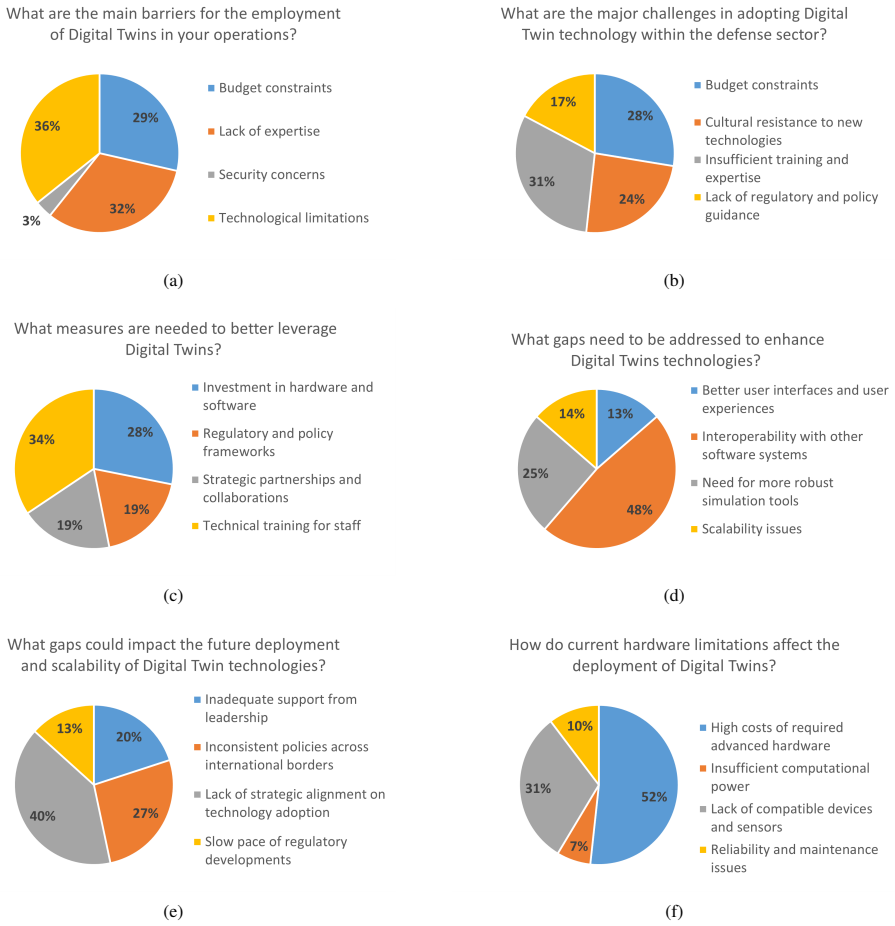
The authors consolidate existing research into a unified framework that links digital twin concepts, simulation-driven application, and real-world deployment in defense scenarios. They introduce a standardized digital twin characterization framework suitable for defense applications that aligns with industrial modeling and simulation standards, and present a taxonomy of defense-specific use cases that highlights recurring requirements. Practical evidence comes from a targeted questionnaire to defense stakeholders and Ministries of Defense that reveals current challenges, leading to the identification of key gaps in interoperability, security, and system integration along with future research
What carries the argument
The standardized digital twin characterization framework that aligns with industrial modeling and simulation standards and organizes applications across planning, training, execution, monitoring, and debriefing.
If this is right
- Digital twins can raise simulation fidelity and support better decisions in defense systems when the unified framework is applied.
- The taxonomy makes it easier to spot shared requirements across different defense use cases.
- Filling the identified gaps in interoperability and security would allow smoother real-world integration of these models.
- Future development can focus on system integration to turn the framework into practical tools for monitoring and debriefing.
Where Pith is reading between the lines
- Adoption of the characterization framework could help compare digital twin projects across different defense programs more consistently.
- The questionnaire findings imply that without early attention to security, deployment timelines may stretch beyond current expectations.
- The taxonomy might serve as a starting point for checking whether new defense simulation tools meet standard requirements.
Load-bearing premise
The surveyed body of literature is representative of the field and the questionnaire responses from targeted defense stakeholders give an accurate picture of current challenges without major selection bias.
What would settle it
A wider set of interviews or data from additional defense organizations that reveals major recurring requirements or challenges absent from the proposed taxonomy and framework would undermine the claim of a representative unified view.
Figures


read the original abstract
Digital twins have emerged as a transformative technology for modeling and simulation in various industries, including defense. This paper provides a comprehensive review of digital twin applications in defense modeling and simulation, focusing on how digital twins can enhance simulation fidelity, interoperability, and decision support within defense systems. We consolidate existing research into a unified framework that links digital twin concepts, simulation-driven application, and real-world deployment in defense scenarios. We discuss the role of digital twin in applications like planning, training, execution and monitoring, and debriefing. We introduce a standardized digital twin characterization framework suitable for defense application that aligns with industrial modeling and simulation standards, and present a taxonomy of defense specific use cases, highlighting recurring requirements. Additionally, practical evidence is provided from a targeted questionnaire distributed to defense stakeholders and Ministries of Defense, revealing current challenges in digital twin integration and deployment. Finally, we conclude by identifying key gaps in digital twins application for defense modeling and simulation, including interoperability, security, and system integration, and we outline future research directions and development opportunities. This review aims to inform defense modeling and simulation practitioners and researchers, guiding future work on digital twin design, implementation and deployment across defense applications.
Editorial analysis
A structured set of objections, weighed in public.
Referee Report
Summary. This paper provides a comprehensive review of digital twin applications in defense modeling and simulation. It consolidates existing research into a unified framework linking digital twin concepts, simulation-driven applications, and real-world deployment. The work discusses roles in planning, training, execution, monitoring, and debriefing; introduces a standardized digital twin characterization framework aligned with industrial standards; presents a taxonomy of defense-specific use cases with recurring requirements; supplies practical evidence from a targeted questionnaire to defense stakeholders and Ministries of Defense; and identifies gaps in interoperability, security, and system integration while outlining future research directions.
Significance. If the synthesis holds, the paper delivers a useful unified framework and taxonomy that connects concepts to deployment, strengthened by direct stakeholder input via questionnaire. The alignment with industrial modeling standards and explicit gap analysis in interoperability and security provide actionable guidance for defense practitioners. The inclusion of questionnaire-derived challenges adds empirical grounding beyond pure literature synthesis.
major comments (1)
- [Abstract] Abstract and review methodology description: limited detail is given on literature selection criteria (e.g., databases, keywords, inclusion/exclusion rules) and questionnaire sampling/distribution methodology. This directly affects the strength of the claim that the consolidated research and stakeholder insights form a representative basis for the unified framework and taxonomy.
minor comments (2)
- [Taxonomy section] The taxonomy of use cases would be clearer if accompanied by an explicit table or diagram mapping each case to the standardized characterization framework introduced earlier.
- [Questionnaire results] Ensure all questionnaire findings are tied back to specific gaps (interoperability, security, integration) with direct quotes or aggregated response statistics for traceability.
Simulated Author's Rebuttal
We thank the referee for the constructive feedback and positive recommendation for minor revision. We address the concern regarding methodology transparency below to strengthen the manuscript's claims.
read point-by-point responses
-
Referee: [Abstract] Abstract and review methodology description: limited detail is given on literature selection criteria (e.g., databases, keywords, inclusion/exclusion rules) and questionnaire sampling/distribution methodology. This directly affects the strength of the claim that the consolidated research and stakeholder insights form a representative basis for the unified framework and taxonomy.
Authors: We agree that additional detail on the review and questionnaire methodologies will improve clarity and better support the representativeness of the framework and taxonomy. In the revised manuscript, we will expand the abstract with a concise statement on the systematic review process and add a dedicated subsection (likely in Section 2 or 3) describing the literature search strategy. This will include the databases queried (e.g., Scopus, IEEE Xplore, Web of Science), keywords and Boolean strings employed, publication date range, inclusion/exclusion criteria (peer-reviewed English-language works focused on defense applications), and screening process. For the questionnaire, we will detail the target population (defense stakeholders and Ministries of Defense), distribution channels (professional networks, official defense contacts, and online platforms), sample size, response rate, and any acknowledged limitations in generalizability. These additions will be kept concise while directly addressing the referee's point. revision: yes
Circularity Check
No circularity: review synthesizes external literature and new questionnaire data
full rationale
This paper is a literature review and survey-based overview that consolidates cited prior work into a proposed taxonomy and framework while adding fresh input from a targeted stakeholder questionnaire. No mathematical derivations, predictions, or first-principles results are claimed that could reduce to self-definitions, fitted parameters, or self-citation chains. The central claims rest on synthesis of independent external sources plus new empirical input, satisfying the self-contained criterion against external benchmarks.
Axiom & Free-Parameter Ledger
axioms (1)
- domain assumption Digital twins can enhance simulation fidelity, interoperability, and decision support within defense systems.
Reference graph
Works this paper leans on
-
[1]
Top Trends in the Gartner Hype Cycle for Emerging Technologies, 2017,
K. Panetta, “Top Trends in the Gartner Hype Cycle for Emerging Technologies, 2017,” Aug. 2017, https://www .gartner.com/ smarterwithgartner/top-trends-in-the-gartner-hype-cycle-for- emerging-technologies-2017 [Accessed: 2025-03-21]
work page 2017
-
[2]
Top Strategic Technology Trends 2023,
D. Groombridge, “Top Strategic Technology Trends 2023,” 2023, https://emt .gartnerweb.com/ngw/globalassets/en/publications/ documents/2023-gartner-top-strategic-technology-trends-ebook .pdf [Accessed: 2024-05-06]
work page 2023
-
[3]
M. Grieves, Virtually perfect: driving innovative and lean products through product lifecycle management. Cocoa Beach, Florida: Space Coast Press, 2011
work page 2011
-
[4]
Digital Twin: Manufacturing Excellence Through Virtual Factory Replication,
——, “Digital Twin: Manufacturing Excellence Through Virtual Factory Replication,” 2014
work page 2014
-
[5]
Digital Twin: Mitigating Unpredictable, Undesirable Emergent Behavior in Complex Systems,
M. Grieves and J. Vickers, “Digital Twin: Mitigating Unpredictable, Undesirable Emergent Behavior in Complex Systems,” in Transdisciplinary Perspectives on Complex Systems , F.-J. Kahlen, S. Flumerfelt, and A. Alves, Eds. Cham: Springer International Publishing, 2017, pp. 85–113. [Online]. Available: http://link.springer.com/10.1007/978-3-319-38756-7 4
-
[6]
Digital Twin in manufacturing: A categorical literature review and classification,
W. Kritzinger, M. Karner, G. Traar, J. Henjes, and W. Sihn, “Digital Twin in manufacturing: A categorical literature review and classification,” IFAC-PapersOnLine, vol. 51, no. 11, pp. 1016–1022,
-
[7]
Available: https://linkinghub .elsevier.com/retrieve/ pii/S2405896318316021
[Online]. Available: https://linkinghub .elsevier.com/retrieve/ pii/S2405896318316021
-
[8]
Digital Twin for maintenance: A literature review,
I. Errandonea, S. Beltr ´an, and S. Arrizabalaga, “Digital Twin for maintenance: A literature review,”Computers in Industry, vol. 123, p. 103316, 2020. [Online]. Available: https://www .sciencedirect.com/ science/article/pii/S0166361520305509
work page 2020
-
[9]
ISO 23247-2:2021 Automation systems and integration — Digital twin framework for manufacturing,
“ISO 23247-2:2021 Automation systems and integration — Digital twin framework for manufacturing,” Oct. 2021. [Online]. Available: https://www.iso.org/standard/78743.html
work page 2021
-
[10]
ISO 23247-3:2021 Automation systems and integration — Digital twin framework for manufacturing,
“ISO 23247-3:2021 Automation systems and integration — Digital twin framework for manufacturing,” Oct. 2021. [Online]. Available: https://www.iso.org/standard/78744.html
work page 2021
-
[11]
ISO 23247-4:2021 Automation systems and integration — Digital twin framework for manufacturing,
“ISO 23247-4:2021 Automation systems and integration — Digital twin framework for manufacturing,” 2021. [Online]. Available: https://www.iso.org/standard/78745.html
work page 2021
-
[12]
ISO 23247-1:2021 Automation systems and integration Digital twin framework for manufacturing,
“ISO 23247-1:2021 Automation systems and integration Digital twin framework for manufacturing,” Oct. 2021. [Online]. Available: https://www.iso.org/standard/75066.html
work page 2021
-
[13]
ISO/CD 23247-5 Automation systems and integration — Digital twin framework for manufacturing
“ISO/CD 23247-5 Automation systems and integration — Digital twin framework for manufacturing.” [Online]. Available: https: //www.iso.org/standard/87425.html
-
[14]
ISO/CD 23247-6 Automation systems and integration — Digital twin framework for manufacturing
“ISO/CD 23247-6 Automation systems and integration — Digital twin framework for manufacturing.” [Online]. Available: https: //www.iso.org/standard/87426.html
-
[15]
E. Brouwer, “Met SUIT naar waar je wilt,” Materieel gezien , vol. 5, 2017, https://magazines .defensie.nl/materieelgezien/2017/05/ mg201705suit [Accessed: 2024-05-30]
work page 2017
-
[16]
Empowering digital twins with eXtended reality collaborations,
L. Stacchio, A. Angeli, and G. Marfia, “Empowering digital twins with eXtended reality collaborations,” Virtual Reality & Intelligent Hardware, vol. 4, no. 6, pp. 487–505, Dec. 2022. [Online]. Available: https://linkinghub.elsevier.com/retrieve/pii/S2096579622000596
work page 2022
-
[17]
Architecture Framework for Manufacturing System Design,
N. Benkamoun, W. ElMaraghy, A.-L. Huyet, and K. Kouiss, “Architecture Framework for Manufacturing System Design,” Procedia CIRP , vol. 17, pp. 88–93, 2014. [Online]. Available: https://linkinghub.elsevier.com/retrieve/pii/S221282711400359X
work page 2014
-
[18]
A systematic review of system-of-systems architecture research,
J. Klein and H. Van Vliet, “A systematic review of system-of-systems architecture research,” in Proceedings of the 9th international ACM Sigsoft conference on Quality of software architectures . Vancouver British Columbia Canada: ACM, June 2013, pp. 13–22. [Online]. Available: https://dl.acm.org/doi/10.1145/2465478.2465490
-
[19]
Navantia’s Digital Twin Implementation Perspective in Military Naval Platform Life Cycle,
J. I. Silvera, J. L. Mu ˜noz, J. M. Luquero, A. Cajade, and M. Bustelo, “Navantia’s Digital Twin Implementation Perspective in Military Naval Platform Life Cycle,” 2020
work page 2020
-
[20]
KNDS and Arquus to create ‘first digital twin demonstrator for a ground combat system’,
Peter Felstead, “KNDS and Arquus to create ‘first digital twin demonstrator for a ground combat system’,” Feb. 2024. [Online]. Available: https://euro-sd .com/2024/02/major-news/36516/ knds-arquus-vbci-digital-twin/
work page 2024
-
[21]
Taking Simulation Interoperabil- ity Standards to the Next Level with Digital Twins,
S. G. Skinner, “Taking Simulation Interoperabil- ity Standards to the Next Level with Digital Twins,” in STO Meeting Proceedings NATO . [Online]. Available: https://www .sto.nato.int/publications/STO%20Meeting% 20Proceedings/STO-MP-MSG-197/MP-MSG-197-25 .pdf
-
[22]
E. Altamiranda and E. Colina, “A System of Systems Digital Twin to Support Life Time Management and Life Extension of Subsea Production Systems,” in OCEANS 2019 - Marseille . Marseille, France: IEEE, June 2019, pp. 1–9. [Online]. Available: https://ieeexplore.ieee.org/document/8867187/
-
[23]
Defence Digital Twin Implementation Road Map and Development Framework,
“Defence Digital Twin Implementation Road Map and Development Framework,” Mar. 2022, https://www .teamdefence.info/wp-content/ uploads/2022/03/20210121-Digital-Twin-Implementation-Road- Map-and-Development-Framework-White-Paper-V1 .pdf [Accessed: 2024-05-06]
work page 2022
-
[24]
Digital Twin: Empowering Enterprises Towards a System-of-Systems Approach,
M. Dietz and G. Pernul, “Digital Twin: Empowering Enterprises Towards a System-of-Systems Approach,” Business & Information Systems Engineering , vol. 62, no. 2, pp. 179–184, Apr. 2020. [Online]. Available: http://link .springer.com/10.1007/s12599-019- 00624-0
-
[25]
Digital Twin Sys- tem Interoperability Framework,
B. Anto and M. Doug, “Digital Twin Sys- tem Interoperability Framework,” Dec. 2021. [Online]. Available: https://www .digitaltwinconsortium.org/pdf/Digital-Twin- System-Interoperability-Framework-12072021 .pdf
work page 2021
-
[26]
Digital twin technologies and smart cities,
M. Farsi, A. Daneshkhah, A. Hosseinian-Far, H. Jahankhani, et al. , “Digital twin technologies and smart cities,” 2020
work page 2020
-
[27]
A digital twin smart city for citizen feedback,
G. White, A. Zink, L. Codec ´a, and S. Clarke, “A digital twin smart city for citizen feedback,” Cities, vol. 110, p. 103064, 2021
work page 2021
-
[28]
A systematic review of a digital twin city: A new pattern of urban governance toward smart cities,
T. Deng, K. Zhang, and Z.-J. M. Shen, “A systematic review of a digital twin city: A new pattern of urban governance toward smart cities,” Journal of Management Science and Engineering , vol. 6, no. 2, pp. 125–134, 2021
work page 2021
-
[29]
N. Mohammadi and J. E. Taylor, “Smart city digital twins,” in 2017 IEEE Symposium Series on Computational Intelligence (SSCI) . IEEE, 2017, pp. 1–5
work page 2017
-
[30]
Smart city based on digital twins,
L. Deren, Y . Wenbo, and S. Zhenfeng, “Smart city based on digital twins,” Computational Urban Science , vol. 1, pp. 1–11, 2021
work page 2021
-
[31]
Localization and mapping for robots in agriculture and forestry: A survey,
A. S. Aguiar, F. N. Dos Santos, J. B. Cunha, H. Sobreira, and A. J. Sousa, “Localization and mapping for robots in agriculture and forestry: A survey,” Robotics, vol. 9, no. 4, p. 97, 2020
work page 2020
-
[32]
Artificial intelligence and digital twins in sustainable agriculture and forestry: a survey,
J. Nie, Y . Wang, Y . Li, and X. Chao, “Artificial intelligence and digital twins in sustainable agriculture and forestry: a survey,”Turkish Journal of Agriculture and Forestry , vol. 46, no. 5, pp. 642–661, 2022
work page 2022
-
[33]
A proposal for a forest digital twin framework and its perspectives,
L. Buonocore, J. Yates, and R. Valentini, “A proposal for a forest digital twin framework and its perspectives,” Forests, vol. 13, no. 4, p. 498, 2022
work page 2022
-
[34]
Digital twins in agriculture and forestry: A review,
A. C. Tagarakis, L. Benos, G. Kyriakarakos, S. Pearson, C. G. Sørensen, and D. Bochtis, “Digital twins in agriculture and forestry: A review,” Sensors, vol. 24, no. 10, p. 3117, 2024
work page 2024
-
[35]
Impactful digital twin in the healthcare revolution,
H. Hassani, X. Huang, and S. MacFeely, “Impactful digital twin in the healthcare revolution,”Big Data and Cognitive Computing, vol. 6, no. 3, p. 83, 2022
work page 2022
-
[36]
Digital twin in healthcare: Recent updates and challenges,
T. Sun, X. He, and Z. Li, “Digital twin in healthcare: Recent updates and challenges,” Digital Health , vol. 9, p. 20552076221149651, 2023
work page 2023
-
[37]
A novel cloud-based framework for the elderly healthcare services using digital twin,
Y . Liu, L. Zhang, Y . Yang, L. Zhou, L. Ren, F. Wang, R. Liu, Z. Pang, and M. J. Deen, “A novel cloud-based framework for the elderly healthcare services using digital twin,” IEEE access , vol. 7, pp. 49 088–49 101, 2019
work page 2019
-
[38]
Technologies for dig- ital twin applications in construction,
V . V . Tuhaise, J. H. M. Tah, and F. H. Abanda, “Technologies for dig- ital twin applications in construction,” Automation in Construction , vol. 152, p. 104931, 2023
work page 2023
-
[39]
Digital twin application in the construction industry: A literature review,
D.-G. J. Opoku, S. Perera, R. Osei-Kyei, and M. Rashidi, “Digital twin application in the construction industry: A literature review,” Journal of Building Engineering , vol. 40, p. 102726, 2021
work page 2021
-
[40]
A digital twin for smart farming,
R. G. Alves, G. Souza, R. F. Maia, A. L. H. Tran, C. Kamienski, J.-P. Soininen, P. T. Aquino, and F. Lima, “A digital twin for smart farming,” in2019 IEEE Global Humanitarian Technology Conference (GHTC). IEEE, 2019, pp. 1–4
work page 2019
-
[41]
Digital twins in smart farming,
C. Verdouw, B. Tekinerdogan, A. Beulens, and S. Wolfert, “Digital twins in smart farming,” Agricultural Systems, vol. 189, p. 103046, 2021
work page 2021
-
[42]
Introducing digital twins to agriculture,
C. Pylianidis, S. Osinga, and I. N. Athanasiadis, “Introducing digital twins to agriculture,” Computers and Electronics in Agriculture , vol. 184, p. 105942, 2021
work page 2021
-
[43]
Toward the next generation of digitalization in agriculture based on digital twin paradigm,
A. Nasirahmadi and O. Hensel, “Toward the next generation of digitalization in agriculture based on digital twin paradigm,” Sensors, vol. 22, no. 2, p. 498, 2022
work page 2022
-
[44]
Building DoD’s largest-ever Digital Twin of its kind,
“Building DoD’s largest-ever Digital Twin of its kind,” https://www.boozallen.com/insights/digital-twin/building-dods- largest-ever-digital-twin-of-its-kind .html [Accessed: 2024-03-28]
work page 2024
-
[45]
A real-time digital twin for active safety in an aircraft hangar,
L. Casey, J. Dooley, M. Codd, R. Dahyot, M. Cognetti, T. Mullarkey, P. Redmond, and G. Lacey, “A real-time digital twin for active safety in an aircraft hangar,” Frontiers in Virtual Reality, vol. 5, p. 1372923, Apr. 2024. [Online]. Available: https://www.frontiersin.org/articles/10.3389/frvir.2024.1372923/full
-
[46]
Digital Twin- Enabled Online Battlefield Learning with Random Finite Sets,
P. Wang, M. Yang, J. Zhu, Y . Peng, and G. Li, “Digital Twin- Enabled Online Battlefield Learning with Random Finite Sets,” Computational Intelligence and Neuroscience , vol. 2021, pp. 1–15, May 2021. [Online]. Available: https://www .hindawi.com/journals/ cin/2021/5582241/
work page 2021
-
[47]
S. Thrun, “Robotic mapping: A survey,” in Exploring Artificial Intelligence in the New Millenium , G. Lakemeyer and B. Nebel, Eds. Morgan Kaufmann, 2002, to appear
work page 2002
-
[48]
Using occupancy grids for mobile robot perception and navigation,
A. Elfes, “Using occupancy grids for mobile robot perception and navigation,” Computer, vol. 22, no. 6, pp. 46–57, 1989
work page 1989
-
[49]
Semantic mapping for mobile robotics tasks: A survey,
I. Kostavelis and A. Gasteratos, “Semantic mapping for mobile robotics tasks: A survey,”Robotics and Autonomous Systems, vol. 66, pp. 86–103, 2015
work page 2015
-
[50]
A comparative survey of lidar-slam and lidar based sensor technologies,
M. U. Khan, S. A. A. Zaidi, A. Ishtiaq, S. U. R. Bukhari, S. Samer, and A. Farman, “A comparative survey of lidar-slam and lidar based sensor technologies,” in 2021 Mohammad Ali Jinnah University International Conference on Computing (MAJICC) . IEEE, 2021, pp. 1–8
work page 2021
-
[51]
Visual slam: What are the current trends and what to expect?
A. Tourani, H. Bavle, J. L. Sanchez-Lopez, and H. V oos, “Visual slam: What are the current trends and what to expect?” Sensors, vol. 22, no. 23, p. 9297, 2022
work page 2022
-
[52]
From slam to situational awareness: Challenges and survey,
H. Bavle, J. L. Sanchez-Lopez, C. Cimarelli, A. Tourani, and H. V oos, “From slam to situational awareness: Challenges and survey,” Sen- sors, vol. 23, no. 10, p. 4849, 2023
work page 2023
-
[53]
Planar fiducial markers: a comparative study,
D. Jurado-Rodriguez, R. Mu ˜noz-Salinas, S. Garrido-Jurado, and R. Medina-Carnicer, “Planar fiducial markers: a comparative study,” Virtual Reality, vol. 27, no. 3, pp. 1733–1749, 2023
work page 2023
-
[54]
M. Kalaitzakis, B. Cain, S. Carroll, A. Ambrosi, C. Whitehead, and N. Vitzilaios, “Fiducial markers for pose estimation: Overview, applications and experimental comparison of the artag, apriltag, aruco and stag markers,”Journal of Intelligent & Robotic Systems, vol. 101, pp. 1–26, 2021
work page 2021
-
[55]
H. Agha, Y . Geng, X. Ma, D. I. Avs ¸ar, R. Kizhakidathazhath, Y .-S. Zhang, A. Tourani, H. Bavle, J.-L. Sanchez-Lopez, H. V oos, et al. , “Unclonable human-invisible machine vision markers leveraging the omnidirectional chiral bragg diffraction of cholesteric spherical reflectors,” Light: Science & Applications , vol. 11, no. 1, p. 309, 2022
work page 2022
-
[56]
Cholesteric liquid crystal shells as enabling material for information-rich design and architecture,
M. Schwartz, G. Lenzini, Y . Geng, P. B. Rønne, P. Y . Ryan, and J. P. Lagerwall, “Cholesteric liquid crystal shells as enabling material for information-rich design and architecture,” Advanced materials , vol. 30, no. 30, p. 1707382, 2018
work page 2018
-
[57]
M. Schwartz, Y . Geng, H. Agha, R. Kizhakidathazhath, D. Liu, G. Lenzini, and J. P. Lagerwall, “Linking physical objects to their digital twins via fiducial markers designed for invisibility to humans,” Multifunctional Materials, vol. 4, no. 2, p. 022002, 2021
work page 2021
-
[58]
This is how the Digital Twin works at the port of Bremen,
“This is how the Digital Twin works at the port of Bremen,” July 2021, https://www .ohb.de/en/magazine/how-the-digital-twin-works- at-the-port-of-bremen [Accessed: 2024-03-29]
work page 2021
-
[59]
A digital twin of Earth for the green transition,
P. Bauer, B. Stevens, and W. Hazeleger, “A digital twin of Earth for the green transition,” Nature Climate Change , vol. 11, no. 2, pp. 80–83, Feb. 2021. [Online]. Available: https://www.nature.com/articles/s41558-021-00986-y
work page 2021
-
[60]
I. DeFelipe, J. Alcalde, E. Baykiev, I. Bernal, K. Boonma, R. Carbonell, S. Flude, A. Folch, J. Fullea, D. Garc ´ıa-Castellanos, A. Geyer, S. Giralt, A. Hern ´andez, I. Jim ´enez-Munt, A. Kumar, M.-G. Llorens, J. Mart ´ı, C. Molina, A. Olivar-Casta ˜no, A. Parnell, M. Schimmel, M. Torn ´e, and S. Ventosa, “Towards a Digital Twin of the Earth System: Geo-S...
-
[61]
S. Nativi and M. Craglia, “Digital Twins of the Earth,” in Encyclopedia of Mathematical Geosciences , B. Daya Sagar, Q. Cheng, J. McKinley, and F. Agterberg, Eds. Cham: Springer International Publishing, 2021, pp. 1–4, series Title: Encyclopedia of Earth Sciences Series. [Online]. Available: https://link .springer.com/ 10.1007/978-3-030-26050-7 457-1
-
[62]
Digital Twin-Enabled Decision Support in Mission Engineering and Route Planning,
E. B. K. Lee, D. L. Van Bossuyt, and J. F. Bickford, “Digital Twin-Enabled Decision Support in Mission Engineering and Route Planning,” Systems, vol. 9, no. 4, p. 82, Nov. 2021. [Online]. Available: https://www.mdpi.com/2079-8954/9/4/82
work page 2021
-
[63]
UA Vradio: Radio link path loss estimation for UA Vs,
D. Al ´aez, M. Celaya-Echarri, L. Azpilicueta, and J. Villadangos, “UA Vradio: Radio link path loss estimation for UA Vs,” SoftwareX, vol. 25, p. 101628, Feb. 2024. [Online]. Available: https: //linkinghub.elsevier.com/retrieve/pii/S2352711023003242
work page 2024
-
[64]
Mastering air combat game with deep reinforcement learning,
J. Zhu, M. Kuang, W. Zhou, H. Shi, J. Zhu, and X. Han, “Mastering air combat game with deep reinforcement learning,” Defence Technology, vol. 34, pp. 295–312, Apr. 2024. [Online]. Available: https://linkinghub.elsevier.com/retrieve/pii/S2214914723002349
work page 2024
-
[65]
AI-based UA V navigation framework with digital twin technology for mobile target visitation,
A. Soliman, A. Al-Ali, A. Mohamed, H. Gedawy, D. Izham, M. Bahri, A. Erbad, and M. Guizani, “AI-based UA V navigation framework with digital twin technology for mobile target visitation,” Engineering Applications of Artificial Intelligence , vol. 123, p. 106318, Aug. 2023. [Online]. Available: https://linkinghub.elsevier.com/retrieve/pii/S095219762300502X
work page 2023
-
[66]
Design and use paradigms for gazebo, an open-source multi-robot simulator,
N. Koenig and A. Howard, “Design and use paradigms for gazebo, an open-source multi-robot simulator,” in 2004 IEEE/RSJ International Conference on Intelligent Robots and Systems (IROS) (IEEE Cat. No.04CH37566), vol. 3. Sendai, Japan: IEEE, 2004, pp. 2149–2154. [Online]. Available: http://ieeexplore.ieee.org/document/1389727/
-
[67]
M. Quigley, K. Conley, B. Gerkey, J. Faust, T. Foote, J. Leibs, R. Wheeler, and A. Ng, ROS: an open-source Robot Operating System. Proc. of the IEEE Intl. Conf. on Robotics and Automation (ICRA) Workshop on Open Source Robotics, Jan. 2009, vol. 3, journal Abbreviation: ICRA Workshop on Open Source Software Publication Title: ICRA Workshop on Open Source Software
work page 2009
-
[68]
“Unity,” 2023, https://unity .com/ [Accessed: 2024-06-20]
work page 2023
-
[69]
Data-driven digital twin technology for optimized control in process systems,
R. He, G. Chen, C. Dong, S. Sun, and X. Shen, “Data-driven digital twin technology for optimized control in process systems,” ISA transactions, vol. 95, pp. 221–234, 2019
work page 2019
-
[70]
Robust additive manufacturing performance through a control oriented digital twin,
P. Stavropoulos, A. Papacharalampopoulos, C. K. Michail, and G. Chryssolouris, “Robust additive manufacturing performance through a control oriented digital twin,” Metals, vol. 11, no. 5, p. 708, 2021
work page 2021
-
[71]
A digital twin based industrial automation and control system security architecture,
C. Gehrmann and M. Gunnarsson, “A digital twin based industrial automation and control system security architecture,” IEEE Transac- tions on Industrial Informatics , vol. 16, no. 1, pp. 669–680, 2019
work page 2019
-
[72]
Control Strategies for Digital Twin Systems,
G.-P. Liu, “Control Strategies for Digital Twin Systems,” IEEE/CAA Journal of Automatica Sinica, vol. 11, no. 1, pp. 170–180, Jan. 2024. [Online]. Available: https://ieeexplore.ieee.org/document/10399361/
-
[73]
“FCX series - A class apart,” 2023, https://www .fincantieri.com/ globalassets/prodotti-servizi/navi-militari/fincantieri broch-m-22- 22-fcx-series-lr .pdf [Accessed: 2024-03-28]
work page 2023
-
[74]
Delivering Digitally for F-35 Force Management Solutions,
“Delivering Digitally for F-35 Force Management Solutions,” Feb. 2021, https://www .f35.com/f35/news-and-features/delivering- digitally-for-f35-force-management-solution .html [Accessed: 2024- 03-28]
work page 2021
-
[75]
A physical-virtual based digital twin robotic hand,
O. Singh and A. K. Ray, “A physical-virtual based digital twin robotic hand,” International Journal on Interactive Design and Manufacturing (IJIDeM) , Mar. 2024. [Online]. Available: https://link.springer.com/10.1007/s12008-024-01773-7
-
[76]
Towards a Digital Twin for Underwater Systems Based on Meta-Learning
M. R. Mod ´eer, “Towards a Digital Twin for Underwater Systems Based on Meta-Learning.” NATO, 2023. [Online]. Available: https://www .sto.nato.int/publications/STO%20Meeting% 20Proceedings/STO-MP-A VT-369/MP-A VT-369-26P.pdf
work page 2023
-
[77]
Physical, Technical, Tactical, Mental – The Next Step,
“Physical, Technical, Tactical, Mental – The Next Step,” May 2007, https://www.badmintoncentral.com/forums/index.php?threads/ physical-technical-tactical-mental-%E2%80%93-the-next- step.44065/ [Accessed: 2024-07-05]
work page 2007
-
[78]
Why the technical, tactical, physical and psychological sides of football are deeply intertwined,
R. Desmond, “Why the technical, tactical, physical and psychological sides of football are deeply intertwined,” July 2022. [Online]. Available: https://themastermindsite .com/2022/07/02/why- the-technical-tactical-physical-and-psychological-sides-of-football- are-deeply-intertwined/
work page 2022
-
[79]
Human digital twin for personalized healthcare: Vision, architecture and future directions,
S. D. Okegbile, J. Cai, D. Niyato, and C. Yi, “Human digital twin for personalized healthcare: Vision, architecture and future directions,” IEEE network, vol. 37, no. 2, pp. 262–269, 2022
work page 2022
-
[80]
Y . Lin, L. Chen, A. Ali, C. Nugent, I. Cleland, R. Li, J. Ding, and H. Ning, “Human digital twin: A survey,” Journal of Cloud Computing, vol. 13, no. 1, p. 131, 2024
work page 2024
discussion (0)
Sign in with ORCID, Apple, or X to comment. Anyone can read and Pith papers without signing in.