REVIEW 5 major objections 6 minor 23 references
Crisp Attention: Regularizing Transformers via Structured Sparsity
T0 review · 5 major / 6 minor · reviewed 2026-08-05 · deepseek-v4-flash
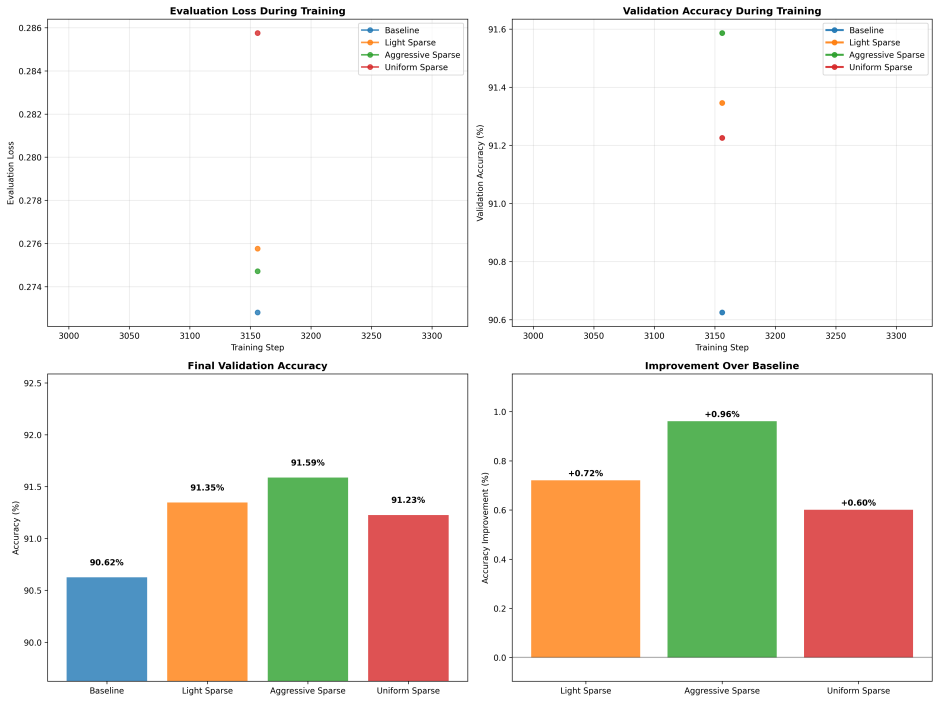
Pith's one-line read The paper reports that pruning 80% of attention weights during fine-tuning lifts SST-2 validation accuracy from 90.62% to 91.59%, and attributes the gain to sparsity acting as a regularizer.
desk verdict A clearly written but statistically underpowered note that repackages top-k attention as a regularizer; the 0.97% gain on SST-2 is within run-to-run noise. read the letter →
The pith
A machine-rendered reading of the paper's core claim, the machinery that carries it, and where it could break.
The reading
What carries the argument
The central mechanism is a percentile-thresholded top-k mask applied to raw attention scores $S = QK^T$ before the softmax: for each head, scores below the $s$-th percentile are set to $-\infty$, and the surviving entries are renormalized by softmax so attention weights still sum to one. The paper calls this renormalization "attention distillation." The mask is computed per batch for adaptive configurations, allowing each layer to set its own threshold; this is what converts sparsity from a static architecture choice into a data-dependent regularizer that shapes the learned attention graph.
What would settle it
Fine-tune the same four configurations with at least ten random seeds and compare the distributions; if the dense baseline accuracy falls within one standard deviation of the 80%-sparse runs, the claimed regularization effect is not distinguishable from noise. Independently, test 80% sparsity on a large dataset where the dense model already generalizes well; the accuracy gain should shrink if the mechanism is overfitting-driven.
Extended reading notes
Core claim
The central claim is that structured, post-hoc sparsity applied during fine-tuning improves, rather than degrades, downstream accuracy. Concretely, an 80%-sparse adaptive attention model achieves 91.59% on SST-2, a 0.97-point absolute gain over the dense 90.62% baseline; the fixed 80% mask reaches 91.23%, and the 60% adaptive model 91.35%. The adaptive models also develop a consistent layer-wise policy — lighter pruning near the input, heavier pruning in deeper layers — and their attention maps have lower entropy, which the authors interpret as sharper, more decisive token interactions. They explain the result by regularization: removing low-scoring connections reduces the surface for overfi
Load-bearing premise
The load-bearing assumption is that one fine-tuning run per configuration gives a reliable estimate of validation accuracy, so the 0.97-point gap between sparse and dense models is real signal rather than random seed-to-seed variation.
Editorial extensions
If this is right
- The reported result implies that the accuracy-versus-sparsity trade-off is not fixed: a 60–80% masked attention model can outperform the same model with dense attention on a downstream classification task.
- With 80% attention sparsity, attention-component FLOPs drop by 80% and total per-layer FLOPs by about 20%, so the accuracy gain comes with a measurable compute reduction in that component, pending sparse kernels.
- Adaptive sparsity's layer-wise pattern — light masking early, heavy masking late — implies that layer-aware sparsity budgets are more effective than a single uniform rate.
- Lower attention entropy in sparse models suggests the regularization mechanism works by sharpening token-to-token reliance, which could make attention maps easier to interpret.
Reading between the lines
- Editorial extension: the reported effect should be strongest in overfitting regimes, so an easy test is to vary training-set size and watch whether the sparse-dense accuracy gap widens as data shrinks.
- Editorial extension: since the mask is recomputed per batch from raw scores, it is effectively a deterministic, data-dependent analogue of dropout; one testable prediction is that adding standard dropout on top may yield redundant rather than additive regularization.
- Editorial extension: all experiments start from a pretrained DistilBERT, so the claim is untested for training from scratch; a from-scratch small Transformer with the same masks would isolate whether pretrained features are needed for the benefit.
- Editorial extension: a differentiable relaxation of the hard top-k mask would let each layer learn its own sparsity level end-to-end, potentially finding better per-layer budgets than hand-set targets.
Editorial analysis
A structured set of objections, weighed in public.
Referee Report
Summary. The paper proposes 'Crisp Attention', a post-hoc top-k sparsification of attention scores applied during fine-tuning of DistilBERT on SST-2. The authors compare a dense baseline with three sparse configurations (uniform 80% sparsity, adaptive 60%, adaptive 80%) and report that all sparse models outperform the dense baseline, with the best configuration reaching 91.59% vs. 90.62% validation accuracy. They hypothesize that structured attention sparsity acts as an implicit regularizer, and support this with layer-wise sparsity analysis, attention entropy measurements, and training/validation curves. They also provide a theoretical FLOPs analysis.
Significance. If the empirical result held, the paper would offer a simple, parameter-free regularizer for Transformers that challenges the common assumption of an accuracy-efficiency trade-off in attention sparsity. The hypothesis is falsifiable and the proposed method is easy to implement, which are strengths. The paper also gives an honest accounting of the computational savings, noting that the total per-layer FLOPs reduction is modest without custom sparse kernels. However, the current evidence is insufficient: the central comparison rests on a single run per configuration with no error bars, the adaptive sparsity mechanism is underspecified, and the claimed correlation is computed from four points. As presented, the contribution is a plausible conjecture supported by preliminary observations rather than a validated empirical result.
major comments (5)
- [§4.1, Table 1] The central claim that 80% sparse attention improves SST-2 accuracy by 0.97% rests on a single fine-tuning run per configuration. SST-2 validation has about 872 examples, so 0.97% is roughly 8 examples. No seeds, error bars, or significance tests are reported, and DistilBERT fine-tuning typically has run-to-run variation of this magnitude. The reported gap is therefore not distinguishable from noise. All qualitative analyses in Figures 2–4 are derived from these same runs. Please add multiple seeds, report mean±std, run a significance test (e.g., paired bootstrap), and evaluate on a held-out test set before claiming improved generalization.
- [§3.3, Figure 2] The adaptive sparsity mechanism is underspecified. 'Each layer determines its own pruning threshold to achieve a target average sparsity' is not an algorithm: how are per-layer thresholds solved, what is averaged over (tokens, heads, layers), and how does re-calculation per batch interact with gradient flow? Without this, the light_sparse and aggressive_sparse configurations cannot be reproduced or interpreted, and the layer-wise patterns in Figure 2 are not meaningful evidence of learned behavior.
- [§3.2, Eq. (2)] Thresholding all scores below the s-th percentile of S can leave entire query rows with no surviving scores, in which case softmax over a vector of all −∞ is undefined. The paper does not address this edge case or prove that it cannot occur. Specify a per-row top-k selection, a fallback for empty rows, or a proof; otherwise the method is not well-defined as stated.
- [§4.1, Figure 1] The claimed 'strong positive correlation' (r = 0.949) is computed from only four points, two of which have the same x-value (80% sparsity), and no point has an error bar. This is not statistical evidence for a trend and cannot support the causal claim that sparsity improves accuracy. Present per-configuration distributions from multiple seeds or remove the correlation claim.
- [§4.1] The paper uses SST-2 validation accuracy as the measure of 'generalization'. Validation accuracy is typically used for model selection, not as a final estimate of generalization. The central claim should be verified on the held-out SST-2 test set (or with cross-validation) before the authors state that sparsity 'improves model generalization'.
minor comments (6)
- [Abstract / §3.3] The abstract says 'post-hoc sparsity' yet the method is applied during fine-tuning. Please clarify whether sparsity is applied after pretraining but throughout fine-tuning, and why this is called post-hoc.
- [§3.2] The term 'structured sparsity' is used for a per-head top-k threshold, which is not structured in the usual sense (e.g., head or block pruning). Define precisely what structure is being imposed.
- [§2.1] Reference numbering appears inconsistent: [2] is cited as a general efficient-transformer survey, but the reference list item [2] is a survey on efficient vision transformers; [3] is described as a 2024 IEEE survey but the listed item is a 2023 WINCOM paper. Please check all citations and attributions.
- [§4.2, §4.3] Qualitative statements such as 'the adaptive models learn to apply higher sparsity to deeper layers' are based on single runs and on an unspecified threshold-determination mechanism. Use neutral wording ('the resulting configurations show...') unless the learning dynamics are actually characterized.
- [§5] The contribution list claims 'the first definitive empirical proof' of the regularization effect. This is an overclaim given the single-run evidence and one benchmark. Temper the language throughout.
- [Figure 4] The training dynamics figure lacks axis labels, epoch scale, and error bars. At minimum, label the axes and indicate whether curves are smoothed; ideally show multiple seeds.
Circularity Check
No significant circularity: the accuracy result is a measured outcome of an experimental manipulation, not a fitted input or self-citational consequence.
full rationale
The paper's central claim is an empirical comparison: it applies a sparsity mask (Eqs. 2–3) with fixed target ratios s∈{0,0.6,0.8} (Section 3.3) and reports measured SST-2 validation accuracies (Table 1). The accuracy values are not fitted parameters, nor are they derived from the sparsity ratios by construction; changing the sparsity configuration changes the training procedure, and the outcome is measured. The 'sparsity as regularizer' explanation is a post-hoc interpretation, not a step in the derivation. There are no self-citations invoked as load-bearing evidence; the related work is external and used only as background. The correlation r=0.949 in Figure 1 is computed from four points, and the lack of seeds/error bars is a statistical robustness concern, but these are evidentiary weaknesses, not circularity: the claim does not assume what it sets out to prove. No equation reduces a prediction to an input, and no fitted parameter is renamed as a prediction. Hence no significant circularity.
Assumptions & free parameters
assumptions (3)
- standard math Masking pre-softmax scores with -inf and renormalizing is a valid approximation of the attention mechanism
- domain assumption Single-run validation accuracy on SST-2 measures generalization reliably
- ad hoc to paper Sparsity acts as an implicit regularizer by forcing the model to rely on fewer attention links
Cite this review
Pith. "Pith review of Crisp Attention: Regularizing Transformers via Structured Sparsity." pith.science (2026). https://pith.science/paper/4H6GSHNS
@misc{pith2026250806016,
  author       = {Pith},
  title        = {Pith review of: Crisp Attention: Regularizing Transformers via Structured Sparsity},
  year         = {2026},
  howpublished = {\url{https://pith.science/paper/4H6GSHNS}},
  note         = {Machine review of arXiv:2508.06016}
}
read the original abstract
The quadratic computational cost of the self-attention mechanism is a primary challenge in scaling Transformer models. While attention sparsity is widely studied as a technique to improve computational efficiency, it is almost universally assumed to come at the cost of model accuracy. In this paper, we report a surprising counter-example to this common wisdom. By introducing structured, post-hoc sparsity to the attention mechanism of a DistilBERT model during fine-tuning on the SST-2 sentiment analysis task, we find that model accuracy improves significantly. Our model with 80\% attention sparsity achieves a validation accuracy of 91.59\%, a 0.97\% absolute improvement over the dense baseline. We hypothesize that this phenomenon is due to sparsity acting as a powerful implicit regularizer, preventing the model from overfitting by forcing it to make predictions with a more constrained and robust set of features. Our work recasts attention sparsity not just as a tool for computational efficiency, but as a potential method for improving the generalization and performance of Transformer models.
Figures


Figures from the paper (1 more)
Reference graph
Works this paper leans on
-
[18]
The Lazy Neuron Phenomenon: On Emergence of Activation Sparsity in Transformers
Li, Z., et al. “The Lazy Neuron Phenomenon: On Emergence of Activation Sparsity in Transformers.” arXiv preprint arXiv:2210.06313, 2022
arXiv 2022
-
[21]
Sparse Transformer: Concentrated Attention Through Explicit Selection
Zhao, G., Lin, J., Zhang, Z., Ren, X., and Sun, X. “Sparse Transformer: Concentrated Attention Through Explicit Selection.” URL: https://api.semanticscholar.org/CorpusID:209486442, 2019
work page 2019
-
[20]
Memory-efficient Transformers via Top-k Attention
Gupta, A., Dar, G., Goodman, S., Ciprut, D., and Berant, J. “Memory-efficient Transformers via Top-k Attention.” In Proceedings of the Second Workshop on Simple and Efficient Natural Language Processing (SustaiNLP), 2021
work page 2021
-
[22]
Sparser is Faster and Less is More: Efficient Sparse Attention for Long-Range Transformers
Lou, C., Jia, Z., Zheng, Z., and Tu, K. “Sparser is Faster and Less is More: Efficient Sparse Attention for Long-Range Transformers.” arXiv preprint arXiv:2406.16747, 2024
arXiv 2024
-
[1]
Efficient Transformers: A Survey
Tay, Y ., Dehghani, M., Bahri, D., and Metzler, D. “Efficient Transformers: A Survey.” arXiv preprint arXiv:2009.06732, 2020
arXiv 2009
-
[2]
A Survey on Efficient Vision Transformers: Algorithms, Techniques, and Performance Benchmarking
Papa, G., Lorenzo, A., Russo, P., Amerini, I., and Zhou, L. “A Survey on Efficient Vision Transformers: Algorithms, Techniques, and Performance Benchmarking.” In IEEE Transactions on Pattern Analysis and Machine Intelligence, 46(12):7682–7700, 2024
work page 2024
-
[3]
A Comprehensive Survey on Efficient Transformers
Elouargui, Y ., Zyate, M., Sassioui, A., Chergui, M., El Kamili, M., and Ouzzif, M. “A Comprehensive Survey on Efficient Transformers.” In Proceedings of the 2023 10th International Conference on Wireless Networks and Mobile Communications (WINCOM), pages 1–6. IEEE, 2023
work page 2023
-
[4]
Generating Long Sequences with Sparse Transformers
Child, R., Gray, S., Radford, A., and Sutskever, I. “Generating Long Sequences with Sparse Transformers.” arXiv preprint arXiv:1904.10509, 2019
arXiv 1904
Show all 23 references
-
[5]
Linformer: Self-Attention with Linear Complexity
Wang, S., Li, B. Z., Khabsa, M., Fang, H., and Ma, H. “Linformer: Self-Attention with Linear Complexity.” arXiv preprint arXiv:2006.04768, 2020
2006 arXiv
-
[6]
Reformer: The Efficient Transformer
Kitaev, N., Kaiser, L., and Levskaya, A. “Reformer: The Efficient Transformer.” In International Conference on Learning Representations (ICLR), 2020
2020
-
[7]
FlashAttention: Fast and Memory-Efficient Exact Attention with IO-Awareness
Dao, T., Fu, D. Y ., Ermon, S., Rudra, A., and Ré, C. “FlashAttention: Fast and Memory-Efficient Exact Attention with IO-Awareness.” In Advances in Neural Information Processing Systems 35 (NeurIPS 2022), 2022. 8
2022
-
[8]
Smarter, Better, Faster, Longer: A Modern Bidirectional Encoder for Fast, Memory Efficient, and Long Context Finetuning and Inference
Warner, B., Chaffin, A., Clavié, B., Weller, O., Hallström, O., Taghadouini, S., Gallagher, A., Biswas, R., Ladhak, F., Aarsen, T., Cooper, N., Adams, G., Howard, J., and Poli, I. “Smarter, Better, Faster, Longer: A Modern Bidirectional Encoder for Fast, Memory Efficient, and ...
2024 arXiv
-
[9]
TKwinFormer: Top k Window Attention in Vision Transformers for Feature Matching
Liao, Y ., Di, Y ., Zhou, H., Zhu, K., Lu, M., Zhang, Y ., Duan, Q., and Liu, J. “TKwinFormer: Top k Window Attention in Vision Transformers for Feature Matching.” arXiv preprint arXiv:2308.15144, 2023
2023 arXiv
-
[10]
Optimal Brain Damage
LeCun, Y ., Denker, J. S., and Solla, S. A. “Optimal Brain Damage.” InAdvances in Neural Information Processing Systems 2 (NIPS 1990), pp. 598–605, 1990
1990
-
[11]
Learning Both Weights and Connections for Efficient Neural Networks
Han, S., Pool, J., Tran, J., and Dally, W. J. “Learning Both Weights and Connections for Efficient Neural Networks.” In Advances in Neural Information Processing Systems 28 (NIPS 2015), pp. 1135–1143, 2015
2015
-
[12]
Sparsity in Transformers: A Systematic Literature Review
Farina, M., Ahmad, U., Taha, A., Younes, H., Mesbah, Y ., Yu, X., and Pedrycz, W. “Sparsity in Transformers: A Systematic Literature Review.” In Neurocomputing, 582:127468, 2024
2024
-
[13]
Graph-based Vision Transformer with Sparsity for Training on Small Datasets from Scratch
Li, P., Huang, L., Li, J., Yan, H., and Shan, D. “Graph-based Vision Transformer with Sparsity for Training on Small Datasets from Scratch.” In Scientific Reports, 15(1):24520, 2025
2025
-
[14]
Dropout: A Simple Way to Prevent Neural Networks from Overfitting
Srivastava, N., Hinton, G., Krizhevsky, A., Sutskever, I., and Salakhutdinov, R. “Dropout: A Simple Way to Prevent Neural Networks from Overfitting.” Journal of Machine Learning Research, 15:1929–1958, 2014
1929
-
[15]
L1 Norm Regularization and Sparsity Explained for Dummies
Yan, S. “L1 Norm Regularization and Sparsity Explained for Dummies.” ML Review, 2016
2016
-
[16]
Regularizing Transformers with Deep Probabilistic Layers
Aguilera, A. C., Olmos, P. M., Artes-Rodriguez, A., and Pérez-Cruz, F. “Regularizing Transformers with Deep Probabilistic Layers.” In Neural Networks, 161:565–574, 2023
2023
-
[17]
Double Consistency Regularization for Transformer Networks
Wan, Y ., Zhang, W., and Li, Z. “Double Consistency Regularization for Transformer Networks.” InElectronics, 12(20):4357, 2023
2023
-
[19]
Efficient Algorithms for PDE Solving and Network Pruning
Wu, Y . “Efficient Algorithms for PDE Solving and Network Pruning.” PhD dissertation, Hong Kong University of Science and Technology (Hong Kong), 2023
2023
-
[23]
Zoology: Measuring and Improving Recall in Efficient Language Models
Arora, S., Eyuboglu, S., Timalsina, A., Johnson, I., Poli, M., Zou, J., Rudra, A., and Ré, C. “Zoology: Measuring and Improving Recall in Efficient Language Models.” In Proceedings of the 12th International Conference on Learning Representations (ICLR), 2023. 9
2023
Reviewed August 5, 2026 · model on record in the stance chip above.
Discussion (0). Sign in to comment.