REVIEW 2 major objections 4 minor 84 references
Nonlinear dispersive waves in soft elastic laminates under finite magneto-deformations
T0 review · 2 major / 4 minor · reviewed 2026-08-05 · deepseek-v4-flash
Pith's one-line read Nonlinear shear waves across a soft magneto-active laminate are governed by a single effective dispersive wave equation, with explicit coefficients and magnetically tunable solitary-wave solutions.
desk verdict New effective equation is a solid homogenization result; the solitary-wave section applies it where the two-scale expansion does not hold, so the speed-bound claims need reframing or direct simulation. read the letter →
The pith
A machine-rendered reading of the paper's core claim, the machinery that carries it, and where it could break.
The reading
What carries the argument
The load-bearing object is the homogenized nonlinear dispersive wave equation $$$c^{2}$(1+\zeta $u_y^{2}$)u_{yy}+\eta\$ell^{2}$ $c^{2}$ u_{yyyy}=u_{tt},$$ with effective coefficients $\zeta$ and $\eta$ given by explicit formulas in terms of the layer properties. This equation carries the argument by replacing the alternating-layer microstructure with a homogeneous dispersive medium, so that nonlinearity, dispersion, and magneto-elastic tunability are all encoded in a handful of coefficient formulas.
What would settle it
Measure the maximum speed of shear solitary waves in a hard-magnetic Gent laminate under a range of magnetic inductions and compare with the predicted bound; exceeding the bound, or finding the bound insensitive to the field, would falsify the homogenised model. Alternatively, compute the next-order amplitude correction in the homogenisation expansion and check whether its coefficient is negligible compared with the nonlinearity coefficient at moderate amplitudes.
Extended reading notes
Core claim
The paper's central claim is that a periodically layered soft magneto-active solid can be replaced, in the long-wave moderate-amplitude regime, by a homogeneous nonlinear dispersive medium governed by $$$c^{2}$(1+\zeta $u_y^{2}$)u_{yy}+\eta\$ell^{2}$ $c^{2}$ u_{yyyy}=u_{tt},$$ where $c^2=\langle g\rangle/\langle\rho\rangle$ and the dimensionless coefficients $\zeta$ and $\eta$ are explicit functions of the two phases' volume fractions, shear stiffnesses, and densities. The paper further claims that this equation admits solitary waves with an explicit sech profile, a speed–amplitude relation, and a magnetically tunable upper bound on speed, and that a unidirectional modified Korteweg–de Vries reduction captu
Load-bearing premise
The load-bearing premise is that each layer's shear stiffness is exactly the quadratic truncation $g^{(\alpha)}+\tfrac{1}{3}h^{(\alpha)}u_y^2$ and that the remnant magnetisation stays constant during wave propagation; if the neglected magnetisation fluctuations or fourth-order strain terms matter at the amplitudes considered, the effective equation, the mKdV reduction, and the solitary-wave speed bounds all change.
Editorial extensions
If this is right
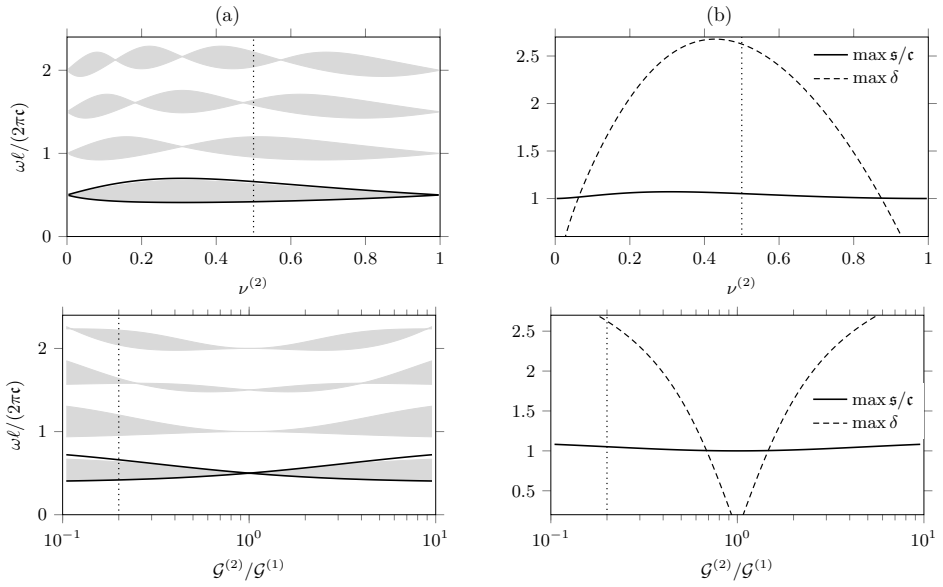
- The first shear band gap of a soft magneto-active laminate is approximated by the homogenised dispersion relation with optimised coefficients, so band-gap edges can be estimated directly from phase properties.
- In Gent-type laminates the effective dispersion coefficient and the solitary-wave speed bound change with the applied magnetic field through the static stretch, giving a post-fabrication tuning knob.
- Solitary waves in the homogenised model exist only for relative speeds satisfying a polynomial inequality; approaching the bound shrinks the wavelength to zero while saturating the strain amplitude.
- The mKdV reduction describes unidirectional propagation accurately only for speeds close to the linear wave speed, and should not be used for quantitative high-amplitude predictions.
- The derived effective strain energy links dynamic homogenisation to a static homogenised material theory, so static and dynamic laminate responses can be described within one model in the small-nonlinearity limit.
Reading between the lines
- A natural extension is to relax the fixed-remnant-magnetisation assumption; allowing magnetisation fluctuations would likely add magnetic coupling terms to the effective equation and could shift the solitary-wave speed bound.
- Because the dispersion coefficient is an explicit function of the impedance contrast between phases, measuring the first band-gap edge could serve as a non-destructive route to infer layer properties.
- Applying the same homogenisation scheme to the two-polarisation shear system would likely yield a vector dispersive equation supporting polarised solitary-wave families.
- The optimised homogenised model, being much cheaper than finite-volume simulations of the layered medium, could act as a surrogate in design optimisation of magnetically tunable acoustic filters.
Editorial analysis
A structured set of objections, weighed in public.
Referee Report
Summary. The paper studies nonlinear shear waves in periodic hard-magnetic soft laminates. It first revisits the hard-magnetic constitutive framework to use a symmetric total stress and, for generalized neo-Hookean layers under a static magneto-deformation, reduces the layer dynamics to the nonlinear equation (1) with cubic stiffness. Using two-scale homogenization along the lines of Andrianov et al., it derives the effective Boussinesq-type equation (2) with closed-form effective coefficients (Table 1), and an approximate effective strain-energy function (56). It then improves the linear dispersive representation by means of three parameters, reduces the equation to an mKdV model, studies sech solitary waves, derives speed-amplitude relations and an upper bound on the solitary-wave speed, and demonstrates magnetic tunability of band gaps and of the solitary-wave speed bound. The mKdV model is compared with finite-volume simulations of an impact problem in a layered medium.
Significance. If taken at face value, the paper provides a compact, closed-form description of nonlinear dispersive shear waves in magneto-active laminates, with no fitting of the central homogenized coefficients, and it gives concrete, falsifiable predictions for magnetically tunable solitary-wave speeds. The comparison with the exact Floquet-Bloch dispersion relation is a strong point, as is the explicit derivation of an effective strain energy. The main reservation is that the solitary-wave analysis is presented in a regime where the homogenization's scale-separation parameters are not small; the predictions are interesting but currently not supported by layer-resolved simulations in that regime. With appropriate restrictions or additional validation, the paper would be a useful contribution.
major comments (2)
- [§4.1, Eq. (47); §5.3, Eqs. (69)-(72), (83)] The solitary-wave branch violates the scale-separation hypotheses ε=ℓ/L≪1 and δ=a/L≪1 under which Eq. (2) was derived. For Table 3 with s=1.026c, Eq. (69) gives c1≈10.9, so L/ℓ≈0.30 and δ≈1.85; the mKdV branch (70) gives L/ℓ≈0.44 and δ≈1.77. Thus ε and δ are O(1), not small. The speed bound (83) is approached exactly as L/ℓ→0, since at s²/c²=√(1+η/ηt) the coefficient c3 in Eq. (69) diverges and L→0, which is the extreme violation of the long-wave limit. The paper's own Conclusion states that Eq. (64) is restricted to the low-frequency range and to waves of moderate amplitude. The layer-resolved validation in §5.4 covers only the mKdV model at wavelengths 8ℓ–16ℓ, and in the nonlinear dispersive case the comparison is qualitative. Please either restrict the soliton claims to the valid asymptotic regime, provide direct layer-resolved simulations of the solitary waves in that regime, or clea
- [§5.2-§5.4] The numerical validation in §5.4 does not exercise the full homogenized model used for the solitary-wave branch. The mKdV reduction (65) is independent of the splitting (ηy,ηm,ηt) as long as Eq. (58)2 holds, so the agreement in Figs. 5–6 says little about the modified dispersion model (58)/(62) or about the solitary waves (69)-(72) that underlie the speed bound (83). In the nonlinear dispersive case (iii), the authors themselves state that the comparison is only qualitative. Moreover, the coefficients (62) are chosen to match the first band gap and are not derived from the two-scale expansion. To support the central speed-amplitude claim, the full model (64) should be compared with layer-resolved simulations, or the claim should be presented as a prediction of the homogenized model only.
minor comments (4)
- [§5.2, scaling paragraph] In the change of variables {ŷ=ε²y, t̂=t−y/c, u=εû}, the parameter ε is said to be 'of the same order as the microstructure's characteristic length ℓ'. Since y and u are dimensional, ε must be dimensionless. Please clarify by writing ε=ℓ/L or by introducing normalized variables, so that the ordering is unambiguous.
- [Eqs. (74), (84)] The nested square roots in these equations are typeset ambiguously. Add explicit parentheses, e.g. maxδ = sqrt( (sqrt(1+η/ηt)−1)/(ζ/6) ), so the reader can verify the numerical values.
- [Table 1] It would help to state explicitly that h(α) has the same units as g(α), so that ζ is dimensionless, and that the expression for η is dimensionless only after using c²=⟨g⟩/⟨ρ⟩.
- [§5.4, footnotes 2] The artificial mass density choices are clearly flagged as a thought experiment. A short remark on whether the shock-formation distance (76) changes when c is modified by those density choices would avoid possible confusion.
Circularity Check
No significant circularity: effective coefficients are explicit functions of layer properties and the solitary-wave results are derived, not fitted; only minor non-load-bearing self-citations and a consistency-based energy construction are present.
full rationale
The central derivation chain is self-contained. The layer-wise equation (1) with coefficients g(alpha),h(alpha) from the Taylor expansion (44) is homogenized by a two-scale expansion; the effective coefficients zeta and eta in Eq. (52)/Table 1 are explicit algebraic functions of the phase properties and contain no fitted constants. The travelling-wave analysis (68)-(72) and the speed-amplitude bounds (69)-(74), (83) are obtained by substitution into the homogenized PDE, not by fitting to data. The mKdV model (65) is validated against direct finite-volume simulations of the heterogeneous layer equations (Section 5.4), and the linear dispersion comparison (Fig. 3) uses the independent Floquet-Bloch relation (59). Self-citations such as [75] are used for background, for the constant-remnant-magnetization assumption, and for comparisons, but the load-bearing coefficients and wave solutions are rederived here; no uniqueness theorem or ansatz is imported from the authors' earlier work. The effective strain energy (56) in Appendix B is explicitly constructed to be 'consistent with' Eq. (2) through the constraints (100); this is a consistency check, not an independent prediction, so it does not create circularity. The paper's own limitation statement in Section 7 ('the validity of our homogenised wave equation (64) is restricted to the low frequency range and to waves of moderate amplitude') is a domain-of-validity caveat; the skeptic's observation that soliton parameters near the speed bound violate the two-scale assumptions is a correctness/validity concern, not a definitional circularity. Score 2 reflects only the presence of minor non-load-bearing self-citations and the consistency-based energy construction, not a reduction of the central claims to their inputs.
Assumptions & free parameters
free parameters (3)
- per-phase nonlinearity parameter beta =
0.0132 (Table 3)
- improved dispersion coefficients eta_y, eta_m, eta_t =
eta_y ~ 0.0507, eta_m = 0, eta_t ~ 0.0414 (Table 3)
- artificial mass density rho(2) =
4650 kg/m3 and 3720 kg/m3 in thought experiments (Section 5.4)
assumptions (5)
- domain assumption Incompressibility and generalized neo-Hookean response W(I1) for each layer
- domain assumption Remnant magnetisation is unaffected by the shear wave (br constant during propagation)
- domain assumption Two-scale asymptotic expansions truncated at order (eps^2, delta^2), with u2,u3 from the linearized problems of [6,19]
- ad hoc to paper Modified dispersion representation (58) with coefficients (62)
- domain assumption Small beta expansion for the effective energy (56)
Cite this review
Pith. "Pith review of Nonlinear dispersive waves in soft elastic laminates under finite magneto-deformations." pith.science (2026). https://pith.science/paper/F3OIYXYA
@misc{pith2026250806324,
  author       = {Pith},
  title        = {Pith review of: Nonlinear dispersive waves in soft elastic laminates under finite magneto-deformations},
  year         = {2026},
  howpublished = {\url{https://pith.science/paper/F3OIYXYA}},
  note         = {Machine review of arXiv:2508.06324}
}
read the original abstract
Layered media can be used as acoustic filters, allowing only waves of certain frequencies to propagate. In soft magneto-active laminates, the shear wave band gaps (i.e., the frequency intervals for which shear waves cannot propagate) can be adjusted after fabrication by exploiting the magneto-elastic coupling. In the present study, the control of shear wave propagation in magneto-active stratified media is revisited by means of homogenisation theory, and extended to nonlinear waves of moderate amplitude. Building upon earlier works, the layers are modelled by means of a revised hard-magnetic material theory for which the total Cauchy stress is symmetric, and the incompressible elastic response is of generalised neo-Hookean type (encompassing Yeoh, Fung-Demiray, and Gent materials). Using asymptotic homogenisation, a nonlinear dispersive wave equation with cubic nonlinearity is derived, under certain simplifying assumptions. In passing, an effective strain energy function describing such laminates is obtained. The combined effects of nonlinearity and wave dispersion contribute to the formation of solitary waves, which are analysed using the homogenised wave equation and a modified Korteweg-de Vries (mKdV) approximation of the latter. The mKdV equation is compared to direct numerical simulations of the impact problem, and various consequences of these results are explored. In particular, we show that an upper bound for the speed of solitary waves can be adjusted by varying the applied magnetic field, or by modifying the properties of the microstructure.
Figures


Figures from the paper (5 more)


Reference graph
Works this paper leans on
-
[1]
M. Agoras, O. Lopez-Pamies, and P. Ponte Castañeda. A general hyperelastic model for incompressible fiber-reinforced elastomers. J. Mech. Phys. Solids , 57(2):268–286, 2009. doi:10.1016/j.jmps.2008.10.014
- [2]
- [3]
-
[4]
H. Alawiye, E. Kuhl, and A. Goriely. Revisiting the wrinkling of elastic bilayers I: linear analysis.Phil. Trans. R. Soc. A , 377(2144):20180076, 2019. doi:10.1098/rsta.2018.0076
-
[5]
H. G. Allen. Analysis and Design of Structural Sandwich Panels . Pergamon Press, Oxford, UK, 1969. doi:10.1016/C2013-0-02134-2
-
[6]
I. V. Andrianov, V. I. Bolshakov, V. V. Danishevs’kyy, and D. Weichert. Higher order asymptotic homog- enization and wave propagation in periodic composite materials.Proc. R. Soc. A , 464(2093):1181–1201,
-
[7]
I. V. Andrianov, V. V. Danishevs’kyy, O. I. Ryzhkov, and D. Weichert. Dynamic homogeniza- tion and wave propagation in a nonlinear 1D composite material. Wave Motion , 50:271–281, 2013. doi:10.1016/j.wavemoti.2012.08.013
-
[8]
D. S. Bale, R. J. Leveque, S. Mitran, and J. A. Rossmanith. A wave propagation method for conservation laws and balance laws with spatially varying flux functions.SIAM J. Sci. Comput. , 24(3):955–978, 2003. doi:10.1137/S106482750139738X
Show all 84 references
-
[9]
Berjamin
H. Berjamin. On the accuracy of one-way approximate models for nonlinear waves in soft solids.J. Acoust. Soc. Am., 153(3):1924–1932, 2023. doi:10.1121/10.0017681
1924 doi
-
[10]
Berjamin and S
H. Berjamin and S. Rudykh. Elastic wave propagation in magneto-active fibre composites.Int. J. Solids Struct., 316:113373, 2025. doi:10.1016/j.ijsolstr.2025.113373
2025
-
[11]
Berjamin, B
H. Berjamin, B. Lombard, G. Chiavassa, and N. Favrie. Plane-strain waves in nonlinear elastic solids with softening. Wave Motion, 89:65–78, 2019. doi:10.1016/j.wavemoti.2019.03.002
2019 doi
-
[12]
Boulanger and M
P. Boulanger and M. Hayes. Finite-amplitude waves in deformed Mooney-Rivlin materials.Q. J. Mech. Appl. Math., 45(4):575–593, 1992. doi:10.1093/qjmam/45.4.575
1992 doi
-
[13]
Chadwick
P. Chadwick. Thermo-mechanics of rubberlike materials.Phil. Trans. R. Soc. Lond. A , 276(1260):371–403,
-
[14]
M. S. Chaki and J. Bravo-Castillero. A study of non-uniform imperfect contact in shear wave propaga- tion in a magneto-electro-elastic laminated periodic structure. Arch. Appl. Mech. , 94:1475–1501, 2024. doi:10.1007/s00419-024-02584-8
2024 doi
-
[15]
J. Chen, H. Yang, J. Li, J. Chen, Y. Zhang, and X. Zeng. The development of an artificial skin model and its frictional interaction with wound dressings.J. Mech. Behav. Biomed. Mater. , 94:308–316, 2019. doi:10.1016/j.jmbbm.2019.03.013
2019 doi
-
[16]
Chockalingam and T
S. Chockalingam and T. Cohen. Shear shock evolution in incompressible soft solids.J. Mech. Phys. Solids , 134:103746, 2020. doi:10.1016/j.jmps.2019.103746
2020
-
[17]
C. I. Christov, G. A. Maugin, and A. V. Porubov. On Boussinesq’s paradigm in nonlinear wave propagation. C. R. Mécanique , 335(9-10):521–535, 2007. doi:10.1016/j.crme.2007.08.006
2007 doi
-
[18]
Conroy Broderick and S
H. Conroy Broderick and S. Rudykh. Analysis of shear shock waves in soft materials: From periodic elastic laminates and fibre-reinforced composites to molecular chain networks.Int. J. Solids Struct. , 295:112790,
-
[19]
Cornaggia and B
R. Cornaggia and B. B. Guzina. Second-order homogenization of boundary and transmission con- ditions for one-dimensional waves in periodic media. Int. J. Solids Struct. , 188:88–102, 2020. doi:10.1016/j.ijsolstr.2019.09.009. 27
2020 doi
-
[20]
Cornaggia and B
R. Cornaggia and B. Lombard. A homogenized model accounting for dispersion, interfaces and source points for transient waves in 1D periodic media.ESAIM Math. Model. Numer. Anal. , 57(3):1413–1444,
-
[21]
R. V. Craster, J. Kaplunov, and A. V. Pichugin. High-frequency homogenization for periodic media.Proc. R. Soc. A , 466(2120):2341–2362, 2010. doi:10.1098/rspa.2009.0612
2010
-
[22]
Danas and P
K. Danas and P. M. Reis. Stretch-independent magnetization in incompressible isotropic hard magnetorhe- ological elastomers. J. Mech. Phys. Solids , 191:105764, 2024. doi:10.1016/j.jmps.2024.105764
2024
-
[23]
deBotton
G. deBotton. Transversely isotropic sequentially laminated composites in finite elasticity.J. Mech. Phys. Solids, 53(6):1334–1361, 2005. doi:10.1016/j.jmps.2005.01.006
2005 doi
-
[24]
Destrade and R
M. Destrade and R. W. Ogden. On magneto-acoustic waves in finitely deformed elastic solids.Math. Mech. Solids, 16(6):594–604, 2011. doi:10.1177/1081286510387695
2011 doi
-
[25]
Destrade and G
M. Destrade and G. Saccomandi. Nonlinear transverse waves in deformed dispersive solids.Wave Motion, 45(3):325–336, 2008. doi:10.1016/j.wavemoti.2007.07.002
2008 doi
-
[26]
Destrade, G
M. Destrade, G. Saccomandi, and I. Sgura. Methodical fitting for mathematical models of rubber-like materials. Proc. R. Soc. A , 473(2198):20160811, 2017. doi:10.1098/rspa.2016.0811
2017
-
[27]
P. A. Deymier, editor.Acoustic Metamaterials and Phononic Crystals . Springer, Berlin, Heidelberg, 2013. doi:10.1007/978-3-642-31232-8
2013 doi
-
[28]
Dorfmann and R
A. Dorfmann and R. W. Ogden. Nonlinear magnetoelastic deformations.Q. J. Mech. Appl. Math. , 57(4): 599–622, 2004. doi:10.1093/qjmam/57.4.599
2004 doi
-
[29]
Dorfmann and R
L. Dorfmann and R. W. Ogden. Hard-magnetic soft magnetoelastic materials: Energy considerations.Int. J. Solids Struct. , 294:112789, 2024. doi:10.1016/j.ijsolstr.2024.112789
2024
-
[30]
G. A. El, M. A. Hoefer, and M. Shearer. Dispersive and diffusive-dispersive shock waves for nonconvex conservation laws. SIAM Rev., 59(1):3–61, 2017. doi:10.1137/15M1015650
2017 doi
-
[31]
Engelbrecht, A
J. Engelbrecht, A. Salupere, and K. Tamm. Waves in microstructured solids and the Boussinesq paradigm. Wave Motion, 48(8):717–726, 2011. doi:10.1016/j.wavemoti.2011.04.001
2011 doi
-
[32]
J. Fish, W. Chen, and G. Nagai. Non-local dispersive model for wave propagation in heterogeneous media: one-dimensional case. Int. J. Numer. Methods Eng. , 54(3):331–346, 2002. doi:10.1002/nme.423
2002 doi
-
[33]
T. R. Fogarty and R. J. LeVeque. High-resolution finite-volume methods for acoustic waves in periodic and random media. J. Acoust. Soc. Am. , 106(1):17–28, 1999. doi:10.1121/1.428038
1999 doi
-
[34]
S. Forest. Continuum thermomechanics of nonlinear micromorphic, strain and stress gradient media.Phil. Trans. R. Soc. A , 378(2170):20190169, 2020. doi:10.1098/rsta.2019.0169
2020
-
[35]
P. I. Galich, N. X. Fang, M. C. Boyce, and S. Rudykh. Elastic wave propagation in finitely deformed layered materials. J. Mech. Phys. Solids , 98:390–410, 2017. doi:10.1016/j.jmps.2016.10.002
2017 doi
-
[36]
F. E. Garbuzov, A. V. Belashov, A. A. Zhikhoreva, Y. M. Beltukov, and I. V. Semenova. Shock wave evolution into strain solitary wave in nonlinearly elastic solid bar. Wave Motion , 114:103022, 2022. doi:10.1016/j.wavemoti.2022.103022
2022
-
[37]
Gebhart and T
P. Gebhart and T. Wallmersperger. Modeling of hysteresis effects in magneto-active polymers: constitutive theory and variational principles.Acta Mech., pages 1–27, 2025. doi:10.1007/s00707-025-04274-0
2025 doi
-
[38]
Giorgi and A
C. Giorgi and A. Morro. On the modeling of magneto-mechanical effects in solids.J. Magn. Magn. Mater. , 626:173038, 2025. doi:10.1016/j.jmmm.2025.173038
2025
-
[39]
G. A. Holzapfel.Nonlinear Solid Mechanics: A Continuum Approach for Engineering . John Wiley & Sons, Chichester, 2000
2000
-
[40]
Polymers for 3D Printing: Methods, Properties, and Characteristics
J.Izdebska-Podsiadły, editor. Polymers for 3D Printing: Methods, Properties, and Characteristics . William Andrew Publishing, Oxford, UK, 2022
2022
-
[41]
Karami Mohammadi, P
N. Karami Mohammadi, P. I. Galich, A. O. Krushynska, and S. Rudykh. Soft magnetoactive laminates: large deformations, transverse elastic waves and band gaps tunability by a magnetic field.J. Appl. Mech., 86(11):111001, 2019. doi:10.1115/1.4044497. 28
2019 doi
-
[42]
D. I. Ketcheson and R. J. LeVeque. Shock dynamics in layered periodic media.Commun. Math. Sci. , 10 (3):859–874, 2012. doi:10.4310/CMS.2012.v10.n3.a7
2012 doi
-
[43]
A. Kovetz. Electromagnetic Theory . Oxford University Press, New York, 2000. doi:10.1093/oso/9780198506041.001.0001
2000
-
[44]
P. D. Lax.Hyperbolic Systems of Conservation Laws and the Mathematical Theory of Shock Waves . SIAM, Philadelphia, PA, 1973. doi:10.1137/1.9781611970562
1973 doi
-
[45]
Ling and X
L. Ling and X. Sun. The multi elliptic-localized solutions and their asymptotic behaviors for the mKdV equation. Stud. Appl. Math. , 150(1):135–183, 2023. doi:10.1111/sapm.12536
2023 doi
-
[46]
G. Liu, H. Liao, X. Zhao, J. Cao, and W.-H. Liao. A self-powered magnetoelectric tactile sensor for material recognition. Sensor. Actuat. A Phys. , 366:114942, 2024. doi:10.1016/j.sna.2023.114942
2024
-
[47]
Lopez-Pamies and P
O. Lopez-Pamies and P. Ponte Castañeda. Microstructure evolution in hyperelastic laminates and implications for overall behavior and macroscopic stability. Mech. Mat. , 41(4):364–374, 2009. doi:10.1016/j.mechmat.2009.01.006
2009 doi
-
[48]
Lucarini, M
S. Lucarini, M. Hossain, and D. Garcia-Gonzalez. Recent advances in hard-magnetic soft composites: Synthesis, characterisation, computational modelling, and applications.Compos. Struct., 279:114800, 2022. doi:10.1016/j.compstruct.2021.114800
2022
-
[49]
Madeo, P
A. Madeo, P. Neff, I.-D. Ghiba, L. Placidi, and G. Rosi. Wave propagation in relaxed micromorphic continua: modeling metamaterials with frequency band-gaps.Cont. Mech. Thermodyn., 27:551–570, 2015. doi:10.1007/s00161-013-0329-2
2015 doi
-
[50]
Mahoney, D
P. Mahoney, D. Carr, R. Arm, I. Gibb, N. Hunt, and R. J. Delaney. Ballistic impacts on an anatomically correct synthetic skull with a surrogate skin/soft tissue layer. Int. J. Legal Med. , 132:519–530, 2018. doi:10.1007/s00414-017-1737-9
2018 doi
-
[51]
Marigo and A
J.-J. Marigo and A. Maurel. Second order homogenization of subwavelength stratified media including finite size effect. SIAM J. Appl. Math. , 77(2):721–743, 2017. doi:10.1137/16M1070542
2017 doi
-
[52]
A. Morro. On the entropy inequality and its exploitation in continuum physics.Meccanica, 59:1731–1743,
-
[53]
Mukherjee and K
D. Mukherjee and K. Danas. A unified dual modeling framework for soft and hard magnetorheological elastomers. Int. J. Solids Struct. , 257:111513, 2022. doi:10.1016/j.ijsolstr.2022.111513
2022
-
[54]
R. W. Ogden and D. J. Steigmann, editors.Mechanics and Electrodynamics of Magneto- and Electro-elastic Materials. Springer, Vienna, 2011. doi:10.1007/978-3-7091-0701-0
2011 doi
-
[55]
W. J. Parnell. Effective wave propagation in a prestressed nonlinear elastic composite bar.IMA J. Appl. Math., 72(2):223–244, 2007. doi:10.1093/imamat/hxl033
2007 doi
-
[56]
P. K. Purohit and R. Abeyaratne. On the dissipation at a shock wave in an elastic bar.Int. J. Solids Struct., 257:111371, 2022. doi:10.1016/j.ijsolstr.2021.111371
2022
-
[57]
doi:10.1007/s11012-024-01804-3
-
[58]
L. Rosati. Derivatives and rates of the stretch and rotation tensors. J. Elast. , 56(3):213–230, 1999. doi:10.1023/A:1007663620943
1999 doi
-
[59]
Rudykh and K
S. Rudykh and K. Bertoldi. Stability of anisotropic magnetorheological elastomers in finite deformations: A micromechanical approach.J. Mech. Phys. Solids , 61(4):949–967, 2013. doi:10.1016/j.jmps.2012.12.008
2013 doi
-
[60]
Ruggieri, J
M. Ruggieri, J. Ciambella, G. Tomassetti, and S. Rudykh. Magneto-viscoelastic laminates in finite shear. Int. J. Non-Linear Mech. , 175:105085, 2025. doi:10.1016/j.ijnonlinmec.2025.105085
2025
-
[61]
Saxena, M
P. Saxena, M. Hossain, and P. Steinmann. A theory of finite deformation magneto-viscoelasticity.Int. J. Solids Struct., 50(24):3886–3897, 2013. doi:10.1016/j.ijsolstr.2013.07.024
2013 doi
-
[62]
A. H. Rahmati, R. Jia, K. Tan, X. Zhao, Q. Deng, L. Liu, and P. Sharma. Theory of hard magnetic soft materials to create magnetoelectricity. J. Mech. Phys. Solids , 171:105136, 2023. doi:10.1016/j.jmps.2022.105136
2023
-
[63]
S. A. Spinelli and O. Lopez-Pamies. Some simple explicit results for the elastic dielectric properties and stability of layered composites.Int. J. Eng. Sci. , 88:15–28, 2015. doi:10.1016/j.ijengsci.2014.01.005
2015 doi
-
[64]
D. J. Steigmann. Equilibrium theory for magnetic elastomers and magnetoelastic membranes. Int. J. Non-Linear Mech., 39(7):1193–1216, 2004. doi:10.1016/j.ijnonlinmec.2003.08.002
2004 doi
-
[65]
L. N. Trefethen. Spectral methods in MATLAB . SIAM, Philadelphia, PA, 2000. doi:10.1137/1.9780898719598
2000 doi
-
[66]
J. M. Vivar-Pérez, U. Gabbert, H. Berger, R. Rodríguez-Ramos, J. Bravo-Castillero, R. Guinovart-Díaz, and F. Sabina. A dispersive nonlocal model for wave propagation in periodic composites.J. Mech. Mat. Struct., 4(5):951–976, 2009. doi:10.2140/jomms.2009.4.951
2009 doi
-
[67]
Shmuel and G
G. Shmuel and G. deBotton. Out-of-plane shear of fiber composites at moderate stretch levels.J. Eng. Math., 68:85–97, 2010. doi:10.1007/s10665-009-9352-5. 29
2010 doi
-
[68]
L. Wang, Y. Kim, C. F. Guo, and X. Zhao. Hard-magnetic elastica.J. Mech. Phys. Solids , 142:104045,
-
[69]
Wautier and B
A. Wautier and B. B. Guzina. On the second-order homogenization of wave motion in periodic media and the sound of a chessboard.J. Mech. Phys. Solids , 78:382–414, 2015. doi:10.1016/j.jmps.2015.03.001
2015 doi
-
[70]
J. R. Willis. Exact effective relations for dynamics of a laminated body.Mech. Mat., 41(4):385–393, 2009. doi:10.1016/j.mechmat.2009.01.010
2009 doi
-
[71]
D. Yan, B. F. G. Aymon, and P. M. Reis. A reduced-order, rotation-based model for thin hard-magnetic plates. J. Mech. Phys. Solids , 170:105095, 2023. doi:10.1016/j.jmps.2022.105095
2023
-
[72]
B. Wang, H. Deng, and X. Gong. Modelling the magnetic-mechanical coupled viscoelastic behaviour of transversely isotropic soft magnetorheological elastomers. Int. J. Solids Struct. , 298:112863, 2024. doi:10.1016/j.ijsolstr.2024.112863
2024
-
[73]
D. H. Yong and R. J. LeVeque. Solitary waves in layered nonlinear media.SIAM J. Appl. Math. , 63(5): 1539–1560, 2003. doi:10.1137/S0036139902408151
2003 doi
-
[74]
E. A. Zabolotskaya, M. F. Hamilton, Y. A. Ilinskii, and G. D. Meegan. Modeling of nonlinear shear waves in soft solids. J. Acoust. Soc. Am. , 116(5):2807–2813, 2004. doi:10.1121/1.1802533
2004 doi
-
[75]
Zhang and S
Q. Zhang and S. Rudykh. Magneto-deformation and transverse elastic waves in hard-magnetic soft lami- nates. Mech. Mater., 169:104325, 2022. doi:10.1016/j.mechmat.2022.104325
2022
-
[76]
R. Zhao, Y. Kim, S. A. Chester, P. Sharma, and X. Zhao. Mechanics of hard-magnetic soft materials.J. Mech. Phys. Solids , 124:244–263, 2019. doi:10.1016/j.jmps.2018.10.008
2019 doi
-
[77]
Y. Zhao, B. Feng, J. Lee, N. Lu, and D. M. Pierce. A multi-layered model of human skin eluci- dates mechanisms of wrinkling in the forehead. J. Mech. Behav. Biome. Mater. , 105:103694, 2020. doi:10.1016/j.jmbbm.2020.103694
2020
-
[78]
Q. Yao, N. Arora, D. Chen, Y. Xiang, and S. Rudykh. Elastic instabilities of soft laminates with stiffening behavior. Appl. Math. Model., 130:658–675, 2024. doi:10.1016/j.apm.2024.03.011
2024 doi
-
[84]
Ziv and G
R. Ziv and G. Shmuel. Observation of vector solitary waves in soft laminates using a finite-volume method. Int. J. Non-Linear Mech. , 124:103502, 2020. doi:10.1016/j.ijnonlinmec.2020.103502. 30
2020
-
[1974]
doi:10.1098/rsta.1974.0026
1974
-
[2008]
doi:10.1098/rspa.2007.0267
2007
-
[2020]
doi:10.1016/j.jmps.2020.104045
2020
-
[2023]
doi:10.1051/m2an/2023027
-
[2024]
doi:10.1016/j.ijsolstr.2024.112790
2024
Reviewed August 5, 2026 · model on record in the stance chip above.
Discussion (0). Sign in to comment.