Inclusion of the Longitudinal Momentum-Transfer Component and Kinematic Factors in a diffraction approach for H(d,p)X Reactions
Pith reviewed 2026-05-19 00:04 UTC · model grok-4.3
The pith
Including the longitudinal momentum component in the diffraction model for deuteron breakup decreases the cross section with rising transverse momentum and shifts its maximum slightly.
A machine-rendered reading of the paper's core claim, the machinery that carries it, and where it could break.
Core claim
Within the Glauber-Sitenko approximation and with deuteron wave functions that include single-Gaussian, multi-Gaussian K2, and forms derived from the Av18 and NijmI nucleon-nucleon potentials, the inclusion of the longitudinal momentum-transfer component Qz and associated kinematic factors produces a decrease in the differential cross section as transverse momentum p_perp increases, together with a relatively small shift and growth of the cross-section maximum.
What carries the argument
The Glauber-Sitenko multiple-scattering approximation extended to include the longitudinal momentum transfer Qz and full kinematic factors when evaluating the differential cross section for deuteron breakup.
Load-bearing premise
The Glauber-Sitenko approximation stays valid and the selected deuteron wave-function parametrizations correctly describe the kinematics for Qz below 0.5 GeV/c and p_perp below 0.5 GeV/c.
What would settle it
A set of measurements that shows the cross section increasing rather than decreasing with transverse momentum, or that exhibits a large unaccounted shift in the peak position, would contradict the predicted effect of adding the longitudinal component.
Figures


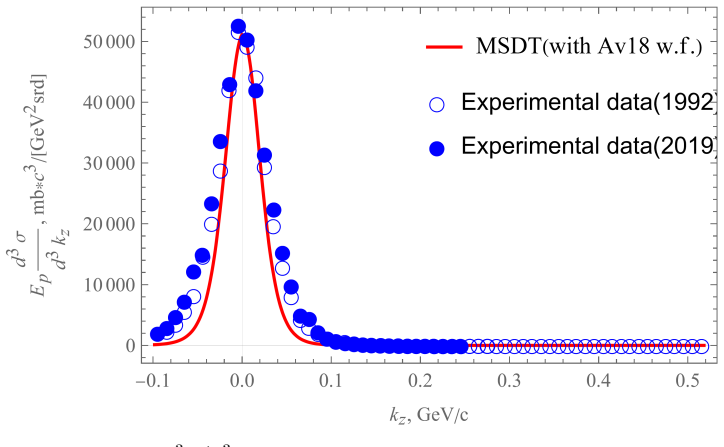

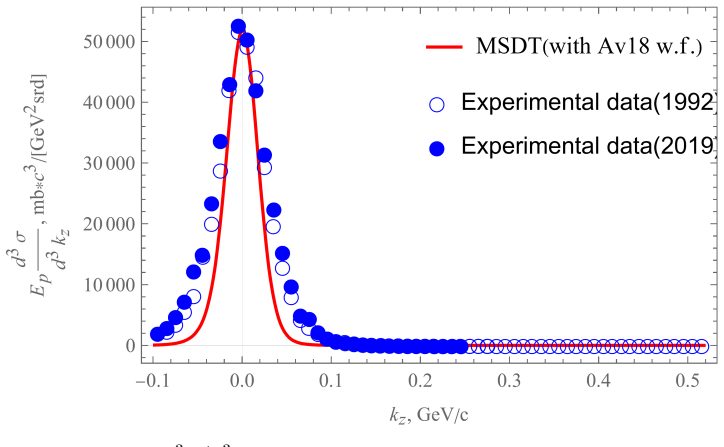


read the original abstract
In this work, within the framework of the Glauber-Sitenko approximation, an analysis of the differential cross section for deuteron breakup into a proton in the reaction H(d,p)X is presented. The study is carried out using various parameterizations of the deuteron wave function, including the single-Gaussian parametrization, the multi-Gaussian K2 parametrization, and models based on the Av18 and NijmI nucleon-nucleon potentials. Special attention is given to the effects of small longitudinal components of the transferred momentum (Qz < 0.5 GeV/c) and the transverse momentum of the proton-neutron pair (p_perp < 0.5 GeV/c) in the anti-laboratory reference frame. The results are compared with experimental data, particularly in the region of longitudinal momenta p\_3 = 0.25-0.5 GeV/c, where quark effects are expected to manifest. Preliminary estimates show a decrease in the cross section with increasing transverse momentum, as well as a relatively small shift (and growth) of the cross-section maximum due to the inclusion of the longitudinal component Qz.
Editorial analysis
A structured set of objections, weighed in public.
Referee Report
Summary. The manuscript analyzes the differential cross section for the H(d,p)X deuteron-breakup reaction in the Glauber-Sitenko diffraction approximation. It incorporates the longitudinal momentum-transfer component Qz (< 0.5 GeV/c) together with transverse momentum p_perp (< 0.5 GeV/c) in the anti-laboratory frame, employing four deuteron wave-function models (single-Gaussian, K2 multi-Gaussian, Av18, NijmI). Preliminary estimates are reported of a decrease in cross section with rising p_perp and a modest shift plus growth of the maximum when Qz is restored; results are compared with data in the p3 = 0.25–0.5 GeV/c interval where quark effects are anticipated.
Significance. If the quantitative trends survive a full error analysis and explicit validation of the eikonal assumptions, the work would supply a concrete test of the diffraction framework at intermediate momenta and help quantify the kinematic window in which quark-gluon degrees of freedom might become visible. The systematic comparison across several wave-function parametrizations is a clear strength that allows model dependence to be assessed.
major comments (2)
- [Abstract and §4 (Results)] Abstract and §4 (Results): the central claims of a decrease in cross section with p_perp and a small shift/growth of the maximum are stated only as “preliminary estimates” with no numerical values, error bars, or explicit comparison tables shown; without these the magnitude and statistical significance of the reported effects cannot be verified.
- [§2 (Formalism) and §3 (Kinematics)] §2 (Formalism) and §3 (Kinematics): the Glauber-Sitenko eikonal series is applied for Qz < 0.5 GeV/c and p_perp < 0.5 GeV/c without any explicit check that the high-energy, small-angle, and negligible-off-shell assumptions remain valid; this kinematic window precisely overlaps the short-distance region (p3 = 0.25–0.5 GeV/c) where the paper expects quark effects to appear, rendering the approximation’s applicability load-bearing for the claimed trends.
minor comments (2)
- [§1 (Introduction)] Define the anti-laboratory frame and the relation between p3, Qz and p_perp explicitly at first use to improve readability.
- [§2 (Wave functions)] Add a short table summarizing the parameters of each deuteron wave function (rms radius, D-state probability, etc.) for direct comparison.
Simulated Author's Rebuttal
We thank the referee for the careful reading of our manuscript and the constructive comments. We address each major comment below and indicate the revisions planned for the updated version.
read point-by-point responses
-
Referee: [Abstract and §4 (Results)] Abstract and §4 (Results): the central claims of a decrease in cross section with p_perp and a small shift/growth of the maximum are stated only as “preliminary estimates” with no numerical values, error bars, or explicit comparison tables shown; without these the magnitude and statistical significance of the reported effects cannot be verified.
Authors: We agree that the presentation would benefit from more quantitative detail. In the revised manuscript we will update the abstract and §4 to quote explicit numerical examples of the cross-section reduction with rising p_perp and the magnitude of the peak shift and growth when Qz is restored. A compact table comparing results obtained with and without the longitudinal component for the four wave-function models will also be added. A complete statistical error analysis lies beyond the scope of this initial exploration and is reserved for subsequent work. revision: partial
-
Referee: [§2 (Formalism) and §3 (Kinematics)] §2 (Formalism) and §3 (Kinematics): the Glauber-Sitenko eikonal series is applied for Qz < 0.5 GeV/c and p_perp < 0.5 GeV/c without any explicit check that the high-energy, small-angle, and negligible-off-shell assumptions remain valid; this kinematic window precisely overlaps the short-distance region (p3 = 0.25–0.5 GeV/c) where the paper expects quark effects to appear, rendering the approximation’s applicability load-bearing for the claimed trends.
Authors: We acknowledge the importance of this point. The revised §2 will contain an explicit paragraph discussing the range of validity of the Glauber-Sitenko eikonal approximation at the momenta considered, supported by references to earlier applications of the same framework to deuteron-breakup reactions at comparable energies. We will also state the kinematic conditions under which the high-energy and small-angle assumptions are expected to hold and note the proximity of the chosen window to the region where quark effects may appear. revision: yes
Circularity Check
No significant circularity; kinematic inclusion is independent of inputs
full rationale
The paper computes the differential cross section for H(d,p)X within the Glauber-Sitenko eikonal framework by adding the longitudinal momentum transfer Qz < 0.5 GeV/c and transverse p_perp < 0.5 GeV/c to the standard kinematic factors. It employs four external deuteron wave-function inputs (single-Gaussian parametrization, K2 multi-Gaussian, Av18 and NijmI potentials) taken from prior NN literature and performs direct numerical integration to obtain the reported decrease in cross section with p_perp and the small shift/growth of the maximum. These outcomes are explicit consequences of the added Qz term in the amplitude and are compared against experimental data; they do not reduce to the wave-function parameters or the Glauber-Sitenko ansatz by algebraic identity or by renaming a fit. No self-citation chain, uniqueness theorem, or fitted-input-as-prediction pattern appears in the derivation. The calculation remains self-contained against external benchmarks.
Axiom & Free-Parameter Ledger
free parameters (1)
- deuteron wave-function parameters
axioms (1)
- domain assumption Glauber-Sitenko approximation is applicable for the small-momentum kinematics considered
Reference graph
Works this paper leans on
-
[1]
Including the longitudinal transferred momentum componentQz and the transverse momenta of nucleons in the anti-laboratory reference frame, and analyzing their impact on the cross- section shape
-
[2]
Investigating how these effects influence the conclusions of previous studies concerning the manifestation of quark degrees of freedom in the short-range part of the deuteron wave func- tion. The second objective warrants separate discussion. The relevance of this investigation is further underscored by the fact that soon after the pioneering studies [7],...
-
[3]
This definition is valid in the vicinity ofp 3 ∼ 1 2 pd
=p ∗ 3, wherep ∗ andn ∗ are the proton and neutron momenta in the so-called anti-laboratory frame, whilepandnrefer to their momenta in the laboratory frame. This definition is valid in the vicinity ofp 3 ∼ 1 2 pd. 6 In Ref. [30], the perpendicular component of the relative momentum in the anti-laboratory frame, p⊥, was set to zero. However, in reality, du...
-
[4]
(Figs. 1-4); for the multi-Gaussian parametrization K2 [49] (Figs. 5-8); for the multi-Gaussian parametrization Av18 [50] (Figs. 9 -14); and for the realistic Nijm-I potential [37] (Figs. 15, 16). Figure 1: Dependence ofE p d3σ/d3konk z, calculated using the single-Gaussian "Tartakovsky parametrization" [32], forp x = 0.00001GeV/candQ z = 0.00001GeV/c. Th...
-
[5]
The coefficient in front of the delta function must be equal to 1: |D|2(2π)3 = (2π)3 ⇒D= 1
-
[6]
The second term,|C| 2 ( ˜φ∗ s(k) ˜φs(k′) + ˜φ∗ d(k) ˜φd(k′)), must vanish. However, this is only possible if: •C= 0(which contradicts the previous results, sinceC= (2π) 3/2D= (2π) 3/2; see Appendices A,B, andCI), •or the Fourier transforms of the bound states satisfy a special condition:˜φ ∗ s(k) ˜φs(k′) + ˜φ∗ d(k) ˜φd(k′)≪δ(k−k ′), which holds for locali...
-
[7]
The Deuteron: Structure and Form Factors,
M. Gar¸ con, J. W. Van Orden, “The Deuteron: Structure and Form Factors,” in: J. W. Negele, E. W. Vogt (Eds.),Advances in Nuclear Physics, Vol. 26 (Springer, Boston, MA, 2001), p. 293. doi:10.1007/0-306-47915-X_4. 29
-
[8]
Amarasingheet al., “Variational study of two-nucleon systems with lattice QCD,”Phys. Rev. D107 (2023) 094508; Erratum:Phys. Rev. D110(2024) 119904. doi:10.1103/PhysRevD.107.094508
-
[9]
Polarization observables in A(d,p) breakup and quark degrees of freedom in the deuteron,
A. P. Kobushkin, “Polarization observables in A(d,p) breakup and quark degrees of freedom in the deuteron,”Phys. Lett. B421(1998) 53–58;Phys. Atom. Nucl.62(1999) 1146;Yad. Fiz.62(1999) 1213. doi:10.1016/S0370-2693(97)01602-X
-
[10]
Novel QCD phenomena in deuteron collisions,
S. J. Brodsky, “Novel QCD phenomena in deuteron collisions,”Few-Body Syst.63(2022) 72. doi:10.1007/s00601-022-01765-x
-
[11]
Deuteron structure at high momentum transfer,
M. Strikman, “Deuteron structure at high momentum transfer,”J. Phys. G50(2023) 033001. doi:10.1088/1361-6471/ace5f1
-
[12]
Ya. D. Krivenko-Emetov, O. S. Shevchuk, “Investigation of the internal structure of the deuteron against two-photon exchange effects in elastic e–d scattering,”Nucl. Phys. At. Energy25(2024) 309. doi:10.15407/jnpae2024.04.309
-
[13]
Proton momentum spectrum from deuteron fragmentation at 8.9 GeV/c,
V. G. Ableevet al., “Proton momentum spectrum from deuteron fragmentation at 8.9 GeV/c,”Nucl. Phys. A393(1983) 491;411(1984) 501;Sov. JETP Lett.37(1983) 196
work page 1983
-
[14]
Study of high-energy deuteron interactions,
S. A. Zaporozhetset al., “Study of high-energy deuteron interactions,” in:Proc. VIII Int. Seminar in High Energy Problems(Dubna, JINR D1,2-86-668, 1986), p. 341
work page 1986
-
[15]
Cross section andT20 in 0°deuteron breakup at 2.1 GeV,
C. F. Perdrisatet al., “Cross section andT20 in 0°deuteron breakup at 2.1 GeV,”Phys. Rev. Lett.59 (1987) 2840. doi:10.1103/PhysRevLett.59.2840
-
[16]
Tensor analyzing power of12C(d,p) at 9.1 GeV/c,
V. G. Ableevet al., “Tensor analyzing power of12C(d,p) at 9.1 GeV/c,”Pis’ma v ZhETF47(1988) 558
work page 1988
-
[17]
Deuteron breakup at 2.1 and 1.25 GeV,
V. Punjabiet al., “Deuteron breakup at 2.1 and 1.25 GeV,”Phys. Rev. C39(1989) 608. doi:10.1103/PhysRevC.39.608
-
[18]
Proton and triton momentum distributions from4He fragmentation,
V. G. Ableevet al., “Proton and triton momentum distributions from4He fragmentation,”Few-Body Syst.8(1991) 137
work page 1991
-
[19]
Polarization transfer and tensor analyzing power in polarized deuteron breakup,
A. A. Nomolovet al., “Polarization transfer and tensor analyzing power in polarized deuteron breakup,” Phys. Lett. B325(1994) 327. doi:10.1016/0370-2693(94)90020-5
-
[20]
Tensor analyzing powerT20 in inclusive deuteron breakup at 9 GeV/c,
L. S. Azhgireyet al., “Tensor analyzing powerT20 in inclusive deuteron breakup at 9 GeV/c,”Phys. Lett. B387(1996) 37. doi:10.1016/0370-2693(96)01007-6
-
[21]
Polarization transfer in1H(d,p)X at 2.1 GeV,
N. E. Cheunget al., “Polarization transfer in1H(d,p)X at 2.1 GeV,”Phys. Lett. B284(1992) 210
work page 1992
-
[22]
Polarization transfer in (d,p) at 4.5 GeV/c proton momentum,
B. Kuehnet al., “Polarization transfer in (d,p) at 4.5 GeV/c proton momentum,”Phys. Lett. B334 (1994) 298
work page 1994
-
[23]
Tensor analyzing powerT20 for ⃗d+12C→p(0 ◦) +X,
T. Aonoet al., “Tensor analyzing powerT20 for ⃗d+12C→p(0 ◦) +X,”Phys. Rev. Lett.74(1995) 4997. doi:10.1103/PhysRevLett.74.4997
-
[24]
Relativistic polarized deuteron fragmentation as a test of the six-quark nature,
A. P. Kobushkin, L. Vizireva, “Relativistic polarized deuteron fragmentation as a test of the six-quark nature,”J. Phys. G8(1982) 893
work page 1982
-
[25]
Relativistic and spin effects in elastic backward p-d scattering
A. P. Ierusalimov, G. I. Lykasov, M. Viviani, “Relativistic and spin effects in elastic backward p–d scattering,” arXiv:1002.0249 (2010). arXiv:1002.0249. 30
work page internal anchor Pith review Pith/arXiv arXiv 2010
-
[26]
O. G. Sitenko, V. K. Tartakovskyi,Nuclear Theory(Kyiv: Lybid, 2000), 608 p
work page 2000
-
[27]
M. N. Platonova, “Dibaryon resonances and three-body forces in large-angle pd elastic scattering at intermediate energies,”Phys. Part. Nucl.54(2023) 405
work page 2023
-
[28]
Evidence for a new resonance from polarized neutron–proton scattering,
P. Adlarsonet al., “Evidence for a new resonance from polarized neutron–proton scattering,”Phys. Rev. Lett.112(2014) 202301. doi:10.1103/PhysRevLett.112.202301
-
[29]
V. G. Ableev, D. V. Anchishkin, Kh. Dimitrov, S. A. Zaporozhets,et al., Momentum distribution of protons and deuterons from 3He fragmentation by carbon at 10.78 GeV/c and zero angles, J. Exp. Theor. Phys. Lett.,45, 596–599 (1987); Proc. of VIII Int. Seminar on High Energy Problems (Dubna, June 1986), D1, 2-86-668, 341–349 (1986)
work page 1987
-
[30]
L. S. Azhgirey,et al., JINR Rap. Comm.,3-96, 23 (1996)
work page 1996
-
[31]
L. S. Azhgirey,et al., Phys. Atom. Nucl.,61, 432–447 (1998) [Yad. Fiz.,61, 494–510 (1998)]; Phys. Lett. B,391, 22–28 (1997)
work page 1998
-
[32]
Inelastic diffraction scattering,
R. J. Glauber, “Inelastic diffraction scattering,”Phys. Rev.115(1959) 928. doi:10.1103/PhysRev.115.928
-
[33]
Diffractional scattering of fast deuterons by nuclei,
A. I. Akhiezer, A. G. Sitenko, “Diffractional scattering of fast deuterons by nuclei,”Phys. Rev.106 (1957) 1236. doi:10.1103/PhysRev.106.1236
-
[34]
// Preprint, Institute for Nuclear Research, NAS of Ukraine
Nemetz F. // Preprint, Institute for Nuclear Research, NAS of Ukraine. – 1980. – № ITF-79-31R
work page 1980
-
[35]
High-energy scattering of protons by nuclei,
R. J. Glauber, G. Matthiae, “High-energy scattering of protons by nuclei,”Nucl. Phys. B21(1970) 135. doi:10.1016/0550-3213(70)90511-0
-
[36]
Effect of the Coulomb interaction in A(d,p) fragmentation
A. P. Kobushkin, Ya. D. Krivenko-Emetov, “Effect of the Coulomb interaction in A(d,p) fragmenta- tion,”Ukr. J. Phys.53(2008) 751. doi:10.48550/arXiv.0712.1151
work page internal anchor Pith review Pith/arXiv arXiv doi:10.48550/arxiv.0712.1151 2008
-
[37]
Energy spectra of protons in diffraction break-up of deuterons on 12C and 40Ca,
V. V. Davydovskyy, A. D. Foursat, “Energy spectra of protons in diffraction break-up of deuterons on 12C and 40Ca,”Nucl. Phys. At. Energy17(2016) 111
work page 2016
-
[38]
Diffraction splitting of a triton by an incident proton,
V. K. Tartakovsky, A. V. Fursaev, B. I. Sidorenko, “Diffraction splitting of a triton by an incident proton,”Phys. Atom. Nucl.68(2005). doi:10.1134/1.1858555
-
[39]
V. K. Tartakovskyi, V. I. Kovalchuk, Rozshcheplennia deitroniv z enerhiiamy 23 ta 26 MeV iadramy 64Cu, 197Au,Zhurnal fizychnykh doslidzhen (Journal of Physical Studies), vol. 10, no. 1 (2006), pp. 29–34
work page 2006
-
[40]
V. K. Tartakovsky, O. I. Ivanova,The diffraction scattering of two-cluster nuclei on protons with taking into account the Coulomb interaction, Yaderna Fizika (Nuclear Physics), UDC 539.171, [year, vol., no., pp.]
-
[41]
Deuteron breakup at zero angle in the Coulomb nuclear field,
I. Sitnik, “Deuteron breakup at zero angle in the Coulomb nuclear field,” ISHEPP (Dubna, 2019)
work page 2019
-
[42]
Ya. D. Krivenko-Emetov, “Effect of the Coulomb interaction on inelastic deuteron scattering and the structure of the deuteron,”Management of Development of Complex Systems48(2021) 75. doi:10.32347/2412-9933.2021.48.75-84
-
[43]
Construction of high-quality NN potential models,
W. G. J. Stoks, R. A. M. Klomp, C. P. F. Terheggen, J. J. de Swart, “Construction of high-quality NN potential models,”Phys. Rev. C49(1994) 2950. doi:10.1103/PhysRevC.49.2950. 31
-
[44]
M. A. Braun, V. V. Vechernin, On the role of pion rescattering in the formation of cumulative protons from the deuteron,Yadernaya Fizika40(1984) 1588–1590
work page 1984
-
[45]
M. A. Braun, V. V. Vechernin, Contribution of pion rescattering to cumulative proton production on the deuteron,Yadernaya Fizika43(1986) 1579–1586
work page 1986
-
[46]
Seely et al.,Modification of the nucleon structure in nuclear matter, Phys
J. Seely et al.,Modification of the nucleon structure in nuclear matter, Phys. Rev. Lett.103, 202301 (2009), 10.1103/PhysRevLett.103.202301
-
[47]
Buballa,NJL-model analysis of quark matter, Phys
M. Buballa,NJL-model analysis of quark matter, Phys. Rept.407, 205 (2005), 10.1016/j.physrep.2004.11.004
-
[48]
K. Saito, K. Tsushima, A. W. Thomas, Quark-meson coupling model for finite nuclei,Prog. Part. Nucl. Phys.58, 1 (2007). doi:10.1016/j.ppnp.2005.07.003
-
[49]
Bazavov et al.,QCD phase diagram from lattice simulations, Phys
A. Bazavov et al.,QCD phase diagram from lattice simulations, Phys. Rev. D95, 054504 (2019), 10.1103/PhysRevD.95.054504
-
[50]
Aokiet al., Review of lattice results concerning low-energy particle physics,Eur
S. Aokiet al., Review of lattice results concerning low-energy particle physics,Eur. Phys. J. C77, 112 (2017). doi:10.1140/epjc/s10052-016-4509-7
-
[51]
S. Gongyo, K. Sasaki, T. Miyamoto, S. Aoki, T. Doi, T. Hatsuda, Y. Ikeda, T. Inoue, N. Ishii, Thed ∗ dibaryon from lattice QCD, Phys. Lett. B811, 135935 (2020). doi:10.48550/arXiv.2006.00856, arXiv:2006.00856 [hep-lat]
-
[52]
L. D. Landau, E. M. Lifshitz,Quantum Mechanics: Non-Relativistic Theory, 3rd ed., (Pergamon Press, Oxford, 1977)
work page 1977
-
[53]
O. O. Beiyuskinaet al., Energy distributions of protons in the D(d,p) reaction,Nucl. Phys. At. Energy 16(2015) 343–351
work page 2015
-
[54]
Evlanov M.V., Polozov A.D., and Struzhko B.G. //Ukr. J.Phys.1980. 25. P. 813
work page 1980
-
[55]
P’yatnytskyi D. V., Simenog I. V. Nuclear interaction potentials for joint description of few-nucleon systems and structural functions of three-nucleon nuclei // Ukr. J. Phys. – 2008. – Vol. 53, No. 7. – P. 629–639.; Hrynyuk B. Ye., Simenog I. V. High-precision variational calculations of energies and sizes of D, T, 3He and 4He nuclei // Ukr. J. Phys. – 2...
work page 2008
-
[56]
Accurate nucleon–nucleon potential with charge- independence breaking,
R. B. Wiringa, V. G. J. Stoks, R. Schiavilla, “Accurate nucleon–nucleon potential with charge- independence breaking,”Phys. Rev. C51(1995) 38. doi:10.1103/PhysRevC.51.38
-
[57]
D.,Electron scattering and nuclear structure, Advances in Physics,15(1966), 1–109
De Forest T., Walecka J. D.,Electron scattering and nuclear structure, Advances in Physics,15(1966), 1–109
work page 1966
-
[58]
Donnelly T. W., Walecka J. D.,Electron Scattering and Nuclear Structure, Annual Review of Nuclear Science,25(1975), 329–405
work page 1975
-
[59]
Kobushkin A. P.,Deuteron Electromagnetic Form-Factors at the Large Transferred Momentum, Yader- naya Fizika,28(1978), 495–509. 32
work page 1978
discussion (0)
Sign in with ORCID, Apple, or X to comment. Anyone can read and Pith papers without signing in.