REVIEW 3 major objections 4 minor 3 cited by
High-Fidelity Microwave-Polarization Control in a Rydberg-Ensemble Experiment
T0 review · 3 major / 4 minor · reviewed 2026-08-05 · deepseek-v4-flash
Pith's one-line read Three repurposed DC electrodes, calibrated in place by Rydberg-EIT measurements, generate σ−, π, and σ+ microwaves with >99% fidelity in a steel chamber not built for microwave control.
desk verdict A genuinely useful methods paper: measured chamber matrix plus manual fine-tuning gives >99% polarization purity in a reflective chamber, and the self-calibration caveat is real but not fatal. read the letter →
The pith
A machine-rendered reading of the paper's core claim, the machinery that carries it, and where it could break.
The reading
What carries the argument
The 'chamber matrix' $C$ is the central object: a 3×3 complex linear map (18 real parameters) from the three source voltage amplitudes $V_\alpha$ to field components $E_q$ in the spherical ($\sigma_-,\pi,\sigma_+$) basis. Its nine amplitudes are measured from single-source Rydberg-EIT avoided crossings via a four-level susceptibility fit; its relative phases, from two-source interference sinusoids. The probe is blind to phase between orthogonal polarizations, so purification controls intensities, with orientation left to further interference techniques. Off-resonance, the machinery is an auxiliary field creating two-photon resonances to the $87D$ manifold, using single-pathway states $|d,-5/
What would settle it
Take identical control settings and extract the fields with a method independent of the four-level EIT fit — a Rydberg heterodyne mixer, a different Rydberg state pair, or EIT scans with the quantization axis rotated ($B$ along $\hat{x}$) — and compare the inferred $\{E_q,\varphi_q\}$ with chamber-matrix predictions. Disagreement beyond the quoted $\pm1\sigma$ uncertainties falsifies the claimed fidelities. The rotated-basis test also probes the unmeasured relative phase between orthogonal polarizations: a correct $C$ must reproduce the same fields when expressed in either basis.
Extended reading notes
Core claim
The central claim: high-purity microwave polarization can be synthesized inside a reflective chamber by measuring rather than modeling the fields. Three DC-electrode sets are calibrated through a measured 3×3 complex 'chamber matrix' $C$ from source voltages $V$ to the field $E$ at the atoms; nine amplitude elements come from single-source Rydberg-EIT avoided crossings, and relative phases from two-source interference. From $C^{-1}$ plus manual fine-tuning, the authors reach fidelities of 99.60(5)%, 99.2(1)%, and 99.58(5)% and form superpositions by adding purified voltage vectors. Off-resonance, an auxiliary field opens two-photon transitions to the $87D$ manifold, closing the unwanted cros
Load-bearing premise
The reported fidelities stand or fall with the four-level susceptibility model that converts measured EIT spectra into Rabi frequencies and field amplitudes: the same fitting model both calibrates the chamber matrix and sets the final fidelity numbers, so a systematic bias in the model would enter both without being detected.
Editorial extensions
If this is right
- Because the control system is linear, superposition polarizations are generated by adding the purified voltage vectors, so any desired set of polarization intensities can be produced by electronic adjustment alone.
- Experiments no longer must design chambers and antennas to suppress microwave reflections; a conductive chamber with any three independent radiating structures can be calibrated in place, relaxing apparatus-design constraints.
- Within the roughly 50 MHz calibration bandwidth the fields are characterized to better than 99% purity, and the two-photon method extends this reach far outside that band, demonstrated at 5418 MHz.
- The stated applications follow directly: engineering dipolar interactions among Rydberg atoms (blockade enhancement, nullified interactions, asymmetric blockade) and polarization-sensitive microwave shielding of ultracold molecules.
- The paper's own boundary: relative phases between orthogonal polarization components are not measured, so superpositions have precisely specified intensities but an unknown field orientation in the plane transverse to the quantization axis.
Reading between the lines
- Because the same four-level susceptibility model converts spectra into fields on both the calibration and verification sides, a systematic model error would survive the loop undetected; an independent field probe (a second Rydberg state pair or a heterodyne mixer) would bound that shared error.
- The chamber-matrix recipe is generic — any three linearly independent radiators in any reflective enclosure could be calibrated the same way — so the protocol should transfer to other atom species, molecule experiments, and microwave bands without new theory.
- Measuring the inter-polarization phase, for example by the paper's suggested rotation of the quantization axis, would upgrade the system from intensity-specified to fully orientation-specified vector field synthesis.
- The two-photon barrier is practical rather than fundamental: higher powers should reach further detunings, and a systematic sweep over S, P, D state choices could map the accessible frequency landscape, since the paper notes accidental resonances as the main obstacle.
Editorial analysis
A structured set of objections, weighed in public.
Referee Report
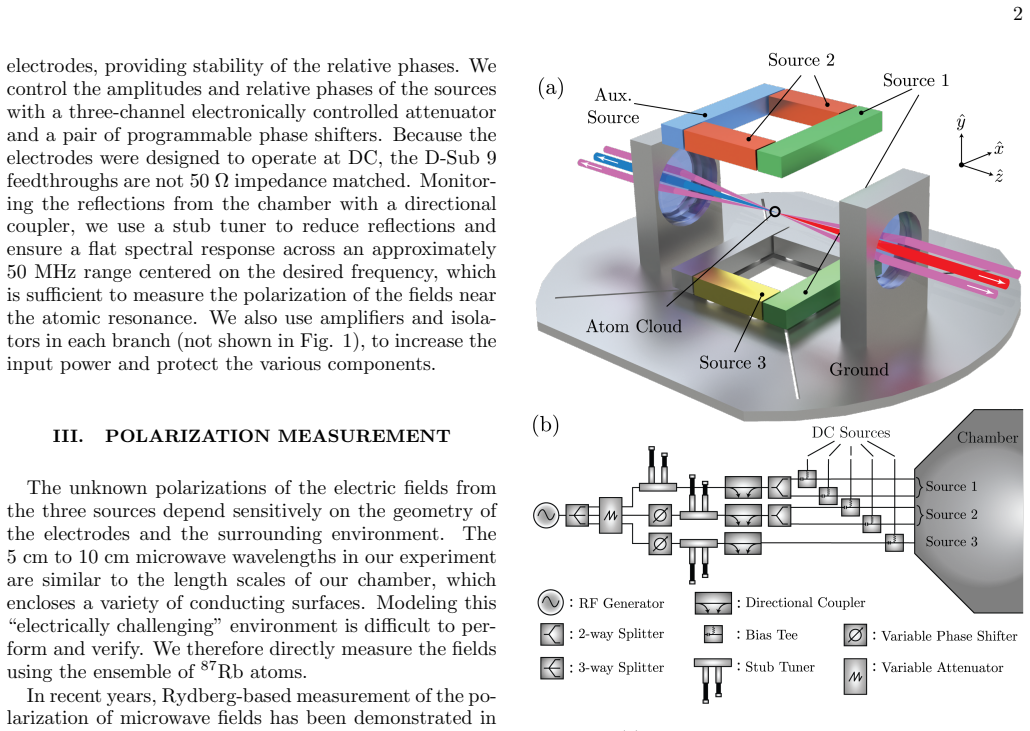
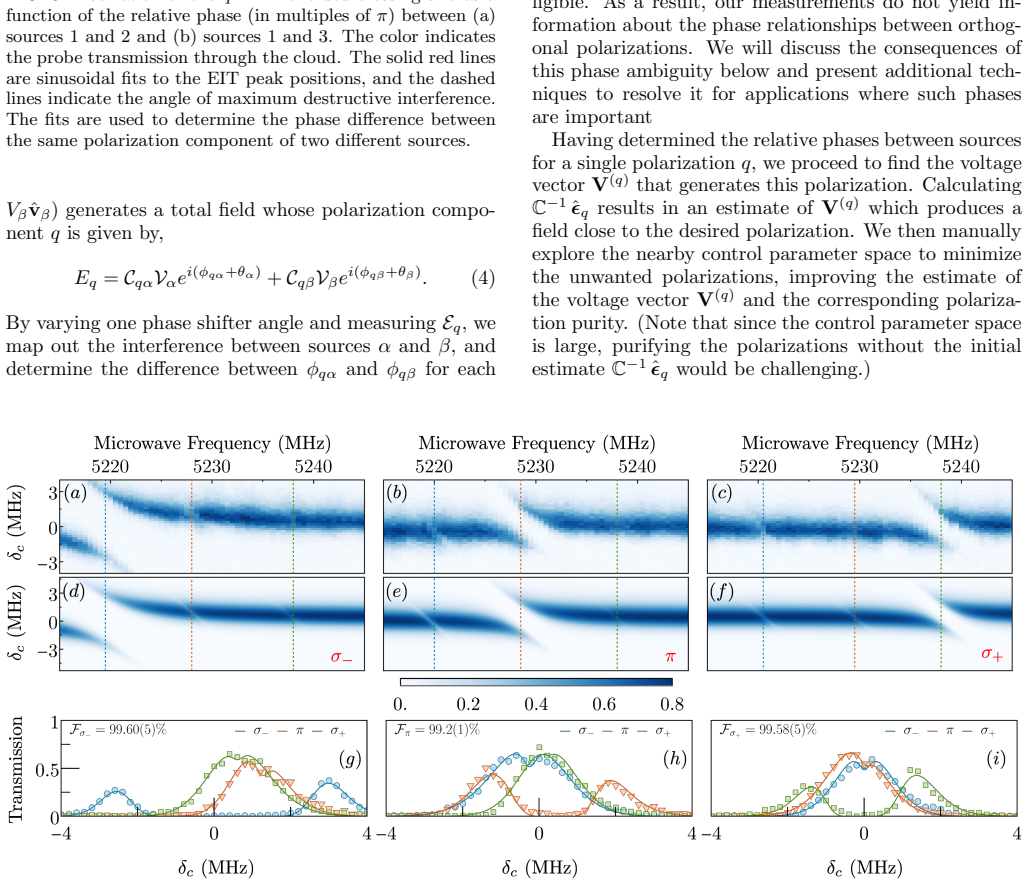
Summary. The paper reports a method for generating high-fidelity microwave polarizations inside a stainless-steel vacuum chamber that was not designed for microwave control. Three sets of in-vacuum DC electrodes are repurposed as microwave antennas, driven with independent amplitude and phase control. The fields at the atoms are characterized by Rydberg-EIT avoided-crossing spectroscopy of the 88S1/2-88P3/2 manifold, yielding a 3x3 complex chamber matrix C that maps control voltages to spherical-basis field components. Using C^{-1} plus manual fine-tuning, the authors produce σ−, π, and σ+ fields with quoted fidelities 99.60(5)%, 99.2(1)%, and 99.58(5)% (defined as the normalized projection of the field onto the desired polarization). They also demonstrate off-resonant purification at 5418 MHz by using an auxiliary field that creates two-photon resonances between S and D manifolds, closing unwanted avoided crossings. The paper is clearly written, and the experimental approach is novel and practical.
Significance. If the reported numbers hold, the work is significant: it relaxes the common requirement that microwave environments be carefully designed for polarization purity, and it provides a systematic calibration procedure that can be transferred to Rydberg-atom and polar-molecule experiments where arbitrary microwave polarization engineering is needed. The paper's strengths include the use of external atomic benchmarks (known Rb dipole matrix elements and Zeeman structure), a measured rather than assumed chamber matrix, full-manifold simulations that reproduce the observed spectra, a clear disclosure of the relative-phase ambiguity for orthogonal polarizations, and openly available data. The main limitation is that the fidelity numbers and the calibration share the same EIT extraction model, so systematic errors in that model would enter both calibration and verification; the quoted uncertainties are statistical only.
major comments (3)
- [Introduction and Section V, Fig. 4] The text says the authors realize polarizations with 'intensity fidelities > 99%', but Eq. (in Fig. 4) defines fidelity as F_q = E(q)·ε_q / |E(q)|, which is a field-amplitude fidelity, not an intensity fidelity. For the π polarization the quoted amplitude ratios (0.097 : 1 : 0.076) give F_π = 99.2% but the intensity fraction in the desired polarization is only 1/(1+0.097^2+0.076^2) = 98.5%. Thus the 'intensity fidelity' statement is not supported by the definition. Please correct the terminology consistently, either by using 'field fidelity' throughout or by recomputing the intensities if the intent is literally an intensity ratio.
- [Sections III and V, Figs. 2(c) and 4(g-i)] The chamber matrix and the quoted fidelities are both extracted from the same four-level EIT susceptibility model. A systematic error in converting measured transmission spectra into Rabi frequencies—for example from unmodeled optical-depth or Doppler averaging, an uncalibrated control Rabi frequency, residual DC electric fields, or small field gradients across the ensemble—would shift the calibration and the verification in the same direction and would not show up in the quoted ±1σ statistical uncertainties. Since the unwanted amplitudes that limit the fidelities are only 0.06–0.10 relative to the desired component, such systematics are directly relevant to the '>99%' claim. I request a quantitative systematic-uncertainty estimate or an independent cross-check (e.g., varying control power/optical depth, using a different Rydberg transition, rotating the quantization axis, or comparing w
- [Section VI] The off-resonance demonstration convincingly shows that selected two-photon avoided crossings can be closed, but no final fidelity is quantified. The paper does not overclaim absolute numbers here, but the wording 'purification' could be clarified to state that the demonstrated observable is the closing of the target avoided crossings, not a measured global field fidelity. A sentence defining what is demonstrated (and what is not) at 5418 MHz would prevent overinterpretation.
minor comments (4)
- [Abstract and Section II] The abstract says 'three in-vacuum DC electrodes', but the text and Fig. 1 refer to three sets of electrodes. Please align the wording.
- [Fig. 2(c) and text] The caption/text describes 'red and blue solid lines', but the figure shows an unperturbed EIT peak in orange and an Autler-Townes spectrum in blue. Please correct the color labels.
- [Section V] The manual fine-tuning step after C^{-1} is not described. A brief description of the search procedure (e.g., how many parameters were varied, what criterion was used to stop) would improve reproducibility.
- [Section VI] The phrase 'well outside our typical purification bandwidth' is vague. Earlier the purification bandwidth is quoted as roughly 50 MHz around resonance; explicitly stating that 5418 MHz is about 200 MHz detuned from the unperturbed resonance is helpful, but the reader must infer the bandwidth statement. Please specify the detuning and the operating bandwidth more precisely.
Circularity Check
No circularity: the chamber matrix is measured, fidelity is an optimized experimental result, and the only self-references are non-load-bearing context citations.
full rationale
The paper's derivation chain is self-contained and anchored to external atomic benchmarks. The chamber matrix C is measured, not postulated: Rabi frequencies are extracted from Rydberg-EIT transmission spectra using a four-level probe-susceptibility model and converted to field amplitudes via known dipole matrix elements and Zeeman structure (Sec. III). The fidelity is then defined directly from the measured field E(q) and the desired spherical unit vector (Sec. V). The voltage vectors V(q) are obtained by inverting the measured C and then manually minimizing unwanted polarizations in the measured spectra, so the reported >99% fidelities are experimental optimization outcomes, not identities or fitted parameters renamed as predictions. The same EIT model is used for calibration and verification, which is a measurement-accuracy limitation rather than a logical circularity; the paper honestly states the statistical nature of uncertainties and the lack of measured phases between orthogonal polarizations. The only self-citations (Refs. [14] and [33]) are context and data-availability pointers and are not load-bearing. No circular step satisfying the required evidentiary standard was found.
Assumptions & free parameters
assumptions (6)
- domain assumption The 87Rb Rydberg level structure, dipole matrix elements dq, and Zeeman shifts used to convert measured Rabi frequencies into field amplitudes are accurate.
- domain assumption The chamber response is linear: E = C V, with a fixed complex 3x3 matrix C over the operating bandwidth.
- domain assumption With stray DC fields nulled and a 0.5 mT field along the probe axis, the quantization axis is well defined so σ−, π, σ+ components map onto spectrally resolved resonances.
- domain assumption Zeeman splittings exceed the microwave Rabi frequencies at the used magnetic fields, so interference between different polarization components is negligible in the phase-difference measurements.
- domain assumption The chosen |s⟩ to |d, mJ⟩ two-photon transitions (mJ = −5/2 and +3/2) have a single excitation pathway, so closing their avoided crossings uniquely implies elimination of the corresponding primary polarization.
- domain assumption The auxiliary microwave field has nonzero amplitude in all three polarizations across the frequency range of interest.
Cite this review
Pith. "Pith review of High-Fidelity Microwave-Polarization Control in a Rydberg-Ensemble Experiment." pith.science (2026). https://pith.science/paper/7GSEKVR4
@misc{pith2026250806820,
  author       = {Pith},
  title        = {Pith review of: High-Fidelity Microwave-Polarization Control in a Rydberg-Ensemble Experiment},
  year         = {2026},
  howpublished = {\url{https://pith.science/paper/7GSEKVR4}},
  note         = {Machine review of arXiv:2508.06820}
}
abstract
Control of the polarization of microwave fields is a key experimental capability for a number of atomic physics platforms. However, producing high-fidelity microwaves requires a well-controlled microwave environment, where reflections that distort the polarization must be avoided or well characterized, a constraint that often conflicts with other experimental design considerations. Here we demonstrate a microwave control system capable of producing high-fidelity microwave polarizations in a Rydberg-ensemble experiment. We use three in-vacuum DC electrodes, repurposed as microwave antennae, to produce imperfect and initially unknown polarizations. Each source is driven with independent phase and amplitude control to generate the desired microwave fields. We probe the fields produced at the position of the atoms using Rydberg-EIT spectroscopy of the microwave-induced avoided crossings. We produce $\sigma_-$, $\pi$, and $\sigma_+$ polarized microwaves with > 99 % fidelity and generate their combinations. We extend our purification techniques to frequencies away from Rydberg resonances by utilizing an auxiliary microwave field, generating two-photon microwave resonances. The techniques developed here will facilitate the engineering of dipolar interactions in atomic and molecular physics experiments.
Figures


Figures from the paper (4 more)


Forward citations
Cited by 3 Pith papers
-
Self-calibrated multiparameter measurement of three-dimensional microwave fields
Multi-level Zeeman-resolved Rydberg EIT extracts 3D MW polarization amplitudes and relative phases self-calibrated from one spectrum via internal closed interferometric loops.
-
Generation of strong ultralow-phase-noise microwave fields with tunable ellipticity for ultracold polar molecules
A dual-feed rectangular waveguide with low-noise electronics delivers 6.9 kV/m, polarization-tunable microwaves at 5.64 GHz, reaching 71 MHz Rabi frequencies and 9.6 s one-body lifetimes for 23Na40K molecules.
-
Observation of anomalous Floquet non-Abelian topological insulators
An acoustic crystal driven by time-periodic couplings shows topological edge modes in all three gaps even though the bulk is topologically trivial.
Reference graph
Works this paper leans on
-
[1]
Coherent transfer between low-angular momentum and circular Rydberg states
A. Signoles, E. K. Dietsche, A. Facon, D. Grosso, S. Haroche, J. M. Raimond, M. Brune, and S. Gleyzes, Coherent Transfer between Low-Angular-Momentum and Circular Rydberg States, Physical Review Letters 118, 253603 (2017), 1703.05918
work page Pith review arXiv 2017
-
[2]
S. R. Cohen and J. D. Thompson, Quantum Computing with Circular Rydberg Atoms, PRX Quantum 2, 030322 (2021), 2103.12744
arXiv 2021
-
[3]
Microwave shielding of ultracold polar molecules with imperfectly circular polarization
T. Karman and J. M. Hutson, Microwave shielding of ultracold polar molecules with imperfectly circular polarization, Physical Review A 100, 052704 (2019), 1908.01759
work page Pith review arXiv 2019
-
[4]
Observation of Microwave Shielding of Ultracold Molecules
L. Anderegg, S. Burchesky, Y. Bao, S. S. Yu, T. Karman, E. Chae, K.-K. Ni, W. Ketterle, and J. M. Doyle, Ob- servation of microwave shielding of ultracold molecules, Science 373, 779 (2021), 2102.04365
work page Pith review arXiv 2021
-
[5]
Dipolar evaporation of reactive molecules to below the Fermi temperature
G. Valtolina, K. Matsuda, W. G. Tobias, J.-R. Li, L. D. Marco, and J. Ye, Dipolar evaporation of reactive molecules to below the Fermi temperature, Nature 588, 239 (2020), 2007.12277
work page Pith review arXiv 2020
-
[6]
Evaporation of microwave-shielded polar molecules to quantum degeneracy
A. Schindewolf, R. Bause, X.-Y. Chen, M. Duda, T. Kar- man, I. Bloch, and X.-Y. Luo, Evaporation of microwave- shielded polar molecules to quantum degeneracy, Nature 607, 677 (2022), 2201.05143
work page Pith review arXiv 2022
-
[7]
Observation of Bose-Einstein Condensation of Dipolar Molecules
N. Bigagli, W. Yuan, S. Zhang, B. Bulatovic, T. Karman, I. Stevenson, and S. Will, Observation of Bose–Einstein condensation of dipolar molecules, Nature 631, 289 (2024), 2312.10965
work page Pith review arXiv 2024
-
[8]
A. V. Gorshkov, P. Rabl, G. Pupillo, A. Micheli, P. Zoller, M. D. Lukin, and H. P. B¨ uchler, Suppression of Inelas- tic Collisions Between Polar Molecules With a Repul- sive Shield, Physical Review Letters 101, 073201 (2008), 0805.0457
work page Pith review arXiv 2008
Show all 33 references
-
[9]
Karman and J
T. Karman and J. M. Hutson, Microwave Shielding of Ultracold Polar Molecules, Physical Review Letters 121, 163401 (2018), 1806.03608
2018 arXiv
-
[10]
Karman, N
T. Karman, N. Bigagli, W. Yuan, S. Zhang, I. Steven- son, and S. Will, Double Microwave Shielding, arXiv 10.48550/arxiv.2501.08095 (2025), 2501.08095
2025 doi
-
[11]
Tanasittikosol, J
M. Tanasittikosol, J. D. Pritchard, D. Maxwell, A. Gau- guet, K. J. Weatherill, R. M. Potvliege, and C. S. Adams, Microwave dressing of Rydberg dark states, Journal of Physics B: Atomic, Molecular and Optical Physics 44, 184020 (2011), 1102.0226
2011 arXiv
-
[12]
Brekke, J
E. Brekke, J. O. Day, and T. G. Walker, Excitation sup- pression due to interactions between microwave-dressed Rydberg atoms, Physical Review A 86, 033406 (2012), 1207.3006
2012 arXiv
-
[13]
Xu, G.-S
B. Xu, G.-S. Ye, Y. Chang, T. Shi, and L. Li, Con- tinuously tunable single-photon level nonlinearity with Rydberg state wave-function engineering, Reports on Progress in Physics 87, 110502 (2024)
2024
-
[14]
Kurdak, P
D. Kurdak, P. R. Banner, Y. Li, S. R. Muleady, A. V. Gorshkov, S. L. Rolston, and J. V. Porto, Enhancement of Rydberg Blockade via Microwave Dressing, Physical Review Letters 134, 123404 (2025), 2411.08236
2025 arXiv
-
[15]
Sevin¸ cli and T
S. Sevin¸ cli and T. Pohl, Microwave control of Rydberg atom interactions, New Journal of Physics 16, 123036 (2014), 1412.4925
2014 arXiv
-
[16]
Shi and T
X.-F. Shi and T. A. B. Kennedy, Annulled van der Waals interaction and fast Rydberg quantum gates, Physical Review A 95, 043429 (2017), 1606.08516
2017 arXiv
-
[17]
J. T. Young, P. Bienias, R. Belyansky, A. M. Kaufman, and A. V. Gorshkov, Asymmetric Blockade and Multi- qubit Gates via Dipole-Dipole Interactions, Physical Re- view Letters 127, 120501 (2021), 2006.02486
2021 arXiv
-
[18]
W. Yuan, S. Zhang, N. Bigagli, C. Warner, I. Stevenson, and S. Will, A planar cloverleaf antenna for circularly po- larized microwave fields in atomic and molecular physics experiments, Review of Scientific Instruments 94, 123201 (2023), 2306.14791
2023 arXiv
-
[19]
Bigagli, C
N. Bigagli, C. Warner, W. Yuan, S. Zhang, I. Steven- son, T. Karman, and S. Will, Collisionally stable gas of bosonic dipolar ground-state molecules, Nature Physics 19, 1579 (2023), 2303.16845
2023 arXiv
-
[20]
J. Lin, G. Chen, M. Jin, Z. Shi, F. Deng, W. Zhang, G. Qu´ em´ ener, T. Shi, S. Yi, and D. Wang, Microwave Shielding of Bosonic NaRb Molecules, Physical Review X 13, 031032 (2023), 2304.08312
2023 arXiv
-
[21]
J. A. Sedlacek, A. Schwettmann, H. K¨ ubler, and J. P. Shaffer, Atom-Based Vector Microwave Electrometry Us- ing Rubidium Rydberg Atoms in a Vapor Cell, Physical Review Letters 111, 063001 (2013), 1304.4299
2013 arXiv
-
[22]
Cloutman, M
M. Cloutman, M. Chilcott, A. Elliott, J. S. Otto, A. B. Deb, and N. Kjærgaard, Polarization-insensitive microwave electrometry using Rydberg atoms, Physical Review Applied 21, 044025 (2024), 2312.01974
2024 arXiv
-
[23]
S. H. You, M. H. Cai, H. A. Zhang, Z. F. Song, and H. Liu, RF spectra induced by different polarized mi- crowave, AIP Advances 14, 015245 (2024)
2024
- [24]
-
[25]
Sheng-yuan, J
R. Sheng-yuan, J. Ming-yong, Z. Hao, W. Xiao-bo, and Z. Lin-jie, Atom-Based Vector Measurement of Near Field Scattering Field of Radio Frequency Identification Tag, Spectroscopy and Spectral Analysis 42, 298 (2022)
2022
-
[26]
J. Bai, J. Fan, L. Hao, N. L. R. Spong, Y. Jiao, and J. Zhao, Measurement of the Near Field Distribution of 8 a Microwave Horn Using a Resonant Atomic Probe, Ap- plied Sciences 9, 4895 (2019)
2019
-
[27]
P. K. Elgee, K. C. Cox, J. C. Hill, P. D. Kunz, and D. H. Meyer, Complete three-dimensional vector polarimetry with a Rydberg-atom rf electrometer, Physical Review Applied 22, 064012 (2024), 2407.20369
2024 arXiv
-
[28]
Y. Wang, F. Jia, J. Hao, Y. Cui, F. Zhou, X. Liu, J. Mei, Y. Yu, Y. Liu, J. Zhang, F. Xie, and Z. Zhong, Precise measurement of microwave polarization using a Rydberg atom-based mixer, Optics Express 31, 10449 (2023)
2023
-
[29]
W. Yin, J. Zhang, F. Jia, Y. Wang, Y. Wang, J. Hao, Y. Cui, Y. Liu, and Z. Zhong, Measurement of microwave polarization using two polarization orthogonal local mi- crowave electric fields in a Rydberg atom-based mixer, Optics Express 32, 38372 (2024)
2024
-
[30]
Fleischhauer, A
M. Fleischhauer, A. Imamoglu, and J. P. Marangos, Elec- tromagnetically induced transparency: Optics in coher- ent media, Reviews of Modern Physics 77, 633 (2005)
2005
-
[31]
X.-F. Shi, P. Svetlichnyy, and T. A. B. Kennedy, Spin–charge separation of dark-state polaritons in a Ry- dberg medium, Journal of Physics B: Atomic, Molecular and Optical Physics 49, 074005 (2016)
2016
-
[32]
Liu, K.-Y
X.-H. Liu, K.-Y. Liao, Z.-X. Zhang, H.-T. Tu, W. Bian, Z.-Q. Li, S.-Y. Zheng, H.-H. Li, W. Huang, H. Yan, and S.-L. Zhu, Continuous-Frequency Microwave Heterodyne Detection in an Atomic Vapor Cell, Physical Review Ap- plied 18, 054003 (2022)
2022
-
[33]
High-Fidelity Microwave- Polarization Control in a Rydberg-Ensemble Experi- ment
D. Kurdak, Y. Li, P. R. Banner, J. V. Porto, and S. L. Rolston, Datasets for “High-Fidelity Microwave- Polarization Control in a Rydberg-Ensemble Experi- ment”, Dataset on Zenodo (2025)
2025
Reviewed August 5, 2026 · model on record in the stance chip above.
Discussion (0). Sign in to comment.