REVIEW 2 major objections 6 minor 145 references
Advancements in Chinese font generation since deep learning era: A survey
T0 review · 2 major / 6 minor · reviewed 2026-08-05 · deepseek-v4-flash
Pith's one-line read This survey maps a decade of deep-learning Chinese font generation into two method families.
desk verdict A useful but sloppy survey; the central taxonomy is violated by at least one of its own entries. read the letter →
The pith
A machine-rendered reading of the paper's core claim, the machinery that carries it, and where it could break.
The reading
What carries the argument
The organizing machinery is the taxonomy itself: a two-level decision tree rooted in the number of reference samples needed. At the first level, methods divide into many-shot (paired-data-based versus unpaired-data-based) and few-shot (universal-feature-based versus structural-feature-based). The few-shot split relies on the style-content disentanglement paradigm, in which a content encoder and a style encoder produce separate representations that are recombined to synthesize a target glyph; universal-feature methods merge these representations directly, while structural-feature methods first decompose characters into strokes, radicals, or components. The taxonomy does the work of the argume
What would settle it
Collect thirty recent Chinese font generation methods and ask independent readers to classify each using the paper's definitions. If a single method can be plausibly assigned to both the few-shot universal and few-shot structural categories, or to both many-shot and few-shot depending on how its reference count is counted, the taxonomy fails to give unique assignments; observing this for more than a handful of methods would falsify the clean split.
Extended reading notes
Core claim
On its own terms, the paper's discovery is not a new algorithm but a map. It claims that every notable deep-learning Chinese font generation method can be placed into one of two broad families determined by the number of reference samples required to generate a new font. Many-shot methods, which need hundreds of images, split into paired-data-based and unpaired-data-based approaches; few-shot methods, which work from a handful of references, split into universal-feature-based and structural-feature-based approaches. The paper positions this taxonomy against earlier surveys, arguing that existing reviews are narrower, outdated, or built on less informative distinctions such as stroke-trajecto
Load-bearing premise
The survey's whole organization depends on the assumption that every method can be cleanly assigned to exactly one of its four categories — many-shot paired, many-shot unpaired, few-shot universal, or few-shot structural — and that a method mixing categories or changing category under different training configurations is rare enough to ignore.
Editorial extensions
If this is right
- If the taxonomy is correct, choosing a method can be driven by data budget: hundreds of paired or unpaired references for many-shot methods, a handful for few-shot methods.
- Few-shot generation, especially structural-feature-based methods, is the likeliest route to practical font design because it reduces the cost of gathering a coherent reference set, at the price of requiring stroke or component annotations.
- The open problems the survey lists — limited public datasets, copyright restrictions, and metrics that miss perceptual calligraphic quality — will determine where progress is most needed.
- The recent shift toward diffusion- and transformer-based few-shot methods suggests that future work will continue moving from GAN-based many-shot baselines to data-efficient generation.
- Progress will remain hard to compare across methods until shared benchmarks and unified evaluation protocols exist.
Reading between the lines
- A testable extension of the taxonomy would be a decision procedure: for any new method, measure the minimum number of reference glyphs it needs and whether its style representation is localized; the taxonomy predicts these two axes are nearly independent.
- The survey's cost argument implies a quantitative claim it does not test: total annotation cost for a new font scales roughly with the required number of references, making the many-shot/few-shot split track practical deployment cost more directly than the older input-type split.
- The challenges section suggests that a shared public benchmark with culturally informed perceptual metrics could change which methods win; this is an inference from their discussion, not a result they demonstrate.
- Meta-learning methods that fine-tune per style could plausibly be classified as either many-shot or few-shot depending on training configuration; the survey does not resolve these edge cases, so the taxonomy's exclusivity is an open question.
Signed reviews
Editorial analysis
A structured set of objections, weighed in public.
Referee Report
Summary. The paper presents a survey of deep-learning-based Chinese font generation methods published from 2016 to 2025. It describes the literature selection methodology, reviews fundamentals (architectures, font representations, public datasets, evaluation metrics), and organizes existing methods into a two-level taxonomy: many-shot versus few-shot, with many-shot split into paired- and unpaired-data-based methods and few-shot split into universal- and structural-feature-based methods. For each category, it summarizes representative approaches, their strengths and limitations, and concludes with challenges and future directions.
Significance. If its taxonomy were applied consistently, the survey would provide a useful up-to-date organizing framework for a rapidly growing and fragmented field. The paper compiles a broad set of recent works, including 2024–2025 contributions, and offers convenient tables of datasets and method summaries. Its value is as a structured literature map rather than as a source of new algorithms or quantitative benchmarks. The central many-shot/few-shot axis is intuitive but requires consistent, clearly operationalized application; the current text contains a concrete classification inconsistency that undermines the proposed organizing principle.
major comments (2)
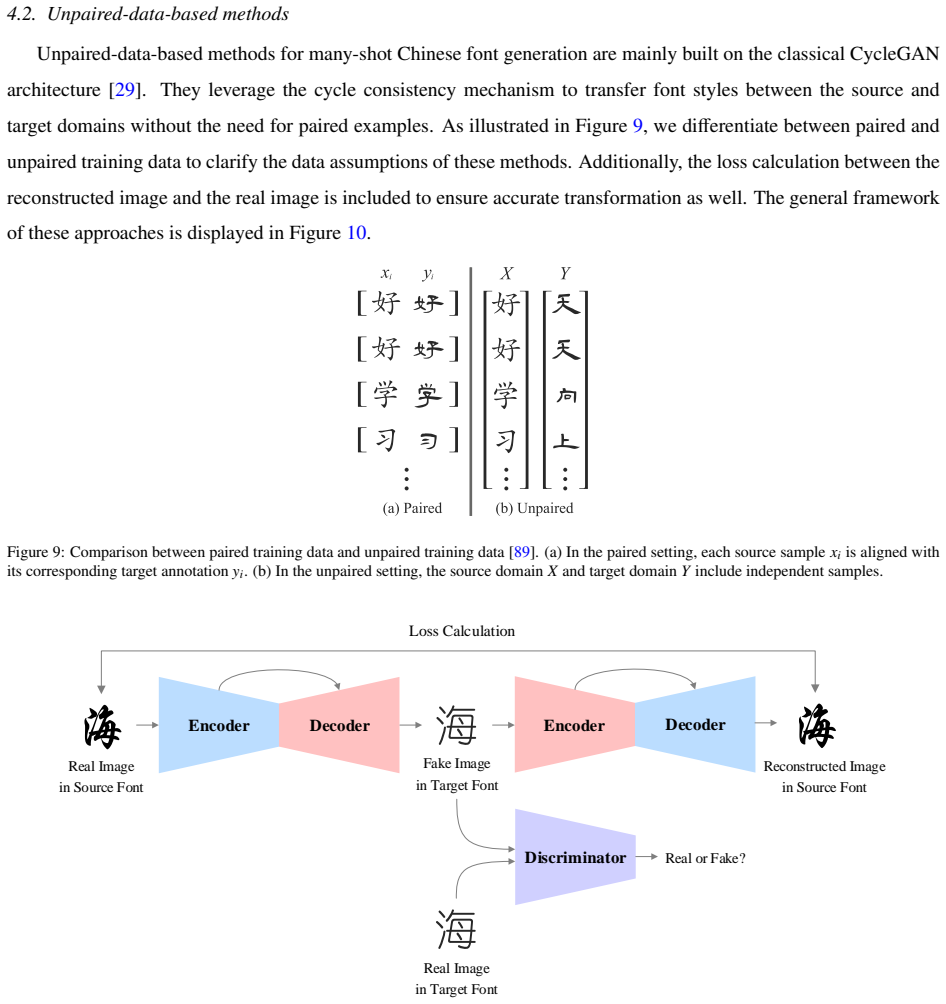
- [§4.2, Table 4] Callifusion [108] is classified under unpaired-data-based many-shot methods, but the text states that it 'does not necessitate the use of any images during inference' and relies on Chinese text descriptions as the control condition. This is zero-shot by the survey's own definition in the first paragraph of Section 4 ('fine-tuned on hundreds of reference samples'). Placing a zero-shot method in the many-shot category violates the primary classification axis stated in the Abstract and Introduction, and it casts doubt on the method counts reported in Figure 3(b). Please reclassify this method, introduce an explicit zero-shot/conditional category, or refine the definition of 'reference samples' so that the taxonomy is self-consistent.
- [§4, first paragraph vs §4.2] The many-shot criterion is stated as 'fine-tuned on hundreds of reference samples,' which is an inference/fine-tuning-time notion. However, the unpaired-data-based methods in Table 4 are described as trained with cycle consistency on a source-target corpus; their entries (e.g., FontGAN, MTfontGAN) do not indicate that a new font requires hundreds of reference samples at inference. The paper conflates training-time data volume with inference-time reference count. Please specify whether 'many-shot' refers to the number of samples needed during training or the number of reference samples needed when generating a new font, and apply that definition uniformly across all entries.
minor comments (6)
- [Figures 7, 9, 11, 13, 15–19, 23, 25] Multiple figures are screenshots from the original papers, retaining original figure numbers, captions, and body text. For example, Figure 7's caption refers to Guo et al. [79], but the displayed image contains SCFont's 'Figure 5' and surrounding text. Please redraw or cleanly crop all figures and ensure captions match the displayed content.
- [Figure 3] The caption for Figure 3(b) says 'Year-wise publications to data,' but the plot shows method-wise coverage. The legend also contains duplicated counts. Please correct the caption and legend.
- [§3.4.1, Eq. (3)] PSNR is defined as 10 ln(L^2/MSE); the correct formula uses log10. Additionally, the text identifies Fréchet distance as 'Wasserstein-2 distance,' which is not accurate; the two distances are related but not identical. Please fix both.
- [Various] Typos and copy-editing issues: 'mata-style matrix' (Table 6, Deep imitator) should be 'meta-style matrix'; 'illutrated' (§5.1) should be 'illustrated'; 'PNSR' (§6.1.3) should be 'PSNR'; 'matric' (§3.4.1) should be 'matrix'; 'e ffort' spacing artifacts appear throughout.
- [§4, first paragraph] The citation [65] is used to support the definition of many-shot as 'hundreds of reference samples.' Reference [65] is a specific method paper (MSD-Font), not an authoritative source for this terminological definition. Please provide a more appropriate citation or rephrase the sentence.
- [Table 2] The dataset table would benefit from a column indicating licensing/accessibility status, since the paper itself notes that copyright restrictions hinder open sharing. This would increase practical value for readers.
Circularity Check
No significant circularity: survey taxonomy is an editorial organization, not a derived prediction; minor self-citations are not load-bearing.
full rationale
This is a literature survey, not a derivation. It makes no first-principles predictions and fits no parameters, so the circularity patterns that involve fitting data and renaming fitted values as predictions do not apply. The central output is a taxonomy (many-shot vs. few-shot, then paired/unpaired and universal/structural), which is a design choice about how to organize cited methods rather than a claim derived from equations that could reduce to its inputs. The paper's own definitions are used descriptively: Section 4 states many-shot methods are 'fine-tuned on hundreds of reference samples,' and Section 5 defines few-shot as using 'only a few reference images.' The skeptic's example, Callifusion, is placed in Table 4 under unpaired-data-based methods while Section 4.2 notes it 'does not necessitate the use of any images during inference'—an internal inconsistency in applying the sample-count criterion. This is a correctness/consistency concern for the survey's organizing framework, not a circular step under the review's hard rules (no equation reduces to itself, no fitted parameter is renamed as a prediction, no uniqueness theorem is imported). The two self-citations involving the survey's authors (refs [10] and [155], used in Section 4.1 and Section 6.1.3 respectively) are descriptive mentions of prior work and a related metrics survey; neither is load-bearing for any argument, and no alternative-forbidding uniqueness claim rests on them. Accordingly, the paper is self-contained as a review and receives a low score reflecting only the minor presence of non-load-bearing self-citations and the noted taxonomy inconsistency, which lies outside circularity proper.
Assumptions & free parameters
assumptions (3)
- domain assumption The keyword-based literature search in Section 2 captured the relevant publications in Chinese font generation.
- domain assumption The taxonomy in Figure 1 is a valid and useful way to categorize methods.
- domain assumption The brief descriptions of methods in Tables 3, 4, 6, and 7 are faithful to the original papers.
Cite this review
Pith. "Pith review of Advancements in Chinese font generation since deep learning era: A survey." pith.science (2026). https://pith.science/paper/WBBAV7H2
@misc{pith2026250806900,
  author       = {Pith},
  title        = {Pith review of: Advancements in Chinese font generation since deep learning era: A survey},
  year         = {2026},
  howpublished = {\url{https://pith.science/paper/WBBAV7H2}},
  note         = {Machine review of arXiv:2508.06900}
}
read the original abstract
Chinese font generation aims to create a new Chinese font library based on some reference samples. It is a topic of great concern to many font designers and typographers. Over the past years, with the rapid development of deep learning algorithms, various new techniques have achieved flourishing and thriving progress. Nevertheless, how to improve the overall quality of generated Chinese character images remains a tough issue. In this paper, we conduct a holistic survey of the recent Chinese font generation approaches based on deep learning. To be specific, we first illustrate the research background of the task. Then, we outline our literature selection and analysis methodology, and review a series of related fundamentals, including classical deep learning architectures, font representation formats, public datasets, and frequently-used evaluation metrics. After that, relying on the number of reference samples required to generate a new font, we categorize the existing methods into two major groups: many-shot font generation and few-shot font generation methods. Within each category, representative approaches are summarized, and their strengths and limitations are also discussed in detail. Finally, we conclude our paper with the challenges and future directions, with the expectation to provide some valuable illuminations for the researchers in this field.
Figures


Figures from the paper (23 more)







Reference graph
Works this paper leans on
-
[108]
Q. Liao, G. Xia, Z. Wang, Calli ffusion: Chinese Calligraphy Generation and Style Transfer with Di ffusion Modeling, preprint at http://arxiv.org/abs/2305.19124 (2023)
arXiv 2023
-
[1]
J. Fei, The evolution of the form and carrier of Chinese characters and the historical and cultural inheritance, Sinogram Culture. 335 (11) (2023) 93–95, https://doi.org/10.14014/j.cnki.cn11-2597/g2.2023.11.018
-
[2]
Z. Yang, D. Peng, Y . Kong, Y . Zhang, C. Yao, L. Jin, FontDiffuser: One-Shot Font Generation via Denoising Di ffusion with Multi-Scale Content Aggregation and Style Contrastive Learning, in: Proceedings of the Thirty-Eighth AAAI Conference on Artificial Intelligence, AAAI, Vancouver, Canada, February 20-27, 2024, pp. 6603–6611, https://doi.org/10.1609/aa...
-
[3]
J. Zhang, G. Mao, H. Lin, J. Yu, C. Zhou, Outline Font Generating from Images of Ancient Chinese Calligraphy, Trans. Edutainment. 5 (2011) 122–131, https://doi.org/10.1007/978-3-642-18452-9 10
-
[4]
B. Zhou, W. Wang, Z. Chen, Easy generation of personal Chinese handwritten fonts, in: Proceedings of the 2011 IEEE International Confer- ence on Multimedia and Expo, ICME, Barcelona, Catalonia, Spain, July 11-15, 2011, pp. 1–6, https://doi.org/10.1109/ICME.2011.6011892
arXiv 2011
-
[5]
A. Zong, Y . Zhu, StrokeBank: Automating Personalized Chinese Handwriting Generation, in: Proceedings of the Twenty- Eighth AAAI Conference on Artificial Intelligence, AAAI, Qu ´ebec City, Qu ´ebec, Canada, July 27-31, 2014, pp. 3024–3029, https://doi.org/10.1609/aaai.v28i2.19029. 34
-
[6]
Z. Lian, J. Xiao, Automatic shape morphing for Chinese characters, in: Proceedings of SIGGRAPH Asia 2012 Technical Briefs, Singapore, November 28 - December 1, 2012, pp. 1–4, https://doi.org/10.1145/2407746.2407748
arXiv 2012
-
[7]
R. Cheng, X. Zhao, H. Zhou, H. Ye, Review of Chinese font style transfer research based on deep learning, Journal of Zhejiang University (Engineering Science). 56 (3) (2022) 510–519, https://doi.org/10.3785/j.issn.1008-973X.2022.03.010
Show all 145 references
-
[8]
T. T. Khoei, H. O. Slimane, N. Kaabouch, Deep learning: systematic review, models, challenges, and research directions, Neural Comput. Appl. 35 (31) (2023) 23103–23124, https://doi.org/10.1007/s00521-023-08957-4
2023 doi
-
[9]
Alzubaid, J
L. Alzubaid, J. Zhang, A. J. Humaidi, et al., Review of deep learning: concepts, CNN architectures, challenges, applications, future direc- tions, J. Big Data. 8 (1) (2021) 1–74, https://doi.org/10.1186/s40537-021-00444-8
2021 doi
-
[11]
D. Sun, T. Ren, C. Li, H. Su, J. Zhu, Learning to Write Stylized Chinese Characters by Reading a Handful of Examples, in: Proceedings of the Twenty-Seventh International Joint Conference on Artificial Intelligence, IJCAI, Stockholm, Sweden, July 13-19, 2018, pp. 920–927, https...
2018 doi
-
[12]
J. Liu, C. Gu, J. Wang, G. Youn, J.-U. Kim, Multi-scale multi-class conditional generative adversarial network for handwritten character generation, J. Supercomput. 75 (4) (2019) 1922–1940, https://doi.org/10.1007/s11227-017-2218-0
2019 doi
-
[13]
M. Ren, Y . Zhang, Q. Wang, F. Yin, C. Liu, Diff-Writer: A Diffusion Model-Based Stylized Online Handwritten Chinese Character Gener- ator, in: Proceedings of the 30th International Conference on Neural Information Processing, ICONIP, Changsha, China, November 20-23, 2023, pp....
2023 doi
-
[14]
X. Wang, C. Li, Z. Sun, L. Hui, Review of GAN-Based Research on Chinese Character Font Generation, Chinese Journal of Electronics. 33 (3) (2024) 584–600, https://doi.org/10.23919/cje.2022.00.402
2024 doi
-
[15]
C. Wang, G. Wu, Y . Yao, Y . Ren, et al., Review of Chinese characters generation and font transfer based on deep learning, Journal of image and Graphics. 27 (12) (2022) 3415–3428
2022
-
[16]
Huang, Q
Z. Huang, Q. Chen, W. Luo, Chinese Character Generation Method Based on Deep Learning, Computer Engineering and Applications. 57 (17) (2021) 29–36, https://doi.org/10.3778/j.issn.1002-8331.2103-0297
2021
-
[17]
Y . Ma, Y . Dong, et al., A Survey of Chinese Character Style Transfer, in: Proceedings of the 14th Conference on Image and Graphics Technologies and Applications, IGTA, Beijing, China, April 19-20, 2019, pp. 392–404, https://doi.org/10.1007/978-981-13-9917-6 38
2019 doi
-
[18]
L. Wang, Y . Liu, M. Y . Sharum, R. Y . et al., Deep learning for Chinese font generation: A survey, Expert Syst. Appl. 276 (2025) 1–23, https://doi.org/10.1016/j.eswa.2025.127105
2025
-
[19]
Z. Ren, Y . Pan, J. Chen, L. Zhao, et al., A Survey on Deep Learning-Based Chinese Font Style Transfer, IEEE Transactions on Artificial Intelligence 1 (2025) 1–16, https://doi.org/10.1109/TAI.2025.3574300
2025
-
[20]
M. J. Page, J. E. McKenzie, et al., The PRISMA 2020 statement: An updated guideline for reporting systematic reviews, International Journal of Surgery. 88 (2021) 1–9, https://doi.org/10.1016/j.ijsu.2021.105906
2020
-
[21]
F. Zhou, L. Jin, J. Dong, Review of Convolutional Neural Network, Chinese Journal of Computers. 40 (6) (2017) 1229–1251
2017
-
[22]
J. Lai, X. Wang, Q. Xiang, Y . Song, W. Quan, Review on autoencoder and its application, Journal on Communications. 42 (9) (2021) 218–230, https://doi.org/10.11959/j.issn.1000-436x.2021160
2021 doi
-
[23]
Rumelhart, G
D. Rumelhart, G. Hinton, R. Williams, Learning representations by back-propagating errors, Nature. 323 (1986) 533–536, https://doi.org/10.1038/323533a0
1986 doi
-
[24]
Bourlard, Y
H. Bourlard, Y . Kamp, Auto-association by multilayer perceptrons and singular value decomposition, Biol. Cybern. 59 (1988) 291–294, https://doi.org/10.1007/BF00332918
1988 doi
-
[25]
D. P. Kingma, M. Welling, Auto-Encoding Variational Bayes, in: Proceedings of 2nd International Conference on Learning Representations, ICLR, Banff, AB, Canada, April 14-16, 2014, pp. 1–14
2014
-
[26]
Xiao, The style-transfer of Chinese character based on Deep Learning, Jinan University, Guangdong, 2018
F. Xiao, The style-transfer of Chinese character based on Deep Learning, Jinan University, Guangdong, 2018. 35
2018
-
[27]
I. J. Goodfellow, J. Pouget-Abadie, M. Mirza, et al., Generative Adversarial Nets, in: Proceedings of the Advances in Neural Information Processing Systems 27: Annual Conference on Neural Information Processing Systems, NIPS, Montreal, Quebec, Canada, December 8-13, 2014, pp. ...
2014
-
[28]
Mirza, S
M. Mirza, S. Osindero, Conditional Generative Adversarial Nets, preprint at http: //arxiv.org/abs/1411.1784 (2014)
2014 arXiv
-
[30]
Arjovsky, S
M. Arjovsky, S. Chintala, L. Bottou, Wasserstein GAN, preprint at http: //arxiv.org/abs/1701.07875 (2017)
2017 arXiv
-
[31]
Gulrajani, F
I. Gulrajani, F. Ahmed, M. Arjovsky, V . Dumoulin, A. C. Courville, Improved Training of Wasserstein GANs, in: Proceedings of Advances in Neural Information Processing Systems 30: Annual Conference on Neural Information Processing Systems, NIPS, Long Beach, CA, USA, December 4...
2017
-
[32]
Y . Choi, M. Choi, M. Kim, J. Ha, S. Kim, J. Choo, StarGAN: Unified Generative Adversarial Networks for Multi-Domain Image-to-Image Translation, in: Proceedings of IEEE Conference on Computer Vision and Pattern Recognition, CVPR, Salt Lake City, UT, USA, June 18-22, 2018, pp. ...
2018
-
[33]
J. Zeng, Q. Chen, Y . Liu, et al., StrokeGAN: Reducing Mode Collapse in Chinese Font Generation via Stroke Encoding, in: Pro- ceedings of Thirty-Fifth AAAI Conference on Artificial Intelligence, AAAI, Virtual Event, February 2-9, 2021, pp. 3270–3277, https://doi.org/10.1609/aa...
2021 doi
-
[34]
Liang, Research and Application of Font Style Migration Algorithm Based on Deep Learning, Xijing University, Shanxi, 2021
C. Liang, Research and Application of Font Style Migration Algorithm Based on Deep Learning, Xijing University, Shanxi, 2021
2021
-
[35]
J. Zeng, Q. Chen, M. Wang, Diversity Regularized StarGAN for Multi-style Fonts Generation of Chinese Characters, J. Phys.: Conf. Ser. 1880 (2021) 1–10, https://doi.org/10.1109/T10.1088/1742-6596/1880/1/012017
2021 doi
-
[36]
Vaswani, N
A. Vaswani, N. Shazeer, N. Parmar, et al., Attention is All you Need, in: Proceedings of Advances in Neural Information Processing Systems 30: Annual Conference on Neural Information Processing Systems, NIPS, Long Beach, CA, USA, December 4-9,, 2017, pp. 5998–6008
2017
-
[37]
Dosovitskiy, L
A. Dosovitskiy, L. Beyer, A. Kolesnikov, et al., An Image is Worth 16x16 Words: Transformers for Image Recognition at Scale, in: Proceedings of the 9th International Conference on Learning Representations, ICLR, Virtual Event, Austria, May 3-7, 2021, pp. 1–22
2021
-
[38]
X. Chen, L. Wu, Y . Su, L. Meng, X. Meng, Font transformer for few-shot font generation, Comput. Vis. Image Underst. 245 (2024) 1–10, https://doi.org/10.1016/j.cviu.2024.104043
2024
-
[39]
Y . Liu, F. Khalid, M. R. Musta ffa, A. bin Azman, Dual-modality learning and transformer-based approach for high-quality vector font generation, Expert Syst. Appl. 240 (2024) 1–19, https://doi.org/10.1016/j.eswa.2023.122405
2024
-
[40]
Sohl-Dickstein, E
J. Sohl-Dickstein, E. A. Weiss, N. Maheswaranathan, S. Ganguli, Deep Unsupervised Learning using Nonequilibrium Thermodynamics, in: Proceedings of the 32nd International Conference on Machine Learning, ICML, Lille, France, July 6-11, 2015, pp. 2256–2265
2015
-
[41]
J. Ho, A. Jain, P. Abbeel, Denoising Diffusion Probabilistic Models, in: Proceedings of Advances in Neural Information Processing Systems 33: Annual Conference on Neural Information Processing Systems, NeurIPS, December 6-12, virtual, 2020, pp. 1–25
2020
-
[42]
W. Pan, A. Zhu, X. Zhou, et al., Few shot font generation via transferring similarity guided global style and quantization local style, in: Proceedings of IEEE /CVF International Conference on Computer Vision, ICCV, Paris, France, October 1-6, 2023, pp. 19449–19459, https://do...
2023
-
[43]
M. Yao, Y . Zhang, X. Lin, et al., VQ-Font: Few-Shot Font Generation with Structure-Aware Enhancement and Quantization, in: Proceed- ings of Thirty-Eighth AAAI Conference on Artificial Intelligence, AAAI, Vancouver, Canada, February 20-27, 2024, pp. 16407–16415, https://doi.or...
2024 doi
-
[44]
H. He, X. Chen, C. Wang, J. Liu, B. Du, et al., Di ff-Font: Di ffusion Model for Robust One-Shot Font Generation, preprint at https://arxiv.org/abs/2212.05895 (2022)
2022 arXiv
-
[45]
W. G. Xinpeng Chen, Xiao Ke, IF-Font: Ideographic Description Sequence-Following Font Generation, in: Proceedings of the Advances in Neural Information Processing Systems 38: Annual Conference on Neural Information Processing Systems, NIPS, Vancouver, Canada, December 10-15, 2...
2024
-
[47]
Y . Wang, Z. Lian, DeepVecFont: Synthesizing High-quality Vector Fonts via Dual-modality Learning, ACM Trans. Graph. 40 (6) (2021) 1–15, https://doi.org/10.1145/3478513.3480488
2021
-
[48]
Y . Liu, Z. Lian, QT-Font: High-efficiency Font Synthesis via Quadtree-based Diffusion Models, in: Proceedings of ACM SIGGRAPH 2024 Conference Papers, Denver, CO, USA, July 27 - August 1, 2024, pp. 1–11, https://doi.org/10.1145/3641519.3657451
2024
-
[49]
Z. L. Hua Li, HFH-Font: Few-shot Chinese Font Synthesis with Higher Quality, Faster Speed, and Higher Resolution, in: Proceedings of SIGGRAPH Asia Technical Briefs, Tokyo, Japan, December 3-6, 2024, pp. 1–16
2024
-
[50]
C. Liu, F. Yin, et al., CASIA Online and O ffline Chinese Handwriting Databases, in: Proceedings of International Conference on Document Analysis and Recognition, ICDAR, Beijing, China, September 18-21, 2011, pp. 37–41, https://doi.org/10.1109/ICDAR.2011.17
2011 doi
-
[51]
Y . Gao, Y . Guo, Z. Lian, Y . Tang, J. Xiao, Artistic glyph image synthesis via one-stage few-shot learning, ACM Trans. Graph. 38 (6) (2019) 1–12, https://doi.org/10.1145/3355089.3356574
2019
-
[52]
W. Li, Y . He, Y . Qi, Z. Li, Y . Tang, FET-GAN: Font and E ffect Transfer via K-shot Adaptive Instance Normalization, in: Proceedings of the Thirty-Fourth AAAI Conference on Artificial Intelligence, AAAI, New York, NY , USA, February 7-12, 2020, pp. 1717–1724, https://doi.org...
2020 doi
-
[54]
S. Yang, W. Wang, J. Liu, TE141K: Artistic Text Benchmark for Text E ffect Transfer, IEEE Trans. Pattern Anal. Mach. Intell. 43 (10) (2021) 3709–3723, https://doi.org/10.1109/TPAMI.2020.2983697
2021
-
[55]
Y . Li, G. Lin, M. He, D. Yuan, K. Liao, Layer similarity guiding few-shot Chinese style transfer, Vis Comput. 40 (4) (2024) 2265–2278, https://doi.org/10.1007/s00371-023-02915-w
2024 doi
-
[56]
Ghosh, H
A. Ghosh, H. Kumar, P. S. Sastry, Robust Loss Functions under Label Noise for Deep Neural Networks, in: Proceedings of the Thirty-First AAAI Conference on Artificial Intelligence, AAAI, San Francisco, California, USA, February 4-9, 2017, pp. 1919–1925, https://doi.org/10.1609/...
2017 doi
-
[57]
Bauer, R
E. Bauer, R. Kohavi, An Empirical Comparison of Voting Classification Algorithms: Bagging, Boosting, and Variants, Mach. Learn. 36 (1) (1999) 105–139, https://doi.org/10.1023/A:1007515423169
1999 doi
-
[58]
Willmott, K
C. Willmott, K. Matsuura, Advantages of the mean absolute error (MAE) over the root mean square error (RMSE) in assessing average model performance, Climate Research. 30 (1) (2005) 79–82, https://doi.org/10.3354/cr030079
2005 doi
-
[59]
Avcibas, B
I. Avcibas, B. Sankur, K. Sayood, Statistical evaluation of image quality measures, J. Electronic Imaging. 11 (2) (2002) 206–223, https://doi.org/10.1117/1.1455011
2002 doi
-
[60]
H. R. S. Zhou Wang, A. C. Bovik, E. P. Simoncelli, Image quality assessment: from error visibility to structural similarity, IEEE Trans. Image Process. 13 (4) (2004) 600–612, https://doi.org/10.1109/TIP.2003.819861
2004
-
[61]
Heusel, H
M. Heusel, H. Ramsauer, T. Unterthiner, B. Nessler, S. Hochreiter, GANs Trained by a Two Time-Scale Update Rule Converge to a Local Nash Equilibrium, in: Proceedings of Advances in Neural Information Processing Systems 30: Annual Conference on Neural Information Processing Sys...
2017
-
[62]
Zhang, P
R. Zhang, P. Isola, A. A. Efros, E. Shechtamn, O. Wang, The Unreasonable E ffectiveness of Deep Features as a Perceptual Metric, in: Proceedings of IEEE Conference on Computer Vision and Pattern Recognition, CVPR, Salt Lake City, UT, USA, June 18-22, 2018, pp. 586–595, https:/...
2018
-
[65]
B. Fu, F. Yu, A. Liu, et al., Generate Like Experts: Multi-Stage Font Generation by Incorporating Font Transfer Process into Di ffusion Models, in: Proceedings of the IEEE/CVF Conference on Computer Vision and Pattern Recognition, CVPR, Seattle W A, USA, June 17-21, 2024, pp. ...
2024
-
[66]
https: //github.com/kaonashi-tyc/Rewrite
-
[67]
Isola, J
P. Isola, J. Zhu, et al., Image-to-image translation with conditional adversarial networks, in: Proceedings of IEEE Conference on Computer Vision and Pattern Recognition, CVPR, Honolulu, HI, USA, July 21-26, 2017, pp. 5967–5976, https://doi.org/10.1109/CVPR.2017.632
2017 doi
-
[68]
https: //github.com/kaonashi-tyc/zi2zi
-
[69]
Jiang, Z
Y . Jiang, Z. Lian, Y . Tang, J. Xiao, DCFont: an end-to-end deep Chinese font generation system, in: Proceedings of SIGGRAPH Asia Technical Briefs, Bangkok, Thailand, November 27-30, 2017, pp. 1–4, https://doi.org/10.1145/3145749.3149440
2017
-
[70]
Chang, Y
J. Chang, Y . Gu, Y . Zhang, Y . Wang, Chinese Handwriting Imitation with Hierarchical Generative Adversarial Network, in: Proceedings of British Machine Vision Conference, BMVC, Newcastle, UK, September 3-6, 2018, pp. 1–12
2018
-
[71]
P. Lyu, X. Bai, C. Yao, Z. Zhu, T. Huang, W. Liu, Auto-Encoder Guided GAN for Chinese Calligraphy Synthesis, in: Proceedings of the 14th IAPR International Conference on Document Analysis and Recognition, ICDAR, Kyoto, Japan, November 9-15, 2017, pp. 1095–1100, https://doi.org...
2017 doi
-
[72]
D. Sun, Q. Zhang, J. Yang, Pyramid Embedded Generative Adversarial Network for Automated Font Generation, in: Proceed- ings of the 24th International Conference on Pattern Recognition, ICPR, Beijing, China, August 20-24, 2018, pp. 976–981, https://doi.org/10.1109/ICPR.2018.8545701
2018
-
[73]
Ronneberger, P
O. Ronneberger, P. Fischer, T. Brox, U-Net: Convolutional Networks for Biomedical Image Segmentation, in: Proceedings of Medical Image Computing and Computer-Assisted Intervention - MICCAI 18th International Conference Munich, Germany, October 5-9, 2015, pp. 234–241, https://d...
2015 doi
-
[74]
Zhang, X
Z. Zhang, X. Zhou, M. Qin, X. Chen, Chinese character style transfer based on multi-scale GAN, Signal Image Video Process. 16 (2) (2022) 559–567, https://doi.org/10.1007/s11760-021-02000-6
2022 doi
-
[75]
Zhang, Font style transfer algorithms based on generative adversarial nets, Dalian Maritime University, Liaoning, 2019
Q. Zhang, Font style transfer algorithms based on generative adversarial nets, Dalian Maritime University, Liaoning, 2019
2019
-
[76]
P. Wang, P. Chen, Y . Yuan, D. Liu, Z. Huang, X. Hou, et al., Understanding Convolution for Semantic Segmentation, in: Proceedings of IEEE Winter Conference on Applications of Computer Vision, W ACV, Lake Tahoe, NV , USA, March 12-15, 2018, pp. 1451–1460, https://doi.org/10.11...
2018
-
[77]
C. Ren, S. Lyu, H. Zhan, Y . Lu, SAFont: Automatic Font Synthesis using Self-Attention Mechanisms, Aust. J. Intell. Inf. Process. Syst. 16 (2) (2019) 19–25
2019
-
[78]
Y . Miao, H. Jia, K. Tang, Chinese font migration combining local and global features learning, Pattern Anal Applic. 24 (2021) 1533–1547, https://doi.org/10.1007/s10044-021-01003-w
2021 doi
-
[79]
Y . Guo, Z. Lian, Y . Tang, J. Xiao, Creating New Chinese Fonts based on Manifold Learning and Adversarial Networks, in: Proceedings of 39th Annual Conference of the European Association for Computer Graphics, Eurographics - Short Papers, Delft, The Netherlands, April 16-20, 2...
2018 doi
-
[80]
Z. Lian, B. Zhao, J. Xiao, Automatic generation of large-scale handwriting fonts via style learning, in: Proceedings of SIGGRAPH ASIA Technical Briefs, Macao, December 5-8, 2016, pp. 1–4, https://doi.org/10.1145/3005358.3005371
2016
-
[81]
Jiang, Z
Y . Jiang, Z. Lian, Y . Tang, J. Xiao, SCFont: Structure-Guided Chinese Font Generation via Deep Stacked Networks, in: Proceedings of the Thirty-Third AAAI Conference on Artificial Intelligence, AAAI, Honolulu, Hawaii, USA, January 27 - February 1, 2019, pp. 4015–4022, https:/...
2019 doi
-
[82]
Y . Gao, Z. Lian, Y . Tang, J. Xiao, Automatic Generation of Chinese Vector Fonts via Deep Layout Inferring, in: Proceedings of SIGGRAPH Asia Technical Briefs, Brisbane, QLD, Australia, November 17-20, 2019, pp. 33–36, https://doi.org/10.1145/3355088.3365142
2019
-
[83]
S. J. Wu, C. Yang, J. Y . Hsu, CalliGAN: Style and Structure-aware Chinese Calligraphy Character Generator, preprint at https://arxiv.org/abs/2005.12500 (2020). 38
2005 arXiv
-
[84]
Zhang, D
J. Zhang, D. Chen, G. Han, G. Li, J. He, Z. Liu, Z. Ruan, SSNet: Structure-Semantic Net for Chinese typography generation based on image translation, Neurocomputing. 371 (2020) 15–26, https://doi.org/10.1016/j.neucom.2019.08.072
2020 doi
-
[85]
C. Wen, J. Chang, Y . Zhang, S. Chen, Y . Wang, M. Han, Q. Tian, Handwritten Chinese Font Generation with Collaborative Stroke Refine- ment, in: Proceedings of IEEE Winter Conference on Applications of Computer Vision, W ACV, Waikoloa, HI, USA, January 3-8, 2021, pp. 3881–3890...
2021
-
[86]
C. Wang, Y . Ding, Y . Liu, G. Zhan, Z. Li, Chinese Font Generation from Stroke Semantic and Attention Mechanism, Journal of Computer- Aided Design & Computer Graphics. 34 (8) (2022) 1229–1237, https://doi.org/10.3724/SP.J.1089.2022.19125
2022
-
[87]
Z. Lian, Y . Gao, CVFont: Synthesizing Chinese Vector Fonts via Deep Layout Inferring, Comput. Graph. Forum. 41 (6) (2022) 212–225, https://doi.org/10.1111/cgf.14580
2022 doi
-
[88]
Y . Liu, F. binti Khalid, C. Wang, et al., An end-to-end Chinese font generation network with stroke semantics and deformable attention skip-connection, Expert Syst. Appl. 237 (2024) 1–13, https://doi.org/10.1016/j.eswa.2023.121407
2024
-
[89]
P. Zhou, Z. Zhao, K. Zhang, C. Li, C. Wang, An end-to-end model for Chinese calligraphy generation, Multimed Tools Appl. 80 (5) (2021) 6737–6754, https://doi.org/10.1007/s11042-020-09709-5
2021 doi
-
[90]
Chang, Q
B. Chang, Q. Zhang, S. Pan, L. Meng, Generating Handwritten Chinese Characters Using CycleGAN, in: Proceedings of IEEE Winter Conference on Applications of Computer Vision, W ACV, Lake Tahoe, NV , USA, March 12-15, 2018, pp. 199–207, https://doi.org/10.1109/W ACV .2018.00028
2018
-
[91]
Huang, Z
G. Huang, Z. Liu, et al., Densely Connected Convolutional Networks, in: Proceedings of IEEE Conference on Computer Vision and Pattern Recognition, CVPR, Honolulu, HI, USA, July 21-26, 2017, pp. 2261–2269, https://doi.org/10.1109/CVPR.2017.243
2017 doi
-
[92]
Zhang, F
X. Zhang, F. Yin, Y . Zhang, C. Liu, Y . Bengio, Drawing and Recognizing Chinese Characters with Recurrent Neural Network, IEEE Trans. Pattern Anal. Mach. Intell. 40 (4) (2018) 849–862, https://doi.org/10.1109/TPAMI.2017.2695539
2018
-
[93]
S. Tang, Z. Xia, Z. Lian, Y . Tang, J. Xiao, FontRNN: Generating Large-scale Chinese Fonts via Recurrent Neural Network, Comput. Graph. Forum. 38 (7) (2019) 567–577, https://doi.org/10.1111/cgf.13861
2019 doi
-
[94]
X. Liu, G. Meng, S. Xiang, C. Pan, FontGAN: A Unified Generative Framework for Chinese Character Stylization and De-stylization, preprint at http://arxiv.org/abs/1910.12604 (2019)
1910 arXiv
-
[95]
Zhang, Generating Handwritten Chinese Characters with GANs, East China Normal University, Shanghai, 2019
Y . Zhang, Generating Handwritten Chinese Characters with GANs, East China Normal University, Shanghai, 2019
2019
-
[97]
Fan, Research on Chinese character generation technology based on generation adversarial network, Nanning Normal University, Guangxi, 2020
W. Fan, Research on Chinese character generation technology based on generation adversarial network, Nanning Normal University, Guangxi, 2020
2020
-
[98]
Zhang, Research on Chinese Character Generation Method Based on Generative Adversarial Networks, Tianjin Normal University, Tianjin, 2020
H. Zhang, Research on Chinese Character Generation Method Based on Generative Adversarial Networks, Tianjin Normal University, Tianjin, 2020
2020
-
[99]
Y . Gao, J. Wu, GAN-Based Unpaired Chinese Character Image Translation via Skeleton Transformation and Stroke Rendering, in: Proceed- ings of The Thirty-Fourth AAAI Conference on Artificial Intelligence, AAAI, New York, NY , USA, February 7-12, 2020, pp. 646–653, https://doi.o...
2020 doi
-
[100]
Y . Lin, H. Yuan, L. Lin, Chinese Typography Transfer Model Based on Generative Adversarial Network, in: Proceedings of 2020 Chinese Automation Congress (CAC), Shanghai, China, November 6-8, 2020, pp. 7005–7010, https://doi.org/10.1109/CAC51589.2020.9326672
2020
-
[101]
Y . Xiao, W. Lei, L. Lu, X. Chang, X. Zheng, X. Chen, CS-GAN: Cross-Structure Generative Adversarial Networks for Chinese calligraphy translation, Knowl. Based Syst. 229 (2021) 1–10, https://doi.org/10.1016/j.knosys.2021.107334
2021
-
[102]
C. Mu, Research and Implementation of Calligraphy Chinese Character Generation Based on Style Transfer Technology, University of Electronic Science and Technology of China, Sichuan, 2021
2021
-
[103]
M. Xue, J. Du, J. Zhang, Z. Wang, B. Wang, B. Ren, Radical Composition Network for Chinese Character Generation, in: Proceedings of the 16th International Conference on Document Analysis and Recognition, ICDAR, Lausanne, Switzerland, September 5-10, 2021, pp. 252–267, https://...
2021 doi
-
[104]
A. U. Hassan, H. Ahmed, J. Choi, Unpaired font family synthesis using conditional generative adversarial networks, Knowl. Based Syst. 229 (2021) 1–12, https://doi.org/10.1016/j.knosys.2021.107304
2021
-
[105]
X. Liu, G. Meng, J. Chang, R. Hu, S. Xiang, C. Pan, Decoupled Representation Learning for Character Glyph Synthesis, IEEE Trans. Multim. 24 (2022) 1787–1799, https://doi.org/10.1109/TMM.2021.3072449
2022
-
[106]
J. Zhou, Y . Wang, Y . Yuan, Q. Huang, J. Zeng, SGCE-Font: Skeleton Guided Channel Expansion for Chinese Font Generation, preprint at http://arxiv.org/abs/2211.14475 (2022)
2022 arXiv
-
[107]
J. Zeng, Q. Chen, M. Wang, Self-supervised Chinese font generation based on square-block transformation, Sci Sin Inform. 52 (1) (2022) 145–159, https://doi.org/10.1360/SSI-2021-0056
2022 doi
-
[109]
X. Ye, H. Zhang, L. Yang, J. Du, Radical Constraint-Based Generative Adversarial Network for Handwritten Chinese Character Generation, Comput. Informatics. 43 (2) (2024) 482–504, https://doi.org/10.31577/cai 2024 2 482
2024 doi
-
[110]
Chung, C ¸
J. Chung, C ¸ . G¨ulc ¸ehre, K. Cho, Y . Bengio, Empirical Evaluation of Gated Recurrent Neural Networks on Sequence Modeling, preprint at https://arxiv.org/abs/1412.3555 (2014)
2014 arXiv
-
[111]
Zhang, Y
Y . Zhang, Y . Zhang, W. Cai, Separating Style and Content for Generalized Style Transfer, in: Proceedings of IEEE Con- ference on Computer Vision and Pattern Recognition, CVPR, Salt Lake City, UT, USA, June 18-22, 2018, pp. 8447–8455, https://doi.org/10.1109/CVPR.2018.00881
2018
-
[112]
Jiang, G
H. Jiang, G. Yang, K. Huang, R. Zhang, W-Net: One-Shot Arbitrary-Style Chinese Character Generation with Deep Neural Networks, in: Proceedings of Neural Information Processing - 25th International Conference, ICONIP, Siem Reap, Cambodia, December 13-16, 2018, pp. 483–493, http...
2018 doi
-
[113]
X. Yan, Y . Wang, R. Yi, Z. Sun, Y . Liu, StarFont: Enabling Font Completion Based on few Shots Examples, in: Proceedings of the 3rd International Conference on Advances in Artificial Intelligence, ICAAI, Istanbul, Turkey, October 26-28, 2019, pp. 1–8, https://doi.org/10.1145/...
2019
-
[114]
S. Yang, J. Liu, W. Wang, Z. Guo, TET-GAN: Text E ffects Transfer via Stylization and Destylization, in: Proceedings of the Thirty- Third AAAI Conference on Artificial Intelligence, AAAI, Honolulu, Hawaii, USA, January 27 - February 1, 2019, pp. 1238–1245, https://doi.org/10.1...
2019 doi
-
[115]
B. Zhao, J. Tao, M. Yang, Z. Tian, C. Fan, Y . Bai, Deep imitator: Handwriting calligraphy imitation via deep attention networks, Pattern Recognit. 104 (2020) 1–14, https://doi.org/10.1016/j.patcog.2019.107080
2020
-
[116]
Z. Lai, C. Tang, J. Lv, Arbitrary Chinese Font Generation from a Single Reference, in: Proceedings of International Joint Conference on Neural Networks, IJCNN, Glasgow, United Kingdom, July 19-24, 2020, pp. 1–7, https://doi.org/10.1109/IJCNN48605.2020.9206919
2020
-
[117]
H. Aoki, K. Tsubota, H. Ikuta, K. Aizawa, Few-Shot Font Generation with Deep Metric Learning, in: Proceedings of 25th International Con- ference on Pattern Recognition, ICPR, Milan, Italy, January 10-15, 2020, pp. 8539–8546, https://doi.org/10.1109/ICPR48806.2021.9412254
2020
-
[118]
A. Zhu, X. Lu, X. Bai, S. Uchida, B. K. Iwana, S. Xiong, Few-Shot Text Style Transfer via Deep Feature Similarity, IEEE Trans. Image Process. 29 (2020) 6932–6946, https://doi.org/10.1109/TIP.2020.2995062
2020
-
[119]
Y . Wang, Y . Gao, Z. Lian, Attribute2Font: creating fonts you want from attributes, ACM Trans. Graph. 39 (4) (2020) 1–15, https://doi.org/10.1145/3386569.3392456
2020
-
[120]
X. Chen, L. Wu, M. He, et al., MLFont: Few-Shot Chinese Font Generation via Deep Meta-Learning, in: Proceedings of International Con- ference on Multimedia Retrieval, ICMR, Taipei, Taiwan, China, August 21-24, 2021, pp. 37–45, https://doi.org/10.1145/3460426.3463606
2021
-
[121]
C. Finn, P. Abbeel, S. Levine, Model-Agnostic Meta-Learning for Fast Adaptation of Deep Networks, in: Proceedings of the 34th Interna- tional Conference on Machine Learning, ICML, Sydney, NSW, Australia, August 6-11, 2017, pp. 1126–1135
2017
-
[122]
Chen, Few-shot Font Generation Based on Deep Learning, Shandong University, Shandong, 2022
X. Chen, Few-shot Font Generation Based on Deep Learning, Shandong University, Shandong, 2022
2022
-
[123]
Q. Wen, S. Li, et al., ZiGAN: Fine-grained Chinese Calligraphy Font Generation via a Few-shot Style Transfer Approach, in: Proceedings of ACM Multimedia Conference, Virtual Event, China, October 20 - 24, 2021, pp. 621–629, https://doi.org/10.1145/3474085.3475225. 40
2021
-
[125]
Y . Xie, X. Chen, L. Sun, Y . Lu, DG-Font: Deformable Generative Networks for Unsupervised Font Generation, in: Pro- ceedings of IEEE Conference on Computer Vision and Pattern Recognition, CVPR, virtual, June 19-25, 2021, pp. 5126–5136, https://doi.org/10.1109/CVPR46437.2021.00509
2021
-
[126]
J. Dai, H. Qi, Y . Xiong, Deformable Convolutional Networks, in: Proceedings of IEEE International Conference on Computer Vision, ICCV 2017, Venice, Italy, October 22-29, 2017, pp. 764–773, https://doi.org/10.1109/ICCV .2017.89
2017 doi
-
[127]
X. Chen, Y . Xie, L. Sun, Y . Lu, DGFont ++: Robust Deformable Generative Networks for Unsupervised Font Generation, preprint at https://arxiv.org/abs/2212.14742 (2022)
2022 arXiv
-
[128]
Zhang, J
Y . Zhang, J. Man, P. Sun, MF-Net: A Novel Few-shot Stylized Multilingual Font Generation Method, in: Proceedings of the 30th ACM In- ternational Conference on Multimedia, Lisboa, Portugal, October 10 - 14, 2022, pp. 2088–2096, https://doi.org/10.1145/3503161.3548414
2022
-
[129]
A. U. Hassan, I. Memon, J. Choi, Learning font-style space using style-guided discriminator for few-shot font generation, Expert Syst. Appl. 242 (2024) 1–11, https://doi.org/10.1016/j.eswa.2023.122817
2024
-
[130]
X. He, M. Zhu, N. Wang, X. Gao, H. Yang, Few-shot Font Generation by Learning Style Di fference and Similarity, preprint at http://arxiv.org/abs/2301.10008 (2023)
2023 arXiv
-
[131]
Mildenhall, P
B. Mildenhall, P. P. Srinivasan, M. Tancik, J. T. Barron, R. Ramamoorthi, R. Ng, NeRF: Representing Scenes as Neural Radiance Fields for View Synthesis, in: Proceedings of Computer Vision - ECCV- 16th European Conference, Glasgow, UK, August 23-28, 2020, pp. 405–421, https://d...
2020 doi
-
[133]
Q. Jin, F. He, W. Tang, CLF-Net: A Few-shot Cross-Language Font Generation Method, in: Proceedings of MultiMedia Modeling - 30th International Conference, MMM, Amsterdam, The Netherlands, January 29 - February 2, 2024, pp. 127–140, https: //doi.org/10.1007/978- 3-031-53308-2 10
2024 doi
-
[134]
B. Fu, F. Yu, A. Liu, et al., Generate Like Experts: Multi-Stage Font Generation by Incorporating Font Transfer Process into Di ffusion Models, in: Proceedings of IEEE /CVF Conference on Computer Vision and Pattern Recognition, CVPR, Seattle, W A, USA, June 16-22, 2024, pp. 68...
2024
-
[135]
Y . Liu, Y . Ding, X. Li, et al., Unsupervised Font Generation Network Integrating Content and Style Representation, Journal of Computer- Aided Design & Computer Graphics 37 (5) (2025) 865–876
2025
-
[136]
Z. Lian, B. Zhao, X. Chen, J. Xiao, EasyFont: A Style Learning-Based System to Easily Build Your Large-Scale Handwriting Fonts, ACM Trans. Graph. 38 (1) (2018) 1–18, https://doi.org/10.1145/3213767
2018 doi
-
[137]
Huang, M
Y . Huang, M. He, L. Jin, Y . Wang, RD-GAN: Few /Zero-Shot Chinese Character Style Transfer via Radical Decomposition and Ren- dering, in: Proceedings of Computer Vision - ECCV- 16th European Conference, Glasgow, UK, August 23-28, 2020, pp. 156–172, https://doi.org/10.1007/978...
2020 doi
-
[138]
S. Tang, Z. Lian, Write Like You: Synthesizing Your Cursive Online Chinese Handwriting via Metric-based Meta Learning, Comput. Graph. Forum. 40 (2) (2021) 141–151, https://doi.org/10.1111/cgf.142621
2021 doi
-
[140]
Y . Liu, Z. Lian, FontRL: Chinese Font Synthesis via Deep Reinforcement Learning, in: Proceedings of Thirty-Fifth AAAI Conference on Artificial Intelligence, AAAI, Virtual Event, February 2-9, 2021, pp. 2198–2206, https://doi.org/10.1609/aaai.v35i3.16318
2021 doi
-
[141]
S. Park, S. Chun, J. Cha, B. Lee, H. Shim, Few-shot Font Generation with Localized Style Representations and Factorization, in: 41 Proceedings of Thirty-Fifth AAAI Conference on Artificial Intelligence, AAAI, Virtual Event, February 2-9, 2021, pp. 2393–2402, https://doi.org/10...
2021 doi
-
[142]
S. Park, S. Chun, J. Cha, B. Lee, H. Shim, Multiple Heads are Better than One: Few-shot Font Generation with Multiple Localized Experts, in: Proceedings of IEEE /CVF International Conference on Computer Vision, ICCV, Montreal, QC, Canada, October 10-17, 2021, pp. 13880–13889, ...
2021
-
[143]
W. Wang, D. Sun, J. Zhang, L. Gao, MX-Font ++: Mixture of Heterogeneous Aggregation Experts for Few-shot Font Generation, in: Proceedings of IEEE International Conference on Acoustics, Speech and Signal Processing (ICASSP), Hyderabad, India, April 6-11, 2025, pp. 1–5, https://...
2025
-
[144]
L. Tang, Y . Cai, J. Liu, Z. Hong, M. Gong, et al., Few-Shot Font Generation by Learning Fine-Grained Local Styles, in: Proceedings of IEEE/CVF Conference on Computer Vision and Pattern Recognition, CVPR, New Orleans, LA, USA, June 18-24, 2022, pp. 7885–7894, https://doi.org/1...
2022
-
[145]
M. Zhao, X. Qi, Z. Hu, et al., Calligraphy Font Generation via Explicitly Modeling Location-Aware Glyph Component Deformations, IEEE Trans. Multim. 26 (2024) 5939–5950, https://doi.org/10.1109/TMM.2023.3342690
2024
-
[146]
S. Yuan, R. Liu, M. Chen, B. Chen, et al., SE-GAN: Skeleton Enhanced Gan-Based Model for Brush Handwriting Font Generation, in: Proceedings of IEEE International Conference on Multimedia and Expo, ICME, Taipei, Taiwan, China, July 18-22, 2022, pp. 1–6, https://doi.org/10.1109/...
2022
-
[147]
Y . Liu, Z. Lian, FontTransformer: Few-shot High-resolution Chinese Glyph Image Synthesis via Stacked Transformers, Pattern Recognit. 141 (2023) 1–16, https://doi.org/10.1016/j.patcog.2023.109593
2023
-
[148]
Y . Su, X. Chen, L. Wu, X. Meng, Learning Component-Level and Inter-Class Glyph Representation for Few-shot Font Generation, in: Proceedings of IEEE International Conference on Multimedia and Expo, ICME, Brisbane, Australia, July 10-14, 2023, pp. 738–743, https://doi.org/10.11...
2023
-
[149]
Zhang, Y
Y . Zhang, Y . Song, A. Li, Handwritten Chinese Character Generation via Embedding, Decomposition and Discrimination, in: Proceedings of International Joint Conference on Neural Networks, IJCNN, Gold Coast, Australia, June 18-23, 2023, pp. 1–7, https://doi.org/10.1109/IJCNN545...
2023
-
[150]
G. Dai, Y . Zhang, Q. Wang, et al., Disentangling Writer and Character Styles for Handwriting Generation, in: Proceedings of IEEE/CVF Conference on Computer Vision and Pattern Recognition, CVPR, Vancouver, BC, Canada, June 17-24, 2023, pp. 5977–5986, https://doi.org/10.1109/CV...
2023
-
[151]
Y . Liu, Z. Lian, DeepCalliFont: Few-shot Chinese Calligraphy Font Synthesis by Integrating Dual-Modality Generative Models, in: Pro- ceedings of Thirty-Eighth AAAI Conference on Artificial Intelligence, AAAI, Vancouver, Canada, February 20-27, 2024, pp. 3774–3782, https://doi...
2024 doi
-
[152]
Xiong, Y
J. Xiong, Y . Wang, J. Zeng, CLIP-Font: Sementic Self-Supervised Few-Shot Font Generation with CLIP, in: Proceedings of IEEE Inter- national Conference on Acoustics, Speech and Signal Processing, ICASSP, Seoul, Republic of Korea, April 14-19, 2024, pp. 3620–3624, https://doi.o...
2024
-
[153]
Zhang, Y
L. Zhang, Y . Zhu, A. Benarab, et al., DP-Font: Chinese Calligraphy Font Generation Using Di ffusion Model and Physical Information Neural Network, in: Proceedings of the Thirty-Third International Joint Conference on Artificial Intelligence, IJCAI, Jeju Island, South Korea, A...
2024 doi
-
[154]
Y . Wang, K. Xiong, Y . Yuan, J. Zeng, EdgeFont: Enhancing style and content representations in few-shot font generation with multi-scale edge self-supervision, Expert Syst. Appl. 262 (2025) 1–11, https://doi.org/10.1016/J.ESW A.2024.125547
2025
-
[155]
W. Chen, J. Su, W. Song, et al., Quality evaluation methods of handwritten Chinese characters: a comprehensive survey, Multim. Syst. 30 (4) (2024) 1–29, https://doi.org/10.1007/s00530-024-01396-8. 42
2024 doi
Reviewed August 5, 2026 · model on record in the stance chip above.
Discussion (0). Continue with ORCID to comment.