REVIEW 4 major objections 5 minor 77 references
Grounding Multilingual Multimodal LLMs With Cultural Knowledge
T0 review · 4 major / 5 minor · reviewed 2026-08-05 · deepseek-v4-flash
Pith's one-line read Training a multilingual multimodal LLM on 22 million Wikidata-derived cultural VQA pairs raises culture-benchmark accuracy by 5.0 points on average without harming general vision-language performance.
desk verdict Large cultural VQA dataset with real promise, but the central attribution claim is undercut by confounded training components and missing ablations. read the letter →
The pith
A machine-rendered reading of the paper's core claim, the machinery that carries it, and where it could break.
The reading
What carries the argument
The load-bearing object is CulturalGround, built by a five-step pipeline. First, culturally significant entities are selected from Wikidata using 76 cultural properties such as birthplace, religion, and heritage designation; second, images are pulled from Wikidata and Wikimedia Commons; third, per-entity factual QA pairs are instantiated from language-specific templates in 39 languages; fourth, an LLM rewrites the pairs to sound natural while hiding the entity's name from the question; fifth, vision-language models filter triplets whose image does not match the entity or the QA content. This pipeline is what turns a structured knowledge graph into visual supervision for cultural grounding.
What would settle it
Audit a random, language-stratified sample (say 1,000 pairs per language) of CulturalGround by human annotators and count image-entity mismatches or factual errors; if the mismatch or error rate is high, the claim that clean cultural grounding drives the gains fails. Alternatively, retrain CulturalPangea without the 90K M3LS entity-recognition examples: if the MERLIN gain collapses, the entity-recognition improvement is not attributable to the cultural VQA data.
Extended reading notes
Core claim
On the paper's own terms, the discovery is that training on culturally grounded, entity-centric multilingual VQA data transfers directly to cultural competence. Starting from Pangea-7B, the authors fine-tune on CulturalGround—about 13M open-ended and 5M multiple-choice samples from a pool of more than 22M—interleaved with multilingual instruction data and a filtered M3LS entity-recognition subset. The resulting CulturalPangea achieves state-of-the-art accuracy among open models on CVQA, ALM-Bench, MaRVL, MERLIN, MaXM, M3Exam, and XM100, averaging +5.0 over its base model, with the largest per-language gains on Sinhala, Hebrew, and Irish in ALM-Bench. The authors interpret this as evidence th
Load-bearing premise
The pipeline's automated LLM rewriting and VLM filtering are assumed to produce culturally accurate, image-grounded training pairs without any human quality audit; if the generated pairs are noisy or wrong, the reported benchmark gains could come from the added entity-recognition data or instruction mixtures rather than from CulturalGround itself.
Editorial extensions
If this is right
- If the central claim is correct, the cultural gap in MLLMs is substantially a data problem, and large-scale synthetic VQA from knowledge graphs is a viable remedy.
- Gains are largest for low-resource languages, suggesting that culturally grounded data helps models serve the long tail of languages rather than only high-resource ones.
- Cultural training can be interleaved with general instruction data so that cultural gains do not degrade English or general multilingual VQA performance.
- The same pipeline extends naturally to more regions, languages, and Wikidata properties, since it is template- and knowledge-graph-driven.
- Entity-centric supervision also improves multimodal entity recognition, as measured on the MERLIN benchmark.
Reading between the lines
- Editorial inference: the paper does not ablate the M3LS entity-recognition subset from training, so the large MERLIN gain could partly reflect that extra supervision rather than CulturalGround alone; a clean ablation would separate the two effects.
- Editorial inference: because the refinement and filtering stages depend on current LLMs and VLMs, the quality ceiling of the dataset is set by those models; as they improve, the pipeline's output quality should improve automatically.
- Editorial inference: the dataset's documented skew toward high-GDP countries and high-resource languages means real-world coverage may still under-represent smaller cultures unless region and language sampling are deliberately rebalanced.
- Editorial inference: the knowledge-graph-to-VQA recipe could be reused for other long-tail multimodal tasks, such as cultural captioning, entity linking, or geographically grounded dialogue, by swapping the templates and properties.
Editorial analysis
A structured set of objections, weighed in public.
Referee Report
Summary. The paper introduces CulturalGround, a large synthetic multilingual multimodal VQA dataset built from Wikidata entities and Wikimedia Commons images via template-based QA generation, LLM-based refinement, and VLM-based filtering. The resulting 22M samples cover 39 languages and 42 countries/regions, with a stated emphasis on long-tail cultural entities. The authors fine-tune Pangea-7B on a mixture of CulturalGround, replayed PangeaInstruct data, and 90K M3LS-derived entity-linking examples, producing CulturalPangea. They report average +5.0 gains over Pangea-7B across culture-focused benchmarks (CVQA, MaRVL, ALM-Bench, MERLIN, MaXM, M3Exam, XM100) without degrading general English/multilingual performance, and conclude that targeted culturally grounded data can substantially narrow the cultural gap in MLLMs.
Significance. If the causal claim is established, this is a significant contribution: it offers a scalable, knowledge-graph-driven recipe for producing culturally diverse multimodal training data and demonstrates measurable gains on multiple culture-focused benchmarks. The dataset size, explicit long-tail focus, public project page, and detailed property/template catalog (Table 13) are concrete assets. The paper also includes useful per-language and per-country statistics, and it evaluates on several established benchmarks rather than only on in-house data. However, the training recipe confounds CulturalGround with two other data sources, and the largest reported gain is on an entity-recognition benchmark whose training-data overlap is only partially addressed. The current evidence supports the conclusion that the mixed fine-tuning recipe improves cultural benchmarks, but not the stronger claim that CulturalGround is the driver.
major comments (4)
- [§3.1, Table 2] The central claim that CulturalGround drives the gains is not supported by the reported experiments. The model is trained on 13M CulturalGround open-ended samples, 5M CulturalGround MCQs, 5.8M replayed PangeaInstruct samples, and 90K M3LS-derived entity-linking samples. The largest improvement over Pangea-7B is +15.1 on MERLIN, an entity-recognition benchmark, and §3.1 explicitly states that M3LS data is included 'to improve entity recognition.' Replaying PangeaInstruct could also improve general multilingual benchmarks. Without ablations that remove each component (e.g., train with CulturalGround alone, with PangeaInstruct alone, with M3LS alone, and with all combinations), the observed +5.0 average cannot be attributed to CulturalGround. At minimum, the authors should report a version without M3LS and a version without PangeaInstruct replay, especially for MERLIN.
- [§2.5–2.6, Appendix Figures 13, 16, 17] The data-quality claim is load-bearing but unverified. The pipeline uses Qwen2.5-72B/Gemma3-27B to refine QA pairs and Qwen2.5-VL/Gemma3 VLMs to filter triplets, but no human verification or sample audit is reported. The filtering prompt in Figure 16 explicitly instructs the VLM: 'If you are not sure about your answer and can not confirm it which might happen alot with long-tail entities, treat it as match and no issue.' This biases the filter toward high recall and likely admits noisy or factually uncertain samples. Because the entire paper's contribution is a dataset, the authors should provide a sample-based human evaluation of factual accuracy, image–text relevance, and entity-name leakage, with inter-annotator agreement, on a few hundred examples across languages.
- [Appendix A.1 and Appendix E] There is a residual benchmark-contamination risk that is not fully addressed. MERLIN is constructed from news articles with entities linked to roughly 2,500 Wikidata entities, and CulturalGround is derived from Wikidata and Wikimedia Commons. The authors remove 4,575 M3LS instances that overlap with MERLIN, but they do not report decontamination of CulturalGround against MERLIN, CVQA, ALM-Bench, or the other evaluation sets. Since the largest reported gain is on MERLIN, the paper should check whether any MERLIN images or Wikidata entity–image pairs appear in CulturalGround, and if so, report results after excluding them. This is a concrete, feasible check and is necessary to rule out contamination as an alternative explanation for part of the observed gains.
- [§1, §5.2, Table 2] The claim of 'state-of-the-art performance among open models' overstates the evidence. The comparison includes LLaVA-Next-7B, Molmo-7B-D, Llama3.2-11B, PaliGemma-3B, mBLIP, AyaVision-8B, and Pangea-7B, but not recently released open MLLMs such as Qwen2.5-VL-7B/72B or Gemma3-4B/12B, even though Qwen2.5 and Gemma models are used for data generation. The abstract and §1 should be reworded to say 'among the open models evaluated here' or the baseline set should be expanded.
minor comments (5)
- [Table 4 vs §2.7 and §3.1] The dataset size is reported inconsistently: the abstract and §2.7 say 22M samples, §3.1 says '13M open-ended VQA pairs sampled from CulturalGround 21M total samples,' and Table 4 lists 30M for CulturalGround. The paper should clarify whether the 22M figure includes MCQs, whether it is pre- or post-filtering, and how the 30M in Table 4 is derived.
- [§4.2, Figure 3] The claim that general performance is 'preserved and even enhanced' would be stronger with confidence intervals or significance tests. Many of the differences over Pangea-7B are small (e.g., MaXM +0.6, M3Exam +4.7 overall, with per-language regressions in some cases). Reporting standard errors across evaluation subsets would help.
- [§4.3, Figure 4] The training curves plot evaluation accuracy during training, but the text does not state whether the evaluation sets were used for early stopping or checkpoint selection. If they were, the curves should be labeled accordingly to avoid selection-bias concerns.
- [§2.2 and Table 13] The property set is described as 76 cultural properties, but Table 13 lists only about 60. Please ensure the full list or a complete count is provided, and clarify how 'cap properties per entity at the country-specific median' interacts with the total number of generated questions.
- [Abstract and §7] The Limitations section is candid about coverage and bias, but it does not mention the absence of human verification in the data pipeline or the possibility that LLM/VLM filtering introduces systematic errors. Adding a sentence about this would make the limitations more complete.
Circularity Check
No significant circularity: evaluation uses external benchmarks, overlap with training-derived data is explicitly removed, and the central claim is not defined in terms of its own outputs.
full rationale
The paper's derivation chain is data construction (Wikidata/Wikimedia entities, template QA, LLM refinement, VLM filtering) followed by standard fine-tuning and evaluation on independent benchmarks (CVQA, ALM-Bench, MaRVL, MERLIN, MaXM, M3Exam, XM100). These benchmarks are not generated from CulturalGround or from the paper's templates, so the reported improvements are not equal by construction to the training objective. The entity-recognition gain on MERLIN is the closest potential concern, since the paper adds 90K M3LS-derived entity-linking samples 'to improve entity recognition'; however, the paper states it removed all instances overlapping with MERLIN (Appendix E), so this is supervised transfer to a held-out benchmark rather than re-evaluating training examples. The use of Pangea-7B as a base model and PangeaInstruct as replay data is a self-citation from the same group, but it is not load-bearing in a circular way: the model's gains are measured against external benchmarks and other open models, and no uniqueness theorem or unverified prior claim is invoked to force the conclusion. The absence of ablations isolating CulturalGround from M3LS and PangeaInstruct is a genuine confound affecting causal attribution, but it is a validity/experimental-design concern, not a circularity: the reported benchmark numbers could in principle be driven by the auxiliary data, yet that would not make the derivation equivalent to its inputs. No self-definitional, fitted-input-renamed-as-prediction, or ansatz-smuggled-via-citation step is present. Therefore the paper is not circular in the sense relevant to this analysis.
Assumptions & free parameters
free parameters (6)
- Region sampling temperature =
4.0
- Language sampling temperature =
1.5
- Learning rate =
5e-6
- Cap on properties per entity =
country-specific median
- Number of training samples sampled =
13M open-ended, 5M MCQ
- Number of checkpoints merged =
4 or 5
assumptions (6)
- domain assumption Wikidata is an accurate and comprehensive source of cultural knowledge for the selected entities and properties.
- domain assumption Images from Wikimedia Commons accurately represent the cultural entities they are associated with.
- domain assumption LLM refinement preserves factual accuracy while improving fluency.
- domain assumption VLM filtering correctly identifies mismatched or irrelevant image-text triplets.
- domain assumption The external benchmarks (CVQA, ALM-Bench, etc.) are not contaminated by the training data distribution.
- domain assumption Pangea-7B is a reasonable base model; improvements on top of it generalize to other base models.
Cite this review
Pith. "Pith review of Grounding Multilingual Multimodal LLMs With Cultural Knowledge." pith.science (2026). https://pith.science/paper/CROECZPV
@misc{pith2026250807414,
  author       = {Pith},
  title        = {Pith review of: Grounding Multilingual Multimodal LLMs With Cultural Knowledge},
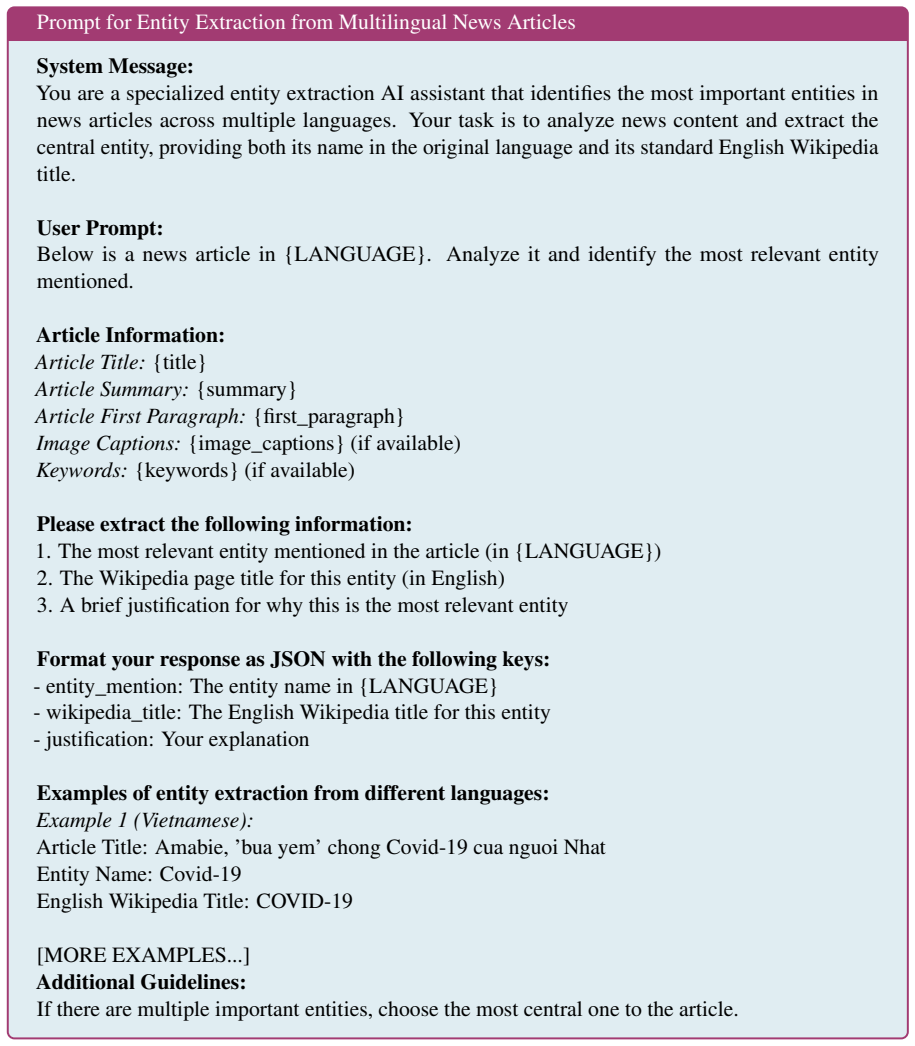
  year         = {2026},
  howpublished = {\url{https://pith.science/paper/CROECZPV}},
  note         = {Machine review of arXiv:2508.07414}
}
read the original abstract
Multimodal Large Language Models excel in high-resource settings, but often misinterpret long-tail cultural entities and underperform in low-resource languages. To address this gap, we propose a data-centric approach that directly grounds MLLMs in cultural knowledge. Leveraging a large scale knowledge graph from Wikidata, we collect images that represent culturally significant entities, and generate synthetic multilingual visual question answering data. The resulting dataset, CulturalGround, comprises 22 million high-quality, culturally-rich VQA pairs spanning 42 countries and 39 languages. We train an open-source MLLM CulturalPangea on CulturalGround, interleaving standard multilingual instruction-tuning data to preserve general abilities. CulturalPangea achieves state-of-the-art performance among open models on various culture-focused multilingual multimodal benchmarks, outperforming prior models by an average of 5.0 without degrading results on mainstream vision-language tasks. Our findings show that our targeted, culturally grounded approach could substantially narrow the cultural gap in MLLMs and offer a practical path towards globally inclusive multimodal systems.
Figures


Figures from the paper (20 more)




Reference graph
Works this paper leans on
-
[1]
Maintain the precise property being asked about in the original question (like location, category, administrative territory, awards, etc.)
-
[2]
Use natural, conversational phrasing in authentic {language_name} that a native speaker would use
-
[3]
Computational Linguistics, 50(3):1097– 1179
Bias and fairness in large language models: A survey. Computational Linguistics, 50(3):1097– 1179. Gregor Geigle, Abhay Jain, Radu Timofte, and Goran Glavaš. 2023. mblip: Efficient bootstrap- ping of multilingual vision-llms. arXiv preprint arXiv:2307.06930. Gemma Team, Aishwarya Kamath, Johan Ferret, Shreya Pathak, Nino Vieillard, Ramona Merhej, Sarah Pe...
arXiv 2023
-
[4]
arXiv preprint arXiv:2406.05967
Cvqa: Culturally-diverse multilingual vi- sual question answering benchmark. arXiv preprint arXiv:2406.05967. Krishna Srinivasan, Karthik Raman, Jiecao Chen, Michael Bendersky, and Marc Najork. 2021. Wit: Wikipedia-based image text dataset for multimodal multilingual machine learning. In Proceedings of the 44th international ACM SIGIR conference on resear...
arXiv 2021
-
[5]
Make the question grammatically correct, clear, and unambiguous
-
[6]
Phrase it as if someone is looking at an image of this entity and asking about it
-
[7]
Avoid awkward phrasing or other template artifacts For the answer:
-
[8]
Do NOT reveal specific details about the entity in the question unless absolutely necessary
Show all 77 references
-
[9]
Ensure cultural sensitivity and respect for local naming conventions and terminology
-
[13]
Ensure complete factual accuracy based on the provided information
-
[14]
Use natural language appropriate for {language_name} with proper cultural context
-
[15]
Include key factual details from the original answer and leave out any unnecessary information
-
[16]
When appropriate, provide brief additional cultural context or significance of the entity
-
[17]
Make sure to include the full entity name and keep the answer around the property being asked about
-
[18]
Ensure the answer is clear, concise, relevant, don’t include unnecessary details
Avoid vague phrases - be specific and informative. Ensure the answer is clear, concise, relevant, don’t include unnecessary details
-
[19]
It is best to avoid adding new information unless it is a well-known fact about the entity that enhances understanding
-
[20]
We are grounding the model to cultural knowledge, so it is really important to be accurate and keep answers factually correct
-
[21]
The region/country of the entity {region} is provided to you for context, so please don’t confuse the entity with other regions or countries. Format your response exactly as: Q: [your reformulated question] A: [your reformulated answer] Figure 13: Refining QA Prompt 20 Cultura...
-
[22]
Maintain the original topic but use natural, engaging phrasing in {language_name}
-
[23]
NEVER reveal specific details about the entity in the question unless necessary
-
[24]
Respect cultural context and sensitivity
-
[25]
Make it grammatically correct, clear, and culturally relevant
-
[26]
Vary question formats beyond basic identification
-
[27]
Create questions with appropriate difficulty level
-
[28]
Aim for questions that test deeper cultural knowledge
-
[29]
Keep the entity as the grounding point For the options:
-
[30]
Option A should ALW AYS be the correct answer
-
[31]
Create three plausible but incorrect options (B, C, D)
-
[32]
All options should be culturally accurate, sensible, and realistic
-
[33]
Ensure all options are similar in length and format
-
[34]
All incorrect options should be from the same general category
-
[35]
Options should represent meaningful distinctions but yet plausible and challenging within the cultural/regional context For the explanation:
-
[36]
Briefly explain why option A is correct
-
[38]
Keep explanation concise but informative (1-3 sentences)
-
[39]
Keep the entity as the grounding point Example format will be provided based on language context. Create a multiple-choice question for this entity in exactly this format: Q: [your multiple-choice question] A) [correct answer] B) [plausible incorrect option] C) [plausible inco...
-
[40]
Create either a clear statement OR a yes/no question about the entity in {language_name}
-
[41]
Mix between statements and questions for variety
-
[42]
Make it unambiguous - clearly either true or false
-
[43]
Test meaningful cultural knowledge, not trivial details
-
[44]
Respect cultural sensitivity
-
[45]
Keep the entity as the central focus
-
[46]
Vary between true and false answers for diversity For the explanation:
-
[47]
Briefly explain why the statement is true or false
-
[48]
Include relevant cultural or historical context
-
[49]
Keep it concise (1-2 sentences) Example format will be provided based on language context. Create a true/false item for this entity in exactly this format: Statement: [your true/false statement] Answer: [True/False] Explanation: [brief explanation] OR Question: [your true/fals...
-
[50]
Does the image show or reasonably represent the entity described?
-
[51]
Are there any quality issues with this sample? Common issues to check for:
-
[52]
Or entity is about park but image show city, or entity is about a person but image is of a building)
Image completely unrelated to the entity (e.g., entity is about a person, but image is of animal. Or entity is about park but image show city, or entity is about a person but image is of a building)
-
[53]
Mixed languages in question or answer
-
[54]
Obvious factual errors in the answer that you can confirm and very sure about
-
[55]
Question and answer mismatch
-
[56]
Corrupted or incomplete answer If you are not sure about the answer:
-
[57]
Treat sample as match and no issue
-
[58]
We are mostly concerned with the image being completely irrelevant to the entity and we understand some models may not know some long-tail entities
-
[59]
So unless there is a clear mismatch or quality issue in rephrased question/answer, treat it as match Other considerations:
-
[60]
If the question asks about education or birth place or other entity properties, treat it as a match if the image is related to the entity, even if it does not show the specific property
-
[61]
If the image is not provided, treat it as match unless the answer is clearly unrelated to the entity or has problematic issues mentioned above
-
[62]
You assess whether questions match with cultural entities and check for quality issues
I repeat, if you are not sure about your answer and can not confirm it which might happen alot with long-tail entities, treat it as match and no issue Format your response exactly as (Notice and keep the line breaks): MATCH: [True/False] ISSUE: [None/ImageMismatch/MixedLanguag...
-
[63]
Does the image (if present) reasonably represent the entity described?
-
[64]
Is the question culturally relevant to the specified region?
-
[65]
Are there any quality issues with this MCQ? Common issues to check for:
-
[66]
Image completely unrelated to the entity or question
-
[67]
Question not relevant to the cultural context or region
-
[68]
Incorrect answer or poor explanation
-
[69]
Mixed languages in question, options, or explanation
-
[70]
Poorly formed question or confusing options
-
[71]
Factual errors you can confirm Guidelines:
-
[72]
If you are not sure about cultural relevance or correctness, treat it as acceptable
-
[73]
Focus on obvious mismatches and clear quality issues
-
[74]
For questions without images, focus on cultural relevance and question quality
-
[75]
Your task is to analyze news content and extract the central entity, providing both its name in the original language and its standard English Wikipedia title
Consider regional context when evaluating cultural appropriateness Format your response exactly as: MATCH: [True/False] CULTURALLY_RELEV ANT: [True/False] ISSUE: [None/ImageMismatch/CulturalMismatch/IncorrectAnswer/MixedLanguage/ PoorQues- tion/FactualError/Other] EXPLANATION:...
-
[76]
The most relevant entity mentioned in the article (in {LANGUAGE})
-
[77]
The Wikipedia page title for this entity (in English)
-
[78]
A brief justification for why this is the most relevant entity Format your response as JSON with the following keys: - entity_mention: The entity name in {LANGUAGE} - wikipedia_title: The English Wikipedia title for this entity - justification: Your explanation Examples of ent...
1977
-
[2021]
arXiv preprint arXiv:2104.05025
New insights on reducing abrupt represen- tation change in online continual learning. arXiv preprint arXiv:2104.05025. Samuel Cahyawijaya, Holy Lovenia, Joel Ruben Antony Moniz, Tack Hwa Wong, Mohammad Rifqi Farhan- syah, Thant Thiri Maung, Frederikus Hudi, David Anugraha, Muh...
2025 arXiv
-
[2024]
arXiv preprint arXiv:2410.16153
Pangeabench: A comprehensive benchmark for multilingual multimodal llms. arXiv preprint arXiv:2410.16153. Yung-Sung Chuang, Yang Li, Dong Wang, Ching-Feng Yeh, Kehan Lyu, Ramya Raghavendra, James Glass, Lifei Huang, Jason Weston, Luke Zettlemoyer, Xinlei Chen, Zhuang Liu, Sain...
2025 arXiv
-
[2025]
Also known as
Kwai keye-vl technical report. arXiv preprint arXiv:2507.01949. Ashish V Thapliyal, Roberto Ponté, Shachi H Mullap- pilly, Ananya Srinivasan, Yiyi Shen, Zhong Ding, and Radu Soricut. 2022. Crossmodal-3600: A massively multilingual multimodal evaluation dataset. arXiv preprint ...
2022 arXiv
Reviewed August 5, 2026 · model on record in the stance chip above.
Discussion (0). Sign in to comment.