REVIEW 3 major objections 4 minor 34 references
Grid2Guide: A* Enabled Small Language Model for Indoor Navigation
T0 review · 3 major / 4 minor · reviewed 2026-08-05 · deepseek-v4-flash
Pith's one-line read Grid2Guide claims that indoor navigation can be made fast and accurate by shifting all spatial reasoning to A* search on a grid, leaving a small language model only the task of turning terse route commands into natural language.
desk verdict A sensible A*+SLM integration undercut by a tautological accuracy metric and a diagonal-move bug that breaks walkability guarantees. read the letter →
The pith
A machine-rendered reading of the paper's core claim, the machinery that carries it, and where it could break.
The reading
What carries the argument
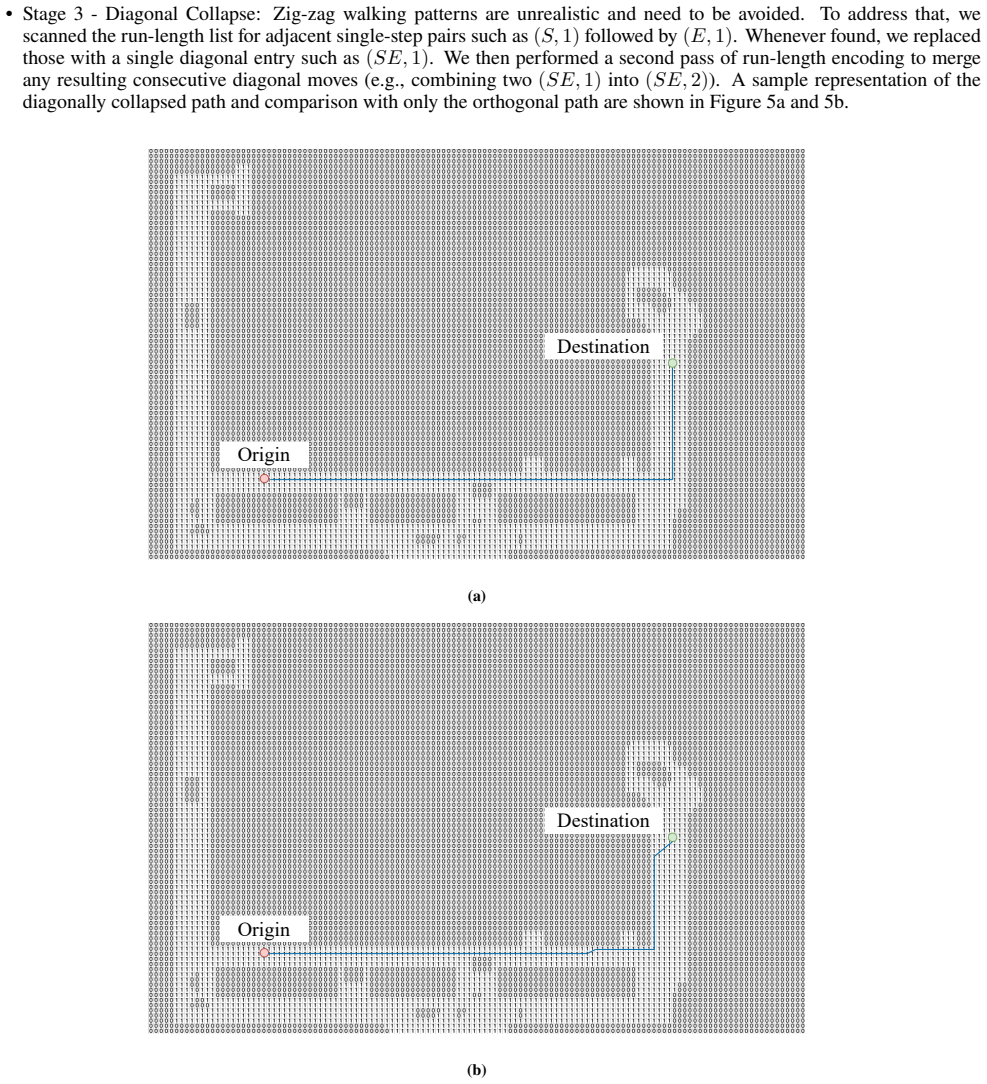
The load-bearing object is the binary occupancy grid $G \in \{0,1\}^{m \times n}$, with every free cell as a node connected to its eight neighbors. A* uses edge costs $c=1$ for orthogonal and $c=\sqrt{2}$ for diagonal steps, plus an admissible and consistent Chebyshev heuristic $h((i,j),(i_t,j_t)) = \max\{|i-i_t|, |j-j_t|\}$, guaranteeing an optimal path. A three-stage compression (vectorization, run-length encoding, diagonal collapse) converts the cell sequence into terse commands, which the SLM then turns into numbered walking instructions.
What would settle it
Take a floor plan with a corner where an orthogonal step south followed by a step east would cross a blocked diagonal cell; ask the pipeline for a route that turns that corner. If the compressed output contains a single diagonal move such as (SE,1) and the corresponding diagonal cell is occupied, the instruction is not walkable, directly contradicting the claim of 100% accuracy and guaranteed optimal routes.
Extended reading notes
Core claim
The core discovery is a modular decomposition: spatial reasoning is handled entirely by A* on a binarized occupancy grid with 8-way connectivity, edge costs of $1$ for orthogonal moves and $\sqrt{2}$ for diagonal moves, and an admissible Chebyshev heuristic. Because A* is deterministic, the route is identical on every run, and because the SLM only transforms text, the system avoids the 4–5 minute image-processing latency and spatial hallucinations reported for prior LLM-based navigation. The paper reports 100% successful route generation on all four tested maps, compared with 62–82% for the ChatGPT-based baseline, and total execution time between 14 and 21 seconds, dominated by SLM text gene
Load-bearing premise
The manually constructed occupancy grid, the manually placed portal nodes, and the diagonal-collapse compression assume that the reduced path stays on physically walkable cells, so the claimed optimality and 100% accuracy can break on real floor plans where a diagonal shortcut crosses a blocked region.
Editorial extensions
If this is right
- If correct, real-time indoor navigation instructions can be generated on CPU-only handheld devices without Wi-Fi, beacons, RFID, or other dedicated infrastructure.
- The occupancy grid is built once per map and reused for every query, so the preprocessing cost is paid once while each A* query takes under 5 milliseconds.
- Because the SLM receives only text and is model-agnostic, any instruction-tuned small language model can replace TinyLlama without changing the pathfinding or compression stages.
- Route accuracy no longer depends on the language model's probabilistic understanding of images, decoupling correctness from model scale and prompt tuning.
- The text-only output can be converted to speech, offering a path to navigation assistance for visually impaired users.
Reading between the lines
- The diagonal-collapse stage in Stage 3 merges adjacent orthogonal steps such as (S,1)+(E,1) into (SE,1) without verifying that the diagonal cell is walkable; on floor plans with diagonal walls or tight corners this can produce instructions that cut through blocked regions, so the reported 100% accuracy may not generalize to all real layouts.
- The manual effort needed to construct the occupancy grid and place portal nodes is a hidden cost; automating grid creation from CAD files or sensor data would make the pipeline truly turnkey, an extension the paper mentions only as future work.
- The 14–21 second total latency is dominated by SLM generation, not A*; using a smaller or quantized model, or caching common route phrasings, could bring the user-visible response much closer to the sub-5ms pathfinding time.
- The comparison with the Coffrini baseline is based on route-generation success, not on user satisfaction or instruction comprehension; a field study with real users would be needed to judge whether the SLM output is genuinely helpful.
Editorial analysis
A structured set of objections, weighed in public.
Referee Report
Summary. Grid2Guide proposes a five-stage indoor navigation pipeline: (i) convert a floorplan image into a binary occupancy grid; (ii) build an implicit graph with 8-way connectivity; (iii) run A* with Chebyshev heuristic to obtain an optimal grid path; (iv) compress the path into terse run-length directional commands, including a diagonal-collapse step; (v) use TinyLlama-1.1B, instruction-tuned with 1000 examples, to turn the terse commands into natural-language numbered directions. The paper claims that offloading all spatial reasoning to A* guarantees accurate optimal routes, that portal nodes enable multi-floor navigation, and that the whole pipeline runs in near-real-time on commodity CPUs. Experiments on four indoor maps (80 route queries) report A* runtimes under 5 ms, total pipeline time averaging 16.92 s, and a 100% route-success rate, compared against an LLM-only baseline (Coffrini et al.).
Significance. The core architectural idea—decoupling deterministic path planning from language generation so that a small language model only performs text formatting—is pragmatic and potentially useful for resource-constrained indoor navigation. If the path were guaranteed physically walkable and the generated instructions were shown to be accurate and useful, the system would be a meaningful lightweight alternative to LLM-based navigation without infrastructure. However, the paper's central claims are not currently established: the A* movement model permits diagonal crossings through blocked wall corners, the reported 100% accuracy is a tautology of A* completeness rather than a measure of instruction quality, and no evaluation of the final natural-language output is provided. The contribution, as presented, is therefore more of a system sketch than a validated navigation solution.
major comments (3)
- [Algorithm 1 and §III.3] The 8-way neighbor expansion checks only whether the destination cell v is in bounds and G[v]=1 (line 17); it never verifies that the two orthogonally adjacent cells (i+Δi,j) and (i,j+Δj) are free. On coarse grids such as the 30×107 Bergamo map, a diagonal step can therefore cut through the corner of a wall. This invalidates the claim in Contribution 1 of 'guaranteeing accurate optimal routes' that are physically walkable. The fix is standard: permit a diagonal move only when both orthogonal neighbors are free, and update Algorithm 1 and the cost model accordingly.
- [§III.4, Stage 3 (Diagonal Collapse)] The compression routine replaces an adjacent pair (S,1)+(E,1) with (SE,1) without checking whether the SE cell is free. This is not just a cosmetic issue: if the A* path contains such adjacent orthogonal steps, the direct diagonal cell is usually blocked (otherwise A* would have preferred the cheaper √2 diagonal). Thus the collapse can emit an instruction that sends the user through a wall or obstacle. This further undermines the claim of 'accurate optimal routes' and needs correction before the route-integrity claim can be accepted.
- [§IV.5 and Table 6] The headline '100% accuracy' is the route-generation rate of A*, which is complete by construction: for any origin–destination pair that has a path, A* will return one. Thus the 100% figure is tautological and does not test the SLM, the generated instructions, or the physical validity of the route. The paper provides no metric—human ratings, instruction correctness, agreement with ground-truth routes—for the natural-language output that is the system's stated contribution. Without such an evaluation, the comparison with Coffrini et al. in Table 6 is not meaningful.
minor comments (4)
- [Table 1 and §IV.3] In Table 1, the cost formula lists the same condition '|Δi|+|Δj|=1' for both orthogonal and diagonal moves; the diagonal case should be '=2'. In §IV.3, the text says orthogonal moves have 'cost = 10' while Table 1 says cost=1; the text should say cost=1.
- [§IV.4] The example system-prompt output has two numbered steps both labeled '2.' (the escalator step and the final step). This is likely a typo but should be fixed since the prompt instructs the model to produce one number per line.
- [§IV.5] The phrase 'true real-time performance' is not supported by the reported 16.92 s average total time (Table 5). While this is far faster than the 4–5 minute LLM baseline, the paper should define its real-time target and, ideally, report perceived-latency acceptability from a user study.
- [§III.1 and §II] The occupancy grid and portal nodes are manually constructed ('interactive grid layer' and 'portal nodes are manually defined'). This should be explicitly stated as a limitation: the 'infrastructure-free' claim refers to runtime infrastructure, not to the one-time human effort needed per map. Also, the reference formatting duplicates 'Coffrini et al.' in several places.
Circularity Check
The reported 100% route-accuracy is A* completeness by construction: the metric counts the algorithm's own guarantee on the authors' hand-labeled grid and never tests the SLM, so the headline empirical claim reduces to its input.
-
self definitional
[Section IV.5 (Evaluation Outcomes), Table 6; Contribution 1 in Section I; Algorithm 1 in Section III.3]
"As a result, our system achieved 100% accuracy across all experimented maps. Moreover, the reliance on lightweight local inference substantially reduced computational overhead."
Table 6's 'successful route-generation rate' is evaluated on the same hand-labeled occupancy grid that Algorithm 1 searches (Section IV.1: 'An interactive grid layer was created over the map overlays to mark the walkable paths and blocked regions'). Section III.3 states A* 'is both (i) complete: it will surely find a path if one exists, (ii) optimal'; Algorithm 1 (line 17) admits any in-bounds neighbor with G[v]=1 and (line 25) returns the reconstructed path. So for any start-goal pair with a connected free route, success is guaranteed by construction: the 100% figure restates A*'s completeness rather than testing the system. The metric never isolates the SLM (the learned component), reports no instruction-quality measure, and cannot catch that diagonal moves (Algorithm 1 line 17) check on
full rationale
The derivation chain is: floor plan → hand-labeled occupancy grid G (Section IV.1) → 8-way A* on G (Algorithm 1) → RLE/diagonal-collapse compression (Section III.4) → SLM text generation (Section III.5) → evaluation (Section IV). The A* optimality claim rests on the external, textbook theorem of Hart et al. (1968) with an admissible Chebyshev heuristic, so the optimal-route guarantee itself is independent and not circular; the runtime measurements in Tables 4 and 5 are genuine empirical results. The circular step is the headline validation: Table 6's 'successful route-generation rate' measures only whether a route is produced on the same hand-labeled grid that the authors built and that Algorithm 1 itself searches. Because the paper states A* is complete ('it will surely find a path if one exists') and Algorithm 1 admits any in-bounds free neighbor, 100% success is guaranteed by construction for any connected start-goal pair; it restates the algorithm's definitional property. That metric cannot detect errors in the novel learned component (the SLM) or in the compressed instructions, and no instruction-quality metric (analogous to Coffrini et al.'s instruction-level accuracy) is reported, so the claim that the system 'guarantees accurate optimal routes' is validated only against the authors' own labeling. This is a genuine reduction by construction and warrants 6 rather than lower. Separately, there is a correctness gap that I do not count as circularity: Algorithm 1's diagonal moves and Stage-3 Diagonal Collapse never check the two orthogonally adjacent cells, so 'optimal' paths can cut blocked wall corners and the compressed output may leave the free space; this weakens the walkability guarantee but is a validity issue, not a logical circularity. No self-citations or imported uniqueness theorems appear; the comparison against Coffrini et al. does show the LLM-only baseline fails where a deterministic complete search trivially succeeds, but that contrast is meaningful. Overall: partial circularity — the core A* result is externally grounded, but the central empirical accuracy claim reduces by construction.
Assumptions & free parameters
free parameters (5)
- Occupancy grid dimensions per map =
Birmingham 90x130, Bergamo 30x107, Bologna 120x190, Orio ground 80x130, Orio first 80x100
- Binarization majority threshold =
50%
- Portal node placements =
Manually defined at elevators, escalators, and stairs
- SLM fine-tuning dataset =
1,000 examples with LoRA, dataset not released
- System prompt wording =
Iteratively refined prompt in Section IV.4
assumptions (6)
- domain assumption Floor plan images can be binarized into walkable and blocked cells by thresholding and majority voting.
- domain assumption 8-way connectivity with diagonal edges is a valid model of indoor movement and does not cut through obstacles.
- ad hoc to paper Replacing adjacent orthogonal steps with a diagonal preserves a traversable path.
- domain assumption A floor plan is static and accurately represents current walkable space.
- standard math The Chebyshev heuristic is admissible and consistent for the mixed 1 and sqrt(2) cost model.
- domain assumption The SLM follows the system prompt and is sufficiently instruction-tuned to convert terse commands into correct instructions.
invented entities (1)
-
Portal nodes for vertical movement
Cite this review
Pith. "Pith review of Grid2Guide: A* Enabled Small Language Model for Indoor Navigation." pith.science (2026). https://pith.science/paper/DC27ZGJ7
@misc{pith2026250808100,
  author       = {Pith},
  title        = {Pith review of: Grid2Guide: A* Enabled Small Language Model for Indoor Navigation},
  year         = {2026},
  howpublished = {\url{https://pith.science/paper/DC27ZGJ7}},
  note         = {Machine review of arXiv:2508.08100}
}
read the original abstract
Reliable indoor navigation remains a significant challenge in complex environments, particularly where external positioning signals and dedicated infrastructures are unavailable. This research presents Grid2Guide, a hybrid navigation framework that combines the A* search algorithm with a Small Language Model (SLM) to generate clear, human-readable route instructions. The framework first conducts a binary occupancy matrix from a given indoor map. Using this matrix, the A* algorithm computes the optimal path between origin and destination, producing concise textual navigation steps. These steps are then transformed into natural language instructions by the SLM, enhancing interpretability for end users. Experimental evaluations across various indoor scenarios demonstrate the method's effectiveness in producing accurate and timely navigation guidance. The results validate the proposed approach as a lightweight, infrastructure-free solution for real-time indoor navigation support.
Figures


Figures from the paper (6 more)



Reference graph
Works this paper leans on
-
[1]
Belir, O. and Onder, D. E. (2013). Accessibility in public spaces: Spatial legibility for visually impaired people. InProceedings of the Ninth International Space Syntax Symposium Edited by Kim, YO, Park, HT and Seo, KW
work page 2013
-
[2]
Borges, C. D. B., Almeida, A. M. A., J´ unior, I. C. P., and Junior, J. J. d. M. S. (2019). A strategy and evaluation method for ground global path planning based on aerial images. Expert Systems with Applications, 137:232–252
work page 2019
-
[3]
Bosch, S. J. and Gharaveis, A. (2017). Flying solo: A review of the literature on wayfinding for older adults experiencing visual or cognitive decline. Applied ergonomics, 58:327–333
work page 2017
-
[4]
Candeloro, M., Lekkas, A. M., and Sørensen, A. J. (2017). A voronoi-diagram-based dynamic path-planning system for underactuated marine vessels. Control Engineering Practice, 61:41–54
work page 2017
-
[5]
Chou, J.-S., Cheng, M.-Y., Hsieh, Y.-M., Yang, I.-T., and Hsu, H.-T. (2019). Optimal path planning in real time for dynamic building fire rescue operations using wireless sensors and visual guidance. Automation in construction, 99:1–17
work page 2019
-
[6]
Chung, H. W., Hou, L., Longpre, S., Zoph, B., Tay, Y., Fedus, W., Li, Y., Wang, X., Dehghani, M., Brahma, S., et al. (2024). Scaling instruction-finetuned language models. Journal of Machine Learning Research, 25(70):1–53
work page 2024
-
[7]
A., Barsocchi, P., Furfari, F., Crivello, A., and Ferrari, A
Coffrini, A., Zadenoori, M. A., Barsocchi, P., Furfari, F., Crivello, A., and Ferrari, A. (2025). Toward a method for llm-enabled indoor navigation
work page 2025
-
[8]
Das, P. K., Behera, H. S., and Panigrahi, B. K. (2016). A hybridization of an improved particle swarm optimization and gravitational search algorithm for multi-robot path planning. Swarm and evolutionary computation, 28:14–28
work page 2016
Show all 34 references
-
[9]
Dettmers, T., Lewis, M., Belkada, Y., and Zettlemoyer, L. (2022). Gpt3. int8 (): 8-bit matrix multiplication for transformers at scale. Advances in neural information processing systems, 35:30318–30332
2022
-
[10]
Dubins, L. E. (1957). On curves of minimal length with a constraint on average curvature, and with prescribed initial and terminal positions and tangents. American Journal of mathematics, 79(3):497–516
1957
-
[11]
A., and Adan, I
Fransen, K., Van Eekelen, J., Pogromsky, A., Boon, M. A., and Adan, I. J. (2020). A dynamic path planning approach for dense, large, grid-based automated guided vehicle systems. Computers & Operations Research, 123:105046
2020
-
[12]
Fu, X.-Y., Laskar, M. T. R., Khasanova, E., Chen, C., and TN, S. B. (2024). Tiny titans: Can smaller large language models punch above their weight in the real world for meeting summarization? arXiv preprint arXiv:2402.00841
2024 arXiv
-
[13]
Furfari, F., Crivello, A., Barsocchi, P., Palumbo, F., and Potort `ı, F. (2019). What is next for indoor localisation? taxonomy, protocols, and patterns for advanced location based services. In 2019 International Conference on Indoor Positioning and Indoor Navigation (IPIN), pages 1–8
2019
-
[14]
Guerreiro, J., Ahmetovic, D., Sato, D., Kitani, K., and Asakawa, C. (2019). Airport accessibility and navigation assistance for people with visual impairments. In Proceedings of the 2019 CHI conference on human factors in computing systems, pages 1–14
2019
-
[15]
K., Agarwal, H., and Parsediya, D
Guruji, A. K., Agarwal, H., and Parsediya, D. (2016). Time-efficient a* algorithm for robot path planning.Procedia Technology, 23:144–149
2016
-
[16]
E., Nilsson, N
Hart, P. E., Nilsson, N. J., and Raphael, B. (1968). A formal basis for the heuristic determination of minimum cost paths.IEEE transactions on Systems Science and Cybernetics, 4(2):100–107
1968
-
[17]
Howden, W. E. (1968). The sofa problem. The computer journal, 11(3):299–301
1968
-
[18]
Hurtuk, J., ˇCerveˇn´ak, J., ˇStancel, M., Huli ˇc, M., and Fecil’ak, P. (2019). Indoor navigation using indooratlas library. In 2019 IEEE 17th International Symposium on Intelligent Systems and Informatics (SISY), pages 139–142. IEEE
2019
-
[19]
Iftikhar, H., Shah, P., and Luximon, Y. (2021). Human wayfinding behaviour and metrics in complex environments: A systematic literature review. Architectural Science Review, 64(5):452–463
2021
-
[20]
Jamshidi, S., Ensafi, M., and Pati, D. (2020). Wayfinding in interior environments: An integrative review. Frontiers in Psychology, 11:549628
2020
-
[21]
M., and Kim, S.-C
Jeong, J., Yeon, S., Kim, T., Lee, H., Kim, S. M., and Kim, S.-C. (2018). Sala: Smartphone-assisted localization algorithm for positioning indoor iot devices. Wireless Networks, 24:27–47. MapsPeople (2021). Hospital wayfinding: Why it matters more than you think. https://www.m...
2018
-
[22]
Ouyang, L., Wu, J., Jiang, X., Almeida, D., Wainwright, C., Mishkin, P., Zhang, C., Agarwal, S., Slama, K., Ray, A., et al. (2022). Training language models to follow instructions with human feedback. Advances in neural information processing systems, 35:27730–27744
2022
-
[23]
and Lee, J.-H
Park, H. and Lee, J.-H. (2007). B-spline curve fitting based on adaptive curve refinement using dominant points.Computer-Aided Design, 39(6):439–451. Quuppa (2019). Quuppa intelligent locating system. https://www.quuppa.com
2007
-
[24]
Ramani, S. V. and Tank, Y. N. (2014). Indoor navigation on google maps and indoor localization using rss fingerprinting.arXiv preprint arXiv:1405.5669
2014 arXiv
-
[25]
and McDonell, K
Reynolds, L. and McDonell, K. (2021). Prompt programming for large language models: Beyond the few-shot paradigm. In Extended abstracts of the 2021 CHI conference on human factors in computing systems, pages 1–7
2021
-
[26]
K., Saha, S., Jain, V., Mondal, S., and Chadha, A
Sahoo, P., Singh, A. K., Saha, S., Jain, V., Mondal, S., and Chadha, A. (2024). A systematic survey of prompt engineering in large language models: Techniques and applications. arXiv preprint arXiv:2402.07927
2024 arXiv
-
[27]
Santiago, R. M. C., De Ocampo, A. L., Ubando, A. T., Bandala, A. A., and Dadios, E. P. (2017). Path planning for mobile robots using genetic algorithm and probabilistic roadmap. In2017IEEE 9th international conference on humanoid, nanotechnology, information technology, commun...
2017
-
[28]
Tang, G., Tang, C., Claramunt, C., Hu, X., and Zhou, P. (2021). Geometric a-star algorithm: An improved a-star algorithm for agv path planning in a port environment. IEEE access, 9:59196–59210. UAB Medicine (2017). Hospital wayfinding: Challenges for patients and staff. https:...
2021
-
[29]
Wang, H., Yu, Y., and Yuan, Q. (2011). Application of dijkstra algorithm in robot path-planning. In2011 second international conference on mechanic automation and control engineering, pages 1067–1069. IEEE
2011
-
[30]
Y., Guu, K., Yu, A
Wei, J., Bosma, M., Zhao, V. Y., Guu, K., Yu, A. W., Lester, B., Du, N., Dai, A. M., and Le, Q. V. (2021). Finetuned language models are zero-shot learners. arXiv preprint arXiv:2109.01652
2021 arXiv
-
[31]
V., Zhou, D., et al
Wei, J., Wang, X., Schuurmans, D., Bosma, M., Xia, F., Chi, E., Le, Q. V., Zhou, D., et al. (2022). Chain-of-thought prompting elicits reasoning in large language models. Advances in neural information processing systems, 35:24824–24837
2022
-
[32]
Wichmann, J., Paetow, T., Leyer, M., Aweno, B., and Sandkuhl, K. (2024). Determining design criteria for indoor positioning system projects in hospitals: A design science approach. Digital Health, 10:20552076241229148
2024
-
[33]
Xiong, C., Chen, D., Lu, D., Zeng, Z., and Lian, L. (2019). Path planning of multiple autonomous marine vehicles for adaptive sampling using voronoi-based ant colony optimization. Robotics and Autonomous Systems, 115:90–103
2019
-
[34]
Zhang, P., Zeng, G., Wang, T., and Lu, W. (2024). Tinyllama: An open-source small language model. arXiv preprint arXiv:2401.02385
2024 arXiv
Reviewed August 5, 2026 · model on record in the stance chip above.
Discussion (0). Continue with ORCID to comment.