REVIEW 2 major objections 3 minor 24 references
Average Contraction Coefficients of Quantum Channels
T0 review · 2 major / 3 minor · reviewed 2026-08-05 · deepseek-v4-flash
Pith's one-line read This paper introduces average contraction coefficients for quantum channels and proves that typical-state distinguishability survives weak noise but collapses beyond a critical noise rate.
desk verdict Introduces moments of contraction and proves real phase transitions for average trace-distance contraction; core claims hold up, though a log-base ambiguity and a mis-stated Cor. 32 need fixing. read the letter →
The pith
A machine-rendered reading of the paper's core claim, the machinery that carries it, and where it could break.
The reading
What carries the argument
The central object is the p-th moment of contraction, η_p(T, D, ν) = E_{ν}[(D(T(ρ)∥T(σ))/D(ρ∥σ))^p]^{1/p}, which interpolates between average contraction at p = 1 and the usual worst-case contraction as p → ∞. The lower-bound mechanism is a projector onto the δ-typical set of Kraus sequences, whose rank is controlled by the Choi entropy S(τ); the upper-bound mechanism combines concentration of the trace distance for random states with exact 2-design expectations for the output 2-norm.
What would settle it
Compute numerically the average trace-distance contraction for n-fold depolarizing noise at p = 0.35 for increasing n: if the value stays bounded away from both 0 and 1, the claimed two-threshold dichotomy is incomplete. Independently, solve the defining equation for p1 with natural logarithms; the solution is approximately 0.442, which exceeds p2 ≈ 0.423, so the interval between p2 and p1 must be resolved by fixing the logarithm base convention in Theorem 18 and Proposition 22.
Extended reading notes
Core claim
On its own terms, the paper establishes that worst-case contraction coefficients systematically overestimate the noise suffered by typical quantum states, and it replaces them with a p-th moment hierarchy. For n-fold tensor products of single-qubit depolarizing noise, the average trace-distance contraction is 1 for p < p1 ≈ 0.25 and decays exponentially in n for p > p2 ≈ 0.42. For the channel that discards M of N qubits, the asymptotic average contraction is exactly 1 for M < N/2, exactly 0 for M > N/2, and equals 1/4 + 1/pi at M = N/2. For random circuits with unital noise, constant depth does not shrink the average trace distance even for highly entangled 1-design inputs, while at log log
Load-bearing premise
The lower-threshold calculation identifies the entropy of a canonical Kraus distribution with the Choi entropy and reads the defining equation of p1 in a specific logarithm base; if that base is not the one used for the von Neumann entropy, the claimed thresholds p1 ≈ 0.25 and p2 ≈ 0.42 overlap and the phase transition as stated is not self-consistent.
Editorial extensions
If this is right
- For local depolarizing noise at a fixed rate above about 0.42, most pairs of n-qubit outputs are indistinguishable without exponentially many samples, while below about 0.25 most pairs remain maximally distinguishable.
- Discarding more than half of an N-qubit system makes the remaining state essentially independent of the input on average, whereas discarding less than half preserves distinguishability, with a sharp critical point at exactly half.
- Constant-depth noisy quantum circuits with unital noise and 1-design unitary layers do not contract the average trace distance, so simple depth-based arguments for error-mitigation limitations do not apply in that regime.
- Local differential privacy regimes that force depolarizing noise close to maximal also force average trace-distance contraction to vanish exponentially, making typical outputs essentially indistinguishable.
- The f-divergence moment relations extend these conclusions beyond the trace distance, so vanishing average contraction of trace distance implies vanishing average contraction for a large class of quantum divergences.
Reading between the lines
- The same typical-set and 2-design moment machinery likely yields thresholds for higher moments p > 1, with the phase transition sharpening as p increases toward worst-case contraction.
- A testable extension is to non-unital noise, where the lower-bound entropy condition from Theorem 18 would need a fixed-point correction; the paper leaves this case open.
- If the phase transition persists under more operationally motivated input distributions, it would give an average-case analogue of reverse threshold theorems, separating instances where noise is benign from instances where it destroys information.
- The f-divergence inequalities suggest that in strong-privacy regimes, not only trace distance but also relative-entropy and chi-squared-based privacy metrics become vacuously small for typical inputs, with rates governed by the divergence's boundary behavior.
Editorial analysis
A structured set of objections, weighed in public.
Referee Report
Summary. The paper defines p-th moments of contraction coefficients for quantum channels and divergences, interpolating between average and worst-case contraction. It derives general properties of these moments, upper and lower bounds for the trace distance under unitarily invariant input ensembles, and phase-transition results for tensor-product noise channels (notably depolarizing and partial trace), random noisy circuits, f-divergences, and local differential privacy. The central technical tools are concentration bounds for random states, 1- and 2-design computations, and a typical-set lower bound in the spirit of the asymptotic equipartition property. The manuscript also contains numerical simulations of the finite-size behavior for several single-qubit channels.
Significance. If the technical points are repaired, this is a valuable contribution. The framework of average contraction coefficients is natural and likely to be reused. The phase transitions for tensor-product noise are genuinely new phenomena, and the random-circuit result—constant-depth unital noisy circuits do not shrink average trace distance, contrasted with superpolynomial decay at slightly larger depth—is an interesting and nontrivial complement to existing limitations on noisy quantum computation. The paper is also refreshingly candid about the regimes in which its bounds are not predictive. However, the central depolarizing phase-transition threshold is affected by an unspecified logarithm base, so the main claim is not currently well-defined as written.
major comments (2)
- [§4.2, Prop. 22 and Thm. 18] Theorem 18's typical-set argument uses |T_δ^n|≤2^{n(H(X)+δ)}, so H(X)=S(τ) must be measured in bits. Proposition 22 defines p1 by (1−3p/4)log(1−3p/4)+(3p/4)log(p/4)=−1 and states p1≈0.25. This is correct only for base-2 logarithms; with natural logarithms the solution is ≈0.442, which exceeds p2=1−1/√3≈0.4226. Under the natural-log reading, Thm. 18's lower bound and Cor. 13's upper bound both apply on (0.4226,0.442), forcing the average contraction to tend both to 1 and to 0. Since Section 2 never fixes the base of log in S(τ), the claimed phase transition is not well-defined as written. Please state explicitly that all entropies and exponents in §4.2 and in the numerical thresholds are in bits, or consistently carry base-e factors throughout Thm. 18.
- [§4.3, Thm. 23 / App. B] Theorem 23 states 'there is a large enough D (but independent of n)' with bound 1−ε−2^{D(S(τ)+δ)−n}. For fixed n, increasing D makes the right-hand side negative, so the theorem is vacuous. The intended nontrivial statement must be 'for any fixed D and all sufficiently large n' (with D chosen before n); otherwise the advertised constant-depth result is not captured. In addition, Corollary 41 in App. B gives a bound of the form (1−ε)^D−2^{n[D(S(τ)+δ)−1]}, which is not the same as Theorem 23's 1−ε−2^{D(S(τ)+δ)−n}; please reconcile the two statements and proofs.
minor comments (3)
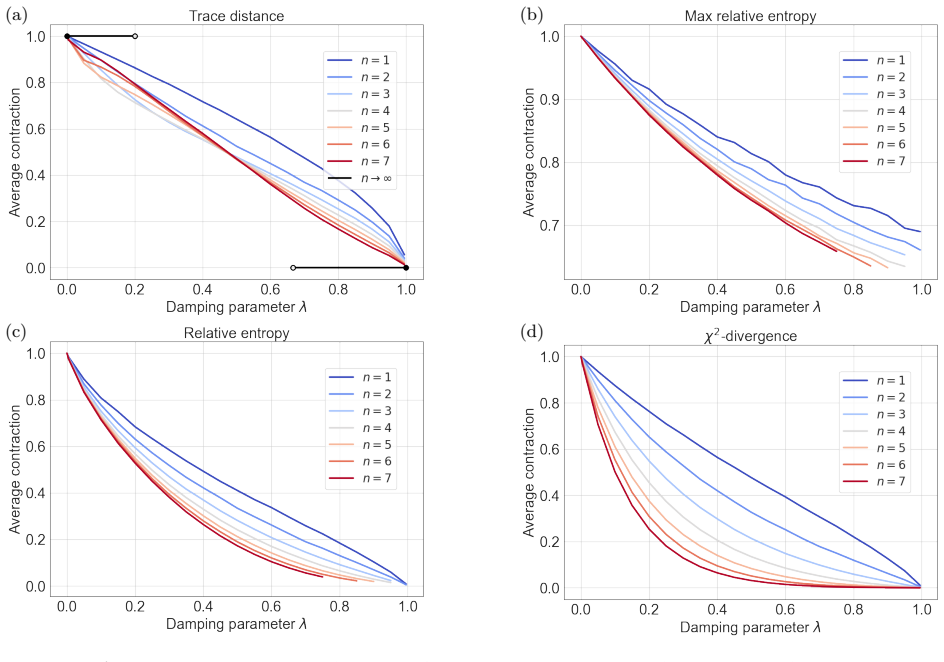
- [§7 and App. E, amplitude damping] The main text says 'Tr√Tr2τ^2_damp falls below 1 for λ≲0.46', but App. E gives the exact expression 1/2[√(2−λ+λ^2)+√((1−λ)(2−λ))], which crosses 1 at λ≈0.67, not 0.46. This numerical inconsistency affects the accompanying discussion of Fig. 4 and should be corrected.
- [§5, Eq. (140)] The displayed chain ηp(D_f) ≤ d/(d−1)ηp(Tr) ≤ sqrt(...) ηp(D_f) is not a valid chain: the first inequality upper-bounds D_f by the trace distance, while the second is a square-root bound on the trace distance in terms of D_f. The two inequalities should be stated separately; as written, the display suggests a cancellation that does not hold.
- [Fig. 1 caption] The caption refers to p0≈0.25 and p1≈0.42, while the text and Prop. 22 use p1≈0.25 and p2≈0.42. Please unify the notation.
Circularity Check
No circularity: derivations are self-contained and externally benchmarked; the noted log-base ambiguity is a correctness concern, not a circular step.
full rationale
I walked the main derivation chain and found no step in which a claimed prediction or derived result reduces by construction to its own inputs, nor any load-bearing self-citation. The moments of contraction are defined independently of the paper's bounds, and the p→∞ limit recovers the standard worst-case contraction coefficient by L^p monotonicity and dominated convergence (Prop. 2), giving an external benchmark. The upper bounds (Thm. 6, Thm. 11, Cor. 13) are proved from stated ensemble assumptions — Hilbert-Schmidt concentration (Lemma 5, from PPZ16) and 2-design moment computations (App. A) — and are expressed in terms of channel quantities (Choi purity, Choi entropy, and π=T(I/d)) that are computed from the announced channel model, not fitted to the target contraction values. The lower bounds (Thm. 18, Prop. 17, Prop. 22, Thm. 23) use standard δ-typical-set arguments and 1-design identities; H(X)=S(τ) is stated as a fact about the canonical Kraus decomposition, and the resulting thresholds p1 and p2 are consequences of the derived inequalities rather than inputs. Citations such as [QFK+24] and [DNS+21] are used for comparison and context, not as the justification of the paper's central claims; the author overlap on [QFK+24] does not make the cited result load-bearing here. The partial-trace threshold M=N/2 is derived and matches the independent concentration result for Hilbert-Schmidt states, not imported. The log-base ambiguity in Prop. 22 (the defining equation for p1 gives ≈0.25 only for base 2, while natural log gives ≈0.442) is a real consistency/correctness issue in the manuscript but is not a circularity: it concerns whether the stated numerical threshold follows from the stated equation under a fixed convention, not whether the conclusion is equivalent to the premise. Therefore no circular step meets the evidentiary bar set by the review rules.
Assumptions & free parameters
assumptions (5)
- domain assumption Trace distance of independent Hilbert-Schmidt random states concentrates around D = 1/4+1/pi with exponential rate exp(-lambda d^2 delta^2) (Lemma 5, from Prop 2 of [PPZ16]).
- domain assumption For a 1-design over pure states, Pr[1/2 ||rho-sigma||_1 <= 1-delta] <= 1/(d delta) (Lemma 39), and 2-design collision probability Pr[rho=sigma] = O(d^-4) (Lemma 38).
- domain assumption Quantum f-divergences via the integral representation, with the reverse Pinsker bound of Prop 5.2 of [HT24] (Prop 25 here) and the Pinsker-type lower bound (Prop 26, from [Gil10]).
- ad hoc to paper Asymptotic equipartition property for i.i.d. Kraus sequences: typical set size at most 2^{n(H(X)+delta)} and probability at least 1-epsilon, with H(X) identified with Choi entropy S(tau) for a canonical Kraus decomposition (Thm 18, App B).
- standard math Choi-state identities: Tr tau^2 equals the mean squared singular value, Tr tau^2 <= d'/d, d Tr_2 tau^2 >= pi^2, and S(tau) <= H(X) (Facts 42-45).
Cite this review
Pith. "Pith review of Average Contraction Coefficients of Quantum Channels." pith.science (2026). https://pith.science/paper/HNE62XV5
@misc{pith2026250808214,
  author       = {Pith},
  title        = {Pith review of: Average Contraction Coefficients of Quantum Channels},
  year         = {2026},
  howpublished = {\url{https://pith.science/paper/HNE62XV5}},
  note         = {Machine review of arXiv:2508.08214}
}
abstract
The data-processing inequality ensures quantum channels reduce state distinguishability, with contraction coefficients quantifying optimal bounds. However, these can be overly optimistic and not representative of the usual behavior. We study how noise contracts distinguishability of `typical' states, beyond the worst-case. To that end, we introduce and study a family of moments of contraction for quantum divergences, which interpolate between the worst-case contraction coefficient of a channel and its average behavior under a chosen ensemble of input states. We establish general properties of these moments, relate moments for different divergences, and derive bounds in terms of channel parameters like the entropy or purity of its Choi state. Focusing on the trace distance, we obtain upper and lower bounds on its average contraction under tensor-product noise channels, and prove that, depending on the local noise strength, there is a phase transition in the limit of many channel uses: below a critical error rate the average contraction remains near unity, whereas above it decays exponentially with system size. We extend these phase-transition phenomena to random quantum circuits with unital noise, showing that constant-depth noisy circuits do not shrink the trace distance on average, even when given highly entangled states as input. In contrast, even at $\log\log n$ depth, the average trace distance can become superpolynomially small. Finally, we explore moments of contraction for f-divergences and discuss applications to local differential privacy, demonstrating that noise regimes ensuring privacy can render outputs essentially indistinguishable on average. Thus, our results provide a fine-grained framework to quantify typical channel noise in quantum information and computation and unveil new phenomena in contraction coefficients, such as phase transitions for average contraction.
Figures


Figures from the paper (2 more)

Reference graph
Works this paper leans on
-
[1]
[ABO08] Dorit Aharonov and Michael Ben-Or. Fault-tolerant quantum computation with constant error rate.SIAM Journal on Computing, 38(4):1207–1282, January 2008.doi:10.1137/ s0097539799359385. [ABOIN96] D. Aharonov, M. Ben-Or, R. Impagliazzo, and N. Nisan. Limitations of noisy reversible computation, 1996.doi:10.48550/arxiv.quant-ph/9611028. [ADK23] Armand...
-
[7]
The algorithmic foundations of differential privacy
[DR13] Cynthia Dwork and Aaron Roth. The algorithmic foundations of differential privacy. Foundations and Trends®in Theoretical Computer Science, 9(3–4):211–407, 2013.doi: 10.1561/0400000042. 39 [FHT03] A.A. Fedotov, P. Harremoes, and F. Topsoe. Refinements of pinsker’s inequality.IEEE Trans- actions on Information Theory, 49(6):1491–1498, 2003.doi:10.110...
arXiv 2013
-
[15]
[QFK+24] Yihui Quek, Daniel Stilck Fran¸ ca, Sumeet Khatri, Johannes Jakob Meyer, and Jens Eisert. Exponentially tighter bounds on limitations of quantum error mitigation.Nature Physics, 20(10):1648–1658, 2024.doi:10.1038/s41567-024-02536-7. [RF A25] Cambyse Rouz´ e, Daniel Stilck Fran¸ ca, and ´Alvaro M. Alhambra. Efficient thermalization and universal q...
-
[18]
[SW10] Claude Sammut and Geoffrey I
42 [SV16] Igal Sason and Sergio Verdu.f-divergence inequalities.IEEE Transactions on Information Theory, 62(11):5973–6006, November 2016.doi:10.1109/tit.2016.2603151. [SW10] Claude Sammut and Geoffrey I. Webb, editors.Accuracy, pages 9–10. Springer US, Boston, MA, 2010.doi:10.1007/978-0-387-30164-8_3. [SZP16] Uttam Singh, Lin Zhang, and Arun Kumar Pati. A...
-
[19]
doi:10.1007/978-0-387-30164-8_157. [Tin10b] Kai Ming Ting. Precision and recall. In Claude Sammut and Geoffrey I. Webb, editors, Encyclopedia of Machine Learning, pages 781–781. Springer US, Boston, MA, 2010.doi: 10.1007/978-0-387-30164-8_652. [TKR+10] K. Temme, M. J. Kastoryano, M. B. Ruskai, M. M. Wolf, and F. Verstraete. Theχ 2- divergence and mixing t...
arXiv 2010
-
[20]
Watkins, Samuel Yen-Chi Chen, and Shinjae Yoo
[WCY23] William M. Watkins, Samuel Yen-Chi Chen, and Shinjae Yoo. Quantum machine learn- ing with differential privacy.Scientific Reports, 13(1):2453, Feb 2023.doi:10.1038/ s41598-022-24082-z. [Wil17] Mark M. Wilde.Quantum Information Theory. Cambridge University Press, 2 edition,
work page 2023
-
[22]
Volume of the set of separable states.Phys
[ZHSL98] Karol ˙Zyczkowski, Pawe l Horodecki, Anna Sanpera, and Maciej Lewenstein. Volume of the set of separable states.Phys. Rev. A, 58:883–892, Aug 1998.doi:10.1103/PhysRevA.58.883. [ZS01] Karol ˙Zyczkowski and Hans-J¨ urgen Sommers. Induced measures in the space of mixed quantum states.Journal of Physics A: Mathematical and General, 34(35):7111, aug
-
[23]
[ZY17] Li Zhou and Mingsheng Ying
doi:10.1088/0305-4470/34/35/335. [ZY17] Li Zhou and Mingsheng Ying. Differential privacy in quantum computation. In2017 IEEE 30th Computer Security Foundations Symposium (CSF), page 249–262. IEEE, August
Show all 24 references
-
[24]
∥T(ρ)−T(σ)∥ 2 2 ∥ρ−σ∥ 2 2 # =E X∼ν
doi:10.1109/csf.2017.23. 43 A Expectation values fort-invariant distributions A distributionνover Hermitian matrices is unitarily invariant if it satisfiesUΛU † ∼νfor Λ∼νand any unitaryU. When such a distribution is defined over quantum states, it reflects the absence of a pre...
2017 doi
-
[1934]
[HMPB11] Fumio Hiai, Mil´ an Mosonyi, D´ enes Petz, and C´ edric B´ eny
Chapter 4.8. [HMPB11] Fumio Hiai, Mil´ an Mosonyi, D´ enes Petz, and C´ edric B´ eny. Quantumf-divergences and error correction.Reviews in Mathematical Physics, 23(07):691–747, 2011.doi:10.1142/ S0129055X11004412. [HP91] Fumio Hiai and D´ enes Petz. The proper formula for rela...
2011
-
[1963]
Exact and approxi- mate unitary 2-designs and their application to fidelity estimation.Phys
[DCEL09] Christoph Dankert, Richard Cleve, Joseph Emerson, and Etera Livine. Exact and approxi- mate unitary 2-designs and their application to fidelity estimation.Phys. Rev. A, 80:012304, Jul 2009.doi:10.1103/PhysRevA.80.012304. [DHL+21] Yuxuan Du, Min-Hsiu Hsieh, Tongliang L...
2009 doi
-
[1966]
American Mathemat- ical Society, August 2017.doi:10.1090/surv/223
38 [AS17] Guillaume Aubrun and Stanis law Szarek.Alice and Bob Meet Banach. American Mathemat- ical Society, August 2017.doi:10.1090/surv/223. [A W01] R. Ahlswede and A. Winter. Strong converse for identification via quantum channels,
2017 doi
-
[1973]
[LR99] Andrew Lesniewski and Mary Beth Ruskai
doi:10.1063/1.1666274. [LR99] Andrew Lesniewski and Mary Beth Ruskai. Monotone Riemannian metrics and rela- tive entropy on noncommutative probability spaces.Journal of Mathematical Physics, 40(11):5702–5724, November 1999.doi:10.1063/1.533053. [Mat18] Keiji Matsumoto. A new q...
1999 doi
-
[1985]
Quasi-entropies for finite quantum systems.Reports on Mathematical Physics, 23(1):57–65, 1986.doi:10.1016/0034-4877(86)90067-4
[Pet86] D´ enes Petz. Quasi-entropies for finite quantum systems.Reports on Mathematical Physics, 23(1):57–65, 1986.doi:10.1016/0034-4877(86)90067-4. [PGWPR06] David P´ erez-Garc ´ ıa, Michael M. Wolf, Denes Petz, and Mary Beth Ruskai. Contractivity of positive and trace-prese...
1986 doi
-
[1996]
[BKZ06] Robin Blume-Kohout and Wojciech H. Zurek. Quantum darwinism: Entanglement, branches, and the emergent classicality of redundantly stored quantum information.Phys. Rev. A, 73:062310, Jun 2006.doi:10.1103/PhysRevA.73.062310. [BSW23] Mario Berta, David Sutter, and Michael...
2006
-
[2001]
[Bha96] R
arXiv:quant-ph/0012127. [Bha96] R. Bhatia.Matrix Analysis. Graduate Texts in Mathematics. Springer New York,
-
[2010]
[NGW24] Theshani Nuradha, Ziv Goldfeld, and Mark M. Wilde. Quantum pufferfish privacy: A flex- ible privacy framework for quantum systems.IEEE Transactions on Information Theory, 70(8):5731–5762, August 2024.doi:10.1109/tit.2024.3404927. [NW25] Theshani Nuradha and Mark M. Wil...
2024
-
[2012]
[SP18] Maria Schuld and Francesco Petruccione.Supervised learning with quantum computers
doi:10.1007/s11128-011-0238-x. [SP18] Maria Schuld and Francesco Petruccione.Supervised learning with quantum computers. Quan- tum Science and Technology (QST). Springer,
-
[2014]
Springer Berlin Heidelberg, 2008.doi:10.1007/978-3-540-70575-8_69
[KRUdW08] Julia Kempe, Oded Regev, Falk Unger, and Ronald de Wolf.Upper Bounds on the Noise Threshold for Fault-Tolerant Quantum Computing, page 845–856. Springer Berlin Heidelberg, 2008.doi:10.1007/978-3-540-70575-8_69. [LC20] Ryan LaRose and Brian Coyle. Robust data encoding...
2008 doi
-
[2017]
Optimized quantum f-divergences and data processing.Journal of Physics A: Mathematical and Theoretical, 51(37):374002, aug 2018.doi:10.1088/1751-8121/aad5a1
[Wil18] Mark M Wilde. Optimized quantum f-divergences and data processing.Journal of Physics A: Mathematical and Theoretical, 51(37):374002, aug 2018.doi:10.1088/1751-8121/aad5a1. [Wol12] Michael M. Wolf. Quantum channels and operations - guided tour,
2018 doi
-
[2018]
[Mel24] Antonio Anna Mele
Springer Singapore. [Mel24] Antonio Anna Mele. Introduction to Haar measure tools in quantum information: A begin- ner’s tutorial.Quantum, 8:1340, May 2024.doi:10.22331/q-2024-05-08-1340. [MHF18] Alexander M¨ uller-Hermes and Daniel Stilck Franca. Sandwiched R´ enyi convergenc...
2024 doi
-
[2021]
[DHL+22] Yuxuan Du, Min-Hsiu Hsieh, Tongliang Liu, Shan You, and Dacheng Tao
doi:10.1103/physrevresearch.3.023153. [DHL+22] Yuxuan Du, Min-Hsiu Hsieh, Tongliang Liu, Shan You, and Dacheng Tao. Quantum dif- ferentially private sparse regression learning.IEEE Transactions on Information Theory, 68(8):5217–5233, August 2022.doi:10.1109/tit.2022.3164726. [...
2022
-
[2022]
[Gil10] Gustavo L
doi:10.1103/PRXQuantum.3.040326. [Gil10] Gustavo L. Gilardoni. On Pinsker’s and Vajda’s Type Inequalities for Csisz´ ar’sf- Divergences.IEEE Transactions on Information Theory, 56(11):5377–5386, 2010.doi: 10.1109/TIT.2010.2068710. [Hel69] Carl W. Helstrom. Quantum detection an...
2010
-
[2025]
[RS09] Aidan Roy and A
Association for Computing Machinery.doi:10.1145/3717823.3718268. [RS09] Aidan Roy and A. J. Scott. Unitary designs and codes.Designs, Codes and Cryptography, 53(1):13–31, April 2009.doi:10.1007/s10623-009-9290-2. [SBSW20] Maria Schuld, Alex Bocharov, Krysta M. Svore, and Natha...
2009
Reviewed August 5, 2026 · model on record in the stance chip above.
Discussion (0). Continue with ORCID to comment.