Oscillating bound states in waveguide-QED system with two giant atoms
Pith reviewed 2026-05-18 22:49 UTC · model grok-4.3
The pith
Two giant atoms coupled to a waveguide support both static and oscillating bound states in the continuum.
A machine-rendered reading of the paper's core claim, the machinery that carries it, and where it could break.
Core claim
The system supports static bound states with persistent atomic excitations, and oscillating bound states with periodic atom-photon or atom-atom excitation exchange. Under certain conditions, oscillating bound states can contain more harmonic components owing to the emergence of additional quasi-dark modes.
What carries the argument
General dark-state conditions derived from the Hamiltonian, which classify bound states according to coupling configurations, atomic parameters, and resulting dynamical behaviors.
If this is right
- Static bound states maintain constant atomic excitations without decay into the waveguide.
- Oscillating bound states produce periodic atom-photon or atom-atom excitation exchange over time.
- Additional quasi-dark modes introduce multiple harmonic components into the dynamics of certain oscillating states.
- These features position the system as a platform for controlled light-matter interactions in quantum technologies.
Where Pith is reading between the lines
- The classification of static versus oscillating behaviors could guide the design of time-dependent quantum gates using similar multi-atom setups.
- Observing the extra harmonics from quasi-dark modes in experiment would test the link between dark-state conditions and dynamical complexity.
- Extending the dark-state analysis to non-identical atoms or curved waveguides might uncover additional bound-state types.
Load-bearing premise
The analysis relies on specific coupling configurations and atomic parameters that permit decay suppression to be derived directly from the Hamiltonian.
What would settle it
Long-time measurements showing either constant atomic excitations or undamped periodic oscillations in atomic and photon populations at frequencies set by the system parameters would confirm the predicted bound states.
Figures




read the original abstract
We study the bound states in the continuum (BIC) in a system of two identical two-level giant atoms coupled to a one-dimensional waveguide. By deriving general dark-state conditions, we clarify how coupling configurations and atomic parameters influence decay suppression. Through analysis of the long-time dynamical behaviors of atoms and bound photons, we carry out a detailed classification of bound states and explore the connections between these dynamical behaviors and the system's intrinsic light-matter interactions. The system supports static bound states with persistent atomic excitations, and oscillating bound states with periodic atom-photon or atom-atom excitation exchange. Under certain conditions, oscillating bound states can contain more harmonic components owing to the emergence of additional quasi-dark modes, rendering them promising platforms for high-capacity quantum information processing. These findings advance the understanding of BIC in waveguide quantum electrodynamics with multiple giant atoms and reveal their prospective applications in quantum technologies.
Editorial analysis
A structured set of objections, weighed in public.
Referee Report
Summary. The paper studies bound states in the continuum (BIC) for two identical two-level giant atoms coupled to a one-dimensional waveguide. It derives general dark-state conditions from the system Hamiltonian to clarify how coupling configurations and atomic parameters suppress decay. Long-time dynamical analysis classifies the bound states into static types with persistent atomic excitations and oscillating types with periodic atom-photon or atom-atom excitation exchange; under certain conditions, additional quasi-dark modes allow oscillating states to contain more harmonic components, with suggested applications to high-capacity quantum information processing.
Significance. If the results hold, the work provides a useful dynamical classification of bound states in a two-giant-atom waveguide-QED system and connects these behaviors to the underlying light-matter interactions. The emphasis on tunable oscillating states with extra harmonics could inform designs for quantum technologies, extending standard waveguide-QED treatments to giant atoms with multiple coupling points.
major comments (1)
- [Derivation of dark-state conditions and subsequent dynamical classification] The central classification of static versus oscillating bound states rests on algebraic conditions for zero-decay eigenmodes obtained from the two-giant-atom Hamiltonian. These conditions on the coupling phases e^{ikx} and atomic detuning hold exactly only when inter-atom separation and individual coupling-point spacings satisfy discrete relations (e.g., multiples of λ/4) that produce perfect destructive interference. For generic separations the imaginary part of the self-energy is not nulled, so the claimed general dark states become decaying resonances; this restriction propagates to the long-time dynamics and the attribution of extra harmonic components to quasi-dark modes.
minor comments (2)
- [Abstract] The abstract states that the system supports static and oscillating bound states but does not indicate the range of validity of the dark-state conditions; the main text should explicitly state the discrete separation requirements.
- [Hamiltonian and dark-state derivation] Notation for the coupling phases and self-energy should be introduced with a clear reference to the Hamiltonian before the dark-state conditions are derived.
Simulated Author's Rebuttal
We thank the referee for their careful reading and constructive feedback. We address the major comment below, clarifying the scope of our derivations while acknowledging the need for greater precision on the conditions for exact dark states.
read point-by-point responses
-
Referee: [Derivation of dark-state conditions and subsequent dynamical classification] The central classification of static versus oscillating bound states rests on algebraic conditions for zero-decay eigenmodes obtained from the two-giant-atom Hamiltonian. These conditions on the coupling phases e^{ikx} and atomic detuning hold exactly only when inter-atom separation and individual coupling-point spacings satisfy discrete relations (e.g., multiples of λ/4) that produce perfect destructive interference. For generic separations the imaginary part of the self-energy is not nulled, so the claimed general dark states become decaying resonances; this restriction propagates to the long-time dynamics and the attribution of extra harmonic components to quasi-dark modes.
Authors: We agree that exact nulling of the imaginary part of the self-energy, and thus true bound states in the continuum, occurs only when the coupling phases satisfy the discrete relations corresponding to separations that are multiples of λ/4 (or equivalent). Our derivation obtains the algebraic conditions on phases and detuning from the Hamiltonian precisely to identify those regimes where decay is fully suppressed. The term 'general' in the manuscript refers to the form of these conditions across different coupling configurations, not to their validity for arbitrary separations. For generic separations the states are resonances, as the referee notes, and our long-time dynamical classification and discussion of quasi-dark modes apply specifically to the parameter regimes where the derived conditions are satisfied. We will revise the manuscript to state explicitly that perfect destructive interference and exact dark states require these discrete separations, while retaining the general algebraic framework for when such states exist. This clarification will also be added to the discussion of oscillating states and extra harmonic components. revision: partial
Circularity Check
Derivations from standard Hamiltonian are self-contained with no circular reductions
full rationale
The paper begins with the standard waveguide-QED Hamiltonian for two identical two-level giant atoms and derives dark-state conditions algebraically by setting the imaginary part of the self-energy to zero. Classification into static and oscillating bound states follows from solving the resulting eigenmodes and examining long-time atomic and photonic dynamics. No parameters are fitted to data and then relabeled as predictions, no self-citation chains carry the central claims, and no ansatz or uniqueness theorem is smuggled in from prior author work. The algebraic conditions on coupling phases and detunings are obtained directly from the equations of motion without reducing to the input assumptions by construction.
Axiom & Free-Parameter Ledger
free parameters (1)
- coupling configurations and atomic parameters
axioms (1)
- domain assumption Two identical two-level giant atoms coupled to a one-dimensional waveguide
Lean theorems connected to this paper
-
IndisputableMonolith/Cost/FunctionalEquation.leanwashburn_uniqueness_aczel unclear?
unclearRelation between the paper passage and the cited Recognition theorem.
dark-state condition ... Ω + ½ N γ cot(½ ωq τ) = ωn
What do these tags mean?
- matches
- The paper's claim is directly supported by a theorem in the formal canon.
- supports
- The theorem supports part of the paper's argument, but the paper may add assumptions or extra steps.
- extends
- The paper goes beyond the formal theorem; the theorem is a base layer rather than the whole result.
- uses
- The paper appears to rely on the theorem as machinery.
- contradicts
- The paper's claim conflicts with a theorem or certificate in the canon.
- unclear
- Pith found a possible connection, but the passage is too broad, indirect, or ambiguous to say the theorem truly supports the claim.
Reference graph
Works this paper leans on
-
[1]
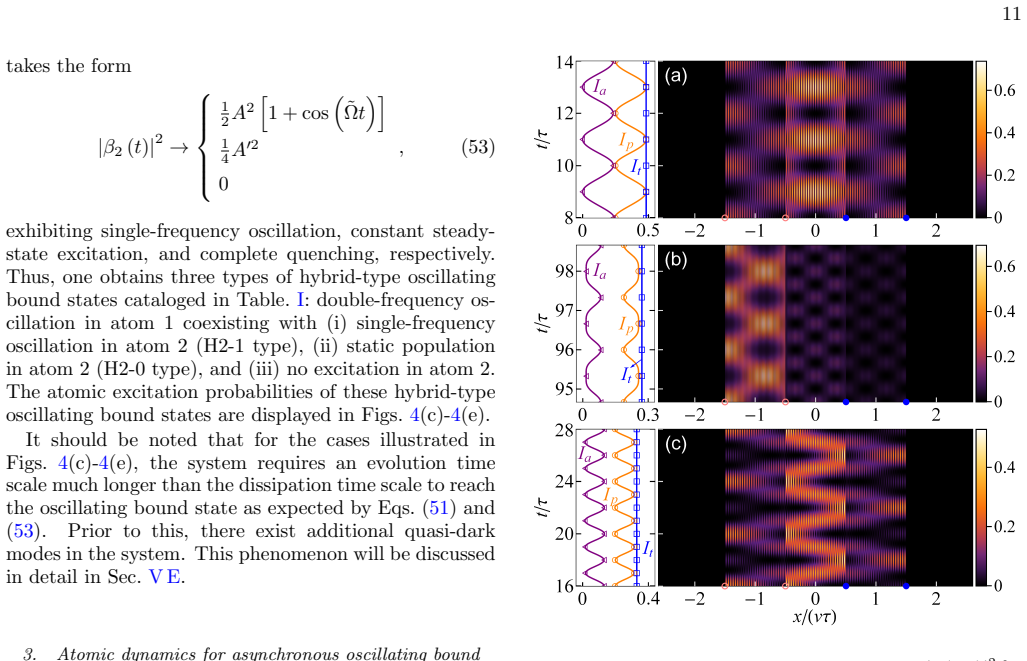
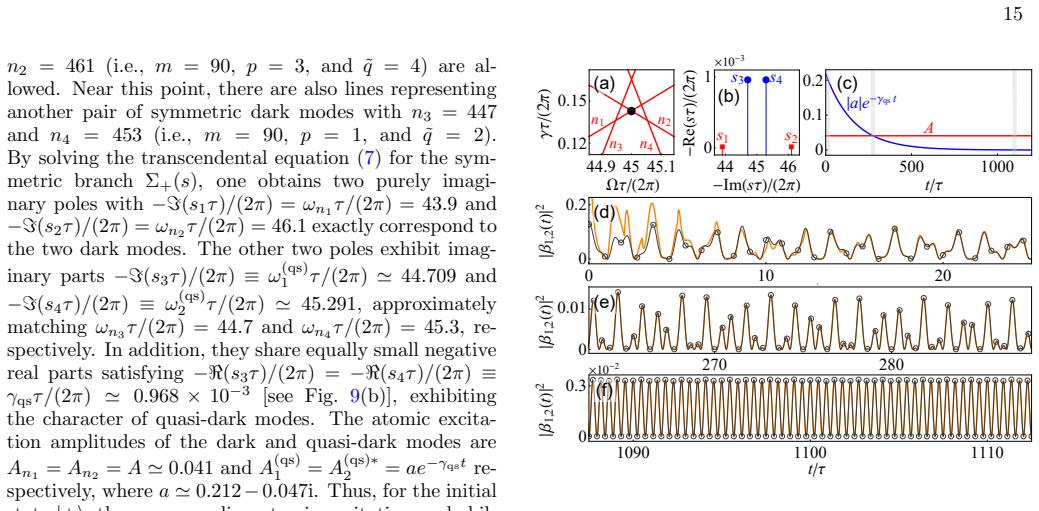
Atomic dynamics for synchronous oscillating bound state In Figs. 4(a) and 4(b), we present two distinct types of synchronous oscillating bound states for two separate giant atoms. The parameter point shown in the inset of Fig. 4(a) satisfies m ∈ E+ and p = 1 , 3, · · · , m − 1. Thus, the system with the initial state |+⟩ supports two symmetric dark modes ...
-
[2]
Some of these parameter points are illustrated in the right insets of Figs
Atomic dynamics for asynchronous oscillating bound state I: hybrid type The formation of hybrid-type oscillating bound states necessitates the existence of degenerate symmetric and antisymmetric dark modes. Some of these parameter points are illustrated in the right insets of Figs. 4(c)-4(e), which are determined by the following parameters: (i) m ∈ O+; p...
-
[3]
An example of the corresponding parameter points is illus- trated in the inset of Fig
Atomic dynamics for asynchronous oscillating bound state II: exchange-type The formation of exchange-type oscillating bound states necessitates the coexistence of symmetric and an- tisymmetric dark modes with different frequencies. An example of the corresponding parameter points is illus- trated in the inset of Fig. 4(f), satisfying m ∈ E+; p = 1, 3, · ·...
-
[4]
Long-time evolution of the field intensity The right panels of Figs. 5(a)-5(c) provide long-time evolution of the field intensity in the waveguide for two separate giant atoms. The left panels show that the corresponding atomic and photonic excitations undergo periodic exchange, demonstrating the coherent coupling between atoms and photons in the effectiv...
-
[5]
Exchange-type oscillating bound states Similar to the separate configuration, the synchronous oscillating bound states of two braided giant atoms are classified into two types: S1 and S2 (as summarized in Table II). In the subsequent analysis, we focus on asyn- chronous oscillating bound states, particularly the novel E1-type oscillating bound states, whi...
-
[6]
Relation between exchange-type oscillating bound states and the decoherence free interactions The previously discussed various types of oscillating bound states are all located in the non-Markovian regime (with γτ ≳ N −3, see the discussion in Sec. V A). Here we will show that, for two braided atoms, the E1-type oscil- lating quasi-bound states can also o...
-
[7]
A. F. Kockum, Quantum optics with giant atoms—the first five years, in International Symposium on Mathe- matics, Quantum Theory, and Cryptography , Mathemat- ics for Industry, edited by T. Takagi, M. Wakayama, K. Tanaka, N. Kunihiro, K. Kimoto, and Y. Ikematsu (Springer Singapore, Singapore, 2021) pp. 125–146
work page 2021
-
[8]
D. Roy, C. M. Wilson, and O. Firstenberg, Colloquium: Strongly interacting photons in one-dimensional contin- uum, Rev. Mod. Phys. 89, 021001 (2017)
work page 2017
-
[9]
X. Gu, A. F. Kockum, A. Miranowicz, Y.-x. Liu, and F. Nori, Microwave photonics with superconducting quantum circuits, Phys. Rep. 718-719, 1 (2017)
work page 2017
-
[10]
A. S. Sheremet, M. I. Petrov, I. V. Iorsh, A. V. Poshakin- skiy, and A. N. Poddubny, Waveguide quantum electro- dynamics: Collective radiance and photon-photon corre- lations, Rev. Mod. Phys. 95, 015002 (2023)
work page 2023
-
[11]
G. Andersson, B. Suri, L. Guo, T. Aref, and P. Delsing, Non-exponential decay of a giant artificial atom, Nat. Phys. 15, 1123 (2019)
work page 2019
-
[12]
B. Kannan, M. J. Ruckriegel, D. L. Campbell, A. F. Kockum, J. Braum¨ uller, D. K. Kim, M. Kjaergaard, P. Krantz, A. Melville, B. M. Niedzielski, A. Veps¨ al¨ ainen, R. Winik, J. L. Yoder, F. Nori, T. P. Orlando, S. Gustavs- son, and W. D. Oliver, Waveguide quantum electrody- namics with superconducting artificial giant atoms, Na- ture (London) 583, 775 (2020)
work page 2020
-
[13]
Z.-Q. Wang, Y.-P. Wang, J. Yao, R.-C. Shen, W.-J. Wu, J. Qian, J. Li, S.-Y. Zhu, and J. Q. You, Giant spin ensembles in waveguide magnonics, Nat. Commun. 13, 7580 (2022)
work page 2022
-
[14]
A. F. Kockum, P. Delsing, and G. Johansson, Designing frequency-dependent relaxation rates and lamb shifts for a giant artificial atom, Phys. Rev. A 90, 013837 (2014)
work page 2014
-
[15]
A. F. Kockum, G. Johansson, and F. Nori, Decoherence- free interaction between giant atoms in waveguide quan- tum electrodynamics, Phys. Rev. Lett. 120, 140404 (2018)
work page 2018
-
[16]
A. Carollo, D. Cilluffo, and F. Ciccarello, Mechanism of decoherence-free coupling between giant atoms, Phys. Rev. Res. 2, 043184 (2020)
work page 2020
-
[17]
L. Du, L. Guo, and Y. Li, Complex decoherence-free interactions between giant atoms, Phys. Rev. A 107, 023705 (2023)
work page 2023
-
[18]
R. E. Ingelsten, A. F. Kockum, and A. Soro, Avoiding decoherence with giant atoms in a two-dimensional struc- tured environment, Phys. Rev. Res. 6, 043222 (2024)
work page 2024
-
[19]
L. Guo, A. Grimsmo, A. F. Kockum, M. Pletyukhov, and G. Johansson, Giant acoustic atom: A single quantum system with a deterministic time delay, Phys. Rev. A 95, 053821 (2017)
work page 2017
-
[20]
L. Guo, A. F. Kockum, F. Marquardt, and G. Johansson, Oscillating bound states for a giant atom, Phys. Rev. Res. 2, 043014 (2020)
work page 2020
- [21]
-
[22]
F. Roccati and D. Cilluffo, Controlling markovianity with chiral giant atoms, Phys. Rev. Lett. 133, 063603 (2024)
work page 2024
-
[23]
Q.-Y. Qiu and X.-Y. L¨ u, Non-markovian collective emis- sion of giant emitters in the zeno regime, Phys. Rev. Res. 6, 033243 (2024)
work page 2024
-
[24]
V. Yannopapas, Entanglement dynamics of two giant atoms embedded in a one-dimensional photonic lattice with a synthetic gauge field, Photonics 12, 612 (2025)
work page 2025
-
[25]
A. V. Sivakumar, J. Liu, and M. S. Zubairy, Single- photon trapping in a giant-atom cavity coupled to a one-dimensional waveguide, Phys. Rev. A 111, 033714 (2025)
work page 2025
-
[26]
S. John and J. Wang, Quantum electrodynamics near a photonic band gap: Photon bound states and dressed atoms, Phys. Rev. Lett. 64, 2418 (1990)
work page 1990
-
[27]
Q.-J. Tong, J.-H. An, H.-G. Luo, and C. H. Oh, Deco- herence suppression of a dissipative qubit by the non- markovian effect, J. Phys. B 43, 155501 (2010)
work page 2010
-
[28]
G. Calaj´ o, F. Ciccarello, D. Chang, and P. Rabl, Atom- field dressed states in slow-light waveguide qed, Phys. Rev. A 93, 033833 (2016)
work page 2016
- [29]
-
[30]
J. D. Hood, A. Goban, A. Asenjo-Garcia, M. Lu, S.-P. Yu, D. E. Chang, and H. J. Kimble, Atom–atom interac- tions around the band edge of a photonic crystal waveg- uide, Proc. Natl. Acad. Sci. USA 113, 10507 (2016)
work page 2016
- [31]
-
[32]
N. M. Sundaresan, R. Lundgren, G. Zhu, A. V. Gorshkov, and A. A. Houck, Interacting qubit-photon bound states with superconducting circuits, Phys. Rev. X 9, 011021 (2019)
work page 2019
-
[33]
W. Zhao and Z. Wang, Single-photon scattering and bound states in an atom-waveguide system with two or multiple coupling points, Phys. Rev. A 101, 053855 (2020)
work page 2020
-
[34]
V. S. Ferreira, J. Banker, A. Sipahigil, M. H. Matheny, A. J. Keller, E. Kim, M. Mirhosseini, and O. Painter, Collapse and revival of an artificial atom coupled to a structured photonic reservoir, Phys. Rev. X 11, 041043 (2021)
work page 2021
-
[35]
X. Wang, T. Liu, A. F. Kockum, H.-R. Li, and F. Nori, Tunable chiral bound states with giant atoms, Phys. Rev. Lett. 126, 043602 (2021)
work page 2021
-
[36]
M. Scigliuzzo, G. Calaj` o, F. Ciccarello, D. Perez Lozano, A. Bengtsson, P. Scarlino, A. Wallraff, D. Chang, P. Dels- ing, and S. Gasparinetti, Controlling atom-photon bound states in an array of josephson-junction resonators, Phys. Rev. X 12, 031036 (2022)
work page 2022
-
[37]
X. Wang and H.-R. Li, Chiral quantum network with 21 giant atoms, Quantum Sci. Technol 7, 035007 (2022)
work page 2022
-
[38]
A. Soro, C. S. Mu˜ noz, and A. F. Kockum, Interaction between giant atoms in a one-dimensional structured en- vironment, Phys. Rev. A 107, 013710 (2023)
work page 2023
-
[39]
W. Z. Jia and M. T. Yu, Atom-photon dressed states in a waveguide-qed system with multiple giant atoms, Opt. Express 32, 9495 (2024)
work page 2024
-
[40]
T. Tufarelli, F. Ciccarello, and M. S. Kim, Dynamics of spontaneous emission in a single-end photonic waveguide, Phys. Rev. A 87, 013820 (2013)
work page 2013
-
[41]
C. W. Hsu, B. Zhen, A. D. Stone, J. D. Joannopoulos, and M. Soljaˇ ci´ c, Bound states in the continuum, Nat. Rev. Mater. 1, 16048 (2016)
work page 2016
-
[42]
P. T. Fong and C. K. Law, Bound state in the continuum by spatially separated ensembles of atoms in a coupled- cavity array, Phys. Rev. A 96, 023842 (2017)
work page 2017
- [43]
-
[44]
G. Calaj´ o, Y.-L. L. Fang, H. U. Baranger, and F. Cic- carello, Exciting a bound state in the continuum through multiphoton scattering plus delayed quantum feedback, Phys. Rev. Lett. 122, 073601 (2019)
work page 2019
- [45]
-
[46]
Q.-Y. Qiu, Y. Wu, and X.-Y. L¨ u, Collective radiance of giant atoms in non-markovian regime, Sci. China-Phys. Mech. Astron. 66, 224212 (2023)
work page 2023
-
[47]
H. Yu, X. Zhang, Z. Wang, and J. Wang, Rabi oscillation and fractional population via the bound states in the continuum in a giant-atom waveguide qed setup, Phys. Rev. A 111, 053710 (2025)
work page 2025
-
[48]
F. Lombardo, F. Ciccarello, and G. M. Palma, Photon lo- calization versus population trapping in a coupled-cavity array, Phys. Rev. A 89, 053826 (2014)
work page 2014
-
[49]
Y. He, G. Sun, J. Li, Y. Yang, J. Lu, and L. Zhou, Emergent oscillating bound states in a semi-infinite lin- ear waveguide with a point-like λ-type quantum emitter driven by a classical field, Adv. Quantum Technol. 8, 2400535 (2025)
work page 2025
-
[50]
S. Guo, Y. Wang, T. Purdy, and J. Taylor, Beyond spon- taneous emission: Giant atom bounded in the continuum, Phys. Rev. A 102, 033706 (2020)
work page 2020
-
[51]
K. H. Lim, W.-K. Mok, and L.-C. Kwek, Oscillating bound states in non-markovian photonic lattices, Phys. Rev. A 107, 023716 (2023)
work page 2023
- [52]
-
[53]
Z. Y. Li and H. Z. Shen, Non-markovian dynamics with a giant atom coupled to a semi-infinite photonic waveguide, Phys. Rev. A 109, 023712 (2024)
work page 2024
-
[54]
Y. Yang, G. Sun, J. Li, J. Lu, and L. Zhou, Coherent control of spontaneous emission for a giant driven Λ-type three-level atom, Phys. Rev. A 111, 013707 (2025)
work page 2025
-
[55]
G. Sun, Y. Yang, J. Li, J. Lu, and L. Zhou, Cavity- modified oscillating bound states with a Λ-type giant emitter in a linear waveguide, Phys. Rev. A 111, 033701 (2025)
work page 2025
-
[56]
D. D. Noachtar, J. Kn¨ orzer, and R. H. Jonsson, Nonper- turbative treatment of giant atoms using chain transfor- mations, Phys. Rev. A 106, 013702 (2022)
work page 2022
-
[57]
S. Terradas-Brians´ o, C. A. Gonz´ alez-Guti´ errez, F. Nori, L. Mart´ ın-Moreno, and D. Zueco, Ultrastrong waveguide qed with giant atoms, Phys. Rev. A 106, 063717 (2022)
work page 2022
-
[58]
Y. P. Peng and W. Z. Jia, Single-photon scattering from a chain of giant atoms coupled to a one-dimensional waveg- uide, Phys. Rev. A 108, 043709 (2023)
work page 2023
discussion (0)
Sign in with ORCID, Apple, or X to comment. Anyone can read and Pith papers without signing in.