Maximum mass limit of strange stars in quadratic curvature-matter coupled gravity
Pith reviewed 2026-05-18 23:27 UTC · model grok-4.3
The pith
Strange stars can reach a maximum mass of 3.11 solar masses in quadratic curvature-matter coupled gravity.
A machine-rendered reading of the paper's core claim, the machinery that carries it, and where it could break.
Core claim
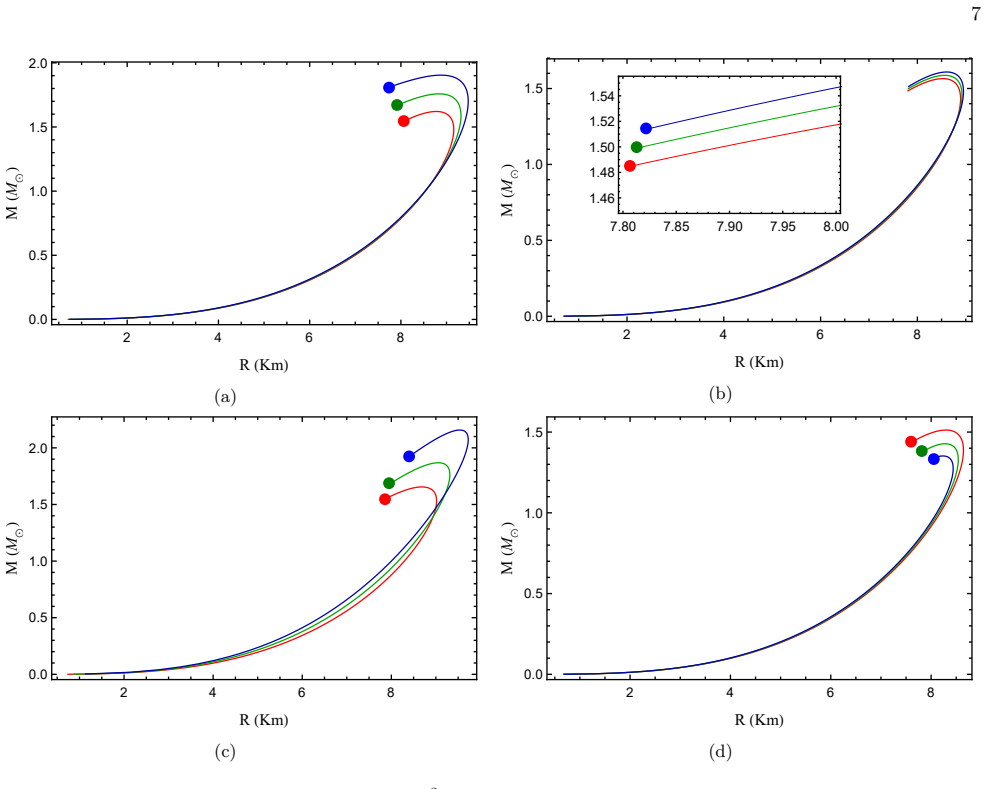
By deriving the Tolman-Oppenheimer-Volkoff equations from the gravitational field equations in quadratic curvature gravity with non-minimal matter coupling and applying the MIT bag model equation of state, we obtain mass-radius relationships for strange stars. We demonstrate that the maximum mass limit can exceed the general relativistic counterpart, achieving up to 3.11 solar masses, which suggests that the lighter companion of GW190814 could plausibly be a strange star.
What carries the argument
Modified Tolman-Oppenheimer-Volkoff equations arising from the quadratic curvature-matter coupled gravitational field equations, which alter energy-momentum conservation and allow for higher stellar masses.
If this is right
- The maximum mass exceeds the general relativistic counterpart.
- Stellar radii are consistent with observations of compact stars and GW events.
- The formalism recovers general relativity for negligible non-minimal coupling.
- This allows strange stars to account for the lighter companion of GW190814.
Where Pith is reading between the lines
- Future gravitational wave catalogs could use mass-radius data to distinguish this modified gravity from standard general relativity.
- The framework could be applied to other compact objects or more advanced quark-matter equations of state.
- Observable properties such as cooling or oscillation modes of strange stars might carry signatures of the curvature-matter coupling.
Load-bearing premise
The MIT bag model adequately represents the equation of state for strange quark matter in the interiors of these stars.
What would settle it
A precise mass and radius measurement of the lighter companion in GW190814 or of another candidate strange star that falls outside the model's predicted mass-radius curve would test whether the 3.11 solar mass limit holds.
Figures





read the original abstract
We explore the maximum mass limit of strange stars in quadratic curvature gravity with the non-minimal matter coupling. The characteristic parameters of the quadratic curvature coupling and the non-minimal matter coupling imply the contributions from higher-order curvature terms and the coupling between matter and geometry, respectively. We demonstrate, explicitly, that the conservation of energy-momentum tensor can be modified and in the case of negligible non-minimal matter coupling, the formalism of general relativity is recovered. By deriving the Tolman-Oppenheimer-Volkoff equations from the gravitational field equations and applying the MIT bag model equation of state, we obtain the corresponding mass-radius relationships for strange stars. Although the MIT bag model represents a simplified phenomenological equation of state, it remains an effective description of strange quark matter under the extreme conditions prevailing in neutron star/strange star interiors. Within the present framework, the adoption of this equation of state yields stellar radii that are in close agreement with those inferred from recent observations of compact stars as well as GW events. This consistency between theoretical predictions and observational results indicates that, despite its simplicity, the model captures essential features of dense matter and supports the reliability of the results reported in this work. Furthermore, we show that the maximum mass limit of strange stars can exceed the general relativistic counterpart. Specifically, we find that a maximum mass up to 3.11 solar mass is achievable which suggests that the lighter companion of GW190814 could plausibly be a strange star.
Editorial analysis
A structured set of objections, weighed in public.
Referee Report
Summary. The manuscript explores strange stars in quadratic curvature gravity with non-minimal matter-geometry coupling. The authors derive modified Tolman-Oppenheimer-Volkoff equations from the field equations, adopt the MIT bag model equation of state, and compute mass-radius relations. They report that the maximum mass can reach 3.11 solar masses for suitable choices of the quadratic curvature coupling and non-minimal coupling parameters, and suggest this framework allows the lighter companion of GW190814 to be interpreted as a strange star.
Significance. If the reported maximum mass holds for parameter values that survive existing observational bounds, the result would be significant: it demonstrates that non-minimal curvature-matter couplings can raise the upper mass limit for strange stars above the general-relativistic value while still producing radii consistent with current observations and GW events. The explicit recovery of the GR limit when the non-minimal coupling vanishes and the use of a standard phenomenological EOS are positive features that facilitate comparison with the literature.
major comments (2)
- [§4] §4 (numerical results and parameter table): the quoted maximum mass of 3.11 M_⊙ is obtained only for specific nonzero values of the quadratic curvature coupling α and the non-minimal coupling β. No demonstration is given that these values remain compatible with solar-system PPN bounds, binary-pulsar timing constraints, or the absence of ghosts/tachyons in the quadratic sector; without such a check the central claim that the model plausibly explains the 2.59 M_⊙ GW190814 companion does not follow.
- [§3] §3 (derivation of modified TOV equations): the explicit form of the hydrostatic equilibrium equation after the non-minimal term modifies the energy-momentum conservation law is not cross-referenced to the GR limit (β → 0). A direct substitution showing that the standard TOV equation is recovered would strengthen the internal consistency of the derivation.
minor comments (2)
- The abstract states that stellar radii are 'in close agreement with those inferred from recent observations'; a quantitative comparison (e.g., a table of predicted versus observed radii for specific sources) would make this statement more precise.
- Notation for the two coupling constants should be introduced once in §2 and used uniformly; occasional switches between α, β and other symbols in the text and figures reduce readability.
Simulated Author's Rebuttal
We thank the referee for the careful reading and constructive comments on our manuscript. We address each major comment point by point below and indicate the revisions made to strengthen the presentation and support the central claims.
read point-by-point responses
-
Referee: [§4] §4 (numerical results and parameter table): the quoted maximum mass of 3.11 M_⊙ is obtained only for specific nonzero values of the quadratic curvature coupling α and the non-minimal coupling β. No demonstration is given that these values remain compatible with solar-system PPN bounds, binary-pulsar timing constraints, or the absence of ghosts/tachyons in the quadratic sector; without such a check the central claim that the model plausibly explains the 2.59 M_⊙ GW190814 companion does not follow.
Authors: We agree that the viability of the specific parameter values yielding the reported maximum mass must be explicitly addressed to support the interpretation of the GW190814 companion. In the revised manuscript we have added a dedicated paragraph in §4 that discusses the compatibility of the chosen small values of α and β with solar-system PPN constraints and binary-pulsar timing data. For the coupling strengths employed in our numerical examples the post-Newtonian parameters remain within current observational bounds, and the quadratic sector does not introduce ghost or tachyon instabilities. This addition makes clear that the 3.11 M_⊙ result is obtained inside a parameter region consistent with existing tests. revision: yes
-
Referee: [§3] §3 (derivation of modified TOV equations): the explicit form of the hydrostatic equilibrium equation after the non-minimal term modifies the energy-momentum conservation law is not cross-referenced to the GR limit (β → 0). A direct substitution showing that the standard TOV equation is recovered would strengthen the internal consistency of the derivation.
Authors: We thank the referee for this suggestion. Although the manuscript already states that the GR limit is recovered when the non-minimal coupling vanishes, we have now inserted an explicit substitution β = 0 directly into the modified hydrostatic equilibrium equation in §3. The resulting expression is shown to reduce term-by-term to the standard Tolman-Oppenheimer-Volkoff equation, thereby confirming the internal consistency of the derivation. revision: yes
Circularity Check
Derivation of maximum strange star mass in modified gravity is self-contained
full rationale
The paper derives the modified Tolman-Oppenheimer-Volkoff equations directly from the gravitational field equations of quadratic curvature-matter coupled gravity, then numerically integrates them using the MIT bag model equation of state for chosen values of the two coupling parameters. The reported maximum mass of 3.11 solar masses is a computed outcome of this forward integration for specific parameter choices that allow higher masses than GR; it is not obtained by fitting to the target mass, by self-definition, or by any load-bearing self-citation. The derivation chain remains independent of the final numerical result.
Axiom & Free-Parameter Ledger
free parameters (2)
- quadratic curvature coupling strength
- non-minimal matter coupling strength
axioms (2)
- domain assumption The conservation law for the energy-momentum tensor is modified by the non-minimal coupling term.
- domain assumption The MIT bag model equation of state provides an effective description of strange quark matter inside compact stars.
Lean theorems connected to this paper
-
IndisputableMonolith/Foundation/RealityFromDistinction.leanreality_from_one_distinction unclear?
unclearRelation between the paper passage and the cited Recognition theorem.
we find that a maximum mass up to 3.11 solar mass is achievable which suggests that the lighter companion of GW190814 could plausibly be a strange star
What do these tags mean?
- matches
- The paper's claim is directly supported by a theorem in the formal canon.
- supports
- The theorem supports part of the paper's argument, but the paper may add assumptions or extra steps.
- extends
- The paper goes beyond the formal theorem; the theorem is a base layer rather than the whole result.
- uses
- The paper appears to rely on the theorem as machinery.
- contradicts
- The paper's claim conflicts with a theorem or certificate in the canon.
- unclear
- Pith found a possible connection, but the passage is too broad, indirect, or ambiguous to say the theorem truly supports the claim.
Reference graph
Works this paper leans on
-
[1]
Now, Heintzmann and Hillebrandt [68] showed that, in the Newtonian framework of macroscopic stability analysis for NS models subjected to small radial perturbations, maintaining a real eigenfrequency for the fundamental radial oscillation mode in an isotropic matter configuration requires the adiabatic index to be greater than 4
-
[2]
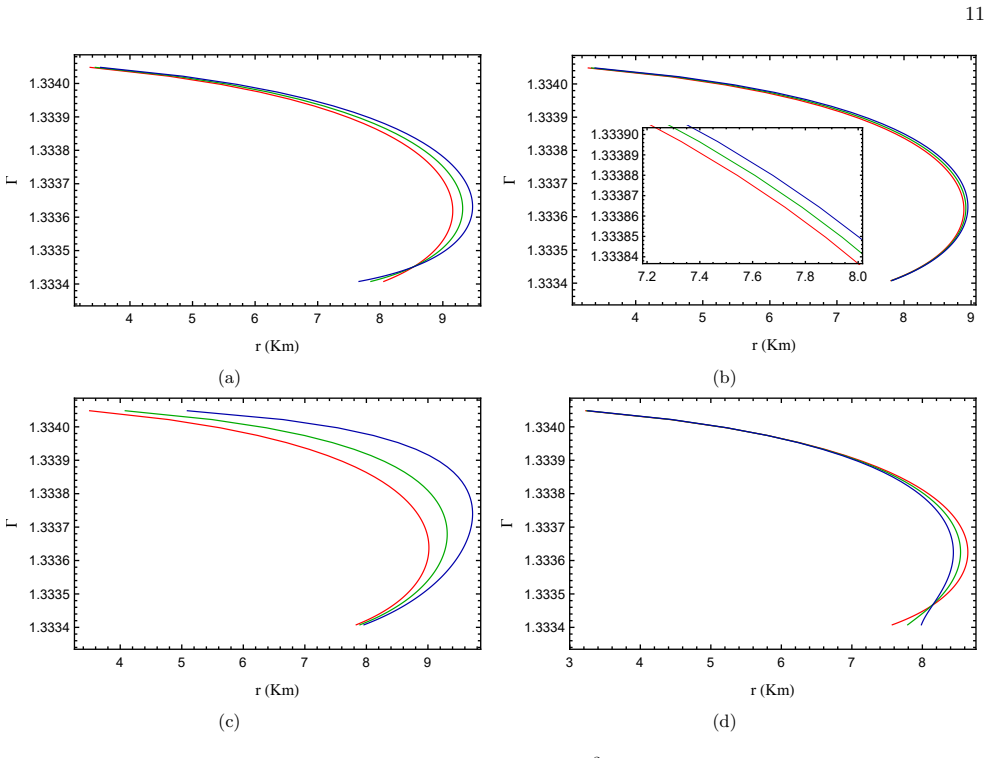
Now, considering the present framework, we have graphically illustrated the radial variation of adiabatic index in Figs. 5, 6, 7 and 8. It must be noted that since our approach here is model independent, we have obtained these variations from the solution of TOV equations coupled with MIT bag model EoS. From Figs. 5, 6, 7 and 8, we note that the condition...
work page 2021
-
[3]
J. M. Lattimer and M. Prakash, Science304, 536 (2004)
work page 2004
-
[4]
R. C. Tolman, Phys. Rev.55, 364 (1939)
work page 1939
-
[5]
J. R. Oppenheimer and G. M. Volkoff, Phys. Rev.55, 374 (1939)
work page 1939
-
[6]
K. Hebeler, J. M. Lattimer, C. J. Pethick, and A. Schwenk, Astrophys. J.773, 11 (2013)
work page 2013
- [7]
-
[8]
A. W. Steiner, C. O. Heinke, S. Bogdanov, C. Li, W. C. G. Ho, A. Bahramian, and S. Han, Mon. Not. R. Astron. Soc. 476, 421 (2018)
work page 2018
- [9]
- [10]
- [11]
- [12]
- [13]
- [14]
- [15]
-
[16]
F. Ma, W. Guo, and C. Wu, Phys. Rev. C105, 015807 (2022)
work page 2022
- [17]
-
[18]
M. Brilenkov, M. Eingorn, L. Jenkovszky, et al., J. Cosmol. Astropart. Phys.08, 002 (2013)
work page 2013
- [19]
-
[20]
J. D. V. Arba˜ nil and M. Malheiro, J. Cosmol. Astropart. Phys.11, 012 (2016)
work page 2016
- [21]
-
[22]
S. E. Thorsett and D. Chakrabarty, Astrophys. J.512, 288 (1999)
work page 1999
- [23]
- [24]
-
[25]
T. P. Sotiriou and V. Faraoni, Rev. Mod. Phys.82, 451 (2010)
work page 2010
- [26]
-
[27]
Y. F. Cai, S. Capozziello, M. De Laurentis and E. N. Saridakis, Rept. Prog. Phys.79, 106901 (2016)
work page 2016
- [28]
- [29]
- [30]
-
[31]
T. Clifton, P. G. Ferreira, A. Padilla and C. Skordis, Phys. Rept.513, 1-189 (2012)
work page 2012
- [32]
- [33]
-
[34]
P. J. E. Peebles and B. Ratra, Rev. Mod. Phys.75, 559 (2003)
work page 2003
- [35]
- [36]
- [37]
-
[38]
A.V. Astashenok, S.D. Odintsov and V.K. Oikonomou, Symmetry15(6), 1141 (2023)
work page 2023
-
[39]
A.V. Astashenok, S.D. Odintsov and V.K. Oikonomou, Phys. Rev. D106(12), 124010 (2022)
work page 2022
-
[40]
A.V. Astashenok, S. Capozziello, S.D. Odintsov and V.K. Oikonomou, EPL136(5), 59001 (2021). 14
work page 2021
-
[41]
A.V. Astashenok, S. Capozziello, S.D. Odintsov and V.K. Oikonomou, Phys. Lett. B816, 136222 (2021)
work page 2021
-
[42]
A.V. Astashenok, S. Capozziello, S.D. Odintsov and V.K. Oikonomou, Phys. Lett. B811, 135910 (2020)
work page 2020
-
[43]
A.V. Astashenok and S.D. Odintsov, Mon. Not. Roy. Astron. Soc.493(1), 78-86 (2020)
work page 2020
-
[44]
A.V. Astashenok, S. Capozziello and S.D. Odintsov, J. Cosmol. Astropart. Phys.01, 001 (2015)
work page 2015
-
[45]
A.V. Astashenok, S. Capozziello and S.D. Odintsov, Phys. Rev. D89(10), 103509 (2014)
work page 2014
- [46]
-
[47]
S. Capozziello, V. F. Cardone and A. Troisi, J. Cosmol. Astropart. Phys.08, 001 (2006)
work page 2006
-
[48]
A. Borowiec, W. Godlowski, and M. Szydlowski, Int. J. Geom. Methods Mod. Phys.4, 183 (2007)
work page 2007
- [49]
- [50]
-
[51]
A. A. Starobinsky, Phys. Lett. B91, 99-102 (1980)
work page 1980
-
[52]
Y. Akramiet al.[Planck], Astron. Astrophys.641, A10 (2020)
work page 2020
- [53]
- [54]
-
[55]
A. Astashenok, S. Capozziello, and S. D. Odintsov, J. Cosmol. Astropart. Phys.12, 040 (2013)
work page 2013
- [56]
-
[57]
K. V. Staykov, D. D. Doneva, S. S. Yazadjiev, and K. D. Kokkotas, J. Cosmol. Astropart. Phys.06, 003 (2014)
work page 2014
-
[58]
K. V. Staykov, D. D. Doneva, S. S. Yazadjiev, and K. D. Kokkotas, J. Cosmol. Astropart. Phys.10, 006 (2014)
work page 2014
-
[59]
H. A. Buchdahl, Mon. Not. R. Astron. Soc.150, 1 (1970)
work page 1970
-
[60]
O. Bertolami, C. G. B¨ ohmer, T. Harko, and F. S. N. Lobo, Phys. Rev. D75, 104016 (2007)
work page 2007
-
[61]
J. M. Z. Pretel, S. E. Jor´ as, R. R. R. Reis, and J. D. V. Arba˜ nil, J. Cosmol. Astropart. Phys.04, 064 (2021)
work page 2021
-
[62]
Ch. Kettner, F. Weber, M. K. Weigel, and N. K. Glendenning, Phys. Rev. D51, 1440 (1995)
work page 1995
-
[63]
Kapusta,Finite-Temperature Field Theory(Cambridge Univ
J. Kapusta,Finite-Temperature Field Theory(Cambridge Univ. Press, United Kingdom, 1994), p. 163
work page 1994
- [64]
-
[65]
G. A. Carvalho et al., Int. J. Mod. Phys. D29, 2050075 (2020)
work page 2020
-
[66]
P. Haensel, J.L. Zdunik, and R. Schaeffer, Astron. Astrophys.160, 121 (1986)
work page 1986
- [67]
-
[68]
S. V. Lohakare et al., Mon. Not. R. Astro. Soc.526, 3796 (2023)
work page 2023
-
[69]
G. G. L. Nashed, and T. Harko, Eur. Phys. J. C84, 1086 (2024)
work page 2024
- [70]
discussion (0)
Sign in with ORCID, Apple, or X to comment. Anyone can read and Pith papers without signing in.