REVIEW 3 major objections 5 minor 37 references
APFL: Analytic Personalized Federated Learning via Dual-Stream Least Squares
T0 review · 3 major / 5 minor · reviewed 2026-08-05 · deepseek-v4-flash
Pith's one-line read APFL claims that replacing gradient updates with two closed-form least-squares streams makes each client’s personalized federated model independent of how the other clients’ data are distributed.
desk verdict APFL is a genuinely new closed-form PFL scheme with a dual-stream least-squares design, but the arXiv version lacks its main proofs and has two load-bearing protocol gaps that make the central claims conditional. read the letter →
The pith
A machine-rendered reading of the paper's core claim, the machinery that carries it, and where it could break.
The reading
What carries the argument
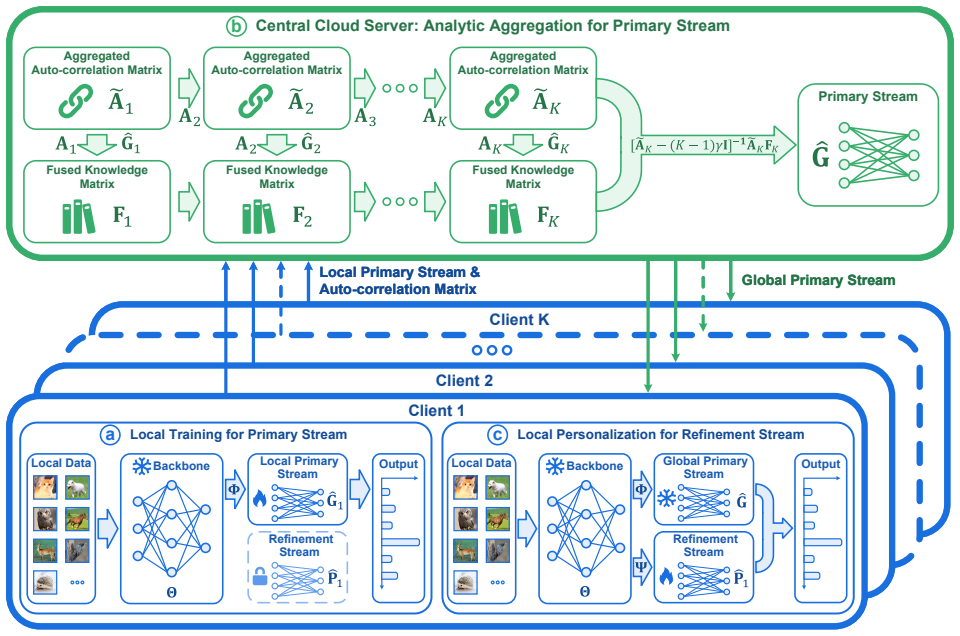
The key mechanism is the recursive aggregation of the aggregated auto-correlation matrix $\tilde{A}_k = \tilde{A}_{k-1} + A_k$ with $A_k = \Phi_k^\top \Phi_k + \gamma I$, and the Fused Knowledge Matrix $F_k = \Lambda_k F_{k-1} + \Delta_k \hat{G}_k$, with the coefficient matrices defined in equation (9). These recurrences are constructed so that the server output $\hat{G} = [\tilde{A}_K - (K-1)\gamma I]^{-1} \tilde{A}_K F_K$ equals the centralized least-squares solution defined in (2). The refinement stream uses a separate random projection $\Psi_k$ and solves $\hat{P}_k = (\Psi_k^\top \Psi_k + \beta I)^{-1}(\Psi_k^\top Y_k - \Psi_k^\top \Phi_k \hat{G})$, a local ridge regression on the prima
What would settle it
Take one pooled dataset, split it into two different partitions among clients, and run APFL under the paper’s protocol: if the final $\{\hat{G}, \hat{P}_k\}$ differ between partitions, Theorem 3 fails. Equivalently, compare the server’s aggregated $\hat{G}$ from equations (7)–(10) with a direct centralized computation $(\Phi_{1:K}^\top \Phi_{1:K} + \gamma I)^{-1} \Phi_{1:K}^\top Y_{1:K}$; any mismatch falsifies Theorem 1. A second check: run clients with different $R_P$ matrices and see whether the aggregation still matches the centralized solution.
Extended reading notes
Core claim
The central claim is that the dual-stream construction exactly solves the PFL objective (1)–(2) without iterative optimization. The primary stream $\hat{G}$ is not an approximation or a federation heuristic: Theorem 1 states that the server’s recursive aggregation over per-client matrices $A_k$ and $\hat{G}_k$ equals the minimizer of the centralized ridge regression over all clients’ activated features. The refinement streams $\hat{P}_k$ are the closed-form least-squares fits to the residuals $Y_k - \Phi_k \hat{G}$ (Theorem 2). Theorem 3 then states heterogeneity invariance: if a client’s local data and the pooled data are fixed, the final model $\{\hat{G}, \hat{P}_k\}$ is unchanged no matte
Load-bearing premise
The proof that the per-client auto-correlation matrices can be summed assumes every client uses the same random projection matrix $R_P$ and activation $\sigma_P$ for the primary stream, so all $A_k$ live in one common feature space; the paper does not state this sharing requirement explicitly.
Editorial extensions
If this is right
- APFL completes global aggregation and local personalization in a single communication round; the experiments show accuracy above 200-round gradient baselines.
- The final personalized model is invariant to the non-IID partition of other clients’ data, so tuning a federated system to the particular heterogeneity pattern becomes unnecessary for the given backbone features.
- The primary stream is exactly the centralized ridge-regression solution, so the aggregation step loses no information relative to pooling all features and labels.
- The refinement stream’s closed form means personalization is computed locally with no extra server communication.
- Under the stated assumptions, raw features and labels cannot be fully reconstructed from the uploaded $A_k$ and $\hat{G}_k$.
- The same recursive aggregation generalizes directly to other ridge-regression objectives, such as weighted least squares, while preserving the closed form.
- Because the backbone is frozen, the invariance is invariance in feature space; a testable sequel is whether a lightly trained adapter before the analytic streams preserves the closed-form aggregation.
- A natural stress test is to let different clients use different random projection matrices $R_P$ for the primary stream; if the aggregation then diverges from the centralized solution, the common-projection requirement is exactly the load-bearing assumption.
Signed reviews
Editorial analysis
A structured set of objections, weighed in public.
Referee Report
Summary. This paper proposes APFL, an analytic personalized federated learning method. Each client extracts features from a frozen foundation model, applies a random projection and nonlinear activation to form two feature spaces: a shared primary stream Φ_k and a local refinement stream Ψ_k. The primary stream is trained locally as ridge regression (Eqs. (4)-(5)); clients upload the auto-correlation matrix A_k and local model G_k. The server aggregates them via recursive equations (7)-(10) to obtain a global primary stream G that is claimed to coincide with the centralized ridge regression solution over all clients' data (Eq. (2)). Each client then solves a local residual regression (Eqs. (12)-(13)) to obtain a refinement stream P_k, and inference is a weighted combination (Eq. (14)). The paper states three theorems: equivalence of primary and refinement streams and a 'heterogeneity invariance' property, plus a privacy theorem and complexity analysis. Experiments on CIFAR-100 and ImageNet-R with 50/100 clients under Dirichlet non-IID splits show accuracy improvements over baselines and lower communication/computation overhead.
Significance. If the equivalence theorems are proven, APFL is a significant contribution: it gives a closed-form single-round aggregation for PFL that is exactly the centralized ERM solution, avoiding iterative gradient updates and the associated non-IID drift. The heterogeneity invariance property is a direct consequence of defining G via the pooled objective (Eq. (2)); it is not a learned property, but the analytic aggregation does realize it exactly. The empirical gains are large and consistent. However, the paper currently ships without the appendices containing the proofs, and the aggregation equivalence depends on an unstated assumption of a shared random projection/activation across clients. These issues must be addressed before the claims can be accepted.
major comments (3)
- [§3.4 Theorems 1-4] The proofs of Theorems 1-4 are deferred to 'Appendix A/B', but the manuscript as submitted contains no appendices. Theorem 1 is the central claim that the recursive aggregation (7)-(10) equals the centralized least-squares solution (2); Theorem 4 is a privacy guarantee. Without these proofs, the reader cannot verify the load-bearing claims. The complexity derivation in §3.4 (Appendix C) is likewise absent. Please include the full proofs and derivations in the revision.
- [§3.2, Eq. (3), (6)-(10)] The aggregation step sums A_k = Φ_k^T Φ_k + γI across clients. This is well-defined and equivalent to centralized ERM only if all Φ_k live in the same feature space, i.e., if R_P and σ_P in Eq. (3) are common across clients. The protocol never states that R_P/σ_P are generated once on the server (or from a common seed) and shared with all clients. If each client samples an independent random projection, the Φ_k lie in different random subspaces, and Theorems 1 and 3 no longer follow. Please state the sharing requirement explicitly and add it as a condition in the theorem statements and Algorithm 1.
- [§3.4 Theorem 4] The privacy claim is both unsupported and, as stated, suspect. From the uploaded quantities the server can compute A_k G_k = Φ_k^T Y_k, which directly reveals class-level feature sums. Whether this allows reconstruction of Φ_k or Y_k depends on the adversary's background knowledge and on N_k relative to d_P. The theorem asserts an unconditional impossibility. A formal model of the adversary (e.g., what is known about the backbone, R_P, label space) and a precise notion of impossibility are required. The proof is currently absent, so the claim cannot be evaluated.
minor comments (5)
- [§3.2, Eq. (8)] The Fused Knowledge Matrix is initialized as F_1 = P_hat_1, which appears to be a typo. The refinement stream is not available at aggregation time; the update (8) uses G_k. This should presumably be F_1 = G_hat_1. If it is not a typo, the recursion is broken.
- [§4.1 / Table 1] No error bars, confidence intervals, or significance tests are reported, and the asterisks in the 'Advance' row are not explained. Given the large claimed margins, at least a brief statistical summary would strengthen the empirical claim.
- [§3.4 / §4] The exact values of γ, β, d_P, d_R used in the main experiments are not stated in the main text; they are only said to be in Appendix D, which is missing. Please include these training details in the main text or provide the appendix.
- [§3.2, Eq. (3)] The notation X_k ∈ R^{N_k × l × w × h} is nonstandard for image data; typically one writes N_k × C × H × W. Please align with the common convention.
- [§3.4, Theorem 3] The phrasing 'depending solely on the complete dataset D_1:K and its local dataset D_k' is slightly ambiguous, since D_1:K includes D_k. It may be clearer to say 'depending on the union of all data and on D_k, but not on the partition.'
Circularity Check
Mostly non-circular least-squares derivation, but 'heterogeneity invariance' is a by-construction property and the F1=P̂1 initialization is circular as written.
-
self definitional
[Section 3.2, Eq. (8), Fused Knowledge Matrix initialization]
"Subsequently, the server constructs the Fused Knowledge Matrix, which is initialized with F1 = ˆP1 and recursively updated to incorporate each client’s local knowledge:"
F1 is the base state of the recursion (8)–(10) that is supposed to produce the global primary stream Ĝ before any refinement stream is available. Yet ˆP1 is the refinement stream defined later, via (12)–(13), as a function of Ĝ. Taken literally, F1 = ˆP1 makes the computation of Ĝ depend on ˆP1, which in turn depends on Ĝ. Unless this is a typographical error for Ĝ1 or A1Ĝ1, the primary-stream aggregation is self-referential and not well-founded.
-
renaming known result
[Section 3.4, Theorem 3 (and Abstract, Contribution 3)]
"Theorem 3 (Heterogeneity Invariance): For any client k, the resulting final model { ˆG, ˆPk} derived from our APFL are independent of the data distributions of other clients, depending solely on the complete dataset D1:K and its local dataset Dk. Formally, given two arbitrary PFL systems with distinct data distributions {Di}K i=1 and {D′ i}K i=1. As long as Dk = D′ k and ∪K i=1 Di = ∪K i=1 D′ i, their resulting{ ˆG, ˆPk} will be identical."
This property is built into the optimization problem. Eq. (2) defines Ĝ as the minimizer of a ridge regression over the union D1:K, so any two partitions with the same union give the same Ĝ by definition. Eq. (12) then defines ˆPk using only Dk and Ĝ. Theorem 3 therefore restates the construction of the objective rather than deriving an emergent property of the aggregation algorithm. Presenting it as a standalone theoretical discovery is a renaming of the trivial partition-invariance of pooled empirical risk.
full rationale
The paper's main technical derivation (Theorems 1 and 2) is an algebraic identity: the recursive aggregation (7)–(10) is designed to reproduce the closed-form least-squares solution of (2)/(1), and no fitted parameter is relabeled as a prediction. The method is self-contained against external benchmarks, and the self-citations (e.g., Zhuang et al. 2021; He et al. 2025) support standard analytic-learning techniques rather than carrying the load-bearing argument. Circularity is therefore confined to two places. First, the literal initialization F1 = ˆP1 makes the primary-stream recursion depend on the refinement stream, which itself depends on the primary stream being computed; absent a typo, the recursion is self-referential. Second, Theorem 3's 'heterogeneity invariance' is an immediate consequence of defining the global objective over the union D1:K and the local objective over Dk; it is not an emergent property of the algorithm, so presenting it as a key theoretical contribution is a renaming of a trivial partition-invariance. A separate, non-circular weakness is that Theorems 1 and 3 require all clients to use the same random projection R_P and activation σ_P so that the A_k matrices can be summed in a common feature space; the main text never states this sharing requirement, but that is a validity gap, not circularity. Overall, the central least-squares derivation has independent content, so the score is 4 rather than higher.
Assumptions & free parameters
free parameters (5)
- gamma (primary stream regularization) =
0.01 (CIFAR-100); 0.01-1 (ImageNet-R)
- beta (refinement stream regularization) =
1-10 (CIFAR-100); 10 (ImageNet-R)
- lambda (balance hyperparameter) =
0.3-0.5 (CIFAR-100); 0.1-0.3 (ImageNet-R)
- d_P and d_R (random projection dimensions) =
around 210-213
- random projection matrices R_P and R_R =
random, shared across clients (assumed)
assumptions (5)
- standard math The recursive aggregation (eqs. 7-10) computes the exact global ridge solution; this relies on blockwise recursive Moore-Penrose inverse identities from prior analytic learning work.
- domain assumption All clients use the same random projection R_P (and activation sigma_P) for the primary stream, so that auto-correlation matrices are in a common feature space.
- domain assumption The frozen backbone's features are sufficiently discriminative that a linear (or mildly nonlinear) head can classify them; refinement captures only residual error.
- domain assumption MSE loss on one-hot labels is an acceptable surrogate for classification accuracy.
- domain assumption The union of all client data has a consistent label space and the pooled regression (2) is the desired global objective.
Cite this review
Pith. "Pith review of APFL: Analytic Personalized Federated Learning via Dual-Stream Least Squares." pith.science (2026). https://pith.science/paper/LDXFJZPY
@misc{pith2026250810732,
  author       = {Pith},
  title        = {Pith review of: APFL: Analytic Personalized Federated Learning via Dual-Stream Least Squares},
  year         = {2026},
  howpublished = {\url{https://pith.science/paper/LDXFJZPY}},
  note         = {Machine review of arXiv:2508.10732}
}
read the original abstract
Personalized Federated Learning (PFL) has presented a significant challenge to deliver personalized models to individual clients through collaborative training. Existing PFL methods are often vulnerable to non-IID data, which severely hinders collective generalization and then compromises the subsequent personalization efforts. In this paper, to address this non-IID issue in PFL, we propose an Analytic Personalized Federated Learning (APFL) approach via dual-stream least squares. In our APFL, we use a foundation model as a frozen backbone for feature extraction. Subsequent to the feature extractor, we develop dual-stream analytic models to achieve both collective generalization and individual personalization. Specifically, our APFL incorporates a shared primary stream for global generalization across all clients, and a dedicated refinement stream for local personalization of each individual client. The analytical solutions of our APFL enable its ideal property of heterogeneity invariance, theoretically meaning that each personalized model remains identical regardless of how heterogeneous the data are distributed across all other clients. Empirical results across various datasets also validate the superiority of our APFL over state-of-the-art baselines, with advantages of at least 1.10%-15.45% in accuracy.
Figures


Figures from the paper (1 more)

Reference graph
Works this paper leans on
-
[1]
, " * write output.state after.block = add.period write newline
ENTRY address archivePrefix author booktitle chapter edition editor eid eprint howpublished institution isbn journal key month note number organization pages publisher school series title type volume year label extra.label sort.label short.list INTEGERS output.state before.all mid.sentence after.sentence after.block FUNCTION init.state.consts #0 'before.a...
-
[2]
write newline
" write newline "" before.all 'output.state := FUNCTION n.dashify 't := "" t empty not t #1 #1 substring "-" = t #1 #2 substring "--" = not "--" * t #2 global.max substring 't := t #1 #1 substring "-" = "-" * t #2 global.max substring 't := while if t #1 #1 substring * t #2 global.max substring 't := if while FUNCTION word.in bbl.in capitalize " " * FUNCT...
-
[3]
Fan, K.; Huang, Y.; He, J.; Han, F.; Tang, J.; Zhuang, H.; Liu, A.; Wang, T.; Dong, M.; Song, H. H.; and Liu, Y. 2025. CALM : A Ubiquitous Crowdsourced Analytic Learning Mechanism for Continual Service Construction with Data Privacy Preservation. Proceedings of the ACM on Interactive, Mobile, Wearable and Ubiquitous Technologies, 9(2)
work page 2025
-
[4]
Guo, J.; Li, Z.; Liu, A.; Li, X.; and Chen, T. 2024. REC-Fed : A Robust and Efficient Clustered Federated System for Dynamic Edge Networks. IEEE Transactions on Mobile Computing, 23(12): 15256--15273
work page 2024
-
[5]
Guo, P.; Lyu, M. R.; and Mastorakis, N. 2001. Pseudoinverse learning algorithm for feedforward neural networks. Advances in Neural Networks and Applications, 1(321-326)
work page 2001
-
[6]
Han, P.; Wang, S.; Jiao, Y.; and Huang, J. 2024. Federated Learning While Providing Model as a Service: Joint Training and Inference Optimization. In IEEE INFOCOM 2024 - IEEE Conference on Computer Communications, 631--640
work page 2024
-
[7]
He, K.; Chen, X.; Xie, S.; Li, Y.; Dollár, P.; and Girshick, R. 2022. Masked Autoencoders Are Scalable Vision Learners. In 2022 IEEE/CVF Conference on Computer Vision and Pattern Recognition, 15979--15988
work page 2022
-
[8]
He, R.; Tong, K.; Fang, D.; Sun, H.; Zeng, Z.; Li, H.; Chen, T.; and Zhuang, H. 2025. AFL : A Single-Round Analytic Approach for Federated Learing with Pre-trained Models. In Proceedings of the IEEE/CVF Conference on Computer Vision and Pattern Recognition
work page 2025
Show all 37 references
-
[9]
Hendrycks, D.; Basart, S.; Mu, N.; Kadavath, S.; Wang, F.; Dorundo, E.; Desai, R.; Zhu, T.; Parajuli, S.; Guo, M.; et al. 2021. The many faces of robustness: A critical analysis of out-of-distribution generalization. In Proceedings of the IEEE/CVF International Conference on C...
2021
-
[10]
Hui, L.; and Belkin, M. 2021. Evaluation of Neural Architectures Trained with Square Loss vs Cross-Entropy in Classification Tasks. In International Conference on Learning Representations
2021
-
[11]
Krizhevsky, A.; and Hinton, G. 2009. Learning multiple layers of features from tiny images. Technical Report
2009
-
[12]
H.; Yue, Y.; Liu, Y.; and Zhuang, H
Li, J.; Fan, K.; Lai, S.; Lv, L.; Xu, J.; Tang, J.; Liu, A.; Song, H. H.; Yue, Y.; Liu, Y.; and Zhuang, H. 2025 a . TS-ACL : Closed-Form Solution for Time Series-oriented Continual Learning. arXiv preprint
2025
-
[13]
Li, J.; Li, R.; Qi, J.; Lai, S.; Lv, L.; Fan, K.; Tang, J.; Yue, Y.; Zhou, D.; Liu, Y.; and Zhuang, H. 2025 b . CFSSeg : Closed-Form Solution for Class-Incremental Semantic Segmentation of 2D Images and 3D Point Clouds. arXiv preprint
2025
-
[14]
Li, T.; Hu, S.; Beirami, A.; and Smith, V. 2021. Ditto : Fair and robust federated learning through personalization. In International Conference on Machine Learning, 6357--6368. PMLR
2021
-
[15]
K.; Zaheer, M.; Sanjabi, M.; Talwalkar, A.; and Smith, V
Li, T.; Sahu, A. K.; Zaheer, M.; Sanjabi, M.; Talwalkar, A.; and Smith, V. 2020. Federated optimization in heterogeneous networks. Proceedings of Machine Learning and Systems, 2: 429--450
2020
-
[16]
U.; and Jaggi, M
Lin, T.; Kong, L.; Stich, S. U.; and Jaggi, M. 2020. Ensemble Distillation for Robust Model Fusion in Federated Learning. In Advances in Neural Information Processing Systems, volume 33, 2351--2363. Curran Associates, Inc
2020
-
[17]
Liu, Y.; Chang, S.; Liu, Y.; Li, B.; and Wang, C. 2024. FairFed : Improving Fairness and Efficiency of Contribution Evaluation in Federated Learning via Cooperative Shapley Value. In IEEE INFOCOM 2024 - IEEE Conference on Computer Communications, 621--630
2024
-
[18]
Luo, J.; Mendieta, M.; Chen, C.; and Wu, S. 2023. PGFed : Personalize Each Client's Global Objective for Federated Learning. In Proceedings of the IEEE/CVF International Conference on Computer Vision, 3946--3956
2023
-
[19]
McMahan, B.; Moore, E.; Ramage, D.; Hampson, S.; and y Arcas, B. A. 2017. Communication-efficient learning of deep networks from decentralized data. In Artificial Intelligence and Statistics, 1273--1282. PMLR
2017
-
[20]
Park, J.; and Sandberg, I. W. 1991. Universal approximation using radial-basis-function networks. Neural Computation, 3(2): 246--257
1991
-
[21]
Z.; Gao, Y.; Li, A.; Li, X.; Li, Z.; and Yang, Q
Ren, C.; Yu, H.; Peng, H.; Tang, X.; Zhao, B.; Yi, L.; Tan, A. Z.; Gao, Y.; Li, A.; Li, X.; Li, Z.; and Yang, Q. 2025. Advances and Open Challenges in Federated Foundation Models. IEEE Communications Surveys & Tutorials, 1--41
2025
-
[22]
Shen, L.; Tang, Z.; Wu, L.; Zhang, Y.; Chu, X.; Qin, T.; and Han, B. 2025. Hot-pluggable Federated Learning: Bridging General and Personalized FL via Dynamic Selection. In The Thirteenth International Conference on Learning Representations
2025
-
[23]
Sun, Y.; Pan, S.; Sun, A.; Fu, Z.; Long, S.; and Li, Z. 2025. FedLFP : Communication-Efficient Personalized Federated Learning on Non-IID Data in Mobile Edge Computing Environments. IEEE Transactions on Mobile Computing, 1--13
2025
-
[24]
Tamirisa, R.; Xie, C.; Bao, W.; Zhou, A.; Arel, R.; and Shamsian, A. 2024. FedSelect : Personalized federated learning with customized selection of parameters for fine-tuning. In Proceedings of the IEEE/CVF Conference on Computer Vision and Pattern Recognition, 23985--23994
2024
-
[25]
Z.; Yu, H.; Cui, L.; and Yang, Q
Tan, A. Z.; Yu, H.; Cui, L.; and Yang, Q. 2022 a . Towards personalized federated learning. IEEE Transactions on Neural Networks and Learning Systems, 34(12): 9587--9603
2022
-
[26]
Tan, Y.; Long, G.; Ma, J.; Liu, L.; Zhou, T.; and Jiang, J. 2022 b . Federated learning from pre-trained models: A contrastive learning approach. Advances in Neural Information Processing Systems, 35: 19332--19344
2022
-
[27]
Tang, J.; Zhuang, H.; Fang, D.; Li, J.; Han, F.; Huang, Y.; Fan, K.; Wang, L.; Zhu, Z.; Zhang, S.; et al. 2025 a . ACU : Analytic Continual Unlearning for Efficient and Exact Forgetting with Privacy Preservation. arXiv preprint arXiv:2505.12239
2025 arXiv
-
[28]
H.; and Liu, Y
Tang, J.; Zhuang, H.; He, J.; He, R.; Wang, J.; Fan, K.; Liu, A.; Wang, T.; Wang, L.; Zhu, Z.; Zhang, S.; Song, H. H.; and Liu, Y. 2025 b . AFCL : Analytic Federated Continual Learning for Spatio-Temporal Invariance of Non-IID Data. arXiv preprint
2025
-
[29]
Yang, X.; Huang, W.; and Ye, M. 2024. FedAS : Bridging inconsistency in personalized federated learning. In Proceedings of the IEEE/CVF Conference on Computer Vision and Pattern Recognition, 11986--11995
2024
-
[30]
Yang, Y.; Long, G.; Shen, T.; Jiang, J.; and Blumenstein, M. 2024. Dual-Personalizing Adapter for Federated Foundation Models. In Globerson, A.; Mackey, L.; Belgrave, D.; Fan, A.; Paquet, U.; Tomczak, J.; and Zhang, C., eds., Advances in Neural Information Processing Systems, ...
2024
-
[31]
Yu, H.; Yang, X.; Gao, X.; Kang, Y.; Wang, H.; Zhang, J.; and Li, T. 2024. Personalized Federated Continual Learning via Multi-Granularity Prompt. In Proceedings of the 30th ACM SIGKDD Conference on Knowledge Discovery and Data Mining, KDD '24, 4023–4034. New York, NY, USA: As...
2024
-
[32]
Zhang, J.; Hua, Y.; Cao, J.; Wang, H.; Song, T.; XUE, Z.; Ma, R.; and Guan, H. 2023 a . Eliminating Domain Bias for Federated Learning in Representation Space. Advances in Neural Information Processing Systems, 36: 14204--14227
2023
-
[33]
Zhang, J.; Hua, Y.; Wang, H.; Song, T.; Xue, Z.; Ma, R.; and Guan, H. 2023 b . FedALA : Adaptive local aggregation for personalized federated learning. In Proceedings of the AAAI Conference on Artificial Intelligence, volume 37, 11237--11244
2023
-
[34]
Zhang, R.; Chen, Y.; Wu, C.; Wang, F.; and Li, B. 2024. Multi-level personalized federated learning on heterogeneous and long-tailed data. IEEE Transactions on Mobile Computing, 23(12): 12396--12409
2024
-
[35]
I.-K.; Ma, J.; Pan, Y.; and Jin, Q
Zhou, X.; Yang, Q.; Zheng, X.; Liang, W.; Wang, K. I.-K.; Ma, J.; Pan, Y.; and Jin, Q. 2024. Personalized federated learning with model-contrastive learning for multi-modal user modeling in human-centric metaverse. IEEE Journal on Selected Areas in Communications, 42(4): 817--831
2024
-
[36]
Zhuang, H.; Chen, Y.; Fang, D.; He, R.; Tong, K.; Wei, H.; Zeng, Z.; and Chen, C. 2024. GACL : Exemplar-free generalized analytic continual learning. Advances in Neural Information Processing Systems, 37: 83024--83047
2024
-
[37]
Zhuang, H.; Lin, Z.; and Toh, K.-A. 2021. Blockwise recursive Moore--Penrose inverse for network learning. IEEE Transactions on Systems, Man, and Cybernetics: Systems, 52(5): 3237--3250
2021
Reviewed August 5, 2026 · model on record in the stance chip above.
Discussion (0). Continue with ORCID to comment.