REVIEW 5 major objections 7 minor 2 cited by
PhysHPO, a hierarchical cross-modal direct preference optimization, improves the physical plausibility of text-to-video models, lifting CogVideoX-5B's VideoPhy overall score from 39.6 to 45.9.
Reviewed by Pith at T0; open to challenge. T0 means a machine referee read the full paper against a public rubric. the ladder, T0–T4 →
A hierarchical direct preference optimization with four alignment levels plus automated data selection improves physical plausibility of text-to-video models.
T0 review reviewed 2026-08-05 challenge →
load-bearing objection A useful post-training recipe with consistent gains, but the same benchmark used for tuning and evaluation means the headline physical-plausibility claim still needs a held-out check. the 5 major comments →
Hierarchical Fine-grained Preference Optimization for Physically Plausible Video Generation
The pith
A machine-rendered reading of the paper's core claim, the machinery that carries it, and where it could break.
The reading
Core claim
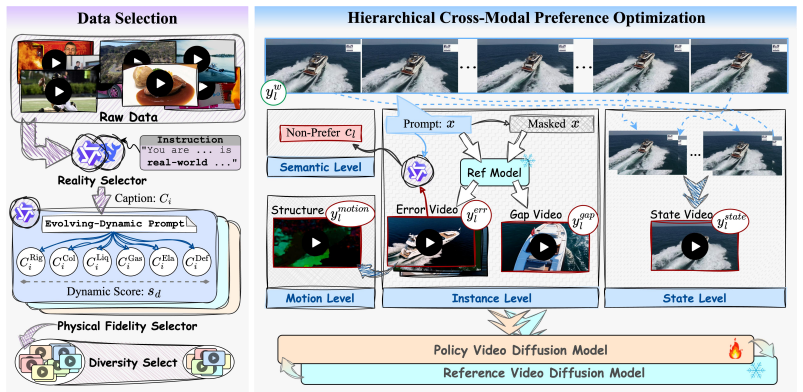
PhysHPO is a post-training framework that extends Diffusion-DPO's reward reparameterization to four preference objectives. At the instance level, the preferred video is a selected real-world clip and the non-preferred video is either an error-prone generation (the base model's output most visually similar to the preferred) or a gap sample generated from a masked prompt. At the state level, the first and last frames of the preferred video are replaced to build a boundary-violating negative. At the motion level, optical flow is extracted from both videos and the DPO contrast is applied to these structural features. At the semantic level, a vision-language model rewrites the prompt to match the
What carries the argument
The load-bearing object is the hierarchical construction of preference pairs: for each granularity, the paper creates a negative that violates physics specifically at that granularity, then applies a shared DPO-style log-sigmoid contrast. Instance negatives split into 'error' samples (base-model generations semantically aligned but physically flawed) and 'gap' samples (prompt-masked generations missing content); state negatives are made by replacing the first and last $N$ frames of the good video; motion negatives use optical flow rather than pixels; semantic negatives use a VLM-rewritten caption. The second mechanism is the data-selection pipeline, which filters real-world videos with VLMs,
Load-bearing premise
The paper assumes that LLM scores assigned to captions—after evolving prompting over 17 physical phenomena—measure the physical fidelity of the corresponding videos; if these scores reward wording rather than actual physics, then training the model to prefer high-scoring captions will not transfer to benchmark physical correctness.
What would settle it
Train PhysHPO on a dataset selected by the caption-scoring pipeline but whose captions describe physically impossible events while still scoring high, such as 'water flows uphill into a glass'; if the trained model still improves VideoPhy and PhyGenBench scores, the selection score is not what carries the gain. Conversely, selecting the lowest-scoring captions and observing no drop in physics benchmarks would indicate the LLM scores carry no physical signal.
If this is right
- If the claim holds, text-to-video models can be made more physically plausible by post-training on selected existing data, removing the need for expensive manual or synthetic physics datasets.
- Data selection becomes a first-class ingredient in video post-training: the reported 21K-video selection outperforms a 433K raw pool and a 32K manually built dataset under identical DPO.
- Fine-grained alignment matters: ablations show each of the four levels contributes, and the full hierarchy outperforms instance-only DPO by 4.6 VideoPhy-overall points on CogVideoX-5B.
- Physics-aligned models also become more robust on 'impossible prompt' tests (IPV-TXT), suggesting the gains are not a fixed library of physical rules.
- General video quality (VBench) is not sacrificed: small improvements are reported alongside the physics gains.
Where Pith is reading between the lines
- A natural next test is whether caption-level LLM scoring can be replaced by video-based physical verifiers or differentiable physics simulators; if a video-supervised selector works as well or better, the method's dependence on LLM caption judgments would shrink.
- The four-granularity decomposition may transfer to other alignment goals in video—safety, style, or identity preservation—where instance-only DPO has been the default.
- Because the semantic level optimizes the same video under two captions, PhysHPO effectively performs cross-modal contrastive learning, suggesting a link to vision-language representation learning that the paper does not develop.
- The diversity stage uses caption embeddings; using motion or visual embeddings there might yield an even more physically diverse selection, a variant the paper leaves untested.
Editorial analysis
A structured set of objections, weighed in public.
Referee Report
Summary. The paper proposes PhysHPO, a hierarchical cross-modal direct preference optimization framework for improving physical plausibility in text-to-video generation. The method defines four alignment granularities: instance-level overall preference (Eq. 5-6), state-level boundary preference by swapping boundary frames (Eq. 7), motion-level preference using structural information such as optical flow (Sec. 5.3), and semantic-level consistency using VLM-generated captions (Eq. 8). To avoid constructing new datasets, the authors introduce a data-selection pipeline that filters OpenVidHD-0.4M for real-world content, scores captions with LLM-based evolving prompts across 17 physical phenomena, and applies diversity filtering. Experiments on CogVideoX-2B/5B and HunyuanVideo report consistent improvements on VideoPhy, PhyGenBench, and VBench (Table 2 and Table 4), with ablations isolating each loss level (Table 3) and a small user study (Fig. 5). The central claim is that PhysHPO significantly improves physical plausibility and overall video quality of existing advanced models.
Significance. If the reported gains are robust, the paper makes a useful contribution by showing that fine-grained, multi-level DPO, combined with automatic data selection from real-world videos, can improve physics-related generation quality without expensive dataset construction. The framework is clearly structured, the ablation study indicates each loss component contributes, and the additional evaluation on HunyuanVideo provides some cross-model evidence. However, the strength of the claim currently rests on automated benchmarks whose scores are thresholded and were also used for hyperparameter and data-selection choices. The lack of error bars, statistical tests, and an independent human evaluation with quantitative results means the central claim is not yet established at the level claimed. The work is timely and could be publishable after substantial validation improvements.
major comments (5)
- [Appendix C.1, Table 2] The reported VideoPhy and PhyGenBench numbers are proportions obtained after binarizing PC and SA at a 0.5 threshold. This creates a nonlinear mapping in which small continuous-score improvements can be amplified into large percentage-point changes. No error bars, seed variance, or significance tests are reported for any row in Table 2 or Table 4. Without these, a gain such as CogVideoX-2B VideoPhy Overall 18.6→25.9 cannot be distinguished from threshold noise. Please report continuous scores, multiple seeds, and confidence intervals or significance tests.
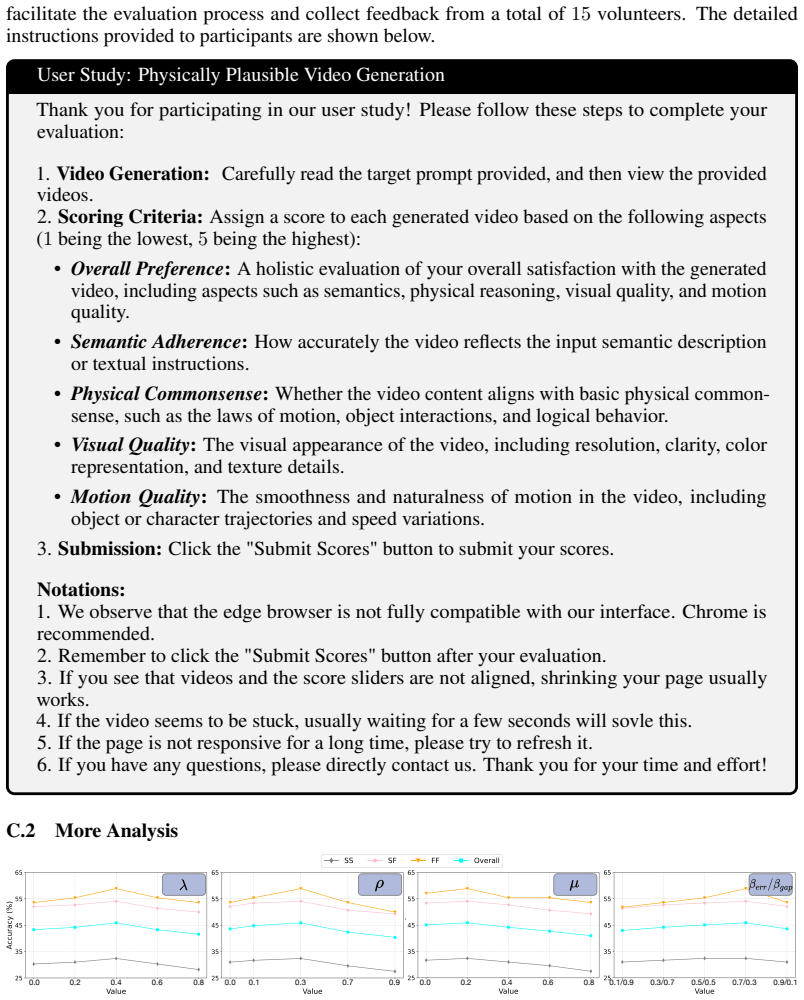
- [Figure 13, Figure 3, Table 2] Hyperparameters (λ, ρ, μ, βerr/βgap, boundary-frame count, number of generated negatives) are selected using VideoPhy accuracy in Figure 13 and Figure 14, and the data-selection strategy and dataset size are selected using PhyGenBench in Figure 3. Table 2 then reports improvements on those same benchmarks. This is a selection-on-the-test-set loop: the reported gains may partly reflect fitting the benchmark rather than genuine physical-plausibility improvement. A held-out validation set or nested tuning procedure is needed to support the headline claim.
- [Sec. 4.2, Sec. 5.4, Appendix C.1, Fig. 5] Training-data selection uses LLM/VLM caption scoring (sd×st×so) and VLM-generated semantic captions, while the main evaluations on VideoPhy and PhyGenBench use VideoCon-Physics, an automated VLM judge. If the LLM/VLM rewards physics-sounding wording or superficial cues rather than actual physical behavior, the training signal and the evaluation signal share the same bias, allowing benchmark gains without true physical improvement. The only human check is a 15-volunteer user study with no reported per-dimension scores, confidence intervals, or significance tests. A larger, statistically analyzed human evaluation, or an independently validated judge not used anywhere in training, is necessary to break this loop.
- [Sec. 5.2, Eq. (7)] The state-level non-preferred sample y_l^state is defined as the preferred video with 'the first and last N frames' replaced, but the manuscript never states what they are replaced with. This is the central operation behind LState and Eq. (7), and without specifying the replacement source (e.g., frames from the base model, noise, or another generated video) the method is not reproducible. Please provide the exact construction and justify why it yields a valid non-preferred sample for state consistency.
- [Sec. 5.3] The motion-level objective is stated as uMotion(x, yw→ymotion_w, yl→ymotion_l, t) 'following Eq. (7)', but the manuscript does not define how the DPO log-ratio is computed on optical flow or other structural representations. Is the structural information used as a conditioning signal, as an additional modal input, or are the log-probabilities evaluated on motion features? This is a central component of the hierarchy and needs an explicit mathematical formulation and implementation description.
minor comments (7)
- [Sec. 4.3] The diversity criterion is described as 'cosine distance d' and a sample is added if d < τ with τ=0.9. For a distance, smaller values mean greater similarity, so d < 0.9 would select near-duplicates rather than diverse samples. If τ is applied to cosine similarity instead, please say so explicitly; otherwise the current text is internally inconsistent.
- [Fig. 3] The y-axis label reads 'PhysGenBench'; the benchmark name is PhyGenBench.
- [Fig. 15] One row label says '+ PhysDPO' but the method is PhysHPO; please correct the typo.
- [Sec. 4.2] The total score s = sd × st × so could be zero if one category is missing, and the scaling or normalization of the three sub-scores is not explained. Please clarify how missing or low sub-scores are handled and how the product is calibrated.
- [Sec. 4.3] The text says captions are 'encoded into embeddings' using LLaMA-1 13B, but LLaMA is not an embedding model. Please specify the exact feature extraction procedure (e.g., mean-pooled hidden states) and distance metric.
- [Table 2 caption] The caption says 'Webold the best results' — likely 'We bold the best results'; no bold formatting appears in the rendered table.
- [Appendix C.1] The user-study section lists instructions to volunteers but does not provide the actual per-dimension MOS values, sample sizes per condition, or statistical comparisons. Even a small study can be reported with mean, standard deviation, and a paired test.
Circularity Check
Physics gains are partly fitted: data strategy and hyperparameters are selected on PhyGenBench/VideoPhy, then reported on those same benchmarks as evidence.
specific steps
-
fitted input called prediction
[Section 4.1 / Eq. (4), Section 4.3 / Figure 3, Section 6.2 / Table 2]
"The objective is to select a subset S(m) of size m that maximizes the post-training performance P. ... Figure 3: Performance comparison of different data strategies with our PhysHPO on PhysGenBench [54]."
The data-selection pipeline (reality filter, LLM physical-fidelity score s = sd × st × so, diversity threshold τ = 0.9, and dataset size 21K vs 59K/433K) is chosen because it gives the highest PhyGenBench accuracy in Figure 3. Table 2 then reports PhyGenBench Overall (0.61 for CogVideoX-5B) as evidence that PhysHPO improves physical plausibility. The reported PhyGenBench number is the same metric used as the selection objective in Eq. (4); it is a fitted maximum over the compared strategies, not an independent prediction.
-
fitted input called prediction
[Section 5.4 / Eq. (9), Section 6.1 Implementation Details, Appendix C.2 / Figure 13]
"The overall loss function for PhysHPO is defined as follows: LPhysHPO = LInstance + λLState + ρLMotion + μL Semantic. ... Figure 13 presents a detailed analysis of the impact of various hyperparameters on the performance of PhysHPO on the VideoPhy [6] benchmark."
The hyperparameters λ, ρ, μ in Eq. (9) and the instance-level weights βerr/βgap in Eq. (6) are not derived from first principles; Appendix C.2 selects them by peaking accuracy on VideoPhy (λ = 0.4, ρ = 0.3, μ = 0.2, βerr/βgap = 0.7/0.3). Table 2 then reports the VideoPhy Overall score (45.9 for CogVideoX-5B) of that selected configuration as evidence of physical-plausibility improvement. The VideoPhy gain is therefore the value of the selection objective—a fitted quantity—rather than an out-of-sample evaluation of the method.
full rationale
The PhysHPO training objective itself is not circular: Eqs. (5)–(9) define a genuine DPO-style loss over real-video/generated-video pairs, and the trained model is not directly optimized to maximize VideoPhy or PhyGenBench scores. However, the paper's headline physics evaluations are partly fitted. Figure 3 selects the entire data-strategy pipeline using PhyGenBench, and Figure 13 selects the loss weights using VideoPhy; Table 2 then reports improvements on these same benchmarks as the central evidence. That is test-set tuning, so the reported physics gains are not clean predictions. The user study is a human check, but it is reported for only 15 volunteers with no variance, confidence intervals, or significance tests, so it cannot break the selection loop. The paper also contains self-citations (e.g., VistadPO [31], Temporal Regularization [13]), but these are not load-bearing: the DPO formulation and benchmark protocols come from external work, and the central mechanism does not reduce to a self-citation chain. The training and evaluation both rely on LLM/VLM judgments, which raises a validity concern about shared textual heuristics, but that is not a derivation-level circularity, so I do not count it as a separate circular step.
Axiom & Free-Parameter Ledger
free parameters (6)
- state-level loss weight lambda =
0.4
- motion-level loss weight rho =
0.3
- semantic-level loss weight mu =
0.2
- instance negative weights beta_err / beta_gap =
0.7 / 0.3
- boundary frames swapped N =
2
- number of generated error negatives =
3
axioms (5)
- domain assumption Real-world videos are the best reflections of physical phenomena, so preferring them over generated videos improves physical plausibility.
- domain assumption LLM-as-a-judge scoring of captions, augmented by evolving prompts, accurately measures physical fidelity.
- standard math The Diffusion-DPO reward parameterization (Eq. 2-3) is valid for video diffusion models.
- domain assumption Optical flow is a faithful structural representation of physical motion for preference optimization.
- ad hoc to paper Replacing boundary frames of the preferred video produces a useful non-preferred sample for state consistency.
Cite this review
Pith. "Pith review of Hierarchical Fine-grained Preference Optimization for Physically Plausible Video Generation." pith.science (2026). https://pith.science/paper/T4P5UITR
@misc{pith2026250810858,
  author       = {Pith},
  title        = {Pith review of: Hierarchical Fine-grained Preference Optimization for Physically Plausible Video Generation},
  year         = {2026},
  howpublished = {\url{https://pith.science/paper/T4P5UITR}},
  note         = {Machine review of arXiv:2508.10858}
}
read the original abstract
Recent advancements in video generation have enabled the creation of high-quality, visually compelling videos. However, generating videos that adhere to the laws of physics remains a critical challenge for applications requiring realism and accuracy. In this work, we propose PhysHPO, a novel framework for Hierarchical Cross-Modal Direct Preference Optimization, to tackle this challenge by enabling fine-grained preference alignment for physically plausible video generation. PhysHPO optimizes video alignment across four hierarchical granularities: a) Instance Level, aligning the overall video content with the input prompt; b) State Level, ensuring temporal consistency using boundary frames as anchors; c) Motion Level, modeling motion trajectories for realistic dynamics; and d) Semantic Level, maintaining logical consistency between narrative and visuals. Recognizing that real-world videos are the best reflections of physical phenomena, we further introduce an automated data selection pipeline to efficiently identify and utilize "good data" from existing large-scale text-video datasets, thereby eliminating the need for costly and time-intensive dataset construction. Extensive experiments on both physics-focused and general capability benchmarks demonstrate that PhysHPO significantly improves physical plausibility and overall video generation quality of advanced models. To the best of our knowledge, this is the first work to explore fine-grained preference alignment and data selection for video generation, paving the way for more realistic and human-preferred video generation paradigms.
Figures





Forward citations
Cited by 2 Pith papers
-
Enhancing Physical Plausibility in Video Generation by Reasoning the Implausibility
A training-free framework uses physics-violating counterfactual prompts and Synchronized Decoupled Guidance to suppress implausible motions in diffusion-based video generation while preserving photorealism.
-
PhysRAG: Enhancing Physics-Awareness in Video Generation via Retrieval-Augmented Generation
PhysRAG curates 7K videos from WISA-80K, builds a physical video database, and injects knowledge via learnable queries into a diffusion model to reach SOTA visual quality and physical compliance on PhyGenBench and VBench.
Reference graph
Works this paper leans on
-
[1]
Amro Abbas, Kushal Tirumala, Dániel Simig, Surya Ganguli, and Ari S Morcos. Semd- edup: Data-efficient learning at web-scale through semantic deduplication.arXiv preprint arXiv:2303.09540, 2023
Pith/arXiv arXiv 2023
-
[2]
Cosmos world foundation model platform for physical ai.arXiv preprint arXiv:2501.03575, 2025
Niket Agarwal, Arslan Ali, Maciej Bala, Yogesh Balaji, Erik Barker, Tiffany Cai, Prithvijit Chattopadhyay, Yongxin Chen, Yin Cui, Yifan Ding, et al. Cosmos world foundation model platform for physical ai.arXiv preprint arXiv:2501.03575, 2025
Pith/arXiv arXiv 2025
-
[3]
A survey on data selection for language models.arXiv preprint arXiv:2402.16827, 2024
Alon Albalak, Yanai Elazar, Sang Michael Xie, Shayne Longpre, Nathan Lambert, Xinyi Wang, Niklas Muennighoff, Bairu Hou, Liangming Pan, Haewon Jeong, et al. A survey on data selection for language models.arXiv preprint arXiv:2402.16827, 2024
Pith/arXiv arXiv 2024
-
[4]
Qwen2.5-vl technical report.arXiv preprint arXiv:2502.13923, 2025
Shuai Bai, Keqin Chen, Xuejing Liu, Jialin Wang, Wenbin Ge, Sibo Song, Kai Dang, Peng Wang, Shijie Wang, Jun Tang, Humen Zhong, Yuanzhi Zhu, Mingkun Yang, Zhaohai Li, Jianqiang Wan, Pengfei Wang, Wei Ding, Zheren Fu, Yiheng Xu, Jiabo Ye, Xi Zhang, Tianbao Xie, Zesen Cheng, Hang Zhang, Zhibo Yang, Haiyang Xu, and Junyang Lin. Qwen2.5-vl technical report.ar...
Pith/arXiv arXiv 2025
-
[5]
Impossible videos.arXiv preprint arXiv:2503.14378, 2025
Zechen Bai, Hai Ci, and Mike Zheng Shou. Impossible videos.arXiv preprint arXiv:2503.14378, 2025
Pith/arXiv arXiv 2025
-
[6]
Videophy: Evaluating physical commonsense for video generation.arXiv preprint arXiv:2406.03520, 2024
Hritik Bansal, Zongyu Lin, Tianyi Xie, Zeshun Zong, Michal Yarom, Yonatan Bitton, Chen- fanfu Jiang, Yizhou Sun, Kai-Wei Chang, and Aditya Grover. Videophy: Evaluating physical commonsense for video generation.arXiv preprint arXiv:2406.03520, 2024
Pith/arXiv arXiv 2024
-
[7]
Color-filter: Conditional loss reduction filtering for targeted language model pre- training.Advances in Neural Information Processing Systems, 37:97618–97649, 2024
David Brandfonbrener, Hanlin Zhang, Andreas Kirsch, Jonathan Richard Schwarz, and Sham Kakade. Color-filter: Conditional loss reduction filtering for targeted language model pre- training.Advances in Neural Information Processing Systems, 37:97618–97649, 2024
2024
-
[8]
Video generation models as world simulators
Tim Brooks, Bill Peebles, Connor Holmes, Will DePue, Yufei Guo, Li Jing, David Schnurr, Joe Taylor, Troy Luhman, Eric Luhman, Clarence Ng, Ricky Wang, and Aditya Ramesh. Video generation models as world simulators. 2024. URL https://openai.com/research/ video-generation-models-as-world-simulators
2024
-
[9]
Miaomiao Cai, Simiao Li, Wei Li, Xudong Huang, Hanting Chen, Jie Hu, and Yunhe Wang. Dspo: Direct semantic preference optimization for real-world image super-resolution.arXiv preprint arXiv:2504.15176, 2025
Pith/arXiv arXiv 2025
-
[10]
Skyreels-v2: Infinite-length film generative model.arXiv preprint arXiv:2504.13074, 2025
Guibin Chen, Dixuan Lin, Jiangping Yang, Chunze Lin, Juncheng Zhu, Mingyuan Fan, Hao Zhang, Sheng Chen, Zheng Chen, Chengchen Ma, et al. Skyreels-v2: Infinite-length film generative model.arXiv preprint arXiv:2504.13074, 2025
Pith/arXiv arXiv 2025
-
[12]
Harold Haodong Chen, Harry Yang, and Ser-Nam Lim. Beyond generation: Unlocking universal editing via self-supervised fine-tuning.arXiv preprint arXiv:2412.02114, 2024
Pith/arXiv arXiv 2024
-
[13]
Temporal regularization makes your video generator stronger
Harold Haodong Chen, Haojian Huang, Xianfeng Wu, Yexin Liu, Yajing Bai, Wen-Jie Shu, Harry Yang, and Ser-Nam Lim. Temporal regularization makes your video generator stronger. arXiv preprint arXiv:2503.15417, 2025
Pith/arXiv arXiv 2025
-
[14]
Alpagasus: Training a better alpaca with fewer data.arXiv preprint arXiv:2307.08701, 2023
Lichang Chen, Shiyang Li, Jun Yan, Hai Wang, Kalpa Gunaratna, Vikas Yadav, Zheng Tang, Vijay Srinivasan, Tianyi Zhou, Heng Huang, et al. Alpagasus: Training a better alpaca with fewer data.arXiv preprint arXiv:2307.08701, 2023
Pith/arXiv arXiv 2023
-
[15]
Goku: Flow based video generative foundation models.arXiv preprint arXiv:2502.04896, 2025
Shoufa Chen, Chongjian Ge, Yuqi Zhang, Yida Zhang, Fengda Zhu, Hao Yang, Hongxiang Hao, Hui Wu, Zhichao Lai, Yifei Hu, Ting-Che Lin, Shilong Zhang, Fu Li, Chuan Li, Xing Wang, Yanghua Peng, Peize Sun, Ping Luo, Yi Jiang, Zehuan Yuan, Bingyue Peng, and Xiaobing Liu. Goku: Flow based video generative foundation models.arXiv preprint arXiv:2502.04896, 2025. 10
Pith/arXiv arXiv 2025
-
[16]
Haoran Cheng, Qide Dong, Liang Peng, Zhizhou Sha, Weiguo Feng, Jinghui Xie, Zhao Song, Shilei Wen, Xiaofei He, and Boxi Wu. Discriminator-free direct preference optimization for video diffusion.arXiv preprint arXiv:2504.08542, 2025
Pith/arXiv arXiv 2025
-
[17]
Vicuna: An open-source chatbot impressing gpt-4 with 90%* chatgpt quality.See https://vicuna
Wei-Lin Chiang, Zhuohan Li, Ziqing Lin, Ying Sheng, Zhanghao Wu, Hao Zhang, Lianmin Zheng, Siyuan Zhuang, Yonghao Zhuang, Joseph E Gonzalez, et al. Vicuna: An open-source chatbot impressing gpt-4 with 90%* chatgpt quality.See https://vicuna. lmsys. org (accessed 14 April 2023), 2(3):6, 2023
2023
-
[18]
Ganqu Cui, Lifan Yuan, Ning Ding, Guanming Yao, Bingxiang He, Wei Zhu, Yuan Ni, Guotong Xie, Ruobing Xie, Yankai Lin, et al. Ultrafeedback: Boosting language models with scaled ai feedback.arXiv preprint arXiv:2310.01377, 2023
Pith/arXiv arXiv 2023
-
[19]
One-minute video generation with test-time training.arXiv preprint arXiv:2504.05298, 2025
Karan Dalal, Daniel Koceja, Gashon Hussein, Jiarui Xu, Yue Zhao, Youjin Song, Shihao Han, Ka Chun Cheung, Jan Kautz, Carlos Guestrin, et al. One-minute video generation with test-time training.arXiv preprint arXiv:2504.05298, 2025
Pith/arXiv arXiv 2025
-
[20]
Ning Ding, Yulin Chen, Bokai Xu, Yujia Qin, Zhi Zheng, Shengding Hu, Zhiyuan Liu, Maosong Sun, and Bowen Zhou. Enhancing chat language models by scaling high-quality instructional conversations.arXiv preprint arXiv:2305.14233, 2023
Pith/arXiv arXiv 2023
-
[21]
What’s in my big data?arXiv preprint arXiv:2310.20707, 2023
Yanai Elazar, Akshita Bhagia, Ian Magnusson, Abhilasha Ravichander, Dustin Schwenk, Alane Suhr, Pete Walsh, Dirk Groeneveld, Luca Soldaini, Sameer Singh, et al. What’s in my big data?arXiv preprint arXiv:2310.20707, 2023
Pith/arXiv arXiv 2023
-
[22]
Wave: Warping ddim inversion features for zero-shot text-to-video editing
Yutang Feng, Sicheng Gao, Yuxiang Bao, Xiaodi Wang, Shumin Han, Juan Zhang, Baochang Zhang, and Angela Yao. Wave: Warping ddim inversion features for zero-shot text-to-video editing. InEuropean Conference on Computer Vision, pages 38–55. Springer, 2024
2024
-
[23]
CHip: Cross-modal hierarchical direct preference optimization for multimodal LLMs
Jinlan Fu, huangfushenzhen, Hao Fei, Xiaoyu Shen, Bryan Hooi, Xipeng Qiu, and See- Kiong Ng. CHip: Cross-modal hierarchical direct preference optimization for multimodal LLMs. InThe Thirteenth International Conference on Learning Representations, 2025. URL https://openreview.net/forum?id=7lpDn2MhM2
2025
-
[24]
Yuan Ge, Yilun Liu, Chi Hu, Weibin Meng, Shimin Tao, Xiaofeng Zhao, Hongxia Ma, Li Zhang, Boxing Chen, Hao Yang, et al. Clustering and ranking: Diversity-preserved instruc- tion selection through expert-aligned quality estimation.arXiv preprint arXiv:2402.18191, 2024
Pith/arXiv arXiv 2024
-
[25]
Task-adaptive pretrained lan- guage models via clustered-importance sampling
David Grangier, Simin Fan, Skyler Seto, and Pierre Ablin. Task-adaptive pretrained lan- guage models via clustered-importance sampling. InThe Thirteenth International Confer- ence on Learning Representations, 2025. URL https://openreview.net/forum?id= p6ncr0eTKE
2025
-
[26]
A survey on llm-as-a-judge.arXiv preprint arXiv:2411.15594, 2024
Jiawei Gu, Xuhui Jiang, Zhichao Shi, Hexiang Tan, Xuehao Zhai, Chengjin Xu, Wei Li, Yinghan Shen, Shengjie Ma, Honghao Liu, et al. A survey on llm-as-a-judge.arXiv preprint arXiv:2411.15594, 2024
Pith/arXiv arXiv 2024
-
[27]
Detecting and preventing hallucinations in large vision language models
Anisha Gunjal, Jihan Yin, and Erhan Bas. Detecting and preventing hallucinations in large vision language models. InProceedings of the AAAI Conference on Artificial Intelligence, volume 38, pages 18135–18143, 2024
2024
-
[28]
Long context tuning for video generation.arXiv preprint arXiv:2503.10589, 2025
Yuwei Guo, Ceyuan Yang, Ziyan Yang, Zhibei Ma, Zhijie Lin, Zhenheng Yang, Dahua Lin, and Lu Jiang. Long context tuning for video generation.arXiv preprint arXiv:2503.10589, 2025
Pith/arXiv arXiv 2025
-
[29]
Denoising diffusion probabilistic models.Advances in neural information processing systems, 33:6840–6851, 2020
Jonathan Ho, Ajay Jain, and Pieter Abbeel. Denoising diffusion probabilistic models.Advances in neural information processing systems, 33:6840–6851, 2020
2020
-
[30]
Animate anyone: Consistent and controllable image-to-video synthesis for character animation
Li Hu. Animate anyone: Consistent and controllable image-to-video synthesis for character animation. InProceedings of the IEEE/CVF Conference on Computer Vision and Pattern Recognition, pages 8153–8163, 2024. 11
2024
-
[31]
Haojian Huang, Haodong Chen, Shengqiong Wu, Meng Luo, Jinlan Fu, Xinya Du, Han- wang Zhang, and Hao Fei. Vistadpo: Video hierarchical spatial-temporal direct preference optimization for large video models.arXiv preprint arXiv:2504.13122, 2025
Pith/arXiv arXiv 2025
-
[32]
A survey on hallucination in large language models: Principles, taxonomy, challenges, and open questions.ACM Transactions on Information Systems, 43(2):1–55, 2025
Lei Huang, Weijiang Yu, Weitao Ma, Weihong Zhong, Zhangyin Feng, Haotian Wang, Qiang- long Chen, Weihua Peng, Xiaocheng Feng, Bing Qin, et al. A survey on hallucination in large language models: Principles, taxonomy, challenges, and open questions.ACM Transactions on Information Systems, 43(2):1–55, 2025
2025
-
[33]
Yuzhou Huang, Ziyang Yuan, Quande Liu, Qiulin Wang, Xintao Wang, Ruimao Zhang, Pengfei Wan, Di Zhang, and Kun Gai. Conceptmaster: Multi-concept video customization on diffusion transformer models without test-time tuning.arXiv preprint arXiv:2501.04698, 2025
Pith/arXiv arXiv 2025
-
[34]
VBench: Comprehensive benchmark suite for video generative models
Ziqi Huang, Yinan He, Jiashuo Yu, Fan Zhang, Chenyang Si, Yuming Jiang, Yuanhan Zhang, Tianxing Wu, Qingyang Jin, Nattapol Chanpaisit, Yaohui Wang, Xinyuan Chen, Limin Wang, Dahua Lin, Yu Qiao, and Ziwei Liu. VBench: Comprehensive benchmark suite for video generative models. InProceedings of the IEEE/CVF Conference on Computer Vision and Pattern Recognition, 2024
2024
-
[35]
Hamish Ivison, Yizhong Wang, Valentina Pyatkin, Nathan Lambert, Matthew Peters, Pradeep Dasigi, Joel Jang, David Wadden, Noah A Smith, Iz Beltagy, et al. Camels in a changing climate: Enhancing lm adaptation with tulu 2.arXiv preprint arXiv:2311.10702, 2023
Pith/arXiv arXiv 2023
-
[36]
Lifan Jiang, Boxi Wu, Jiahui Zhang, Xiaotong Guan, and Shuang Chen. Huvidpo: Enhancing video generation through direct preference optimization for human-centric alignment.arXiv preprint arXiv:2502.01690, 2025
Pith/arXiv arXiv 2025
-
[37]
Miradata: A large-scale video dataset with long durations and structured captions.Advances in Neural Information Processing Systems, 37:48955–48970, 2024
Xuan Ju, Yiming Gao, Zhaoyang Zhang, Ziyang Yuan, Xintao Wang, Ailing Zeng, Yu Xiong, Qiang Xu, and Ying Shan. Miradata: A large-scale video dataset with long durations and structured captions.Advances in Neural Information Processing Systems, 37:48955–48970, 2024
2024
-
[38]
Bingyi Kang, Yang Yue, Rui Lu, Zhijie Lin, Yang Zhao, Kaixin Wang, Gao Huang, and Jiashi Feng. How far is video generation from world model: A physical law perspective.arXiv preprint arXiv:2411.02385, 2024
Pith/arXiv arXiv 2024
-
[39]
Weijie Kong, Qi Tian, Zijian Zhang, Rox Min, Zuozhuo Dai, Jin Zhou, Jiangfeng Xiong, Xin Li, Bo Wu, Jianwei Zhang, et al. Hunyuanvideo: A systematic framework for large video generative models.arXiv preprint arXiv:2412.03603, 2024
Pith/arXiv arXiv 2024
-
[40]
Differentiable physics simulation of dynamics- augmented neural objects.IEEE Robotics and Automation Letters, 8(5):2780–2787, 2023
Simon Le Cleac’h, Hong-Xing Yu, Michelle Guo, Taylor Howell, Ruohan Gao, Jiajun Wu, Zachary Manchester, and Mac Schwager. Differentiable physics simulation of dynamics- augmented neural objects.IEEE Robotics and Automation Letters, 8(5):2780–2787, 2023
2023
-
[41]
Chenyu Li, Oscar Michel, Xichen Pan, Sainan Liu, Mike Roberts, and Saining Xie. Pisa experiments: Exploring physics post-training for video diffusion models by watching stuff drop.arXiv preprint arXiv:2503.09595, 2025
Pith/arXiv arXiv 2025
-
[42]
Dacheng Li, Yunhao Fang, Yukang Chen, Shuo Yang, Shiyi Cao, Justin Wong, Michael Luo, Xiaolong Wang, Hongxu Yin, Joseph E Gonzalez, et al. Worldmodelbench: Judging video generation models as world models.arXiv preprint arXiv:2502.20694, 2025
Pith/arXiv arXiv 2025
-
[43]
Hengjia Li, Lifan Jiang, Xi Xiao, Tianyang Wang, Hongwei Yi, Boxi Wu, and Deng Cai. Magicid: Hybrid preference optimization for id-consistent and dynamic-preserved video customization.arXiv preprint arXiv:2503.12689, 2025
Pith/arXiv arXiv 2025
-
[44]
Jialuo Li, Wenhao Chai, Xingyu Fu, Haiyang Xu, and Saining Xie. Science-t2i: Addressing scientific illusions in image synthesis.arXiv preprint arXiv:2504.13129, 2025
arXiv 2025
-
[45]
Ming Li, Yong Zhang, Zhitao Li, Jiuhai Chen, Lichang Chen, Ning Cheng, Jianzong Wang, Tianyi Zhou, and Jing Xiao. From quantity to quality: Boosting llm performance with self-guided data selection for instruction tuning.arXiv preprint arXiv:2308.12032, 2023. 12
Pith/arXiv arXiv 2023
-
[46]
Selective reflection-tuning: Student-selected data recycling for llm instruction-tuning
Ming Li, Lichang Chen, Jiuhai Chen, Shwai He, Jiuxiang Gu, and Tianyi Zhou. Selective reflection-tuning: Student-selected data recycling for llm instruction-tuning. InFindings of the Association for Computational Linguistics ACL 2024, pages 16189–16211, 2024
2024
-
[47]
Ming Li, Yong Zhang, Shwai He, Zhitao Li, Hongyu Zhao, Jianzong Wang, Ning Cheng, and Tianyi Zhou. Superfiltering: Weak-to-strong data filtering for fast instruction-tuning.arXiv preprint arXiv:2402.00530, 2024
Pith/arXiv arXiv 2024
-
[48]
Open-sora plan: Open-source large video generation model.arXiv preprint arXiv:2412.00131, 2024
Bin Lin, Yunyang Ge, Xinhua Cheng, Zongjian Li, Bin Zhu, Shaodong Wang, Xianyi He, Yang Ye, Shenghai Yuan, Liuhan Chen, et al. Open-sora plan: Open-source large video generation model.arXiv preprint arXiv:2412.00131, 2024
Pith/arXiv arXiv 2024
-
[49]
Yu, and Meng Cao
Aiwei Liu, Haoping Bai, Zhiyun Lu, Yanchao Sun, Xiang Kong, Xiaoming Simon Wang, Jiulong Shan, Albin Madappally Jose, Xiaojiang Liu, Lijie Wen, Philip S. Yu, and Meng Cao. TIS-DPO: Token-level importance sampling for direct preference optimization with estimated weights. InThe Thirteenth International Conference on Learning Representations, 2025. URL http...
2025
-
[50]
Runtao Liu, Chen I Chieh, Jindong Gu, Jipeng Zhang, Renjie Pi, Qifeng Chen, Philip Torr, Ashkan Khakzar, and Fabio Pizzati. Safetydpo: Scalable safety alignment for text-to-image generation.arXiv preprint arXiv:2412.10493, 2024
Pith/arXiv arXiv 2024
-
[51]
Runtao Liu, Haoyu Wu, Zheng Ziqiang, Chen Wei, Yingqing He, Renjie Pi, and Qifeng Chen. Videodpo: Omni-preference alignment for video diffusion generation.arXiv preprint arXiv:2412.14167, 2024
Pith/arXiv arXiv 2024
-
[52]
Physgen: Rigid-body physics-grounded image-to-video generation
Shaowei Liu, Zhongzheng Ren, Saurabh Gupta, and Shenlong Wang. Physgen: Rigid-body physics-grounded image-to-video generation. InEuropean Conference on Computer Vision, pages 360–378. Springer, 2024
2024
-
[53]
What makes good data for alignment? a comprehensive study of automatic data selection in instruction tuning
Wei Liu, Weihao Zeng, Keqing He, Yong Jiang, and Junxian He. What makes good data for alignment? a comprehensive study of automatic data selection in instruction tuning. In The Twelfth International Conference on Learning Representations, 2024. URL https: //openreview.net/forum?id=BTKAeLqLMw
2024
-
[54]
Fanqing Meng, Jiaqi Liao, Xinyu Tan, Wenqi Shao, Quanfeng Lu, Kaipeng Zhang, Yu Cheng, Dianqi Li, Yu Qiao, and Ping Luo. Towards world simulator: Crafting physical commonsense- based benchmark for video generation.arXiv preprint arXiv:2410.05363, 2024
Pith/arXiv arXiv 2024
-
[55]
Motioncraft: Physics-based zero-shot video generation.Advances in Neural Information Processing Systems, 37:123155–123181, 2024
Antonio Montanaro, Luca Savant Aira, Emanuele Aiello, Diego Valsesia, and Enrico Magli. Motioncraft: Physics-based zero-shot video generation.Advances in Neural Information Processing Systems, 37:123155–123181, 2024
2024
-
[56]
Saman Motamed, Laura Culp, Kevin Swersky, Priyank Jaini, and Robert Geirhos. Do generative video models learn physical principles from watching videos?arXiv preprint arXiv:2501.09038, 2025
Pith/arXiv arXiv 2025
-
[57]
Kepan Nan, Rui Xie, Penghao Zhou, Tiehan Fan, Zhenheng Yang, Zhijie Chen, Xiang Li, Jian Yang, and Ying Tai. Openvid-1m: A large-scale high-quality dataset for text-to-video generation.arXiv preprint arXiv:2407.02371, 2024
Pith/arXiv arXiv 2024
-
[58]
Training language models to follow instructions with human feedback.Advances in neural information processing systems, 35:27730–27744, 2022
Long Ouyang, Jeffrey Wu, Xu Jiang, Diogo Almeida, Carroll Wainwright, Pamela Mishkin, Chong Zhang, Sandhini Agarwal, Katarina Slama, Alex Ray, et al. Training language models to follow instructions with human feedback.Advances in neural information processing systems, 35:27730–27744, 2022
2022
-
[59]
Xingyuan Pan, Luyang Huang, Liyan Kang, Zhicheng Liu, Yu Lu, and Shanbo Cheng. G- dig: Towards gradient-based diverse and high-quality instruction data selection for machine translation.arXiv preprint arXiv:2405.12915, 2024
Pith/arXiv arXiv 2024
-
[60]
Haonan Qiu, Menghan Xia, Yong Zhang, Yingqing He, Xintao Wang, Ying Shan, and Ziwei Liu. Freenoise: Tuning-free longer video diffusion via noise rescheduling.arXiv preprint arXiv:2310.15169, 2023. 13
Pith/arXiv arXiv 2023
-
[61]
Direct preference optimization: Your language model is secretly a reward model
Rafael Rafailov, Archit Sharma, Eric Mitchell, Christopher D Manning, Stefano Ermon, and Chelsea Finn. Direct preference optimization: Your language model is secretly a reward model. Advances in Neural Information Processing Systems, 36:53728–53741, 2023
2023
-
[62]
High-resolution image synthesis with latent diffusion models
Robin Rombach, Andreas Blattmann, Dominik Lorenz, Patrick Esser, and Björn Ommer. High-resolution image synthesis with latent diffusion models. InProceedings of the IEEE/CVF conference on computer vision and pattern recognition, pages 10684–10695, 2022
2022
-
[63]
Shouwei Ruan, Zhenyu Wu, Yao Huang, Ruochen Zhang, Yitong Sun, Caixin Kang, and Xingx- ing Wei. Towards nsfw-free text-to-image generation via safety-constraint direct preference optimization.arXiv preprint arXiv:2504.14290, 2025
arXiv 2025
-
[64]
Team Seawead, Ceyuan Yang, Zhijie Lin, Yang Zhao, Shanchuan Lin, Zhibei Ma, Haoyuan Guo, Hao Chen, Lu Qi, Sen Wang, et al. Seaweed-7b: Cost-effective training of video generation foundation model.arXiv preprint arXiv:2504.08685, 2025
Pith/arXiv arXiv 2025
-
[65]
Finephys: Fine-grained human action generation by explicitly incorporating physical laws for effective skeletal guidance
Dian Shao, Mingfei Shi, Shengda Xu, Haodong Chen, Yongle Huang, and Binglu Wang. Finephys: Fine-grained human action generation by explicitly incorporating physical laws for effective skeletal guidance. InProceedings of the Computer Vision and Pattern Recognition Conference, pages 1905–1916, 2025
1905
-
[66]
Deep unsuper- vised learning using nonequilibrium thermodynamics
Jascha Sohl-Dickstein, Eric Weiss, Niru Maheswaranathan, and Surya Ganguli. Deep unsuper- vised learning using nonequilibrium thermodynamics. InInternational conference on machine learning, pages 2256–2265. pmlr, 2015
2015
-
[67]
Conifer: Improving complex constrained instruction-following ability of large language models
Haoran Sun, Lixin Liu, Junjie Li, Fengyu Wang, Baohua Dong, Ran Lin, and Ruohui Huang. Conifer: Improving complex constrained instruction-following ability of large language models. arXiv preprint arXiv:2404.02823, 2024
Pith/arXiv arXiv 2024
-
[68]
Dsv: Exploiting dynamic sparsity to accelerate large-scale video dit training
Xin Tan, Yuetao Chen, Yimin Jiang, Xing Chen, Kun Yan, Nan Duan, Yibo Zhu, Daxin Jiang, and Hong Xu. Dsv: Exploiting dynamic sparsity to accelerate large-scale video dit training. arXiv preprint arXiv:2502.07590, 2025
arXiv 2025
-
[69]
Stanford alpaca: An instruction-following llama model, 2023
Rohan Taori, Ishaan Gulrajani, Tianyi Zhang, Yann Dubois, Xuechen Li, Carlos Guestrin, Percy Liang, and Tatsunori B Hashimoto. Stanford alpaca: An instruction-following llama model, 2023
2023
-
[70]
D4: Improving llm pretraining via document de-duplication and diversification.Advances in Neural Information Processing Systems, 36:53983–53995, 2023
Kushal Tirumala, Daniel Simig, Armen Aghajanyan, and Ari Morcos. D4: Improving llm pretraining via document de-duplication and diversification.Advances in Neural Information Processing Systems, 36:53983–53995, 2023
2023
-
[71]
Llama: Open and efficient foundation language models.arXiv preprint arXiv:2302.13971, 2023
Hugo Touvron, Thibaut Lavril, Gautier Izacard, Xavier Martinet, Marie-Anne Lachaux, Timo- thée Lacroix, Baptiste Rozière, Naman Goyal, Eric Hambro, Faisal Azhar, et al. Llama: Open and efficient foundation language models.arXiv preprint arXiv:2302.13971, 2023
Pith/arXiv arXiv 2023
-
[72]
Diffusion model alignment using direct preference optimization
Bram Wallace, Meihua Dang, Rafael Rafailov, Linqi Zhou, Aaron Lou, Senthil Purushwalkam, Stefano Ermon, Caiming Xiong, Shafiq Joty, and Nikhil Naik. Diffusion model alignment using direct preference optimization. InProceedings of the IEEE/CVF Conference on Computer Vision and Pattern Recognition, pages 8228–8238, 2024
2024
-
[73]
Wan: Open and advanced large-scale video generative models.arXiv preprint arXiv:2503.20314, 2025
Ang Wang, Baole Ai, Bin Wen, Chaojie Mao, Chen-Wei Xie, Di Chen, Feiwu Yu, Haiming Zhao, Jianxiao Yang, Jianyuan Zeng, et al. Wan: Open and advanced large-scale video generative models.arXiv preprint arXiv:2503.20314, 2025
Pith/arXiv arXiv 2025
-
[74]
A survey on data selection for llm instruction tuning.arXiv preprint arXiv:2402.05123, 2024
Jiahao Wang, Bolin Zhang, Qianlong Du, Jiajun Zhang, and Dianhui Chu. A survey on data selection for llm instruction tuning.arXiv preprint arXiv:2402.05123, 2024
Pith/arXiv arXiv 2024
-
[75]
Jing Wang, Ao Ma, Ke Cao, Jun Zheng, Zhanjie Zhang, Jiasong Feng, Shanyuan Liu, Yuhang Ma, Bo Cheng, Dawei Leng, et al. Wisa: World simulator assistant for physics-aware text-to- video generation.arXiv preprint arXiv:2503.08153, 2025
Pith/arXiv arXiv 2025
-
[76]
Yi Wang, Yinan He, Yizhuo Li, Kunchang Li, Jiashuo Yu, Xin Ma, Xinhao Li, Guo Chen, Xinyuan Chen, Yaohui Wang, et al. Internvid: A large-scale video-text dataset for multimodal understanding and generation.arXiv preprint arXiv:2307.06942, 2023. 14
Pith/arXiv arXiv 2023
-
[77]
Yizhong Wang, Yeganeh Kordi, Swaroop Mishra, Alisa Liu, Noah A Smith, Daniel Khashabi, and Hannaneh Hajishirzi. Self-instruct: Aligning language models with self-generated instruc- tions.arXiv preprint arXiv:2212.10560, 2022
Pith/arXiv arXiv 2022
-
[78]
Xianfeng Wu, Yajing Bai, Haoze Zheng, Harold Haodong Chen, Yexin Liu, Zihao Wang, Xuran Ma, Wen-Jie Shu, Xianzu Wu, Harry Yang, et al. Lightgen: Efficient image generation through knowledge distillation and direct preference optimization.arXiv preprint arXiv:2503.08619, 2025
Pith/arXiv arXiv 2025
-
[79]
Zhiyu Wu, Xiaokang Chen, Zizheng Pan, Xingchao Liu, Wen Liu, Damai Dai, Huazuo Gao, Yiyang Ma, Chengyue Wu, Bingxuan Wang, et al. Deepseek-vl2: Mixture-of-experts vision- language models for advanced multimodal understanding.arXiv preprint arXiv:2412.10302, 2024
Pith/arXiv arXiv 2024
-
[80]
LESS: Selecting influential data for targeted instruction tuning
Mengzhou Xia, Sadhika Malladi, Suchin Gururangan, Sanjeev Arora, and Danqi Chen. LESS: Selecting influential data for targeted instruction tuning. InInternational Conference on Machine Learning (ICML), 2024
2024
-
[81]
Data selection for language models via importance resampling
Sang Michael Xie, Shibani Santurkar, Tengyu Ma, and Percy Liang. Data selection for language models via importance resampling. InThirty-seventh Conference on Neural Information Processing Systems, 2023. URLhttps://openreview.net/forum?id=uPSQv0leAu
2023
This paper was first reviewed by deepseek-v4-flash on August 5, 2026.
discussion (0)
Sign in with ORCID, Apple, or X to comment. Anyone can read and Pith papers without signing in.