REVIEW 2 major objections 5 minor 3 cited by
ToonComposer: Streamlining Cartoon Production with Generative Post-Keyframing
T0 review · 2 major / 5 minor · reviewed 2026-08-05 · deepseek-v4-flash
Pith's one-line read ToonComposer claims that cartoon inbetweening and colorization can be collapsed into a single generative post-keyframing stage that outperforms two-stage pipelines.
desk verdict Genuinely new post-keyframing formulation with a thoughtful evaluation, but the ToonCrafter baseline setup on PKBench is under-specified and could be unfair; deserves review but needs a rebuttal. read the letter →
The pith
A machine-rendered reading of the paper's core claim, the machinery that carries it, and where it could break.
The reading
What carries the argument
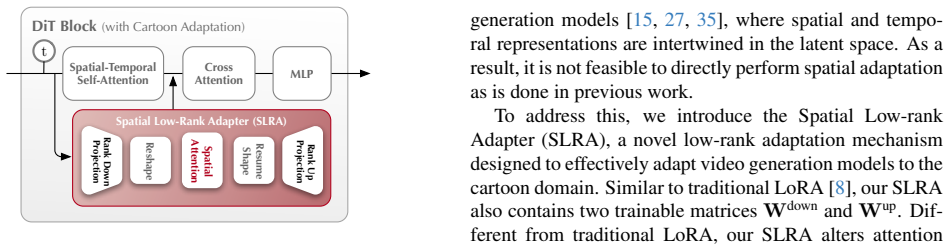
The post-keyframing stage itself is the organizing object: it unifies inbetweening and colorization into one diffusion generation step. Two mechanisms carry the argument. Sparse sketch injection embeds sketch latents as extra tokens with rotary-position-encoding mappings taken from the corresponding video tokens, plus a trainable position-aware residual that lets users adjust control strength. The Spatial Low-Rank Adapter (SLRA) downsamples token features, applies self-attention only along the spatial dimension within each frame, and adds the resulting residual after the main full-attention module, thereby adapting appearance without modifying temporal attention.
What would settle it
Run the SLRA-adapted model against a variant in which the temporal layers are also fine-tuned, using cartoon clips with exaggerated, non-photorealistic motion (squash-and-stretch, held frames, fast action arcs). If the frozen-temporal-prior version does not match or beat the fully adapted version on motion-quality measures and professional-animator preference, the central claim about preserving the temporal prior fails.
Extended reading notes
Core claim
On its own terms, the paper establishes a new task formulation: given a colored reference frame $f_1$ and a sketch frame $s_j$ at temporal position $j$, a model $G_\theta$ directly generates the K-frame cartoon video, $\{\hat{f}_k\}_{k=1}^K = G_\theta(f_1, s_j, e_{\text{text}})$. The central technical claim is that this can be achieved by (1) injecting sparse sketch tokens into the latent token sequence with position-aware residual connections, and (2) adapting a Diffusion Transformer video foundation model to the cartoon domain with a Spatial Low-Rank Adapter (SLRA), which computes a residual from per-frame spatial attention only, so the base model's temporal prior is preserved. The paper r
Load-bearing premise
The method's load-bearing premise is that in a full-attention video diffusion transformer, cartoon style is mostly spatial—so training only a spatial residual leaves the base model's motion behavior valid for cartoons; if cartoon motion is itself domain-specific, the frozen temporal prior is the wrong prior.
Editorial extensions
If this is right
- The cartoon production pipeline can shrink from keyframing, inbetweening, and colorization to keyframing plus one generative post-keyframing pass.
- Because the model accepts a variable number of sketches at arbitrary temporal locations, artists can trade control against automation depending on motion complexity.
- Region-wise control lets artists leave parts of the sketch blank and have the model generate plausible content in those regions, further reducing manual input.
- With fine-tuning on a small dataset, the same post-keyframing approach transfers to 3D-rendered animation, suggesting a broader production pipeline.
- If the reported benchmarks hold, unified post-keyframing avoids the cross-stage error accumulation that plagues interpolation-then-colorization pipelines.
Reading between the lines
- The success of SLRA rests on an untested separability claim: if cartoon motion itself is domain-specific, preserving the natural-video temporal prior wholesale could limit stylized timing and exaggeration; a direct test would fine-tune temporal layers as well and compare motion quality.
- The post-keyframing formulation may transfer to other chained image-to-image production tasks—for example, storyboard-to-preview animation or layout-to-final rendering—where two sequential generative stages are currently used.
- The adjustable control-strength mechanism suggests an interactive workflow where artists progressively add keyframe sketches until the generated motion matches their intent, effectively using the model as a search tool for motion.
- Because the benchmark includes human-drawn sketches, the claimed advantage may partly reflect robustness to sketch style variation; a useful extension would measure how performance degrades as sketch style diverges from the training distribution.
Editorial analysis
A structured set of objections, weighed in public.
Referee Report
Summary. The paper proposes ToonComposer, a DiT-based video generation model that unifies the inbetweening and colorization stages of cartoon production into a single 'post-keyframing' stage. Given one colored reference frame and one or more sparse keyframe sketches at arbitrary temporal positions, it generates a full cartoon video. The method introduces sparse sketch injection (position encoding mapping plus a position-aware residual) and a Spatial Low-Rank Adapter (SLRA) that adapts the Wan 2.1 foundation model to the cartoon domain while keeping its temporal prior intact. Region-wise control is also included to handle blank sketch regions. The authors curate a 37K-clip training dataset (PKData) and a 30-sample benchmark with human-drawn sketches (PKBench), and evaluate against AniDoc, LVCD, and ToonCrafter using reference-based metrics, VBench metrics, and a 47-participant user study, reporting consistent improvements.
Significance. If the reported results hold, ToonComposer is a useful contribution to AI-assisted animation: it directly addresses error accumulation in two-stage pipelines and substantially reduces the manual sketching burden. The introduction of PKBench with human-drawn sketches held out from training is a genuine strength, as is the explicit comparison against assembled two-stage baselines. The SLRA idea, adapting only spatial attention in a full-attention DiT, is interesting and potentially transferable. However, the empirical superiority claim rests on the fairness of the baseline protocol, and the paper does not currently disclose a critical detail about how ToonCrafter is given its required second color keyframe. The SLRA ablation also lacks statistical support for its claimed advantage. These issues are fixable but need to be addressed before the central claims can be accepted.
major comments (2)
- [§4.2, Baseline Methods (ToonCrafter protocol)] The comparison against ToonCrafter is underspecified and potentially degenerate. ToonCrafter's sketch-guidance mode requires both a first and a last color frame as input, but the paper states only that dense sketches are interpolated and then ToonCrafter is run, without specifying what is used as the last color frame on PKBench, where only one colored reference frame is provided. If the first reference frame is reused as the last frame, ToonCrafter is forced to generate videos with identical endpoints, which would artificially suppress its motion scores and user preference. Conversely, if the ground-truth last frame is used on the synthetic benchmark, ToonCrafter would receive privileged information. Since Tables 1–3 and the user study are the principal support for the claimed superiority, the exact protocol must be stated. If the first frame was reused, the baseline should be rerun with
- [§4.5, Table 4 (SLRA ablation)] The SLRA ablation is the only direct evidence for the load-bearing claim that spatial-only adaptation preserves temporal priors. The margins over the LoRA baseline are small: LPIPS 0.1874 vs 0.1922, DISTS 0.0955 vs 0.1082, CLIP 0.9634 vs 0.9628. No error bars, multiple seeds, or significance tests are reported, and the ablation does not include motion-specific metrics such as VBench motion smoothness or subject consistency, even though the argument is specifically about temporal behavior. With such small differences and no variance estimates, the observed improvements are not clearly distinguishable from noise. The authors should add variance over multiple training runs and ideally evaluate temporal metrics in the ablation.
minor comments (5)
- [§4.5, first sentence] "with results detailed in Figure 4" should read "with results detailed in Table 4", since Figure 4 shows the SLRA architecture rather than ablation results.
- [References] Several reference IDs appear to be placeholders, e.g., [26] lists arXiv:2503.00000 and [32] lists arXiv:2405.12345. Please verify these. Also, [23] has an author-name typo: "Li Chenn" should likely be "Li Chen".
- [§4.4, Human Evaluation] The paper says "randomly select 30 samples from the benchmarks," but PKBench has exactly 30 samples; clarify whether this is the full PKBench set or a subset. In addition, reporting confidence intervals or per-sample variance for the preference rates in Table 3 would help assess the strength of the 70.99%/68.58% figures.
- [§4.1, Metrics and Table 1] The metrics list mentions "motion consistency," but Table 1 reports "Motion Smo." and Table 2 reports "M.S." Please unify the terminology and define all abbreviations in the text.
- [§3.2, Eq. (4)] The position-aware residual is trained with α=1 and only adjusted at inference. It is unclear whether the model is expected to generalize to other α values without training-time augmentation. A sentence clarifying this would be helpful.
Circularity Check
No significant circularity: the paper's central claims rest on empirical head-to-head evaluation against external methods, not on a derivation that reduces to its inputs.
full rationale
The load-bearing claim—that the K-frame video in Eq. (1) is generated directly from a colored reference frame and a sparse sketch—is a task definition, not a derived result. The model is trained on PKData and evaluated on held-out benchmarks, with the paper explicitly stating that evaluation movies were excluded from training and that human-drawn sketches are reserved for the real benchmark. No fitted parameter is renamed as a prediction, and no equation is equivalent to its inputs by construction. The SLRA design is supported by an ablation (Table 4) rather than by definitional circularity. The only self-citation of note is [32] (ToonCrafter), which shares author Ying Shan, but it is used as prior work and baseline, not as load-bearing justification for the paper's own quantitative superiority. One methodological ambiguity—the unspecified last color frame for ToonCrafter on PKBench, which only provides one color reference—is a fairness concern for the comparison, but it is not a circularity of the derivation. Overall, the central results are externally evaluated and do not reduce to the model's own assumptions.
Assumptions & free parameters
free parameters (4)
- SLRA rank D_low =
144 (LoRA comparison arm uses rank 24 to match parameter count)
- Sketch control strength alpha =
1 during training, user-adjustable at inference
- Training schedule =
10 epochs, batch size 16, learning rate 1e-5
- Mask channel m_in =
user-specified binary mask
assumptions (6)
- domain assumption Wan 2.1 provides a video-generation prior of sufficient quality for cartoon video.
- domain assumption Spatial appearance and temporal motion are separable in the full-attention DiT latent space, so a spatial-only residual (SLRA) adapts style while preserving motion.
- domain assumption One colored reference frame plus one sketch at an arbitrary temporal location is sufficient conditioning to determine identity, style, and motion of the whole clip.
- domain assumption Sketches synthesized by four CNN sketch models plus IC-Sketcher approximate the distribution of real human-drawn sketches.
- standard math Rectified flow velocity-prediction objective trains the conditional model correctly.
- domain assumption The inbetweening and colorization stages share an internal correspondence-search mechanism, so merging them does not lose information.
Cite this review
Pith. "Pith review of ToonComposer: Streamlining Cartoon Production with Generative Post-Keyframing." pith.science (2026). https://pith.science/paper/ZANR65PN
@misc{pith2026250810881,
  author       = {Pith},
  title        = {Pith review of: ToonComposer: Streamlining Cartoon Production with Generative Post-Keyframing},
  year         = {2026},
  howpublished = {\url{https://pith.science/paper/ZANR65PN}},
  note         = {Machine review of arXiv:2508.10881}
}
read the original abstract
Traditional cartoon and anime production involves keyframing, inbetweening, and colorization stages, which require intensive manual effort. Despite recent advances in AI, existing methods often handle these stages separately, leading to error accumulation and artifacts. For instance, inbetweening approaches struggle with large motions, while colorization methods require dense per-frame sketches. To address this, we introduce ToonComposer, a generative model that unifies inbetweening and colorization into a single post-keyframing stage. ToonComposer employs a sparse sketch injection mechanism to provide precise control using keyframe sketches. Additionally, it uses a cartoon adaptation method with the spatial low-rank adapter to tailor a modern video foundation model to the cartoon domain while keeping its temporal prior intact. Requiring as few as a single sketch and a colored reference frame, ToonComposer excels with sparse inputs, while also supporting multiple sketches at any temporal location for more precise motion control. This dual capability reduces manual workload and improves flexibility, empowering artists in real-world scenarios. To evaluate our model, we further created PKBench, a benchmark featuring human-drawn sketches that simulate real-world use cases. Our evaluation demonstrates that ToonComposer outperforms existing methods in visual quality, motion consistency, and production efficiency, offering a superior and more flexible solution for AI-assisted cartoon production.
Figures


Figures from the paper (7 more)


Forward citations
Cited by 3 Pith papers
-
MoZoo:Unleashing Video Diffusion power in animal fur and muscle simulation
MoZoo generates high-fidelity animal videos with fur and muscle dynamics from coarse meshes by extending video diffusion with role-aware RoPE and asymmetric decoupled attention, trained on a new synthetic-to-real dataset.
-
PeCA: Palette Context Assisted Inference for Test-Time Paint-Bucket Colourisation on Animation Videos
A training-free inference framework combining target-aware reference expansion, soft top-k palette voting, and cycle-gated temporal fusion improves segment-matching colourisation on animation videos.
-
Meta-CoT: Enhancing Granularity and Generalization in Image Editing
Meta-CoT uses two-level decomposition of editing operations into meta-tasks and a CoT consistency reward to improve granularity and generalization, reporting 15.8% gains across 21 tasks.
Reference graph
Works this paper leans on
-
[1]
Stable video diffusion: Scaling latent video diffusion models to large datasets
Andreas Blattmann, Tim Dockhorn, Sumith Kulal, Daniel Mendelevitch, Maciej Kilian, Dominik Lorenz, Yam Levi, Zion English, Vikram V oleti, Adam Letts, et al. Stable video diffusion: Scaling latent video diffusion models to large datasets. arXiv preprint arXiv:2311.15127, 2023. 3
arXiv 2023
-
[2]
Align your latents: High-resolution video synthesis with la- tent diffusion models
Andreas Blattmann, Robin Rombach, Huan Ling, Tim Dock- horn, Seung Wook Kim, Sanja Fidler, and Karsten Kreis. Align your latents: High-resolution video synthesis with la- tent diffusion models. In Proceedings of the IEEE/CVF Con- ference on Computer Vision and Pattern Recognition, pages 22563–22575, 2023. 3
2023
-
[3]
Image quality assessment: Unifying structure and texture similarity
Keyan Ding, Kede Ma, Shiqi Wang, and Eero P Simoncelli. Image quality assessment: Unifying structure and texture similarity. IEEE transactions on pattern analysis and ma- chine intelligence, 44(5):2567–2581, 2020. 6
2020
-
[4]
Scaling recti- fied flow transformers for high-resolution image synthesis
Patrick Esser, Sumith Kulal, Andreas Blattmann, Rahim Entezari, Jonas M ¨uller, Harry Saini, Yam Levi, Dominik Lorenz, Axel Sauer, Frederic Boesel, et al. Scaling recti- fied flow transformers for high-resolution image synthesis. In Forty-first international conference on machine learning,
-
[5]
Cameractrl: Enabling camera control for text-to-video generation
Hao He, Yinghao Xu, Yuwei Guo, Gordon Wetzstein, Bo Dai, Hongsheng Li, and Ceyuan Yang. Cameractrl: Enabling camera control for text-to-video generation. arXiv preprint arXiv:2404.02101, 2024. 3
arXiv 2024
-
[6]
Denoising diffu- sion probabilistic models
Jonathan Ho, Ajay Jain, and Pieter Abbeel. Denoising diffu- sion probabilistic models. arXiv preprint arXiv:2006.11239,
arXiv 2006
-
[7]
Video dif- fusion models
Jonathan Ho, Tim Salimans, Alexey Gritsenko, William Chan, Mohammad Norouzi, and David J Fleet. Video dif- fusion models. Advances in Neural Information Processing Systems, 35:8633–8646, 2022. 3
2022
-
[8]
Lora: Low-rank adaptation of large language models
Edward J Hu, Yelong Shen, Phillip Wallis, Zeyuan Allen- Zhu, Yuanzhi Li, Shean Wang, Lu Wang, Weizhu Chen, et al. Lora: Low-rank adaptation of large language models. ICLR, 1(2):3, 2022. 5, 8, 10
2022
Show all 41 references
-
[9]
Animate anyone: Consistent and controllable image- to-video synthesis for character animation
Li Hu. Animate anyone: Consistent and controllable image- to-video synthesis for character animation. InProceedings of the IEEE/CVF Conference on Computer Vision and Pattern Recognition, pages 8153–8163, 2024. 3
2024
-
[10]
In-context lora for diffusion transformers
Lianghua Huang, Wei Wang, Zhi-Fan Wu, Yupeng Shi, Huanzhang Dou, Chen Liang, Yutong Feng, Yu Liu, and Jin- gren Zhou. In-context lora for diffusion transformers. arXiv preprint arXiv:2410.23775, 2024. 6
2024 arXiv
-
[11]
Vbench: Comprehensive bench- mark suite for video generative models
Ziqi Huang, Yinan He, Jiashuo Yu, Fan Zhang, Chenyang Si, Yuming Jiang, Yuanhan Zhang, Tianxing Wu, Qingyang Jin, Nattapol Chanpaisit, et al. Vbench: Comprehensive bench- mark suite for video generative models. In Proceedings of the IEEE/CVF Conference on Computer Vision and P...
2024
-
[12]
Lvcd: reference-based lineart video colorization with diffusion models
Zhitong Huang, Mohan Zhang, and Jing Liao. Lvcd: reference-based lineart video colorization with diffusion models. ACM Transactions on Graphics (TOG), 43(6):1–11,
-
[13]
Phillip Isola, Jun-Yan Zhu, Tinghui Zhou, and Alexei A. Efros. Image-to-image translation with conditional adver- sarial networks. arXiv preprint arXiv:1611.07004, 2017. 3
2017 arXiv
-
[14]
Exploring the frontiers of animation video gener- ation in the sora era: Method, dataset and benchmark
Yudong Jiang, Baohan Xu, Siqian Yang, Mingyu Yin, Jing Liu, Chao Xu, Siqi Wang, Yidi Wu, Bingwen Zhu, Jixuan Xu, et al. Exploring the frontiers of animation video gener- ation in the sora era: Method, dataset and benchmark. arXiv preprint arXiv:2412.10255, 2024. 2, 3
2024 arXiv
-
[15]
Hunyuanvideo: A systematic framework for large video generative models
Weijie Kong, Qi Tian, Zijian Zhang, Rox Min, Zuozhuo Dai, Jin Zhou, Jiangfeng Xiong, Xin Li, Bo Wu, Jianwei Zhang, et al. Hunyuanvideo: A systematic framework for large video generative models. arXiv preprint arXiv:2412.03603, 2024. 3, 5
2024 arXiv
-
[16]
Xiaoyu Li, Bo Zhang, Jing Liao, and Pedro V . Sander. Deep sketch-guided cartoon video inbetweening. IEEE Transac- tions on Visualization and Computer Graphics, 28(8):2938– 2952, 2021. 3
2021
-
[17]
Image conductor: Precision control for interactive video syn- thesis
Yaowei Li, Xintao Wang, Zhaoyang Zhang, Zhouxia Wang, Ziyang Yuan, Liangbin Xie, Yuexian Zou, and Ying Shan. Image conductor: Precision control for interactive video syn- thesis. arXiv preprint arXiv:2406.15339, 2024. 3
2024 arXiv
-
[18]
Decoupled weight decay regularization
Ilya Loshchilov and Frank Hutter. Decoupled weight decay regularization. arXiv preprint arXiv:1711.05101, 2017. 7
2017 arXiv
-
[19]
Anidoc: Animation creation made easier
Yihao Meng, Hao Ouyang, Hanlin Wang, Qiuyu Wang, Wen Wang, Ka Leong Cheng, Zhiheng Liu, Yujun Shen, and Huamin Qu. Anidoc: Animation creation made easier. arXiv preprint arXiv:2412.14173, 2024. 2, 3, 7
2024 arXiv
-
[20]
Scalable diffusion models with transformers
William Peebles and Saining Xie. Scalable diffusion models with transformers. arXiv preprint arXiv:2303.12345, 2023. 3
2023 arXiv
-
[21]
Learning transferable visual models from natural language supervi- sion
Alec Radford, Jong Wook Kim, Chris Hallacy, Aditya Ramesh, Gabriel Goh, Sandhini Agarwal, Girish Sastry, Amanda Askell, Pamela Mishkin, Jack Clark, et al. Learning transferable visual models from natural language supervi- sion. In International conference on machine learning, ...
2021
-
[22]
Zero: Memory optimizations toward training trillion parameter models
Samyam Rajbhandari, Jeff Rasley, Olatunji Ruwase, and Yuxiong He. Zero: Memory optimizations toward training trillion parameter models. In SC20: International Confer- ence for High Performance Computing, Networking, Storage and Analysis, pages 1–16. IEEE, 2020. 7
2020
-
[23]
Enhanced deep animation video interpolation
Wang Shen, Cheng Ming, Wenbo Bao, Guangtao Zhai, Li Chenn, and Zhiyong Gao. Enhanced deep animation video interpolation. In 2022 IEEE International Conference on Im- age Processing (ICIP), pages 31–35. IEEE, 2022. 3
2022
-
[24]
Tiny and efficient model for the edge detec- tion generalization
Xavier Soria, Yachuan Li, Mohammad Rouhani, and An- gel D Sappa. Tiny and efficient model for the edge detec- tion generalization. In Proceedings of the IEEE/CVF Inter- national Conference on Computer Vision, pages 1364–1373,
-
[25]
Roformer: Enhanced transformer with rotary position embedding
Jianlin Su, Murtadha Ahmed, Yu Lu, Shengfeng Pan, Wen Bo, and Yunfeng Liu. Roformer: Enhanced transformer with rotary position embedding. Neurocomputing, 568:127063,
-
[26]
Generative ai for cel-animation: A survey
Yunlong Tang, Junjia Guo, Pinxin Liu, Zhiyuan Wang, Hang Hua, Jia-Xing Zhong, Yunzhong Xiao, Chao Huang, Luchuan Song, Susan Liang, Yizhi Song, Liu He, Jing Bi, Mingqian Feng, Xinyang Li, Zeliang Zhang, and Chenliang Xu. Generative ai for cel-animation: A survey. arXiv preprin...
2025
-
[27]
Wan: Open and advanced large-scale video gen- erative models
Ang Wang, Baole Ai, Bin Wen, Chaojie Mao, Chen-Wei Xie, Di Chen, Feiwu Yu, Haiming Zhao, Jianxiao Yang, Jianyuan Zeng, et al. Wan: Open and advanced large-scale video gen- erative models. arXiv preprint arXiv:2503.20314, 2025. 2, 3, 4, 5
2025 arXiv
-
[28]
Cinemaster: A 3d-aware and controllable frame- work for cinematic text-to-video generation
Qinghe Wang, Yawen Luo, Xiaoyu Shi, Xu Jia, Huchuan Lu, Tianfan Xue, Xintao Wang, Pengfei Wan, Di Zhang, and Kun Gai. Cinemaster: A 3d-aware and controllable frame- work for cinematic text-to-video generation. arXiv preprint arXiv:2502.08639, 2025. 3
2025 arXiv
-
[29]
Cogvlm: Visual expert for pretrained language models
Weihan Wang, Qingsong Lv, Wenmeng Yu, Wenyi Hong, Ji Qi, Yan Wang, Junhui Ji, Zhuoyi Yang, Lei Zhao, Song XiX- uan, et al. Cogvlm: Visual expert for pretrained language models. Advances in Neural Information Processing Sys- tems, 37:121475–121499, 2024. 6
2024
-
[30]
Motionctrl: A unified and flexible motion controller for video generation
Zhouxia Wang, Ziyang Yuan, Xintao Wang, Yaowei Li, Tianshui Chen, Menghan Xia, Ping Luo, and Ying Shan. Motionctrl: A unified and flexible motion controller for video generation. In ACM SIGGRAPH 2024 Conference Pa- pers, pages 1–11, 2024. 3
2024
-
[31]
Adversarial open domain adap- tation for sketch-to-photo synthesis
Xiaoyu Xiang, Ding Liu, Xiao Yang, Yiheng Zhu, Xiaohui Shen, and Jan P Allebach. Adversarial open domain adap- tation for sketch-to-photo synthesis. In Proceedings of the IEEE/CVF Winter Conference on Applications of Computer Vision, pages 1434–1444, 2022. 6, 7
2022
-
[32]
Toon- crafter: Generative cartoon interpolation
Jinbo Xing, Hanyuan Liu, Menghan Xia, Yong Zhang, Xintao Wang, Ying Shan, and Tien-Tsin Wong. Toon- crafter: Generative cartoon interpolation. arXiv preprint arXiv:2405.12345, 2024. 2, 3, 4, 5, 7
2024 arXiv
-
[33]
Make-your-video: Cus- tomized video generation using textual and structural guid- ance
Jinbo Xing, Menghan Xia, Yuxin Liu, Yuechen Zhang, Yong Zhang, Yingqing He, Hanyuan Liu, Haoxin Chen, Xi- aodong Cun, Xintao Wang, et al. Make-your-video: Cus- tomized video generation using textual and structural guid- ance. IEEE Transactions on Visualization and Computer Gra...
2024
-
[34]
Dynamicrafter: Animating open-domain images with video diffusion priors
Jinbo Xing, Menghan Xia, Yong Zhang, Haoxin Chen, Wangbo Yu, Hanyuan Liu, Gongye Liu, Xintao Wang, Ying Shan, and Tien-Tsin Wong. Dynamicrafter: Animating open-domain images with video diffusion priors. In Eu- ropean Conference on Computer Vision , pages 399–417. Springer, 2024. 3
2024
-
[35]
Cogvideox: Text-to-video diffusion models with an expert transformer
Zhuoyi Yang, Jiayan Teng, Wendi Zheng, Ming Ding, Shiyu Huang, Jiazheng Xu, Yuanming Yang, Wenyi Hong, Xiao- han Zhang, Guanyu Feng, et al. Cogvideox: Text-to-video diffusion models with an expert transformer. arXiv preprint arXiv:2408.06072, 2024. 3, 5
2024 arXiv
-
[36]
Ip- adapter: Text compatible image prompt adapter for text-to- image diffusion models
Hu Ye, Jun Zhang, Sibo Liu, Xiao Han, and Wei Yang. Ip- adapter: Text compatible image prompt adapter for text-to- image diffusion models. arXiv preprint arXiv:2308.06721,
-
[37]
Adding conditional control to text-to-image diffusion models
Lvmin Zhang and Maneesh Agrawala. Adding conditional control to text-to-image diffusion models. arXiv preprint arXiv:2302.05543, 2023. 3, 6
2023 arXiv
-
[38]
The unreasonable effectiveness of deep features as a perceptual metric
Richard Zhang, Phillip Isola, Alexei A Efros, Eli Shecht- man, and Oliver Wang. The unreasonable effectiveness of deep features as a perceptual metric. In Proceedings of the IEEE conference on computer vision and pattern recogni- tion, pages 586–595, 2018. 6
2018
-
[39]
Champ: Controllable and consistent human image an- imation with 3d parametric guidance
Shenhao Zhu, Junming Leo Chen, Zuozhuo Dai, Zilong Dong, Yinghui Xu, Xun Cao, Yao Yao, Hao Zhu, and Siyu Zhu. Champ: Controllable and consistent human image an- imation with 3d parametric guidance. In European Confer- ence on Computer Vision , pages 145–162. Springer, 2024. 3
2024
-
[40]
Colorflow: Retrieval- augmented image sequence colorization
Junhao Zhuang, Xuan Ju, Zhaoyang Zhang, Yong Liu, Shiyi Zhang, Chun Yuan, and Ying Shan. Colorflow: Retrieval- augmented image sequence colorization. arXiv preprint arXiv:2412.11815, 2024. 3
2024 arXiv
-
[41]
Cobra: Efficient line art colorization with broader references
Junhao Zhuang, Lingen Li, Xuan Ju, Zhaoyang Zhang, Chun Yuan, and Ying Shan. Cobra: Efficient line art colorization with broader references. arXiv preprint arXiv:2504.12240,
Reviewed August 5, 2026 · model on record in the stance chip above.
Discussion (0). Sign in to comment.