REVIEW 3 major objections 5 minor 73 references
Two non-asymptotic bounds govern CARD conditional diffusion: the Wasserstein-2 gap between generated and target conditionals is bounded by integrated score error plus endpoint mismatch, and the score error has an explicit Taylor rate.
Reviewed by Pith at T0; open to challenge. T0 means a machine referee read the full paper against a public rubric. the ladder, T0–T4 →
CARD's generated conditional distribution is shown to converge in Wasserstein distance to the true conditional distribution, with a separate score-estimation error bound controlled by network resolution and distribution smoothness.
T0 review reviewed 2026-08-05 challenge →
load-bearing objection The W2 reduction for CARD is a real but narrow adaptation of Kwon et al.; the paper's central claim that Y|f_phi(X) approximates Y|X is unsupported, and Theorem 2 rests on a missing lemma. the 3 major comments →
Non-asymptotic convergence bound of conditional diffusion models
The pith
A machine-rendered reading of the paper's core claim, the machinery that carries it, and where it could break.
The reading
Core claim
The paper's central claim: CARD's sampling error is a score term plus an endpoint term. Theorem 1 gives $W_2(q(y_0\mid f_\phi(x)),p(y_0\mid f_\phi(x)))\le \int_0^T \beta_t M(t)\sqrt{H(t)}\,dt+M(T)W_2(q(y_T\mid f_\phi(x)),p(y_T\mid f_\phi(x)))$, with $M(t)$ a Grönwall factor, $H(t)$ the mean squared score error; vanishing loss plus endpoint gap implies convergence. Theorem 2 bounds $H(t)$: for a $\beta$-Hölder light-tailed conditional density with bounded $f_\phi(x)$ and truncated domains, the integrated squared score error is $O\big((\sqrt{\log\varepsilon^{-1}}+1)(N^{-\beta}/\gamma_t^{d/2}+N^{-d}/\sigma_t^d+N^{-d-\beta}/\sigma_t^d)\big)$, with $N$ grid divisions per dimension.
What carries the argument
Two mechanisms carry the argument. First, the Fokker–Planck equations of the forward and reverse CARD SDEs become continuity equations on probability space, and the time derivative of the Wasserstein-2 distance between their solutions is bounded by the optimal-transport contraction formula; the one-sided Lipschitz constants of drift and score estimator feed the Grönwall factor $M(t)=\exp(\int_0^t(l_1(s)+l_2(s)\beta_s)ds)$, yielding Theorem 1. Second, Theorem 2 approximates the diffused conditional density — a Gaussian convolution of the original conditional density, with mean $\gamma_t y_0+(1-\gamma_t)f_\phi(x)$ and variance $\sigma_t^2 I$ — by piecewise Taylor polynomials of the density and
Load-bearing premise
The load-bearing premise is that conditioning on the predicted mean $f_\phi(x)$ is as informative as conditioning on $x$ once $f_\phi(x)\approx E[Y\mid X]$; for a response whose conditional mean is not a sufficient statistic — a symmetric two-mode mixture, say — that identification can fail even with a perfect score estimator, and every bound here is stated for $Y\mid f_\phi(x)$, not $Y\mid x$.
What would settle it
Two checks. (1) On a target $Y\mid X$ that is a symmetric two-mode mixture (so the conditional mean sits between modes), train CARD with an accurate score estimator for $Y\mid f_\phi(X)$: if generated samples miss a mode while $L_1\to 0$, the Assumption 4 bridge — not Theorem 1's arithmetic — failed, since the theorem controls $Y\mid f_\phi(x)$, not $Y\mid x$. (2) Equation (20) fixes the slope of $\log W_2$ vs $\log L_1$ at $1/2$; on a heavy-tailed conditional violating the light-tail/truncation assumptions, a flattened slope or violated bound would localize where Theorem 2's rate breaks.
If this is right
- If Theorem 1 is correct, CARD's generated conditional distribution converges to the target in Wasserstein-2 whenever the score-matching loss $L_1(\phi,\theta,\lambda)$ and the endpoint gap $W_2(q(y_T\mid f_\phi(x)),p(y_T\mid f_\phi(x)))$ both vanish — generation quality is governed by the two quantities the model actually trains.
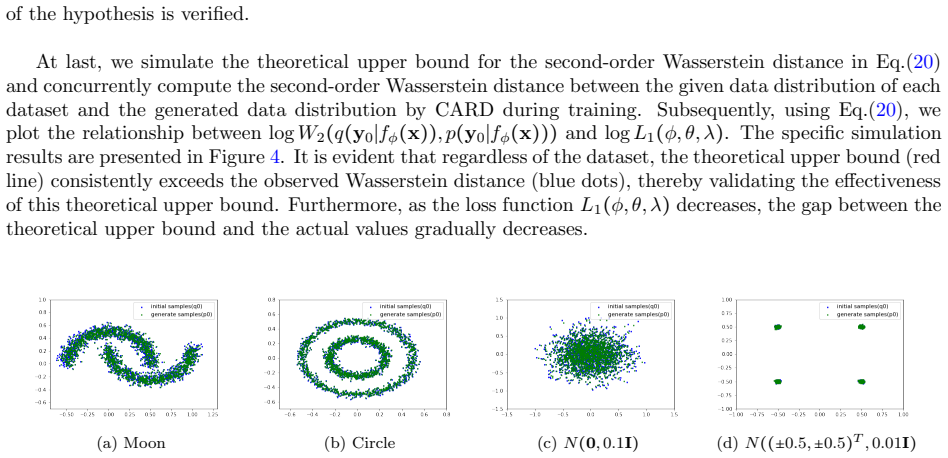
- Corollary 1 upgrades the bound to $\log W_2 \le \tfrac12\log(2\int_0^T\beta_t M^2(t)\,dt)+\tfrac12\log L_1$ when $\lambda(t)=\beta_t$; the paper's simulations on Moon, Circle, Gaussian, and Gaussian-mixture data confirm the upper bound stays above the measured Wasserstein distances throughout training.
- Because the Fokker-Planck derivation carries two covariates $(y_t,f_\phi(x))$, the bound covers a generalized score function with two covariates, extending the theory from scalar to multivariate conditional-generation settings.
- Theorem 2's rate $O\big((\sqrt{\log\varepsilon^{-1}}+1)(N^{-\beta}/\gamma_t^{d/2}+N^{-d}/\sigma_t^d+N^{-d-\beta}/\sigma_t^d)\big)$ makes the score error explicit in the grid size $N$, the Hölder smoothness $\beta$, and time $t$; since $\sigma_t\to 0$ as $t\to 0$, the bound is only meaningful away from time zero, and the paper itself notes a threshold step $t_0$ is required.
- The approximating score is realized by a concrete ReLU network (the clipped ratio $h_4/(\sigma_t h_{1,\mathrm{clip}})$), so the non-asymptotic guarantee applies to an architecture that can be trained, not only to an idealized estimator.
Where Pith is reading between the lines
- My inference: the $Y\mid X$ framing in the abstract is an extrapolation from what is proven; the theorems only control $Y\mid f_\phi(x)$, and on symmetric-multimodal conditionals — where $E[Y\mid X]$ destroys mode information — the bounds could hold while generation conditioned on $x$ badly misses modes. A sufficient-statistic surrogate (learned representation, quantiles) is the natural fix to tes
- My inference: the slope-$1/2$ law $\log W_2 \le \text{const}+\tfrac12\log L_1$ is falsifiable per dataset; measuring the empirical slope on heavy-tailed conditionals (where the truncation assumptions fail) would show where the theory's rate degrades, giving practitioners a cheap diagnostic.
- My inference: the paper leaves optimality untouched; comparing the $N^{-d-\beta}$ term against known minimax rates for conditional density estimation under Hölder classes would reveal whether the Taylor construction is sharp in dimension.
- My inference: the H1/H2 truncation terms depend on the radius $R\sim c\sqrt{\log\varepsilon^{-1}}$ and the threshold $\epsilon_{\mathrm{low}}$; tracking $H_1+H_2$ separately during training on outlier-prone data would show whether the bound is dominated by out-of-domain or by low-density errors — a split the paper's simulation plots do not isolate.
Editorial analysis
A structured set of objections, weighed in public.
Referee Report
Summary. The paper studies Classification and Regression Diffusion Models (CARD), where a pre-trained conditional-mean estimator f_phi(x) is injected into the forward and reverse diffusion processes. The main theoretical contributions are: (i) an SDE/Fokker-Planck formulation of CARD; (ii) Theorem 1, a non-asymptotic bound on the second-order Wasserstein distance W2(q(y0|f_phi(x)), p(y0|f_phi(x))) in terms of an integrated conditional score-estimation error H(t) plus an endpoint mismatch term; (iii) Corollary 1, a Cauchy-Schwarz reformulation in terms of the score-matching loss; and (iv) Theorem 2, a non-asymptotic bound on the conditional score-estimation error under Hölder smoothness, light-tailedness, and truncation assumptions, proved via local Taylor polynomials. Numerical experiments on four 2-D datasets plot the Wasserstein distance against the loss to illustrate the bound. The derivation of Theorem 1 is structurally standard, but the paper's advertised claim about generating from Y|X is not actually proved, because all theoretical statements are about the surrogate conditioning variable f_phi(x). The proof of Theorem 2 also rests on an unproved truncation assumption and contains a time-dependence inconsistency.
Significance. If Theorem 1 is read literally as a statement about the conditional distribution given f_phi(x), it is a clean and potentially useful reduction: it separates the score-estimation error, measured by H(t), from the endpoint error, and it does not require log-concavity or other strong structural assumptions on the target. The attempt in Theorem 2 to control H(t) under Hölder smoothness and light-tail assumptions is also a legitimate direction, and the authors correctly identify that the practical loss L2 differs from the theoretical L1. However, the central advertised result --- that CARD generates from the true conditional distribution Y|X --- is not established. Assumption 4 only gives convergence of f_phi(X) to E[Y|X], and the conditional mean is not a sufficient statistic in general. Thus the Wasserstein bound in Eq. (14) controls the wrong conditioning variable relative to the abstract's claim. The proof of Theorem 2 is also not self-contained: Assumption 9 is asserted rather than proved, and the final bound in Eq. (19) has the opposite time dependence from what the text claims. These issues are load-bearing, so the manuscript requires substantial revision before the results can
major comments (3)
- [Section 3.2, Assumption 4 and Theorem 1 (Eq. 14)] Assumption 4 only asserts that f_phi(X) converges to E[Y|X] in probability. The paragraph following it states that when f_phi(X) performs well, Y|f_phi(X) 'closely approximates' Y|X, but no theorem or lemma bounds W2(q(y|x), q(y|f_phi(x))) in terms of ||f_phi(x) - E[Y|X]||. This implication is false in general because the conditional mean is not a sufficient statistic. For example, let X=(X1,X2) with X2~Bernoulli(1/2), X1 independent of Y, and Y|X2=1 ~ N(0,25), Y|X2=0 ~ N(0,1). Then E[Y|X]=0 for every x, so Assumption 4 holds exactly with f_phi(X)=0, yet q(y|X2=1)=N(0,25) while q(y|f_phi(X)=0)=0.5 N(0,1)+0.5 N(0,25), and the two distributions have strictly positive Wasserstein distance. Consequently, Theorem 1 and Corollary 1 bound only W2(q(y0|f_phi(x)), p(y0|f_phi(x))), not W2(q(y0|x), p(y0|f_phi(x))). A triangle-inequality term for the covariate conditioning gap is missing; without it
- [Appendix B.2, Assumption 9 (Eqs. 49-50)] Assumption 9 asserts that the integrals of q(y0|f_phi(x)) phi(yt|y0,f_phi(x)) and of the gradient-weighted versions over the complement of the truncation domain D0 are bounded by epsilon. This assumption is load-bearing for the proof of Theorem 2: it is used in Lemma 3 (Appendix B.3.2) to control the score-function bound, and it ultimately enters the H1 and H2 estimates in Appendix B.3.3. However, it is introduced with the sentence 'From the inspiration of the Lemma A.8 in XXX, we may as well obtain Assumption 9', and no proof or reference is supplied. The text in Section B.2 says the error 'could be controlled' but gives no argument. Since Theorem 2's upper bound in Eq. (19) depends critically on these inequalities, the score-estimation result is not self-contained. The authors need either to prove Eqs. (49)-(50) from the preceding assumptions or to provide a complete reference.
- [Theorem 2, Eq. (19), and Appendix B.4.4] The claimed upper bound in Eq. (19) contains the term N^{-beta} / gamma_t^{d/2}, where gamma_t = e^{-beta t/2}. For fixed N and beta>0, this term equals N^{-beta} e^{beta t d/4}, which grows exponentially in t. Thus the right-hand side of Eq. (19) diverges as t increases, for example as t -> infinity. The surrounding text states that 'the approximation error increases as time t decreases' and that 'we consider the error upper bound when t is large', which is the opposite of what the displayed formula implies. At a minimum, the theorem and proof must specify a quantitative regime for t (for example, an upper bound on t or a lower bound on gamma_t) for the bound to be meaningful, and the discussion must be corrected. Without this, the stated non-asymptotic convergence guarantee in Theorem 2 is not supported.
minor comments (5)
- [Corollary 1, Eqs. (16)-(17)] The displayed formulas contain corrupted symbols such as '⌟roo⟪⟪op' and the square-root notation is mangled. Please regenerate these equations and verify the typesetting.
- [Appendix A.1, reverse SDE derivation] The derivation of the reverse SDE is written in a way that is hard to follow: the quantities HH1, HH2, HH3 are introduced without clear definitions, and several limit steps are stated informally. A cleaner presentation with explicit definitions of the remainder terms would help the reader check the argument.
- [Section 5] The text says that the loss used in simulations is L2 (Eq. (18)), but the plots are described as showing L1(phi,theta,lambda). Please clarify which quantity is actually computed and plotted, and make the notation consistent.
- [Notation and typos] There are numerous typos and inconsistencies: 'Futhermore', 'Firstlt', 'detrive', 'fractional function' for score function, and inconsistent use of f_phi(x) vs fphi(x). A careful proofreading pass is needed.
- [Assumptions section] Assumption 9 is stated in the appendix rather than in the main Assumptions section (Section 4.1). Since it is used in the proof of Theorem 2, it should be listed in the main assumptions or explicitly cross-referenced from Section 4.1.
Circularity Check
No significant circularity: the main bounds reduce sampling error to score-estimation error under explicit assumptions; weaknesses are correctness gaps, not circular reductions.
full rationale
Theorem 1 (Eq. 14) is a genuine reduction: it bounds W2(q(y0|f_phi(x)), p(y0|f_phi(x))) by ∫ β_t M(t)√H(t) dt plus an endpoint mismatch term, where H(t) is the mean squared score-estimation error with respect to the forward conditional density. This is not a tautology: H(t) is a training objective that must be controlled, and the bound has independent content as a standard Fokker–Planck/optimal-transport argument adapted to the CARD drift. Theorem 2 then gives an approximation-theoretic bound on H(t) under explicit Hölder, light-tail, truncation, and density-lower-bound assumptions. No fitted parameter is renamed as a prediction, no load-bearing self-citation chain appears (the paper cites external prior work such as Kwon et al.), and the construction of the network estimator in Eq. (72) is a standard existence/approximation argument rather than a circular fit. The paper's abstract-level claim that Y|f_phi(X) approximates Y|X when f_phi(X) approximates E[Y|X] is not proved by any theorem — the theorems concern q(·|f_phi(x)), not q(·|x) — but this is an unsupported bridge, not a circular derivation. Similarly, Assumption 9 is introduced as an explicit tail/truncation assumption (with an unnamed 'Lemma A.8 in XXX' reference) and the proof uses it as a hypothesis; this is an assumption, not an equation that reduces the theorem to itself. There is also an apparent technical mismatch in the proof of Theorem 1 (H(t) is defined with E_{π_t} in Eq. 37 but with E_{q(y_t|f_phi(x))} in the theorem statement), but that is a correctness/proof gap, not circularity. Overall, the derivation chain is not circular; the paper's central claims either follow from the stated assumptions or are explicitly conditional on them.
Axiom & Free-Parameter Ledger
free parameters (5)
- Truncation radius R
- Density threshold epsilon_low
- Condition truncation radius Rf
- Truncation error epsilon
- Taylor grid resolution N
axioms (10)
- standard math Ito's lemma and Fokker-Planck equation for SDEs with drift -beta/2(y-fphi(x)) and diffusion sqrt(beta)
- standard math Wasserstein contraction inequality: d/dt W2^2(qt,pt) = 2 E_pi_t[(yt-zt)(v[pt](yt)-v[pt](zt))]
- domain assumption Lipschitz drift, bounded diffusion coefficient, one-sided Lipschitz score estimator (Assumptions 1-3)
- ad hoc to paper Assumption 4: fphi(X) -> E[Y|X] implies Y|fphi(X) approximates Y|X
- domain assumption Assumption 5: q(y0|fphi(x)) is Holder beta and light-tailed sub-Gaussian
- domain assumption Assumption 6: distribution of fphi(x) is light-tailed with ||fphi(x)|| <= c
- domain assumption Assumptions 7-8: truncation of yt to radius R and density threshold epsilon_low
- ad hoc to paper Assumption 9: integrals over truncation domain bounded by epsilon (Eqs. 49-50)
- domain assumption Constant diffusion coefficient beta in Gaussian representation gamma_t = exp(-beta t/2), sigma_t^2 = 1 - exp(-beta t)
- domain assumption Sub-Gaussian tail bound P(||yt||_infinity >= m) <= c6 exp(-m^2/(2 sigma_t^2))
Cite this review
Pith. "Pith review of Non-asymptotic convergence bound of conditional diffusion models." pith.science (2026). https://pith.science/paper/KPPPOCS2
@misc{pith2026250810944,
  author       = {Pith},
  title        = {Pith review of: Non-asymptotic convergence bound of conditional diffusion models},
  year         = {2026},
  howpublished = {\url{https://pith.science/paper/KPPPOCS2}},
  note         = {Machine review of arXiv:2508.10944}
}
read the original abstract
Learning and generating various types of data based on conditional diffusion models has been a research hotspot in recent years. Although conditional diffusion models have made considerable progress in improving acceleration algorithms and enhancing generation quality, the lack of non-asymptotic properties has hindered theoretical research. To address this gap, we focus on a conditional diffusion model within the domains of classification and regression (CARD), which aims to learn the original distribution with given input x (denoted as Y|X). It innovatively integrates a pre-trained model f_{\phi}(x) into the original diffusion model framework, allowing it to precisely capture the original conditional distribution given f (expressed as Y|f_{\phi}(x)). Remarkably, when f_{\phi}(x) performs satisfactorily, Y|f_{\phi}(x) closely approximates Y|X. Theoretically, we deduce the stochastic differential equations of CARD and establish its generalized form predicated on the Fokker-Planck equation, thereby erecting a firm theoretical foundation for analysis. Mainly under the Lipschitz assumptions, we utilize the second-order Wasserstein distance to demonstrate the upper error bound between the original and the generated conditional distributions. Additionally, by appending assumptions such as light-tailedness to the original distribution, we derive the convergence upper bound between the true value analogous to the score function and the corresponding network-estimated value.
Figures



Reference graph
Works this paper leans on
-
[1]
Deep unsupervised learning using nonequilibrium thermodynamics
Jascha Sohl-Dickstein, Eric Weiss, Niru Maheswaranathan, and Surya Ganguli. Deep unsupervised learning using nonequilibrium thermodynamics. In International conference on machine learning, pages 2256--2265. PMLR, 2015
2015
-
[2]
Denoising diffusion probabilistic models
Jonathan Ho, Ajay Jain, and Pieter Abbeel. Denoising diffusion probabilistic models. Advances in neural information processing systems, 33: 0 6840--6851, 2020
2020
-
[3]
Generative modeling by estimating gradients of the data distribution
Yang Song and Stefano Ermon. Generative modeling by estimating gradients of the data distribution. Advances in neural information processing systems, 32, 2019
2019
-
[4]
Diffusion models beat gans on image synthesis
Prafulla Dhariwal and Alexander Nichol. Diffusion models beat gans on image synthesis. Advances in neural information processing systems, 34: 0 8780--8794, 2021
2021
-
[5]
High-resolution image synthesis with latent diffusion models
Robin Rombach, Andreas Blattmann, Dominik Lorenz, Patrick Esser, and Bj \"o rn Ommer. High-resolution image synthesis with latent diffusion models. In Proceedings of the IEEE/CVF conference on computer vision and pattern recognition, pages 10684--10695, 2022
2022
-
[6]
Adding conditional control to text-to-image diffusion models
Lvmin Zhang, Anyi Rao, and Maneesh Agrawala. Adding conditional control to text-to-image diffusion models. In Proceedings of the IEEE/CVF International Conference on Computer Vision, pages 3836--3847, 2023
work page 2023
-
[7]
Conditional text image generation with diffusion models
Yuanzhi Zhu, Zhaohai Li, Tianwei Wang, Mengchao He, and Cong Yao. Conditional text image generation with diffusion models. In Proceedings of the IEEE/CVF Conference on Computer Vision and Pattern Recognition, pages 14235--14245, 2023
work page 2023
-
[8]
Seeing beyond the brain: Conditional diffusion model with sparse masked modeling for vision decoding
Zijiao Chen, Jiaxin Qing, Tiange Xiang, Wan Lin Yue, and Juan Helen Zhou. Seeing beyond the brain: Conditional diffusion model with sparse masked modeling for vision decoding. In Proceedings of the IEEE/CVF Conference on Computer Vision and Pattern Recognition, pages 22710--22720, 2023 a
work page 2023
-
[9]
Structured denoising diffusion models in discrete state-spaces
Jacob Austin, Daniel D Johnson, Jonathan Ho, Daniel Tarlow, and Rianne Van Den Berg. Structured denoising diffusion models in discrete state-spaces. Advances in Neural Information Processing Systems, 34: 0 17981--17993, 2021
work page 2021
-
[10]
Diffusion-lm improves controllable text generation
Xiang Li, John Thickstun, Ishaan Gulrajani, Percy S Liang, and Tatsunori B Hashimoto. Diffusion-lm improves controllable text generation. Advances in Neural Information Processing Systems, 35: 0 4328--4343, 2022
work page 2022
-
[11]
Diffusion Models for Non-autoregressive Text Generation: A Survey
Yifan Li, Kun Zhou, Wayne Xin Zhao, and Ji-Rong Wen. Diffusion models for non-autoregressive text generation: A survey. arXiv preprint arXiv:2303.06574, 2023 a
work page internal anchor Pith review Pith/arXiv arXiv 2023
-
[12]
Ar-diffusion: Auto-regressive diffusion model for text generation
Tong Wu, Zhihao Fan, Xiao Liu, Hai-Tao Zheng, Yeyun Gong, Jian Jiao, Juntao Li, Jian Guo, Nan Duan, Weizhu Chen, et al. Ar-diffusion: Auto-regressive diffusion model for text generation. Advances in Neural Information Processing Systems, 36: 0 39957--39974, 2023
work page 2023
-
[13]
Egdiff: An experiment-guided diffusion model for protein
Yikai Liu, Abhilash Sahoo, Zongxin Yu, Guang Lin, Ming Chen, and Sonya M Hanson. Egdiff: An experiment-guided diffusion model for protein
-
[14]
Deep learning for inferring gene relationships from single-cell expression data
Ye Yuan and Ziv Bar-Joseph. Deep learning for inferring gene relationships from single-cell expression data. Proceedings of the National Academy of Sciences, 116 0 (52): 0 27151--27158, 2019
work page 2019
-
[15]
Ai-driven antibody design with generative diffusion models: current insights and future directions
Xin-heng He, Jun-rui Li, James Xu, Hong Shan, Shi-yi Shen, Si-han Gao, and H Eric Xu. Ai-driven antibody design with generative diffusion models: current insights and future directions. Acta Pharmacologica Sinica, pages 1--10, 2024
work page 2024
-
[16]
Bingxin Zhou, Lirong Zheng, Banghao Wu, Kai Yi, Bozitao Zhong, Yang Tan, Qian Liu, Pietro Li \`o , and Liang Hong. A conditional protein diffusion model generates artificial programmable endonuclease sequences with enhanced activity. Cell Discovery, 10 0 (1): 0 95, 2024
work page 2024
-
[17]
Generative adversarial networks
Ian Goodfellow, Jean Pouget-Abadie, Mehdi Mirza, Bing Xu, David Warde-Farley, Sherjil Ozair, Aaron Courville, and Yoshua Bengio. Generative adversarial networks. Communications of the ACM, 63 0 (11): 0 139--144, 2020
2020
-
[18]
Auto-encoding variational bayes
Diederik P Kingma and Max Welling. Auto-encoding variational bayes. arXiv preprint arXiv:1312.6114, 2013
Pith/arXiv arXiv 2013
-
[19]
Maximum likelihood training of score-based diffusion models
Yang Song, Conor Durkan, Iain Murray, and Stefano Ermon. Maximum likelihood training of score-based diffusion models. Advances in neural information processing systems, 34: 0 1415--1428, 2021
2021
-
[20]
Denoising diffusion implicit models
Jiaming Song, Chenlin Meng, and Stefano Ermon. Denoising diffusion implicit models. arXiv preprint arXiv:2010.02502, 2020 a
Pith/arXiv arXiv 2010
-
[21]
gddim: Generalized denoising diffusion implicit models
Qinsheng Zhang, Molei Tao, and Yongxin Chen. gddim: Generalized denoising diffusion implicit models. arXiv preprint arXiv:2206.05564, 2022
Pith/arXiv arXiv 2022
-
[22]
Improved denoising diffusion probabilistic models
Alexander Quinn Nichol and Prafulla Dhariwal. Improved denoising diffusion probabilistic models. In International conference on machine learning, pages 8162--8171. PMLR, 2021
2021
-
[23]
Classifier-free diffusion guidance
Jonathan Ho and Tim Salimans. Classifier-free diffusion guidance. arXiv preprint arXiv:2207.12598, 2022
Pith/arXiv arXiv 2022
-
[24]
On distillation of guided diffusion models
Chenlin Meng, Robin Rombach, Ruiqi Gao, Diederik Kingma, Stefano Ermon, Jonathan Ho, and Tim Salimans. On distillation of guided diffusion models. In Proceedings of the IEEE/CVF Conference on Computer Vision and Pattern Recognition, pages 14297--14306, 2023
work page 2023
-
[25]
Classifier-free guidance makes image captioning models more descriptive
Simon Kornblith, Lala Li, Zirui Wang, and Thao Nguyen. Classifier-free guidance makes image captioning models more descriptive. In ICLR 2023 Workshop on Multimodal Representation Learning: Perks and Pitfalls, 2023
work page 2023
-
[26]
Card: Classification and regression diffusion models
Xizewen Han, Huangjie Zheng, and Mingyuan Zhou. Card: Classification and regression diffusion models. Advances in Neural Information Processing Systems, 35: 0 18100--18115, 2022
work page 2022
-
[27]
Hyungjin Chung, Byeongsu Sim, and Jong Chul Ye. Come-closer-diffuse-faster: Accelerating conditional diffusion models for inverse problems through stochastic contraction. In Proceedings of the IEEE/CVF Conference on Computer Vision and Pattern Recognition, pages 12413--12422, 2022
work page 2022
-
[28]
Dpm-solver: A fast ode solver for diffusion probabilistic model sampling in around 10 steps
Cheng Lu, Yuhao Zhou, Fan Bao, Jianfei Chen, Chongxuan Li, and Jun Zhu. Dpm-solver: A fast ode solver for diffusion probabilistic model sampling in around 10 steps. Advances in Neural Information Processing Systems, 35: 0 5775--5787, 2022 a
work page 2022
-
[29]
Dpm-solver++: Fast solver for guided sampling of diffusion probabilistic models
Cheng Lu, Yuhao Zhou, Fan Bao, Jianfei Chen, Chongxuan Li, and Jun Zhu. Dpm-solver++: Fast solver for guided sampling of diffusion probabilistic models. arXiv preprint arXiv:2211.01095, 2022 b
Pith/arXiv arXiv 2022
-
[30]
Dpm-solver-v3: Improved diffusion ode solver with empirical model statistics
Kaiwen Zheng, Cheng Lu, Jianfei Chen, and Jun Zhu. Dpm-solver-v3: Improved diffusion ode solver with empirical model statistics. Advances in Neural Information Processing Systems, 36: 0 55502--55542, 2023
work page 2023
-
[31]
Unipc: A unified predictor-corrector framework for fast sampling of diffusion models
Wenliang Zhao, Lujia Bai, Yongming Rao, Jie Zhou, and Jiwen Lu. Unipc: A unified predictor-corrector framework for fast sampling of diffusion models. Advances in Neural Information Processing Systems, 36, 2024
work page 2024
-
[32]
Diffusion schr \"o dinger bridge with applications to score-based generative modeling
Valentin De Bortoli, James Thornton, Jeremy Heng, and Arnaud Doucet. Diffusion schr \"o dinger bridge with applications to score-based generative modeling. Advances in Neural Information Processing Systems, 34: 0 17695--17709, 2021
work page 2021
-
[33]
Score-based generative modeling secretly minimizes the wasserstein distance
Dohyun Kwon, Ying Fan, and Kangwook Lee. Score-based generative modeling secretly minimizes the wasserstein distance. Advances in Neural Information Processing Systems, 35: 0 20205--20217, 2022
work page 2022
-
[34]
Convergence of denoising diffusion models under the manifold hypothesis
Valentin De Bortoli. Convergence of denoising diffusion models under the manifold hypothesis. arXiv preprint arXiv:2208.05314, 2022
Pith/arXiv arXiv 2022
-
[35]
Convergence for score-based generative modeling with polynomial complexity
Holden Lee, Jianfeng Lu, and Yixin Tan. Convergence for score-based generative modeling with polynomial complexity. Advances in Neural Information Processing Systems, 35: 0 22870--22882, 2022
work page 2022
-
[36]
Sampling is as easy as learning the score: theory for diffusion models with minimal data assumptions
Sitan Chen, Sinho Chewi, Jerry Li, Yuanzhi Li, Adil Salim, and Anru R Zhang. Sampling is as easy as learning the score: theory for diffusion models with minimal data assumptions. arXiv preprint arXiv:2209.11215, 2022
Pith/arXiv arXiv 2022
-
[37]
A deep generative approach to conditional sampling
Xingyu Zhou, Yuling Jiao, Jin Liu, and Jian Huang. A deep generative approach to conditional sampling. Journal of the American Statistical Association, 118 0 (543): 0 1837--1848, 2023
work page 2023
-
[38]
Convergence of score-based generative modeling for general data distributions
Holden Lee, Jianfeng Lu, and Yixin Tan. Convergence of score-based generative modeling for general data distributions. In International Conference on Algorithmic Learning Theory, pages 946--985. PMLR, 2023
work page 2023
-
[39]
Minshuo Chen, Kaixuan Huang, Tuo Zhao, and Mengdi Wang. Score approximation, estimation and distribution recovery of diffusion models on low-dimensional data. In International Conference on Machine Learning, pages 4672--4712. PMLR, 2023 b
work page 2023
-
[40]
Diffusion models are minimax optimal distribution estimators
Kazusato Oko, Shunta Akiyama, and Taiji Suzuki. Diffusion models are minimax optimal distribution estimators. In International Conference on Machine Learning, pages 26517--26582. PMLR, 2023
work page 2023
-
[41]
Linear convergence bounds for diffusion models via stochastic localization
Joe Benton, Valentin De Bortoli, Arnaud Doucet, and George Deligiannidis. Linear convergence bounds for diffusion models via stochastic localization. arXiv preprint arXiv:2308.03686, 2023
Pith/arXiv arXiv 2023
-
[42]
Optimal score estimation via empirical bayes smoothing
Andre Wibisono, Yihong Wu, and Kaylee Yingxi Yang. Optimal score estimation via empirical bayes smoothing. arXiv preprint arXiv:2402.07747, 2024
Pith/arXiv arXiv 2024
-
[43]
Reward-directed conditional diffusion: Provable distribution estimation and reward improvement
Hui Yuan, Kaixuan Huang, Chengzhuo Ni, Minshuo Chen, and Mengdi Wang. Reward-directed conditional diffusion: Provable distribution estimation and reward improvement. Advances in Neural Information Processing Systems, 36, 2024
work page 2024
-
[44]
Conditional score-based diffusion models for bayesian inference in infinite dimensions
Lorenzo Baldassari, Ali Siahkoohi, Josselin Garnier, Knut Solna, and Maarten V de Hoop. Conditional score-based diffusion models for bayesian inference in infinite dimensions. Advances in Neural Information Processing Systems, 36, 2024
work page 2024
-
[45]
Restoration-degradation beyond linear diffusions: A non-asymptotic analysis for ddim-type samplers
Sitan Chen, Giannis Daras, and Alex Dimakis. Restoration-degradation beyond linear diffusions: A non-asymptotic analysis for ddim-type samplers. In International Conference on Machine Learning, pages 4462--4484. PMLR, 2023 c
work page 2023
-
[46]
Convergence analysis for general probability flow odes of diffusion models in wasserstein distances
Xuefeng Gao and Lingjiong Zhu. Convergence analysis for general probability flow odes of diffusion models in wasserstein distances. arXiv preprint arXiv:2401.17958, 2024
Pith/arXiv arXiv 2024
-
[47]
Convergence analysis of discrete diffusion model: Exact implementation through uniformization
Hongrui Chen and Lexing Ying. Convergence analysis of discrete diffusion model: Exact implementation through uniformization. arXiv preprint arXiv:2402.08095, 2024
Pith/arXiv arXiv 2024
-
[48]
Towards faster non-asymptotic convergence for diffusion-based generative models
Gen Li, Yuting Wei, Yuxin Chen, and Yuejie Chi. Towards faster non-asymptotic convergence for diffusion-based generative models. arXiv preprint arXiv:2306.09251, 2023 b
Pith/arXiv arXiv 2023
-
[49]
Towards a mathematical theory for consistency training in diffusion models
Gen Li, Zhihan Huang, and Yuting Wei. Towards a mathematical theory for consistency training in diffusion models. arXiv preprint arXiv:2402.07802, 2024 a
Pith/arXiv arXiv 2024
-
[50]
Accelerating convergence of score-based diffusion models, provably
Gen Li, Yu Huang, Timofey Efimov, Yuting Wei, Yuejie Chi, and Yuxin Chen. Accelerating convergence of score-based diffusion models, provably. arXiv preprint arXiv:2403.03852, 2024 b
Pith/arXiv arXiv 2024
-
[51]
A sharp convergence theory for the probability flow odes of diffusion models
Gen Li, Yuting Wei, Yuejie Chi, and Yuxin Chen. A sharp convergence theory for the probability flow odes of diffusion models. arXiv preprint arXiv:2408.02320, 2024 c
Pith/arXiv arXiv 2024
-
[52]
Model Free Prediction with Uncertainty Assessment
Yuling Jiao, Lican Kang, Jin Liu, Heng Peng, and Heng Zuo. Model free prediction with uncertainty assessment. arXiv preprint arXiv:2405.12684, 2024
work page internal anchor Pith review Pith/arXiv arXiv 2024
-
[53]
Rong Tang, Lizhen Lin, and Yun Yang. Conditional diffusion models are minimax-optimal and manifold-adaptive for conditional distribution estimation. arXiv preprint arXiv:2409.20124, 2024
Pith/arXiv arXiv 2024
-
[54]
Theory on Score-Mismatched Diffusion Models and Zero-Shot Conditional Samplers
Yuchen Liang, Peizhong Ju, Yingbin Liang, and Ness Shroff. Theory on score-mismatched diffusion models and zero-shot conditional samplers. arXiv preprint arXiv:2410.13746, 2024 a
work page internal anchor Pith review Pith/arXiv arXiv 2024
-
[55]
Hongrui Chen, Holden Lee, and Jianfeng Lu. Improved analysis of score-based generative modeling: User-friendly bounds under minimal smoothness assumptions. In International Conference on Machine Learning, pages 4735--4763. PMLR, 2023 d
work page 2023
-
[56]
o (d/t) convergence theory for diffusion probabilistic models under minimal assumptions
Gen Li and Yuling Yan. o (d/t) convergence theory for diffusion probabilistic models under minimal assumptions. arXiv preprint arXiv:2409.18959, 2024
Pith/arXiv arXiv 2024
-
[57]
Generative modeling with denoising auto-encoders and langevin sampling
Adam Block, Youssef Mroueh, and Alexander Rakhlin. Generative modeling with denoising auto-encoders and langevin sampling. arXiv preprint arXiv:2002.00107, 2020
Pith/arXiv arXiv 2002
-
[58]
Let us build bridges: Understanding and extending diffusion generative models
Xingchao Liu, Lemeng Wu, Mao Ye, and Qiang Liu. Let us build bridges: Understanding and extending diffusion generative models. arXiv preprint arXiv:2208.14699, 2022
Pith/arXiv arXiv 2022
-
[59]
Broadening Target Distributions for Accelerated Diffusion Models via a Novel Analysis Approach
Yuchen Liang, Peizhong Ju, Yingbin Liang, and Ness Shroff. Non-asymptotic convergence of discrete-time diffusion models: New approach and improved rate. arXiv preprint arXiv:2402.13901, 2024 b
work page internal anchor Pith review Pith/arXiv arXiv 2024
-
[60]
Contractive diffusion probabilistic models
Wenpin Tang and Hanyang Zhao. Contractive diffusion probabilistic models. arXiv preprint arXiv:2401.13115, 2024
Pith/arXiv arXiv 2024
-
[61]
The probability flow ode is provably fast
Sitan Chen, Sinho Chewi, Holden Lee, Yuanzhi Li, Jianfeng Lu, and Adil Salim. The probability flow ode is provably fast. Advances in Neural Information Processing Systems, 36, 2024
work page 2024
-
[62]
Kl convergence guarantees for score diffusion models under minimal data assumptions
Giovanni Conforti, Alain Durmus, and Marta Gentiloni Silveri. Kl convergence guarantees for score diffusion models under minimal data assumptions. SIAM Journal on Mathematics of Data Science, 7 0 (1): 0 86--109, 2025
work page 2025
-
[63]
Low-dimensional adaptation of diffusion models: Convergence in total variation
Jiadong Liang, Zhihan Huang, and Yuxin Chen. Low-dimensional adaptation of diffusion models: Convergence in total variation. arXiv preprint arXiv:2501.12982, 2025
Pith/arXiv arXiv 2025
-
[64]
Unveil conditional diffusion models with classifier-free guidance: A sharp statistical theory
Hengyu Fu, Zhuoran Yang, Mengdi Wang, and Minshuo Chen. Unveil conditional diffusion models with classifier-free guidance: A sharp statistical theory. arXiv preprint arXiv:2403.11968, 2024
Pith/arXiv arXiv 2024
-
[65]
Theoretical Insights for Diffusion Guidance: A Case Study for Gaussian Mixture Models
Yuchen Wu, Minshuo Chen, Zihao Li, Mengdi Wang, and Yuting Wei. Theoretical insights for diffusion guidance: A case study for gaussian mixture models. arXiv preprint arXiv:2403.01639, 2024
work page internal anchor Pith review Pith/arXiv arXiv 2024
-
[66]
Provable acceleration for diffusion models under minimal assumptions
Gen Li and Changxiao Cai. Provable acceleration for diffusion models under minimal assumptions. arXiv preprint arXiv:2410.23285, 2024
Pith/arXiv arXiv 2024
-
[67]
Score-based generative modeling through stochastic differential equations
Yang Song, Jascha Sohl-Dickstein, Diederik P Kingma, Abhishek Kumar, Stefano Ermon, and Ben Poole. Score-based generative modeling through stochastic differential equations. arXiv preprint arXiv:2011.13456, 2020 b
Pith/arXiv arXiv 2011
-
[68]
Convergence of continuous normalizing flows for learning probability distributions
Yuan Gao, Jian Huang, Yuling Jiao, and Shurong Zheng. Convergence of continuous normalizing flows for learning probability distributions. arXiv preprint arXiv:2404.00551, 2024
Pith/arXiv arXiv 2024
-
[69]
Improved techniques for training score-based generative models
Yang Song and Stefano Ermon. Improved techniques for training score-based generative models. Advances in neural information processing systems, 33: 0 12438--12448, 2020
work page 2020
-
[70]
Score-based generative modeling in latent space
Arash Vahdat, Karsten Kreis, and Jan Kautz. Score-based generative modeling in latent space. Advances in neural information processing systems, 34: 0 11287--11302, 2021
work page 2021
-
[71]
Stochastic differential equations: an introduction with applications
Bernt Oksendal. Stochastic differential equations: an introduction with applications. Springer Science & Business Media, 2013
2013
-
[72]
Gradient flows: in metric spaces and in the space of probability measures
Luigi Ambrosio, Nicola Gigli, and Giuseppe Savar \'e . Gradient flows: in metric spaces and in the space of probability measures. Springer Science & Business Media, 2005
work page 2005
-
[73]
Optimal transport for applied mathematicians
Filippo Santambrogio. Optimal transport for applied mathematicians. Birk \"a user, NY , 55 0 (58-63): 0 94, 2015
2015
This paper was first reviewed by deepseek-v4-flash on August 5, 2026.
discussion (0)
Sign in with ORCID, Apple, or X to comment. Anyone can read and Pith papers without signing in.