REVIEW 4 major objections 5 minor 67 references
Generic Event Boundary Detection via Denoising Diffusion
T0 review · 4 major / 5 minor · reviewed 2026-08-15 · deepseek-v4-flash
Pith's one-line read DiffGEBD claims that generic event boundary detection should be modeled as sampling from a distribution of plausible boundaries, and that one diffusion model can generate diverse, controllable boundary sets for the same video.
desk verdict A genuinely new generative angle on GEBD with a sensible two-metric evaluation, but the diversity-aware SOTA claim rests on a baseline protocol that may not be apples-to-apples. read the letter →
The pith
A machine-rendered reading of the paper's core claim, the machinery that carries it, and where it could break.
The reading
What carries the argument
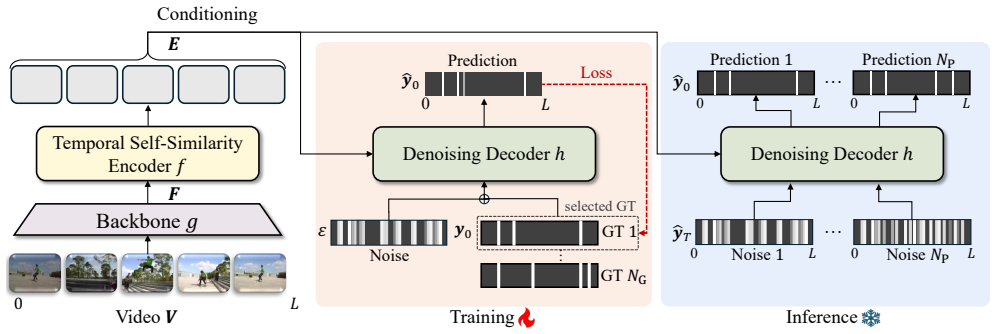
The load-bearing mechanism is a conditional denoising decoder $h(y_t, t, E)$ that predicts clean boundary labels $y_0$ from noisy labels $y_t$, conditioned on temporal self-similarity embeddings $E$. The encoder builds $E$ through a sliding-window temporal self-similarity module, which highlights changes between adjacent frames; the decoder is a Transformer encoder layer with a scale-and-shift injection of the diffusion time step. At inference the decoder follows DDIM steps from random Gaussian noise $\hat{y}_T$ to $\hat{y}_0$, so different starting noises yield different candidate boundary sets. Diversity control comes from classifier-free guidance: the model is trained both with and without $E$, and inference combines the two predictions by $\hat{y}_t = (1+w)\hat{y}_t^c - w\hat{y}_t^u$, so a small $w$ produces spread-out samples and a large $w$ produces near-deterministic ones. The paper's evaluation machinery is equally central: the symmetric F1 score is the harmonic mean of $\mathrm{F1}_{p2g}$ and $\mathrm{F1}_{g2p}$, measuring how well predictions cover annotations and annotations cover predictions, while the diversity score averages pairwise $1-\mathrm{F1}$ over the generated set.
What would settle it
Train the strongest deterministic baseline from Table 1 five times with different random seeds, feed its five outputs into the paper's symmetric-F1 and diversity metrics, and check whether those outputs already reach DiffGEBD's reported diversity of 20.4 at F1sym 74.0; if they do, the claimed generative advantage in diversity is not established.
Extended reading notes
Core claim
The central claim is that the mapping from a video to its event boundaries is a distribution, not a single answer, and that this distribution can be learned and sampled by a conditional denoising diffusion model. From the video, a backbone extracts visual features; a temporal self-similarity encoder turns them into conditioning embeddings that highlight changes between adjacent frames; a Transformer-based decoder iteratively denoises random Gaussian noise into a binary boundary label sequence. Different initial noises produce different boundary sets from the same trained model, and classifier-free guidance with weight $w$ interpolates between diverse samples and strongly conditioned, faithful ones. The paper also claims that the standard F1 protocol is inadequate for such a generative model, and proposes symmetric F1—the harmonic mean of prediction-to-ground-truth F1 and ground-truth-to-prediction F1—plus a pairwise diversity score. On Kinetics-GEBD and TAPOS it reports the best or comparable fidelity among compared methods while producing measurably more diverse predictions.
Load-bearing premise
The load-bearing premise is that five boundary sets sampled from one DiffGEBD model are the same kind of quantity as five boundary sets obtained by training a deterministic baseline five times with different random seeds, so that the reported diversity and symmetric-F1 comparison is fair.
Editorial extensions
If this is right
- A single DiffGEBD model can replace multiple training runs of a deterministic detector when multiple plausible boundary sets are needed: at CFG weight $0.6$ it reports F1sym $74.0$, F1g2p $72.9$, and diversity $20.4$ on Kinetics-GEBD, the best among the compared methods.
- The same model can be switched to a high-fidelity mode by raising the guidance weight: at $w=4.0$ it reaches F1@0.05 of $78.4$ on Kinetics-GEBD and $65.8$ on TAPOS, the best reported on TAPOS.
- Temporal self-similarity conditioning carries the boundary signal: replacing $E$ with raw visual features drops F1sym from $74.0$ to $68.5$.
- Diffusion steps behave as an accuracy knob: F1sym and diversity both improve up to 32 DDIM steps and then plateau, so the generative gain does not require full 50-step sampling.
- The new metrics offer a template for other tasks with multiple human annotations, where a set of predictions must be compared with a set of ground truths rather than with a single label.
Reading between the lines
- A fairer reading of the Table 1 comparison would test whether seed-varied deterministic retraining is the right reference distribution for a generative model's within-model samples; the paper does not justify that equivalence.
- The same recipe could transfer to other structured video outputs with subjective annotations, such as temporal action segmentation, if the conditioning carried class information and the diversity metric were made class-aware.
- A practical extension not explored here is per-video guidance: a user could request one confident segmentation (high $w$) or many exploratory segmentations (low $w$) from the same checkpoint without retraining.
- The annotation-reliability experiment suggests that filtering or reweighting human annotations by consistency during diffusion conditioning could improve fidelity further, since including all five annotators lowers F1sym even as diversity keeps rising.
Signed reviews
Editorial analysis
A structured set of objections, weighed in public.
Referee Report
Summary. The paper proposes DiffGEBD, a diffusion-based model for generic event boundary detection (GEBD). The model uses a temporal self-similarity encoder to extract conditioning features and a denoising decoder that iteratively refines random noise into boundary predictions, with classifier-free guidance (CFG) to control the diversity of the generated boundary sets. The authors also introduce a diversity-aware evaluation protocol with two metrics: symmetric F1, which combines Pred-to-GT (F1p2g) and GT-to-Pred (F1g2p) alignment scores, and a diversity score measuring average pairwise dissimilarity among predictions. Experiments on Kinetics-GEBD and TAPOS show that DiffGEBD achieves the best F1sym, F1g2p, and diversity among compared methods on Kinetics-GEBD in the diversity-aware protocol, and the best F1@0.05 on TAPOS in the conventional protocol. The paper includes ablations on CFG weight, number of annotations, inference steps, conditioning features, and diffusion samplers, together with supplementary results including generalized energy distance and threshold robustness.
Significance. The generative formulation of GEBD is novel and addresses a real limitation of prior deterministic methods, and the proposed diversity-aware metrics (symmetric F1 and diversity score) fill a gap in how stochastic predictors are evaluated for tasks with subjective annotations. The paper also provides reproduced baselines, an efficiency comparison, and a broad set of ablations, which are useful for the community. If the evaluation protocol is accepted, the reported results would demonstrate a meaningful advance. However, the headline comparisons rest on an asymmetric protocol that may bias the diversity-aware claims, and the absence of uncertainty estimates weakens the support for state-of-the-art statements.
major comments (4)
- [Sec. 5.4, Table 1] The diversity-aware comparison in Table 1 compares five predictions sampled from a single DiffGEBD model with five predictions obtained by training each deterministic baseline five times with different random seeds. These two protocols draw from different distributions: seed-varied training spans optimization uncertainty, which can be arbitrarily small if training is stable, whereas diffusion sampling with w=0.6 draws from a deliberately regularized generative distribution. Consequently, the claimed state-of-the-art margins in F1sym (74.0 vs 72.9) and diversity (20.4 vs 18.9) may be artifacts of the baseline protocol rather than evidence that DiffGEBD better covers the space of human annotations. The authors should justify this protocol explicitly, add an alternative way of obtaining multiple predictions from deterministic baselines (e.g., test-time dropout, varied thresholds, or multiple checkpoints), or temper the state-of-the-art claim.
- [All results tables (Tables 1, 4, S6-S8)] No uncertainty intervals are reported anywhere in the paper: all tables give single F1 or diversity values, and the five-seed baselines are summarized only by means. Without per-seed ranges or confidence intervals, it is impossible to tell whether the reported margins (e.g., F1sym 74.0 vs 72.9, diversity 20.4 vs 18.9) exceed the seed-induced or sampling-induced variance. For a paper whose main contribution is an evaluation protocol, reporting the spread of the metrics (across the five predictions for DiffGEBD and across the five seeds for the baselines) should be a requirement.
- [Supplementary Alg. 1] Algorithm 1 in the supplementary material computes a corrupted label y_crpt but then calls the decoder as h(y_0, E, t), i.e., it passes the clean ground-truth label instead of the noisy label y_t. This contradicts Sec. 4.2 and Eq. (9), which state that the decoder input is y_t. As written, the diffusion time-step conditioning is vacuous and the training procedure cannot be reproduced from the pseudo-code. The algorithm should be corrected to pass y_crpt to the decoder, or the main-text equations should be amended accordingly.
- [Sec. 3, Eqs. (1) and (3)] The forward process definition in Eq. (1), q(xt|xt-1) = N(xt; sqrt(alpha_t) x_{t-1}, alpha_t I), uses a variance of alpha_t I, which is inconsistent with the standard DDPM variance of (1 - alpha_t) I. In Eq. (3), the subscript 0 is used instead of t in the cumulative product coefficient, and the expression has misplaced parentheses around the mean term. These appear to be typographical errors, but because the forward process is foundational to the method, they should be corrected for clarity and precision.
minor comments (5)
- [Sec. 5.1] The sentence 'We employ the BasicGEBD-L4 encoder [60] and a 6-layer Transformer [47] for our encoder f and decoder h, .' contains a stray comma and incomplete clause; the sentence should end cleanly.
- [Supplementary Alg. 2] Algorithm 2 uses 'linespace' instead of 'linspace' in the time-step scheduling line.
- [Table S1] The entry 'cV AE' should be formatted consistently, e.g., as 'cVAE' or 'VQ-VAE', and the model should be named completely the first time it appears.
- [Sec. 5.4] The name 'EfficentGEBD' is misspelled in the discussion paragraph after Table 1; it should be 'EfficientGEBD'.
- [Sec. 5.1 and Fig. 5 caption] Please clarify whether the selection of the top-NG annotations by F1 consistency score is performed per video or globally across the training set, and whether the evaluation at inference time uses all five ground-truth annotations.
Circularity Check
No significant circularity: DiffGEBD's predictions are evaluated with externally defined metrics on fixed benchmarks, and the reported results do not reduce to the paper's own inputs or fitted parameters.
full rationale
The paper's central derivation is self-contained. DiffGEBD's predictions are produced by a standard DDPM/DDIM pipeline (Eqs. 4, 6, and 12) trained with mean-squared-error loss (Eq. 10) on ground-truth boundary labels, and its claimed performance is measured against fixed external benchmarks (Kinetics-GEBD and TAPOS) using metrics defined directly from prediction-to-ground-truth boundary alignments and pairwise prediction dissimilarity. The proposed symmetric F1 and diversity scores are formal functions of boundary sets; they do not embed any DiffGEBD parameter or fitted value. The CFG weight w is swept and reported in Fig. 4 and Table S7; selecting an operating point on the validation set is standard model selection, not a fitted parameter renamed as a prediction. The conventional F1@0.05 comparisons in Table 4 use independently published or reproduced baselines, and Table S6 confirms that the reproduced conventional numbers match the reported values, so the benchmark comparisons are not self-referential. The five-seed protocol for deterministic baselines in Sec. 5.4 is a debatable fairness choice, but it does not make any claimed result equivalent to the paper's own inputs by construction. There is also no load-bearing self-citation chain: the cited prior work on diffusion, classifier-free guidance, and temporal self-similarity encoders is external and is not used to assert the authors' own result as a consequence of a self-citation. Therefore no circular step is identified.
Assumptions & free parameters
free parameters (4)
- Classifier-free guidance weight w =
w = 0.6 for diversity-aware evaluation; w = 4.0 for conventional evaluation
- Boundary threshold delta =
0.5 (Kinetics-GEBD), 0.3 (TAPOS)
- Number of diffusion inference steps =
32
- CFG conditioning drop probability p =
0.1
assumptions (6)
- domain assumption Human event-boundary subjectivity can be modeled as stochastic variation in a conditional generative model, with the degree of variation controlled by classifier-free guidance.
- domain assumption Temporal self-similarity features E are a sufficient conditioning signal for event boundary prediction.
- domain assumption The relative-distance F1 score is a valid pairwise similarity measure for boundary sets, used both for conventional evaluation and inside the new diversity score.
- domain assumption Five random-seed training runs of deterministic baselines provide a fair distribution of predictions for comparison with five stochastic samples from one model.
- domain assumption The F1 consistency score is a valid measure of annotation reliability for selecting training annotations.
- standard math Standard DDPM forward and DDIM reverse process equations hold as background for training and inference.
Cite this review
Pith. "Pith review of Generic Event Boundary Detection via Denoising Diffusion." pith.science (2026). https://pith.science/paper/4X4HG755
@misc{pith2026250812084,
  author       = {Pith},
  title        = {Pith review of: Generic Event Boundary Detection via Denoising Diffusion},
  year         = {2026},
  howpublished = {\url{https://pith.science/paper/4X4HG755}},
  note         = {Machine review of arXiv:2508.12084}
}
read the original abstract
Generic event boundary detection (GEBD) aims to identify natural boundaries in a video, segmenting it into distinct and meaningful chunks. Despite the inherent subjectivity of event boundaries, previous methods have focused on deterministic predictions, overlooking the diversity of plausible solutions. In this paper, we introduce a novel diffusion-based boundary detection model, dubbed DiffGEBD, that tackles the problem of GEBD from a generative perspective. The proposed model encodes relevant changes across adjacent frames via temporal self-similarity and then iteratively decodes random noise into plausible event boundaries being conditioned on the encoded features. Classifier-free guidance allows the degree of diversity to be controlled in denoising diffusion. In addition, we introduce a new evaluation metric to assess the quality of predictions considering both diversity and fidelity. Experiments show that our method achieves strong performance on two standard benchmarks, Kinetics-GEBD and TAPOS, generating diverse and plausible event boundaries.
Figures


Figures from the paper (3 more)


Reference graph
Works this paper leans on
-
[1]
Uncertainty-aware antic- ipation of activities
Yazan Abu Farha and Juergen Gall. Uncertainty-aware antic- ipation of activities. In Proceedings of the IEEE/CVF Inter- national Conference on Computer Vision Workshops, pages 0–0, 2019. 2
work page 2019
-
[2]
Segdiff: Image segmentation with diffusion proba- bilistic models
Tomer Amit, Tal Shaharbany, Eliya Nachmani, and Lior Wolf. Segdiff: Image segmentation with diffusion proba- bilistic models. arXiv preprint arXiv:2112.00390, 2021. 2
arXiv 2021
-
[3]
Vivit: A video vision transformer
Anurag Arnab, Mostafa Dehghani, Georg Heigold, Chen Sun, Mario Lu ˇci´c, and Cordelia Schmid. Vivit: A video vision transformer. In Proceedings of the IEEE/CVF inter- national conference on computer vision , pages 6836–6846,
-
[4]
The cramer distance as a solution to biased wasser- stein gradients
Marc G Bellemare, Ivo Danihelka, Will Dabney, Shakir Mo- hamed, Balaji Lakshminarayanan, Stephan Hoyer, and R´emi Munos. The cramer distance as a solution to biased wasser- stein gradients. arXiv preprint arXiv:1705.10743, 2017. 2, 13
arXiv 2017
-
[5]
Quo vadis, action recognition? a new model and the kinetics dataset
Joao Carreira and Andrew Zisserman. Quo vadis, action recognition? a new model and the kinetics dataset. In pro- ceedings of the IEEE Conference on Computer Vision and Pattern Recognition, pages 6299–6308, 2017. 1
2017
-
[6]
Dif- fusiondet: Diffusion model for object detection
Shoufa Chen, Peize Sun, Yibing Song, and Ping Luo. Dif- fusiondet: Diffusion model for object detection. In Proceed- ings of the IEEE/CVF International Conference on Com- puter Vision, pages 19830–19843, 2023. 2
work page 2023
-
[7]
ImageNet: a large-scale hierarchical image database
Jia Deng, Wei Dong, Richard Socher, Li-Jia Li, Kai Li, and Li Fei-Fei. ImageNet: a large-scale hierarchical image database. In CVPR, 2009. 5, 8
work page 2009
-
[8]
Diffusion models beat gans on image synthesis
Prafulla Dhariwal and Alexander Nichol. Diffusion models beat gans on image synthesis. Advances in neural informa- tion processing systems, 34:8780–8794, 2021. 2
2021
Show all 67 references
-
[9]
Tempo- ral action segmentation: An analysis of modern techniques
Guodong Ding, Fadime Sener, and Angela Yao. Tempo- ral action segmentation: An analysis of modern techniques. IEEE Transactions on Pattern Analysis and Machine Intelli- gence, 2023. 1
2023
-
[10]
Weakly-supervised action seg- mentation with iterative soft boundary assignment
Li Ding and Chenliang Xu. Weakly-supervised action seg- mentation with iterative soft boundary assignment. In Pro- ceedings of the IEEE conference on computer vision and pat- tern recognition, pages 6508–6516, 2018. 7, 16
2018
-
[11]
Ms-tcn: Multi-stage tem- poral convolutional network for action segmentation
Yazan Abu Farha and Jurgen Gall. Ms-tcn: Multi-stage tem- poral convolutional network for action segmentation. InPro- ceedings of the IEEE/CVF conference on computer vision and pattern recognition, pages 3575–3584, 2019. 1
2019
-
[12]
Action detection via an image diffusion process
Lin Geng Foo, Tianjiao Li, Hossein Rahmani, and Jun Liu. Action detection via an image diffusion process. InProceed- ings of the IEEE/CVF Conference on Computer Vision and Pattern Recognition, pages 18351–18361, 2024. 2
2024
-
[13]
Deep residual learning for image recognition
Kaiming He, Xiangyu Zhang, Shaoqing Ren, and Jian Sun. Deep residual learning for image recognition. In Proceed- ings of the IEEE conference on computer vision and pattern recognition, pages 770–778, 2016. 8
2016
-
[14]
Deep residual learning for image recognition
Kaiming He, Xiangyu Zhang, Shaoqing Ren, and Jian Sun. Deep residual learning for image recognition. In CVPR,
-
[15]
Classifier-free diffusion guidance
Jonathan Ho and Tim Salimans. Classifier-free diffusion guidance. In NeurIPS 2021 Workshop on Deep Generative Models and Downstream Applications, 2021. 2, 4, 6
2021
-
[16]
Denoising dif- fusion probabilistic models
Jonathan Ho, Ajay Jain, and Pieter Abbeel. Denoising dif- fusion probabilistic models. Advances in neural information processing systems, 33:6840–6851, 2020. 2, 4
2020
-
[17]
Con- nectionist temporal modeling for weakly supervised action labeling
De-An Huang, Li Fei-Fei, and Juan Carlos Niebles. Con- nectionist temporal modeling for weakly supervised action labeling. In Computer Vision–ECCV 2016: 14th European Conference, Amsterdam, The Netherlands, October 11–14, 2016, Proceedings, Part IV 14 , pages 137–153. Springer,
2016
-
[18]
Equilibrium free-energy differences from nonequilibrium measurements: A master-equation ap- proach
Christopher Jarzynski. Equilibrium free-energy differences from nonequilibrium measurements: A master-equation ap- proach. Physical Review E, 56(5):5018, 1997. 2
1997
-
[19]
Coarse-fine net- works for temporal activity detection in videos
Kumara Kahatapitiya and Michael S Ryoo. Coarse-fine net- works for temporal activity detection in videos. In Proceed- ings of the IEEE/CVF Conference on Computer Vision and Pattern Recognition, pages 8385–8394, 2021. 1
2021
-
[20]
Uboco: Unsupervised boundary contrastive learning for generic event boundary detection
Hyolim Kang, Jinwoo Kim, Taehyun Kim, and Seon Joo Kim. Uboco: Unsupervised boundary contrastive learning for generic event boundary detection. In Proceedings of the IEEE/CVF Conference on Computer Vision and Pattern Recognition, pages 20073–20082, 2022. 1, 2, 7, 16
2022
-
[21]
The kinetics hu- man action video dataset
Will Kay, Joao Carreira, Karen Simonyan, Brian Zhang, Chloe Hillier, Sudheendra Vijayanarasimhan, Fabio Viola, Tim Green, Trevor Back, Paul Natsev, et al. The kinetics hu- man action video dataset. arXiv preprint arXiv:1705.06950,
-
[22]
A probabilistic u-net for segmentation of ambiguous im- ages
Simon Kohl, Bernardino Romera-Paredes, Clemens Meyer, Jeffrey De Fauw, Joseph R Ledsam, Klaus Maier-Hein, SM Eslami, Danilo Jimenez Rezende, and Olaf Ronneberger. A probabilistic u-net for segmentation of ambiguous im- ages. Advances in neural information processing systems , ...
2018
-
[23]
Segmental spatiotemporal cnns for fine-grained action seg- mentation
Colin Lea, Austin Reiter, Ren ´e Vidal, and Gregory D Hager. Segmental spatiotemporal cnns for fine-grained action seg- mentation. In Computer Vision–ECCV 2016: 14th European Conference, Amsterdam, The Netherlands, October 11-14, 2016, Proceedings, Part III 14, pages 36–52. Sp...
2016
-
[24]
Structured con- text transformer for generic event boundary detection
Congcong Li, Xinyao Wang, Dexiang Hong, Yufei Wang, Libo Zhang, Tiejian Luo, and Longyin Wen. Structured con- text transformer for generic event boundary detection. arXiv preprint arXiv:2206.02985, 2022. 2, 5, 6, 7, 13, 14, 16
2022 arXiv
-
[25]
End-to-end compressed video 9 representation learning for generic event boundary detection
Congcong Li, Xinyao Wang, Longyin Wen, Dexiang Hong, Tiejian Luo, and Libo Zhang. End-to-end compressed video 9 representation learning for generic event boundary detection. In Proceedings of the IEEE/CVF Conference on Computer Vision and Pattern Recognition, pages 13967–13976...
2022
-
[26]
Bmn: Boundary-matching network for temporal action pro- posal generation
Tianwei Lin, Xiao Liu, Xin Li, Errui Ding, and Shilei Wen. Bmn: Boundary-matching network for temporal action pro- posal generation. In Proceedings of the IEEE/CVF Interna- tional Conference on Computer Vision (ICCV) , 2019. 1, 7, 16
2019
-
[27]
Flow matching for genera- tive modeling
Yaron Lipman, Ricky TQ Chen, Heli Ben-Hamu, Maxim- ilian Nickel, and Matthew Le. Flow matching for genera- tive modeling. In The Eleventh International Conference on Learning Representations. 13, 15
-
[28]
Diffusion action segmenta- tion
Daochang Liu, Qiyue Li, Anh-Dung Dinh, Tingting Jiang, Mubarak Shah, and Chang Xu. Diffusion action segmenta- tion. In Proceedings of the IEEE/CVF International Con- ference on Computer Vision, pages 10139–10149, 2023. 1, 2
2023
-
[29]
Dpm-solver++: Fast solver for guided sam- pling of diffusion probabilistic models.Machine Intelligence Research, pages 1–22, 2025
Cheng Lu, Yuhao Zhou, Fan Bao, Jianfei Chen, Chongxuan Li, and Jun Zhu. Dpm-solver++: Fast solver for guided sam- pling of diffusion probabilistic models.Machine Intelligence Research, pages 1–22, 2025. 13
2025
-
[30]
Glide: Towards photorealis- tic image generation and editing with text-guided diffusion models
Alexander Quinn Nichol, Prafulla Dhariwal, Aditya Ramesh, Pranav Shyam, Pamela Mishkin, Bob Mcgrew, Ilya Sutskever, and Mark Chen. Glide: Towards photorealis- tic image generation and editing with text-guided diffusion models. In International Conference on Machine Learning, p...
2022
-
[31]
Film: Visual reasoning with a general conditioning layer
Ethan Perez, Florian Strub, Harm De Vries, Vincent Du- moulin, and Aaron Courville. Film: Visual reasoning with a general conditioning layer. In Proceedings of the AAAI con- ference on artificial intelligence, 2018. 4, 5
2018
-
[32]
Ambiguous medical image segmentation using diffusion models
Aimon Rahman, Jeya Maria Jose Valanarasu, Ilker Haci- haliloglu, and Vishal M Patel. Ambiguous medical image segmentation using diffusion models. In Proceedings of the IEEE/CVF conference on computer vision and pattern recognition, pages 11536–11546, 2023. 2
2023
-
[33]
Hierarchical text-conditional image gener- ation with clip latents
Aditya Ramesh, Prafulla Dhariwal, Alex Nichol, Casey Chu, and Mark Chen. Hierarchical text-conditional image gener- ation with clip latents. arXiv preprint arXiv:2204.06125, 1 (2):3, 2022. 2
2022 arXiv
-
[34]
High-resolution image synthesis with latent diffusion models
Robin Rombach, Andreas Blattmann, Dominik Lorenz, Patrick Esser, and Bj ¨orn Ommer. High-resolution image synthesis with latent diffusion models. In Proceedings of the IEEE/CVF conference on computer vision and pattern recognition, pages 10684–10695, 2022. 2
2022
-
[35]
Improving gans using optimal transport
Tim Salimans, Han Zhang, Alec Radford, and Dimitris Metaxas. Improving gans using optimal transport. arXiv preprint arXiv:1803.05573, 2018. 2, 13
2018 arXiv
-
[36]
Intra-and inter-action understanding via temporal action parsing
Dian Shao, Yue Zhao, Bo Dai, and Dahua Lin. Intra-and inter-action understanding via temporal action parsing. In Proceedings of the IEEE/CVF Conference on Computer Vi- sion and Pattern Recognition , pages 730–739, 2020. 5, 7, 12, 13, 16
2020
-
[37]
Generic event boundary de- tection: A benchmark for event segmentation
Mike Zheng Shou, Stan Weixian Lei, Weiyao Wang, Deepti Ghadiyaram, and Matt Feiszli. Generic event boundary de- tection: A benchmark for event segmentation. In Proceed- ings of the IEEE/CVF international conference on computer vision, pages 8075–8084, 2021. 1, 2, 5, 6, 7, 12, 13, 16
2021
-
[38]
Deep unsupervised learning using nonequilibrium thermodynamics
Jascha Sohl-Dickstein, Eric Weiss, Niru Maheswaranathan, and Surya Ganguli. Deep unsupervised learning using nonequilibrium thermodynamics. In International confer- ence on machine learning, pages 2256–2265. PMLR, 2015. 2
2015
-
[39]
Learning structured output representation using deep conditional gen- erative models
Kihyuk Sohn, Honglak Lee, and Xinchen Yan. Learning structured output representation using deep conditional gen- erative models. In Advances in Neural Information Process- ing Systems. Curran Associates, Inc., 2015. 13
2015
-
[40]
Denois- ing diffusion implicit models
Jiaming Song, Chenlin Meng, and Stefano Ermon. Denois- ing diffusion implicit models. In International Conference on Learning Representations, 2020. 2, 3
2020
-
[41]
Consistency models
Yang Song, Prafulla Dhariwal, Mark Chen, and Ilya Sutskever. Consistency models. In International Conference on Machine Learning, pages 32211–32252. PMLR, 2023. 15
2023
-
[42]
Sz ´ekely and Maria L
G ´abor J. Sz ´ekely and Maria L. Rizzo. Energy statistics: A class of statistics based on distances. Journal of Statistical Planning and Inference, 143(8):1249–1272, 2013. 2, 13
2013
-
[43]
Temporal perceiver: A general architecture for arbitrary boundary detection
Jing Tan, Yuhong Wang, Gangshan Wu, and Limin Wang. Temporal perceiver: A general architecture for arbitrary boundary detection. IEEE Transactions on Pattern Analysis and Machine Intelligence, 2023. 1, 6, 7, 13, 14, 16
2023
-
[44]
Progressive attention on multi-level dense difference maps for generic event boundary detection
Jiaqi Tang, Zhaoyang Liu, Chen Qian, Wayne Wu, and Limin Wang. Progressive attention on multi-level dense difference maps for generic event boundary detection. In Proceedings of the IEEE/CVF Conference on Computer Vision and Pat- tern Recognition, pages 3355–3364, 2022. 1, 2, ...
2022
-
[45]
Learning spatiotemporal features with 3d convolutional networks
Du Tran, Lubomir Bourdev, Rob Fergus, Lorenzo Torresani, and Manohar Paluri. Learning spatiotemporal features with 3d convolutional networks. InProceedings of the IEEE inter- national conference on computer vision , pages 4489–4497,
-
[46]
A closer look at spatiotemporal convolutions for action recognition
Du Tran, Heng Wang, Lorenzo Torresani, Jamie Ray, Yann LeCun, and Manohar Paluri. A closer look at spatiotemporal convolutions for action recognition. In Proceedings of the IEEE conference on Computer Vision and Pattern Recogni- tion, pages 6450–6459, 2018. 1
2018
-
[47]
Attention is all you need
Ashish Vaswani, Noam Shazeer, Niki Parmar, Jakob Uszko- reit, Llion Jones, Aidan N Gomez, Łukasz Kaiser, and Illia Polosukhin. Attention is all you need. In NeurIPS, 2017. 4, 5
2017
-
[48]
Non-local neural networks
Xiaolong Wang, Ross Girshick, Abhinav Gupta, and Kaim- ing He. Non-local neural networks. In Proceedings of the IEEE conference on computer vision and pattern recogni- tion, pages 7794–7803, 2018. 1
2018
-
[49]
Long-term feature banks for detailed video understanding
Chao-Yuan Wu, Christoph Feichtenhofer, Haoqi Fan, Kaim- ing He, Philipp Krahenbuhl, and Ross Girshick. Long-term feature banks for detailed video understanding. In Proceed- ings of the IEEE/CVF Conference on Computer Vision and Pattern Recognition, pages 284–293, 2019. 1
2019
-
[50]
Medsegdiff: Medical image segmentation with diffusion probabilistic model
Junde Wu, Rao Fu, Huihui Fang, Yu Zhang, Yehui Yang, Haoyi Xiong, Huiying Liu, and Yanwu Xu. Medsegdiff: Medical image segmentation with diffusion probabilistic model. In Medical Imaging with Deep Learning , pages 1623–1639. PMLR, 2024. 2 10
2024
-
[51]
G-tad: Sub-graph localization for tempo- ral action detection
Mengmeng Xu, Chen Zhao, David S Rojas, Ali Thabet, and Bernard Ghanem. G-tad: Sub-graph localization for tempo- ral action detection. In Proceedings of the IEEE/CVF con- ference on computer vision and pattern recognition , pages 10156–10165, 2020. 1
2020
-
[52]
As- former: Transformer for action segmentation
Fangqiu Yi, Hongyu Wen, and Tingting Jiang. As- former: Transformer for action segmentation. arXiv preprint arXiv:2110.08568, 2021. 1
2021 arXiv
-
[53]
J. M. Zacks and B. Tversky. Event structure in perception and conception. Psychological Bulletin, 127:3–21, 2001. 1
2001
-
[54]
Gated temporal diffusion for stochastic long-term dense anticipation
Olga Zatsarynna, Emad Bahrami, Yazan Abu Farha, Gian- piero Francesca, and Juergen Gall. Gated temporal diffusion for stochastic long-term dense anticipation. In European Conference on Computer Vision , pages 454–472. Springer,
-
[55]
Graph con- volutional networks for temporal action localization
Runhao Zeng, Wenbing Huang, Mingkui Tan, Yu Rong, Peilin Zhao, Junzhou Huang, and Chuang Gan. Graph con- volutional networks for temporal action localization. In Pro- ceedings of the IEEE/CVF international conference on com- puter vision, pages 7094–7103, 2019. 1
2019
-
[56]
Actionformer: Lo- calizing moments of actions with transformers
Chen-Lin Zhang, Jianxin Wu, and Yin Li. Actionformer: Lo- calizing moments of actions with transformers. In European Conference on Computer Vision , pages 492–510. Springer,
-
[57]
Local compressed video stream learning for generic event boundary detection
Libo Zhang, Xin Gu, Congcong Li, Tiejian Luo, and Heng Fan. Local compressed video stream learning for generic event boundary detection. International Journal of Com- puter Vision, 132(4):1187–1204, 2024. 2, 7, 16
2024
-
[58]
A probabilistic model for controlling diversity and accuracy of ambiguous medical image segmentation
Wei Zhang, Xiaohong Zhang, Sheng Huang, Yuting Lu, and Kun Wang. A probabilistic model for controlling diversity and accuracy of ambiguous medical image segmentation. page 4751–4759, New York, NY , USA, 2022. Association for Computing Machinery. 5
2022
-
[59]
Unipc: A unified predictor-corrector framework for fast sampling of diffusion models
Wenliang Zhao, Lujia Bai, Yongming Rao, Jie Zhou, and Jiwen Lu. Unipc: A unified predictor-corrector framework for fast sampling of diffusion models. Advances in Neural Information Processing Systems, 36:49842–49869, 2023. 13
2023
-
[60]
Rethinking the architecture design for efficient generic event boundary detection
Ziwei Zheng, Zechuan Zhang, Yulin Wang, Shiji Song, Gao Huang, and Le Yang. Rethinking the architecture design for efficient generic event boundary detection. In Proceedings of the 32nd ACM International Conference on Multimedia , pages 1215–1224, 2024. 1, 2, 4, 5, 6, 7, 13, 14, 16
2024
-
[61]
Fine-grained dynamic network for generic event boundary detection
Ziwei Zheng, Lijun He, Le Yang, and Fan Li. Fine-grained dynamic network for generic event boundary detection. In European Conference on Computer Vision, pages 107–123. Springer, 2025. 2, 5, 7, 16
2025
-
[62]
"" V: video [B, T, H, W, 3] T: diffusion time-step y_0: ground-truth boundary labels [B, L, 1] p: CFG probability
Zixin Zhu, Wei Tang, Le Wang, Nanning Zheng, and Gang Hua. Enriching local and global contexts for temporal action localization. In Proceedings of the IEEE/CVF international conference on computer vision, pages 13516–13525, 2021. 1 11 Generic Event Boundary Detection via Denoi...
2021
-
[63]
1 and Alg
Algorithms We present the training and inference algorithms in Alg. 1 and Alg. 2, respectively. During training, both conditional and unconditional models are jointly trained with probabil- ity p, enabling classifier-free guidance. During inference, we iteratively refine the o...
-
[64]
"" V: video [B, T, H, W, 3] T: diffusion time step steps: the number of inference steps w: classifier-free guidance weight
Experimental Details 8.1. Datasets Kinetics-GEBD. Kinetics-GEBD [37] is the largest GEBD dataset, encompassing a wide spectrum of videos. Algorithm 2 DiffGEBD inference algorithm def inference(V, T, steps, w): """ V: video [B, T, H, W, 3] T: diffusion time step steps: the numb...
-
[65]
All experiments were conducted on the Kinetics-GEBD dataset
Additional Experimental Results We present additional experimental results following the same settings as in the main paper. All experiments were conducted on the Kinetics-GEBD dataset. Effect of diffusion process. We evaluate our diffusion- based approach against two primary ...
-
[66]
The model demonstrates robust detection of boundaries with significant scene changes across all guidance weights
More Example Results We provide additional qualitative results in Fig S2. The model demonstrates robust detection of boundaries with significant scene changes across all guidance weights. However, for subtle transitions, such as minor object move- ments observed at 1.70s (S2b)...
-
[67]
While our diffusion-based method effectively generates multiple predictions, its iter- ative process significantly slows down inference
Discussion Limitations and future work. While our diffusion-based method effectively generates multiple predictions, its iter- ative process significantly slows down inference. Future work will address this limitation by adapting methods like Flow Matching [27] and Consistency...
Reviewed August 15, 2026 · model on record in the stance chip above.
Discussion (0). Continue with ORCID to comment.