REVIEW 3 major objections 6 minor 191 references
Simulating Quantum Turbulence with Matrix Product States
T0 review · 3 major / 6 minor · reviewed 2026-08-15 · deepseek-v4-flash
Pith's one-line read A matrix product state solver for the damped Gross-Pitaevskii equation reproduces nonlinear excitations and turbulent statistics with 10x to over 10,000x memory compression.
desk verdict A solid quantics-MPS benchmark for the GP equation with convincing 1D/2D/3D validation, but the flagship reconnection and the 10,000x memory claim rest on self-convergence and unquantified extrapolation rather than a DNS baseline. read the letter →
The pith
A machine-rendered reading of the paper's core claim, the machinery that carries it, and where it could break.
The reading
What carries the argument
The central object is the quantics MPS: a continuous function on a $2^N$ grid is reshaped into an $N$-qubit state whose qubits label binary length scales, then compressed by singular-value truncation. The paper's `staircase` ordering couples the same length scales of different axes and concentrates correlations at the center of the chain, which gives lower truncation error than interleaved or sequential orderings. Time evolution uses a two-site time-dependent variational principle with Strang splitting of the kinetic and nonlinear potential terms, where the nonlinear term is applied through a matrix product operator representing the Hadamard product. Derivatives use eighth-order finite differences built from shift-operator MPOs, and the kinetic term can also be applied via a low-rank quantum Fourier transform MPO. Vortex lines are extracted directly in the compressed representation using MPS sampling and Fourier interpolation, avoiding a costly full contraction. The method's cost is dominated by the $O(N\chi^4)$ Hadamard-product step.
What would settle it
A direct check would be to run the same MPS solver on a 3D turbulent state at a higher vortex line density or for a longer time and compare vortex density decay and the incompressible spectrum with DNS: if the required bond dimension grows faster than the square root of the grid-point count, or if the memory percentage rises steeply with system size at fixed density, the compression claim fails. For the flagship reconnection, comparing Kelvin-wave ring emission times against a DNS on a sufficiently large supercomputer would settle whether the self-convergence tests missed physics.
Extended reading notes
Core claim
The central discovery is that the wavefunction of the damped Gross-Pitaevskii equation, when encoded in a quantics binary length-scale basis, has a strongly decaying correlation structure that a matrix product state can exploit: truncating weak interlength-scale correlations yields accurate dynamics at a fraction of the direct-simulation cost. For single dark solitons, vortex dipoles, and vortex rings, MPS evolutions match DNS with infidelities near or below $10^{-4}$, using as little as 0.4% of the memory for 3D rings. For the flagship 3D vortex-line reconnection in a box of size $L=512\xi$, the method uses 0.03% of DNS memory, about 40 MB per snapshot, and still captures reconnections, Kelvin waves, the Crow instability, and vortex ring cascades. For turbulent states, the maximum bond dimension scales as the square root of the number of grid points, while the memory percentage depends mainly on the soliton or vortex density; the incompressible kinetic energy spectrum, including the $k^{-5/3}$ and $k^{-3}$ regimes, is recovered with modest bond dimensions.
Load-bearing premise
The method's utility rests on the empirical fact that the damped Gross-Pitaevskii wavefunction stays sufficiently low-entangled in the quantics length-scale encoding during turbulent evolution, so truncating virtual bonds at a few hundred retains the physically correct dynamics and statistics.
Editorial extensions
If this is right
- If the central claim holds, 3D quantum turbulence simulations at vortex line densities around $2\times 10^{-5}\,\xi^{-2}$ and $L=512\xi$ need only tens of megabytes per snapshot rather than roughly 128 GB, fitting on a single 40 GB GPU.
- Turbulent statistics such as two-point correlations, vortex density decay, and the incompressible energy spectrum are recoverable at bond dimensions below those needed for pointwise chaotic accuracy, so spectral studies can run even more cheaply.
- The memory percentage depending on excitation density rather than system size implies that larger boxes at fixed density do not erase the compression advantage.
- The same MPS pipeline extends to generalized Ginzburg-Landau models, dipolar and supersolid condensates, and other nonlinear multiscale PDEs.
Reading between the lines
- In my reading, the near-constant memory percentage with system size is the load-bearing extrapolation: if a few percent of DNS memory holds at $2048^3$ grids, previously inaccessible sizes become reachable, but the paper does not derive this density-only dependence from the equations.
- The success at recovering the incompressible spectrum with low bond dimensions suggests a general principle: statistics dominated by topologically protected vortex cores are cheaper to compress than full chaotic fields, which may transfer to other vortex-dominated turbulent systems.
- A natural test is to force the system continuously and check whether the long-time statistically steady state remains low-entangled; the paper demonstrates decaying turbulence, and forced turbulence could generate more compressible sound-wave entanglement.
- Replacing the Hadamard product with tensor cross interpolation would lower the nonlinear step from $O(N\chi^4)$ to $O(N\chi^3)$, which the paper identifies as a bottleneck; if successful, the practical speedup may exceed the memory savings.
Signed reviews
Editorial analysis
A structured set of objections, weighed in public.
Referee Report
Summary. The manuscript presents a quantics matrix product state (MPS) solver for the damped Gross-Pitaevskii equation, using a binary (quantics) encoding of spatial length scales, staircase ordering of qubits, two-site TDVP time evolution with Strang splitting, and MPO representations of finite-difference derivatives. The authors benchmark the solver against DNS and analytic solutions for a 1D dark soliton, a 2D vortex dipole, and a 3D vortex ring, reporting infidelities of order 1e-4 or below. They then apply the method to a 2048^3 vortex-line reconnection in a 512ξ box, to a 1D soliton gas, to 2D vortex turbulence, and to a 3D vortex tangle, reporting that memory usage can be reduced by factors of 10 to more than 10,000 relative to DNS while reproducing vortex densities, correlation functions, and energy spectra above a threshold bond dimension. A scaling analysis in Sec. V A claims that the required bond dimension grows as ~sqrt(L^d) for fixed excitation density while the memory percentage saturates to a density-dependent constant.
Significance. The central methodological claim—that quantics MPS time evolution can efficiently compress the GP wavefunction across the dynamically relevant length scales—is well supported for the benchmarked single-excitation systems. The paper's careful comparison with independent DNS and analytic solutions, with no fitted parameters, gives the 1D/2D/3D excitation results high credibility. The statistical comparisons for turbulence (vortex density decay, two-point correlation functions, and kinetic energy spectra) also provide concrete, falsifiable benchmarks that will be useful to the community. If the 512ξ reconnection and the memory-scaling extrapolation can be validated more strongly, the work would be an important advance for quantum turbulence simulation, enabling system sizes that are currently prohibitive for DNS. The main limitations are that the flagship reconnection lacks an external DNS baseline and that the central 'over 10,000x' memory claim rests on an unquantified extrapolation in Fig. 10.
major comments (3)
- [Sec. IV D, Appendix E, Figs. 6–9 and 25] The >10,000x memory-reduction demonstration rests solely on the 512ξ reconnection, for which the only validation is self-convergence in bond dimension. Because the two runs share the same quantics encoding, finite-difference derivative, Strang splitting, and TDVP manifold projection, mutual agreement cannot exclude a systematic truncation bias in reconnection physics. I request an external validation at a scale accessible to DNS, for example the same four-vortex setup in a smaller periodic domain (e.g., L=64ξ or 128ξ), comparing reconnection time, emitted vortex ring radii, and Kelvin wave dynamics between MPS and split-step DNS. If such a DNS comparison is not feasible, the abstract's 'over 10,000x' claim should be weakened to the cases actually benchmarked against DNS.
- [Sec. V A, Fig. 10(j–l)] The claim that the memory percentage saturates to a constant at fixed excitation density, which is used to extrapolate to the 5760^3 comparison and to support the largest memory-reduction factors, is asserted without derivation and without statistical error bars. The six-state averages in panels (a–c) are not propagated to panels (j–l), and the linear interpolation used to obtain the fixed-density curves is not accompanied by residuals or fit uncertainties. Please add the spread across random initial states, a statistical characterization of the saturation, and either a derivation of the constant-memory scaling or an explicit statement that the extrapolation is conjectural.
- [Appendix E, Fig. 25(b,c)] The relative y-momentum error (≈1e-3) is four orders of magnitude larger than the energy error (≈1e-7), yet the text describes both as showing that the conserved quantities are 'well conserved.' Because momentum conservation is part of the validation of the reconnection simulation, this discrepancy needs an explanation (for example, accumulation of phase error in the finite-difference derivative, truncation of high-frequency components, or a periodic-boundary effect), together with reported conservation of P_x and P_z, before the self-convergence argument can be considered conclusive.
minor comments (6)
- [Sec. III A] There is a typo: 'choosen' should be 'chosen'.
- [Sec. IV B] There are typos: 'anhihiated' should be 'annihilated' and 'anihilation' should be 'annihilation'.
- [Sec. V B 2] The 'Mandelung transformation' should be the 'Madelung transformation.'
- [Sec. IV D vs Appendix E] The main text says the convergence tests confirm that results vary by less than 10^-4 in infidelity when the bond dimension is increased, but Fig. 25(a) reports I≤10^-5 for the largest bond-dimension step; these numbers should be reconciled.
- [Sec. VI] The statement 'memory reduction of 4 orders of magnitude (0.03%)' is arithmetically inconsistent: 0.03% corresponds to about 3.3 orders of magnitude, not 4. The earlier 0.002% figure is closer to 4.3 orders, so the wording should be adjusted to match the actual compression ratio used.
- [Fig. 10] The dashed power-law lines labeled ~sqrt(L), ~L, and ~L^{3/2} would be more informative if the fitted exponents and confidence intervals were reported; this is a presentation issue but would strengthen the scaling claim.
Circularity Check
No circularity found: the MPS method is benchmarked against independent DNS and analytic solutions; the reconnection run uses self-convergence, which is a validation limitation rather than a circular derivation.
full rationale
I walked the derivation chain: the central quantitative claims are the memory ratios (defined arithmetically by Eq. (2) from measured bond dimensions), the benchmark infidelities against DNS (Figs. 3–5, 11–16), and the reproduction of two-point correlations and energy spectra in 2D turbulence (Figs. 12–14). None of these involves fitting a parameter to a subset of data and then predicting that same subset. The soliton test is checked against the analytic Jacobi-elliptic solution (Appendix B1), and the 2D/3D benchmarks are checked against split-step Fourier DNS. The scaling chi_max ~ sqrt(L^d) is presented as an observed trend and traced back to the untruncated SVD bound chi_SVD_max = sqrt(M); this is a consistency statement, not a self-imported constraint. The only self-referential piece is the 512-xi reconnection validation, where the paper states: "Due to the large grid size we employed to model this physics, it is impractical to use DNS... instead of comparing to the respective DNS, alternative convergence criteria are discussed in Appendix E." Appendix E compares MPS runs of different bond dimensions and checks energy/momentum conservation. That is a legitimate numerical convergence check, not an equation that reduces to its own input; it is weaker external evidence than a DNS comparison, but it does not make the memory-reduction or reconnection-topology claims circular. Self-citations (e.g., Gourianov et al. for quantics turbulence) are background and are not load-bearing: the benchmarks here are self-contained against external DNS/analytic references. Overall, no circular step meets the bar of Eq. X = Eq. Y by construction or fitted-input-renamed-as-prediction.
Assumptions & free parameters
assumptions (6)
- domain assumption The damped Gross-Pitaevskii equation is a valid mean-field model for the Bose-Einstein condensate dynamics studied here.
- standard math The quantics binary encoding (Eq. (3)) maps continuous functions to tensors such that bounded interlength-scale correlations imply low bond dimension.
- domain assumption The time-dependent variational principle with Strang splitting converges to the exact GP evolution when bond dimension is sufficient.
- domain assumption A random phase interpolation with imaginary time evolution generates representative turbulent initial states with specified vortex/soliton densities.
- domain assumption The eighth-order finite difference Laplacian in the MPO representation is accurate at the xi/4 grid resolution used.
- domain assumption Truncated bond dimensions introduce errors small enough that statistical quantities of turbulence are preserved, even when pointwise wavefunctions diverge.
Cite this review
Pith. "Pith review of Simulating Quantum Turbulence with Matrix Product States." pith.science (2026). https://pith.science/paper/5ZIMU2VW
@misc{pith2026250812191,
  author       = {Pith},
  title        = {Pith review of: Simulating Quantum Turbulence with Matrix Product States},
  year         = {2026},
  howpublished = {\url{https://pith.science/paper/5ZIMU2VW}},
  note         = {Machine review of arXiv:2508.12191}
}
abstract
Quantum turbulence spans length scales from the system size $L$ to the healing length $\xi$, making direct numerical simulations (DNS) of the Gross-Pitaevskii (GP) equation computationally expensive when $L \gg \xi$. We present a matrix product state (MPS) solver for the GP equation that efficiently compresses the wavefunction by truncating weak interlength-scale correlations. This approach reduces memory usage by factors ranging from 10x to over 10,000x compared to DNS. We benchmark our approach on nonlinear excitations, namely dark solitons (1D) and quantized vortices (2D, 3D), capturing key dynamics such as Kelvin wave propagation and vortex ring emission in the case of vortex line reconnection. For turbulent states composed of multiple nonlinear excitations, we find that the memory compression of the MPS representation is directly proportional to the soliton or vortex densities. We also accurately reproduce established results from two-point correlation functions and energy spectra, where we recover the incompressible kinetic energy spectrum with little memory overhead. These results demonstrate the representative capabilities of the MPS ansatz for quantum turbulence and pave the way for studying this nonequilibrium state using previously-prohibited system sizes to uncover novel physics.
Figures


Figures from the paper (22 more)






Reference graph
Works this paper leans on
-
[1]
Hadamard product Consider an MPS that represents a function using the quantics framework from Sec. III A. The element- wise multiplication operation for this format is called the Hadamard product [51], which is performed using 3-rank delta tensorsδi,j,k that equal 1 fori=j=kand zero oth- erwise. We apply a delta tensor for each physical index in the MPS, ...
-
[2]
shoulder
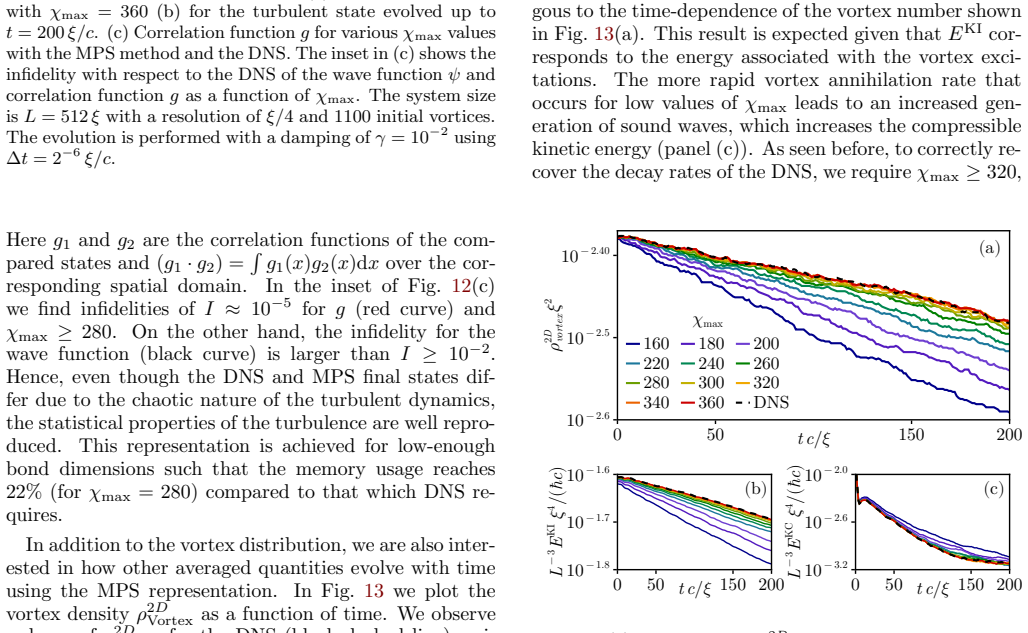
2D Point-vortex distribution We choose a system size ofL= 512ξwith a vortex den- sity ofρ 2D Vortex = 4.2×10 −3ξ−2. We let the state evolve fort= 200ξ/cwithγ= 10 −2. The density profiles of the final states are shown in Fig. 12, for DNS (panel (a)) and MPS withχ max = 360 (panel (b)). Here, we observe similar vortex distributions with small discrepancies....
-
[3]
We consider an initial state with a density ofρ 3D Vortex = 1.1×10 −2ξ−2 in a domain withL= 64ξwith the fixed resolution ξ/4
3D Vortex tangle Finally, we simulate the dynamics of a 3D turbulent system using the MPS time evolution. We consider an initial state with a density ofρ 3D Vortex = 1.1×10 −2ξ−2 in a domain withL= 64ξwith the fixed resolution ξ/4. We evolve the turbulent state untilt= 128ξ/c withγ= 10 −2. We show snapshot samples in Fig. 15 for DNS (upper row) and TDVP (...
-
[4]
To build the latter, we first write 1D 2D 3D Sequential 3 4 4 Staircase 4 4 Interleaved 6 8 TABLE I
Derivatives The derivatives are constructed using an eighth-order finite difference approximation with periodic boundary conditions [160]. To build the latter, we first write 1D 2D 3D Sequential 3 4 4 Staircase 4 4 Interleaved 6 8 TABLE I. Bond dimensionsχof the Laplacian∇ 2 MPO rep- resentation in one to three dimensions using the sequential, staircase, ...
-
[5]
1D Dark soliton Using the exact result from Ref. [98] we build the dark soliton ansatzψ(x) = p ρ(x)eiϕ(x) corresponding to ρ(x) =ρ 1 + (ρ0−ρ 1)cn u x L;k ,k 2 ,(B1) ϕ(x) =vx− Lv 2 +π Π h 1− ρ1 ρ0 ,am u x L;k ,k ,k i Π h 1− ρ1 ρ0 ,k i . (B2) Herecn(x,k) andam(x,k) are the elliptic cosine and Ja- cobi amplitude, Π(n,k) and Π(n;ϕ|k) are the complete and inco...
-
[6]
The vortex dipole is characterized by a dipole lengthd=|r 2−r 1|, andθ j(r) = Angle(r−r j,r 2−r 1) is the angle ofr−r j measured from the directionr 2−r 1
2D V ortex dipole Here, the wave function consists of the composition of an ansatz for each vortex, both with opposite charges, given by ψ(r) =ψ 1(r)·ψ ∗ 2(r)·e i(θ1(x,L)−θ2(x,L)) 2y L,(B5) ψj(r) = s |r−r j|2(a1 +a 2|r−r j|2) 1 +b 1|r−r j|2 +b 2|r−r j|4 eiθj(r),(B6) a1 = 11/32,(B7) a2 =a 1(b1−1/4),(B8) b1 = 5−32a 1 48−192a 1 ,(B9) b2 =a 2,(B10) wherer= (x...
-
[7]
Then, for a given ra- diusRwe definer 1 = (−R,L/2),r 2 = (R,L/2) and r= ( p (x−L/2) 2 + (y−L/2) 2,z), and substitute in 19 FIG
3D V ortex ring The vortex ring is generated by taking the ansatz from Appendix B 2 and rotating it with respect to the axis along which the dipole moves. Then, for a given ra- diusRwe definer 1 = (−R,L/2),r 2 = (R,L/2) and r= ( p (x−L/2) 2 + (y−L/2) 2,z), and substitute in 19 FIG. 20. Initial condition for the vortex ring with periodic boundary condition...
-
[8]
Also, an imaginary time evolution is ap- plied to suppress initial sound waves
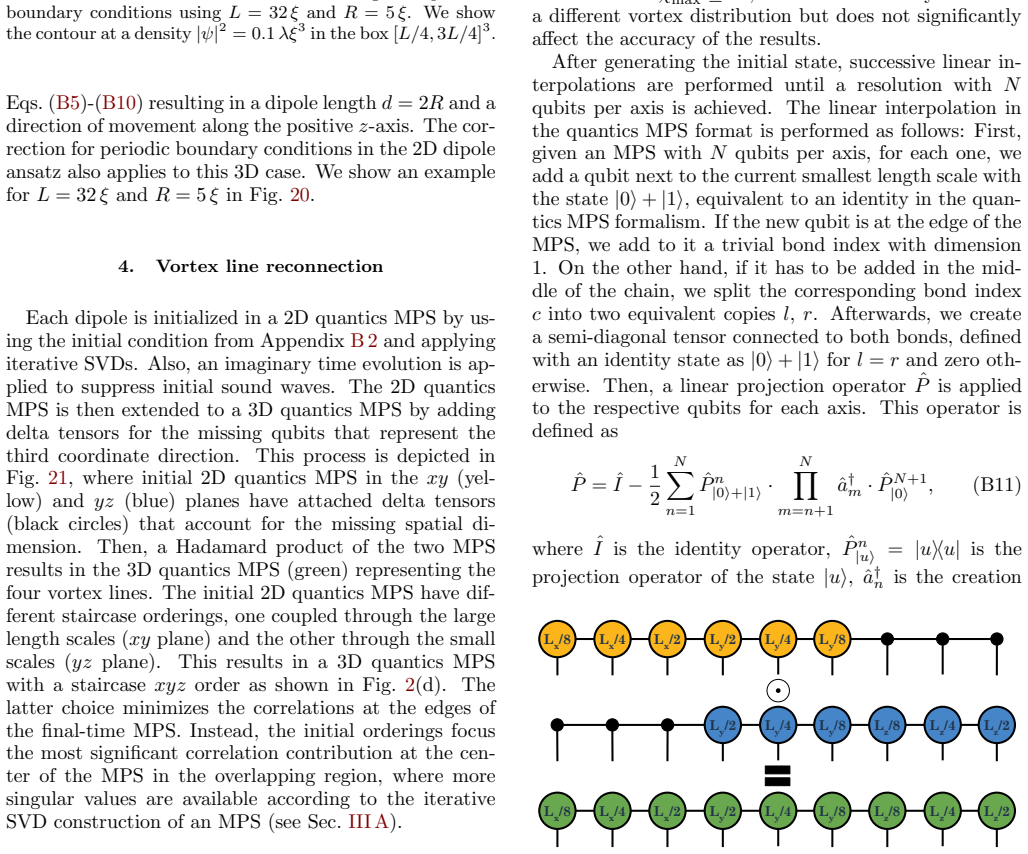
V ortex line reconnection Each dipole is initialized in a 2D quantics MPS by us- ing the initial condition from Appendix B 2 and applying iterative SVDs. Also, an imaginary time evolution is ap- plied to suppress initial sound waves. The 2D quantics MPS is then extended to a 3D quantics MPS by adding delta tensors for the missing qubits that represent the...
Show all 191 references
-
[9]
For the DNS, we sample uniformly from the inter- val [−1,1] for both the real and imaginary components
Random phase interpolation Motivated by Kobayashi,et al.[115], we first create a coarse grid withN RPI < Nqubits per axis, choosing randomly-generated values of the wave function on each point. For the DNS, we sample uniformly from the inter- val [−1,1] for both the real and i...
-
[10]
Afterwards, we create a semi-diagonal tensor connected to both bonds, defined with an identity state as|0⟩+|1⟩forl=rand zero oth- erwise
On the other hand, if it has to be added in the mid- dle of the chain, we split the corresponding bond index cinto two equivalent copiesl,r. Afterwards, we create a semi-diagonal tensor connected to both bonds, defined with an identity state as|0⟩+|1⟩forl=rand zero oth- erwise...
-
[11]
2D V ortex dipole We compare in Fig. 23 the density profiles of a vortex dipole after truncating their MPS representation with the interleaved (a) and staircase (b) orderings, the two possi- bilities considered in this work for 2D. We useχ max = 8. Here we observe that, for th...
-
[12]
23, we focus our anal- ysis on the three-dimensional staircase ordering shown in Fig
3D V ortex ring Motivated by the results in Fig. 23, we focus our anal- ysis on the three-dimensional staircase ordering shown in Fig. 2(d). This MPS ordering has six different pos- sibilities indicated by the various possible permutations of the axes (x,y, orz) across the MPS...
-
[13]
General algorithm To obtain a single vortex line, we follow the next steps:
-
[14]
Choose an initial point in the gridr 0. The advan- tage of the MPS ansatz is that it can be interpreted as a probability distribution of its free index entries, for which efficient sampling algorithms have been developed [157, 169]. In particular, points close to a vortex line...
-
[15]
The first vector (ˆ w0) points in the direction of the pseudovorticityω 0 evaluated at the initial sampled point; this indicates the di- rection of the vortex line
Define a set of orthonormal vectors at the initial sampled pointr 0. The first vector (ˆ w0) points in the direction of the pseudovorticityω 0 evaluated at the initial sampled point; this indicates the di- rection of the vortex line. The other two (ˆ u 0,ˆ v0) are arbitrary ve...
-
[16]
∆urn ∆vrn # =− Re ∂(n) u ψn Re ∂(n) v ψn Im ∂(n) u ψn Im ∂(n) v ψn −1
Apply a Newton–Raphson method to find the clos- est zero ofψfrom the initial sampled pointr 0 in the plane perpendicular to the vortex line. The vortex core estimationr n at then-th iteration is obtained according tor n+1 =r n + (∆urn)ˆ un + (∆vrn)ˆ vn, where " ∆urn ∆vrn # =− ...
-
[17]
This evolution is performed so that the next sampled point follows the direction of the vortex line given byˆ w n atr n
To find the coordinates of the subsequent point in the vortex line, the following initial point is chosen asr n+1 =r n +ζˆ wn whereζis the resolution of the vortex line. This evolution is performed so that the next sampled point follows the direction of the vortex line given b...
-
[18]
This method is iterated to obtain the complete set of vortex lines
The previous steps are repeated until the lastr n 23 and firstr 0 vortex core positions fullfill|r n−r 0|< ζ, indicating the closing of the vortex line. This method is iterated to obtain the complete set of vortex lines. To avoid double counting, Ref. [106] pro- posed using a ...
-
[19]
F ourier interpolation To efficiently recover the information of the wavefunc- tionψand its derivatives∇ψat an arbitrary positionr n (in then-th iteration of the Newton-Raphson step from Appendix D 1) with subgrid resolution, we use Fourier interpolation [170]. The procedure c...
-
[20]
III B, the largest computational costs scale asO(χ 4) and correspond to the Hadamard products used to cal- culate|ω| 2
Computational cost In analogy to the time evolution method presented in Sec. III B, the largest computational costs scale asO(χ 4) and correspond to the Hadamard products used to cal- culate|ω| 2. Then, the calculation of the MPSsF[ψ] and F[∇ψ] each scales asO(χ 3) and only ha...
-
[21]
Lamporesi, S
G. Lamporesi, S. Donadello, S. Serafini, F. Dalfovo, and G. Ferrari, Spontaneous creation of Kibble–Zurek soli- tons in a Bose–Einstein condensate, Nat. Phys.9, 656 (2013)
2013
-
[22]
M. H. Anderson, J. R. Ensher, M. R. Matthews, C. E. Wieman, and E. A. Cornell, Observation of Bose- Einstein Condensation in a Dilute Atomic Vapor, Sci- ence269, 198 (1995)
1995
-
[23]
K. B. Davis, M. O. Mewes, M. R. Andrews, N. J. van Druten, D. S. Durfee, D. M. Kurn, and W. Ketterle, Bose-Einstein Condensation in a Gas of Sodium Atoms, Phys. Rev. Lett.75, 3969 (1995)
1995
-
[24]
C. J. Pethick and H. Smith,Bose–Einstein Condensa- tion in Dilute Gases, 2nd ed. (Cambridge University Press, Cambridge, 2008)
2008
-
[25]
M. S. Paoletti and D. P. Lathrop, Quantum Turbulence, Annu. Rev. Condens. Matter Phys.2, 213 (2011)
2011
-
[26]
Madeira, M
L. Madeira, M. A. Caracanhas, F. E. A. dos Santos, and V. S. Bagnato, Quantum Turbulence in Quan- tum Gases, Annu. Rev. Condens. Matter Phys.11, 37 (2020)
2020
-
[27]
N. P. Proukakis, A century of Bose-Einstein condensa- tion, Commun. Phys.8, 264 (2025)
2025
-
[28]
Dalfovo, S
F. Dalfovo, S. Giorgini, L. P. Pitaevskii, and S. Stringari, Theory of Bose-Einstein condensation in trapped gases, Rev. Mod. Phys.71, 463 (1999)
1999
-
[29]
Bloch, J
I. Bloch, J. Dalibard, and W. Zwerger, Many-body physics with ultracold gases, Rev. Mod. Phys.80, 885 (2008)
2008
-
[30]
Bloch, J
I. Bloch, J. Dalibard, and S. Nascimb` ene, Quantum sim- ulations with ultracold quantum gases, Nat. Phys.8, 267 (2012)
2012
-
[31]
Est` eve, C
J. Est` eve, C. Gross, A. Weller, S. Giovanazzi, and M. K. Oberthaler, Squeezing and entanglement in a Bose– Einstein condensate, Nature455, 1216 (2008)
2008
-
[32]
T. V. Ngo, D. V. Tsarev, R.-K. Lee, and A. P. Alod- 25 jants, Bose–Einstein condensate soliton qubit states for metrological applications, Sci. Rep.11, 19363 (2021)
2021
-
[33]
T.-W. Mao, Q. Liu, X.-W. Li, J.-H. Cao, F. Chen, W.- X. Xu, M. K. Tey, Y.-X. Huang, and L. You, Quantum- enhanced sensing by echoing spin-nematic squeezing in atomic Bose–Einstein condensate, Nat. Phys.19, 1585 (2023)
2023
-
[34]
O. J. Wales, A. Rakonjac, T. P. Billam, J. L. Helm, S. A. Gardiner, and S. L. Cornish, Splitting and recombina- tion of bright-solitary-matter waves, Commun. Phys.3, 51 (2020)
2020
-
[35]
C. L. Grimshaw, T. P. Billam, and S. A. Gardiner, Soli- ton Interferometry with Very Narrow Barriers Obtained from Spatially Dependent Dressed States, Phys. Rev. Lett.129, 040401 (2022)
2022
-
[36]
Bennemann and J
K.-H. Bennemann and J. B. Ketterson,Novel Superflu- ids: Volume 1(Oxford University Press, 2013)
2013
-
[37]
Bennemann and J
K.-H. Bennemann and J. B. Ketterson, eds.,Novel Su- perfluids: Volume 2(Oxford University Press, 2014)
2014
-
[38]
S. O. Demokritov, V. E. Demidov, O. Dzyapko, G. A. Melkov, A. A. Serga, B. Hillebrands, and A. N. Slavin, Bose–Einstein condensation of quasi-equilibrium magnons at room temperature under pumping, Nature 443, 430 (2006)
2006
-
[39]
Klaers, J
J. Klaers, J. Schmitt, F. Vewinger, and M. Weitz, Bose– Einstein condensation of photons in an optical micro- cavity, Nature468, 545 (2010)
2010
-
[40]
(b,c) Relative change in energyE(b) and linear momentum in theydirectionP y (c) with respect to the initial valuesE 0 andP y0, respectively
The dashed line indicatesI= 10 −5. (b,c) Relative change in energyE(b) and linear momentum in theydirectionP y (c) with respect to the initial valuesE 0 andP y0, respectively. Both (b,c) have the same color coding. Appendix E: Convergence of vortex reconnection simulation To a...
-
[41]
Altfeder, A
I. Altfeder, A. A. Voevodin, M. H. Check, S. M. Eich- feld, J. A. Robinson, and A. V. Balatsky, Scanning Tun- neling Microscopy Observation of Phonon Condensate, Sci. Rep.7, 43214 (2017)
2017
-
[42]
Bigagli, W
N. Bigagli, W. Yuan, S. Zhang, B. Bulatovic, T. Kar- man, I. Stevenson, and S. Will, Observation of Bose– Einstein condensation of dipolar molecules, Nature631, 289 (2024)
2024
-
[43]
C.-R. Yi, S. Liu, R.-H. Jiao, J.-Y. Zhang, Y.-S. Zhang, and S. Chen, Exploring Inhomogeneous Kibble-Zurek Mechanism in a Spin-Orbit Coupled Bose-Einstein Con- densate, Phys. Rev. Lett.125, 260603 (2020)
2020
-
[44]
D. M. Stamper-Kurn and M. Ueda, Spinor Bose gases: Symmetries, magnetism, and quantum dynamics, Rev. Mod. Phys.85, 1191 (2013)
2013
-
[45]
A. C. White, B. P. Anderson, and V. S. Bagnato, Vor- tices and turbulence in trapped atomic condensates, Proc. Natl. Acad. Sci. U.S.A.111, 4719 (2014)
2014
-
[46]
Navon, A
N. Navon, A. L. Gaunt, R. P. Smith, and Z. Hadzibabic, Emergence of a turbulent cascade in a quantum gas, Nature539, 72 (2016)
2016
-
[47]
T. Z. Fischer and A. S. Bradley, Regimes of steady- state turbulence in a quantum fluid, Phys. Rev. A111, 023308 (2025)
2025
-
[48]
Kinoshita, T
T. Kinoshita, T. Wenger, and D. S. Weiss, A quantum Newton’s cradle, Nature440, 900 (2006)
2006
-
[49]
Langen, S
T. Langen, S. Erne, R. Geiger, B. Rauer, T. Schweigler, M. Kuhnert, W. Rohringer, I. E. Mazets, T. Gasenzer, and J. Schmiedmayer, Experimental observation of a generalized Gibbs ensemble, Science348, 207 (2015)
2015
-
[50]
Ruggiero, P
P. Ruggiero, P. Calabrese, B. Doyon, and J. Dubail, Quantum Generalized Hydrodynamics, Phys. Rev. Lett. 124, 140603 (2020)
2020
-
[51]
Bonnemain, B
T. Bonnemain, B. Doyon, and G. El, Generalized hy- drodynamics of the KdV soliton gas, J. Phys. A: Math. Theor.55, 374004 (2022)
2022
-
[52]
Doyon, S
B. Doyon, S. Gopalakrishnan, F. Møller, J. Schmied- mayer, and R. Vasseur, Generalized Hydrodynamics: A Perspective, Phys. Rev. X15, 010501 (2025)
2025
-
[53]
T. W. Neely, A. S. Bradley, E. C. Samson, S. J. Rooney, E. M. Wright, K. J. H. Law, R. Carretero-Gonz´ alez, P. G. Kevrekidis, M. J. Davis, and B. P. Anderson, Characteristics of Two-Dimensional Quantum Turbu- lence in a Compressible Superfluid, Phys. Rev. Lett. 111, 235301 (2013)
2013
-
[54]
S. P. Johnstone, A. J. Groszek, P. T. Starkey, C. J. Billington, T. P. Simula, and K. Helmerson, Evolution of large-scale flow from turbulence in a two-dimensional superfluid, Science364, 1267 (2019)
2019
-
[55]
Gauthier, M
G. Gauthier, M. T. Reeves, X. Yu, A. S. Bradley, M. A. Baker, T. A. Bell, H. Rubinsztein-Dunlop, M. J. Davis, and T. W. Neely, Giant vortex clusters in a two- dimensional quantum fluid, Science364, 1264 (2019)
2019
-
[56]
Ga lka, P
M. Ga lka, P. Christodoulou, M. Gazo, A. Karailiev, N. Dogra, J. Schmitt, and Z. Hadzibabic, Emergence of Isotropy and Dynamic Scaling in 2D Wave Turbu- lence in a Homogeneous Bose Gas, Phys. Rev. Lett.129, 190402 (2022)
2022
-
[57]
M. T. Reeves, K. Goddard-Lee, G. Gauthier, O. R. Stockdale, H. Salman, T. Edmonds, X. Yu, A. S. Bradley, M. Baker, H. Rubinsztein-Dunlop, M. J. Davis, and T. W. Neely, Turbulent Relaxation to Equilibrium in a Two-Dimensional Quantum Vortex Gas, Phys. Rev. X12, 011031 (2022)
2022
-
[58]
Karailiev, M
A. Karailiev, M. Gazo, M. Ga lka, C. Eigen, T. Satoor, and Z. Hadzibabic, Observation of an Inverse Turbulent- Wave Cascade in a Driven Quantum Gas, Phys. Rev. Lett.133, 243402 (2024)
2024
-
[59]
Hadzibabic, P
Z. Hadzibabic, P. Kr¨ uger, M. Cheneau, B. Battelier, and J. Dalibard, Berezinskii–Kosterlitz–Thouless crossover in a trapped atomic gas, Nature441, 1118 (2006)
2006
-
[60]
Sunami, V
S. Sunami, V. P. Singh, D. Garrick, A. Beregi, A. J. Barker, K. Luksch, E. Bentine, L. Mathey, and C. J. Foot, Universal scaling of the dynamic BKT transition in quenched 2D Bose gases, Science382, 443 (2023)
2023
-
[61]
Pitaevskii and S
L. Pitaevskii and S. Stringari,Bose-Einstein Condensa- tion and Superfluidity(Oxford University Press, 2016)
2016
-
[62]
L. M. Pismen,Vortices in Nonlinear Fields: From Liquid Crystals to Superfluids From Non-Equilibrium Patterns to Cosmic Strings(Oxford University Press, 1999)
1999
-
[63]
C. F. Barenghi, H. A. J. Middleton-Spencer, L. Galan- tucci, and N. G. Parker, Types of quantum turbulence, AVS Quantum Sci.5, 025601 (2023)
2023
-
[64]
G. V. Kolmakov, P. V. E. McClintock, and S. V. Nazarenko, Wave turbulence in quantum fluids, Proc. Natl. Acad. Sci. U.S.A.111, 4727 (2014)
2014
-
[65]
C. F. Barenghi, L. Skrbek, and K. R. Sreenivasan, In- troduction to quantum turbulence, Proc. Natl. Acad. Sci. U.S.A.111, 4647 (2014)
2014
-
[66]
Schollw¨ ock, The density-matrix renormalization group in the age of matrix product states, Ann
U. Schollw¨ ock, The density-matrix renormalization group in the age of matrix product states, Ann. Phys. 326, 96 (2011)
2011
-
[67]
Or´ us, A practical introduction to tensor networks: Matrix product states and projected entangled pair states, Ann
R. Or´ us, A practical introduction to tensor networks: Matrix product states and projected entangled pair states, Ann. Phys.349, 117 (2014)
2014
-
[68]
I. V. Oseledets, Approximation of 2d×2 d matrices using 26 tensor decomposition, SIAM J. Matrix Anal. Appl.31, 2130 (2010)
2010
-
[69]
B. N. Khoromskij, O(dlog N)-Quantics Approximation of N-d Tensors in High-Dimensional Numerical Model- ing, Constr. Approx.34, 257 (2011)
2011
-
[70]
I. V. Oseledets, Tensor-Train Decomposition, SIAM J. Sci. Comput.33, 2295 (2011)
2011
-
[71]
Gourianov, M
N. Gourianov, M. Lubasch, S. Dolgov, Q. Y. van den Berg, H. Babaee, P. Givi, M. Kiffner, and D. Jaksch, A quantum-inspired approach to exploit turbulence struc- tures, Nat. Comput. Sci.2, 30 (2022)
2022
-
[72]
Gourianov,Exploiting the Structure of Turbulence with Tensor Networks, Ph.D
N. Gourianov,Exploiting the Structure of Turbulence with Tensor Networks, Ph.D. thesis, University of Ox- ford (2022)
2022
-
[73]
Kornev, S
E. Kornev, S. Dolgov, M. Perelshtein, and A. Melnikov, TetraFEM: Numerical Solution of Partial Differential Equations Using Tensor Train Finite Element Method, Mathematics12, 3277 (2024)
2024
-
[74]
Kiffner and D
M. Kiffner and D. Jaksch, Tensor network reduced or- der models for wall-bounded flows, Phys. Rev. Fluids8, 124101 (2023)
2023
-
[75]
R. D. Peddinti, S. Pisoni, A. Marini, P. Lott, H. Ar- gentieri, E. Tiunov, and L. Aolita, Quantum-inspired framework for computational fluid dynamics, Commun. Phys.7, 1 (2024)
2024
-
[76]
H¨ olscher, P
L. H¨ olscher, P. Rao, L. M¨ uller, J. Klepsch, A. Luckow, T. Stollenwerk, and F. K. Wilhelm, Quantum-inspired fluid simulation of two-dimensional turbulence with GPU acceleration, Phys. Rev. Research7, 013112 (2025)
2025
-
[77]
Gourianov, P
N. Gourianov, P. Givi, D. Jaksch, and S. B. Pope, Ten- sor networks enable the calculation of turbulence prob- ability distributions, Sci. Adv.11, eads5990 (2025)
2025
-
[78]
D. Adak, M. E. Danis, D. P. Truong, K. Ø. Ras- mussen, and B. S. Alexandrov, Tensor Network Space- Time Spectral Collocation Method for Solving the Non- linear Convection Diffusion Equation, J. Sci. Comput. 103, 46 (2025)
2025
-
[79]
Pisoni, R
S. Pisoni, R. D. Peddinti, E. Tiunov, S. E. Guz- man, and L. Aolita, Compression, simulation, and syn- thesis of turbulent flows with tensor trains (2025), arXiv:2506.05477
2025
-
[80]
Arenstein, M
L. Arenstein, M. Mikkelsen, and M. Kastoryano, Fast and Flexible Quantum-Inspired Differential Equation Solvers with Data Integration (2025), arXiv:2505.17046
2025 arXiv
-
[81]
Ye and N
E. Ye and N. F. G. Loureiro, Quantum-inspired method for solving the Vlasov-Poisson equations, Phys. Rev. E 106, 035208 (2022)
2022
-
[82]
Ye and N
E. Ye and N. F. Loureiro, Quantized tensor networks for solving the Vlasov–Maxwell equations, J. Plasma Phys. 90, 805900301 (2024)
2024
-
[83]
Fraschini, V
S. Fraschini, V. Kazeev, and I. Perugia, Sym- plectic QTT-FEM solution of the one-dimensional acoustic wave equation in the time domain (2024), arXiv:2411.11321
2024 arXiv
-
[84]
Lively, V
K. Lively, V. Pagni, and G. Camacho, A Quantum- Inspired Algorithm for Wave Simulation Using Tensor Networks (2025), arXiv:2504.11181
2025
-
[85]
Shinaoka, M
H. Shinaoka, M. Wallerberger, Y. Murakami, K. No- gaki, R. Sakurai, P. Werner, and A. Kauch, Multiscale Space-Time Ansatz for Correlation Functions of Quan- tum Systems Based on Quantics Tensor Trains, Phys. Rev. X13, 021015 (2023)
2023
-
[86]
M. K. Ritter, Y. N´ u˜ nez Fern´ andez, M. Wallerberger, J. von Delft, H. Shinaoka, and X. Waintal, Quantics Tensor Cross Interpolation for High-Resolution Par- simonious Representations of Multivariate Functions, Phys. Rev. Lett.132, 056501 (2024)
2024
-
[87]
Rohshap, M
S. Rohshap, M. K. Ritter, H. Shinaoka, J. von Delft, M. Wallerberger, and A. Kauch, Two-particle calcula- tions with quantics tensor trains: Solving the parquet equations, Phys. Rev. Res.7, 023087 (2025)
2025
-
[88]
Suret, S
P. Suret, S. Randoux, A. Gelash, D. Agafontsev, B. Doyon, and G. El, Soliton gas: Theory, numerics, and experiments, Phys. Rev. E109, 061001 (2024)
2024
-
[89]
M. T. Reeves, B. P. Anderson, and A. S. Bradley, Classi- cal and quantum regimes of two-dimensional turbulence in trapped Bose-Einstein condensates, Phys. Rev. A86, 053621 (2012)
2012
-
[90]
Nowak, J
B. Nowak, J. Schole, D. Sexty, and T. Gasenzer, Non- thermal fixed points, vortex statistics, and superfluid turbulence in an ultracold Bose gas, Phys. Rev. A85, 043627 (2012)
2012
-
[91]
Simula, M
T. Simula, M. J. Davis, and K. Helmerson, Emergence of Order from Turbulence in an Isolated Planar Superfluid, Phys. Rev. Lett.113, 165302 (2014)
2014
-
[92]
Salman and D
H. Salman and D. Maestrini, Long-range ordering of topological excitations in a two-dimensional superfluid far from equilibrium, Phys. Rev. A94, 043642 (2016)
2016
-
[93]
C. Nore, M. Abid, and M. E. Brachet, Decaying Kol- mogorov turbulence in a model of superflow, Phys. Flu- ids9, 2644 (1997)
1997
-
[94]
N. G. Berloff and B. V. Svistunov, Scenario of strongly nonequilibrated Bose-Einstein condensation, Phys. Rev. A66, 013603 (2002)
2002
-
[95]
Nowak, D
B. Nowak, D. Sexty, and T. Gasenzer, Superfluid tur- bulence: Nonthermal fixed point in an ultracold Bose gas, Phys. Rev. B84, 020506 (2011)
2011
-
[96]
S. Choi, S. A. Morgan, and K. Burnett, Phenomenolog- ical damping in trapped atomic Bose-Einstein conden- sates, Phys. Rev. A57, 4057 (1998)
1998
-
[97]
Tsubota, K
M. Tsubota, K. Kasamatsu, and M. Ueda, Vortex lattice formation in a rotating Bose-Einstein condensate, Phys. Rev. A65, 023603 (2002)
2002
-
[98]
A. S. Bradley and B. P. Anderson, Energy Spectra of Vortex Distributions in Two-Dimensional Quantum Turbulence, Phys. Rev. X2, 041001 (2012)
2012
-
[99]
M. T. Reeves, T. P. Billam, B. P. Anderson, and A. S. Bradley, Inverse Energy Cascade in Forced Two- Dimensional Quantum Turbulence, Phys. Rev. Lett. 110, 104501 (2013)
2013
-
[100]
T. P. Billam, M. T. Reeves, B. P. Anderson, and A. S. Bradley, Onsager-Kraichnan Condensation in Decay- ing Two-Dimensional Quantum Turbulence, Phys. Rev. Lett.112, 145301 (2014)
2014
-
[101]
T. P. Billam, M. T. Reeves, and A. S. Bradley, Spec- tral energy transport in two-dimensional quantum vor- tex dynamics, Phys. Rev. A91, 023615 (2015)
2015
-
[102]
A. W. Baggaley and C. F. Barenghi, Decay of homoge- neous two-dimensional quantum turbulence, Phys. Rev. A97, 033601 (2018)
2018
-
[103]
S. J. Rooney, P. B. Blakie, and A. S. Bradley, Stochastic projected Gross-Pitaevskii equation, Phys. Rev. A86, 053634 (2012)
2012
-
[104]
G. W. Stagg, N. G. Parker, and C. F. Barenghi, Ultra- quantum turbulence in a quenched homogeneous Bose gas, Phys. Rev. A94, 053632 (2016)
2016
-
[105]
C. Chin, R. Grimm, P. Julienne, and E. Tiesinga, Fes- 27 hbach resonances in ultracold gases, Rev. Mod. Phys. 82, 1225 (2010)
2010
-
[106]
A. W. Baggaley and C. F. Barenghi, Quantum turbulent velocity statistics and quasiclassical limit, Phys. Rev. E 84, 067301 (2011)
2011
-
[107]
Verstraete, V
F. Verstraete, V. Murg, and J. Cirac, Matrix product states, projected entangled pair states, and variational renormalization group methods for quantum spin sys- tems, Adv. Phys.57, 143 (2008)
2008
-
[108]
W. Bao, D. Jaksch, and P. A. Markowich, Numeri- cal solution of the Gross–Pitaevskii equation for Bose– Einstein condensation, J. Comput. Phys.187, 318 (2003)
2003
-
[109]
Haegeman, J
J. Haegeman, J. I. Cirac, T. J. Osborne, I. Piˇ zorn, H. Verschelde, and F. Verstraete, Time-Dependent Vari- ational Principle for Quantum Lattices, Phys. Rev. Lett. 107, 070601 (2011)
2011
-
[110]
Haegeman, C
J. Haegeman, C. Lubich, I. Oseledets, B. Vandereycken, and F. Verstraete, Unifying time evolution and opti- mization with matrix product states, Phys. Rev. B94, 165116 (2016)
2016
-
[111]
S. R. White, Density matrix formulation for quan- tum renormalization groups, Phys. Rev. Lett.69, 2863 (1992)
1992
-
[112]
Paeckel, T
S. Paeckel, T. K¨ ohler, A. Swoboda, S. R. Manmana, U. Schollw¨ ock, and C. Hubig, Time-evolution meth- ods for matrix-product states, Ann. Phys.411, 167998 (2019)
2019
-
[113]
Yang and S
M. Yang and S. R. White, Time-dependent variational principle with ancillary Krylov subspace, Phys. Rev. B 102, 094315 (2020)
2020
-
[114]
R. J. J. Connor, C. W. Duncan, and A. J. Daley, Tensor network methods for the Gross-Pitaevskii equation on fine grids (2025), arXiv:2507.01149
2025 arXiv
-
[115]
Bezanson, A
J. Bezanson, A. Edelman, S. Karpinski, and V. B. Shah, Julia: A fresh approach to numerical computing, SIAM Rev.59, 65 (2017)
2017
-
[116]
Frigo and S
M. Frigo and S. Johnson, The Design and Implementa- tion of FFTW3, Proc. IEEE93, 216 (2005)
2005
-
[117]
Fishman, S
M. Fishman, S. White, and E. M. Stoudenmire, The ITensor Software Library for Tensor Network Calcula- tions, SciPost Phys. Codebases , 004 (2022)
2022
-
[118]
Fishman, S
M. Fishman, S. White, and E. M. Stoudenmire, Code- base release 0.3 for ITensor, SciPost Phys. Codebases , 004 (2022)
2022
-
[119]
J. Sato, R. Kanamoto, E. Kaminishi, and T. Deguchi, Quantum states of dark solitons in the 1D Bose gas, New J. Phys.18, 075008 (2016)
2016
-
[120]
M. A. Nielsen and I. L. Chuang,Quantum Computa- tion and Quantum Information(Cambridge University Press, 2010)
2010
-
[121]
Koplik and H
J. Koplik and H. Levine, Vortex reconnection in super- fluid helium, Phys. Rev. Lett.71, 1375 (1993)
1993
-
[122]
Serafini, L
S. Serafini, L. Galantucci, E. Iseni, T. Bienaim´ e, R. N. Bisset, C. F. Barenghi, F. Dalfovo, G. Lamporesi, and G. Ferrari, Vortex Reconnections and Rebounds in Trapped Atomic Bose-Einstein Condensates, Phys. Rev. X7, 021031 (2017)
2017
-
[123]
Villois, D
A. Villois, D. Proment, and G. Krstulovic, Irreversible Dynamics of Vortex Reconnections in Quantum Fluids, Phys. Rev. Lett.125, 164501 (2020)
2020
-
[124]
R. M. Kerr, Vortex Stretching as a Mechanism for Quantum Kinetic Energy Decay, Phys. Rev. Lett.106, 224501 (2011)
2011
-
[125]
Villois, D
A. Villois, D. Proment, and G. Krstulovic, Universal and nonuniversal aspects of vortex reconnections in su- perfluids, Phys. Rev. Fluids2, 044701 (2017)
2017
-
[126]
Kobayashi, P
M. Kobayashi, P. Parnaudeau, F. Luddens, C. Lothod´ e, L. Danaila, M. Brachet, and I. Danaila, Quantum turbu- lence simulations using the Gross–Pitaevskii equation: High-performance computing and new numerical bench- marks, Comput. Phys. Commun.258, 107579 (2021)
2021
-
[127]
Villois, G
A. Villois, G. Krstulovic, D. Proment, and H. Salman, A vortex filament tracking method for the Gross– Pitaevskii model of a superfluid, J. Phys. A: Math. Theor.49, 415502 (2016)
2016
-
[128]
Kursa, K
M. Kursa, K. Bajer, and T. Lipniacki, Cascade of vor- tex loops initiated by a single reconnection of quantum vortices, Phys. Rev. B83, 014515 (2011)
2011
-
[129]
Barenghi and N
C. Barenghi and N. G. Parker,A Primer on Quan- tum Fluids, SpringerBriefs in Physics (Springer Inter- national Publishing, Cham, 2016)
2016
-
[130]
N. G. Berloff and P. H. Roberts, Motion in a Bose condensate: IX. Crow instability of antiparallel vortex pairs, J. Phys. A: Math. Gen.34, 10057 (2001)
2001
-
[131]
V. E. Zakharov, Turbulence in Integrable Systems, Stud. Appl. Math.122, 219 (2009)
2009
-
[132]
Suret, M
P. Suret, M. Dufour, G. Roberti, G. El, F. Copie, and S. Randoux, Soliton refraction by an optical soliton gas, Phys. Rev. Research5, L042002 (2023)
2023
-
[133]
I. S. Aranson and L. Kramer, The world of the com- plex Ginzburg-Landau equation, Rev. Mod. Phys.74, 99 (2002)
2002
-
[134]
Suret, A
P. Suret, A. Tikan, F. Bonnefoy, F. Copie, G. Ducrozet, A. Gelash, G. Prabhudesai, G. Michel, A. Cazaubiel, E. Falcon, G. El, and S. Randoux, Nonlinear Spectral Synthesis of Soliton Gas in Deep-Water Surface Gravity Waves, Phys. Rev. Lett.125, 264101 (2020)
2020
-
[135]
C. F. Barenghi, L. Skrbek, and K. R. Sreenivasan, Quantum Turbulence(Cambridge University Press, Cambridge, 2023)
2023
-
[136]
Kobayashi and M
M. Kobayashi and M. Tsubota, Kolmogorov Spectrum of Superfluid Turbulence: Numerical Analysis of the Gross-Pitaevskii Equation with a Small-Scale Dissipa- tion, Phys. Rev. Lett.94, 065302 (2005)
2005
-
[137]
L.-Z. Meng, N. Mao, and L.-C. Zhao, The dispersion re- lation of a dark soliton, New J. Phys.25, 043015 (2023)
2023
-
[138]
C. L. Phillips, T. Peterka, D. Karpeyev, and A. Glatz, Detecting vortices in superconductors: Extracting one- dimensional topological singularities from a discretized complex scalar field, Phys. Rev. E91, 023311 (2015)
2015
-
[139]
Yepez, G
J. Yepez, G. Vahala, L. Vahala, and M. Soe, Super- fluid Turbulence from Quantum Kelvin Wave to Classi- cal Kolmogorov Cascades, Phys. Rev. Lett.103, 084501 (2009)
2009
-
[140]
Mandel and E
L. Mandel and E. Wolf,Optical Coherence and Quantum Optics(Cambridge University Press, Cambridge, 1995)
1995
-
[141]
G. D. Mahan,Many-Particle Physics(Springer US, Boston, MA, 2000)
2000
-
[142]
Numasato, M
R. Numasato, M. Tsubota, and V. S. L’vov, Direct en- ergy cascade in two-dimensional compressible quantum turbulence, Phys. Rev. A81, 063630 (2010)
2010
-
[143]
R. H. Kraichnan, Inertial Ranges in Two-Dimensional Turbulence, Phys. Fluids10, 1417 (1967)
1967
-
[144]
G. K. Batchelor, Computation of the Energy Spectrum in Homogeneous Two-Dimensional Turbulence, Phys. Fluids12, II (1969)
1969
-
[145]
Zakharov, V
V. Zakharov, V. Lvov, and G. Falkovich,Kolmogorov- 28 Zakharov Spectra of Turbulence: Wave Turbulence, Graduate Texts in Physics (Springer Nature Switzer- land, Cham, 2025)
2025
-
[146]
Griffin, T
A. Griffin, T. Nikuni, and E. Zaremba,Bose-Condensed Gases at Finite Temperatures(Cambridge University Press, Cambridge, 2009)
2009
-
[147]
Proukakis, S
N. Proukakis, S. Gardiner, M. Davis, and M. Szyma´ nska,Quantum Gases: Finite Tempera- ture and Non-Equilibrium Dynamics, Cold Atoms, Vol. 1 (Imperial College Press, 2013)
2013
-
[148]
Kasprzak, M
J. Kasprzak, M. Richard, S. Kundermann, A. Baas, P. Jeambrun, J. M. J. Keeling, F. M. Marchetti, M. H. Szyma´ nska, R. Andr´ e, J. L. Staehli, V. Savona, P. B. Littlewood, B. Deveaud, and L. S. Dang, Bose–Einstein condensation of exciton polaritons, Nature443, 409 (2006)
2006
-
[149]
N. G. Berloff and J. Keeling, Universality in Modelling Non-equilibrium Pattern Formation in Polariton Con- densates, inPhysics of Quantum Fluids: New Trends and Hot Topics in Atomic and Polariton Condensates, edited by A. Bramati and M. Modugno (Springer, Berlin, Heidelberg, ...
2013
-
[150]
Lahaye, C
T. Lahaye, C. Menotti, L. Santos, M. Lewenstein, and T. Pfau, The physics of dipolar bosonic quantum gases, Rep. Prog. Phys.72, 126401 (2009)
2009
-
[151]
Chomaz, I
L. Chomaz, I. Ferrier-Barbut, F. Ferlaino, B. Laburthe- Tolra, B. L. Lev, and T. Pfau, Dipolar physics: A re- view of experiments with magnetic quantum gases, Rep. Prog. Phys.86, 026401 (2022)
2022
-
[152]
S´ anchez-Baena, C
J. S´ anchez-Baena, C. Politi, F. Maucher, F. Ferlaino, and T. Pohl, Heating a dipolar quantum fluid into a solid, Nat. Commun.14, 1868 (2023)
2023
-
[153]
Casotti, E
E. Casotti, E. Poli, L. Klaus, A. Litvinov, C. Ulm, C. Politi, M. J. Mark, T. Bland, and F. Ferlaino, Ob- servation of vortices in a dipolar supersolid, Nature , 1 (2024)
2024
-
[154]
Kirkby, H
W. Kirkby, H. Salman, T. Gasenzer, and L. Chomaz, Kibble-Zurek scaling of the superfluid-supersolid tran- sition in an elongated dipolar gas, Phys. Rev. Research 7, 023248 (2025)
2025
-
[155]
N. G. Berloff, M. Brachet, and N. P. Proukakis, Mod- eling quantum fluid dynamics at nonzero temperatures, Proc. Natl. Acad. Sci. U.S.A.111, 4675 (2014)
2014
-
[156]
Skrbek, D
L. Skrbek, D. Schmoranzer, ˇS. Midlik, and K. R. Sreeni- vasan, Phenomenology of quantum turbulence in su- perfluid helium, Proc. Natl. Acad. Sci. U.S.A.118, e2018406118 (2021)
2021
-
[157]
N. G. Berloff and P. H. Roberts, Capture of an impurity by a vortex line in a Bose condensate, Phys. Rev. B63, 024510 (2000)
2000
-
[158]
Jin and W
D. Jin and W. Guo, Vortex nucleation induced phonon radiation from a moving electron bubble in superfluid 4He, Phys. Rev. B82, 094524 (2010)
2010
-
[159]
Villois and H
A. Villois and H. Salman, Vortex nucleation limited mo- bility of free electron bubbles in the Gross-Pitaevskii model of a superfluid, Phys. Rev. B97, 094507 (2018)
2018
-
[160]
S. Z. Alamri, A. J. Youd, and C. F. Barenghi, Recon- nection of Superfluid Vortex Bundles, Phys. Rev. Lett. 101, 215302 (2008)
2008
-
[161]
Tindall, M
J. Tindall, M. Stoudenmire, and R. Levy, Compressing multivariate functions with tree tensor networks (2024), arXiv:2410.03572
2024 arXiv
-
[162]
J. I. Cirac, D. P´ erez-Garc´ ıa, N. Schuch, and F. Ver- straete, Matrix product states and projected entangled pair states: Concepts, symmetries, theorems, Rev. Mod. Phys.93, 045003 (2021)
2021
-
[163]
Vidal, Class of Quantum Many-Body States That Can Be Efficiently Simulated, Phys
G. Vidal, Class of Quantum Many-Body States That Can Be Efficiently Simulated, Phys. Rev. Lett.101, 110501 (2008)
2008
-
[164]
J. Chen, E. Stoudenmire, and S. R. White, Quan- tum Fourier Transform Has Small Entanglement, PRX Quantum4, 040318 (2023)
2023
-
[165]
Oseledets and E
I. Oseledets and E. Tyrtyshnikov, TT-cross approxima- tion for multidimensional arrays, Linear Algebra Appl. 432, 70 (2010)
2010
-
[166]
Dolgov and D
S. Dolgov and D. Savostyanov, Parallel cross interpo- lation for high-precision calculation of high-dimensional integrals, Comput. Phys. Commun.246, 106869 (2020)
2020
-
[167]
D. V. Savostyanov, Quasioptimality of maximum- volume cross interpolation of tensors, Linear Algebra Appl.458, 217 (2014)
2014
-
[168]
Ghahremani and H
B. Ghahremani and H. Babaee, Cross interpolation for solving high-dimensional dynamical systems on low- rank Tucker and tensor train manifolds, Comput. Meth- ods Appl. Mech. Eng.432, 117385 (2024)
2024
-
[169]
Niedermeier, A
M. Niedermeier, A. Moulinas, T. Louvet, J. L. Lado, and X. Waintal, Solving the Gross-Pitaevskii equation on multiple different scales using the quantics tensor train representation (2025), arXiv:2507.04262
2025 arXiv
-
[170]
N´ u˜ nez Fern´ andez, M
Y. N´ u˜ nez Fern´ andez, M. K. Ritter, M. Jeannin, J.-W. Li, T. Kloss, T. Louvet, S. Terasaki, O. Parcollet, J. von Delft, H. Shinaoka, and X. Waintal, Learning tensor net- works with tensor cross interpolation: New algorithms and libraries, SciPost Phys.18, 104 (2025)
2025
-
[171]
Jaksch, P
D. Jaksch, P. Givi, A. J. Daley, and T. Rung, Vari- ational Quantum Algorithms for Computational Fluid Dynamics, AIAA J.61, 1885 (2023)
2023
-
[172]
Tennie, S
F. Tennie, S. Laizet, S. Lloyd, and L. Magri, Quantum computing for nonlinear differential equations and tur- bulence, Nat. Rev. Phys.7, 220 (2025)
2025
-
[173]
Alipanah, F
H. Alipanah, F. Zhang, Y. Yao, R. Thompson, N. Nguyen, J. Liu, P. Givi, B. J. McDermott, and J. J. Mendoza-Arenas, Quantum Dynamics Sim- ulation of the Advection-Diffusion Equation (2025), arXiv:2503.13729
2025
-
[174]
Bou-Comas, M
A. Bou-Comas, M. P lodzie´ n, L. Tagliacozzo, and J. J. Garc´ ıa-Ripoll, Quantics Tensor Train for solving Gross- Pitaevskii equation (2025), arXiv:2507.03134
2025 arXiv
-
[175]
Chen, I.-K
Q.-C. Chen, I.-K. Liu, J.-W. Li, and C.-M. Chung, Solv- ing the Gross-Pitaevskii Equation with Quantic Tensor Trains: Ground States and Nonlinear Dynamics (2025), arXiv:2507.04279
2025 arXiv
-
[176]
S.-J. Ran, E. Tirrito, C. Peng, X. Chen, L. Tagli- acozzo, G. Su, and M. Lewenstein,Tensor Network Contractions: Methods and Applications to Quantum Many-Body Systems, Lecture Notes in Physics, Vol. 964 (Springer International Publishing, Cham, 2020)
2020
-
[177]
Catarina and B
G. Catarina and B. Murta, Density-matrix renormaliza- tion group: A pedagogical introduction, Eur. Phys. J. B96, 111 (2023)
2023
-
[178]
E. M. Stoudenmire and S. R. White, Minimally entan- gled typical thermal state algorithms, New J. Phys.12, 055026 (2010)
2010
-
[179]
A. A. Michailidis, C. Fenton, and M. Kiffner, Tensor Train Multiplication (2024), arXiv:2410.19747
2024 arXiv
-
[180]
Cama˜ no, E
C. Cama˜ no, E. N. Epperly, and J. A. Tropp, Suc- cessive randomized compression: A randomized algo- rithm for the compressed MPO-MPS product (2025), 29 arXiv:2504.06475
2025
-
[181]
Fornberg, Generation of finite difference formulas on arbitrarily spaced grids, Math
B. Fornberg, Generation of finite difference formulas on arbitrarily spaced grids, Math. Comp.51, 699 (1988)
1988
-
[182]
V. A. Kazeev and B. N. Khoromskij, Low-Rank Explicit QTT Representation of the Laplace Operator and Its Inverse, SIAM J. Matrix Anal. Appl.33, 742 (2012)
2012
-
[183]
J. Ren, W. Li, T. Jiang, and Z. Shuai, A general auto- matic method for optimal construction of matrix prod- uct operators using bipartite graph theory, J. Chem. Phys.153, 084118 (2020)
2020
-
[184]
G. K.-L. Chan, A. Keselman, N. Nakatani, Z. Li, and S. R. White, Matrix product operators, matrix prod- uct states, and ab initio density matrix renormalization group algorithms, J. Chem. Phys.145, 014102 (2016)
2016
-
[185]
Hubig, I
C. Hubig, I. P. McCulloch, and U. Schollw¨ ock, Generic construction of efficient matrix product operators, Phys. Rev. B95, 035129 (2017)
2017
-
[186]
Keller, M
S. Keller, M. Dolfi, M. Troyer, and M. Reiher, An ef- ficient matrix product operator representation of the quantum chemical Hamiltonian, J. Chem. Phys.143, 244118 (2015)
2015
-
[187]
Ehlers, S
G. Ehlers, S. R. White, and R. M. Noack, Hybrid- space density matrix renormalization group study of the doped two-dimensional Hubbard model, Phys. Rev. B 95, 125125 (2017)
2017
-
[188]
Corbett and A
B. Corbett and A. Miyake, Scaling up the transcor- related density matrix renormalization group (2025), arXiv:2506.07441
2025 arXiv
-
[189]
N. G. Berloff, Pad´ e approximations of solitary wave so- lutions of the Gross–Pitaevskii equation, J. Phys. A: Math. Gen.37, 1617 (2004)
2004
-
[190]
A. J. Ferris and G. Vidal, Perfect sampling with unitary tensor networks, Phys. Rev. B85, 165146 (2012)
2012
-
[191]
J. J. Garc´ ıa-Ripoll, Quantum-inspired algorithms for multivariate analysis: From interpolation to partial dif- ferential equations, Quantum5, 431 (2021)
2021
Reviewed August 15, 2026 · model on record in the stance chip above.
Discussion (0). Continue with ORCID to comment.