A Neural-Network Framework for Tracking and Identification of Cosmic-Ray Nuclei in the RadMap Telescope
Pith reviewed 2026-05-18 23:13 UTC · model grok-4.3
The pith
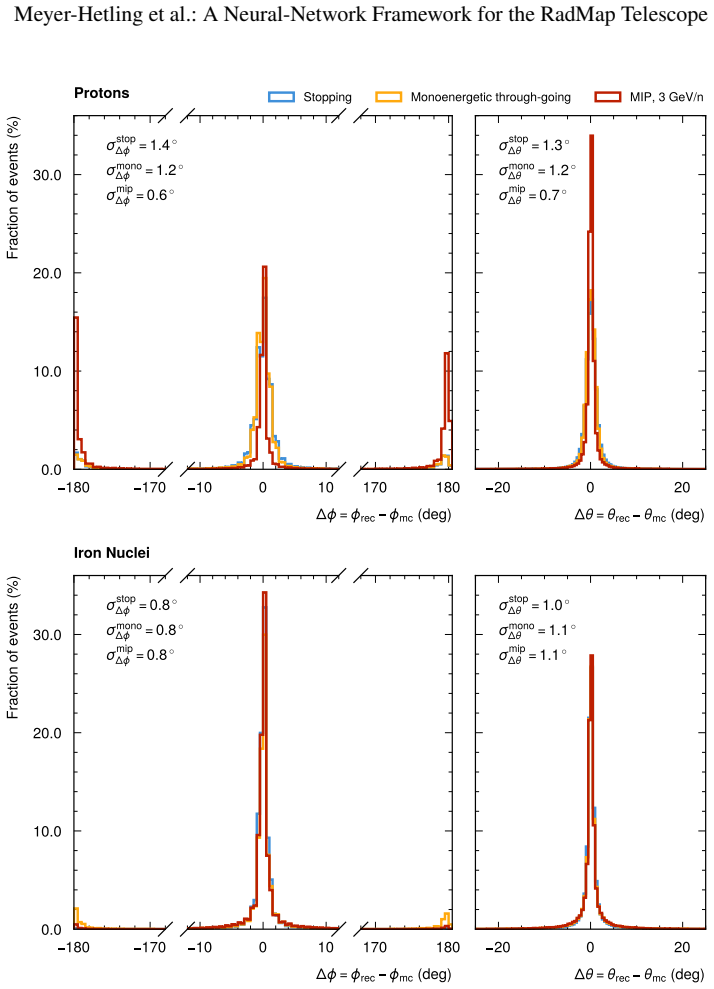
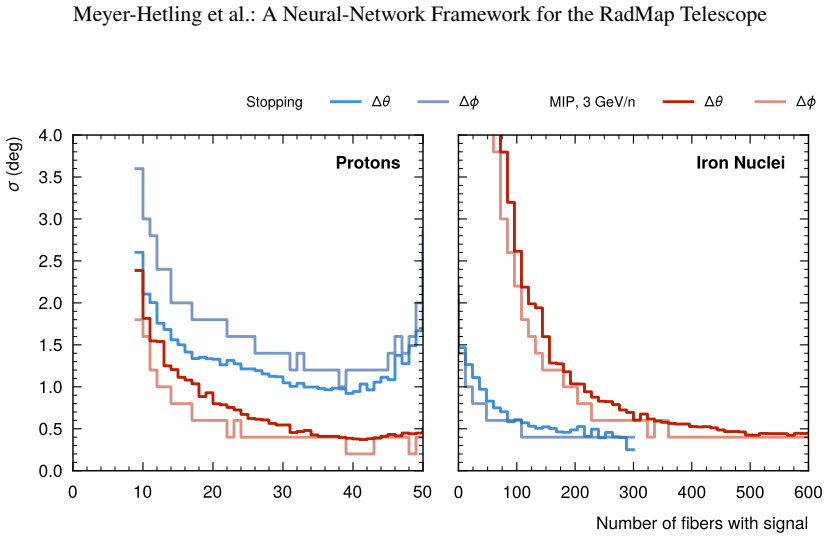
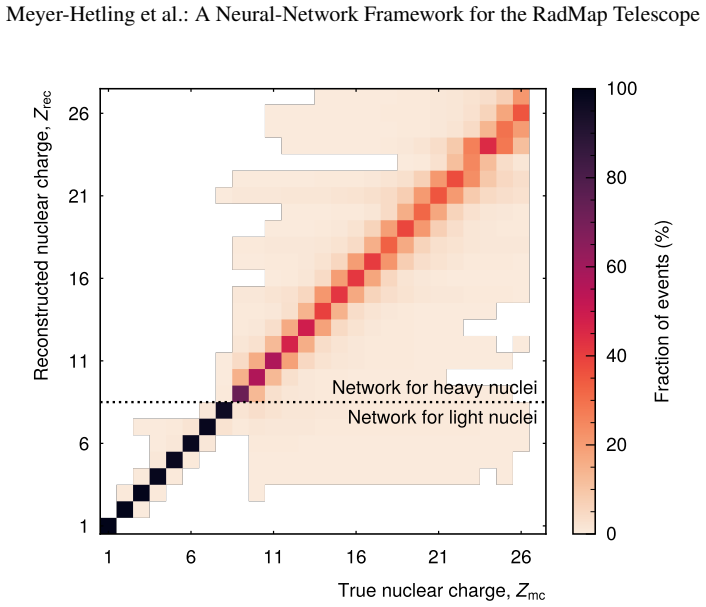
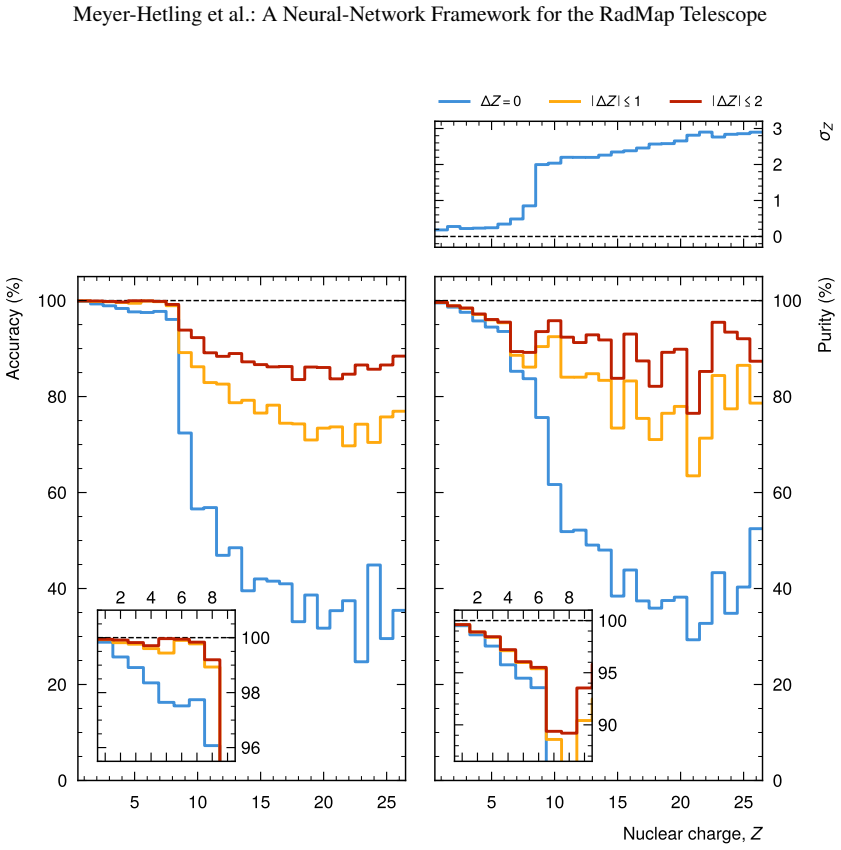
A neural network reconstructs cosmic-ray trajectories to better than 1.4 degrees and separates charges to 99.8 percent accuracy for hydrogen using simulated detector data.
A machine-rendered reading of the paper's core claim, the machinery that carries it, and where it could break.
Core claim
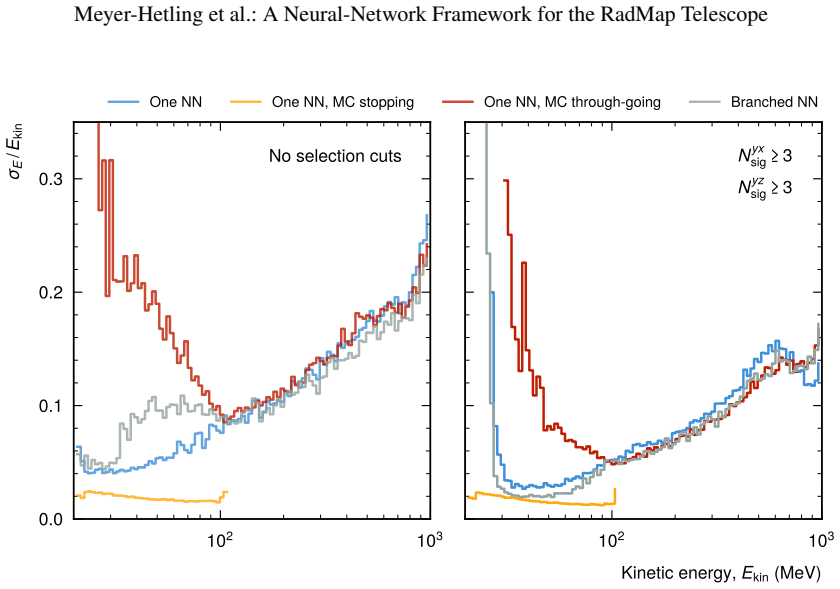
A neural network trained on Geant4-simulated events from a simplified model of the RadMap Telescope's scintillating-fiber calorimeter reconstructs particle trajectories with angular resolution better than 1.4 degrees, separates charges with better than 95 percent accuracy for nuclei with Z less than or equal to 8 (reaching 99.8 percent for hydrogen), and achieves energy resolution below 20 percent for energies under 1 GeV per nucleon up to iron, thereby providing the spectroscopic information needed to determine the radiation dose astronauts experience in space.
What carries the argument
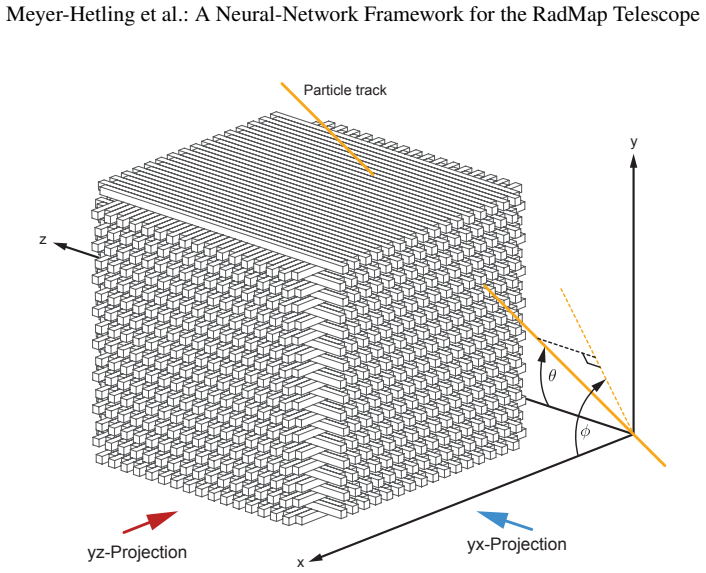
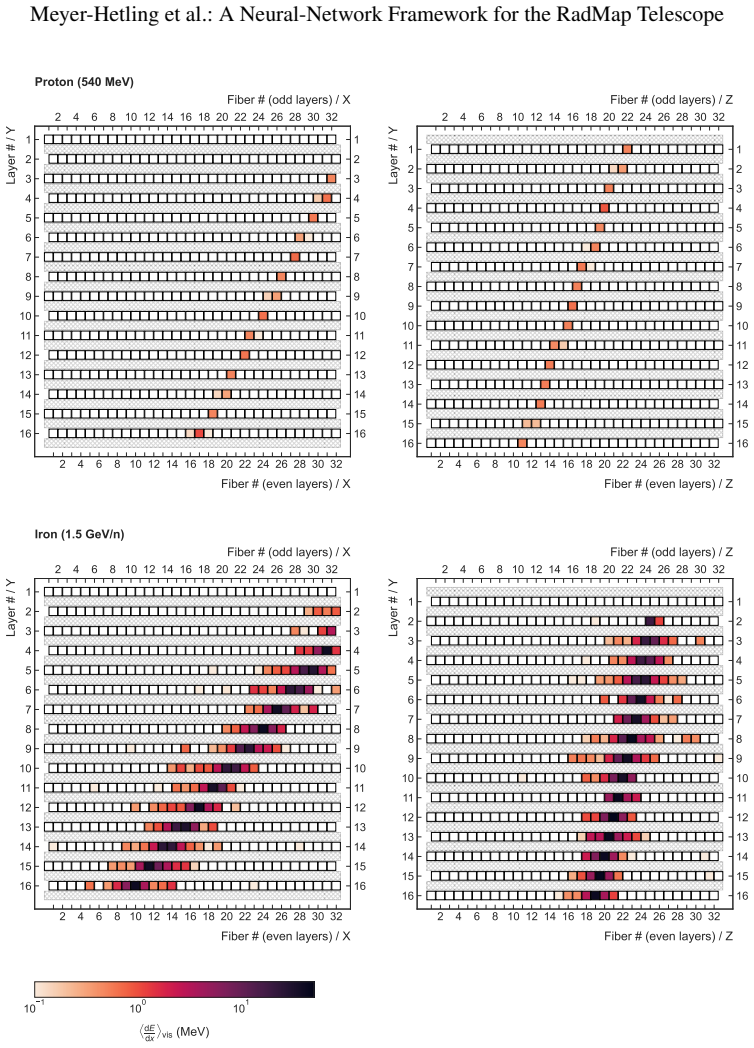
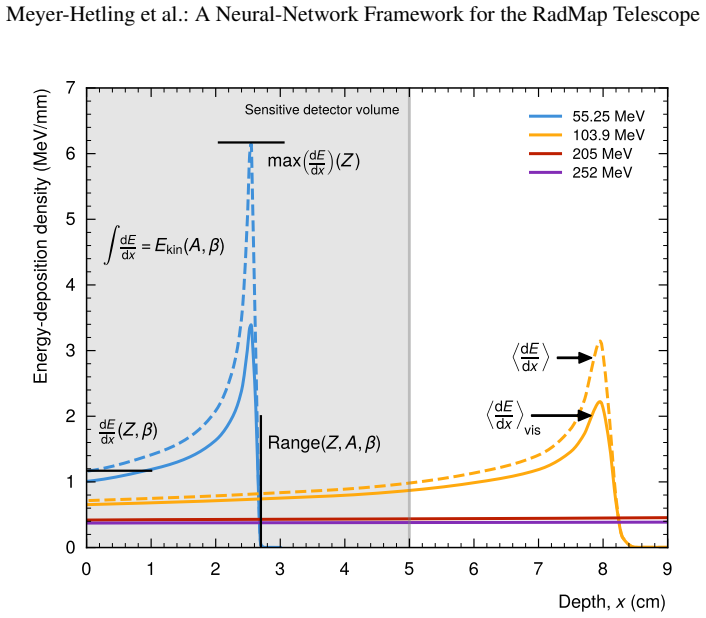
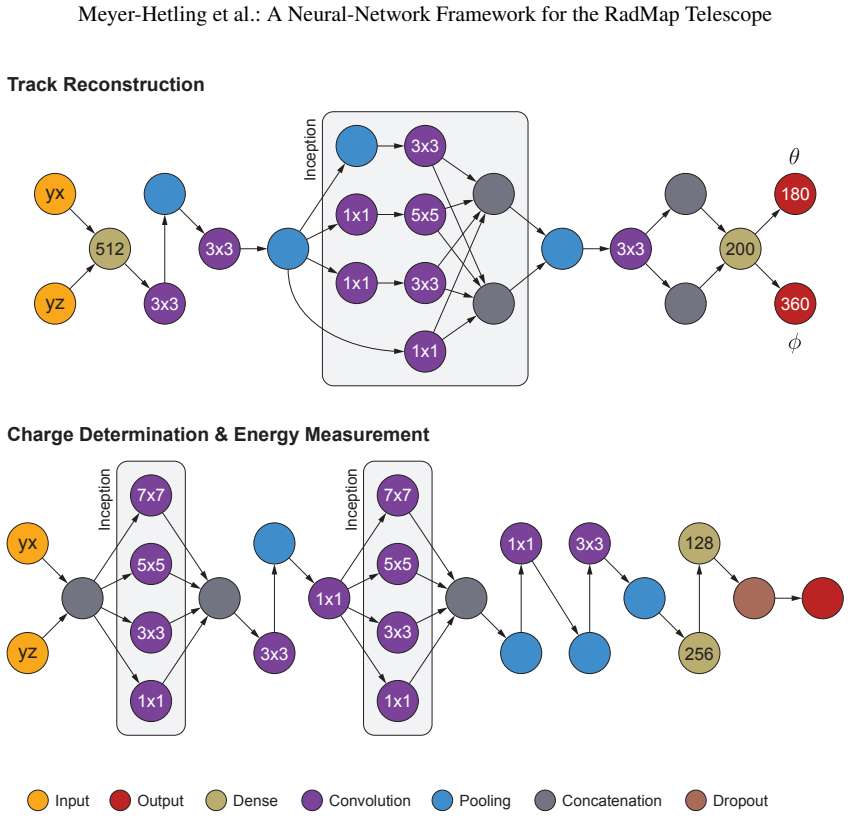
Neural network that ingests hit patterns from the scintillating fibers and outputs estimates of trajectory direction, nuclear charge, and kinetic energy per nucleon.
If this is right
- The reported resolutions enable direct calculation of the biologically weighted radiation dose from measured cosmic-ray spectra.
- The same network architecture can be retrained on improved detector models that include more hardware details.
- Charge and energy estimates can be combined with trajectory information to separate primary cosmic rays from secondary particles produced in the spacecraft.
- The framework supplies a concrete benchmark for comparing neural-network methods against traditional track-fitting algorithms in fiber calorimeters.
Where Pith is reading between the lines
- The method could be adapted to other fiber-based trackers in future space missions without requiring new simulation campaigns for each detector geometry.
- Combining the network outputs with real-time telemetry from the International Space Station would allow continuous monitoring of solar particle events.
- The approach suggests that similar networks might identify heavier nuclei beyond iron if the training set is extended to higher-Z particles.
- Validation against independent ground-based accelerator beams would strengthen confidence before flight deployment.
Load-bearing premise
The simplified Geant4 detector model used to generate all training and test data produces event topologies and light-yield distributions that are sufficiently close to those of the actual RadMap Telescope hardware.
What would settle it
Running the trained network on real flight data from the RadMap Telescope and finding that the charge-separation accuracy for hydrogen falls below 95 percent or the energy resolution exceeds 20 percent for nuclei below 1 GeV per nucleon would falsify the performance claims.
Figures

read the original abstract
We present a neural-network framework designed to reconstruct the properties of cosmic-ray nuclei traversing the scintillating-fiber tracking calorimeter of the RadMap Telescope. Employing the Geant4 simulation toolkit and a simplified model of the detector to generate training and test data, we achieve the spectroscopic capabilities required for an accurate determination of the biologically relevant dose that astronauts receive in space. We can reconstruct a particle's trajectory with an angular resolution of better than $1.4^\circ$ and achieve a charge separation of better than $95\%$ for nuclei with $Z\leq8$; specifically, we reach an accuracy of $99.8\%$ for hydrogen. The energy resolution is $<20\%$ for energies below 1 GeV/n and elements up to iron. We also discuss the limitations of our detector, the reconstruction framework, and this feasibility study, as well as possible improvements.
Editorial analysis
A structured set of objections, weighed in public.
Referee Report
Summary. The manuscript presents a neural-network framework for reconstructing trajectory, charge, and energy of cosmic-ray nuclei in the RadMap Telescope's scintillating-fiber tracking calorimeter. All training and test data are generated via Geant4 using a simplified detector model; the authors report angular resolution better than 1.4°, charge separation >95% for Z≤8 (99.8% for hydrogen), and energy resolution <20% below 1 GeV/n up to iron. The work is framed as a feasibility study discussing limitations and possible improvements.
Significance. If the simulation faithfully reproduces the physical detector response, the multi-task neural network could provide an efficient reconstruction tool for space-based cosmic-ray dosimetry. The approach of jointly optimizing tracking and particle identification is a reasonable application of modern ML to this domain. However, the complete absence of any quantitative sim-to-data comparison substantially reduces the immediate significance for actual RadMap Telescope operations.
major comments (1)
- [Methods (Geant4 simulation)] Methods section on Geant4 simulation and data generation: all quoted performance metrics (angular resolution <1.4°, charge accuracy >95% for Z≤8, energy resolution <20%) are evaluated exclusively on held-out events from the simplified detector model. No quantitative comparison is presented between simulated light-yield distributions, hit multiplicities, or track residuals and any calibration or flight data from the real RadMap Telescope hardware. This gap directly affects the transferability of the claimed resolutions to the instrument.
minor comments (2)
- [Abstract] Abstract and introduction: the claim that the framework achieves 'the spectroscopic capabilities required for an accurate determination of the biologically relevant dose' would benefit from a brief statement of the target dose precision or reference to the relevant radiation-protection standards.
- [Results] Results section: the manuscript could clarify whether the reported resolutions include uncertainty quantification (e.g., bootstrap or ensemble estimates) or are point estimates from a single network training run.
Simulated Author's Rebuttal
We thank the referee for their constructive review of our manuscript. We agree that the lack of real-data validation is a limitation for immediate operational transferability and have revised the text to better emphasize this point while defending the value of the simulation-based feasibility study.
read point-by-point responses
-
Referee: [Methods (Geant4 simulation)] Methods section on Geant4 simulation and data generation: all quoted performance metrics (angular resolution <1.4°, charge accuracy >95% for Z≤8, energy resolution <20%) are evaluated exclusively on held-out events from the simplified detector model. No quantitative comparison is presented between simulated light-yield distributions, hit multiplicities, or track residuals and any calibration or flight data from the real RadMap Telescope hardware. This gap directly affects the transferability of the claimed resolutions to the instrument.
Authors: We agree that all performance metrics are obtained from held-out simulated events generated with a simplified Geant4 model and that no quantitative sim-to-data comparison with real RadMap Telescope calibration or flight data is presented. This is inherent to the current feasibility study, as the instrument is still in development and no such experimental datasets exist for direct comparison at this time. The reported figures therefore represent performance under idealized conditions and should be interpreted as an upper bound. In the revised manuscript we have added a dedicated paragraph in the Discussion section that qualitatively addresses expected differences between simulation and hardware (e.g., fiber attenuation, PMT non-uniformity, electronic noise, and hit-multiplicity variations) and explicitly cautions readers about transferability. We also outline a path for future validation once real data become available. We believe these changes directly respond to the concern while preserving the manuscript’s focus on demonstrating the neural-network framework. revision: partial
- Quantitative comparison of simulated light-yield distributions, hit multiplicities, or track residuals against actual calibration or flight data from the RadMap Telescope hardware, as no such real detector data are currently available.
Circularity Check
No circularity detected in the derivation chain
full rationale
The paper generates synthetic training and test events via a Geant4 simulation of the detector geometry and response, trains a neural network to regress trajectory, charge, and energy, then reports resolution and accuracy figures by comparing network outputs against the known ground-truth labels of the held-out simulated events. These performance numbers are therefore independent measurements rather than quantities defined by the network itself or recovered by construction from the training procedure. No self-definitional equations, fitted parameters relabeled as predictions, load-bearing self-citations, or ansatzes imported from prior author work appear in the reported chain. The framework is a self-contained simulation-based feasibility study whose internal logic does not collapse to its inputs.
Axiom & Free-Parameter Ledger
axioms (1)
- domain assumption Geant4 simulation with simplified detector model produces training data representative of real RadMap Telescope response
Reference graph
Works this paper leans on
-
[1]
Geant4–a simulation toolkit. Nuclear Instruments and Methods in Physics Research Section A: Accelerators, Spectrometers, Detectors and Associated Equipment,506(3), 250–303.http://dx.doi.org/10.1016/s0168-9002(03) 01368-8. 3.4 Alaghband, Y ., P. M. Klein, E. A. Kramar, M. N. Cranston, B. C. Perry, et al.,
-
[2]
1 21 Meyer-Hetling et al.: A Neural-Network Framework for the RadMap Telescope Allison, J., K
Galactic cosmic radiation exposure causes multifaceted neurocognitive impairments.Cellular and Molecular Life Sciences,80(1), 29.http://dx.doi.org/10.1007/s00018-022-04666-8. 1 21 Meyer-Hetling et al.: A Neural-Network Framework for the RadMap Telescope Allison, J., K. Amako, J. Apostolakis, P. Arce, M. Asai, et al.,
-
[3]
Recent developments in Geant4. Nuclear Instruments and Methods in Physics Research Section A: Accelerators, Spectrometers, Detectors and Associated Equipment,835, 186–225.http://dx.doi.org/10.1016/j.nima.2016.06.125. 3.4 Barthel, J., and N. Sarigul-Klijn,
-
[4]
A review of radiation shielding needs and concepts for space voyages beyond Earth’s magnetic influence.Progress in Aerospace Sciences,110.http://dx.doi.org/10. 1016/j.paerosci.2019.100553. 1 Caldwell, A., D. Koll ´ar, and K. Kr ¨oninger,
-
[5]
BAT – The Bayesian analysis toolkit.Computer Physics Communications,180(11), 2197–2209.http://dx.doi.org/10.1016/j.cpc.2009.06.026. 3.3 Chancellor, J. C., R. S. Blue, K. A. Cengel, S. M. Au ˜n´on-Chancellor, K. H. Rubins, H. G. Katzgraber, and A. R. Kennedy,
-
[6]
npj Microgravity,4, 8.http://dx.doi.org/10.1038/s41526-018-0043-2
Limitations in predicting the space radiation health risk for exploration astronauts. npj Microgravity,4, 8.http://dx.doi.org/10.1038/s41526-018-0043-2. 1, 2 Chancellor, J. C., G. Scott, and J. Sutton,
-
[7]
Space Radiation: The Number One Risk to Astronaut Health beyond Low Earth Orbit.Life,4, 491–510.http://dx.doi.org/10.3390/life4030491. 1 Cucinotta, F. A.,
-
[8]
A New Approach to Reduce Uncertainties in Space Radiation Cancer Risk Predictions.PLoS ONE,10, e0120,717.http://dx.doi.org/10.1371/journal.pone.0120717. 2 Cucinotta, F. A., M. Alp, B. Rowedder, and M.-H. Y . Kim,
-
[9]
Safe days in space with accept- able uncertainty from space radiation exposure.Life Sciences in Space Research,5, 31–38.http: //dx.doi.org/10.1016/j.lssr.2015.04.002. 1 Cucinotta, F. A., K. To, and E. Cacao,
-
[10]
Predictions of space radiation fatality risk for exploration missions.Life Sciences in Space Research,13, 1–11.http://dx.doi.org/10.1016/j.lssr.2017. 01.005. 2 Delp, M. D., J. M. Charvat, C. L. Limoli, R. K. Globus, and P. Ghosh,
-
[11]
Apollo Lunar Astronauts Show Higher Cardiovascular Disease Mortality: Possible Deep Space Radiation Effects on the Vascular Endothelium.Scientific Reports,6, 29,901.http://dx.doi.org/10.1038/srep29901. 1 Durante, M., and F. A. Cucinotta,
-
[12]
Physical basis of radiation protection in space travel.Reviews of Modern Physics,83, 1245–1281.http://dx.doi.org/10.1103/RevModPhys.83.1245. 1 Fogtman, A., S. Baatout, B. Baselet, T. Berger, C. E. Hellweg, et al.,
-
[13]
Towards sustainable human space exploration–priorities for radiation research to quantify and mitigate radiation risks.npj Microgravity, 9(1).http://dx.doi.org/10.1038/s41526-023-00262-7. 1 Gruhn, C., M. Binimi, R. Legrain, R. Loveman, W. Pang, et al.,
-
[14]
Neoplasia,32, 100,828.http://dx.doi.org/10.1016/j.neo.2022.100828
Carcinogenesis induced by space radiation: A systematic review. Neoplasia,32, 100,828.http://dx.doi.org/10.1016/j.neo.2022.100828. 1 Hellweg, C. E., T. Berger, D. Matthi¨a, and C. Baumstark-Khan,
-
[15]
SpringerBriefs in Space Life Sciences
Radiation in Space: Relevance and Risk for Human Missions. SpringerBriefs in Space Life Sciences. Springer, Cham. ISBN 978-3-030-46743-2. http://dx.doi.org/10.1007/978-3-030-46744-9. 2 22 Meyer-Hetling et al.: A Neural-Network Framework for the RadMap Telescope Hollender, L.,
-
[16]
Detrimental impacts of mixed- ion radiation on nervous system function.Neurobiology of Disease,151, 105,252.http://dx.doi.org/ 10.1016/j.nbd.2021.105252. 1 Koontz, S. L., P. A. Boeder, C. Pankop, and B. Reddell,
-
[17]
expectations for avionics and materials
The ionizing radiation environment on the International Space Station: performance vs. expectations for avionics and materials. In IEEE Radiation Effects Data Workshop, 110–116. IEEE, Seattle, W A.http://dx.doi.org/10.1109/redw.2005. 1532675. 3.4 Lecun, Y ., L. Bottou, Y . Bengio, and P. Haffner,
-
[18]
Gradient-based learning applied to document recognition
Gradient-based learning applied to document recog- nition.Proceedings of the IEEE,86(11), 2278–2324.http://dx.doi.org/10.1109/5.726791. 3.3 Longair, M. S.,
-
[19]
Cambridge University Press, Cambridge, 3rd edn
High Energy Astrophysics. Cambridge University Press, Cambridge, 3rd edn. ISBN 9780521756181.http://dx.doi.org/10.1017/cbo9780511778346. 2 Losekamm, M. J.,
-
[20]
Measuring Cosmic Rays with the RadMap Telescope on the International Space Station. In Proceedings of 38th International Cosmic Ray Conference – PoS(ICRC2023).http://dx.doi.org/10.22323/1.444.0099. 1 Losekamm, M. J., M. Milde, T. P ¨oschl, D. Greenwald, and S. Paul,
-
[21]
A new analysis method using Bragg curve spectroscopy for a Multi-purpose Active-target Particle Telescope for radiation monitoring. Nuclear Instruments and Methods in Physics Research Section A: Accelerators, Spectrometers, Detectors and Associated Equipment,845, 520–523.http://dx.doi.org/10.1016/j.nima.2016.05.029. 3.3 Losekamm, M. J., S. Paul, T. P ¨osc...
-
[22]
In 2021 IEEE Aerospace Conference (50100)
The RadMap Telescope on the International Space Station. In 2021 IEEE Aerospace Conference (50100). IEEE, Big Sky, MT.http://dx.doi.org/ 10.1109/AERO50100.2021.9438435. 1 Loshchilov, I., and F. Hutter,
-
[23]
Decoupled Weight Decay Regularization
Decoupled Weight Decay Regularization. 10.48550/arXiv.1711.05101, 1711.05101. 4 Mao, X. W., M. J. Pecaut, and D. S. Gridley. Acute Risks of Space Radiation, chap. 27, 263–276. Springer, Cham,
work page internal anchor Pith review Pith/arXiv arXiv doi:10.48550/arxiv.1711.05101
-
[24]
ISBN 978-3-319-12190-1.http://dx.doi.org/10.1007/978-3-319-12191-8_27. 2 Milde, M.,
-
[25]
Space Radiation Protection Countermeasures in Microgravity and Planetary Exploration.Life,11(8).http://dx.doi. org/10.3390/life11080829. 1 Naito, M., and S. Kodaira,
-
[26]
The National Academies Press, Washington, DC
Space Radiation and Astronaut Health: Managing and Communicating Cancer Risks. The National Academies Press, Washington, DC. ISBN 978-0-309-47966-0.http://dx.doi.org/10.17226/26155. 1 Parihar, V . K., B. Allen, K. K. Tran, T. G. Macaraeg, E. M. Chu, et al.,
-
[27]
What happens to your brain on the way to Mars.Science Advances,1, e1400,256.http://dx.doi.org/10.1126/sciadv.1400256. 1 Prechelt, L. Early Stopping - But When?, chap. 3, 55–69. Lecture Notes in Computer Science. Springer, Berlin, Heidelberg,
-
[28]
Measurement of ionization quenching in plastic scintillators.Nuclear Instruments and Methods in Physics Research Section A: Accelerators, Spectrometers, Detectors and Associated Equipment,988, 164,865.http://dx.doi.org/10.1016/ j.nima.2020.164865. 3.2 Raissi, M., P. Perdikaris, and G. Karniadakis,
-
[29]
Journal of Computational Physics,378, 686–707.http://dx.doi.org/10.1016/j.jcp.2018.10
Physics-informed neural networks: A deep learning framework for solving forward and inverse problems involving nonlinear partial differential equations. Journal of Computational Physics,378, 686–707.http://dx.doi.org/10.1016/j.jcp.2018.10
-
[30]
Solar Energetic Particles. Lecture Notes in Physics. Springer, Cham, 2nd edn. ISBN 978-3-030-66401-5.http://dx.doi.org/10.1007/978-3-030-66402-2. 2 Reames, D. V .,
-
[31]
Radiation induced cardiovascular disease: An odyssey of bedside-bench-bedside approach.Life Sciences in Space Research, 27, 49–55.http://dx.doi.org/10.1016/j.lssr.2020.07.005. 1 Scarselli, F., M. Gori, A. C. Tsoi, M. Hagenbuchner, and G. Monfardini,
-
[32]
The Graph Neural Network Model.IEEE Transactions on Neural Networks,20(1), 61–80.http://dx.doi.org/10.1109/TNN. 2008.2005605. 7 Slaba, T. C., A. A. Bahadori, B. D. Reddell, R. C. Singleterry, M. S. Clowdsley, and S. R. Blattnig,
work page doi:10.1109/tnn 2008
-
[33]
http://dx.doi.org/10.1016/j.lssr.2016.12.003
Optimal shielding thickness for galactic cosmic ray environments.Life Sciences in Space Research,12. http://dx.doi.org/10.1016/j.lssr.2016.12.003. 7 24 Meyer-Hetling et al.: A Neural-Network Framework for the RadMap Telescope Szegedy, C., W. Liu, Y . Jia, P. Sermanet, S. Reed, and D. Anguelov,
-
[34]
In 2015 IEEE Conference on Computer Vision and Pattern Recognition (CVPR)
Going deeper with convolutions. In 2015 IEEE Conference on Computer Vision and Pattern Recognition (CVPR). IEEE, Boston, MA. 3.3 van Laarhoven, P. J. M., and E. H. L. Aarts,
work page 2015
-
[35]
Mathematics and Its Applications
Simulated Annealing: Theory and Applications. Mathematics and Its Applications. Springer, Dordrecht. ISBN 978-90-481-8438-5.http://dx.doi. org/10.1007/978-94-015-7744-1. 3.3 Vaswani, A., N. Shazeer, N. Parmar, J. Uszkoreit, L. Jones, A. N. Gomez, L. Kaiser, and I. Polosukhin,
-
[36]
Research plans in Europe for radiation health hazard assessment in exploratory space missions.Life Sciences in Space Research,21, 73–82.http://dx.doi.org/10.1016/j.lssr.2019.04.002. 1 Zeitlin, C., and C. La Tessa,
-
[37]
The Role of Nuclear Fragmentation in Particle Therapy and Space Radiation Protection.Frontiers in Oncology,6, 1–13.http://dx.doi.org/10.3389/fonc.2016. 00065. 3.4 25
discussion (0)
Sign in with ORCID, Apple, or X to comment. Anyone can read and Pith papers without signing in.