REVIEW 4 major objections 3 minor 24 references
MCTR: Midpoint Corrected Triangulation for Autonomous Racing via Digital Twin Simulation in CARLA
T0 review · 4 major / 3 minor · reviewed 2026-08-05 · deepseek-v4-flash
Pith's one-line read MCTR extracts track centerlines from LiDAR midpoints between opposing boundaries, cutting lap time by 18.6% versus DTR while smoothing curvature and jerk.
desk verdict A solid incremental extension of DTR with a useful CARLA digital twin, but the real-world 'consistently outperforms' claim is contradicted by its own M-track result and too many tuning parameters are unreported. read the letter →
The pith
A machine-rendered reading of the paper's core claim, the machinery that carries it, and where it could break.
The reading
What carries the argument
The load-bearing object is the opposing-edge midpoint extraction: after Delaunay triangulation of sampled LiDAR boundary points, edges whose two vertices lie on opposite sides of the current driving direction are selected, and their midpoints form the initial centerline. This replaces DTR's circumcircle-based centerline and eliminates the need for geometric track segmentation. The second component, CCMA, is an optimization over waypoints $q_i$ minimizing fidelity to original points plus $\lambda$-scaled second-difference (velocity-continuity) and $\mu$-scaled fourth-difference (curvature-smoothness) penalties.
What would settle it
Record lap times on a track with a long straight open on one side (no opposite wall within LiDAR range) or with a partial occlusion; if MCTR cannot complete the lap or its centerline diverges, the opposing-edge assumption fails. Alternatively, remove the CCMA module and compute the lap-time change; the paper's own ablation shows only a small drop, so a careful experiment at higher speeds could test whether smoothness, not centerline accuracy, is the main source of the gain.
Extended reading notes
Core claim
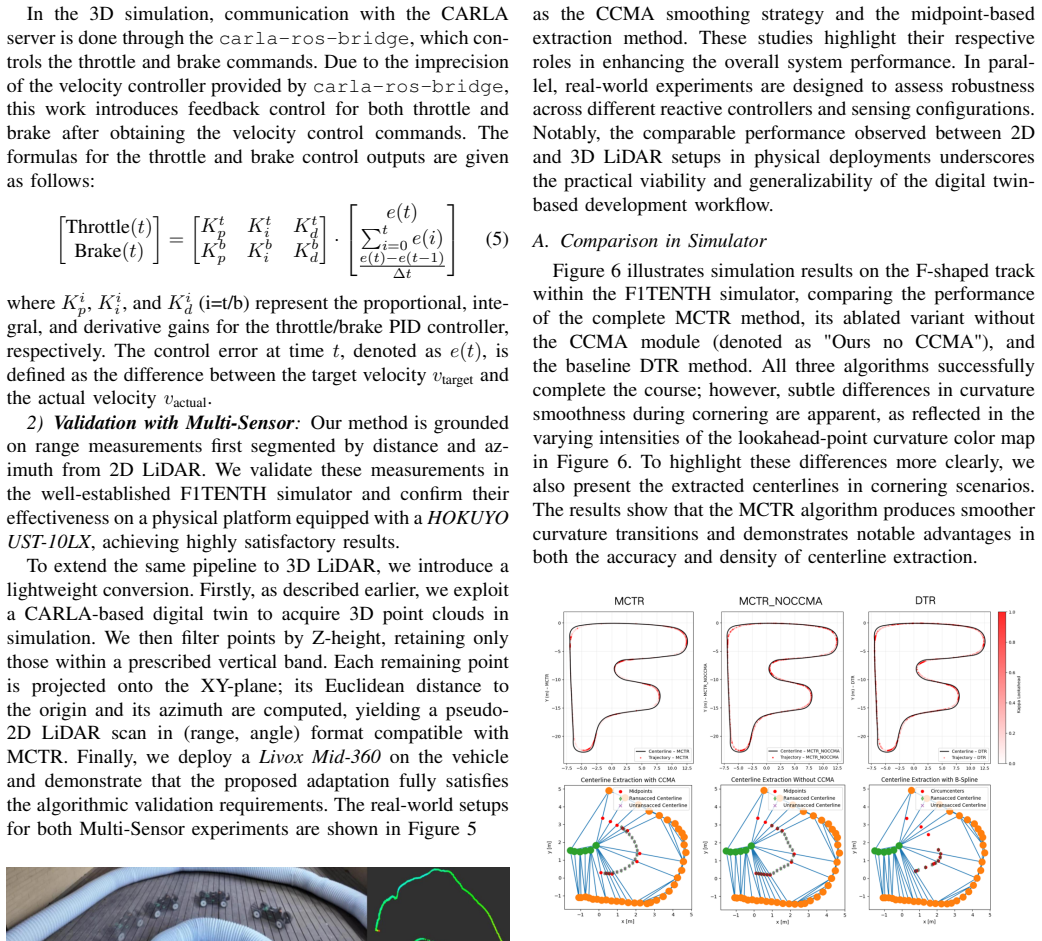
The central discovery is that the quality of a triangulation-based racing line is determined less by the triangulation itself than by which edges are used to define the centerline. DTR relies on circumcircles and pre-segmented track regions; MCTR shows that selecting only opposing edges—edges with one endpoint on each side of the heading—and taking their midpoints yields a more stable and smoother centerline implicitly. Adding a CCMA smoothing step that penalizes both first and second discrete derivatives of the waypoints produces curvature-continuous paths that allow higher cornering speeds. The paper demonstrates this in simulation and on physical vehicles, with both 2D and 3D LiDAR.
Load-bearing premise
The whole method assumes the track is a structured corridor whose opposite boundaries are continuously visible in the LiDAR scan; if a boundary is occluded or too far to be sampled, the opposing-edge midpoint extraction has nothing to anchor the centerline.
Editorial extensions
If this is right
- Reactive mapless controllers can achieve lap times close to planning-based methods on structured tracks, since smoother curvature directly raises attainable cornering speed.
- The pipeline transfers from 2D to 3D LiDAR by projecting the 3D point cloud to a pseudo-2D scan, so algorithms developed in 2D simulation can be deployed on full-scale cars with 3D sensors without retraining.
- The CARLA digital twin can serve as a validation environment for perception-driven racing controllers, reducing the need for expensive on-track testing.
- The CCMA smoothing may generalize beyond racing to any local path-planning task where curvature continuity matters, e.g., warehouse robots or search-and-rescue.
Reading between the lines
- The 18.6% lap-time gain likely comes mostly from higher cornering speed enabled by smoother curvature, not from a shorter path; the paper does not separate path-length from speed effects, so an experiment holding centerline length fixed would isolate the mechanism.
- Because MCTR relies on detecting opposite boundaries, it should fail gracefully on open or occluded tracks; a natural extension is to fuse stereo vision or prior maps to fill boundary gaps, which the authors mention as future work.
- The CCMA parameters $\lambda$ and $\mu$ are not swept in the paper; testing sensitivity to these weights would reveal how much tuning is needed for a new track.
- The digital twin uses a simplified vehicle dynamics model; the sim-to-real gap for higher-speed maneuvers with tire slip is untested, so the 95% passability may degrade near the friction limit.
Signed reviews
Editorial analysis
A structured set of objections, weighed in public.
Referee Report
Summary. The paper proposes MCTR, a reactive LiDAR-based racing controller. MCTR builds on DTR by replacing circumcircle-based centerline extraction with opposing-edge midpoint selection and applying a Curvature Corrected Moving Average (CCMA) smoother; control is then performed with pure pursuit and a curvature-dependent speed law. The authors also construct a CARLA digital twin that supports both 2D and 3D LiDAR, including a projection from 3D point clouds to pseudo-2D scans. In F1TENTH simulation on an F-shaped track, MCTR reports a lap time of 23.39 s versus 28.73 s for DTR, with 20% lower curvature error and 24.83% lower lateral jerk cost. Real-world experiments on 1:10-scale tracks report faster lap times for MCTR than DTR on O- and F-shaped tracks, a slower lap time on an M-shaped track, and passability of 95% versus 80% (DTR) and 45% (FTG). The paper concludes that MCTR "consistently outperforms baselines across diverse track configurations."
Significance. If the empirical claims hold, the paper makes a useful contribution: a simple mapless reactive controller that produces smoother centerlines than DTR, combined with a digital-twin pipeline for 3D LiDAR validation. The open-source release is a concrete strength, as are the simulation and physical experiments with two LiDAR modalities. The core idea is plausible and the simulation ablation suggests that the CCMA component helps. However, the paper's central real-world claim is currently undermined by incomplete reporting: the M-track result contradicts the "consistently outperforming" conclusion, and the absence of variance or significance information makes the reported O/F-track advantages unreliable. The method's load-bearing details, especially the definitions of the smoothness metrics and the implementation of the CCMA objective, are also missing.
major comments (4)
- [§IV-B, Table III and §V] The M-shaped track row directly contradicts the conclusion that MCTR "consistently outperforms baselines across diverse track configurations": MCTR's lap time is 9.59 s while DTR's is 9.28 s, so DTR is 3.3% faster. The table also reports only point values with no per-lap times, standard deviations, or significance tests; the text says each track was tested for five laps, but the PASS metric is aggregated over 20 laps. The authors should either report the full distribution and show that the O/F differences are meaningful, or explicitly acknowledge and analyze the M-track exception and soften the conclusion.
- [§IV-A, Table II and Eq. (4)] The smoothness metrics ε_k and J_lat are never defined. Table II reports them as "curvature error" and "centerline lateral error jerk," but the reference path, the error definition, and the computation method are unspecified, making the 20.00% and 24.83% improvements unverifiable. In addition, Eq. (4) as typeset, v_target = sqrt(μ a_y^max) κ^{-1}, is dimensionally inconsistent; if the intended formula is v_target = sqrt(μ a_y^max / κ), it should be corrected. Since the velocity command is central to the lap-time argument, this needs clarification.
- [§III-A.1, Eq. (1)] The CCMA objective is the paper's main algorithmic contribution, but it is incompletely specified. Eq. (1) is presented as an optimization problem, yet no solver, boundary conditions, or λ and μ values are given, and no sensitivity analysis is reported. The surrounding text also mislabels the terms: the second term is a second finite difference, not a first-derivative/velocity term, and the third term is a fourth finite difference, not a second-derivative/curvature term. This makes the method difficult to reproduce and the description internally inconsistent.
- [§IV-B, Table III] The passability claim (95% vs 80% vs 45%) is not interpretable as reported. The table says each track was tested for five laps, but PASS is described as "out of a total of 20"; the criterion for a "minor collision" is not defined, and no breakdown by track or algorithm is given. The authors should clarify the number of laps per condition, the failure criterion, and whether PASS is aggregated across tracks.
minor comments (3)
- [References] Reference [9] contains a malformed arXiv identifier, 'arXiv:2505.2505.24320'; this should be corrected to 2505.24320.
- [§IV-B] The text compares a CARLA 3D-LiDAR lap time of 7.90 s with a real-world time of 7.23 s, but 7.23 s does not appear in Table III. The track and conditions for this comparison should be identified.
- [§III-A.2, Eq. (5)] The PID gain notation in Eq. (5) is ambiguous: K^i_p, K^i_i, K^i_d with i=t/b is not clearly defined, and the sampling interval Δt and error e(t) should be stated explicitly.
Circularity Check
No significant circularity: the reported curvature-sensitive speed law is a design choice, and the headline metrics are empirical closed-loop outcomes, not algebraic consequences of the smoothing objective.
full rationale
The paper's main derivation chain is empirical: MCTR extracts a centerline, smooths it with CCMA (Eq. 1), and feeds it to a pure-pursuit controller with a curvature-dependent speed command (Eq. 4). Although Eq. 4 makes commanded speed inversely proportional to local curvature, the claimed lap-time, curvature-error, jerk, CPU, and passability results are measured from closed-loop simulation and real-world trials, not computed from Eq. (4) alone. The comparison against DTR uses the same pure-pursuit control strategy ('which is similar to the control strategy in DTR; hence, we choose DTR as our baseline'), so the speed law is not a parameter fitted to MCTR and then renamed a prediction. The self-citations (DTR [9] and R-CARLA [12]) share co-authors, but they are used as a baseline and as a simulation tool respectively; neither is invoked as an external uniqueness theorem, and the sim-to-real 3D LiDAR result (Carla 7.90 s vs. real 7.23 s) provides an independent check. The stated limitation, 'MCTR currently depends on structured tracks with clear boundaries,' is a scope restriction, not a circular step. Separately, the real-world M-shaped-track result in Table III (MCTR 9.59 s vs. DTR 9.28 s) is internally inconsistent with the conclusion's 'consistently outperforming baselines' and the table gives no uncertainty intervals; that is an evidence-quality/correctness issue, not a circular-derivation issue under the definitions used here. No step reduces by construction to its input, so the circularity score is 0.
Assumptions & free parameters
free parameters (4)
- CCMA smoothing weights (lambda, mu) =
not reported in the text, only as symbols
- Pure pursuit lookahead gain k_v and minimum lookahead L_min =
not reported numerically
- Throttle/brake PID gains (K_p, K_i, K_d) for the CARLA vehicle =
not reported
- Maximum friction coefficient mu in velocity model =
obtained by pulling the car with a spring scale, but the numeric value is not reported
assumptions (3)
- domain assumption Delaunay triangulation of LiDAR points yields a meaningful track topology where opposing edges span the track width
- domain assumption The CCMA filter as written in Eq. (1), with the first term preserving fidelity and the higher-order terms smoothing velocity and curvature, produces a trajectory that is dynamically feasible
- domain assumption The kinematic bicycle model is an adequate representation of the race car for control at the tested speeds
Cite this review
Pith. "Pith review of MCTR: Midpoint Corrected Triangulation for Autonomous Racing via Digital Twin Simulation in CARLA." pith.science (2026). https://pith.science/paper/OEFQKPB5
@misc{pith2026250812729,
  author       = {Pith},
  title        = {Pith review of: MCTR: Midpoint Corrected Triangulation for Autonomous Racing via Digital Twin Simulation in CARLA},
  year         = {2026},
  howpublished = {\url{https://pith.science/paper/OEFQKPB5}},
  note         = {Machine review of arXiv:2508.12729}
}
read the original abstract
In autonomous racing, reactive controllers eliminate the computational burden of the full See-Think-Act autonomy stack by directly mapping sensor inputs to control actions. This bypasses the need for explicit localization and trajectory planning. A widely adopted baseline in this category is the Follow-The-Gap method, which performs trajectory planning using LiDAR data. Building on FTG, the Delaunay Triangulation-based Racing algorithm introduces further enhancements. However, DTR's use of circumcircles for trajectory generation often results in insufficiently smooth paths, ultimately degrading performance. Additionally, the commonly used F1TENTH-simulator for autonomous racing competitions lacks support for 3D LiDAR perception, limiting its effectiveness in realistic testing. To address these challenges, this work proposes the MCTR algorithm. MCTR improves trajectory smoothness through the use of Curvature Corrected Moving Average and implements a digital twin system within the CARLA simulator to validate the algorithm's robustness under 3D LiDAR perception. The proposed algorithm has been thoroughly validated through both simulation and real-world vehicle experiments.
Figures


Figures from the paper (2 more)

Reference graph
Works this paper leans on
-
[1]
F1tenth: An open-source evaluation environment for continuous control and reinforcement learning,
M. O’Kelly, H. Zheng, D. Karthik, and R. Mang- haram, “F1tenth: An open-source evaluation environment for continuous control and reinforcement learning,” in NeurIPS 2019 Competition and Demonstration Track. PMLR, 2020, pp. 77–89
work page 2019
-
[2]
Indy autonomous challenge-autonomous race cars at the handling limits,
A. Wischnewski, M. Geisslinger, J. Betz, T. Betz, F. Fent, A. Heilmeier, L. Hermansdorfer, T. Herrmann, S. Huch, P. Karleet al., “Indy autonomous challenge-autonomous race cars at the handling limits,” in12th International Munich Chassis Symposium 2021: chassis. tech plus. Springer, 2022, pp. 163–182
work page 2021
-
[3]
Amz driverless: The full autonomous racing system,
J. Kabzan, M. I. Valls, V . J. Reijgwart, H. F. Hendrikx, C. Ehmke, M. Prajapat, A. Bühler, N. Gosala, M. Gupta, R. Sivanesanet al., “Amz driverless: The full autonomous racing system,”Journal of Field Robotics, vol. 37, no. 7, pp. 1267–1294, 2020
work page 2020
-
[4]
R. Siegwart, I. R. Nourbakhsh, and D. Scaramuzza, Introduction to Autonomous Mobile Robots, 2nd ed. The MIT Press, 2011
work page 2011
-
[6]
N. Baumann, E. Ghignone, J. Kühne, N. Bastuck, J. Becker, N. Imholz, T. Kränzlin, T. Y . Lim, M. Lötscher, L. Schwarzenbachet al., “Forzaeth race stack—scaled autonomous head-to-head racing on fully commercial off-the-shelf hardware,”Journal of Field Robotics, 2024
work page 2024
-
[7]
Learning-based on-track system identification for scaled autonomous rac- ing in under a minute,
O. Dikici, E. Ghignone, C. Hu, N. Baumann, L. Xie, A. Carron, M. Magno, and M. Corno, “Learning-based on-track system identification for scaled autonomous rac- ing in under a minute,”IEEE Robotics and Automation Letters, 2025
work page 2025
-
[8]
C. Hu, Y . Xie, L. Xie, and M. Magno, “Sparse gaussian process-based strategies for two-layer model predictive control in autonomous vehicle drifting,”Transportation Research Part C: Emerging Technologies, vol. 174, p. 105065, 2025
work page 2025
-
[9]
Dtr: Delaunay triangulation-based racing for scaled autonomous racing,
L. Tognoni, N. Reichlin, E. Ghignone, N. Baumann, S. Marty, L. Boyle, and M. Magno, “Dtr: Delaunay triangulation-based racing for scaled autonomous racing,”arXiv preprint arXiv:2505.2505.24320, 2025, fri, 30 May 2025 08:02:49 UTC. [Online]. Available: https://doi.org/10.48550/arXiv.2505.24320
Show all 24 references
-
[10]
A novel obstacle avoidance algorithm: “follow the gap method
V . Sezer and M. Gokasan, “A novel obstacle avoidance algorithm: “follow the gap method”,”Robotics and Autonomous Systems, vol. 60, no. 9, pp. 1123–1134,
-
[11]
F1tenth: An open-source evaluation environment for continuous control and reinforcement learning,
M. O’Kelly, H. Zheng, D. Karthik, and R. Mangharam, “F1tenth: An open-source evaluation environment for continuous control and reinforcement learning,”Proceed- ings of Machine Learning Research, vol. 123, 2020
2020
-
[12]
R-carla: High-fidelity sensor simulations with inter- changeable dynamics for autonomous racing,
M. Brunner, E. Ghignone, N. Baumann, and M. Magno, “R-carla: High-fidelity sensor simulations with inter- changeable dynamics for autonomous racing,” in2025 IEEE Intelligent V ehicles Symposium (IV). IEEE, 2025, pp. 2558–2564
2025
-
[13]
Information theoretic mpc for model-based reinforcement learning,
G. Williams, N. Wagener, B. Goldfain, P. Drews, J. M. Rehg, B. Boots, and E. A. Theodorou, “Information theoretic mpc for model-based reinforcement learning,” pp. 1714–1721, 2017
2017
-
[14]
Cautious model predictive control using gaussian process regres- sion,
L. Hewing, J. Kabzan, and M. N. Zeilinger, “Cautious model predictive control using gaussian process regres- sion,”IEEE Transactions on Control Systems Technology, vol. 28, no. 6, pp. 2736–2743, 2020
2020
-
[15]
Model-and acceleration- based pursuit controller for high-performance au- tonomous racing,
J. Becker, N. Imholz, L. Schwarzenbach, E. Ghignone, N. Baumann, and M. Magno, “Model-and acceleration- based pursuit controller for high-performance au- tonomous racing,”arXiv preprint arXiv:2209.04346, 2022
2022 arXiv
-
[16]
Learning to drive in a day,
A. Kendall, J. Hawke, D. Janz, P. Mazur, D. Reda, J.-M. Allen, V .-D. Lam, A. Bewley, and A. Shah, “Learning to drive in a day,” in2019 International Conference on Robotics and Automation (ICRA), 2019, pp. 8248–8254
2019
-
[17]
Autonomous vehicles on the edge: A survey on autonomous vehicle racing,
J. Betz, H. Zheng, A. Liniger, U. Rosolia, P. Karle, M. Behl, V . Krovi, and R. Mangharam, “Autonomous vehicles on the edge: A survey on autonomous vehicle racing,”IEEE Open Journal of Intelligent Transportation Systems, vol. 3, pp. 458–488, 2022
2022
-
[18]
A practical guide to splines,
C. De Boor, “A practical guide to splines,”Springer- V erlag, 1978, iSBN 0-387-90170-3
1978
-
[19]
Autonomous vehicle control in carla challenge,
J. del Egido Sierra, A. Díaz, L. M. Bergasa, R. Barea, and M. López, “Autonomous vehicle control in carla challenge,”Transportation research procedia, vol. 58, pp. 69–74, 2021
2021
-
[20]
Model- and acceleration- based pursuit controller for high-performance au- tonomous racing,
J. Becker, N. Imholz, L. Schwarzenbach, E. Ghignone, N. Baumann, and M. Magno, “Model- and acceleration- based pursuit controller for high-performance au- tonomous racing,” in2023 IEEE International Confer- ence on Robotics and Automation (ICRA), 2023, pp. 5276–5283
2023
-
[21]
Ros-based localization of a race vehicle at high-speed using lidar,
T. Stahl, A. Wischnewski, J. Betz, and M. Lienkamp, “Ros-based localization of a race vehicle at high-speed using lidar,” inE3S Web of Conferences, vol. 95. EDP Sciences, 2019, p. 04002
2019
-
[22]
Implementation of the Pure Pursuit Path Tracking Algorithm,
R. Coulter, “Implementation of the Pure Pursuit Path Tracking Algorithm,”DTIC Document, 1992
1992
-
[23]
Minimum cur- vature trajectory planning and control for an autonomous race car,
A. Heilmeier, A. Wischnewski, L. Hermansdorfer, J. Betz, M. Lienkamp, and B. Lohmann, “Minimum cur- vature trajectory planning and control for an autonomous race car,”V ehicle System Dynamics, vol. 58, no. 10, pp. 1497–1527, Oct. 2020, publisher Copyright: © 2019 Informa UK Li...
2020
-
[24]
Dithering with blue noise,
R. A. Ulichney, “Dithering with blue noise,”Proceedings of the IEEE, vol. 76, no. 1, pp. 56–79, 1988
1988
-
[2012]
Available: https://www.sciencedirect
[Online]. Available: https://www.sciencedirect. com/science/article/pii/S0921889012000838
Reviewed August 5, 2026 · model on record in the stance chip above.
Discussion (0). Continue with ORCID to comment.