REVIEW 3 major objections 5 minor 47 references
The paper argues that stylizing a photo with several reference images at once, using an averaged style embedding and clustered attention features, beats single-image style transfer while preserving content.
Reviewed by Pith at T0; open to challenge. T0 means a machine referee read the full paper against a public rubric. the ladder, T0–T4 →
A multi-image diffusion stylization pipeline that averages style embeddings, fine-tunes an IPAdapter, and clusters self-attention key/value features from style images achieves state-of-the-art scores on a new style-transfer test set.
T0 review reviewed 2026-08-05 challenge →
load-bearing objection Solid multi-image style-transfer pipeline with real technical work; the SOTA claim rests on a self-built, unreleased evaluation and an untested averaging assumption that should be probed before publication. the 3 major comments →
Leveraging Diffusion Models for Stylization using Multiple Style Images
The pith
A machine-rendered reading of the paper's core claim, the machinery that carries it, and where it could break.
The reading
Core claim
The central claim is that style and content can be disentangled by exploiting the redundancy across multiple style images. Averaging the adapter embeddings, $\phi_s = \frac{1}{n}\sum_i A(I_i^s)$, keeps what is shared by the style set and tones down what varies, namely content. The same logic is applied to self-attention features: instead of concatenating all keys and values from all style images, which is infeasible (about 7 GB of attention data for one image over 50 steps), the method clusters the values with k-means, keeps the value closest to each centroid, and retrieves the paired key. The resulting compact set $K_s^\star, V_s^\star$ is injected into the denoising UNet's self-attention,
What carries the argument
Three mechanisms carry the argument. First, the image prompt adapter, fine-tuned briefly on the style images and evaluated as the mean token sequence $\phi_s$, injects the shared style at the cross-attention level. Second, k-means clustering on the self-attention values extracted by DDIM inversion of each style image selects representative keys and values $(K_s^\star, V_s^\star)$; because keys and values are paired, clustering on values and retrieving the matching keys compresses many images' attention data without mixing mismatched pairs. Third, AdaIN normalization uses queries and keys from a generated average style image $\bar{I}_s$ to align content features, while the same average image
Load-bearing premise
The load-bearing premise is that the style images share one style and differ only in content, so averaging their embeddings keeps the style and suppresses the content; if the input set mixes styles or repeats content, the averaged prompt and statistics are contaminated.
What would settle it
Take a style set of ten paintings that all contain the same distinctive object (for example, a horse) but otherwise share a look. Run the method on content images without horses. If the stylized outputs repeatedly show a horse, then averaging has not separated shared style from shared content, and the central claim fails. A quantitative version is to measure output quality against the within-set variance of CLIP embeddings: if quality does not drop as style consistency decreases, the premise is not doing the work.
If this is right
- Style transfer becomes a set-to-image operation: any number of style images can be combined, with the fine-tuning step taking 3–5 minutes and stylization about 16 seconds per image on an RTX 4090.
- Content leakage from reference images is suppressed because the averaged embedding and clustered attention keep only what the style examples share.
- Artists gain two explicit dials: cropping scale of the style images controls the size of textural details (brush strokes versus structures), and ControlNet strength controls deformation.
- The approach is model-agnostic and already shown to work with SDXL in the supplement, so the multi-image recipe may survive a change of diffusion backbone.
- Adding more style images improves style fidelity, consistent with the observed gain of the BLoRA baseline when it moves from one to multiple images.
Where Pith is reading between the lines
- A stress-test consequence of the averaging premise: if the style set contains a recurring object across all images (say, a face in every portrait), the 'shared property' that survives averaging may be that object, not style. A reader could probe this by repeating the method on such sets.
- The k-means attention distillation reads naturally as a general recipe for condensing a set of exemplars into a compact conditioning signal; the same trick could apply to other generative tasks where the input is a collection rather than a single image or text prompt.
- Using a generated average style image for normalization statistics introduces a second generative choice into the pipeline; one could test whether a median latent or a fixed real image from the set changes the stability of the statistics.
- If the user-study preferences are taken seriously, they imply that existing automated metrics under-weight low-level texture fidelity—a mismatch the paper itself notes when discussing NNST.
Editorial analysis
A structured set of objections, weighed in public.
Referee Report
Summary. The paper proposes a multi-image style transfer method for latent diffusion models. The pipeline has three main components: (i) fine-tuning an IPAdapter on the style set and using the average of the resulting image-prompt embeddings as the style prompt, (ii) extracting self-attention keys/values from DDIM inversion of each style image, compressing them via k-means clustering, and injecting the cluster representatives into self-attention layers, and (iii) normalizing queries/keys using statistics from an 'average style image' generated from the averaged embedding, together with a two-stage high-resolution generation strategy. The method is evaluated against a wide range of single- and multi-image baselines on a self-constructed dataset using five automated metrics and a user study, reporting state-of-the-art results.
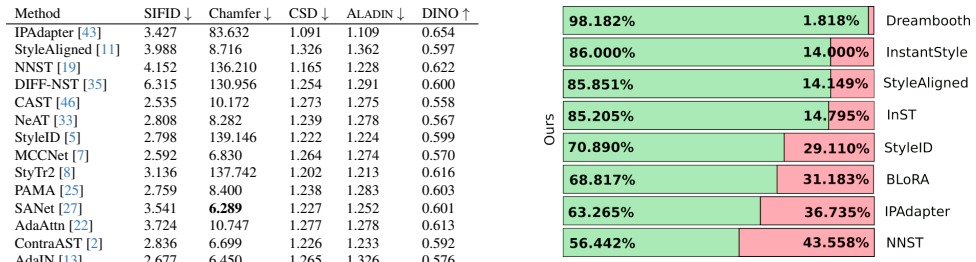
Significance. If the results hold, the paper makes a practical contribution: it shows a workable recipe for scaling style transfer to an arbitrary number of style images while avoiding the 7GB-per-image memory problem of naive multi-image attention injection, and it provides useful ablations showing the contribution of each component (Fig. 8), the negligible quality loss from clustering (Fig. 7), and the user-controllable deformation via ControlNet strength (Fig. 10). The method is also relatively fast at inference (~16 s on an RTX 4090). However, the central claim of content-style disentanglement is not established with sufficient rigor: the core averaging assumption in Eq. (4) is unverified, and the evaluation, while broad, is built on an unreleased, style-consistent test set without variance or significance reporting. The paper is therefore a promising candidate but needs substantial additional evidence before its SOTA claim can be accepted.
major comments (3)
- [§3.1, Eq. (4)] The central claim of content-style disentanglement rests on an untested linearity assumption. The statement that 'by averaging the corresponding embeddings we keep the shared property (i.e. the style) while the differences are toned down (i.e. the content)' presupposes that CLIP/IPAdapter embeddings decompose additively into style and content components. No experiment in the paper isolates or validates this property. The concern is amplified by the clustering step in §3.2, which selects values closest to centroids, i.e., features that recur across style images; if a style group contains a recurring object or scene structure, that content is itself a shared property and will be preserved by Eq. (4) and then selected by k-means. Since the custom test set is described as 'style-consistent' groupings (Sec. 4.2), this failure mode is not tested. This assumption also propagates to the average
- [§4.3, Table 1] The quantitative evaluation reports point estimates only, with no variance, confidence intervals, or per-style-group breakdown. The text states 'from the evaluation it is clear that ours performs best,' but on several metrics the gap over the next-best baseline is small (e.g., SIFID: 2.040 vs 2.512 for BLoRA-multi; CSD: 1.088 vs 1.119) and may be within run-to-run noise, especially given that style sets and content images are heterogeneous. Please report distributions over the 15 style groups (or over content/style pairs), use significance tests or bootstrapped confidence intervals, and clarify whether all methods are evaluated on the same randomly subsampled 10% of combinations. The user study (Fig. 6) also reports only aggregate preference scores for 23 workers; please add the number of tasks per worker, inter-rater variability, and a significance test (e.g., a paired test across worke
- [§4.2] The evaluation dataset is self-constructed, curated for style consistency, and not released. This is problematic for two reasons. First, an unreleased dataset makes the state-of-the-art claim difficult to audit or reproduce. Second, style-consistent curation is exactly the condition under which the Eq. (4) averaging assumption is most plausible; the paper does not test the method on adversarial but realistic inputs, such as style groups that share content structures or that are not all in the same style. Please release the dataset (or a substantial subset) and, at minimum, add a stress-test experiment with deliberately challenging style groups. Reporting dataset statistics (number of images per style group, typical content diversity) would also help the reader understand the scope of the claim.
minor comments (5)
- [Figure 5 / References] Several reference labels in the figure caption are inconsistent with the reference list: 'Dreambooth (multi) [34]' should be [31], 'InstantStyle [43]' should be [39], and 'IPAdapter [47]' should be [43]. This makes the comparison figure hard to read.
- [§3.3] The two-stage high-resolution procedure is described with two alternatives: 'We can either spatially resize the latents and resume the rest of the timesteps, or first generate the image in lower resolution then scale up...' It should be stated explicitly which variant is used in the experiments and with which parameters (resolution, number of timesteps per stage, ControlNet weights).
- [§4.2] The Chamfer color metric is not defined precisely. It is called 'Chamfer distance to measure colour similarity, normalized by the number of pixels,' but the feature representation on which Chamfer is computed (pixel RGB? Lab? deep features?) is not specified. Since the number appears in Table 1, this should be clarified.
- [§3.2] The number of clusters is set to match 'the typical number of vectors found in a single image.' Please state how this count is computed for each layer/timestep/head and provide a sensitivity analysis. The Fig. 7 comparison shows that clustering versus dynamic loading has little quality effect, but the exact cluster count remains a free parameter that should be reported.
- [§4.1 / §4.3] The runtime 'roughly 16 seconds' refers only to the stylization step after preprocessing. A fairer comparison with zero-shot baselines would report end-to-end time, including the 3-5 minute adapter fine-tuning and the under-30-minute clustering step. Also, the paper claims model-agnosticism and shows initial SDXL results 'in supplementary material,' but no details appear in the main text; please summarize those results or refer explicitly.
Circularity Check
No significant circularity: the method combines known components and is evaluated externally; the embedding-averaging step is an inductive assumption, not a circular reduction.
full rationale
The paper's pipeline (fine-tune an IPAdapter, average the style-image embeddings, cluster self-attention keys/values from DDIM-inverted style images, and use an average style image for AdaIN normalization) combines published building blocks. None of the equations defines the stylization output in terms of itself: Eq. (4) averages input embeddings, Eq. (8) concatenates clustered keys/values from style images, and Eq. (9) uses statistics from a generated average style image. The average style image is derived from the input style set via the adapter, but this is a processing design, not a fitted parameter disguised as a prediction. The central SOTA claim is supported by external quantitative metrics (SIFID, Chamfer, CSD, ALADIN, DINOv2) and a user study, rather than by the method's own construction. The loading-bearing 'shared style, varying content' assumption in Sec. 3.1 is an untested inductive premise about CLIP/IPAdapter embedding geometry; if false, the method may fail on stylistically inconsistent or content-repeating style sets, but that is a robustness/correctness concern, not circularity. Self-citations (ALADIN, Diff-NST) appear as metrics or baselines, not as justification for the method's validity. Therefore no circular step is present.
Axiom & Free-Parameter Ledger
free parameters (4)
- cluster count per attention layer/timestep/head =
matched to single-image vector count
- adapter fine-tuning steps =
~100
- two-stage generation resolution =
512px shortest side
- style patch crop scale =
multiple scales, not specified
axioms (5)
- standard math K-means clustering converges to a locally optimal solution and the Faiss GPU implementation is reliable for this feature scale.
- domain assumption All style images in S share a single style and have varied content, so averaging CLIP embeddings suppresses content while preserving style.
- domain assumption DDIM inversion of a style image yields self-attention keys and values that represent the style at each timestep.
- domain assumption The average style image generated from the averaged embedding has unimodal attention distributions that are representative of the whole style group.
- domain assumption AdaIN statistics (mean and variance) of the average-style-image attention features are a valid normalization target for content queries and keys.
Cite this review
Pith. "Pith review of Leveraging Diffusion Models for Stylization using Multiple Style Images." pith.science (2026). https://pith.science/paper/KF7PMCMK
@misc{pith2026250812784,
  author       = {Pith},
  title        = {Pith review of: Leveraging Diffusion Models for Stylization using Multiple Style Images},
  year         = {2026},
  howpublished = {\url{https://pith.science/paper/KF7PMCMK}},
  note         = {Machine review of arXiv:2508.12784}
}
read the original abstract
Recent advances in latent diffusion models have enabled exciting progress in image style transfer. However, several key issues remain. For example, existing methods still struggle to accurately match styles. They are often limited in the number of style images that can be used. Furthermore, they tend to entangle content and style in undesired ways. To address this, we propose leveraging multiple style images which helps better represent style features and prevent content leaking from the style images. We design a method that leverages both image prompt adapters and statistical alignment of the features during the denoising process. With this, our approach is designed such that it can intervene both at the cross-attention and the self-attention layers of the denoising UNet. For the statistical alignment, we employ clustering to distill a small representative set of attention features from the large number of attention values extracted from the style samples. As demonstrated in our experimental section, the resulting method achieves state-of-the-art results for stylization.
Figures




Reference graph
Works this paper leans on
-
[1]
Emerg- ing properties in self-supervised vision transformers, 2021
Mathilde Caron, Hugo Touvron, Ishan Misra, Herv ´e J´egou, Julien Mairal, Piotr Bojanowski, and Armand Joulin. Emerg- ing properties in self-supervised vision transformers, 2021. 5
work page 2021
-
[2]
Artistic style transfer with internal-external learning and contrastive learning
Haibo Chen, Lei Zhao, Zhizhong Wang, Zhang Hui Ming, Zhiwen Zuo, Ailin Li, Wei Xing, and Dongming Lu. Artistic style transfer with internal-external learning and contrastive learning. In Advances in Neural Information Processing Sys- tems, 2021. 7
work page 2021
-
[3]
Pixart-α: Fast training of dif- fusion transformer for photorealistic text-to-image synthesis,
Junsong Chen, Jincheng Yu, Chongjian Ge, Lewei Yao, Enze Xie, Yue Wu, Zhongdao Wang, James Kwok, Ping Luo, Huchuan Lu, and Zhenguo Li. Pixart-α: Fast training of dif- fusion transformer for photorealistic text-to-image synthesis,
-
[4]
Pixart- σ: Weak-to-strong training of diffu- sion transformer for 4k text-to-image generation, 2024
Junsong Chen, Chongjian Ge, Enze Xie, Yue Wu, Lewei Yao, Xiaozhe Ren, Zhongdao Wang, Ping Luo, Huchuan Lu, and Zhenguo Li. Pixart- σ: Weak-to-strong training of diffu- sion transformer for 4k text-to-image generation, 2024. 8
work page 2024
-
[5]
Jiwoo Chung, Sangeek Hyun, and Jae-Pil Heo. Style in- jection in diffusion: A training-free approach for adapting large-scale diffusion models for style transfer.arXiv preprint arXiv:2312.09008, 2023. 5, 7
Pith/arXiv arXiv 2023
-
[6]
Jiwoo Chung, Sangeek Hyun, and Jae-Pil Heo. Style injec- tion in diffusion: A training-free approach for adapting large- scale diffusion models for style transfer. In Proceedings of the IEEE/CVF Conference on Computer Vision and Pattern Recognition, pages 8795–8805, 2024. 1, 2, 4, 5
work page 2024
-
[7]
Arbitrary Video Style Transfer via Multi-Channel Correlation
Yingying Deng, Fan Tang, Weiming Dong, Haibin Huang, Chongyang Ma, and Changsheng Xu. Arbitrary video style transfer via multi-channel correlation. CoRR, abs/2009.08003, 2020. 7
work page internal anchor Pith review Pith/arXiv arXiv 2009
-
[8]
Stytr 2: Image style transfer with transformers, 2022
Yingying Deng, Fan Tang, Weiming Dong, Chongyang Ma, Xingjia Pan, Lei Wang, and Changsheng Xu. Stytr 2: Image style transfer with transformers, 2022. 7
work page 2022
-
[9]
Implicit style-content separation using b-lora,
Yarden Frenkel, Yael Vinker, Ariel Shamir, and Daniel Cohen-Or. Implicit style-content separation using b-lora,
-
[10]
Leon A. Gatys, Alexander S. Ecker, and Matthias Bethge. Image style transfer using convolutional neural networks. In Proceedings of the IEEE Conference on Computer Vision and Pattern Recognition (CVPR), 2016. 2
work page 2016
-
[11]
Style aligned image generation via shared atten- tion, 2024
Amir Hertz, Andrey V oynov, Shlomi Fruchter, and Daniel Cohen-Or. Style aligned image generation via shared atten- tion, 2024. 1, 2, 4, 5, 7
work page 2024
-
[12]
Lora: Low-rank adaptation of large language models
Edward J Hu, Yelong Shen, Phillip Wallis, Zeyuan Allen- Zhu, Yuanzhi Li, Shean Wang, Lu Wang, and Weizhu Chen. Lora: Low-rank adaptation of large language models. arXiv preprint arXiv:2106.09685, 2021. 2
Pith/arXiv arXiv 2021
-
[13]
Arbitrary style transfer in real-time with adaptive instance normalization
Xun Huang and Serge Belongie. Arbitrary style transfer in real-time with adaptive instance normalization. In Proc. ICCV, 2017. 2, 4, 7
work page 2017
-
[14]
Style mixer: Semantic-aware multi-style transfer network
Zixuan Huang, Jinghuai Zhang, and Jing Liao. Style mixer: Semantic-aware multi-style transfer network. In Computer Graphics F orum, pages 469–480. Wiley Online Library,
-
[15]
Neural style transfer: A review
Yongcheng Jing, Yezhou Yang, Zunlei Feng, Jingwen Ye, Yizhou Yu, and Mingli Song. Neural style transfer: A review. IEEE transactions on visualization and computer graphics , 26(11):3365–3385, 2019. 2
work page 2019
-
[16]
In the light of feature distributions: moment matching for Neural Style Transfer
N. Kalischek, J. D. Wegner, and K. Schindler. In the light of feature distributions: moment matching for neural style transfer. CoRR, abs/2103.07208, 2021. 2
work page internal anchor Pith review Pith/arXiv arXiv 2021
-
[17]
A style-based generator architecture for generative adversarial networks
Tero Karras, Samuli Laine, and Timo Aila. A style-based generator architecture for generative adversarial networks. In Proceedings of the IEEE/CVF conference on computer vi- sion and pattern recognition, pages 4401–4410, 2019. 2
2019
-
[18]
Training generative adver- sarial networks with limited data
Tero Karras, Miika Aittala, Janne Hellsten, Samuli Laine, Jaakko Lehtinen, and Timo Aila. Training generative adver- sarial networks with limited data. Advances in neural infor- mation processing systems, 33:12104–12114, 2020. 2
work page 2020
-
[19]
Neural neighbor style transfer, 2022
Nicholas Kolkin, Michal Kucera, Sylvain Paris, Daniel Sykora, Eli Shechtman, and Greg Shakhnarovich. Neural neighbor style transfer, 2022. 2, 5, 7
work page 2022
-
[20]
Multi-concept customization of text-to-image diffusion, 2022
Nupur Kumari, Bingliang Zhang, Richard Zhang, Eli Shechtman, and Jun-Yan Zhu. Multi-concept customization of text-to-image diffusion, 2022. 2
work page 2022
-
[21]
Universal style transfer via feature transforms
Yijun Li, Chen Fang, Jimei Yang, Zhaowen Wang, Xin Lu, and Ming-Hsuan Yang. Universal style transfer via feature transforms. CoRR, abs/1705.08086, 2017. 2
Pith/arXiv arXiv 2017
-
[22]
AdaAttN: Revisit Attention Mechanism in Arbitrary Neural Style Transfer
Songhua Liu, Tianwei Lin, Dongliang He, Fu Li, Meiling Wang, Xin Li, Zhengxing Sun, Qian Li, and Errui Ding. Adaattn: Revisit attention mechanism in arbitrary neural style transfer. CoRR, abs/2108.03647, 2021. 5, 7
work page internal anchor Pith review Pith/arXiv arXiv 2021
-
[23]
Multiple style transfer via variational autoencoder
Zhi-Song Liu, Vicky Kalogeiton, and Marie-Paule Cani. Multiple style transfer via variational autoencoder. In 2021 IEEE International Conference on Image Processing (ICIP), pages 2413–2417. IEEE, 2021. 2
work page 2021
-
[24]
S. Lloyd. Least squares quantization in pcm. IEEE Transac- tions on Information Theory , 28(2):129–137, 1982. 4
work page 1982
-
[25]
Xuan Luo, Zhen Han, Lingkang Yang, and Lingling Zhang. Consistent style transfer. CoRR, abs/2201.02233, 2022. 7
work page internal anchor Pith review Pith/arXiv arXiv 2022
-
[26]
Few-shot image generation via cross-domain correspondence
Utkarsh Ojha, Yijun Li, Jingwan Lu, Alexei A Efros, Yong Jae Lee, Eli Shechtman, and Richard Zhang. Few-shot image generation via cross-domain correspondence. In Pro- ceedings of the IEEE/CVF conference on computer vision and pattern recognition, pages 10743–10752, 2021. 2
work page 2021
-
[27]
Arbitrary Style Transfer with Style-Attentional Networks
Dae Young Park and Kwang Hee Lee. Arbitrary style trans- fer with style-attentional networks. CoRR, abs/1812.02342,
work page internal anchor Pith review Pith/arXiv arXiv
-
[28]
Sdxl: Improving latent diffusion models for high-resolution image synthesis, 2023
Dustin Podell, Zion English, Kyle Lacey, Andreas Blattmann, Tim Dockhorn, Jonas M ¨uller, Joe Penna, and Robin Rombach. Sdxl: Improving latent diffusion models for high-resolution image synthesis, 2023. 2, 8
work page 2023
-
[29]
A. Radford, J. Wook Kim, C. Hallacy, A. Ramesh, G. Goh, S. Agarwal, G. Sastry, A. Askell, P. Mishkin, J. Clark, G. Krueger, and I. Sutskever. Learning transferable visual models from natural language supervision. arXiv preprint arXiv:2103.00020, 2021. 2
Pith/arXiv arXiv 2021
-
[30]
High-resolution image syn- thesis with latent diffusion models, 2022
Robin Rombach, Andreas Blattmann, Dominik Lorenz, Patrick Esser, and Bj¨orn Ommer. High-resolution image syn- thesis with latent diffusion models, 2022. 2, 3
work page 2022
-
[31]
Dreambooth: Fine tuning text-to-image diffusion models for subject-driven generation, 2023
Nataniel Ruiz, Yuanzhen Li, Varun Jampani, Yael Pritch, Michael Rubinstein, and Kfir Aberman. Dreambooth: Fine tuning text-to-image diffusion models for subject-driven generation, 2023. 1, 2, 5, 7
work page 2023
-
[32]
Aladin: All layer adaptive instance normalization for fine- grained style similarity, 2021
Dan Ruta, Saeid Motiian, Baldo Faieta, Zhe Lin, Hailin Jin, Alex Filipkowski, Andrew Gilbert, and John Collomosse. Aladin: All layer adaptive instance normalization for fine- grained style similarity, 2021. 5
work page 2021
-
[33]
Neat: Neural artistic tracing for beautiful style transfer, 2023
Dan Ruta, Andrew Gilbert, John Collomosse, Eli Shecht- man, and Nicholas Kolkin. Neat: Neural artistic tracing for beautiful style transfer, 2023. 5, 7
work page 2023
-
[34]
Dan Ruta, Gemma Canet Tarres, Alexander Black, Andrew Gilbert, and John Collomosse. Aladin-nst: Self-supervised disentangled representation learning of artistic style through neural style transfer, 2023. 2
work page 2023
-
[35]
Diff-nst: Diffusion interleaving for deformable neural style transfer,
Dan Ruta, Gemma Canet Tarr´es, Andrew Gilbert, Eli Shecht- man, Nicholas Kolkin, and John Collomosse. Diff-nst: Diffusion interleaving for deformable neural style transfer,
-
[36]
Babak Saleh and Ahmed Elgammal. Large-scale classifica- tion of fine-art paintings: Learning the right metric on the right feature, 2015. 5
work page 2015
-
[37]
Sin- gan: Learning a generative model from a single natural im- age
Tamar Rott Shaham, Tali Dekel, and Tomer Michaeli. Sin- gan: Learning a generative model from a single natural im- age. CoRR, abs/1905.01164, 2019. 5
Pith/arXiv arXiv 1905
-
[38]
Measuring style similarity in diffusion models, 2024
Gowthami Somepalli, Anubhav Gupta, Kamal Gupta, Shra- may Palta, Micah Goldblum, Jonas Geiping, Abhinav Shri- vastava, and Tom Goldstein. Measuring style similarity in diffusion models, 2024. 5
work page 2024
-
[39]
Instantstyle: Free lunch towards style-preserving in text-to-image generation, 2024
Haofan Wang, Matteo Spinelli, Qixun Wang, Xu Bai, Zekui Qin, and Anthony Chen. Instantstyle: Free lunch towards style-preserving in text-to-image generation, 2024. 2, 7
work page 2024
-
[40]
Multi-source style transfer via style disen- tanglement network
Quan Wang, Sheng Li, Zichi Wang, Xinpeng Zhang, and Guorui Feng. Multi-source style transfer via style disen- tanglement network. IEEE Transactions on Multimedia, 26: 1373–1383, 2023. 2
work page 2023
-
[41]
Wilber, Chen Fang, Hailin Jin, Aaron Hertzmann, John Collomosse, and Serge Belongie
Michael J. Wilber, Chen Fang, Hailin Jin, Aaron Hertzmann, John Collomosse, and Serge Belongie. Bam! the behance artistic media dataset for recognition beyond photography. In Proceedings of the IEEE International Conference on Com- puter Vision (ICCV), 2017. 5
work page 2017
-
[42]
Uncovering the disentanglement capability in text- to-image diffusion models, 2022
Qiucheng Wu, Yujian Liu, Handong Zhao, Ajinkya Kale, Trung Bui, Tong Yu, Zhe Lin, Yang Zhang, and Shiyu Chang. Uncovering the disentanglement capability in text- to-image diffusion models, 2022. 4
work page 2022
-
[43]
Ip- adapter: Text compatible image prompt adapter for text-to- image diffusion models, 2023
Hu Ye, Jun Zhang, Sibo Liu, Xiao Han, and Wei Yang. Ip- adapter: Text compatible image prompt adapter for text-to- image diffusion models, 2023. 1, 2, 3, 5, 7
work page 2023
-
[44]
S2wat: Image style transfer via hierarchical vision transformer using strips window attention, 2022
Chiyu Zhang, Jun Yang, Lei Wang, and Zaiyan Dai. S2wat: Image style transfer via hierarchical vision transformer using strips window attention, 2022. 7
work page 2022
-
[45]
Adding conditional control to text-to-image diffusion models
Lvmin Zhang and Maneesh Agrawala. Adding conditional control to text-to-image diffusion models. arXiv preprint arXiv:2302.05543, 2023
Pith/arXiv arXiv 2023
-
[46]
Do- main enhanced arbitrary image style transfer via contrastive learning
Yuxin Zhang, Fan Tang, Weiming Dong, Haibin Huang, Chongyang Ma, Tong-Yee Lee, and Changsheng Xu. Do- main enhanced arbitrary image style transfer via contrastive learning. In ACM SIGGRAPH, 2022. 7
work page 2022
-
[47]
Inversion-based style transfer with diffusion models, 2023
Yuxin Zhang, Nisha Huang, Fan Tang, Haibin Huang, Chongyang Ma, Weiming Dong, and Changsheng Xu. Inversion-based style transfer with diffusion models, 2023. 5, 7
work page 2023
This paper was first reviewed by deepseek-v4-flash on August 5, 2026.
discussion (0)
Sign in with ORCID, Apple, or X to comment. Anyone can read and Pith papers without signing in.