REVIEW 4 major objections 5 minor 29 references
A Comparative Study of Decoding Strategies in Medical Text Generation
T0 review · 4 major / 5 minor · reviewed 2026-08-05 · deepseek-v4-flash
Pith's one-line read The paper argues that in medical text generation, the inference-time decoding strategy can affect output quality as much as the choice of the language model itself, with deterministic search-based methods generally beating stochastic sampli
desk verdict Useful benchmark matrix, but the headline rankings are selected on the same 100-sample test sets they're evaluated on, so treat the conclusions as preliminary until a held-out validation split confirms them. read the letter →
The pith
A machine-rendered reading of the paper's core claim, the machinery that carries it, and where it could break.
The reading
What carries the argument
The central object is the decoding strategy: the algorithm that turns a model's next-token probability distribution into a chosen token. The comparison is carried by a fixed protocol in which each of 11 strategies is tuned over a hyperparameter grid, applied to five medical benchmarks, scored with ROUGE as the common metric plus BLEU, BERTScore, and MAUVE, and ranked with the Friedman and paired Wilcoxon tests. The load-bearing identity is the speed-quality trade-off: search-based decoders such as beam search expand and compare multiple candidate sequences, buying higher measured fidelity with higher latency, while truncated sampling methods trade fidelity for speed.
What would settle it
Re-run the protocol with hyperparameter selection and model choice made on a separate development split, then compute final scores on a held-out test split, ideally with larger medical corpora. If beam search no longer leads the mean rank, the deterministic ROUGE advantage disappears, or medical models no longer show higher cross-strategy variance than general models, the paper's central claims would be falsified.
Extended reading notes
Core claim
Across five open-ended medical tasks, beam search achieves the best mean rank among 11 decoding strategies, followed by contrastive and diverse beam search, while eta and top-k sampling rank worst. The deterministic-over-stochastic advantage is small but significant (median paired ROUGE difference $0.0029$, $p = 0.0003$); inference time correlates positively with quality ($\tau = 0.4909$, $p = 0.0405$). Medical models show significantly larger variance across decoding strategies than general models (Levene $p = 0.0004$, Brown-Forsythe $p = 0.013$) with no overall performance advantage; larger models score higher but are not more robust. The paper concludes that decoding configuration matters
Load-bearing premise
The load-bearing premise is that hyperparameters were tuned and models selected on the same 100-sample benchmark used for the final ranking; if those tuning choices do not transfer to new or larger data, the strategy ranking, the deterministic-over-stochastic gap, and the medical-model sensitivity result could all shift.
Editorial extensions
If this is right
- Decoding configuration should be reported and tuned alongside model selection in medical LLM deployments, because its effect can rival model choice.
- Medical fine-tuned models need decoding-sensitivity screening before deployment; a strong score under one decoder does not imply stability under another.
- Latency-constrained clinical settings face a measurable accuracy-speed trade-off: choosing faster stochastic sampling has a real quality cost.
- The best strategy is task-dependent—min-p for summarization, beam search for QA and dialogue, contrastive search for captioning—so a single default decoder is not optimal.
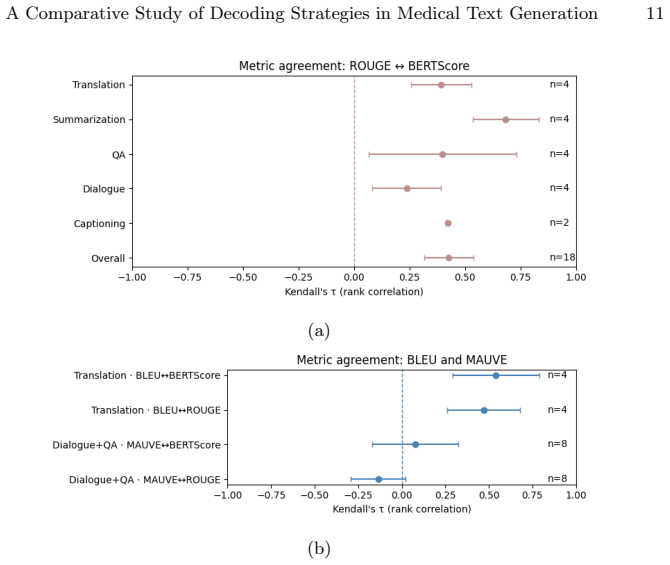
- Medical generation evaluation should not rely on one metric, especially MAUVE, which agrees weakly with ROUGE and BERTScore and is highly sensitive to decoding choice.
Reading between the lines
- A practical extension the paper leaves implicit is a decoding-sensitivity score for model selection: reporting cross-strategy variance alongside mean performance would reveal whether a model's score depends on a lucky decoder setting.
- The stronger sensitivity of medical models could stem from a flattening of output distributions on out-of-domain prompts; measuring predictive entropy across strategies and models would test that mechanism directly.
- The cleanest test of the ranking is a held-out replication with larger medical corpora; if beam search's advantage persists once on-sample tuning is removed, it becomes a robust deployment rule.
Editorial analysis
A structured set of objections, weighed in public.
Referee Report
Summary. The paper reports an empirical study of 11 decoding strategies applied to five open-ended medical text-generation tasks: translation, summarization, question answering, dialogue, and image captioning. Per task, the authors evaluate four LLMs (plus two multimodal models for captioning) on 100 samples, using ROUGE, BERTScore, BLEU, and MAUVE. The main claims are that deterministic/search-based decoding strategies (especially beam search) generally outperform stochastic sampling, that slower methods tend to be higher quality, that larger models are more performant but not more robust to decoding choice, that medical LLMs are significantly more sensitive to decoding strategy than general-purpose models, and that MAUVE diverges from ROUGE/BERTScore. The paper concludes that decoding strategy can be as important as model choice in medical applications.
Significance. If these conclusions were established, they would be practically important: decoding configurations are cheap to change at deployment and could affect safety in clinical text generation. The paper also provides a useful comparison of inference time across decoding strategies and a metric-agreement analysis, and it promises code and full result tables, which is a reproducibility strength. However, the headline findings are not yet reliable because the evaluation protocol selects hyperparameters and per-task models on the same 100-sample evaluation set used for the final ranking and statistical tests. This test-set overfitting risk directly affects the strategy ranking, the deterministic-vs-stochastic gap, the medical-sensitivity result, and the model-vs-decoding comparison. The manuscript is therefore a promising empirical contribution that requires a substantially revised evaluation design before its central claims can be accepted.
major comments (4)
- [§3.2, Table 1; §3.1] The central evaluation protocol is circular with respect to the final ranking. Section 3.2 states 'we explored a range of hyperparameters for each method and selected those that yielded the best performance for our final analysis,' and Table 1 lists up to five candidate values per strategy. Section 3.1 selects per-task models by greedy performance on the same tasks. With only 100 samples per task and small reported score differences (e.g., summarization ROUGE 0.2252 greedy vs 0.2374 BS; QA ROUGE 0.3839 vs 0.4197 in Table 2), selecting the best operating point on the evaluation set can create spurious gaps. The Friedman/Wilcoxon tests in §4.1 and the Levene/Brown-Forsythe comparisons in §4.2 are all computed on these post-selection data, so their p-values do not account for the selection step. The authors must either use a separate validation split or nested cross-validation for hyperpara
- [§4.1] The statistical presentation is internally inconsistent and needs correction. The Friedman test reports n=16 blocks, while the Wilcoxon tests report n=18; the block definition is never stated. The paper reports five significant strategy pairs after Holm correction, but the per-task Wilcoxon tests then find 'no statistically significant differences between individual strategy pairs'; this may be due to power or pooling, but the manuscript does not reconcile the two analyses. The deterministic-vs-stochastic test reports ΔROUGE=0.0029, which is tiny; its practical significance is not discussed. The repeated 'n=18, W=10, n=18' in the same sentence is also a typographical error. Please clarify the block structure, report effect sizes and confidence intervals, and state how the selection step in §3.2 affects these p-values.
- [§6; §5] The conclusion that 'the impact of the decoding strategy can be as significant as the choice of the LLM itself' is not supported by any reported analysis. No variance decomposition, ANOVA, or direct model-vs-decoding comparison is presented; the ROUGE tables show strategy differences of a few points and model differences that are also task-dependent. This sentence in the Conclusion (and the related interpretation in Section 5) should either be removed or substantiated by a quantitative comparison of the variance attributable to models versus decoding strategies.
- [§4.2] The claim that medical LLMs are 'significantly more sensitive to the selected decoding method' rests on Levene and Brown-Forsythe tests applied to coefficient-of-variation values computed per task×model block. These observations are not independent: the same model appears in multiple tasks, and models were pre-selected by greedy performance in §3.1. Moreover, the CVs are computed using the hyperparameters selected in §3.2, so the greater variability for medical models could be an artifact of the selected operating points rather than an intrinsic property. A repeated-measures analysis, or a sensitivity analysis over all tested hyperparameter values rather than only the best ones, is needed before this conclusion can be accepted.
minor comments (5)
- [Table 2] The caption says 'bold values indicate the highest result for that model,' but the bold values appear to be the best score per task column, not per model. Please clarify.
- [§3.2] The DoLa implementation is described only as layer choice 'low/high.' Please specify which layers were compared and how 'low' and 'high' were defined for each model.
- [§4.1] The sentence describing the deterministic-vs-stochastic test contains 'n = 18, W = 10, n = 18' with redundant n; also the earlier per-strategy Wilcoxon results repeat 'n = 18' after W values. Clean up the notation.
- [§4.3] The MAUVE analysis reports weak or negative correlation with ROUGE and BERTScore. Given that MAUVE measures distributional similarity and is computed on only 100 samples, please add confidence intervals and discuss how sample size affects these correlations.
- [§6] The sample-size limitation is acknowledged in the final paragraph, but confidence intervals are missing throughout Sections 4 and 5. Adding them is important because many of the headline differences are small (e.g., ΔROUGE=0.0029).
Circularity Check
No circularity: the paper's empirical comparisons are not derived from their inputs by construction, though the evaluation design has a selection-bias limitation.
full rationale
The paper is an empirical benchmark study; its central findings are measured comparisons, not derivations from stated axioms. The hyperparameter search in Section 3.2 ('we explored a range of hyperparameters for each method and selected those that yielded the best performance for our final analysis') and the per-task model selection in Section 3.1 are performed on the same 100-sample benchmarks used for the final rankings. This is a serious methodological limitation: it risks selection bias and invalidates the reported p-values because the selection step is not accounted for. However, it is not circular in the sense defined here: the reported strategy scores are not by construction equal to the selection criterion across strategies; the final ranking is not predetermined by the fitting procedure; and no load-bearing self-citation or uniqueness claim is invoked. The conclusion that 'deterministic, search-based decoding strategies generally produce higher quality results' is a contingent empirical outcome, not an identity. The acknowledged limitations (small sample size, lack of repetition-penalty analysis) are correctly stated as limitations, not hidden circular assumptions. Therefore no specific circular step can be exhibited, and the circularity score is 0.
Assumptions & free parameters
free parameters (11)
- Beam size (BS) =
not reported; chosen by best performance
- DBS beam size and diversity penalty =
not reported; chosen by best performance
- CS penalty alpha and candidate pool k =
alpha not reported; k fixed at 6
- DoLa layer choice =
not reported; low or high
- Temperature =
not reported; one of 0.3, 0.5, 0.7, 0.9
- Top-p threshold =
not reported; one of 0.8, 0.85, 0.9, 0.95
- Top-k pool size =
not reported; one of 5, 25, 50, 100
- Min-p threshold =
not reported; one of 0.05, 0.1, 0.3, 0.5
- Eta cutoff threshold =
not reported; one of 0.0003, 0.0006, 0.0009, 0.002, 0.004
- Typicality threshold =
not reported; one of 0.2, 0.5, 0.9, 0.95
- Per-task model choice =
varies by task; based on greedy decoding performance
assumptions (5)
- domain assumption Automatic text metrics (ROUGE, BERTScore, BLEU, MAUVE) are valid proxies for medical output quality
- domain assumption 100 samples per task are representative of the medical task distribution
- domain assumption Task x model blocks can be treated as repeated measures for Friedman and Wilcoxon tests
- ad hoc to paper The hyperparameter ranges in Table 1 give each decoding strategy a comparable chance to perform well
- domain assumption Standard or unspecified prompt templates yield valid task evaluations
Cite this review
Pith. "Pith review of A Comparative Study of Decoding Strategies in Medical Text Generation." pith.science (2026). https://pith.science/paper/HIBVZWQY
@misc{pith2026250813580,
  author       = {Pith},
  title        = {Pith review of: A Comparative Study of Decoding Strategies in Medical Text Generation},
  year         = {2026},
  howpublished = {\url{https://pith.science/paper/HIBVZWQY}},
  note         = {Machine review of arXiv:2508.13580}
}
read the original abstract
Large Language Models (LLMs) rely on various decoding strategies to generate text, and these choices can significantly affect output quality. In healthcare, where accuracy is critical, the impact of decoding strategies remains underexplored. We investigate this effect in five open-ended medical tasks, including translation, summarization, question answering, dialogue, and image captioning, evaluating 11 decoding strategies with medically specialized and general-purpose LLMs of different sizes. Our results show that deterministic strategies generally outperform stochastic ones: beam search achieves the highest scores, while {\eta} and top-k sampling perform worst. Slower decoding methods tend to yield better quality. Larger models achieve higher scores overall but have longer inference times and are no more robust to decoding. Surprisingly, while medical LLMs outperform general ones in two of the five tasks, statistical analysis shows no overall performance advantage and reveals greater sensitivity to decoding choice. We further compare multiple evaluation metrics and find that correlations vary by task, with MAUVE showing weak agreement with BERTScore and ROUGE, as well as greater sensitivity to the decoding strategy. These results highlight the need for careful selection of decoding methods in medical applications, as their influence can sometimes exceed that of model choice.
Figures


Reference graph
Works this paper leans on
-
[1]
Cognitive science9(1), 147–169 (1985)
Ackley, D.H., Hinton, G.E., Sejnowski, T.J.: A learning algorithm for boltzmann machines. Cognitive science9(1), 147–169 (1985)
work page 1985
-
[2]
Decoding Decoded: Understanding Hyperparameter Effects in Open-Ended Text Generation
Arias, E.G., Li, M., Heumann, C., Aßenmacher, M.: Decoding decoded: Under- standing hyperparameter effects in open-ended text generation. arXiv preprint arXiv:2410.06097 (2024)
work page Pith review arXiv 2024
-
[3]
In: Proceedings of the 2024 CHI Conference on Human Factors in Computing Systems
Calle, P., Shao, R., Liu, Y., Hébert, E.T., Kendzor, D., Neil, J., Businelle, M., Pan, C.: Towards ai-driven healthcare: systematic optimization, linguistic analysis, and clinicians’ evaluation of large language models for smoking cessation interventions. In: Proceedings of the 2024 CHI Conference on Human Factors in Computing Systems. pp. 1–16 (2024)
work page 2024
-
[4]
Chuang, Y.S., Xie, Y., Luo, H., Kim, Y., Glass, J., He, P.: Dola: Decoding by contrasting layers improves factuality in large language models (2024), https: //arxiv.org/abs/2309.03883
arXiv 2024
-
[5]
Cohan, A., Dernoncourt, F., Kim, D.S., Bui, T., Kim, S., Chang, W., Goharian, N.: A discourse-aware attention model for abstractive summarization of long doc- uments. In: Proceedings of the 2018 Conference of the North American Chapter of the Association for Computational Linguistics: Human Language Technologies, Volume 2 (Short Papers). pp. 615–621. Asso...
-
[6]
Fan, A., Lewis, M., Dauphin, Y.: Hierarchical neural story generation (2018), https://arxiv.org/abs/1805.04833
arXiv 2018
-
[7]
In: Proceedings of the First Workshop on Neural Machine Translation
Freitag, M., Al-Onaizan, Y.: Beam search strategies for neural machine translation. In: Proceedings of the First Workshop on Neural Machine Translation. pp. 56–60. Association for Computational Linguistics, Copenhagen, Denmark (2017).https: //doi.org/10.18653/v1/W17-3207
-
[8]
Google: Introducing gemini: our largest and most capable ai model (2023),https: //blog.google/technology/ai/google-gemini-ai/
work page 2023
Show all 29 references
-
[9]
Information Fusion118, 102963 (2025)
He, K., Mao, R., Lin, Q., Ruan, Y., Lan, X., Feng, M., Cambria, E.: A survey of large language models for healthcare: from data, technology, and applications to accountability and ethics. Information Fusion118, 102963 (2025)
2025
-
[10]
In: Goldberg, Y., Kozareva, Z., Zhang, Y
Hewitt, J., Manning, C., Liang, P.: Truncation sampling as language model desmoothing. In: Goldberg, Y., Kozareva, Z., Zhang, Y. (eds.) Findings of the Association for Computational Linguistics: EMNLP 2022. pp. 3414–3427. As- sociation for Computational Linguistics, Abu Dhabi,...
2022 doi
-
[11]
Holtzman, A., Buys, J., Du, L., Forbes, M., Choi, Y.: The curious case of neural text degeneration (2020),https://arxiv.org/abs/1904.09751
2020 arXiv
-
[12]
In: Webber, B., Cohn, T., He, Y., Liu, Y
Kong, L., Jiang, H., Zhuang, Y., Lyu, J., Zhao, T., Zhang, C.: Calibrated language model fine-tuning for in- and out-of-distribution data. In: Webber, B., Cohn, T., He, Y., Liu, Y. (eds.) Proceedings of the 2020 Conference on Empirical Methods in Natural Language Processing (E...
2020 doi
-
[13]
In: International Conference on Machine Learning
Leviathan, Y., Kalman, M., Matias, Y.: Fast inference from transformers via spec- ulative decoding. In: International Conference on Machine Learning. pp. 19274– 19286. PMLR (2023) 14 O. Presacan et al
2023
-
[14]
Transactions of the Association for Computational Linguistics 11, 102–121 (2023)
Meister, C., Pimentel, T., Wiher, G., Cotterell, R.: Locally typical sampling. Transactions of the Association for Computational Linguistics 11, 102–121 (2023). https://doi.org/10.1162/tacl_a_00536, https://aclanthology.org/ 2023.tacl-1.7/
2023 doi
-
[15]
Nguyen, M.N., Baker, A., Neo, C., Roush, A., Kirsch, A., Shwartz-Ziv, R.: Turning up the heat: Min-p sampling for creative and coherent llm outputs (2025),https: //arxiv.org/abs/2407.01082
2025
-
[16]
arXiv preprint arXiv:2303.13375 (2023)
Nori, H., King, N., McKinney, S.M., Carignan, D., Horvitz, E.: Capabilities of gpt-4 on medical challenge problems. arXiv preprint arXiv:2303.13375 (2023)
2023 arXiv
-
[17]
OpenAI: Introducing gpt-4o (2024), https://openai.com/index/ gpt-4o-and-more-tools-to-chatgpt-free/
2024
-
[18]
Rückert, J., Bloch, L., Brüngel, R., Idrissi-Yaghir, A., Schäfer, H., Schmidt, C.S., Koitka, S., Pelka, O., Ben Abacha, A., Seco de Herrera, A.G., Müller, H., Horn, P.A., Nensa, F., Friedrich, C.M.: ROCOv2: Radiology Objects in Context Ver- sion 2, an Updated Multimodal Image ...
2024
-
[19]
arXiv preprint arXiv:2402.06925 (2024)
Shi, C., Yang, H., Cai, D., Zhang, Z., Wang, Y., Yang, Y., Lam, W.: A thorough ex- amination of decoding methods in the era of llms. arXiv preprint arXiv:2402.06925 (2024)
2024 arXiv
-
[20]
Stribling, D., Xia, Y., Amer, M.K., Graim, K.S., Mulligan, C.J., Renne, R.: The modelstudent:Gpt-4performanceongraduatebiomedicalscienceexams.Scientific Reports 14(1), 5670 (2024)
2024
-
[21]
In: Proceedings of the 36th International Conference on Neural Information Processing Systems
Su, Y., Lan, T., Wang, Y., Yogatama, D., Kong, L., Collier, N.: A contrastive framework for neural text generation. In: Proceedings of the 36th International Conference on Neural Information Processing Systems. NIPS ’22, Curran Asso- ciates Inc. (2022)
2022
-
[22]
Briefings in Bioinformatics25(1) (2023)
Tian, S., Jin, Q., Yeganova, L., Lai, P.T., Zhu, Q., Chen, X., Yang, Y., Chen, Q., Kim, W., Comeau, D.C., et al.: Opportunities and challenges for chatgpt and large language models in biomedicine and health. Briefings in Bioinformatics25(1) (2023)
2023
-
[23]
Vaswani,A.,Shazeer,N.,Parmar,N.,Uszkoreit,J.,Jones,L.,Gomez,A.N.,Kaiser, L., Polosukhin, I.: Attention Is All You Need (2023),https://arxiv.org/abs/ 1706.03762
2023 arXiv
-
[24]
In: Pro- ceedings of the Thirty-Second AAAI Conference on Artificial Intelligence (AAAI- 18)
Vijayakumar, A.K., Cogswell, M., Selvaraju, R.R., Sun, Q., Lee, S., Crandall, D.J., Batra, D.: Diverse beam search for improved description of complex scenes. In: Pro- ceedings of the Thirty-Second AAAI Conference on Artificial Intelligence (AAAI- 18). pp. 7371–7379. AAAI Pres...
2018
-
[25]
Authorea Preprints (2025)
Wang, H., Xu, X., Philip, S.Y., Shu, K.: Beyond tokens: A survey on decoding methods for large language models and large vision-language models. Authorea Preprints (2025)
2025
-
[26]
Transactions of the Association for Computational Linguistics10, 997–1012 (2022)
Wiher, G., Meister, C., Cotterell, R.: On decoding strategies for neural text gener- ators. Transactions of the Association for Computational Linguistics10, 997–1012 (2022)
2022
-
[27]
MedRxiv (2023)
Xie, Q., Schenck, E.J., Yang, H.S., Chen, Y., Peng, Y., Wang, F.: Faithful ai in medicine: a systematic review with large language models and beyond. MedRxiv (2023)
2023
-
[28]
arXiv preprint arXiv:2410.21348 (2024)
Yan, L.K., Niu, Q., Li, M., Zhang, Y., Yin, C.H., Fei, C., Peng, B., Bi, Z., Feng, P., Chen, K., et al.: Large language model benchmarks in medical tasks. arXiv preprint arXiv:2410.21348 (2024)
2024
-
[29]
arXiv preprint arXiv:2004.10450 (2020)
Zhang, H., Duckworth, D., Ippolito, D., Neelakantan, A.: Trading off diversity and quality in natural language generation. arXiv preprint arXiv:2004.10450 (2020)
2004 arXiv
Reviewed August 5, 2026 · model on record in the stance chip above.
Discussion (0). Sign in to comment.