REVIEW 3 major objections 5 minor 90 references
DIME-Net claims that a single network, trained once on a blend of low-light and backlit pairs, can adaptively enhance both types of images without retraining.
Reviewed by Pith at T0; open to challenge. T0 means a machine referee read the full paper against a public rubric. the ladder, T0–T4 →
A single Retinex-based network with sparse mixture-of-experts tone curves, trained on a mixed low-light/backlit dataset, improves PSNR/SSIM/LPIPS on LOLv1 and BAID without dataset-specific retraining.
T0 review reviewed 2026-08-05 challenge →
load-bearing objection The architecture is coherent and the MixBL dataset is a useful artifact, but the unstated BAID/MixBL split overlap is a real leak risk that must be fixed before the cross-dataset generalization claim holds. the 3 major comments →
DIME-Net: A Dual-Illumination Adaptive Enhancement Network Based on Retinex and Mixture-of-Experts
The pith
A machine-rendered reading of the paper's core claim, the machinery that carries it, and where it could break.
The reading
Core claim
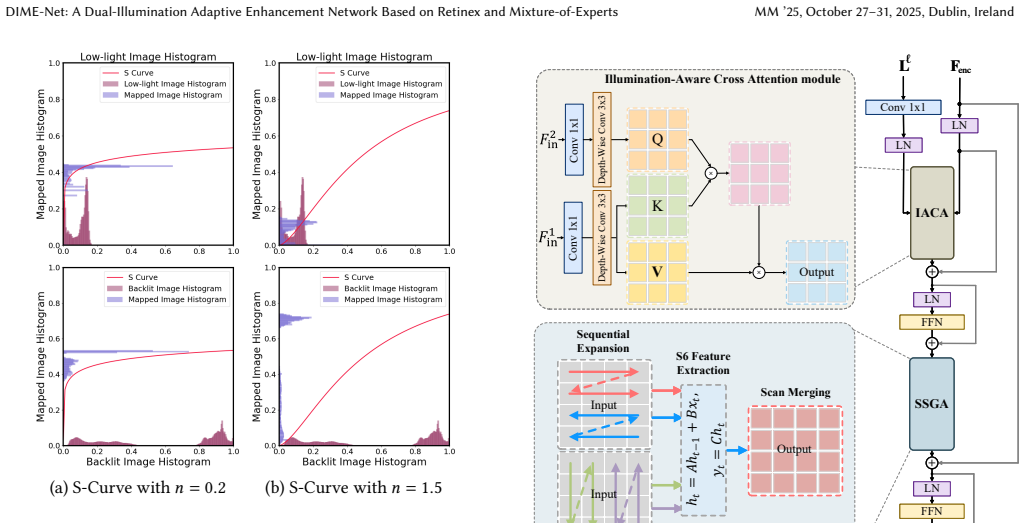
Central claim: one network handles both low-light and backlit enhancement by choosing among a family of S-curve tone mappings rather than one fixed curve. The image is modeled as reflectance times illumination plus disturbances; a compensation map satisfying $\bar{L} \odot L = 1$ recasts enhancement as estimating illumination compensation and a residual degradation C. A top-k sparse gate over 16 S-curve experts lets single-peak dark images and dual-peak backlit images receive different curves. A U-Net damage restorer with illumination-aware cross-attention and sequential-state global attention removes C. Trained once on MixBL and tested without retraining, DIME-Net reports 26.05 dB PSNR on LOLv1 and 25
What carries the argument
The load-bearing component is the Mixture-of-Experts illumination estimator. It contains 16 parameterized S-curve experts, each a nonlinear intensity mapping $f(\sigma,n)=\frac{I^n}{I^n+\sigma^n}$ with a different n, and a top-k sparse gating network that reads the input's mean RGB and produces a softmax weight vector over experts. Around this, the Retinex identity $I \odot \bar{L} = R + C$ (with $\bar{L} \odot L = 1$) provides the justification: estimating the compensation map $\bar{L}$ and the degradation C separates brightness correction from artifact removal. The damage restorer—a U-Net with Illumination-Aware Cross Attention and Sequential-State Global Attention—carries out the artifact removal. The whole design exists so that
Load-bearing premise
The central claim assumes the BAID images randomly chosen for MixBL training do not overlap the BAID test images used for evaluation; if the sets overlap, the reported backlit generalization numbers are inflated.
What would settle it
Compute the intersection between the 600 BAID training images sampled for MixBL and BAID's official 368 test images; any overlap would invalidate the cross-dataset BAID result. Separately, test DIME-Net on a single image with an overexposed background and underexposed foreground: true dual-illumination adaptivity requires both regions to be restored at once, not just a global brightness adjustment.
If this is right
- A single checkpoint can serve both low-light and backlit inputs, so an enhancement pipeline does not need to first classify the degradation type.
- Joint training on mixed data is a viable route: the MixBL-trained model reaches 26.05 dB PSNR on LOLv1 and 25.02 dB on BAID without retraining, competitive with single-dataset specialists in the paper's comparisons.
- The diversity of the expert curves is what preserves adaptivity: the ablation shows that using only n<1 or only n>1 S-curves degrades LOLv1 performance, while the full 16-expert set keeps it high.
- The damage restorer is essential to the result: without it, LOLv1 PSNR drops from 26.05 to 9.325 dB, so illumination estimation alone does not produce clean images.
- MixBL can serve as a common training/evaluation mix for future methods claiming joint low-light and backlit enhancement.
Where Pith is reading between the lines
- The gating signal is a single global average RGB value, so the model's notion of 'illumination characteristics' is coarse; extending the gate to spatial or histogram features would be a natural way to handle images that are half dark and half bright.
- The same recipe—Mixture-of-Experts over parameterized tone curves inside a Retinex estimation loop—could transfer to other degradations with distinct intensity distributions, such as haze, shadows, or underwater scenes.
- A stiffer test of the no-retraining claim would be a mixed scene containing both low-light and backlit regions simultaneously; current benchmarks categorize whole images, so they do not fully exercise the sparse gate's per-image choice.
Editorial analysis
A structured set of objections, weighed in public.
Referee Report
Summary. The paper proposes DIME-Net, a Retinex-based enhancement network with a Mixture-of-Experts illumination estimator that uses 16 parameterized S-curve experts and top-k sparse gating, together with a U-Net damage restorer containing Illumination-Aware Cross Attention and Sequential-State Global Attention. To train one model for both degradations, the authors construct a hybrid dataset, MixBL, from low-light (LOLv2) and backlit (BAID) images. The paper reports quantitative comparisons on MixBL, external evaluation on LOLv1, held-out evaluation on BAID, and ablations of each module, claiming that a single DIME-Net model generalizes to both low-light and backlit images without retraining.
Significance. If the claims hold, a single model that handles both low-light and backlit enhancement is practically significant, and the S-curve MoE with sparse gating is a plausible mechanism for adapting to different illumination modes. The paper has real strengths: it proposes a new hybrid training set, retrains the baselines on that set, includes a cross-dataset test on LOLv1, and provides ablations isolating the MoE, illumination estimator, and damage restorer. However, the central generalization claim currently rests on an under-specified dataset split, the backlit part of the claim is not cross-dataset, and all metrics are single-run numbers without released code or data. These issues are load-bearing for the headline claim and need to be resolved.
major comments (3)
- [§4.1, Tables 1 and 2(b)] The MixBL construction is not specified precisely enough to rule out train/test leakage. The text says the training set includes '600 backlit images randomly selected from BAID' and the test set includes '200 BAID images, all randomly sampled', and then says the original BAID split is 2500:368. It is never stated that the 600 training images were drawn exclusively from the 2500-image BAID training split, nor that the 200 MixBL test images are disjoint from the 600 training images and from the 368-image BAID test split. Table 2(b) evaluates the MixBL-trained model on the BAID 368 test set; if any of the 600 training images overlap that test set, the reported PSNR of 25.02 dB is not a valid generalization result. The same ambiguity applies to the LOLv2 sampling used for Table 1. The authors must state the exact provenance of every MixBL train/test image and confirm disjointness, ideally by
- [Abstract, §4.5, Table 2(b)] The 'without retraining' claim is asymmetric across the two degradations. For low-light, the model is trained on LOLv2 and evaluated on the external LOLv1 test set, which is a genuine cross-dataset test. For backlit, both training and test come from BAID: 600 BAID training images versus the 368-image BAID test split. The BAID result therefore demonstrates held-out performance within one dataset, not generalization to an unseen backlit dataset. The paper should either evaluate on a separate backlit dataset or substantially temper the wording that it generalizes to backlit datasets without retraining.
- [§4.2–4.6, Tables 1–3] All quantitative claims are based on single training runs, with no error bars, no seeds, and no release of code or data. Several headline improvements are small relative to expected run-to-run variation: DIME-Net vs. RetinexFormer is +0.86 dB on MixBL, +0.70 dB on BAID, and +0.89 dB on LOLv1, and on BAID the reported BacklitNet PSNR of 25.06 actually exceeds DIME-Net's 25.02. Reporting mean±std over multiple runs, or at least a significance test, is needed to support the claim that these margins are meaningful. Without split lists and code/data, the central generalization claim cannot be independently checked.
minor comments (5)
- [§3.2, Eqs. (7)–(8)] The symbol n denotes both the S-curve exponent in Eq. (7) and the number of experts in the summation in Eq. (8). Using the same letter in two roles is confusing; please use distinct symbols.
- [§3.1, Eqs. (5)–(6)] Eq. (6) uses F_L^(1) and F_L^(2), but Eq. (5) only defines F_L. Please clarify the relationship between F_L, its intermediate features L_l, and the superscripted outputs.
- [§2.4, reference [11]] The text says 'Sun et al.' for the multi-modal fusion method, but the cited paper's first author is Bing Cao. Please align the citation.
- [§4.1] The 'randomly sampled' selections for MixBL have no seed. Provide a fixed split for exact reproducibility.
- [§1, Figure 2] The caption says '1,000 randomly sampled images from LOL and BAID' without specifying per-dataset counts or whether the samples come from train or test partitions. Please state these details.
Circularity Check
No significant circularity: DIME-Net is an empirical network evaluation grounded in external benchmarks; the dataset-overlap ambiguity is a leakage risk, not circularity.
full rationale
DIME-Net is an empirical network paper. The Retinex-based formulation (Eqs. 1–6) is an algebraic decomposition that introduces the compensation map L̄ and degradation term C as definitions; the network is then trained to estimate these quantities, so there is no claim that the model derives a result from its own output. The MoE S-curve experts (Eqs. 7–10) are parameterized nonlinear mappings with a learned sparse gate; the paper does not fit a parameter to a benchmark and then call the benchmark a prediction. Cross-dataset evaluations on LOLv1 and BAID are against held-out or external splits, and the baselines are retrained under the same MixBL condition. The only concern is a reproducibility ambiguity: Section 4.1 does not explicitly state that the 600 BAID training images and 200 BAID test images in MixBL are disjoint from BAID's original 2500:368 split, which could inflate generalization numbers if overlap exists. That is a data-integrity/leakage risk, not circularity. There are no self-citations that carry a load-bearing argument, and no uniqueness theorem is imported from the authors. Hence no circular step.
Axiom & Free-Parameter Ledger
free parameters (5)
- S-curve exponent n per expert (16 values) =
not reported; described only as n<1 and n>1
- S-curve sigma per expert =
not reported
- Top-k gate sparsity =
not reported
- Loss weights (L1, SSIM, VGG) =
1.0, 0.5, 0.1
- MixBL training composition =
800 low-light (600 real, 200 synthetic) + 600 backlit; 400 test images
axioms (6)
- domain assumption Image I decomposes as R⊙L under Retinex theory (Eq. 1).
- domain assumption Degradations enter as additive disturbances R_hat and L_hat in the Retinex decomposition (Eq. 2).
- ad hoc to paper The residual term C in I⊙L_bar = R + C can be estimated by a U-Net from I⊙L_bar and illumination features L_l (Eqs. 4-6).
- ad hoc to paper The 16 S-curve tone mappings with varying n span the illumination transformations needed for both low-light and backlit images (Eqs. 7-8).
- ad hoc to paper Global average RGB I* is a sufficient gating signal to distinguish low-light from backlit images (Eq. 9).
- domain assumption LOLv2 and BAID paired data provide reliable ground truth for supervised training.
Cite this review
Pith. "Pith review of DIME-Net: A Dual-Illumination Adaptive Enhancement Network Based on Retinex and Mixture-of-Experts." pith.science (2026). https://pith.science/paper/GUEAMPI4
@misc{pith2026250813921,
  author       = {Pith},
  title        = {Pith review of: DIME-Net: A Dual-Illumination Adaptive Enhancement Network Based on Retinex and Mixture-of-Experts},
  year         = {2026},
  howpublished = {\url{https://pith.science/paper/GUEAMPI4}},
  note         = {Machine review of arXiv:2508.13921}
}
read the original abstract
Image degradation caused by complex lighting conditions such as low-light and backlit scenarios is commonly encountered in real-world environments, significantly affecting image quality and downstream vision tasks. Most existing methods focus on a single type of illumination degradation and lack the ability to handle diverse lighting conditions in a unified manner. To address this issue, we propose a dual-illumination enhancement framework called DIME-Net. The core of our method is a Mixture-of-Experts illumination estimator module, where a sparse gating mechanism adaptively selects suitable S-curve expert networks based on the illumination characteristics of the input image. By integrating Retinex theory, this module effectively performs enhancement tailored to both low-light and backlit images. To further correct illumination-induced artifacts and color distortions, we design a damage restoration module equipped with Illumination-Aware Cross Attention and Sequential-State Global Attention mechanisms. In addition, we construct a hybrid illumination dataset, MixBL, by integrating existing datasets, allowing our model to achieve robust illumination adaptability through a single training process. Experimental results show that DIME-Net achieves competitive performance on both synthetic and real-world low-light and backlit datasets without any retraining. These results demonstrate its generalization ability and potential for practical multimedia applications under diverse and complex illumination conditions.
Figures




Reference graph
Works this paper leans on
-
[1]
Mohammad Abdullah-Al-Wadud, Md Hasanul Kabir, M Ali Akber Dewan, and Oksam Chae. 2007. A dynamic histogram equalization for image contrast en- hancement.IEEE transactions on consumer electronics53, 2 (2007), 593–600
2007
-
[2]
Masato Akai, Yoshiaki Ueda, Takanori Koga, and Noriaki Suetake. 2021. A Single Backlit Image Enhancement Method For Improvement Of Visibility Of Dark Part. In2021 IEEE International Conference on Image Processing (ICIP). 1659–1663. doi:10.1109/ICIP42928.2021.9506526
arXiv 2021
- [3]
-
[4]
Alaaeldin Ali, Hugo Touvron, Mathilde Caron, Piotr Bojanowski, Matthijs Douze, Armand Joulin, Ivan Laptev, Natalia Neverova, Gabriel Synnaeve, Jakob Verbeek, et al. 2021. Xcit: Cross-covariance image transformers.Advances in neural information processing systems34 (2021), 20014–20027
2021
-
[5]
Anurag Arnab, Mostafa Dehghani, Georg Heigold, Chen Sun, Mario Lučić, and Cordelia Schmid. 2021. Vivit: A video vision transformer. InProceedings of the IEEE/CVF international conference on computer vision. 6836–6846
2021
-
[6]
Jiesong Bai, Yuhao Yin, Qiyuan He, Yuanxian Li, and Xiaofeng Zhang. 2024. Retinexmamba: Retinex-based mamba for low-light image enhancement.arXiv preprint arXiv:2405.03349(2024)
Pith/arXiv arXiv 2024
- [7]
- [8]
-
[9]
Weilin Cai, Juyong Jiang, Fan Wang, Jing Tang, Sunghun Kim, and Jiayi Huang
-
[10]
Yuanhao Cai, Hao Bian, Jing Lin, Haoqian Wang, Radu Timofte, and Yulun Zhang
-
[11]
Bing Cao, Yiming Sun, Pengfei Zhu, and Qinghua Hu. 2023. Multi-modal gated mixture of local-to-global experts for dynamic image fusion. InProceedings of the IEEE/CVF international conference on computer vision. 23555–23564
2023
-
[12]
Hu Cao, Yueyue Wang, Joy Chen, Dongsheng Jiang, Xiaopeng Zhang, Qi Tian, and Manning Wang. 2022. Swin-unet: Unet-like pure transformer for medical image segmentation. InEuropean conference on computer vision. Springer, 205–218
2022
-
[13]
Turgay Celik and Tardi Tjahjadi. 2011. Contextual and variational contrast enhancement.IEEE Transactions on Image Processing20, 12 (2011), 3431–3441
2011
-
[14]
Chen Chen, Qifeng Chen, Jia Xu, and Vladlen Koltun. 2018. Learning to see in the dark. InProceedings of the IEEE conference on computer vision and pattern recognition. 3291–3300
2018
-
[15]
Qili Chen, Junfang Fan, and Wenbai Chen. 2021. An improved image enhancement framework based on multiple attention mechanism.Displays70 (2021), 102091
work page 2021
-
[16]
Xingbo Dong, Wanyan Xu, Zhihui Miao, Lan Ma, Chao Zhang, Jiewen Yang, Zhe Jin, Andrew Beng Jin Teoh, and Jiajun Shen. 2022. Abandoning the bayer-filter to see in the dark. InProceedings of the ieee/cvf conference on computer vision and pattern recognition. 17431–17440
work page 2022
-
[17]
Minhao Fan, Wenjing Wang, Wenhan Yang, and Jiaying Liu. 2020. Integrating semantic segmentation and retinex model for low-light image enhancement. In Proceedings of the 28th ACM international conference on multimedia. 2317–2325
work page 2020
-
[18]
Tatiana Gaintseva, Martin Benning, and Gregory Slabaugh. 2024. RAVE: Residual Vector Embedding for CLIP-Guided Backlit Image Enhancement. doi:10.48550/ arXiv.2404.01889 arXiv:2404.01889 [cs]
work page internal anchor Pith review Pith/arXiv arXiv doi:10.48550/arxiv.2404.01889 2024
-
[19]
Albert Gu and Tri Dao. 2023. Mamba: Linear-time sequence modeling with selective state spaces.arXiv preprint arXiv:2312.00752(2023)
Pith/arXiv arXiv 2023
-
[20]
Albert Gu, Karan Goel, and Christopher Re. 2022. Efficiently Modeling Long Sequences with Structured State Spaces. InInternational Conference on Learning Representations. https://openreview.net/forum?id=uYLFoz1vlAC
work page 2022
-
[21]
Chunle Guo, Chongyi Li, Jichang Guo, Chen Change Loy, Junhui Hou, Sam Kwong, and Runmin Cong. 2020. Zero-reference deep curve estimation for low- light image enhancement. InProceedings of the IEEE/CVF conference on computer vision and pattern recognition. 1780–1789
2020
-
[22]
Jiahao Huang, Liutao Yang, Fanwen Wang, Yinzhe Wu, Yang Nan, Weiwen Wu, Chengyan Wang, Kuangyu Shi, Angelica I Aviles-Rivero, Carola-Bibiane Schön- lieb, et al. 2025. Enhancing global sensitivity and uncertainty quantification in medical image reconstruction with Monte Carlo arbitrary-masked mamba. Medical Image Analysis99 (2025), 103334
work page 2025
-
[23]
Yifan Jiang, Xinyu Gong, Ding Liu, Yu Cheng, Chen Fang, Xiaohui Shen, Jian- chao Yang, Pan Zhou, and Zhangyang Wang. 2021. Enlightengan: Deep light enhancement without paired supervision.IEEE transactions on image processing 30 (2021), 2340–2349
2021
-
[24]
Yeying Jin, Wenhan Yang, and Robby T Tan. 2022. Unsupervised night image enhancement: When layer decomposition meets light-effects suppression. In European Conference on Computer Vision. Springer, 404–421
2022
-
[25]
Diederik P Kingma and Jimmy Ba. 2014. Adam: A method for stochastic opti- mization.arXiv preprint arXiv:1412.6980(2014)
Pith/arXiv arXiv 2014
-
[26]
Edwin H Land and John J McCann. 1971. Lightness and retinex theory.Journal of the Optical society of America61, 1 (1971), 1–11
work page 1971
-
[27]
Chongyi Li, Chunle Guo, and Chen Change Loy. 2021. Learning to enhance low-light image via zero-reference deep curve estimation.IEEE transactions on pattern analysis and machine intelligence44, 8 (2021), 4225–4238
2021
-
[28]
Chongyi Li, Jichang Guo, Fatih Porikli, and Yanwei Pang. 2018. LightenNet: A convolutional neural network for weakly illuminated image enhancement. Pattern recognition letters104 (2018), 15–22
work page 2018
-
[29]
Jiaqian Li, Juncheng Li, Faming Fang, Fang Li, and Guixu Zhang. 2020. Luminance- aware pyramid network for low-light image enhancement.IEEE Transactions on Multimedia23 (2020), 3153–3165
work page 2020
- [30]
-
[31]
Zhenhao Li and Xiaolin Wu. 2017. Learning-based restoration of backlit images. IEEE Transactions on Image Processing27, 2 (2017), 976–986
work page 2017
-
[32]
Jinxiu Liang, Yong Xu, Yuhui Quan, Boxin Shi, and Hui Ji. 2022. Self-supervised low-light image enhancement using discrepant untrained network priors.IEEE Transactions on Circuits and Systems for Video Technology32, 11 (2022), 7332– 7345
work page 2022
-
[33]
Zhexin Liang, Chongyi Li, Shangchen Zhou, Ruicheng Feng, and Chen Change Loy. 2023. Iterative prompt learning for unsupervised backlit image enhancement. InProceedings of the IEEE/CVF International Conference on Computer Vision. 8094– 8103
work page 2023
-
[34]
Seokjae Lim and Wonjun Kim. 2020. DSLR: Deep stacked Laplacian restorer for low-light image enhancement.IEEE Transactions on Multimedia23 (2020), 4272–4284
work page 2020
-
[35]
Risheng Liu, Long Ma, Jiaao Zhang, Xin Fan, and Zhongxuan Luo. 2021. Retinex- inspired unrolling with cooperative prior architecture search for low-light image enhancement. InProceedings of the IEEE/CVF conference on computer vision and pattern recognition. 10561–10570
2021
-
[36]
Yue Liu, Yunjie Tian, Yuzhong Zhao, Hongtian Yu, Lingxi Xie, Yaowei Wang, Qixiang Ye, Jianbin Jiao, and Yunfan Liu. 2024. Vmamba: Visual state space model. Advances in neural information processing systems37 (2024), 103031–103063
2024
-
[37]
Kin Gwn Lore, Adedotun Akintayo, and Soumik Sarkar. 2017. LLNet: A deep au- toencoder approach to natural low-light image enhancement.Pattern Recognition 61 (2017), 650–662
2017
-
[38]
Kun Lu and Lihong Zhang. 2020. TBEFN: A two-branch exposure-fusion network for low-light image enhancement.IEEE Transactions on Multimedia23 (2020), 4093–4105
work page 2020
-
[39]
Feifan Lv, Bo Liu, and Feng Lu. 2020. Fast enhancement for non-uniform il- lumination images using light-weight CNNs. InProceedings of the 28th ACM International Conference on Multimedia. 1450–1458
work page 2020
-
[40]
Feifan Lv, Feng Lu, Jianhua Wu, and Chongsoon Lim. 2018. MBLLEN: Low-light image/video enhancement using cnns.. InBmvc, Vol. 220. Northumbria University, 4
work page 2018
- [41]
-
[42]
Long Ma, Tengyu Ma, Risheng Liu, Xin Fan, and Zhongxuan Luo. 2022. Toward fast, flexible, and robust low-light image enhancement. InProceedings of the IEEE/CVF conference on computer vision and pattern recognition. 5637–5646
2022
-
[43]
2019.PyTorch: an imperative style, high-performance deep learning library
Adam Paszke, Sam Gross, Francisco Massa, Adam Lerer, James Bradbury, Gregory Chanan, Trevor Killeen, Zeming Lin, Natalia Gimelshein, Luca Antiga, Alban Desmaison, Andreas Köpf, Edward Yang, Zach DeVito, Martin Raison, Alykhan Tejani, Sasank Chilamkurthy, Benoit Steiner, Lu Fang, Junjie Bai, and Soumith Chintala. 2019.PyTorch: an imperative style, high-per...
2019
-
[44]
Xiaohuan Pei, Tao Huang, and Chang Xu. 2024. Efficientvmamba: Atrous selective scan for light weight visual mamba.arXiv preprint arXiv:2403.09977(2024)
Pith/arXiv arXiv 2024
-
[45]
Etta D Pisano, Shuquan Zong, Bradley M Hemminger, Marla DeLuca, R Eugene Johnston, Keith Muller, M Patricia Braeuning, and Stephen M Pizer. 1998. Con- trast limited adaptive histogram equalization image processing to improve the detection of simulated spiculations in dense mammograms.Journal of Digital imaging11 (1998), 193–200
work page 1998
-
[46]
Stephen M Pizer, E Philip Amburn, John D Austin, Robert Cromartie, Ari Geselowitz, Trey Greer, Bart ter Haar Romeny, John B Zimmerman, and Karel Zuiderveld. 1987. Adaptive histogram equalization and its variations.Computer vision, graphics, and image processing39, 3 (1987), 355–368
work page 1987
-
[47]
Wenqi Ren, Sifei Liu, Lin Ma, Qianqian Xu, Xiangyu Xu, Xiaochun Cao, Junping Du, and Ming-Hsuan Yang. 2019. Low-light image enhancement via a deep hybrid network.IEEE Transactions on Image Processing28, 9 (2019), 4364–4375
work page 2019
-
[48]
Ali M Reza. 2004. Realization of the contrast limited adaptive histogram equaliza- tion (CLAHE) for real-time image enhancement.Journal of VLSI signal processing MM ’25, October 27–31, 2025, Dublin, Ireland Ziang Wang, Xiaoqin Wang, Dingyi Wang, Qiang Li, & Shushan Qiao systems for signal, image and video technology38 (2004), 35–44
work page 2004
-
[49]
Noam Shazeer, Azalia Mirhoseini, Krzysztof Maziarz, Andy Davis, Quoc Le, Geoffrey Hinton, and Jeff Dean. 2017. Outrageously large neural networks: The sparsely-gated mixture-of-experts layer.arXiv preprint arXiv:1701.06538(2017)
Pith/arXiv arXiv 2017
-
[50]
Alvy Ray Smith. 1978. Color gamut transform pairs.ACM Siggraph Computer Graphics12, 3 (1978), 12–19
work page 1978
-
[51]
Danai Triantafyllidou, Sean Moran, Steven McDonagh, Sarah Parisot, and Gre- gory Slabaugh. 2020. Low light video enhancement using synthetic data produced with an intermediate domain mapping. InComputer vision–ECCV 2020: 16th Eu- ropean conference, glasgow, UK, August 23–28, 2020, proceedings, part XIII 16. Springer, 103–119
work page 2020
- [52]
-
[53]
Ashish Vaswani, Noam Shazeer, Niki Parmar, Jakob Uszkoreit, Llion Jones, Aidan N Gomez, Łukasz Kaiser, and Illia Polosukhin. 2017. Attention is all you need.Advances in neural information processing systems30 (2017)
2017
- [54]
- [55]
-
[56]
Ruixing Wang, Qing Zhang, Chi-Wing Fu, Xiaoyong Shen, Wei-Shi Zheng, and Jiaya Jia. 2019. Underexposed photo enhancement using deep illumination estimation. InProceedings of the IEEE/CVF conference on computer vision and pattern recognition. 6849–6857
work page 2019
-
[57]
Shuang Wang, Qianwen Lu, Boxing Peng, Yihe Nie, and Qingchuan Tao. 2024. DPEC: Dual-Path Error Compensation Method for Enhanced Low-Light Image Clarity.arXiv preprint arXiv:2407.09553(2024)
work page internal anchor Pith review Pith/arXiv arXiv 2024
-
[58]
Tao Wang, Kaihao Zhang, Tianrun Shen, Wenhan Luo, Bjorn Stenger, and Tong Lu. 2023. Ultra-high-definition low-light image enhancement: A benchmark and transformer-based method. InProceedings of the AAAI conference on artificial intelligence, Vol. 37. 2654–2662
2023
-
[59]
Yufei Wang, Renjie Wan, Wenhan Yang, Haoliang Li, Lap-Pui Chau, and Alex Kot. 2022. Low-light image enhancement with normalizing flow. InProceedings of the AAAI conference on artificial intelligence, Vol. 36. 2604–2612
work page 2022
-
[60]
Zhou Wang, Alan C Bovik, Hamid R Sheikh, and Eero P Simoncelli. 2004. Image quality assessment: from error visibility to structural similarity.IEEE transactions on image processing13, 4 (2004), 600–612
2004
-
[61]
Chen Wei, Wenjing Wang, Wenhan Yang, and Jiaying Liu. 2018. Deep retinex decomposition for low-light enhancement.arXiv preprint arXiv:1808.04560(2018)
Pith/arXiv arXiv 2018
-
[62]
Jiangwei Weng, Zhiqiang Yan, Ying Tai, Jianjun Qian, Jian Yang, and Jun Li. 2024. Mamballie: Implicit retinex-aware low light enhancement with global-then-local state space.arXiv preprint arXiv:2405.16105(2024)
Pith/arXiv arXiv 2024
-
[63]
Bichen Wu, Chenfeng Xu, Xiaoliang Dai, Alvin Wan, Peizhao Zhang, Zhicheng Yan, Masayoshi Tomizuka, Joseph E Gonzalez, Kurt Keutzer, and Peter Vajda. 2021. Visual transformers: Where do transformers really belong in vision models?. In Proceedings of the IEEE/CVF International Conference on Computer Vision. 599–609
work page 2021
-
[64]
Wenhui Wu, Jian Weng, Pingping Zhang, Xu Wang, Wenhan Yang, and Jianmin Jiang. 2022. Uretinex-net: Retinex-based deep unfolding network for low-light image enhancement. InProceedings of the IEEE/CVF conference on computer vision and pattern recognition. 5901–5910
2022
-
[65]
Bin Xiao, Yunqiu Xu, Han Tang, Xiuli Bi, and Weisheng Li. 2019. Histogram learn- ing in image contrast enhancement. InProceedings of the IEEE/CVF Conference on Computer Vision and Pattern Recognition Workshops. 0–0
work page 2019
-
[66]
Ke Xu, Xin Yang, Baocai Yin, and Rynson WH Lau. 2020. Learning to restore low- light images via decomposition-and-enhancement. InProceedings of the IEEE/CVF conference on computer vision and pattern recognition. 2281–2290
work page 2020
-
[67]
Rui Xu, Shu Yang, Yihui Wang, Yu Cai, Bo Du, and Hao Chen. 2024. Visual mamba: A survey and new outlooks.arXiv preprint arXiv:2404.18861(2024)
Pith/arXiv arXiv 2024
-
[68]
Xiaogang Xu, Ruixing Wang, Chi-Wing Fu, and Jiaya Jia. 2022. Snr-aware low- light image enhancement. InProceedings of the IEEE/CVF conference on computer vision and pattern recognition. 17714–17724
2022
-
[69]
Kai-Fu Yang, Cheng Cheng, Shi-Xuan Zhao, Hong-Mei Yan, Xian-Shi Zhang, and Yong-Jie Li. 2023. Learning to adapt to light.International Journal of Computer Vision131, 4 (2023), 1022–1041
work page 2023
-
[70]
Wenhan Yang, Shiqi Wang, Yuming Fang, Yue Wang, and Jiaying Liu. 2020. From fidelity to perceptual quality: A semi-supervised approach for low-light image enhancement. InProceedings of the IEEE/CVF conference on computer vision and pattern recognition. 3063–3072
2020
-
[71]
Jing Ye, Changzhen Qiu, and Zhiyong Zhang. 2023. Spatio-temporal propagation and reconstruction for low-light video enhancement.Digital Signal Processing 139 (2023), 104071
work page 2023
-
[72]
Jing Ye, Changzhen Qiu, and Zhiyong Zhang. 2024. A survey on learning-based low-light image and video enhancement.Displays81 (2024), 102614
work page 2024
-
[73]
Syed Waqas Zamir, Aditya Arora, Salman Khan, Munawar Hayat, Fahad Shah- baz Khan, and Ming-Hsuan Yang. 2022. Restormer: Efficient transformer for high-resolution image restoration. InProceedings of the IEEE/CVF conference on computer vision and pattern recognition. 5728–5739
2022
-
[74]
Syed Waqas Zamir, Aditya Arora, Salman Khan, Munawar Hayat, Fahad Shahbaz Khan, Ming-Hsuan Yang, and Ling Shao. 2020. Learning Enriched Features for Real Image Restoration and Enhancement. InComputer Vision – ECCV 2020, Andrea Vedaldi, Horst Bischof, Thomas Brox, and Jan-Michael Frahm (Eds.). Springer International Publishing, Cham, 492–511. doi:10.1007/9...
-
[75]
Lin Zhang, Lijun Zhang, Xiao Liu, Ying Shen, Shaoming Zhang, and Shengjie Zhao. 2019. Zero-shot restoration of back-lit images using deep internal learning. InProceedings of the 27th ACM international conference on multimedia. 1623–1631
work page 2019
-
[76]
Richard Zhang, Phillip Isola, Alexei A Efros, Eli Shechtman, and Oliver Wang
-
[77]
Xuanqi Zhang, Haijin Zeng, Jinwang Pan, Qiangqiang Shen, and Yongyong Chen
-
[78]
Yonghua Zhang, Xiaojie Guo, Jiayi Ma, Wei Liu, and Jiawan Zhang. 2021. Beyond brightening low-light images.International Journal of Computer Vision129 (2021), 1013–1037
work page 2021
-
[79]
Yonghua Zhang, Jiawan Zhang, and Xiaojie Guo. 2019. Kindling the darkness: A practical low-light image enhancer. InProceedings of the 27th ACM international conference on multimedia. 1632–1640
2019
-
[80]
Zhao Zhang, Huan Zheng, Richang Hong, Mingliang Xu, Shuicheng Yan, and Meng Wang. 2022. Deep color consistent network for low-light image enhance- ment. InProceedings of the IEEE/CVF conference on computer vision and pattern recognition. 1899–1908
work page 2022
This paper was first reviewed by deepseek-v4-flash on August 5, 2026.
discussion (0)
Sign in with ORCID, Apple, or X to comment. Anyone can read and Pith papers without signing in.