ERIS: An Energy-Guided Feature Disentanglement Framework for Out-of-Distribution Time Series Classification
Pith reviewed 2026-05-21 23:26 UTC · model grok-4.3
The pith
ERIS uses energy-based semantic guidance to disentangle label-relevant features from domain-specific signals for better out-of-distribution time series classification.
A machine-rendered reading of the paper's core claim, the machinery that carries it, and where it could break.
Core claim
ERIS achieves guided and reliable feature disentanglement for shift-robust time series classification by combining an energy-guided calibration mechanism that supplies semantic direction, a weight-level orthogonality strategy that enforces structural independence between domain-specific and label-relevant features, and an auxiliary adversarial generalization mechanism that enhances robustness through structured perturbations.
What carries the argument
Energy-guided calibration mechanism, which uses energy scores to provide semantic guidance that anchors the separation of domain-specific from label-relevant features.
If this is right
- The separated label-relevant features remain effective when test distributions differ from training, reducing reliance on spurious correlations.
- Orthogonality prevents domain-specific signals from interfering with the invariant features used for classification.
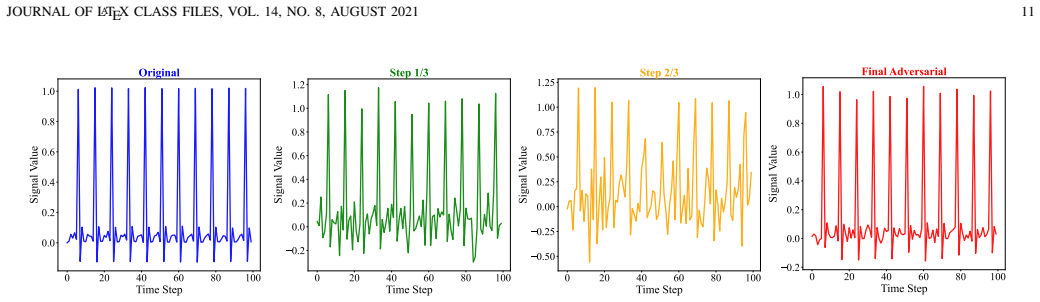
- Adversarial perturbations during training improve generalization to structured variations not seen in the original data.
- The combined mechanisms produce consistent top performance across multiple OOD benchmarks without requiring changes to the base classifier architecture.
Where Pith is reading between the lines
- The same energy-anchored separation idea could be tested on other sequential data such as sensor streams or financial series that face similar distribution shifts.
- Varying the form of the energy function might reveal how tightly the quality of disentanglement depends on the choice of energy measure.
- Once the three mechanisms are in place, the framework could be combined with existing time series architectures to reduce the data requirements for achieving OOD robustness.
Load-bearing premise
The energy function supplies reliable semantic direction that isolates truly universal label-relevant features rather than simply reweighting signals that still depend on training distribution statistics.
What would settle it
Run ERIS and baseline disentanglement methods on a controlled time series benchmark with explicit domain shifts and measure whether ERIS loses its statistically significant top rank; failure to outperform would falsify the value of the energy guidance.
Figures




read the original abstract
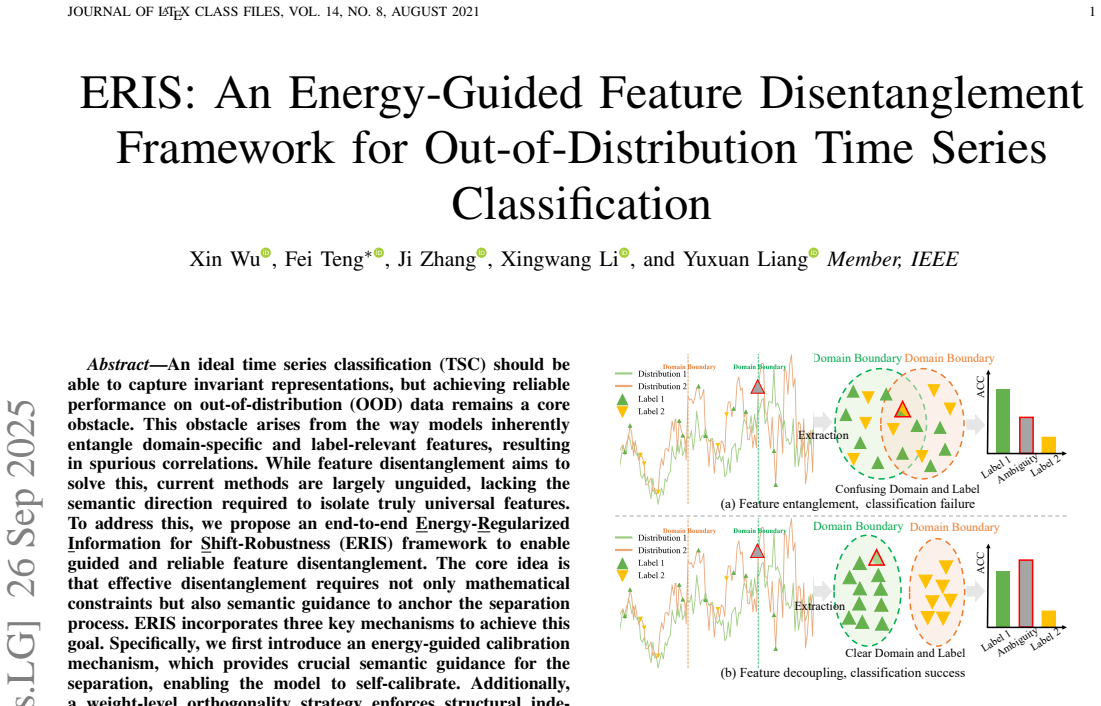
An ideal time series classification (TSC) should be able to capture invariant representations, but achieving reliable performance on out-of-distribution (OOD) data remains a core obstacle. This obstacle arises from the way models inherently entangle domain-specific and label-relevant features, resulting in spurious correlations. While feature disentanglement aims to solve this, current methods are largely unguided, lacking the semantic direction required to isolate truly universal features. To address this, we propose an end-to-end Energy-Regularized Information for Shift-Robustness (ERIS) framework to enable guided and reliable feature disentanglement. The core idea is that effective disentanglement requires not only mathematical constraints but also semantic guidance to anchor the separation process. ERIS incorporates three key mechanisms to achieve this goal. Specifically, we first introduce an energy-guided calibration mechanism, which provides crucial semantic guidance for the separation, enabling the model to self-calibrate. Additionally, a weight-level orthogonality strategy enforces structural independence between domain-specific and label-relevant features, thereby mitigating their interference. Moreover, an auxiliary adversarial generalization mechanism enhances robustness by injecting structured perturbations. Experiments across four benchmarks demonstrate that ERIS achieves a statistically significant improvement over state-of-the-art baselines, consistently securing the top performance rank.
Editorial analysis
A structured set of objections, weighed in public.
Referee Report
Summary. The paper proposes the ERIS (Energy-Regularized Information for Shift-Robustness) framework for out-of-distribution time series classification. It introduces an energy-guided calibration mechanism to supply semantic guidance for disentangling domain-specific and label-relevant features, a weight-level orthogonality strategy to enforce structural independence between these features, and an auxiliary adversarial generalization mechanism that injects structured perturbations for enhanced robustness. The central empirical claim is that experiments across four benchmarks show ERIS achieving statistically significant improvements over state-of-the-art baselines and consistently securing the top performance rank.
Significance. If the empirical results hold and the energy-guided calibration demonstrably isolates invariant label-relevant features rather than reweighting source-domain signals, the work would advance OOD generalization for time series by addressing the lack of semantic direction in prior unguided disentanglement methods. The combination of self-calibrating energy functions with orthogonality and adversarial regularizers could provide a practical template for reducing spurious correlations in TSC applications.
major comments (2)
- [Abstract and §3] Abstract and §3: The energy-guided calibration is described as providing 'semantic guidance' to anchor separation of universal features, yet the energy function is optimized on source-domain data and therefore can encode training-distribution statistics. No invariance proof, domain-invariance metric, or ablation that isolates the calibration's contribution from standard regularizers is supplied; this is load-bearing for the claim that observed gains reflect genuine OOD robustness rather than richer in-distribution fitting.
- [§4] §4 (Experiments): The abstract asserts statistically significant top-rank results on four benchmarks, but the manuscript supplies no information on experimental protocol, baseline implementations, statistical testing procedure, number of runs, or ablation controls. Without these details the central empirical claim cannot be evaluated and the cross-benchmark superiority cannot be verified.
minor comments (1)
- Define the precise form of the energy function and the weight-level orthogonality loss with explicit equations and hyper-parameter ranges to support reproducibility.
Simulated Author's Rebuttal
We thank the referee for the constructive and detailed feedback. We address each major comment below and outline the revisions we will make to strengthen the manuscript.
read point-by-point responses
-
Referee: [Abstract and §3] Abstract and §3: The energy-guided calibration is described as providing 'semantic guidance' to anchor separation of universal features, yet the energy function is optimized on source-domain data and therefore can encode training-distribution statistics. No invariance proof, domain-invariance metric, or ablation that isolates the calibration's contribution from standard regularizers is supplied; this is load-bearing for the claim that observed gains reflect genuine OOD robustness rather than richer in-distribution fitting.
Authors: We agree that the energy function is optimized exclusively on source-domain data and could in principle encode training-distribution statistics. The design intent of the energy-guided calibration is to use the energy score as a self-calibrating signal that favors lower energy for label-consistent predictions, thereby directing the disentanglement toward features that remain predictive under the observed source variations. While a formal invariance proof is not provided, we will add (i) an explicit ablation that removes only the energy-guided term while retaining the orthogonality and adversarial components, (ii) a quantitative comparison against a version that uses a standard reconstruction or mutual-information regularizer instead of the energy term, and (iii) a short discussion of the empirical evidence across the four benchmarks that the performance lift is larger on the OOD test sets than on the in-distribution validation sets. We will also report a simple post-hoc domain-invariance metric (e.g., MMD between source and target feature distributions) for the label-relevant branch with and without the calibration. revision: yes
-
Referee: [§4] §4 (Experiments): The abstract asserts statistically significant top-rank results on four benchmarks, but the manuscript supplies no information on experimental protocol, baseline implementations, statistical testing procedure, number of runs, or ablation controls. Without these details the central empirical claim cannot be evaluated and the cross-benchmark superiority cannot be verified.
Authors: We acknowledge that the current version of §4 omits several necessary experimental details. In the revised manuscript we will expand the section to report: (1) the precise data-splitting protocol and preprocessing steps for each of the four benchmarks; (2) whether baselines were taken from official repositories or re-implemented, together with the hyper-parameter search ranges used; (3) the statistical testing procedure (paired t-test or Wilcoxon signed-rank test with exact p-values and degrees of freedom); (4) the number of independent random seeds (we will run at least five) and the reporting of mean ± standard deviation; and (5) a complete set of ablation tables that isolate each of the three proposed components. These additions will make the empirical claims fully verifiable. revision: yes
Circularity Check
No significant circularity in derivation chain
full rationale
The paper introduces an ERIS framework with an energy-guided calibration mechanism, weight-level orthogonality, and adversarial generalization for OOD time series classification. No equations or self-citations are provided in the available text that reduce any central claim (such as semantic guidance isolating universal features) to a fitted input or prior self-result by construction. The mechanisms are presented as additive regularizers with empirical validation on benchmarks, and the energy function is not shown to be defined circularly in terms of the invariance it claims to produce. This is a standard self-contained proposal with independent experimental support.
Axiom & Free-Parameter Ledger
axioms (1)
- domain assumption Effective disentanglement requires semantic guidance in addition to mathematical constraints to isolate universal features.
invented entities (3)
-
Energy-guided calibration mechanism
no independent evidence
-
Weight-level orthogonality strategy
no independent evidence
-
Auxiliary adversarial generalization mechanism
no independent evidence
Lean theorems connected to this paper
-
IndisputableMonolith/Foundation/BranchSelectionbranch_selection unclear?
unclearRelation between the paper passage and the cited Recognition theorem.
weight-level orthogonality loss Lortho(Wd,Wl) = ||Wd^T Wl||_F^2 ... lim t→∞ Lortho(t)=0
What do these tags mean?
- matches
- The paper's claim is directly supported by a theorem in the formal canon.
- supports
- The theorem supports part of the paper's argument, but the paper may add assumptions or extra steps.
- extends
- The paper goes beyond the formal theorem; the theorem is a base layer rather than the whole result.
- uses
- The paper appears to rely on the theorem as machinery.
- contradicts
- The paper's claim conflicts with a theorem or certificate in the canon.
- unclear
- Pith found a possible connection, but the passage is too broad, indirect, or ambiguous to say the theorem truly supports the claim.
Forward citations
Cited by 1 Pith paper
-
Out-of-Distribution Generalization in Time Series: A Survey
This is the first comprehensive survey of OOD generalization methodologies for time series, organized across data distribution, representation learning, and OOD evaluation.
Reference graph
Works this paper leans on
-
[1]
Maintaining the status quo: Capturing invariant relations for ood spa- tiotemporal learning,
Z. Zhou, Q. Huang, K. Yang, K. Wang, X. Wang, Y . Zhanget al., “Maintaining the status quo: Capturing invariant relations for ood spa- tiotemporal learning,” inProceedings of the ACM SIGKDD Conference on Knowledge Discovery and Data Mining (KDD), 2023, p. 3603–3614
work page 2023
-
[2]
Reliable few-shot learning under dual noises,
J. Zhang, J. Song, L. Gao, N. Sebe, and H. T. Shen, “Reliable few-shot learning under dual noises,”IEEE Transactions on Pattern Analysis and Machine Intelligence, vol. 47, no. 10, pp. 9005–9022, 2025
work page 2025
-
[3]
Semi-supervised time series classification,
L. Wei and E. Keogh, “Semi-supervised time series classification,” inProceedings of the ACM SIGKDD International Conference on Knowledge Discovery and Data Mining (KDD), 2006, p. 748–753
work page 2006
-
[4]
Integrated oversam- pling for imbalanced time series classification,
H. Cao, X.-L. Li, D. Y .-K. Woon, and S.-K. Ng, “Integrated oversam- pling for imbalanced time series classification,”IEEE Transactions on Knowledge and Data Engineering, vol. 25, no. 12, pp. 2809–2822, 2013
work page 2013
-
[5]
Highly comparative feature-based time-series classification,
B. D. Fulcher and N. S. Jones, “Highly comparative feature-based time-series classification,”IEEE Transactions on Knowledge and Data Engineering, vol. 26, no. 12, pp. 3026–3037, 2014
work page 2014
-
[6]
A shapelet transform for time series classification,
J. Lines, L. M. Davis, J. Hills, and A. Bagnall, “A shapelet transform for time series classification,” inProceedings of the ACM SIGKDD International Conference on Knowledge Discovery and Data Mining (KDD), 2012, p. 289–297. JOURNAL OF LATEX CLASS FILES, VOL. 14, NO. 8, AUGUST 2021 12
work page 2012
-
[7]
Domain-specific risk minimization for domain generalization,
Y .-F. Zhang, J. Wang, J. Liang, Z. Zhang, B. Yu, L. Wanget al., “Domain-specific risk minimization for domain generalization,” inPro- ceedings of the ACM SIGKDD Conference on Knowledge Discovery and Data Mining (KDD), 2023, p. 3409–3421
work page 2023
-
[8]
Time- drl: Disentangled representation learning for multivariate time-series,
C. Chang, C.-T. Chan, W.-Y . Wang, W.-C. Peng, and T.-F. Chen, “Time- drl: Disentangled representation learning for multivariate time-series,” in 2024 IEEE 40th International Conference on Data Engineering (ICDE), 2024, pp. 625–638
work page 2024
-
[9]
Distributionally robust learning with stable adversarial training,
J. Liu, Z. Shen, P. Cui, L. Zhou, K. Kuang, and B. Li, “Distributionally robust learning with stable adversarial training,”IEEE Transactions on Knowledge and Data Engineering, vol. 35, no. 11, pp. 11 288–11 300, 2023
work page 2023
-
[10]
Modeling temporal dependencies within the target for long-term time series forecasting,
Q. Xiong, K. Tang, M. Ma, J. Zhang, J. Xu, and T. Li, “Modeling temporal dependencies within the target for long-term time series forecasting,”IEEE Transactions on Knowledge and Data Engineering, pp. 1–14, 2025
work page 2025
-
[11]
Handling out-of-distribution data: A survey,
L. Tamang, M. R. Bouadjenek, R. Dazeley, and S. Aryal, “Handling out-of-distribution data: A survey,”IEEE Transactions on Knowledge and Data Engineering, vol. 37, no. 10, pp. 5948–5966, 2025
work page 2025
-
[12]
Towards learning disentangled representations for time series,
Y . Li, Z. Chen, D. Zha, M. Du, J. Ni, D. Zhanget al., “Towards learning disentangled representations for time series,” inProceedings of the ACM SIGKDD Conference on Knowledge Discovery and Data Mining (KDD), 2022, p. 3270–3278
work page 2022
-
[13]
Foundation models for time series analysis: A tutorial and survey,
Y . Liang, H. Wen, Y . Nie, Y . Jiang, M. Jin, D. Songet al., “Foundation models for time series analysis: A tutorial and survey,” inProceedings of the ACM SIGKDD Conference on Knowledge Discovery and Data Mining (KDD), 2024, p. 6555–6565
work page 2024
-
[14]
Representative time series discovery for data exploration,
G. Lee, S. Huang, Z. Bao, and Y . Zhao, “Representative time series discovery for data exploration,” inProceedings of the VLDB Endow (VLDB), vol. 18, no. 3, Nov. 2024, p. 915–928
work page 2024
-
[15]
Environment agnostic invariant risk minimization for classi- fication of sequential datasets,
P. Venkateswaran, V . Muthusamy, V . Isahagian, and N. Venkatasubra- manian, “Environment agnostic invariant risk minimization for classi- fication of sequential datasets,” inProceedings of the ACM SIGKDD Conference on Knowledge Discovery and Data Mining (KDD), 2021, p. 1615–1624
work page 2021
-
[16]
A tutorial on energy-based learning,
Y . LeCun, S. Chopra, R. Hadsell, M. Ranzato, F. Huanget al., “A tutorial on energy-based learning,”Predicting Structured Data, vol. 1, no. 0, 2006
work page 2006
-
[17]
W. Li, Y . Ma, K. Shao, Z. Yi, W. Cao, M. Yinet al., “The human- machine interface design based on semg and motor imagery eeg for lower limb exoskeleton assistance system,”IEEE Transactions on In- strumentation and Measurement, vol. 73, pp. 1–14, 2024
work page 2024
-
[18]
Trustworthy machine learning: Robustness, generalization, and interpretability,
J. Wang, H. Li, H. Wang, S. J. Pan, and X. Xie, “Trustworthy machine learning: Robustness, generalization, and interpretability,” inProceed- ings of the ACM SIGKDD Conference on Knowledge Discovery and Data Mining (KDD), 2023, p. 5827–5828
work page 2023
-
[19]
Distributionally robust neural networks,
S. Sagawa, P. W. Koh, T. B. Hashimoto, and P. Liang, “Distributionally robust neural networks,” inProceedings of the International Conference on Learning Representations (ICLR), 2020
work page 2020
-
[20]
Out-of-distribution generalization via risk extrapolation (rex),
D. Krueger, E. Caballero, J.-H. Jacobsen, A. Zhang, J. Binas, D. Zhang et al., “Out-of-distribution generalization via risk extrapolation (rex),” inProceedings of the International Conference on Machine Learning (ICML). PMLR, 2021, pp. 5815–5826
work page 2021
-
[21]
M. Arjovsky, L. Bottou, I. Gulrajani, and D. Lopez-Paz, “Invariant risk minimization,”arXiv preprint arXiv:1907.02893, 2019
work page internal anchor Pith review Pith/arXiv arXiv 1907
-
[22]
Certifiable out- of-distribution generalization,
N. Ye, L. Zhu, J. Wang, Z. Zeng, J. Shao, C. Penget al., “Certifiable out- of-distribution generalization,” inProceedings of the AAAI Conference on Artificial Intelligence (AAAI), vol. 37, no. 9, 2023, pp. 10 927–10 935
work page 2023
-
[23]
Foogd: Federated collaboration for both out-of-distribution generalization and detection,
X. Liao, W. Liu, P. Zhou, F. Yu, J. Xu, J. Wanget al., “Foogd: Federated collaboration for both out-of-distribution generalization and detection,” inProceedings of the Advances in Neural Information Processing Systems (NeurIPS), vol. 37, 2024, pp. 132 908–132 945
work page 2024
-
[24]
Z. Huang, M. Li, L. Shen, J. Yu, C. Gong, B. Hanet al., “Winning prize comes from losing tickets: Improve invariant learning by exploring variant parameters for out-of-distribution generalization,”International Journal of Computer Vision, vol. 133, no. 1, pp. 456–474, 2025
work page 2025
-
[25]
General- izing to unseen domains: A survey on domain generalization,
J. Wang, C. Lan, C. Liu, Y . Ouyang, T. Qin, W. Luet al., “General- izing to unseen domains: A survey on domain generalization,”IEEE Transactions on Knowledge and Data Engineering, vol. 35, no. 8, pp. 8052–8072, 2022
work page 2022
-
[26]
Out-of-Distribution Generalization in Time Series: A Survey
X. Wu, F. Teng, X. Li, J. Zhang, T. Li, and Q. Duan, “Out-of- distribution generalization in time series: A survey,”arXiv preprint arXiv:2503.13868, 2025
work page internal anchor Pith review Pith/arXiv arXiv 2025
-
[27]
Adarnn: Adaptive learning and forecasting of time series,
Y . Du, J. Wang, W. Feng, S. Pan, T. Qin, R. Xuet al., “Adarnn: Adaptive learning and forecasting of time series,” inACM International Conference on Information and Knowledge Management (CIKM), 2021, pp. 402–411
work page 2021
-
[28]
Out-of-distribution representation learning for time series classification,
W. Lu, J. Wang, X. Sun, Y . Chen, and X. Xie, “Out-of-distribution representation learning for time series classification,” inProceedings of the International Conference on Learning Representations (ICLR), 2023
work page 2023
-
[29]
Latent independent excitation for generalizable sensor-based cross-person activity recognition,
H. Qian, S. J. Pan, and C. Miao, “Latent independent excitation for generalizable sensor-based cross-person activity recognition,” in Proceedings of the AAAI Conference on Artificial Intelligence (AAAI), vol. 35, no. 13, 2021, pp. 11 921–11 929
work page 2021
-
[30]
Orthogonality matters: Invariant time series representation for out-of-distribution classification,
R. Shi, H. Huang, K. Yin, W. Zhou, and H. Jin, “Orthogonality matters: Invariant time series representation for out-of-distribution classification,” inProceedings of the ACM SIGKDD Conference on Knowledge Discov- ery and Data Mining (KDD), 2024, pp. 2674–2685
work page 2024
-
[31]
W. Xia, Y . Zhang, Y . Yang, J.-H. Xue, B. Zhou, and M.-H. Yang, “Gan inversion: A survey,”IEEE Transactions on Pattern Analysis and Machine Intelligence, vol. 45, no. 3, pp. 3121–3138, 2023
work page 2023
-
[32]
Energy-based open- world uncertainty modeling for confidence calibration,
Y . Wang, B. Li, T. Che, K. Zhou, Z. Liu, and D. Li, “Energy-based open- world uncertainty modeling for confidence calibration,” inProceedings of the IEEE/CVF International Conference on Computer Vision (ICCV), 2021, pp. 9282–9291
work page 2021
-
[33]
Energy-based latent aligner for incremental learning,
K. Joseph, S. Khan, F. S. Khan, R. M. Anwer, and V . N. Balasub- ramanian, “Energy-based latent aligner for incremental learning,” in Proceedings of the IEEE/CVF Conference on Computer Vision and Pattern Recognition (CVPR), 2022, pp. 7452–7461
work page 2022
-
[34]
Egc: Image generation and classification via a diffusion energy-based model,
Q. Guo, C. Ma, Y . Jiang, Z. Yuan, Y . Yu, and P. Luo, “Egc: Image generation and classification via a diffusion energy-based model,” in Proceedings of the IEEE/CVF International Conference on Computer Vision (ICCV), 2023, pp. 22 952–22 962
work page 2023
-
[35]
S. Golan, R. Ganz, and M. Elad, “Enhancing consistency-based im- age generation via adversarialy-trained classification and energy-based discrimination,” inProceedings of the Advances in Neural Information Processing Systems (NeurIPS), vol. 37, 2024, pp. 47 966–47 986
work page 2024
-
[36]
Energy-based out-of-distribution fetection,
W. Liu, X. Wang, J. Owens, and Y . Li, “Energy-based out-of-distribution fetection,” inProceedings of the Advances in Neural Information Pro- cessing Systems (NeurIPS), vol. 33, 2020, pp. 21 464–21 475
work page 2020
-
[37]
D. Anguita, A. Ghio, L. Oneto, X. Parra, and J. L. Reyes-Ortiz, “Human activity recognition on smartphones using a multiclass hardware-friendly support vector machine,” inProceedings of the International Workshop on Ambient Assisted Living (IWAAL). Springer, 2012, pp. 216–223
work page 2012
-
[38]
Human ac- tivity recognition using triaxial acceleration data from smartphone and ensemble learning,
N. Hnoohom, S. Mekruksavanich, and A. Jitpattanakul, “Human ac- tivity recognition using triaxial acceleration data from smartphone and ensemble learning,” inProceedings of the International Conference on Signal-image Technology and Internet-based Systems (SITIS). IEEE, 2017, pp. 408–412
work page 2017
-
[39]
The opportunity challenge: A benchmark database for on-body sensor-based activity recognition,
R. Chavarriaga, H. Sagha, A. Calatroni, S. T. Digumarti, G. Tr ¨oster, J. d. R. Mill´anet al., “The opportunity challenge: A benchmark database for on-body sensor-based activity recognition,”Pattern Recognition Letters, vol. 34, no. 15, pp. 2033–2042, 2013
work page 2033
-
[40]
Latent factors limiting the performance of semg-interfaces,
S. Lobov, N. Krilova, I. Kastalskiy, V . Kazantsev, and V . A. Makarov, “Latent factors limiting the performance of semg-interfaces,”Sensors, vol. 18, no. 4, p. 1122, 2018
work page 2018
-
[41]
Tarnet: Task-aware reconstruction for time-series transformer,
R. R. Chowdhury, X. Zhang, J. Shang, R. K. Gupta, and D. Hong, “Tarnet: Task-aware reconstruction for time-series transformer,” inPro- ceedings of the ACM SIGKDD conference on knowledge discovery and data Mining (KDD), 2022, pp. 212–220
work page 2022
-
[42]
A time series is worth 64 words: Long-term forecasting with transformers,
Y . Nie, N. H. Nguyen, P. Sinthong, and J. Kalagnanam, “A time series is worth 64 words: Long-term forecasting with transformers,” inPro- ceedings of the International Conference on Learning Representations (ICLR), 2023
work page 2023
-
[43]
Graph-aware contrasting for multivariate time-series classification,
Y . Wang, Y . Xu, J. Yang, M. Wu, X. Li, L. Xieet al., “Graph-aware contrasting for multivariate time-series classification,” inProceedings of the AAAI conference on artificial intelligence (AAAI), vol. 38, no. 14, 2024, pp. 15 725–15 734
work page 2024
-
[44]
Y . Mu, M. Shahzad, and X. X. Zhu, “Mptsnet: Integrating multiscale periodic local patterns and global dependencies for multivariate time se- ries classification,” inProceedings of the AAAI Conference on Artificial Intelligence (AAAI), vol. 39, no. 18, 2025, pp. 19 572–19 580
work page 2025
-
[45]
TSMixer: An all-MLP architecture for time series forecast-ing,
S.-A. Chen, C.-L. Li, S. O. Arik, N. C. Yoder, and T. Pfister, “TSMixer: An all-MLP architecture for time series forecast-ing,”Transactions on Machine Learning Research, 2023
work page 2023
-
[46]
An empirical evaluation of generic convolutional and recurrent networks for sequence modeling,
S. Bai, J. Z. Kolter, and V . Koltun, “An empirical evaluation of generic convolutional and recurrent networks for sequence modeling,” inPro- ceedings of the IInternational Conference on Learning Representations (ICLR), 2018
work page 2018
-
[47]
Timexer: Empowering transformers for time series forecasting with exogenous variables,
Y . Wang, H. Wu, J. Dong, G. Qin, H. Zhang, Y . Liuet al., “Timexer: Empowering transformers for time series forecasting with exogenous variables,” inProceedings of the Advances in Neural Information Processing Systems (NeurIPS), vol. 37, 2024, pp. 469–498
work page 2024
discussion (0)
Sign in with ORCID, Apple, or X to comment. Anyone can read and Pith papers without signing in.