REVIEW 6 major objections 5 minor 44 references
S3LoRA claims that zeroing the LoRA layers with the sharpest spectral updates removes unsafe behavior while preserving task utility.
Reviewed by Pith at T0; open to challenge. T0 means a machine referee read the full paper against a public rubric. the ladder, T0–T4 →
S3LoRA prunes LoRA layers with the sharpest spectral update concentration to improve safety in fine-tuned LLM agents without needing base models or extra data.
T0 review reviewed 2026-08-05 challenge →
load-bearing objection A useful data-free pruning recipe that never tests whether SSI beats random pruning, so the safety claim is plausible but not yet demonstrated. the 6 major comments →
S3LoRA: Safe Spectral Sharpness-Guided Pruning in Adaptation of Agent Planner
The pith
A machine-rendered reading of the paper's core claim, the machinery that carries it, and where it could break.
The reading
Core claim
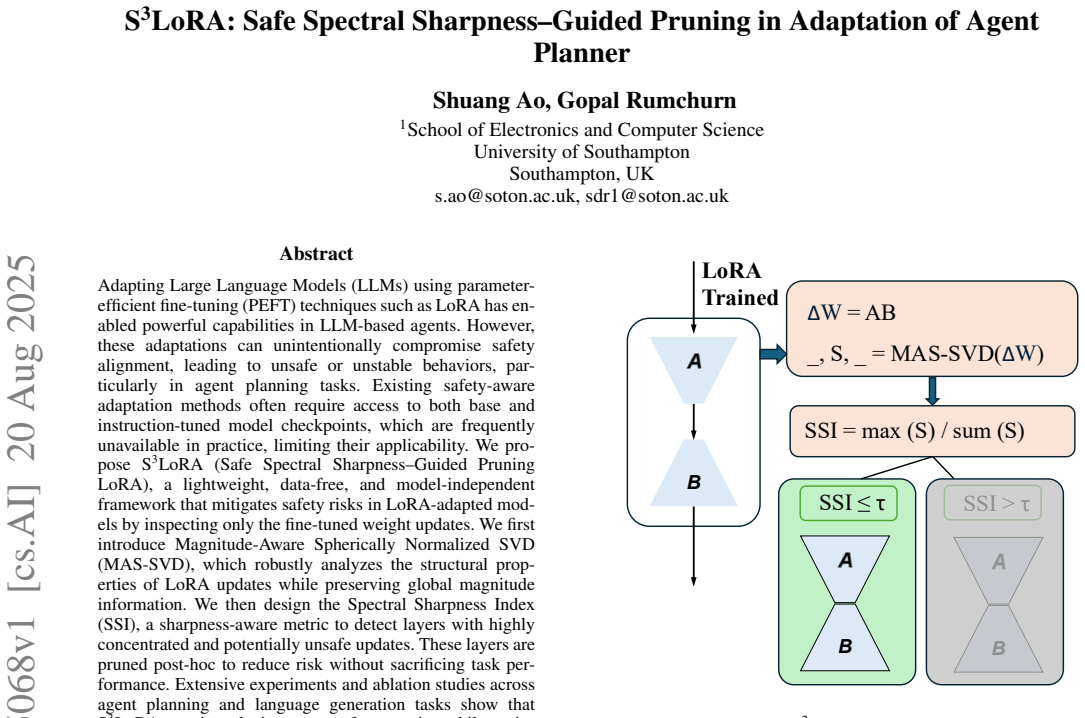
The paper argues that the safety risk introduced by LoRA fine-tuning leaves a measurable fingerprint in the spectrum of the update matrix ΔW. It claims that layers whose singular values are sharply concentrated—one dominant singular value carrying most of the spectral mass—are precisely the layers whose adaptation is unstable and safety-relevant. Its metric, SSI = σ'_1 / Σ σ'_j, computed after MAS-SVD restores global magnitude, ranks layers by this sharpness; zeroing the top ten such layers removes the 'unstable updates' while leaving the frozen base weights intact. On Planner Instruction Tuning, AgentInstruct, Dialogue Summary, and Alpaca, the paper reports that this operation improves Atta
What carries the argument
The engine of the method is MAS-SVD followed by SSI. MAS-SVD row- and column-normalizes ΔW, fits a robust low-rank approximation via iterative ℓ1 fitting with deflation over top-M singular vectors from the two normalization views, then rescales the result's singular values by the average row and column norms of the original ΔW. This rescaling is meant to preserve the update's global magnitude. SSI is then the ratio of the largest rescaled singular value to the sum of the top-h singular values. The pruning rule zeroes ΔW = AB for layers in the top-τ of the SSI ranking, leaving W0 untouched; the paper ties the sharpness-risk link to Wedin's perturbation bounds and spectral-norm generalization
Load-bearing premise
The method assumes that a layer whose LoRA update is concentrated along a single dominant direction is actually the layer causing unsafe behavior, rather than a property that happens to line up with the benchmark results after the prune count is tuned.
What would settle it
On Planner Instruction Tuning 2K, compare S3LoRA's top-10-SSI pruning against random pruning of ten layers and against pruning the ten layers with the largest total singular-value norm. If either control matches S3LoRA's ASR/HS improvements, the SSI ranking itself is not doing the causal work. A more direct test: zero only the single highest-SSI layer and check whether attack success rate moves; the paper's sharpness-risk mechanism predicts a dose-response, whereas its top-10-only report would be equally consistent with any 10-layer removal.
If this is right
- Safety alignment becomes a post-hoc operation on a single fine-tuned checkpoint: no paired base/instruction-tuned models, no calibration data, and no retraining, so it applies where such checkpoints are unavailable.
- The same pruning step yields efficiency: in reported settings, removing ten projection layers cuts per-sample inference time by roughly 12–15% and leaves only about 1% of trainable parameters active.
- Because SSI is defined on ΔW itself, the diagnostic transfers across architectures and tasks; the paper reports consistent safety gains on LLaMA2 and Gemma, on agent-planning and summarization/instruction data.
- Selective prediction improves: higher AUARC under S3LoRA means uncertainty-based rejection of low-confidence outputs becomes a more reliable safety valve.
- The method directly extends the prior pruning-based safety-alignment line of work by removing the need for a separately constructed safety subspace, making the intervention simpler to deploy.
Where Pith is reading between the lines
- I infer that if the SSI–risk link is causal, per-layer safety contributions should follow SSI rank: zeroing the single highest-SSI layer should lower attack success more than zeroing the single lowest-SSI layer by the same amount. The paper reports only top-10 results, so this dose-response is a direct, testable consequence of its own mechanism.
- Because τ=10 is fixed across datasets, a natural extension is to choose τ from the SSI score distribution itself (e.g., prune up to the largest gap in sorted SSI values). That would test whether ten is a property of the models or an artifact of the benchmark.
- The safety metrics count an attack as successful when a refusal keyword is absent, so it remains open whether pruning restores genuine refusal behavior or only surface-level refusals. A stricter evaluation scoring refusal quality would clarify what the reported safety gain consists of.
Editorial analysis
A structured set of objections, weighed in public.
Referee Report
Summary. The paper proposes S3LoRA, a post-hoc, data-free method for mitigating safety degradation after LoRA fine-tuning. The method computes a Magnitude-Aware Spherically Normalized SVD (MAS-SVD) of each LoRA update ΔW, forms a Spectral Sharpness Index (SSI) from the ratio of the largest singular value to the sum of the top-h singular values, and prunes the τ layers with the highest SSI by zeroing their LoRA updates. Experiments on agent-planning (Instruction Tuning 2K, AgentInstruct, HotpotQA, TriviaQA) and language-generation (Dialogue Summary, Alpaca) datasets compare against LoRA, SafeLoRA, SPLoRA, and Vaccine, reporting improved safety (lower ASR/HS) with maintained utility and reduced inference cost. The central claim is that high spectral sharpness identifies unsafe LoRA layers, so pruning them improves safety.
Significance. The problem is well motivated and the proposed method is simple, practical, and model-independent; unlike SafeLoRA/SPLoRA it does not require paired base and instruction-tuned checkpoints. If the SSI-to-risk link were established, this would be a useful safety tool. The paper includes multiple datasets and models and an ablation of the decomposition method. However, the evidence is currently insufficient: there is no random/low-SSI pruning control, the pruning threshold is selected on the same dataset where headline results are reported, key constants M and h are unspecified, and the theoretical link between spectral sharpness and safety is asserted rather than demonstrated. The contributions are potentially useful but need substantially stronger empirical validation.
major comments (6)
- [SSI Guided LoRA Pruning (Eq. 5), Table 4] The central claim that SSI identifies unsafe layers is not tested against a null control. Table 4 varies τ (5/10/15/20) but always prunes the highest-SSI layers. Because pruning reverts the layer to frozen W0, any reduction in LoRA influence could improve ASR/HS. The authors should add random-pruning and lowest-SSI pruning at the same τ and show that SSI-based selection outperforms them. This is load-bearing: without it, MAS-SVD and SSI are not necessary for the reported safety gains. The conclusion's admission that the method 'assumes a general correlation between spectral sharpness and risk' underscores the gap.
- [Implementation Details, Tables 1 and 4] The pruning threshold τ=10 is chosen via the ablation in Table 4 on the Instruction Tuning 2K dataset, and the headline results in Table 1 are reported on the same dataset. This is selection on the test set and can inflate results. The authors should fix the threshold on a validation split or show that the same τ transfers across datasets; at minimum, report threshold sensitivity without using the evaluation set for model selection.
- [Methodology, Eqs. (3)-(4)] M (the number of rank-1 components in MAS-SVD) and h (the number of singular values retained for SSI) are never specified. The method is not reproducible without these values, and SSI in Eq. (4) depends on h for a fixed matrix. Please report the chosen values, provide a sensitivity analysis, and state how they were determined.
- [Spectral Sharpness Index (SSI)] The safety relevance of SSI is asserted rather than derived. The cited Wedin's theorem bounds singular-subspace perturbation under additive noise; it does not imply that a concentrated singular-value distribution in a LoRA update causes harmful outputs. A formal argument or an independent validation (e.g., showing that high-SSI layers correlate with safety degradation under controlled interventions) is needed. The paper's own conclusion calls this an assumption.
- [Tables 1-3, AgentInstruct results] The evidence is reported without error bars or repeated runs, which is material given the small margins. In Table 2, S3LoRA's ASR (16.34) is worse than SPLoRA's (15.74), while the text highlights only HS and AUARC. The claim of 'consistently improving safety metrics' requires at least multiple seeds and confidence intervals, and a clear specification of which safety metric is primary across tables.
- [Table 5 vs Table 3] The MAS-SVD ablation table appears mislabeled. The rows labeled 'DS' report ROUGE 24.02/23.21/25.12 and METEOR 18.35/19.28/20.32, which match the Alpaca numbers in Table 3 (ROUGE around 25, METEOR around 20), not the Dialogue Summary numbers in Table 3 (ROUGE 35.35-37.82, METEOR 43.21-44.96). This undermines the claim that MAS-SVD outperforms SVD/SpSVD on Dialogue Summary.
minor comments (5)
- [Abstract] The code URL contains a space ('S3 LoRA') and is not a valid link.
- [Evaluation Metrics] The full refusal-keyword list for ASR is said to be in the Appendix, but no appendix appears in the manuscript; this affects reproducibility.
- [Table 6] The model name 'Gemma2' is inconsistent with 'Gemma-7B-it' used elsewhere; specify the exact checkpoint.
- [Figure 2] The x-axis label 'Refer to experts' is unexplained; define the uncertainty score and the coverage protocol used to compute the risk-coverage curves.
- [Related Work] Some citations are stylistically inconsistent or incomplete (e.g., 'Yunis et.al' inline); please normalize the reference style.
Circularity Check
Headline IT2K safety result is selected by tuning τ on the same test set; other results give independent support, so partial circularity.
specific steps
-
fitted input called prediction
[Implementation Details section; Table 4 vs Table 1]
"For all our experiments, we prune the top τ = 10 LoRA-updated layers with the highest SSI scores, as determined by our ablation study in Table 4. — Table 4: Impact of layer pruning threshold of SSI. Utility and safety metrics on the Instruction Tuning 2K dataset ... evaluated under different pruning thresholds based on the number of pruned layers."
The pruning threshold τ is selected by scanning τ ∈ {5,10,15,20} on the Instruction Tuning 2K test split and choosing the value with the best AUARC/ASR/HS (Table 4). Table 1 then reports S3LoRA's safety metrics on the very same Instruction Tuning 2K test split. The headline ASR=1.23 and HS=1.15 are thus the argmin of the safety metrics over the scanned thresholds on that split, not an independent prediction. The claimed gain over LoRA/SafeLoRA/SPLoRA on this dataset is partially forced by the selection procedure: no separate validation split or nested selection is described (the paper states only an 80/20 train/test split for each dataset). This is a fitted parameter renamed as a reported outcome, matching the 'fitted input called prediction' pattern.
full rationale
We walked the claimed chain: MAS-SVD decomposes ΔW, SSI=σ′₁/Σσ′ⱼ ranks layers, top-τ layers are zeroed, and safety metrics are then measured. SSI is not defined in terms of ASR/HS, so the core metric is not circular by construction; indeed, the conclusion explicitly concedes that the method 'assumes a general correlation between spectral sharpness and risk,' acknowledging that the SSI→safety link is an assumption rather than a derivation. The one place where a reported result reduces to its own input is τ selection: the Implementation Details say τ=10 is 'determined by our ablation study in Table 4,' and Table 4 evaluates ASR/HS on the Instruction Tuning 2K test split. Table 1 reports S3LoRA's ASR/HS on that same split, so the IT2K 'prediction' is partially forced by model selection on the evaluation set. This is not the whole paper: AgentInstruct, Dialogue Summary, and Alpaca are separate test sets evaluated with τ fixed from IT2K, providing independent evidence, and comparisons to SafeLoRA/SPLoRA/Vaccine are external baselines. The missing random/low-SSI pruning control means the causal role of SSI is not established, but that is an experimental confound rather than a circular equation, so we do not count it as a circularity step. The self-citation to SPLoRA for the 10-layer choice is not load-bearing because the choice is primarily justified by the paper's own Table 4. We also note that MAS-SVD's magnitude rescaling (S′ = S·r̄·c̄) cancels in the SSI ratio, so the 'magnitude-aware' component is inert for the pruning criterion; this is a technical weakness but not circularity. Overall, one statistically forced IT2K result combined with independent support elsewhere warrants a moderate partial-circularity score of 5.
Axiom & Free-Parameter Ledger
free parameters (3)
- tau (number of pruned layers) =
10
- M (number of rank-1 components in MAS-SVD) =
unspecified
- h (singular values kept for SSI) =
unspecified
axioms (4)
- ad hoc to paper High spectral sharpness (SSI) identifies safety-critical LoRA layers
- ad hoc to paper Zeroing the top-tau pruned LoRA updates reduces risk while retaining task utility
- domain assumption The LoRA update Delta W alone is a sufficient proxy for safety risk
- ad hoc to paper Wedin's theorem implies output instability from concentrated spectral shifts
Cite this review
Pith. "Pith review of S3LoRA: Safe Spectral Sharpness-Guided Pruning in Adaptation of Agent Planner." pith.science (2026). https://pith.science/paper/EX6QJBDV
@misc{pith2026250815068,
  author       = {Pith},
  title        = {Pith review of: S3LoRA: Safe Spectral Sharpness-Guided Pruning in Adaptation of Agent Planner},
  year         = {2026},
  howpublished = {\url{https://pith.science/paper/EX6QJBDV}},
  note         = {Machine review of arXiv:2508.15068}
}
read the original abstract
Adapting Large Language Models (LLMs) using parameter-efficient fine-tuning (PEFT) techniques such as LoRA has enabled powerful capabilities in LLM-based agents. However, these adaptations can unintentionally compromise safety alignment, leading to unsafe or unstable behaviors, particularly in agent planning tasks. Existing safety-aware adaptation methods often require access to both base and instruction-tuned model checkpoints, which are frequently unavailable in practice, limiting their applicability. We propose S3LoRA (Safe Spectral Sharpness-Guided Pruning LoRA), a lightweight, data-free, and model-independent framework that mitigates safety risks in LoRA-adapted models by inspecting only the fine-tuned weight updates. We first introduce Magnitude-Aware Spherically Normalized SVD (MAS-SVD), which robustly analyzes the structural properties of LoRA updates while preserving global magnitude information. We then design the Spectral Sharpness Index (SSI), a sharpness-aware metric to detect layers with highly concentrated and potentially unsafe updates. These layers are pruned post-hoc to reduce risk without sacrificing task performance. Extensive experiments and ablation studies across agent planning and language generation tasks show that S3LoRA consistently improves safety metrics while maintaining or improving utility metrics and significantly reducing inference cost. These results establish S3LoRA as a practical and scalable solution for safely deploying LLM-based agents in real-world, resource-constrained, and safety-critical environments.
Figures

Reference graph
Works this paper leans on
-
[1]
, " * write output.state after.block = add.period write newline
ENTRY address archivePrefix author booktitle chapter edition editor eid eprint howpublished institution isbn journal key month note number organization pages publisher school series title type volume year label extra.label sort.label short.list INTEGERS output.state before.all mid.sentence after.sentence after.block FUNCTION init.state.consts #0 'before.a...
-
[2]
write newline
" write newline "" before.all 'output.state := FUNCTION n.dashify 't := "" t empty not t #1 #1 substring "-" = t #1 #2 substring "--" = not "--" * t #2 global.max substring 't := t #1 #1 substring "-" = "-" * t #2 global.max substring 't := while if t #1 #1 substring * t #2 global.max substring 't := if while FUNCTION word.in bbl.in capitalize " " * FUNCT...
-
[3]
L.; Almeida, D.; Altenschmidt, J.; Altman, S.; Anadkat, S.; et al
Achiam, J.; Adler, S.; Agarwal, S.; Ahmad, L.; Akkaya, I.; Aleman, F. L.; Almeida, D.; Altenschmidt, J.; Altman, S.; Anadkat, S.; et al. 2023. Gpt-4 technical report. arXiv preprint arXiv:2303.08774
Pith/arXiv arXiv 2023
-
[4]
Ao, S.; Dong, Y.; Hu, J.; and Ramchurn, S. 2025. Safe Pruning LoRA: Robust Distance-Guided Pruning for Safety Alignment in Adaptation of LLMs. arXiv preprint arXiv:2506.18931
work page internal anchor Pith review Pith/arXiv arXiv 2025
-
[5]
H.; S im s ekli, U.; and Birdal, T
Barsbey, M.; Ribeiro, A. H.; S im s ekli, U.; and Birdal, T. 2025. On the Interaction of Compressibility and Adversarial Robustness. arXiv preprint arXiv:2507.17725
-
[6]
T.; Li, Y.; Lundberg, S.; et al
Bubeck, S.; Chadrasekaran, V.; Eldan, R.; Gehrke, J.; Horvitz, E.; Kamar, E.; Lee, P.; Lee, Y. T.; Li, Y.; Lundberg, S.; et al. 2023. Sparks of artificial general intelligence: Early experiments with gpt-4
2023
-
[7]
Chen, Z.; Li, M.; Huang, Y.; Du, Y.; Fang, M.; and Zhou, T. 2025. Atlas: Agent tuning via learning critical steps. arXiv preprint arXiv:2503.02197
Pith/arXiv arXiv 2025
-
[8]
Chen, Z.; Liu, K.; Wang, Q.; Zhang, W.; Liu, J.; Lin, D.; Chen, K.; and Zhao, F. 2024. Agent-flan: Designing data and methods of effective agent tuning for large language models. arXiv preprint arXiv:2403.12881
Pith/arXiv arXiv 2024
-
[9]
Gliwa, B.; Mochol, I.; Biesek, M.; and Wawer, A. 2019. SAMS um Corpus: A Human-annotated Dialogue Dataset for Abstractive Summarization. In Wang, L.; Cheung, J. C. K.; Carenini, G.; and Liu, F., eds., Proceedings of the 2nd Workshop on New Frontiers in Summarization, 70--79. Hong Kong, China: Association for Computational Linguistics
work page 2019
-
[10]
Han, S.; Jung, S.; and Kim, K. 2024. Robust SVD Made Easy: A fast and reliable algorithm for large-scale data analysis. In International Conference on Artificial Intelligence and Statistics, 1765--1773. PMLR
work page 2024
-
[11]
Hsu, C.-Y.; Tsai, Y.-L.; Lin, C.-H.; Chen, P.-Y.; Yu, C.-M.; and Huang, C.-Y. 2024. Safe lora: The silver lining of reducing safety risks when finetuning large language models. Advances in Neural Information Processing Systems, 37: 65072--65094
work page 2024
-
[12]
J.; Shen, Y.; Wallis, P.; Allen-Zhu, Z.; Li, Y.; Wang, S.; Wang, L.; Chen, W.; et al
Hu, E. J.; Shen, Y.; Wallis, P.; Allen-Zhu, Z.; Li, Y.; Wang, S.; Wang, L.; Chen, W.; et al. 2022. Lora: Low-rank adaptation of large language models. ICLR, 1(2): 3
2022
-
[13]
Hu, M.; Zhao, P.; Xu, C.; Sun, Q.; Lou, J.-G.; Lin, Q.; Luo, P.; and Rajmohan, S. 2025 a . Agentgen: Enhancing planning abilities for large language model based agent via environment and task generation. In Proceedings of the 31st ACM SIGKDD Conference on Knowledge Discovery and Data Mining V. 1, 496--507
work page 2025
-
[14]
Hu, Y.; Goel, K.; Killiakov, V.; and Yang, Y. 2025 b . Eigenspectrum analysis of neural networks without aspect ratio bias. arXiv preprint arXiv:2506.06280
work page internal anchor Pith review Pith/arXiv arXiv 2025
-
[15]
Huang, T.; Hu, S.; and Liu, L. 2024. Vaccine: Perturbation-aware Alignment for Large Language Models against Harmful Fine-tuning Attack. In The Thirty-eighth Annual Conference on Neural Information Processing Systems
work page 2024
-
[16]
Huang, Y.; Ding, L.; Tang, Z.; Wang, T.; Lin, X.; Zhang, W.; Ma, M.; and Zhang, Y. 2025. A Framework for Benchmarking and Aligning Task-Planning Safety in LLM-Based Embodied Agents. arXiv preprint arXiv:2504.14650
Pith/arXiv arXiv 2025
-
[17]
Joshi, M.; Choi, E.; Weld, D. S.; and Zettlemoyer, L. 2017. Triviaqa: A large scale distantly supervised challenge dataset for reading comprehension. arXiv preprint arXiv:1705.03551
Pith/arXiv arXiv 2017
-
[18]
Li, C.; Wong, C.; Zhang, S.; Usuyama, N.; Liu, H.; Yang, J.; Naumann, T.; Poon, H.; and Gao, J. 2023. Llava-med: Training a large language-and-vision assistant for biomedicine in one day. Advances in Neural Information Processing Systems, 36: 28541--28564
work page 2023
-
[19]
Li, Z.; Xia, M.; Zhang, J.; Hui, Z.; Kong, L.; Zhang, Y.; and Yang, X. 2025. Adasvd: Adaptive singular value decomposition for large language models. arXiv preprint arXiv:2502.01403
arXiv 2025
-
[20]
Liu, H.; Li, C.; Wu, Q.; and Lee, Y. J. 2023. Visual instruction tuning. Advances in neural information processing systems, 36: 34892--34916
2023
-
[21]
Nadeem, M. S. A.; Zucker, J.-D.; and Hanczar, B. 2009. Accuracy-rejection curves (ARCs) for comparing classification methods with a reject option. In Machine Learning in Systems Biology, 65--81. PMLR
work page 2009
-
[22]
O’Rourke, S.; Vu, V.; and Wang, K. 2023. Matrices with Gaussian noise: Optimal estimates for singular subspace perturbation. IEEE Transactions on Information Theory, 70(3): 1978--2002
work page 2023
-
[23]
Qi, X.; Zeng, Y.; Xie, T.; Chen, P.-Y.; Jia, R.; Mittal, P.; and Henderson, P. 2023. Fine-tuning aligned language models compromises safety, even when users do not intend to! arXiv preprint arXiv:2310.03693
Pith/arXiv arXiv 2023
-
[24]
Sha, Z.; Tian, H.; Xu, Z.; Cui, S.; Meng, C.; and Wang, W. 2025. Agent Safety Alignment via Reinforcement Learning. arXiv preprint arXiv:2507.08270
Pith/arXiv arXiv 2025
-
[25]
Song, Y.; Xiong, W.; Zhao, X.; Zhu, D.; Wu, W.; Wang, K.; Li, C.; Peng, W.; and Li, S. 2024. Agentbank: Towards generalized llm agents via fine-tuning on 50000+ interaction trajectories. arXiv preprint arXiv:2410.07706
Pith/arXiv arXiv 2024
-
[26]
Staats, M.; Thamm, M.; and Rosenow, B. 2024. Small Singular Values Matter: A Random Matrix Analysis of Transformer Models. arXiv preprint arXiv:2410.17770
arXiv 2024
-
[27]
Taori, R.; Gulrajani, I.; Zhang, T.; Dubois, Y.; Li, X.; Guestrin, C.; Liang, P.; and Hashimoto, T. B. 2023. Stanford alpaca: An instruction-following llama model
work page 2023
-
[28]
Team, G.; Mesnard, T.; Hardin, C.; Dadashi, R.; Bhupatiraju, S.; Pathak, S.; Sifre, L.; Rivi \`e re, M.; Kale, M. S.; Love, J.; et al. 2024. Gemma: Open models based on gemini research and technology. arXiv preprint arXiv:2403.08295
Pith/arXiv arXiv 2024
-
[29]
Touvron, H.; Martin, L.; Stone, K.; Albert, P.; Almahairi, A.; Babaei, Y.; Bashlykov, N.; Batra, S.; Bhargava, P.; Bhosale, S.; et al. 2023. Llama 2: Open foundation and fine-tuned chat models. arXiv preprint arXiv:2307.09288
Pith/arXiv arXiv 2023
-
[30]
Wang, L.; Ma, C.; Feng, X.; Zhang, Z.; Yang, H.; Zhang, J.; Chen, Z.; Tang, J.; Chen, X.; Lin, Y.; et al. 2024. A survey on large language model based autonomous agents. Frontiers of Computer Science, 18(6): 186345
work page 2024
-
[31]
Wang, X.; Alam, S.; Wan, Z.; Shen, H.; and Zhang, M. 2025. Svd-llm v2: Optimizing singular value truncation for large language model compression. arXiv preprint arXiv:2503.12340
Pith/arXiv arXiv 2025
-
[32]
Wedin, P.- . 1972. Perturbation bounds in connection with singular value decomposition. BIT Numerical Mathematics, 12(1): 99--111
work page 1972
-
[33]
Wei, B.; Huang, K.; Huang, Y.; Xie, T.; Qi, X.; Xia, M.; Mittal, P.; Wang, M.; and Henderson, P. 2024. Assessing the brittleness of safety alignment via pruning and low-rank modifications. arXiv preprint arXiv:2402.05162
Pith/arXiv arXiv 2024
-
[34]
Xi, Z.; Chen, W.; Guo, X.; He, W.; Ding, Y.; Hong, B.; Zhang, M.; Wang, J.; Jin, S.; Zhou, E.; et al. 2025. The rise and potential of large language model based agents: A survey. Science China Information Sciences, 68(2): 121101
work page 2025
-
[35]
J.; Zhao, J.; Liu, Q.; Liu, C.; et al
Xie, T.; Zhou, F.; Cheng, Z.; Shi, P.; Weng, L.; Liu, Y.; Hua, T. J.; Zhao, J.; Liu, Q.; Liu, C.; et al. 2023. Openagents: An open platform for language agents in the wild. arXiv preprint arXiv:2310.10634
Pith/arXiv arXiv 2023
-
[36]
Xu, B.; Peng, Z.; Lei, B.; Mukherjee, S.; Liu, Y.; and Xu, D. 2023. Rewoo: Decoupling reasoning from observations for efficient augmented language models. arXiv preprint arXiv:2305.18323
Pith/arXiv arXiv 2023
-
[37]
Yang, X.; Wang, X.; Zhang, Q.; Petzold, L.; Wang, W. Y.; Zhao, X.; and Lin, D. 2023. Shadow alignment: The ease of subverting safely-aligned language models. arXiv preprint arXiv:2310.02949
Pith/arXiv arXiv 2023
-
[38]
W.; Salakhutdinov, R.; and Manning, C
Yang, Z.; Qi, P.; Zhang, S.; Bengio, Y.; Cohen, W. W.; Salakhutdinov, R.; and Manning, C. D. 2018. HotpotQA: A dataset for diverse, explainable multi-hop question answering. arXiv preprint arXiv:1809.09600
Pith/arXiv arXiv 2018
-
[39]
Yehudai, A.; Eden, L.; Li, A.; Uziel, G.; Zhao, Y.; Bar-Haim, R.; Cohan, A.; and Shmueli-Scheuer, M. 2025. Survey on evaluation of llm-based agents. arXiv preprint arXiv:2503.16416
Pith/arXiv arXiv 2025
-
[40]
Yoshida, Y.; and Miyato, T. 2017. Spectral norm regularization for improving the generalizability of deep learning. arXiv preprint arXiv:1705.10941
Pith/arXiv arXiv 2017
-
[41]
K.; Wheeler, S.; Savarese, P.; Vardi, G.; Livescu, K.; Maire, M.; and Walter, M
Yunis, D.; Patel, K. K.; Wheeler, S.; Savarese, P.; Vardi, G.; Livescu, K.; Maire, M.; and Walter, M. R. 2024. Approaching deep learning through the spectral dynamics of weights. arXiv preprint arXiv:2408.11804
Pith/arXiv arXiv 2024
-
[42]
Zeng, A.; Liu, M.; Lu, R.; Wang, B.; Liu, X.; Dong, Y.; and Tang, J. 2023. Agenttuning: Enabling generalized agent abilities for llms. arXiv preprint arXiv:2310.12823
Pith/arXiv arXiv 2023
-
[43]
Zhan, Q.; Fang, R.; Bindu, R.; Gupta, A.; Hashimoto, T.; and Kang, D. 2023. Removing rlhf protections in gpt-4 via fine-tuning. arXiv preprint arXiv:2311.05553
Pith/arXiv arXiv 2023
-
[44]
Zhang, J.; Yin, L.; Zhou, Y.; and Hu, S. 2025. AgentAlign: Navigating Safety Alignment in the Shift from Informative to Agentic Large Language Models. arXiv preprint arXiv:2505.23020
Pith/arXiv arXiv 2025
This paper was first reviewed by deepseek-v4-flash on August 5, 2026.
discussion (0)
Sign in with ORCID, Apple, or X to comment. Anyone can read and Pith papers without signing in.