REVIEW 2 major objections 4 minor 1 cited by
Deterministic Control of Photon-Number Probabilities via Phase-Controlled Quantum Interference
T0 review · 2 major / 4 minor · reviewed 2026-08-05 · deepseek-v4-flash
Pith's one-line read Quantum interference, in a phase-stabilized unbalanced Mach-Zehnder interferometer fed by a pulsed single-photon emitter, deterministically sets the probabilities of vacuum, one-photon, and two-photon output states.
desk verdict Clean time-bin model, solid g^(2) data, and a useful control knob, but the P0/P1/P2 landscape is reconstructed via a single-point efficiency calibration, so treat those numbers as model-dependent. read the letter →
The pith
A machine-rendered reading of the paper's core claim, the machinery that carries it, and where it could break.
The reading
What carries the argument
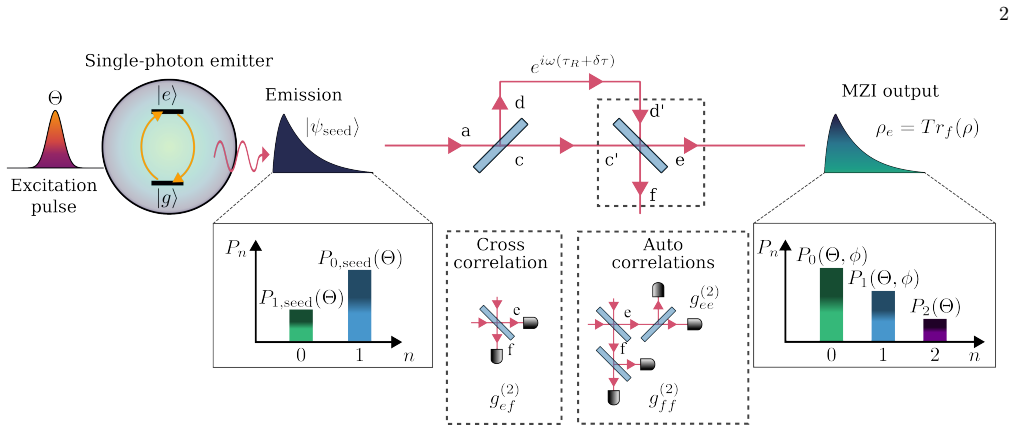
The central object is the phase-controlled, path-unbalanced Mach-Zehnder interferometer: a one-time-bin delay plus a phase ϕ makes each emitted pulse interfere at the second beam splitter with its predecessor, combining vacuum–single-photon interference with Hong-Ou-Mandel bunching. The load-bearing mechanism is the closed-form probability map P2(Θ) = (1/8) sin⁴(Θ/2) and P1(Θ, ϕ) = (1/4) sin⁴(Θ/2) + (1/2) sin²(Θ/2) cos²(Θ/2)(1 − cos ϕ), derived from a discrete time-bin Hilbert-space model in which both beam splitters act quantum-mechanically. This map separates the control variables—Θ fixes the two-photon weight, ϕ redistributes P0 and P1—and, inverted through measured g(2), turns correlatio
What would settle it
Use a photon-number-resolving detector at the interferometer output and compare the directly counted P0, P1, P2 with Eqs. (10)–(12) at several (Θ, ϕ) settings—for instance Θ = π and Θ = 0.25π at ϕ = 0.12π and ϕ = 0.87π. If the directly measured probabilities disagree with the predicted P2 = (1/8) sin⁴(Θ/2) and P1 beyond the stated efficiency uncertainty, or if the third-order correlation reveals P3 above 0.0016, the deterministic probability-control claim would be refuted.
Extended reading notes
Core claim
The claim is that a fully quantized treatment of a pulsed, path-unbalanced Mach-Zehnder interferometer—accounting for the quantum entanglement between adjacent time bins generated by the delay—shows that vacuum–single-photon interference and Hong-Ou-Mandel interference can be combined to shape the photon-number statistics of the output. For a seed state cos(Θ/2)|0⟩ + sin(Θ/2)|1⟩ entering as a pulse train, the output probabilities at one port are P2 = (1/8) sin⁴(Θ/2), P1 = (1/4) sin⁴(Θ/2) + (1/2) sin²(Θ/2) cos²(Θ/2)(1 − cos ϕ), and P0 = 1 − P1 − P2. Thus the pulse area Θ alone fixes the two-photon probability, while the phase ϕ tunes the vacuum-to-single-photon ratio; experimentally the acces
Load-bearing premise
The quantitative claim rests on calibrating the true mean photon number from detected counts with a single total-efficiency factor estimated at the π-pulse point, and on assuming events with three or more photons are negligible; if either is wrong, the reported P0, P1, P2 values move.
Editorial extensions
If this is right
- A standard single-photon source can be upgraded to a deterministic vacuum–single–two-photon generator using only beam splitters, a delay, and a phase shifter.
- The control variables separate cleanly: set the desired two-photon probability with the pulse area, then use the phase to choose the vacuum-to-single-photon ratio.
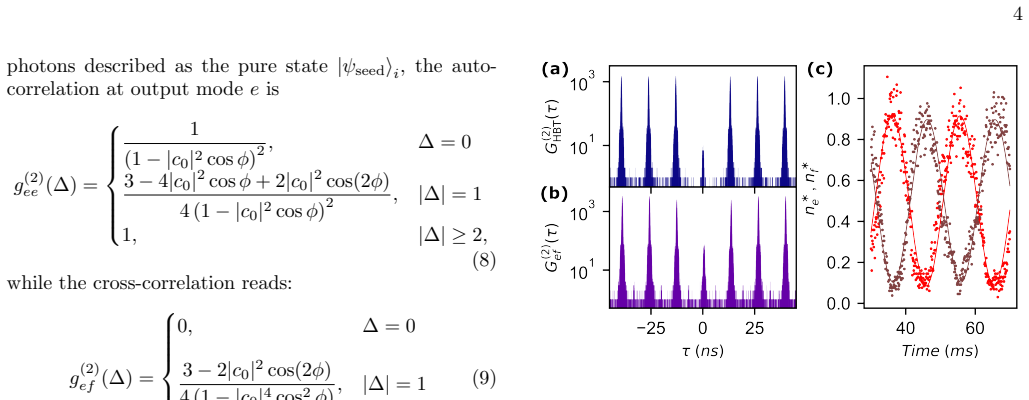
- The measured antibunching-to-bunching transition demonstrates that a high g(2)(0) can accompany a small two-photon probability, clarifying that correlations alone do not reveal photon-number statistics.
- With two mutually indistinguishable emitters (or fast demultiplexing of one), the same model predicts P2 up to 0.5 and P1 down to 0, giving deterministic NOON-type states and a single-photon filter operated purely by phase.
- Because the protocol is all-linear and platform-independent, it can be integrated into chip-scale photonic circuits and existing single-photon source technologies.
Reading between the lines
- Editorial extension: the reconstructed P0, P1, P2 landscape would be independently settled by a direct photon-number-resolving measurement; the current values inherit the uncertainty of the single-point efficiency calibration and the P3 ≈ 0 assumption.
- Editorial extension: the time-bin model has untested predictive content in the |Δ| ≥ 2 correlations and in the response to controlled dephasing or non-pure seeds; measuring these would separate model errors from calibration errors.
- Editorial extension: if the two-emitter prediction holds, it offers a concrete, near-term path to deterministic NOON states for sub-shot-noise metrology, something usually sought through nonlinear or heralded schemes.
- Editorial extension: the same phase-controlled interference could be adapted to other quantum emitters (defects, atoms, molecules) as long as their excitation can be pulsed coherently, but the accessible probability ranges would need re-derivation for non-ideal seed purity.
Editorial analysis
A structured set of objections, weighed in public.
Referee Report
Summary. The manuscript reports an all-linear-optical protocol to tailor the photon-number statistics of a pulsed single-photon source. A resonantly driven quantum dot emits a pulse train that enters a phase-stabilized, path-unbalanced Mach-Zehnder interferometer; the pulse area Θ and interferometric phase ϕ are the two control knobs. The authors derive a discrete time-bin quantum model yielding closed-form expressions for output populations and second-order correlation functions. Experimentally, they observe a phase-controlled transition from antibunching to strong bunching (a >60-fold swing in g^(2)(0) at Θ=0.25π), a temporal signature of two-photon pairs under π-pulse excitation, and reconstructed photon-number probabilities that agree with the model. An extension to two emitters is predicted to give larger accessible ranges and NOON-state generation.
Significance. If the experimental probability reconstruction holds, this is a meaningful advance: it shows linear optics plus a standard single-photon source can reshape Fock-state statistics without nonlinear interactions or heralding. The paper's strengths are its analytic time-bin model with explicit expressions (Eqs. (6)–(12)), the broad set of measured correlation functions (including |Δ|=1 and a 30-hour third-order bound), and the internal consistency of the reconstructed probabilities with the model. The main caveat is that the quantitative P0/P1/P2 demonstration is indirect, relying on a single-point efficiency calibration and on the assumption that higher-order terms truncate at P3.
major comments (2)
- [Section V / Appendix D (Eqs. D1–D4)] The experimental probability bars in Fig. 6 are reconstructed from the mean photon number n_e and g^(2)(0) via P1 = n_e − n_e^2 g^(2), P2 = n_e^2 g^(2)/2. The conversion from detected counts to n_e uses a single total efficiency η_e ≈ 6.75×10^-4, estimated at Θ=π by assuming a maximum population inversion of 0.94 and 0.47 mean photons at output e. Any error in this single-point calibration—due to the phonon-renormalized Rabi fit, the assumed inversion, or a change in collection/detection efficiency across the Θ–ϕ range—propagates systematically into all extracted probabilities. The paper gives no uncertainty on η_e, no propagation of the inversion uncertainty, and no independent calibration. Since the quantitative claim of realizing the reported probability landscape rests on these bars, please add an independent calibration (e.g., a calibrated attenuation chain or a detector-efficiency
- [Section VI and Fig. 6 (Eqs. 10–12)] The text states that 'we access photon-number probabilities within the ranges P0∈[0.6,1], P1∈[0,1/3], P2∈[0,0.125]'. These ranges are the ideal-model predictions; the experiments sample only three pulse areas and a limited set of phases, and the measured extremal values are lower (e.g., P2≈0.109 at Θ=π rather than 0.125). Moreover, the reconstructed probabilities carry no error bars. Please clearly separate (i) the model-predicted accessible ranges, and (ii) the experimentally demonstrated subset, and either verify an extremal point directly (e.g., with a photon-number-resolving measurement) or qualify the claim as 'model-predicted ranges, consistent with the measured points'.
minor comments (4)
- [Section V] The sentence 'assuming unity collection and detection of the system emission (see Appendix D)' is misleading: Appendix D assumes a calibrated total efficiency η_e ≈ 6.75×10^-4, not unity. Please rephrase.
- [Appendix D] The determination of the maximum population inversion (0.94) and the associated η_e should include a goodness-of-fit estimate and an error bar. The phonon-induced Rabi renormalization is noted but not quantified; its effect on the calibration point should be discussed.
- [Appendix E / Fig. 10] The third-order bound P3<0.0016 is derived under the assumption P_i=0 for i≥4. Please state this assumption explicitly where the bound is introduced, and report the confidence level of the 'conservatively assuming one event' procedure.
- [Fig. 6] The bar plots would benefit from error bars and from a legend indicating that the surfaces are the ideal-model predictions, not a fit to the data.
Circularity Check
Minor circularity in the absolute scale of the reconstructed P_n landscape via the single-point efficiency calibration; the central g^(2) and model derivation are otherwise self-contained and independently tested.
-
fitted input called prediction
[Appendix D, Eqs. (D1)-(D4), and Fig. 6]
"Assuming negligible non-radiative decay and unit efficiency, about 0.47 photons per pulse are expected at output e. In our experiment, we obtain about 3.18 × 10⁻⁴ photons per pulse at Θ=π, implying a total efficiency at that output of ηe ≈ 6.75 × 10⁻⁴. Given this value, we estimate the mean photon number ne at output e from the measured counts per second Ne and infer the photon-number probabilities from second-order autocorrelation as [40] ne = NeτR/ηe (D1) ... P2,e = n2eg(2)ee(0)/2 (D4)."
The detection efficiency ηe is calibrated by assuming the model's expected mean photon number of 0.47 at the Θ=π operating point (half of the Rabi-fit inversion 0.94). The extracted two-photon probability is then computed as P2 = ne² g^(2)/2, so the absolute scale of the reported P2 values—including the experimental P2≈0.109 at π and the overall height of the P2 bars in Fig. 6—inherits this model assumption. The agreement between the experimental bars and the theoretical P2 surface is therefore not a fully independent validation of the absolute probabilities; it mainly confirms the correlation shapes and the functional dependence on Θ and φ, while the calibrated absolute scale is fed in from the model.
full rationale
The core theoretical derivation is self-contained: the time-bin model in Section III derives the g^(2) expressions and the photon-number formulas (Eqs. 8-12) from the beam-splitter operators and the coherent vacuum-single-photon seed, with no dependence on the later calibration. The measured g^(2) swing from 19.1 to 0.31 in Fig. 5 is a direct, model-independent observation. The extraction formulas in Appendix D (ne = NeτR/ηe, P1 = ne − ne²g^(2), P2 = ne²g^(2)/2) are generic single-mode relations and are not themselves circular. The only notable circular element is the single-point efficiency calibration: ηe is set using the model's expected 0.47 photons/pulse at Θ=π, which fixes the absolute scale of the reconstructed P0,P1,P2 landscape. This is a mild, localized circularity that affects the quantitative agreement in Fig. 6 but does not undermine the central claim of phase-controlled photon-statistics engineering, which rests on directly measured correlations. The P3<0.0016 bound is measured over 30 hours, so the truncation at two photons is not an unverified ansatz. Overall, no self-citation chain or definitional reduction forces the main result; the circularity score is low.
Assumptions & free parameters
free parameters (3)
- Total collection/detection efficiency at output e (eta_e) =
approximately 6.75e-4
- Maximum population inversion at Theta=pi =
approximately 0.94
- State purity factor lambda =
0.96 to 1 (interval)
assumptions (5)
- standard math Standard linear-optics transformations on Fock states (beam splitters, phase shifts) and bosonic creation/annihilation operators.
- domain assumption Time-bin discretization: the pulse train factorizes into independent Hilbert spaces with one pulse per time bin and no inter-bin overlap.
- domain assumption The emitter preparation follows ideal pulsed Rabi dynamics, c0=cos(Theta/2), c1=sin(Theta/2).
- domain assumption No more than two photons per time bin at the MZI output (P3=0).
- domain assumption The interferometer phase is stable and identical for all pulses; losses and mode mismatch are negligible in the ideal model.
Cite this review
Pith. "Pith review of Deterministic Control of Photon-Number Probabilities via Phase-Controlled Quantum Interference." pith.science (2026). https://pith.science/paper/UCADNURD
@misc{pith2026250815352,
  author       = {Pith},
  title        = {Pith review of: Deterministic Control of Photon-Number Probabilities via Phase-Controlled Quantum Interference},
  year         = {2026},
  howpublished = {\url{https://pith.science/paper/UCADNURD}},
  note         = {Machine review of arXiv:2508.15352}
}
read the original abstract
Deterministically tailoring optical Fock states beyond the single-photon level is crucial for boson sampling, loss-tolerant photonic qubits, and quantum-enhanced sensing, however has yet remained elusive. Here, we report an all-linear-optical protocol that converts a resonantly driven single-photon emitter into a deterministic generator of vacuum--single-photon--two-photon states. A phase-stabilized, path-unbalanced Mach-Zehnder interferometer combines vacuum--single-photon interference and Hong-Ou-Mandel effect, providing two knobs to shape photon-number probabilities. By tuning these knobs, we observe a dynamic transition from antibunching to strong bunching in correlation measurements. A fully quantum-mechanical, discrete time-bin model maps these results onto the tailored photon statistics. The same framework predicts that two indistinguishable emitters would extend the accessible space to deterministic NOON states and single-photon filtering. This protocol relying on linear optics and available single-photon sources provides a scalable, chip-compatible, and platform-independent route to on-demand and deterministic few-photon resources for quantum metrology, photonic computing, as well as long-distance quantum networks.
Figures

Figures from the paper (8 more)


Forward citations
Cited by 1 Pith paper
-
A study to suppress a sneaking cosmic muon background in the COMET experiment
Track-fit quality can tell whether a drift-chamber track is a forward electron or a reverse cosmic muon, suppressing the COMET background by an order of magnitude in Monte Carlo.
Reference graph
Works this paper leans on
-
[1]
Gisin, G
N. Gisin, G. Ribordy, W. Tittel, and H. Zbinden, Rev. Mod. Phys. 74, 145 (2002)
2002
-
[2]
10 (c), we show the unnormalized correlation G(3) e (τ1, τ2) at output e under π-pulse excitation
In Fig. 10 (c), we show the unnormalized correlation G(3) e (τ1, τ2) at output e under π-pulse excitation. The delays τ1(2) = t1(2) − t0 represent the time differences be- tween the detection time at detector 1(2) and that at de- tector 0. To evaluate the correlations between time bins, we integrate the results along both time axes over the pulse repetiti...
-
[3]
Giovannetti, S
V. Giovannetti, S. Lloyd, and L. Maccone, Science 306, 1330 (2004)
2004
-
[4]
C. Sparrow, E. Mart ´ ın-L´ opez, N. Maraviglia, A. Neville, C. Harrold, J. Carolan, Y. N. Joglekar, T. Hashimoto, N. Matsuda, J. L. O’Brien, D. P. Tew, and A. Laing, Nature 557, 660 (2018)
work page 2018
-
[5]
J. L. O’Brien, A. Furusawa, and J. Vuˇ ckovi´ c, Nature Pho- tonics 3, 687 (2009)
work page 2009
-
[6]
P. Kok, W. J. Munro, K. Nemoto, T. C. Ralph, J. P. Dowling, and G. J. Milburn, Rev. Mod. Phys. 79, 135 (2007)
work page 2007
-
[7]
Slussarenko and G
S. Slussarenko and G. J. Pryde, Applied Physics Reviews 6, 041303 (2019)
2019
-
[8]
M. A. Broome, A. Fedrizzi, S. Rahimi-Keshari, J. Dove, S. Aaronson, T. C. Ralph, and A. G. White, Science 339, 794 (2013)
2013
Show all 64 references
-
[9]
Zhong, H
H.-S. Zhong, H. Wang, Y.-H. Deng, M.-C. Chen, L.-C. Peng, Y.-H. Luo, J. Qin, D. Wu, X. Ding, Y. Hu, P. Hu, X.-Y. Yang, W.-J. Zhang, H. Li, Y. Li, X. Jiang, L. Gan, 13 G. Yang, L. You, Z. Wang, L. Li, N.-L. Liu, C.-Y. Lu, and J.-W. Pan, Science 370, 1460 (2020)
2020
-
[10]
Varnava, D
M. Varnava, D. E. Browne, and T. Rudolph, Phys. Rev. Lett. 100, 060502 (2008)
2008
-
[11]
T. C. Ralph, A. J. F. Hayes, and A. Gilchrist, Phys. Rev. Lett. 95, 100501 (2005)
2005
-
[12]
C. M. Caves, Phys. Rev. D 23, 1693 (1981)
1981
-
[13]
Pezz` e, A
L. Pezz` e, A. Smerzi, M. K. Oberthaler, R. Schmied, and P. Treutlein, Rev. Mod. Phys. 90, 035005 (2018)
2018
-
[14]
Senellart, G
P. Senellart, G. Solomon, and A. White, Nature Nan- otechnology 12, 1026 (2017)
2017
-
[15]
Hanschke, K
L. Hanschke, K. A. Fischer, S. Appel, D. Lukin, J. Wierzbowski, S. Sun, R. Trivedi, J. Vuˇ ckovi´ c, J. J. Finley, and K. M¨ uller, npj Quantum Inf.4, 43 (2018)
2018
-
[16]
Schweickert, K
L. Schweickert, K. D. J¨ ons, K. D. Zeuner, S. F. Covre Da Silva, H. Huang, T. Lettner, M. Reindl, J. Zichi, R. Trotta, A. Rastelli, and V. Zwiller, Appl. Phys. Lett. 112, 093106 (2018)
2018
-
[17]
Y.-M. He, Y. He, Y.-J. Wei, D. Wu, M. Atat¨ ure, C. Schneider, S. H¨ ofling, M. Kamp, C.-Y. Lu, and J.- W. Pan, Nature Nanotechnology 8, 213 (2013)
2013
-
[18]
Sch¨ oll, L
E. Sch¨ oll, L. Hanschke, L. Schweickert, K. D. Zeuner, M. Reindl, S. F. Covre da Silva, T. Lettner, R. Trotta, J. J. Finley, K. M¨ uller, A. Rastelli, V. Zwiller, and K. D. J¨ ons, Nano Letters19, 2404 (2019)
2019
-
[19]
Ding, Y.-P
X. Ding, Y.-P. Guo, M.-C. Xu, R.-Z. Liu, G.-Y. Zou, J.- Y. Zhao, Z.-X. Ge, Q.-H. Zhang, H.-L. Liu, L.-J. Wang, M.-C. Chen, H. Wang, Y.-M. He, Y.-H. Huo, C.-Y. Lu, and J.-W. Pan, Nature Photonics 19, 387 (2025)
2025
-
[20]
H. Wang, J. Qin, X. Ding, M.-C. Chen, S. Chen, X. You, Y.-M. He, X. Jiang, L. You, Z. Wang, C. Schneider, J. J. Renema, S. H¨ ofling, C.-Y. Lu, and J.-W. Pan, Phys. Rev. Lett. 123, 250503 (2019)
2019
-
[21]
R. Uppu, F. T. Pedersen, Y. Wang, C. T. Olesen, C. Pa- pon, X. Zhou, L. Midolo, S. Scholz, A. D. Wieck, A. Lud- wig, and P. Lodahl, Science Advances6, eabc8268 (2020)
2020
-
[22]
Masters, X.-X
L. Masters, X.-X. Hu, M. Cordier, G. Maron, L. Pache, A. Rauschenbeutel, M. Schemmer, and J. Volz, Nature Photon. 17, 972 (2023)
2023
-
[23]
S. Liu, O. A. D. Sandberg, M. L. Chan, B. Schrinski, Y. Anyfantaki, R. B. Nielsen, R. G. Larsen, A. Skalkin, Y. Wang, L. Midolo, S. Scholz, A. D. Wieck, A. Ludwig, A. S. Sørensen, A. Tiranov, and P. Lodahl, Nature Phys. 20, 1429 (2024)
2024
-
[24]
Fischer, L
K. Fischer, L. Hanschke, J. Wierzbowski, T. Simmet, C. Dory, J. Finley, J. Vuˇ ckovi´ c, and K. M¨ uller, Nature Physics 13, 649 (2017)
2017
-
[25]
J. C. Loredo, C. Ant´ on, B. Reznychenko, P. Hi- laire, A. Harouri, C. Millet, H. Ollivier, N. Somaschi, L. De Santis, A. Lema ˆ ıtre, I. Sagnes, L. Lanco, A. Auff` eves, O. Krebs, and P. Senellart, Nature Photon- ics 13, 803 (2019)
2019
-
[26]
S. Liu, Y. Wang, Y. Saleem, X. Li, H. Liu, C.-A. Yang, J. Yang, H. Ni, Z. Niu, Y. Meng, X. Hu, Y. Yu, X. Wang, M. Cygorek, and J. Liu, Nature 643, 1234 (2025)
2025
-
[27]
Santori, D
C. Santori, D. Fattal, J. Vuˇ ckovi´ c, G. S. Solomon, and Y. Yamamoto, Nature 419, 594 (2002)
2002
-
[28]
R. A. Campos, B. E. A. Saleh, and M. C. Teich, Phys. Rev. A 40, 1371 (1989)
1989
-
[29]
Knill, R
E. Knill, R. Laflamme, and G. J. Milburn, Nature 409, 46 (2001)
2001
-
[30]
J. L. O’Brien, G. J. Pryde, A. G. White, T. C. Ralph, and D. Branning, Nature 426, 264 (2003)
2003
-
[31]
Kiraz, M
A. Kiraz, M. Atat¨ ure, and A. Imamo˘ glu, Phys. Rev. A 69, 032305 (2004)
2004
-
[32]
Spagnolo, J
M. Spagnolo, J. Morris, S. Piacentini, M. Antesberger, F. Massa, A. Crespi, F. Ceccarelli, R. Osellame, and P. Walther, Nature Photonics 16, 318 (2022)
2022
-
[33]
Bartolucci, P
S. Bartolucci, P. Birchall, H. Bomb ´ ın, H. Cable, C. Daw- son, M. Gimeno-Segovia, E. Johnston, K. Kieling, N. Nickerson, M. Pant, F. Pastawski, T. Rudolph, and C. Sparrow, Nature Communications 14, 912 (2023)
2023
-
[34]
Rudolph, APL Photonics 2, 030901 (2017)
T. Rudolph, APL Photonics 2, 030901 (2017)
2017
-
[35]
C. K. Hong, Z. Y. Ou, and L. Mandel, Phys. Rev. Lett. 59, 2044 (1987)
-
[36]
Wells, T
L. Wells, T. M¨ uller, R. M. Stevenson, J. Skiba- Szymanska, D. A. Ritchie, and A. J. Shields, Nature Communications 14, 8371 (2023)
2023
-
[37]
Allen and J
L. Allen and J. H. Eberly, Optical resonance and two-level atoms (Dover, New York, 1987)
1987
-
[38]
Sbresny, C
F. Sbresny, C. Calcagno, S. K. Kim, K. Boos, W. Rauhaus, F. Bopp, H. Riedl, J. J. Finley, E. Z. Casalengua, and K. M¨ uller, arXiv preprint arXiv:2506.22378
-
[39]
Jehle, L
L. Jehle, L. M. Hansen, P. I. Sund, T. W. Sandø, R. Joos, M. Jetter, S. L. Portalupi, M. Bozzio, P. Michler, and P. Walther, arXiv preprint arXiv:2507.07082
-
[40]
X.-J. Wang, G. Huang, M.-Y. Li, Y.-Z. Wang, L. Liu, B. Wu, H. Liu, H. Ni, Z. Niu, W. Ji, R. Jiao, H.-L. Yin, and Z. Yuan, Nature Communications 16, 6453 (2025)
2025
-
[41]
Zubizarreta Casalengua, J
E. Zubizarreta Casalengua, J. C. L´ opez Carre˜ no, E. del Valle, and F. P. Laussy, Journal of Mathematical Physics 58, 062109 (2017)
2017
-
[42]
Gr¨ unwald, New Journal of Physics21, 093003 (2019)
P. Gr¨ unwald, New Journal of Physics21, 093003 (2019)
2019
-
[43]
Lenzini, B
F. Lenzini, B. Haylock, J. C. Loredo, R. A. Abrah˜ ao, N. A. Zakaria, S. Kasture, I. Sagnes, A. Lemaitre, H.- P. Phan, D. V. Dao, P. Senellart, M. P. Almeida, A. G. White, and M. Lobino, Laser & Photonics Reviews 11, 1600297 (2017), 1600297
2017
-
[44]
M. Pont, R. Albiero, S. E. Thomas, N. Spagnolo, F. Cec- carelli, G. Corrielli, A. Brieussel, N. Somaschi, H. Huet, A. Harouri, A. Lema ˆ ıtre, I. Sagnes, N. Belabas, F. Sciar- rino, R. Osellame, P. Senellart, and A. Crespi, Phys. Rev. X 12, 031033 (2022)
2022
-
[45]
M¨ unzberg, F
J. M¨ unzberg, F. Draxl, S. F. Covre da Silva, Y. Karli, S. Manna, A. Rastelli, G. Weihs, and R. Keil, APL Pho- tonics 7, 070802 (2022)
2022
-
[46]
A. J. Bennett, J. P. Lee, D. J. P. Ellis, I. Farrer, D. A. Ritchie, and A. J. Shields, Nature Nanotechnology 11, 857 (2016)
2016
-
[47]
De Santis, C
L. De Santis, C. Ant´ on, B. Reznychenko, N. Somaschi, G. Coppola, J. Senellart, C. G´ omez, A. Lema ˆ ıtre, I. Sagnes, A. G. White, L. Lanco, A. Auff` eves, and P. Senellart, Nature Nanotechnology 12, 663 (2017)
2017
-
[48]
N. Tomm, N. O. Antoniadis, M. Janovitch, M. Brunelli, R. Schott, S. R. Valentin, A. D. Wieck, A. Ludwig, P. P. Potts, A. Javadi, and R. J. Warburton, Phys. Rev. Lett. 133, 083602 (2024)
2024
-
[49]
Beugnon, M
J. Beugnon, M. P. A. Jones, J. Dingjan, B. Darqui´ e, G. Messin, A. Browaeys, and P. Grangier, Nature 440, 779 (2006)
2006
-
[50]
L. Zhai, G. N. Nguyen, C. Spinnler, J. Ritzmann, M. C. L¨ obl, A. D. Wieck, A. Ludwig, A. Javadi, and R. J. War- burton, Nature Nanotechnology 17, 829 (2022)
2022
-
[51]
M¨ uller, H
M. M¨ uller, H. Vural, C. Schneider, A. Rastelli, O. G. Schmidt, S. H¨ ofling, and P. Michler, Phys. Rev. Lett. 118, 257402 (2017). 14
2017
-
[52]
P. Kok, H. Lee, and J. P. Dowling, Phys. Rev. A 65, 052104 (2002)
2002
-
[53]
Walther, J.-W
P. Walther, J.-W. Pan, M. Aspelmeyer, R. Ursin, S. Gas- paroni, and A. Zeilinger, Nature 429, 158 (2004)
2004
-
[54]
Politi, M
A. Politi, M. J. Cryan, J. G. Rarity, S. Yu, and J. L. O’Brien, Science 320, 646 (2008)
2008
-
[55]
Carolan, C
J. Carolan, C. Harrold, C. Sparrow, E. Mart ´ ın-L´ opez, N. J. Russell, J. W. Silverstone, P. J. Shadbolt, N. Mat- suda, M. Oguma, M. Itoh, G. D. Marshall, M. G. Thomp- son, J. C. F. Matthews, T. Hashimoto, J. L. O’Brien, and A. Laing, Science 349, 711 (2015)
2015
-
[56]
N. C. Harris, G. R. Steinbrecher, M. Prabhu, Y. Lahini, J. Mower, D. Bunandar, C. Chen, F. N. C. Wong, T. Baehr-Jones, M. Hochberg, S. Lloyd, and D. Englund, Nature Photonics 11, 447 (2017)
2017
-
[57]
J. Wang, F. Sciarrino, A. Laing, and M. G. Thompson, Nature Photonics 14, 273 (2020)
2020
-
[58]
R. J. Warburton, C. Sch¨ aflein, D. Haft, F. Bickel, A. Lorke, K. Karrai, J. M. Garcia, W. Schoenfeld, and P. M. Petroff, Nature 405, 926 (2000)
2000
-
[59]
Nick Vamivakas, Y
A. Nick Vamivakas, Y. Zhao, C.-Y. Lu, and M. Atat¨ ure, Nature Phys. 5, 198 (2009)
2009
-
[60]
S. J. Boyle, A. J. Ramsay, F. Bello, H. Y. Liu, M. Hop- kinson, A. M. Fox, and M. S. Skolnick, Phys. Rev. B 78, 075301 (2008)
2008
-
[61]
P. A. Dalgarno, J. M. Smith, B. D. Gerardot, A. O. Gov- orov, K. Karrai, P. M. Petroff, and R. J. Warburton, physica status solidi (a) 202, 2591 (2005)
2005
-
[62]
Loudon, The Quantum Theory of Light (Oxford Uni- versity Press, Oxford, 2000)
R. Loudon, The Quantum Theory of Light (Oxford Uni- versity Press, Oxford, 2000)
2000
-
[63]
A. J. Ramsay, T. M. Godden, S. J. Boyle, E. M. Gauger, A. Nazir, B. W. Lovett, A. M. Fox, and M. S. Skolnick, Phys. Rev. Lett. 105, 177402 (2010)
2010
-
[64]
I. M. de Buy Wenniger, S. C. Wein, D. Fioretto, S. E. Thomas, C. Ant´ on-Solanas, A. Lema ˆ ıtre, I. Sagnes, A. Harouri, N. Belabas, N. Somaschi, P. Hilaire, J. Senel- lart, and P. Senellart, Optica Quantum 2, 404 (2024)
2024
Reviewed August 5, 2026 · model on record in the stance chip above.
Discussion (0). Sign in to comment.