From Near-Integrable to Far-from-Integrable: A Unified Picture of Thermalization and Heat Transport
Pith reviewed 2026-05-18 21:49 UTC · model grok-4.3
The pith
The relaxation dynamics of a one-dimensional diatomic hard-point gas fall into three universal regimes organized by a phase diagram in system size and integrability-breaking strength, with the same regimes governing heat transport.
A machine-rendered reading of the paper's core claim, the machinery that carries it, and where it could break.
Core claim
The central claim is that relaxation in the diatomic hard-point gas is organized by a phase diagram in the (N, δ) plane containing three regimes: near-integrable kinetic relaxation with exponential decay and thermalization time τ ∝ δ^{-2}, far-from-integrable hydrodynamic relaxation with power-law decay and τ scaling linearly with N, and an intermediate regime in which kinetic relaxation precedes hydrodynamic relaxation; heat transport obeys the same three-regime structure, so that the observed dynamics in the thermodynamic limit depend on the order in which the limits N → ∞ and δ → 0 are taken.
What carries the argument
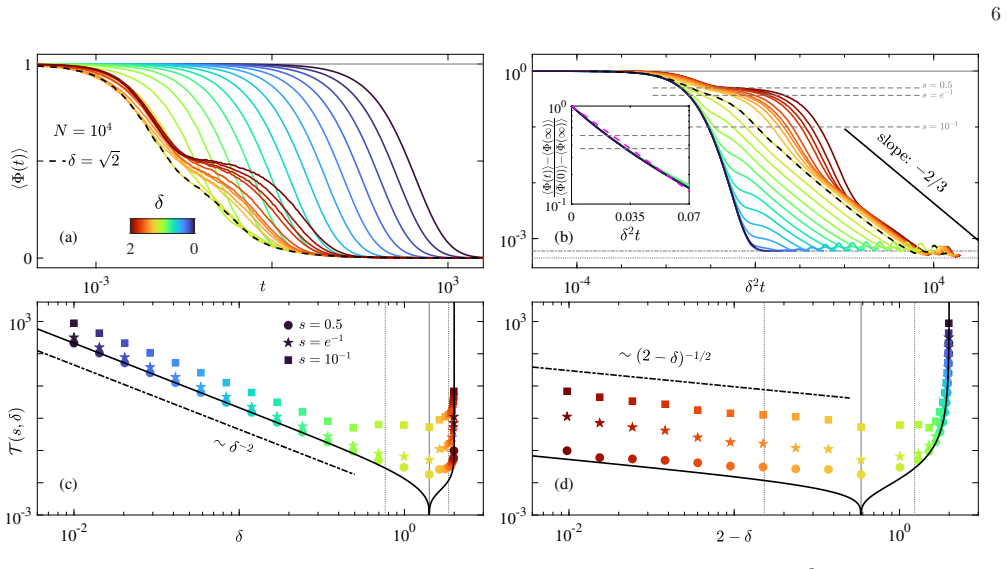
The phase diagram in the plane of system size N and integrability-breaking parameter δ that separates kinetic, intermediate, and hydrodynamic relaxation processes.
If this is right
- In the thermodynamic limit the relaxation behavior depends on whether system size or integrability-breaking strength is taken to its limiting value first.
- Hydrodynamic relaxation can appear in small systems once the system is sufficiently far from integrability.
- The decay of heat-current fluctuations in equilibrium follows the same three-regime scaling as nonequilibrium thermalization.
- The Bogoliubov sequence of kinetic followed by hydrodynamic stages appears explicitly as the intermediate regime in the phase diagram.
Where Pith is reading between the lines
- Analogous phase diagrams may classify relaxation in other one-dimensional systems whose integrability can be tuned continuously.
- Small-system simulations can already access hydrodynamic scaling by choosing sufficiently large integrability-breaking strength.
- The unified picture suggests that thermalization and transport can be studied together in quantum many-body systems with comparable parameter tuning.
Load-bearing premise
The specific collision rules of the diatomic hard-point gas and the chosen measure of integrability breaking capture the generic crossover between kinetic and hydrodynamic relaxation without model-specific artifacts.
What would settle it
Numerical measurement of local energy relaxation time versus δ and N that fails to exhibit the predicted δ^{-2} scaling in the near-integrable limit or the linear-in-N scaling in the far-from-integrable limit would falsify the phase diagram.
Figures




read the original abstract
Whether and how a system approaches equilibrium is central in nonequilibrium statistical physics, crucial to understanding thermalization and transport. Bogoliubov's three-stage (initial, kinetic, and hydrodynamic) evolution hypothesis offers a qualitative framework, but quantitative progress has focused on near-integrable systems like dilute gases. In this work, we investigate the relaxation dynamics of a one-dimensional diatomic hard-point (DHP) gas, presenting a phase diagram that characterizes relaxation behavior across the full parameter space, from near-integrable to far-from-integrable regimes. We analyze thermalization (local energy relaxation in nonequilibrium states) and identify three universal dynamical regimes: (i) In the near-integrable regime, kinetic processes dominate, local energy relaxation decays exponentially, and the thermalization time $\tau$ scales as $\tau \propto \delta^{-2}$. (ii) In the far-from-integrable regime, hydrodynamic effects dominate, energy relaxation decays power-law, and thermalization time scales linearly with system size $N$. (iii) In the intermediate regime, the Bogoliubov phase emerges, characterized by the transition from kinetic to hydrodynamic relaxation. The phase diagram also shows that hydrodynamic behavior can emerge in small systems when sufficiently far from the integrable regime, challenging the view that such effects occur only in large systems. In the thermodynamic limit, the system's relaxation depends on the order in which the limits ($N \to \infty$ or $\delta \to 0$) are taken. We then analyze heat transport (decay of heat-current fluctuations in equilibrium), demonstrating its consistency with thermalization, leading to a unified theoretical description of thermalization and transport. Our approach provides a pathway for studying relaxation dynamics in many-body systems, including quantum systems.
Editorial analysis
A structured set of objections, weighed in public.
Referee Report
Summary. The manuscript studies relaxation in a one-dimensional diatomic hard-point gas, constructing a phase diagram in the (δ, N) plane that identifies three dynamical regimes for local energy thermalization: (i) near-integrable (exponential decay with τ ∝ δ^{-2}), (ii) far-from-integrable (power-law decay with τ ∝ N), and (iii) an intermediate Bogoliubov crossover. It further shows that heat-current fluctuations in equilibrium are consistent with these regimes and discusses the non-commuting limits N → ∞ and δ → 0, claiming a unified picture of thermalization and transport.
Significance. If the reported scalings and regime boundaries are robust, the work supplies a concrete, tunable realization of the kinetic-to-hydrodynamic crossover in a many-body system and demonstrates that hydrodynamic relaxation can appear at modest N when δ is sufficiently large. The explicit link between nonequilibrium thermalization times and equilibrium current fluctuations is a positive feature. The model dependence on the specific hard-point collision rules remains a limitation that affects how far the phase diagram can be viewed as generic.
major comments (2)
- [§2] §2 (model definition): the integrability-breaking parameter δ is introduced via the mass ratio in the elastic two-mass collision rules. Because equal-mass hard-point dynamics maps to free streaming, the specific form of δ may generate additional near-conserved quantities whose relaxation competes with the intended kinetic and hydrodynamic channels. The central claim that the three regimes are universal therefore requires an explicit check that the exponential-versus-power-law distinction and the δ^{-2} scaling survive under a qualitatively different perturbation (e.g., a weak quartic potential).
- [§4] §4 (thermodynamic-limit discussion): the statement that relaxation depends on the order of limits (N → ∞ versus δ → 0) is load-bearing for the phase-diagram interpretation. The manuscript should supply either analytic bounds or numerical data showing how the crossover lines shift when the two limits are taken in opposite order, rather than inferring the dependence solely from finite-N, finite-δ trajectories.
minor comments (2)
- [Figure 2] Figure 2 (phase diagram): the boundaries separating the three regimes are drawn as sharp lines; adding uncertainty bands or indicating the fitting windows used to extract τ would improve clarity.
- [Abstract] Abstract, line 3: the phrase 'three universal dynamical regimes' should be qualified as 'three regimes observed in this model' to avoid implying model-independent universality before the generality check is performed.
Simulated Author's Rebuttal
We thank the referee for the careful reading of our manuscript and the constructive suggestions. We provide point-by-point responses to the major comments below.
read point-by-point responses
-
Referee: [§2] §2 (model definition): the integrability-breaking parameter δ is introduced via the mass ratio in the elastic two-mass collision rules. Because equal-mass hard-point dynamics maps to free streaming, the specific form of δ may generate additional near-conserved quantities whose relaxation competes with the intended kinetic and hydrodynamic channels. The central claim that the three regimes are universal therefore requires an explicit check that the exponential-versus-power-law distinction and the δ^{-2} scaling survive under a qualitatively different perturbation (e.g., a weak quartic potential).
Authors: The referee raises a valid point regarding the potential model-specific features of the mass-ratio perturbation. While we maintain that the diatomic hard-point gas provides a clean realization of the kinetic-to-hydrodynamic crossover, we acknowledge that an explicit verification with an alternative perturbation, such as a weak quartic potential, would help establish broader universality. In the revised manuscript, we will expand the discussion in §2 to address possible near-conserved quantities and argue based on existing literature that the δ^{-2} scaling is characteristic of weak integrability breaking in one-dimensional systems. However, performing new simulations with a different model is beyond the current scope, and we will note this as a direction for future work. revision: partial
-
Referee: [§4] §4 (thermodynamic-limit discussion): the statement that relaxation depends on the order of limits (N → ∞ versus δ → 0) is load-bearing for the phase-diagram interpretation. The manuscript should supply either analytic bounds or numerical data showing how the crossover lines shift when the two limits are taken in opposite order, rather than inferring the dependence solely from finite-N, finite-δ trajectories.
Authors: We agree that the non-commutativity of the limits is crucial and that our original presentation relied on inference from finite-parameter data. To address this directly, we have conducted additional numerical simulations in which the thermodynamic limit is approached by first sending N to infinity at fixed δ and subsequently taking δ to zero. The results, which will be included in the revised §4, show that the crossover lines in the phase diagram indeed shift depending on the order of limits, with the hydrodynamic regime becoming accessible at smaller δ when N is taken to infinity first. This provides concrete support for the phase-diagram interpretation. revision: yes
Circularity Check
No significant circularity; derivation is model-driven and self-contained
full rationale
The paper examines relaxation in an explicit diatomic hard-point gas model by varying the integrability-breaking parameter δ and system size N, then reports observed dynamical regimes and scalings (exponential decay with δ^{-2}, power-law with N) from direct analysis of that model's collision rules and nonequilibrium evolution. No step reduces a claimed prediction to a fitted input by construction, nor does any central claim rest on a self-citation chain or imported uniqueness theorem; the phase diagram and unified thermalization-transport picture follow from the model's explicit dynamics rather than tautological redefinition. This is the normal non-circular outcome for a numerical study of a concrete microscopic system.
Axiom & Free-Parameter Ledger
free parameters (1)
- δ
axioms (1)
- domain assumption Bogoliubov's three-stage (initial, kinetic, hydrodynamic) evolution hypothesis
Lean theorems connected to this paper
-
IndisputableMonolith/Cost/FunctionalEquation.leanwashburn_uniqueness_aczel unclear?
unclearRelation between the paper passage and the cited Recognition theorem.
three universal dynamical regimes: (i) near-integrable ... τ ∝ δ^{-2} ... (ii) far-from-integrable ... power-law ... τ ∝ N ... (iii) intermediate Bogoliubov phase
-
IndisputableMonolith/Foundation/DimensionForcing.leanalexander_duality_circle_linking unclear?
unclearRelation between the paper passage and the cited Recognition theorem.
DHP model ... mass difference δ ... transition matrix A with eigenvalues 1 and λ=δ²/2−1
What do these tags mean?
- matches
- The paper's claim is directly supported by a theorem in the formal canon.
- supports
- The theorem supports part of the paper's argument, but the paper may add assumptions or extra steps.
- extends
- The paper goes beyond the formal theorem; the theorem is a base layer rather than the whole result.
- uses
- The paper appears to rely on the theorem as machinery.
- contradicts
- The paper's claim conflicts with a theorem or certificate in the canon.
- unclear
- Pith found a possible connection, but the passage is too broad, indirect, or ambiguous to say the theorem truly supports the claim.
Reference graph
Works this paper leans on
-
[1]
Here, kinetic effects domi- nate, while hydrodynamic behavior is suppressed. • Case (ii): τf ≪ τk ≪ τh, corresponding to region (II) between the magenta and cyan vertical lines in Fig. 1. This intermediate regime is referred to as the Bogoliubov phase, where ballistic, kinetic, and hydrodynamic effects coexist. • Case (iii): τh ≫ τk and τk → τf , correspond...
-
[2]
These three regimes will be referenced repeatedly in subsequent discussions
In this regime, the kinetic contribution becomes negligible, and the system exhibits pronounced hydrody- namic behavior. These three regimes will be referenced repeatedly in subsequent discussions. Physically, the characteristic time τk is governed by the system’s intrinsic noninte- grability and arises from local collisions, with negligible dependence on...
-
[3]
corresponds to a left-heavy/right-light particle pair, while a negative mass difference ( mi − mi+1 < 0) cor- responds to a left-light/right-heavy configuration. Addi- tionally, vivi+1 > 0 (or < 0) indicates a collision between particles moving in the same (or opposite) direction. In equilibrium, we have ⟨G⟩ = 0 and ⟨G2⟩ = g2T 2 4 . (8) From Eq. ( 3), it is...
-
[4]
Thus, the in- tegrable system does not spontaneously reach a thermal- ized state
simplifies to ˜Ei = Ei+1, and ˜Ei+1 = Ei, (9) which shows that collisions merely exchange energy be- tween particles without redistributing it. Thus, the in- tegrable system does not spontaneously reach a thermal- ized state. Second, in the case of δ = √ 2, we have λ = 0 and g = 1, so G = ± √ EiEi+1, and Eq. ( 3) becomes ˜Ei = ¯E + G, and ˜Ei+1 = ¯E − G, (...
-
[5]
Let |λ|= g, we obtain δc = √ 2 ∓ √
-
[6]
(11) A. Estimation of timescale for thermalization In the kinetic theory of gases [ 100–103], the molecu- lar chaos hypothesis, also known as the Stosszahlansatz, asserts that the velocities of colliding particles are uncor- related and independent of position, i.e., ⟨G⟩ = 0. This implies that the collisions in the system are statistically independent, ma...
-
[7]
and ( 18) represent the main theoretical results of this work, demonstrating that inter- particle collisions drive the gas toward local equilibrium in an exponential manner. From Eq. ( 18), we observe that τk reaches its minimum at δ = √ 2, where λ = 0, meaning the system achieves equipartition after a single collision. However, as shown in Fig. 2, g = 1 ...
-
[8]
Figure 4(b) reveals a collapse for small δ when t is rescaled by δ2
The curve for δ = √ 2 decays the fastest, as shown by the black dashed line. Figure 4(b) reveals a collapse for small δ when t is rescaled by δ2. The curve approximates exponential de- cay (see the inset in semi-logarithmic scale) toward its minimum value 6 /N , indicating that Teq ∝ τk ∝ δ− 2 ≫ τh as δ → 0. This suggests that the system remains in region...
work page 2000
-
[9]
The horizontal panels differ only in the rescaling of the axes. All panels share the legend . Lines with different slopes are drawn for reference. To detect the scaling behavior of Teq with respect to δ, we introduce T (s, δ ), defined by the condition ⟨Φ( T , δ )⟩ = s, where s serves as a threshold. Figure 4(c) shows the nonmonotonic relationship between T ...
-
[10]
It is ob- served that ⟨Φ( t)⟩ exhibits qualitatively identical behav- ior across all system sizes, decaying in a power-law man- ner (i.e., ⟨Φ( t)⟩ ∼ t− 2/ 3) and displaying oscillatory be- havior before stabilizing. Furthermore, the onset of os- cillations depends on N , but becomes independent of δ for sufficiently large N . For example, the curve undergo-...
-
[11]
Additionally, Fig. 5(d) shows nearly complete overlap between all oscillating segments of the curves, suggesting that Teq ∼ τh ≃ N/c s (see the gray vertical line). This indicates significant size- dependence due to hydrodynamic effects, specifically the collisions of acoustic modes. In short, for small δ, when the system size N is less than a critical size ...
-
[12]
(29) Here, ξ is the sole parameter that needs to be determined
and ( 28), and using t = nτf N , we obtain τ = − τf C(0) ξNS . (29) Here, ξ is the sole parameter that needs to be determined. From the thermalization results, we observe that |λ|and g can roughly describe the strength of the kinetic and hy- drodynamic effects for δ ∈ (0, √ 2), where δ2 < (4 − δ2), as shown in Fig. 2. Assuming that the kinetic effect vanish...
-
[13]
R. Pathria and P. Beale, Statistical Mechanics , 4th ed. (Academic Press, Elsevier, 2021)
work page 2021
-
[14]
Ford, The Fermi-Pasta-Ulam problem: Paradox turns discovery, Phys
J. Ford, The Fermi-Pasta-Ulam problem: Paradox turns discovery, Phys. Rep. 213, 271 (1992)
work page 1992
-
[15]
J. L. Lebowitz, Boltzmann’s Entropy and Time’s Arrow, Phys. Today 46, 32 (1993)
work page 1993
-
[16]
J. L. Lebowitz, Statistical mechanics: A selective revi ew of two central issues, Rev. Mod. Phys. 71, S346 (1999)
work page 1999
- [17]
-
[18]
Dauxois, Fermi, Pasta, Ulam and a mysterious lady, Phys
T. Dauxois, Fermi, Pasta, Ulam and a mysterious lady, Phys. Today 61, 55 (2008)
work page 2008
-
[19]
Gallavotti, ed., The Fermi-Pasta-Ulam Problem: A Status Report , Lect
G. Gallavotti, ed., The Fermi-Pasta-Ulam Problem: A Status Report , Lect. Notes Phys., Vol. 728 (Springer, New York, 2008)
work page 2008
-
[20]
N. J. Zabusky, Fermi-Pasta-Ulam, solitons and the fab- ric of nonlinear and computational science: History, synergetics, and visiometrics, Chaos 15, 015102 (2005)
work page 2005
-
[21]
D. K. Campbell, P. Rosenau, and G. M. Zaslavsky, In- troduction: The Fermi-Pasta-Ulam problem—the first fifty years, Chaos 15, 015101 (2005)
work page 2005
-
[22]
G. P. Berman and F. M. Izrailev, The Fermi-Pasta-Ulam problem: Fifty years of progress, Chaos 15, 015104 (2005)
work page 2005
-
[23]
M. Pettini, L. Casetti, M. Cerruti-Sola, R. Franzosi, a nd E. G. D. Cohen, Weak and strong chaos in Fermi-Pasta- Ulam models and beyond, Chaos 15, 015106 (2005)
work page 2005
-
[24]
G. M. Zaslavsky, Long way from the FPU-problem to chaos, Chaos 15, 015103 (2005)
work page 2005
- [25]
-
[26]
W. Fu, Y. Zhang, and H. Zhao, Universal scaling of the thermalization time in one-dimensional lattices, Phys. Rev. E 100, 010101(R) (2019)
work page 2019
-
[27]
W. Fu, Y. Zhang, and H. Zhao, Universal law of ther- malization for one-dimensional perturbed Toda lattices, New J. Phys. 21, 043009 (2019)
work page 2019
-
[28]
W. Fu, Y. Zhang, and H. Zhao, Nonintegrability and thermalization of one-dimensional diatomic lattices, Phys. Rev. E 100, 052102 (2019)
work page 2019
-
[29]
L. Pistone, S. Chibbaro, M. D. Bustamante, Y. V. Lvov, and M. Onorato, Universal route to thermalization in weakly-nonlinear one-dimensional chains, Math. Eng. 1, 672 (2019)
work page 2019
-
[30]
Z. Wang, W. Fu, Y. Zhang, and H. Zhao, Wave- turbulence origin of the instability of Anderson localiza- tion against many-body interactions, Phys. Rev. Lett. 124, 186401 (2020)
work page 2020
-
[31]
W. Fu, Y. Zhang, and H. Zhao, Effect of pressure on thermalization of one-dimensional nonlinear chains, Phys. Rev. E 104, L032104 (2021)
work page 2021
-
[32]
S. Feng, W. Fu, Y. Zhang, and H. Zhao, The anti- Fermi-Pasta-Ulam-Tsingou problem in one-dimensional diatomic lattices, J. Stat. Mech. Theory Exp. 2022, 053104 (2022)
work page 2022
-
[33]
M. Onorato, Y. V. Lvov, G. Dematteis, and S. Chib- baro, Wave turbulence and thermalization in one- dimensional chains, Phys. Rep. 1040, 1 (2023)
work page 2023
-
[34]
Z. Wang, W. Fu, Y. Zhang, and H. Zhao, Thermaliza- tion of one-dimensional classical lattices: beyond the weakly interacting regime, Commun. Theor. Phys. 76, 115601 (2024)
work page 2024
-
[35]
Z. Wang, W. Fu, Y. Zhang, and H. Zhao, Thermal- ization of two- and three-dimensional classical lattices, Phys. Rev. Lett. 132, 217102 (2024)
work page 2024
-
[36]
C. Danieli, D. K. Campbell, and S. Flach, Intermittent many-body dynamics at equilibrium, Phys. Rev. E 95, 060202 (2017)
work page 2017
-
[37]
L. Peng, W. Fu, Y. Zhang, and H. Zhao, Instability dy- namics of nonlinear normal modes in the Fermi-Pasta- Ulam-Tsingou chains, New J. Phys. 24, 093003 (2022)
work page 2022
- [38]
-
[39]
W. Lin, W. Fu, Z. Wang, Y. Zhang, and H. Zhao, Uni- versality classes of thermalization and energy diffusion, Phys. Rev. E 111, 024122 (2025)
work page 2025
- [40]
- [41]
-
[42]
C. Gogolin and J. Eisert, Equilibration, thermalisati on, and the emergence of statistical mechanics in closed quantum systems, Rep. Prog. Phys. 79, 056001 (2016)
work page 2016
-
[43]
Ueda, Quantum equilibration, thermalization and prethermalization in ultracold atoms, Nat
M. Ueda, Quantum equilibration, thermalization and prethermalization in ultracold atoms, Nat. Rev. Phys. 2, 669 (2020)
work page 2020
- [44]
- [45]
-
[46]
A. Bastianello, A. De Luca, B. Doyon, and J. De Nardis, Thermalization of a trapped one-dimensional Bose gas via diffusion, Phys. Rev. Lett. 125, 240604 (2020)
work page 2020
-
[47]
K. Korzekwa and M. Lostaglio, Optimizing thermaliza- tion, Phys. Rev. Lett. 129, 040602 (2022)
work page 2022
- [48]
-
[49]
N. Darkwah Oppong, G. Pasqualetti, O. Bettermann, P. Zechmann, M. Knap, I. Bloch, and S. F¨ olling, Probing transport and slow relaxation in the mass- imbalanced Fermi-Hubbard model, Phys. Rev. X 12, 031026 (2022)
work page 2022
-
[50]
Y. Le, Y. Zhang, S. Gopalakrishnan, M. Rigol, and D. S. Weiss, Observation of hydrodynamization and lo- cal prethermalization in 1d Bose gases, Nature 618, 494 (2023)
work page 2023
-
[51]
M. I. Garc ´ ıa de Soria, P. Maynar, D. Gu´ ery-Odelin, and E. Trizac, Fate of Boltzmann’s breathers: Stokes hypothesis and anomalous thermalization, Phys. Rev. Lett. 132, 027101 (2024)
work page 2024
-
[52]
T. I. Andersen, N. Astrakhantsev, A. H. Karamlou, and et al., Thermalization and criticality on an analogue– digital quantum simulator, Nature 638, 79 (2025)
work page 2025
-
[53]
T. Kinoshita, T. Wenger, and D. S. Weiss, A quantum Newton’s cradle, Nature 440, 900 (2006)
work page 2006
-
[54]
A. P. Luca D’Alessio, Yariv Kafri and M. Rigol, From quantum chaos and eigenstate thermalization to statis- tical mechanics and thermodynamics, Adv. Phys. 65, 239 (2016)
work page 2016
-
[55]
K. Mallayya and M. Rigol, Quantum quenches and re- laxation dynamics in the thermodynamic limit, Phys. Rev. Lett. 120, 070603 (2018)
work page 2018
-
[56]
K. Mallayya, M. Rigol, and W. De Roeck, Prethermal- ization and thermalization in isolated quantum systems, Phys. Rev. X 9, 021027 (2019)
work page 2019
-
[57]
F. Huveneers and J. Lukkarinen, Prethermalization in a classical phonon field: Slow relaxation of the number of phonons, Phys. Rev. Res. 2, 022034 (2020)
work page 2020
-
[58]
K. Mallayya and M. Rigol, Prethermalization, thermal- ization, and Fermi’s golden rule in quantum many-body systems, Phys. Rev. B 104, 184302 (2021)
work page 2021
- [59]
-
[60]
B. S. Shastry and A. P. Young, Dynamics of energy transport in a Toda ring, Phys. Rev. B 82, 104306 (2010)
work page 2010
-
[61]
T. Mori, T. N. Ikeda, E. Kaminishi, and M. Ueda, Ther- malization and prethermalization in isolated quantum systems: a theoretical overview, J. Phys. B: At. Mol. Opt. Phys. 51, 112001 (2018)
work page 2018
-
[62]
C. Gogolin, M. P. M¨ uller, and J. Eisert, Absence of ther- malization in nonintegrable systems, Phys. Rev. Lett. 106, 040401 (2011)
work page 2011
-
[63]
B. N. Balz and P. Reimann, Typical relaxation of isolated many-body systems which do not thermalize, Phys. Rev. Lett. 118, 190601 (2017)
work page 2017
- [64]
- [65]
-
[66]
F. M. Surace and O. Motrunich, Weak integrability breaking perturbations of integrable models, Phys. Rev. Res. 5, 043019 (2023)
work page 2023
-
[67]
Kubo, The fluctuation-dissipation theorem, Rep
R. Kubo, The fluctuation-dissipation theorem, Rep. Prog. Phys. 29, 255 (1966)
work page 1966
- [68]
-
[69]
Dhar, Heat transport in low-dimensional systems, Adv Phys 57, 457 (2008)
A. Dhar, Heat transport in low-dimensional systems, Adv Phys 57, 457 (2008)
work page 2008
-
[70]
S. Lepri, Thermal Transport in Low Dimensions: From Statistical Physics to Nanoscale Heat Transfer , Lecture Notes in Physics (Springer Cham, 2016)
work page 2016
-
[71]
O. Narayan and S. Ramaswamy, Anomalous heat con- duction in one-dimensional momentum-conserving sys- tems, Phys. Rev. Lett. 89, 200601 (2002)
work page 2002
-
[72]
van Beijeren, Exact results for anomalous transport in one-dimensional hamiltonian systems, Phys
H. van Beijeren, Exact results for anomalous transport in one-dimensional hamiltonian systems, Phys. Rev. Lett. 108, 180601 (2012)
work page 2012
-
[73]
C. B. Mendl and H. Spohn, Dynamic correlators of fermi-pasta-ulam chains and nonlinear fluctuating hy- drodynamics, Phys. Rev. Lett. 111, 230601 (2013)
work page 2013
-
[74]
Spohn, Nonlinear fluctuating hydrodynamics for an- harmonic chains, J
H. Spohn, Nonlinear fluctuating hydrodynamics for an- harmonic chains, J. Stat. Phys. 154, 1191 (2014)
work page 2014
- [75]
- [76]
-
[77]
S. Chen, Y. Zhang, J. Wang, and H. Zhao, Finite-size effects on current correlation functions, Phys. Rev. E 89, 022111 (2014)
work page 2014
- [78]
-
[79]
Lepri, Relaxation of classical many-body hamiltoni - 13 ans in one dimension, Phys
S. Lepri, Relaxation of classical many-body hamiltoni - 13 ans in one dimension, Phys. Rev. E 58, 7165 (1998)
work page 1998
-
[80]
J.-S. Wang and B. Li, Intriguing heat conduction of a chain with transverse motions, Phys. Rev. Lett. 92, 074302 (2004)
work page 2004
discussion (0)
Sign in with ORCID, Apple, or X to comment. Anyone can read and Pith papers without signing in.