REVIEW 3 major objections 5 minor 1 cited by
Formation of heavy double neutron stars I: Eddington-limited accretion for a 1.4 $M_{\odot}$ neutron star at solar metallicity
T0 review · 3 major / 5 minor · reviewed 2026-08-05 · deepseek-v4-flash
Pith's one-line read Heavy double neutron stars are not produced by unstable mass transfer, according to a 338-model binary grid.
desk verdict A solid MESA grid and calibrated population model showing heavy DNSs are rare at solar metallicity, but the 'rules out unstable mass transfer' claim is overclaimed because the grid never actually simulates an unstable RLO. read the letter →
The pith
A machine-rendered reading of the paper's core claim, the machinery that carries it, and where it could break.
The reading
What carries the argument
The load-bearing machinery is a grid of 338 MESA binary evolution models, using the 1D stellar evolution code MESA. Each binary starts just after the common-envelope phase as a naked helium star with a 1.4 solar-mass point-mass neutron star companion; the helium star is evolved through core helium burning and Case BB Roche-lobe overflow, with accretion onto the neutron star capped at the Eddington rate and treated as fully non-conservative. The resulting pre-supernova carbon-oxygen core and helium envelope masses are then fed into the Mandel & Müller (2020) remnant-mass and natal-kick prescription, in standard and modified forms; the modified form flattens the slope of the carbon-oxygen core
What would settle it
Observe one Galactic double neutron star with total mass above 3 solar masses in a short, recycled orbit consistent with a solar-metallicity isolated progenitor, or run a hydrodynamical binary model that includes the post-common-envelope hydrogen layer and a heavier first-born neutron star and still produces GW190425-like systems through a dynamically unstable second mass transfer; either would break the paper's exclusion.
Extended reading notes
Core claim
The paper's central claim is a constraint: for helium stars between 2.5 and 9.8 solar masses paired with 1.4 solar-mass neutron stars at solar metallicity, the second phase of mass transfer in the models that matter is always stable Case BB Roche-lobe overflow, and none of the heavy double neutron stars they produce goes through a dynamically unstable mass transfer. With the modified supernova prescription calibrated to the Galactic field population, only about 0.01% of all systems and 0.01% of recycled systems have total mass at or above 3 solar masses, far too few to explain the inferred rate of massive DNS mergers. The paper therefore rules out the unstable-mass-transfer formation channel
Load-bearing premise
The models assume that after the common-envelope phase the neutron star's companion is a bare helium core with no hydrogen left, that the first-born neutron star is exactly 1.4 solar masses, and that mass transfer is capped at the Eddington rate; the unstable mass-transfer channel is never actually simulated, so the exclusion only applies within these starting assumptions.
Editorial extensions
If this is right
- If the exclusion holds, the unstable-mass-transfer 'fast-merger' channel contributes essentially nothing to the GW190425-class merger rate at solar metallicity.
- The observed rate of massive double neutron star mergers would have to be dominated by something else: lower-metallicity progenitors, more massive first-born neutron stars, super-Eddington accretion, or dynamical assembly in dense clusters.
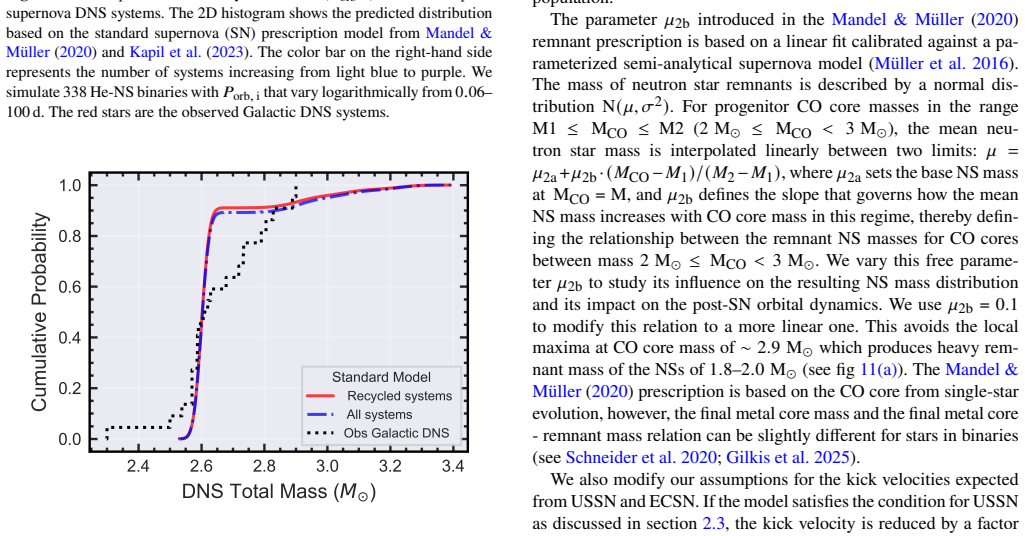
- Calibrated models match the observed total-mass distribution of Galactic double neutron stars, so the high-mass tail in uncalibrated population synthesis is likely an artifact of the carbon-oxygen core to remnant mass relation and kick treatment.
- Heavy double neutron stars that do form should be compact, mostly recycled through stable Case BB Roche-lobe overflow, with a minority non-recycled and thus detectable only by gravitational waves.
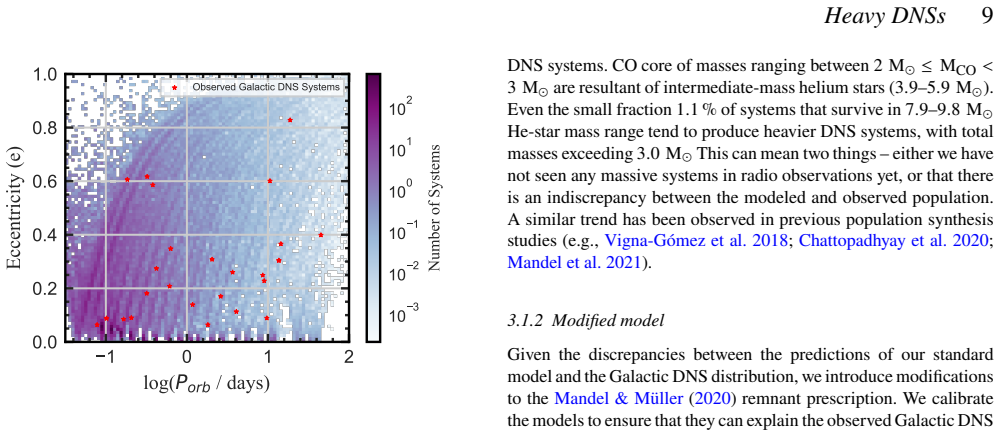
- The predicted eccentricity gap (roughly 0.3 to 0.6) remains unexplained by isolated evolution, pointing to either unseen radio systems or missing kick physics such as distinct kick modes inferred from Be X-ray binaries.
Reading between the lines
- The exclusion is conditional on the naked-helium-star starting point, a fixed 1.4 solar-mass first-born neutron star, and Eddington-limited accretion; if post-common-envelope hydrogen retention or a heavier first-born neutron star shifts the stability boundary of the second mass transfer, the unstable channel could re-open.
- A direct extension the paper leaves for its Part II, rerunning the grid at lower metallicity and with first-born neutron star masses near 2 solar masses, is the cleanest test: if heavy double neutron star yields remain below one percent, GW190425 needs a fundamentally different formation site.
- The predicted roughly 20% branch of non-recycled heavy double neutron stars from massive helium stars that avoid mass transfer gives a concrete gravitational-wave-only population whose chirp-mass distribution and merger rate can be checked against current detector catalogs.
- The calibration suggests rapid population-synthesis codes should not use the unmodified carbon-oxygen core to remnant mass relation when estimating heavy double neutron star merger rates, since it produces a high-mass tail that the Galactic field population does not show.
Editorial analysis
A structured set of objections, weighed in public.
Referee Report
Summary. The paper presents a grid of 338 MESA binary models of helium stars (2.5–9.8 Msun) with a fixed 1.4 Msun neutron star companion at solar metallicity, evolved from the post-common-envelope phase through Case BB mass transfer and the second supernova. Using the Mandel & Müller (2020) remnant/kick prescription, first in a standard form and then with a modified calibration (μ2b=0.1, reduced USSN/ECSN kicks, and a factor-2 kick boost for CO cores >1.66 Msun), the authors construct synthetic DNS populations and compare their P_orb–e and total-mass distributions to the Galactic DNS sample. They find that the modified model broadly reproduces the observed distributions and that only 0.01% of all systems (0.02% of Hubble-time mergers) have total mass ≥3 Msun. The paper concludes that this channel cannot explain the rate of GW190425-like mergers and claims to rule out formation of such systems via the second unstable mass transfer.
Significance. If the central conclusion were fully supported, the paper would be a valuable constraint on formation channels for GW190425 and on the isolated binary evolution channel for heavy double neutron stars. The MESA grid and the comparison to the current Galactic DNS sample are useful, and the authors are transparent about their MESA version and provide inlists and post-processing scripts, which is a strength. However, the most prominent claim—that the models rule out unstable mass transfer as a formation route for GW190425-like systems—is not supported by the computation itself, because the grid never simulates unstable mass transfer. The paper's calibrated fractions also lack uncertainty/sensitivity analysis. The work is therefore a useful exploratory study, but its headline conclusion needs substantial reframing or additional modeling.
major comments (3)
- [Section 2 and Section 3.2] The claim in the Abstract and in Section 3.2 that the models 'rule out the formation of massive DNSs like GW190425 via the second unstable mass transfer' is not supported by the computation. All binaries are initialized after the common-envelope phase as naked helium stars (Section 2.2), and the mass-transfer scheme is the Ritter (1988) quasi-static prescription with Eddington-limited, fully non-conservative accretion. No dynamical-instability criterion for the second RLO is applied anywhere, so by construction none of the heavy-DNS progenitors can undergo unstable mass transfer. The statement in Section 3.2 that 'none of the heavy DNS system progenitors undergo unstable mass transfer' is therefore a built-in property of the grid, not a physical exclusion. The correct conclusion is that the modeled stable Case BB channel produces very few heavy DNSs; to rule out the unstable channel, the
- [Section 3.1.2] The modified model is calibrated to the observed Galactic DNS population using four adjustable choices: μ2b=0.1, the USSN kick reduction factor, the ECSN kick of 30 km/s, and the factor-2 kick boost for CO cores ≥1.66 Msun. The kick boost in particular is stated to be chosen 'by making sure that we do not disrupt the GW population'—i.e., the same population that is used later to infer the heavy-DNS fraction. This makes the subsequent 0.01%/0.02% heavy-DNS fractions post-hoc outcomes of the calibration rather than independent predictions. No sensitivity study is presented to show how these fractions vary when μ2b, the kick factors, or the ECSN threshold are changed within reasonable ranges. Without such robustness tests, the quantitative claim that only 0.01% of DNSs are heavy is not established.
- [Section 3.1.1 and Section 3.2] The absolute fractions (0.01% of all systems, 0.02% of Hubble-time mergers) are computed with an assumed initial distribution of He-star masses and orbital periods: a power-law IMF with α=2.35 and a flat-in-log period distribution (Section 3.1.1). These choices are reasonable but not unique, and the weighting scheme directly determines the fractions. The paper quotes these percentages without uncertainties and without a sensitivity analysis to the assumed weighting or to the binary fraction/normalization. As a result, the statement that the model is 'unable to explain the high rate of GW190425' is stronger than the calculations justify. A rate estimate or an explicit statement that only relative comparisons are intended is needed.
minor comments (5)
- [Abstract and Section 3.2] The phrase 'via the second unstable mass transfer' is used in the Abstract and Section 3.2, but the acronym 'MT' is defined earlier; please ensure the first use in the Abstract is explicit (e.g., 'unstable mass transfer (MT)').
- [Section 3.1.2] The sentence 'We enable this to kick the slow merging systems visible in radio to higher velocities, simultaneously by making sure that we do not disrupt the GW population' is awkwardly worded; the adverb 'simultaneously' seems to modify an incomplete clause. Please rephrase.
- [Section 4] Typo: 'These systems recieve kicks' should be 'receive'. Also, 'Mtot≥3' appears without a space in multiple places; please fix consistency.
- [Table 1] The table lists some systems under 'Globular Clusters' whose total masses (e.g., J0514-4002E at 3.88 Msun) are outside the 2.3–2.9 Msun range quoted in the text. The text acknowledges this, but it would be helpful to explicitly state in Section 1 that the quoted range refers only to the 24 field DNSs, not the full table.
- [Section 2.3] The mapping from ONeMg core mass (1.37–1.43 Msun) to CO core mass (1.43–1.65 Msun) is asserted without a derivation or citation for the CO-core mapping. A reference or a one-sentence justification would improve reproducibility.
Circularity Check
Central 'rule-out' of unstable-mass-transfer formation is built into the model setup, and the quoted heavy-DNS fraction is a product of the calibration to the observed mass distribution.
-
self definitional
[Abstract; Sections 2, 3.2, 4]
"In our models, within both standard and modified prescriptions, none of the heavy DNS system progenitors undergo unstable mass transfer (Galaudage et al. 2021; Romero-Shaw et al. 2020). ... To compute the mass transfer rate from the He star |Mdot_He|, we use the 'Ritter' mass transfer scheme (Ritter 1988). We assume that the mass accretion rate ... is limited to the Eddington accretion rate ... For simplicity, we therefore assume completely non-conservative mass transfer."
The grid initializes every binary after the first common-envelope phase as a naked He star with a 1.4 Msun NS, and all subsequent RLO is integrated with the Ritter scheme under Eddington-limited, fully non-conservative accretion. No dynamical-instability criterion, second common-envelope phase, or unstable RLO branch is modeled. Therefore the statement that 'none of the heavy DNS system progenitors undergo unstable mass transfer' is true by construction for every model, not a computed result. The abstract's claim that the model 'rules out the formation of heavy DNS systems like GW190425 via the second unstable mass transfer' is equivalent to the input assumption that unstable mass transfer is absent from the modeled channel.
-
fitted input called prediction
[Section 3.1.2 (modified model) and Section 3.1.2 B (DNS total mass distribution)]
"We calibrate the models to ensure that they can explain the observed Galactic DNS population. ... We use μ2b = 0.1 to modify this relation to a more linear one. This avoids the local maxima at CO core mass of ~2.9 M⊙ which produces heavy remnant mass of the NSs of 1.8–2.0 M⊙ ... We enable this to kick the slow merging systems visible in radio to higher velocities, simultaneously by making sure that we do not disrupt the GW population. ... Following calibration to ensure consistency with the observed population, the fraction of heavy DNS systems with masses ≥3 M⊙ in all systems is only 0.01%."
The free parameter μ2b is deliberately set to 0.1 to remove the NS remnant masses of 1.8–2.0 M⊙ that previously produced the high-mass DNS tail; the kick modifications are likewise tuned to the observed P−e distribution and to 'not disrupt the GW population.' The calibration sample contains no Galactic DNS with total mass above 2.9 M⊙, so the survival of any ≥3 M⊙ tail is suppressed by construction. Quoting the resulting 0.01% (or 0.02% merging) fraction as evidence that GW190425-like systems are rare is therefore reporting the consequence of the fit, not an independent prediction.
full rationale
The paper contains substantial independent modeling: a 338-model MESA grid of He-star + 1.4 Msun NS binaries, standard and modified SN/kick prescriptions, and comparisons to external Galactic DNS and GW observations. Those parts are not circular. The circularity is concentrated in the central 'rule-out' claim and in the quoted heavy-DNS fraction. Section 3.2's statement that no heavy DNS progenitor undergoes unstable mass transfer is a direct consequence of the Ritter/Eddington-limited, fully non-conservative mass-transfer scheme and the post-CE starting condition; no dynamical-instability criterion or second CE is modeled, so the abstract's rule-out of formation 'via the second unstable mass transfer' reduces to the model's input assumption. Separately, the 0.01%/0.02% heavy-DNS fractions are quoted after modifying μ2b and kicks specifically to remove the high-mass remnant branch and match the observed (heavy-free) Galactic mass distribution; the heavy tail is thus partly a product of the fit. The paper's own limitation statement (fixed 1.4 Msun NS, solar metallicity) is acknowledged but does not address the unstable-MT exclusion. Overall, these are not minor self-citations; they affect the central claims, so a score of 7 is appropriate.
Assumptions & free parameters
free parameters (5)
- mu2b =
0.5 (standard model), 0.1 (modified model)
- USSN kick factor =
reduced by factor 3 in modified model
- ECSN kick velocity =
30 km/s
- CO >= 1.66 Msun kick factor =
2
- IMF slope alpha =
2.35
assumptions (5)
- domain assumption Common envelope evolution leaves naked helium stars with negligible hydrogen
- domain assumption First-born neutron star mass is fixed to 1.4 Msun
- domain assumption Mass transfer is Eddington-limited and completely non-conservative
- domain assumption Mandel & Mueller (2020) remnant prescription with Kapil et al. (2023) calibration is applicable
- domain assumption The observed Galactic field DNS sample is representative for calibration
Cite this review
Pith. "Pith review of Formation of heavy double neutron stars I: Eddington-limited accretion for a 1.4 $M_{\odot}$ neutron star at solar metallicity." pith.science (2026). https://pith.science/paper/BFLNRU34
@misc{pith2026250815624,
  author       = {Pith},
  title        = {Pith review of: Formation of heavy double neutron stars I: Eddington-limited accretion for a 1.4 $M_\odot$ neutron star at solar metallicity},
  year         = {2026},
  howpublished = {\url{https://pith.science/paper/BFLNRU34}},
  note         = {Machine review of arXiv:2508.15624}
}
abstract
More than 30 Galactic double neutron star (DNS) binaries have now been identified through radio pulsar timing. The 24 DNSs in the Galactic field with measured total masses lie in the narrow range of 2.3--2.9 $M_{\odot}$. In contrast, gravitational-wave observations have detected two DNS mergers: GW170817, with a total mass of 2.7 $M_{\odot}$, and GW190425, with a significantly higher mass of 3.4 $M_{\odot}$. The unusually high mass of GW190425 suggests a non-standard formation channel not represented in the known Galactic population. To investigate the origin of such a massive DNS system, we model the late evolutionary stages of helium stars with initial masses between 2.5 and 9.8 $M_{\odot}$ in binaries with 1.4 $M_{\odot}$ neutron star companions, using the 1D stellar evolution code MESA at solar metallicity. We test alternative formation pathways and calibrate our models to reproduce the observed Galactic DNS mass and orbital distributions. By incorporating a modified natal kick prescription, our population synthesis results are broadly consistent with the observed total mass distribution of known DNS systems. Only a small fraction of DNSs of our model have total masses $\geq$ 3 $M_{\odot}$, insufficient to explain the high rate of massive DNS mergers inferred from GW observations. However, our model rules out the formation of heavy DNS systems like GW190425 via the second unstable mass transfer.
Figures


Figures from the paper (10 more)




Forward citations
Cited by 1 Pith paper
-
Probing the redshift evolution and sub-populations of binary neutron stars with the Einstein Telescope
With a few hundred to a few thousand Einstein Telescope detections, binary neutron star mass bimodality and distinct redshift evolutions of light and heavy subpopulations become distinguishable.
Reference graph
Works this paper leans on
-
[1]
Abbott B. P., et al., 2017a, Phys. Rev. Lett., 119, 161101 Abbott B. P., et al., 2017b, ApJ, 848, L12 Abbott B. P., et al., 2017c, The Astrophysical Journal Letters, 848, L13 Abbott B. P., et al., 2017d, The Astrophysical Journal Letters, 851, L16 Abbott B. P., et al., 2020, ApJ, 892, L3 Acernese F., et al., 2015, Classical and Quantum Gravity, 32, 024001...
work page 2020
-
[2]
Corongiu, A. Kramer, M. Stappers, B. W. Lyne, A. G. Jessner, A. Possenti, A. D’Amico, N. Löhmer, O. 2007, A&A, 462, 703 DeCesar M. E., Ransom S. M., Kaplan D. L., Ray P. S., Geller A. M., 2015, ApJ, 807, L23 Dessart L., Burrows A., Ott C. D., Livne E., Yoon S. C., Langer N., 2006, ApJ, 644, 1063 Dewi J. D. M., Pols O. R., 2003, MNRAS, 344, 629 Doherty C. ...
work page Pith review arXiv 2007
Reviewed August 5, 2026 · model on record in the stance chip above.
Discussion (0). Sign in to comment.