Entanglement entropy as a probe of topological phase transitions
Pith reviewed 2026-05-18 21:26 UTC · model grok-4.3
The pith
The difference in entanglement entropy between half-filled and near-half-filled states vanishes in the topological phase of SSH models but stays finite in the trivial phase.
A machine-rendered reading of the paper's core claim, the machinery that carries it, and where it could break.
Core claim
For a class of Su-Schrieffer-Heeger model variants, the difference in entanglement entropy between half-filled and near-half-filled ground states vanishes in the topological phase but remains finite in the trivial phase, a direct consequence of edge-state localization. This behavior persists even in the presence of quasiperiodic or binary disorder. By analyzing domain-wall configurations, subsystem tuning distinguishes genuine topological zero-energy eigenstates from trivial localized states. Exact phase boundaries from Lyapunov exponents via transfer matrices agree closely with numerical results from the entanglement difference and the topological invariant, with cases where the entropy gap
What carries the argument
The difference ΔS^A in entanglement entropy between half-filled and near-half-filled ground states, which vanishes due to edge-state localization in the topological phase.
If this is right
- The entanglement entropy difference provides a robust diagnostic of topological phases that continues to work in the presence of quasiperiodic or binary disorder.
- Subsystem tuning offers a practical method to tell genuine topological zero modes apart from disorder-induced trivial localized states.
- Phase boundaries extracted from the entropy difference match or exceed the accuracy of those from the topological invariant Q in some realizations.
- The approach links quantum information quantities directly to condensed-matter diagnostics of topology.
Where Pith is reading between the lines
- The same filling-dependent entropy difference could be tested in other one-dimensional symmetry-protected topological models to check whether the vanishing signature is general.
- Experimental platforms that measure entanglement via quantum information techniques might use this difference as a practical indicator of topology in disordered samples.
- Extending the framework to two-dimensional topological systems or weakly interacting cases would test whether the edge-localization effect on the entropy gap survives.
Load-bearing premise
That the vanishing of ΔS^A specifically tracks edge-state localization and that subsystem tuning can reliably separate genuine topological zero-energy states from trivial localized states created by disorder.
What would settle it
A controlled experiment on an SSH chain with tunable quasiperiodic or binary disorder that measures whether the entanglement entropy difference reaches zero precisely in the phase independently confirmed to host protected edge states via conductance or direct state imaging.
Figures


read the original abstract
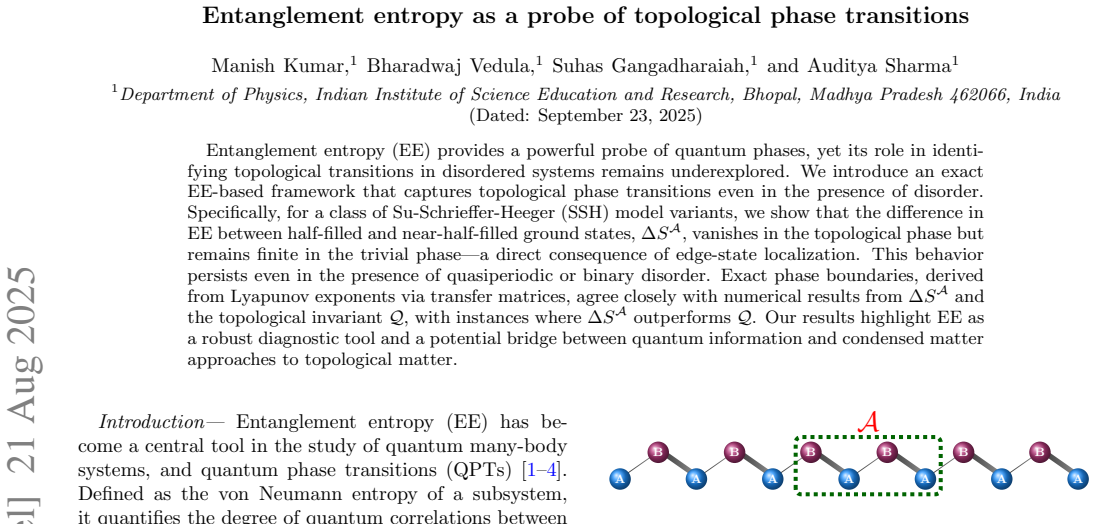
Entanglement entropy (EE) provides a powerful probe of quantum phases, yet its role in identifying topological phase transitions in disordered systems remains underexplored. We introduce an exact EE-based framework that captures topological phase transitions even in the presence of disorder. Specifically, for a class of Su-Schrieffer-Heeger (SSH) model variants, we show that the difference in EE between half-filled and near-half-filled ground states, $\Delta S^{\mathcal{A}}$, vanishes in the topological phase but remains finite in the trivial phase, a direct consequence of edge-state localization. This behavior persists even in the presence of quasiperiodic or binary disorder. By analyzing domain-wall configurations in the SSH chain, we further show how subsystem tuning allows one to distinguish genuine topological zero-energy eigenstates from trivial localized states. Exact phase boundaries, derived from Lyapunov exponents via transfer matrices, agree closely with numerical results from $\Delta S^{\mathcal{A}}$ and the topological invariant $\mathcal{Q}$, with instances where $\Delta S^{\mathcal{A}}$ outperforms $\mathcal{Q}$. Our results highlight EE as a robust diagnostic tool and a potential bridge between quantum information and condensed matter approaches to topological matter.
Editorial analysis
A structured set of objections, weighed in public.
Referee Report
Summary. The manuscript introduces an entanglement-entropy-based diagnostic ΔS^A (difference between half-filled and near-half-filled ground states) for topological phase transitions in Su-Schrieffer-Heeger (SSH) model variants, including those with quasiperiodic or binary disorder. It claims that ΔS^A vanishes in the topological phase due to protected edge-state localization but remains finite in the trivial phase, that subsystem tuning in domain-wall configurations distinguishes genuine topological zero-energy states from trivial disorder-induced localized states, and that phase boundaries obtained from Lyapunov exponents via transfer matrices agree closely with numerical ΔS^A results (sometimes outperforming the invariant Q).
Significance. If the central claims are substantiated, the work supplies a practical EE-based probe for topological transitions in disordered systems where conventional invariants can be ambiguous. The anchoring of phase boundaries in an independent transfer-matrix Lyapunov-exponent calculation is a methodological strength that keeps circularity low and allows direct comparison with both ΔS^A and Q. The persistence of the signal under disorder and the reported instances where ΔS^A outperforms Q would be useful additions to the toolbox for diagnosing topology in one-dimensional chains.
major comments (2)
- [§4 (Subsystem Tuning)] §4 (Subsystem Tuning): The central interpretive step—that subsystem tuning reliably isolates protected topological zero-energy modes from trivial disorder-localized states near zero energy—is load-bearing for the claim that ΔS^A vanishes specifically in the topological phase. The manuscript appears to demonstrate this via numerical examples in selected configurations rather than a general argument or systematic counter-example search; if a trivial localized state can be engineered to produce an identical ΔS^A signature under some tuning, the phase distinction collapses.
- [§3.1 and §5 (Numerical Agreement and Error Analysis)] §3.1 and §5 (Numerical Agreement and Error Analysis): The abstract asserts close agreement between Lyapunov-exponent boundaries and numerical ΔS^A results, yet the manuscript does not provide explicit finite-size scaling, disorder-averaged error bars, or data-exclusion criteria for the disordered cases. Without these, it is difficult to quantify how robust the reported superiority over Q is when fluctuations are large.
minor comments (2)
- [Figures] Figure captions should explicitly label the topological versus trivial regimes and indicate the subsystem sizes used for each ΔS^A curve to facilitate direct visual comparison with the Lyapunov data.
- [Notation] Notation for the near-half-filled filling (e.g., the precise value of δN) should be defined once in the main text rather than only in figure legends.
Simulated Author's Rebuttal
We thank the referee for the careful reading and constructive suggestions. We address the two major comments point by point below and indicate the revisions planned for the resubmitted manuscript.
read point-by-point responses
-
Referee: §4 (Subsystem Tuning): The central interpretive step—that subsystem tuning reliably isolates protected topological zero-energy modes from trivial disorder-localized states near zero energy—is load-bearing for the claim that ΔS^A vanishes specifically in the topological phase. The manuscript appears to demonstrate this via numerical examples in selected configurations rather than a general argument or systematic counter-example search; if a trivial localized state can be engineered to produce an identical ΔS^A signature under some tuning, the phase distinction collapses.
Authors: We agree that the distinction between protected topological zero modes and trivial disorder-induced states is central. Our argument rests on the fact that genuine topological edge states remain exponentially localized at the physical boundaries with a localization length fixed by the bulk gap, whereas trivial localized states have no such protection and their positions are uncorrelated with the subsystem boundaries. Subsystem tuning exploits this difference by varying the cut position and observing whether the entanglement contribution persists only when the cut isolates the protected edge. While the manuscript illustrates this with representative configurations, we acknowledge the absence of an exhaustive counter-example search. In the revised manuscript we will add a short analytic argument based on the transfer-matrix localization length and include additional numerical scans over a wider ensemble of disorder realizations to test for possible mimicry. revision: partial
-
Referee: §3.1 and §5 (Numerical Agreement and Error Analysis): The abstract asserts close agreement between Lyapunov-exponent boundaries and numerical ΔS^A results, yet the manuscript does not provide explicit finite-size scaling, disorder-averaged error bars, or data-exclusion criteria for the disordered cases. Without these, it is difficult to quantify how robust the reported superiority over Q is when fluctuations are large.
Authors: We accept that quantitative error analysis is needed to substantiate the claimed robustness. In the revised version we will add finite-size scaling plots for the phase boundaries extracted from ΔS^A, report disorder-averaged values with standard deviations for the quasiperiodic and binary-disorder ensembles, and state the criteria used to exclude rare configurations with anomalously large fluctuations. These additions will allow a direct, quantitative comparison of the stability of ΔS^A versus Q. revision: yes
Circularity Check
No circularity; phase boundaries anchored in independent transfer-matrix calculation
full rationale
The paper obtains exact phase boundaries from Lyapunov exponents via transfer matrices, an independent external benchmark unrelated to the entanglement entropy computations. Numerical ΔS^A results are compared against these boundaries and the topological invariant Q rather than being used to fit or define them. Subsystem tuning for distinguishing topological zero modes is presented via analysis of domain-wall configurations without reducing to a self-definitional loop, fitted input renamed as prediction, or load-bearing self-citation. The derivation chain remains self-contained against these external benchmarks.
Axiom & Free-Parameter Ledger
axioms (2)
- domain assumption Ground states of the SSH variants are gapped and can be classified by edge-state localization properties.
- standard math Transfer-matrix Lyapunov exponents provide exact phase boundaries independent of the entanglement calculation.
Lean theorems connected to this paper
-
IndisputableMonolith/Foundation/AlexanderDuality.leanalexander_duality_circle_linking unclear?
unclearRelation between the paper passage and the cited Recognition theorem.
difference in EE between half-filled and near-half-filled ground states, ΔS^A, vanishes in the topological phase but remains finite in the trivial phase, a direct consequence of edge-state localization
-
IndisputableMonolith/Cost/FunctionalEquation.leanwashburn_uniqueness_aczel unclear?
unclearRelation between the paper passage and the cited Recognition theorem.
Exact phase boundaries, derived from Lyapunov exponents via transfer matrices
What do these tags mean?
- matches
- The paper's claim is directly supported by a theorem in the formal canon.
- supports
- The theorem supports part of the paper's argument, but the paper may add assumptions or extra steps.
- extends
- The paper goes beyond the formal theorem; the theorem is a base layer rather than the whole result.
- uses
- The paper appears to rely on the theorem as machinery.
- contradicts
- The paper's claim conflicts with a theorem or certificate in the canon.
- unclear
- Pith found a possible connection, but the passage is too broad, indirect, or ambiguous to say the theorem truly supports the claim.
Reference graph
Works this paper leans on
-
[1]
A. Osterloh, L. Amico, G. Falci, and R. Fazio, Scaling of entanglement close to a quantum phase transition, Na- ture 416, 608 (2002)
work page 2002
- [2]
-
[3]
T. J. Osborne and M. A. Nielsen, Entanglement in a sim- ple quantum phase transition, Phys. Rev. A 66, 032110 (2002)
work page 2002
- [4]
-
[5]
C. H. Bennett, H. J. Bernstein, S. Popescu, and B. Schu- macher, Concentrating partial entanglement by local op- erations, Phys. Rev. A 53, 2046 (1996)
work page 2046
-
[6]
L. D. Landau, On the theory of phase transitions, Zh. Eksp. Teor. Fiz. 7, 19 (1937)
work page 1937
-
[7]
A. J. Beekman, L. Rademaker, and J. van Wezel, An introduction to spontaneous symmetry breaking, SciPost Phys. Lect. Notes , 11 (2019)
work page 2019
-
[8]
L. D. Landau, E. M. Lifshitz, E. M. Lifshits, and L. P. Pitaevskii, Statistical Physics: Theory of the Condensed State, Vol. 9 (Butterworth-Heinemann, London, 1980)
work page 1980
-
[9]
M. Z. Hasan and C. L. Kane, Colloquium: Topological insulators, Rev. Mod. Phys. 82, 3045 (2010)
work page 2010
-
[10]
X.-L. Qi and S.-C. Zhang, Topological insulators and su- perconductors, Rev. Mod. Phys. 83, 1057 (2011)
work page 2011
-
[11]
J. E. Moore, The birth of topological insulators, Nature 464, 194 (2010)
work page 2010
- [12]
-
[13]
B. A. Bernevig, Topological Insulators and Topological Superconductors (Princeton University Press, Princeton, 2013)
work page 2013
-
[14]
J. K. Asb´ oth, L. Oroszl´ any, and A. P´ alyi,A Short Course on Topological Insulators (Springer International Pub- lishing, 2016)
work page 2016
-
[15]
K. v. Klitzing, G. Dorda, and M. Pepper, New method for high-accuracy determination of the fine-structure con- stant based on quantized hall resistance, Phys. Rev. Lett. 45, 494 (1980)
work page 1980
-
[16]
J. E. Moore and L. Balents, Topological invariants of time-reversal-invariant band structures, Phys. Rev. B75, 121306 (2007)
work page 2007
-
[17]
D. N. Sheng, Z. Y. Weng, L. Sheng, and F. D. M. Hal- dane, Quantum spin-hall effect and topologically invari- ant chern numbers, Phys. Rev. Lett. 97, 036808 (2006)
work page 2006
-
[18]
T. Fukui and Y. Hatsugai, Topological aspects of the quantum spin-hall effect in graphene: Z2 topological or- der and spin chern number, Phys. Rev. B 75, 121403 (2007)
work page 2007
-
[19]
C. L. Kane and E. J. Mele, Z2 topological order and the quantum spin hall effect, Phys. Rev. Lett. 95, 146802 (2005)
work page 2005
- [20]
-
[21]
R. Roy, Z2 classification of quantum spin hall systems: An approach using time-reversal invariance, Phys. Rev. B 79, 195321 (2009)
work page 2009
-
[22]
Prodan, Robustness of the spin-chern number, Phys
E. Prodan, Robustness of the spin-chern number, Phys. Rev. B 80, 125327 (2009)
work page 2009
-
[23]
B. Leung and E. Prodan, Effect of strong disorder in a three-dimensional topological insulator: Phase diagram and maps of the 𭟋2 invariant, Phys. Rev. B 85, 205136 (2012)
work page 2012
-
[24]
Z. Wang and S.-C. Zhang, Simplified topological invari- ants for interacting insulators, Phys. Rev. X 2, 031008 (2012)
work page 2012
-
[25]
B. P´ erez-Gonz´ alez, M. Bello, A. G´ omez-Le´ on, and G. Platero, Interplay between long-range hopping and disorder in topological systems, Phys. Rev. B 99, 035146 (2019)
work page 2019
- [26]
-
[27]
C.-K. Chiu, J. C. Y. Teo, A. P. Schnyder, and S. Ryu, Classification of topological quantum matter with sym- metries, Rev. Mod. Phys. 88, 035005 (2016)
work page 2016
-
[28]
Wen, Colloquium: Zoo of quantum-topological phases of matter, Rev
X.-G. Wen, Colloquium: Zoo of quantum-topological phases of matter, Rev. Mod. Phys. 89, 041004 (2017)
work page 2017
-
[29]
B. J. Wieder, B. Bradlyn, J. Cano, Z. Wang, M. G. Vergniory, L. Elcoro, A. A. Soluyanov, C. Felser, T. Ne- upert, N. Regnault, and B. A. Bernevig, Topological ma- terials discovery from crystal symmetry, Nature Reviews Materials 7, 196 (2022)
work page 2022
-
[30]
K. L. Hur, L. Henriet, A. Petrescu, K. Plekhanov, G. Roux, and M. Schir´ o, Many-body quantum electro- dynamics networks: Non-equilibrium condensed matter physics with light, Comptes Rendus. Physique 17, 808 (2016)
work page 2016
-
[31]
L. Lu, J. D. Joannopoulos, and M. Soljaˇ ci´ c, Topological photonics, Nature Photonics 8, 821 (2014)
work page 2014
- [32]
- [33]
-
[34]
V. Galitski and I. B. Spielman, Spin–orbit coupling in quantum gases, Nature 494, 49 (2013)
work page 2013
-
[35]
N. R. Cooper, J. Dalibard, and I. B. Spielman, Topo- logical bands for ultracold atoms, Rev. Mod. Phys. 91, 015005 (2019)
work page 2019
-
[36]
N. Goldman, J. C. Budich, and P. Zoller, Topological quantum matter with ultracold gases in optical lattices, Nature Physics 12, 639 (2016)
work page 2016
-
[37]
Vidal, Efficient classical simulation of slightly entan- gled quantum computations, Phys
G. Vidal, Efficient classical simulation of slightly entan- gled quantum computations, Phys. Rev. Lett. 91, 147902 (2003)
work page 2003
- [38]
-
[39]
L. Li, C. Yang, and S. Chen, Winding numbers of phase transition points for one-dimensional topological sys- tems, Europhysics Letters 112, 10004 (2015)
work page 2015
-
[40]
R. K. Malakar and A. K. Ghosh, Engineering topolog- ical phases of any winding and chern numbers in ex- tended su–schrieffer–heeger models, Journal of Physics: Condensed Matter 35, 335401 (2023)
work page 2023
-
[41]
M. G. Yamada, Topological Z2 invariant in kitaev spin liquids: Classification of gapped spin liquids beyond pro- jective symmetry group, Phys. Rev. Res. 3, L012001 (2021)
work page 2021
-
[42]
I. Mondragon-Shem, T. L. Hughes, J. Song, and E. Pro- dan, Topological criticality in the chiral-symmetric aiii class at strong disorder, Phys. Rev. Lett. 113, 046802 (2014)
work page 2014
- [45]
- [46]
-
[47]
B. Zeng, X. Chen, D.-L. Zhou, and X.-G. Wen, Quantum information meets quantum matter – from quantum en- tanglement to topological phase in many-body systems (2018), arXiv:1508.02595 [cond-mat.str-el]
work page internal anchor Pith review Pith/arXiv arXiv 2018
- [48]
-
[49]
T. P. Oliveira and P. D. Sacramento, Entanglement modes and topological phase transitions in superconduc- tors, Phys. Rev. B 89, 094512 (2014)
work page 2014
- [50]
-
[51]
T. Mas lowski and N. Sedlmayr, Quasiperiodic dynamical quantum phase transitions in multiband topological in- sulators and connections with entanglement entropy and fidelity susceptibility, Phys. Rev. B 101, 014301 (2020)
work page 2020
-
[52]
C. Castelnovo and C. Chamon, Quantum topological phase transition at the microscopic level, Phys. Rev. B 77, 054433 (2008)
work page 2008
- [53]
-
[54]
W. P. Su, J. R. Schrieffer, and A. J. Heeger, Solitons in polyacetylene, Phys. Rev. Lett. 42, 1698 (1979)
work page 1979
-
[55]
W. P. Su, J. R. Schrieffer, and A. J. Heeger, Soliton ex- citations in polyacetylene, Phys. Rev. B 22, 2099 (1980)
work page 2099
-
[56]
L. Li, Z. Xu, and S. Chen, Topological phases of general- ized su-schrieffer-heeger models, Phys. Rev. B89, 085111 (2014)
work page 2014
- [58]
- [59]
-
[60]
S. Mandal and S. Kar, Topological solitons in a su- schrieffer-heeger chain with periodic hopping modula- tion, domain wall, and disorder, Phys. Rev. B 109, 195124 (2024)
work page 2024
-
[61]
S. Li, M. Liu, F. Li, and B. Liu, Topological phase tran- sition of the extended non-hermitian su-schrieffer-heeger model, Physica Scripta 96, 015402 (2020)
work page 2020
-
[62]
A. Nava, G. Campagnano, P. Sodano, and D. Giuliano, Lindblad master equation approach to the topological phase transition in the disordered su-schrieffer-heeger model, Phys. Rev. B 107, 035113 (2023)
work page 2023
-
[63]
Z.-S. Xu, J. Gao, A. Iovan, I. M. Khaymovich, V. Zwiller, and A. W. Elshaari, Observation of reentrant metal- insulator transition in a random-dimer disordered ssh lat- tice, npj Nanophotonics 1, 8 (2024)
work page 2024
-
[64]
Y. Wang, X. Xia, L. Zhang, H. Yao, S. Chen, J. You, Q. Zhou, and X.-J. Liu, One-dimensional quasiperiodic mosaic lattice with exact mobility edges, Phys. Rev. Lett. 125, 196604 (2020)
work page 2020
-
[65]
X. Cai and Y.-C. Yu, Exact mobility edges in quasiperi- odic systems without self-duality, Journal of Physics: Condensed Matter 35, 035602 (2022)
work page 2022
-
[66]
X.-C. Zhou, Y. Wang, T.-F. J. Poon, Q. Zhou, and X.- J. Liu, Exact new mobility edges between critical and localized states, Phys. Rev. Lett. 131, 176401 (2023)
work page 2023
-
[67]
Z. Wang, Y. Zhang, L. Wang, and S. Chen, Engineer- ing mobility in quasiperiodic lattices with exact mobility edges, Phys. Rev. B 108, 174202 (2023)
work page 2023
-
[68]
Y. Wang, X. Xia, Y. Wang, Z. Zheng, and X.-J. Liu, Du- ality between two generalized aubry-andr´ e models with exact mobility edges, Phys. Rev. B 103, 174205 (2021)
work page 2021
-
[69]
A. R. Akhmerov, J. P. Dahlhaus, F. Hassler, M. Wim- mer, and C. W. J. Beenakker, Quantized conductance at the majorana phase transition in a disordered supercon- ducting wire, Phys. Rev. Lett. 106, 057001 (2011)
work page 2011
-
[70]
Supplementary material for details on (I) Detailed an- alytical derivation of phase boundaries, (II) Additional numerical results for random binary disordered case, and (III) Performance for Single Disorder Realizations
-
[71]
I. Peschel, Calculation of reduced density matrices from 7 correlation functions, Journal of Physics A: Mathemati- cal and General 36, L205 (2003)
work page 2003
-
[72]
I. Peschel and V. Eisler, Reduced density matrices and entanglement entropy in free lattice models, Journal of Physics A: Mathematical and Theoretical 42, 504003 (2009)
work page 2009
-
[73]
I. Peschel, Special review: Entanglement in solvable many-particle models, Brazilian Journal of Physics 42, 267 (2012). Supplementary Material: Entanglement entropy as a probe of topological phase transitions Manish Kumar, 1 Bharadwaj Vedula, 1 Suhas Gangadharaiah, 1 and Auditya Sharma 1 1Department of Physics, Indian Institute of Science Education and Re...
work page 2012
- [74]
-
[75]
Weyl, ¨Uber die gleichverteilung von zahlen mod
H. Weyl, ¨Uber die gleichverteilung von zahlen mod. eins, Mathematische Annalen 77, 313 (1916)
work page 1916
-
[76]
G. H. Choe, Ergodicity and irrational rotations, Proceed- ings of the Royal Irish Academy. Section A: Mathematical and Physical Sciences 93A, 193 (1993)
work page 1993
-
[77]
Longhi, Metal-insulator phase transition in a non- hermitian aubry-andr´ e-harper model, Phys
S. Longhi, Metal-insulator phase transition in a non- hermitian aubry-andr´ e-harper model, Phys. Rev. B 100, 125157 (2019). 5
work page 2019
-
[78]
I. S. Gradshteyn and I. M. Ryzhik, Table of Integrals, Se- ries, and Products , seventh ed., edited by D. Zwillinger (Academic Press, Amsterdam, 2007)
work page 2007
- [79]
-
[80]
I. C. Fulga, F. Hassler, A. R. Akhmerov, and C. W. J. Beenakker, Scattering formula for the topological quan- tum number of a disordered multimode wire, Phys. Rev. B 83, 155429 (2011)
work page 2011
-
[81]
P. Zhang and F. Nori, Majorana bound states in a dis- ordered quantum dot chain, New Journal of Physics 18, 043033 (2016)
work page 2016
-
[82]
A. R. Akhmerov, J. P. Dahlhaus, F. Hassler, M. Wimmer, and C. W. J. Beenakker, Quantized conductance at the majorana phase transition in a disordered superconduct- ing wire, Phys. Rev. Lett. 106, 057001 (2011)
work page 2011
discussion (0)
Sign in with ORCID, Apple, or X to comment. Anyone can read and Pith papers without signing in.