High temporal stability of niobium superconducting resonators by surface passivation with organophosphonate self-assembled monolayers
Pith reviewed 2026-05-18 21:16 UTC · model grok-4.3
The pith
Niobium superconducting resonators maintain stable performance for days when passivated with organophosphonate self-assembled monolayers.
A machine-rendered reading of the paper's core claim, the machinery that carries it, and where it could break.
Core claim
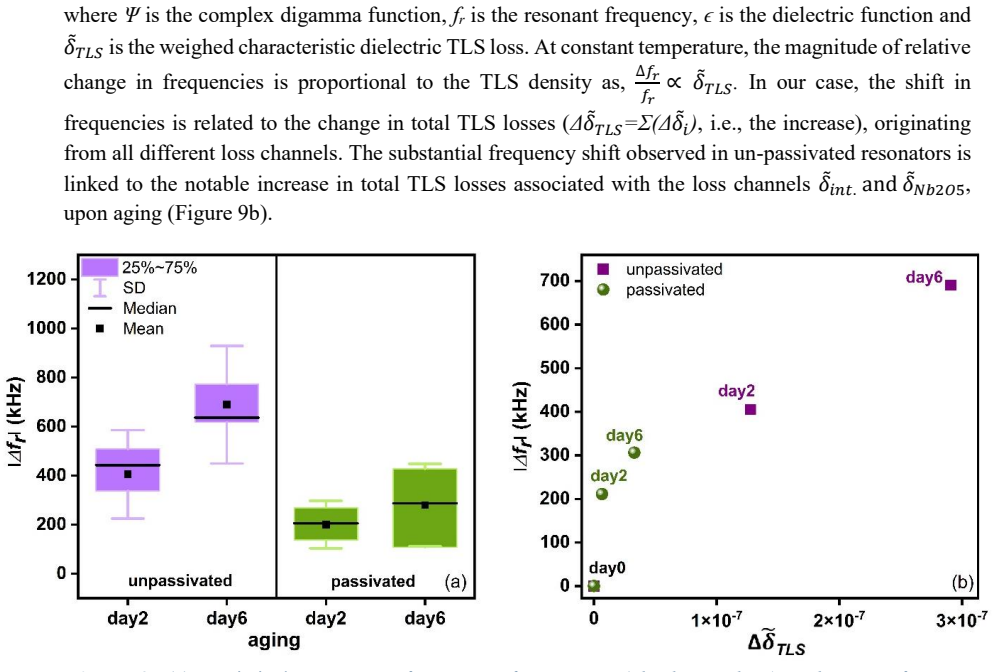
After oxide removal, growth of alkyl-phosphonate self-assembled monolayers on Nb thin films leads to coplanar waveguide resonators that show no significant degradation in quality factor or resonant frequency over six days of air exposure at 10 mK. In comparison, un-passivated resonators display an approximately 80% increase in loss at single-photon power levels. A two-component TLS model distinguishes the loss channels, and the SAMs are found to have a characteristic TLS loss of approximately 5 × 10^{-7}.
What carries the argument
Alkyl-phosphonate self-assembled monolayers that form on the niobium surface after oxide removal to block regrowth of the native oxide layer responsible for TLS losses.
If this is right
- SAM-passivated resonators exhibit high temporal stability with little change in performance over multiple days.
- Unpassivated resonators suffer increased loss due to oxide regrowth at the metal-air interface.
- The two-component TLS model identifies separate loss contributions from the substrate and the surface.
- The SAM layer contributes a low TLS loss value of about 5x10^{-7}, making it suitable for quantum circuits.
Where Pith is reading between the lines
- Devices could be processed and then exposed to air for extended periods without needing immediate vacuum sealing or use.
- Similar surface passivation strategies might reduce losses in other superconducting materials or at different interfaces in qubit designs.
- Measuring the exact oxide thickness over time would directly confirm the mechanism of stability improvement.
Load-bearing premise
The improved stability is due to the SAMs preventing oxide regrowth rather than some other effect of the deposition process or chemistry.
What would settle it
Direct measurement of oxide layer thickness on passivated versus unpassivated niobium samples over several days using surface analysis techniques such as X-ray photoelectron spectroscopy.
Figures
read the original abstract
One main limiting factor towards achieving high coherence times in superconducting circuits is two level system (TLS) losses. Mitigating such losses requires controlling the formation of native oxides at the metal-air interface. Here, we report the growth of alkyl-phosphonate self-assembled monolayers (SAMs) on Nb thin films following oxide removal. The impact of passivation was evaluated via the performance of coplanar waveguide resonators at 10mK, in terms of quality factor and resonant frequency, over six days of air exposure. Un-passivated resonators exhibited an ~80% increase in loss at single-photon power levels, whereas SAM-passivated resonators maintained excellent temporal stability, attributed to suppressed oxide regrowth. By employing a two-component TLS model, we discern distinct prominent loss channels for each resonator type and quantified the characteristic TLS loss of the SAMs to be ~5x10^-7. We anticipate our passivation methodology to offer a promising route toward industrial-scale qubit fabrication, particularly where long-term device stability is critical.
Editorial analysis
A structured set of objections, weighed in public.
Referee Report
Summary. The paper reports growth of alkyl-phosphonate self-assembled monolayers (SAMs) on Nb thin films after oxide removal. Coplanar waveguide resonators fabricated from these films are measured at 10 mK over six days of air exposure. Unpassivated devices show an ~80% increase in loss at single-photon powers while SAM-passivated devices exhibit stable quality factor and resonant frequency; the authors attribute the difference to suppressed oxide regrowth. A two-component TLS model is applied to the data to identify distinct loss channels and to extract a characteristic TLS loss for the SAM of ~5×10^{-7}.
Significance. If the empirical stability result holds, the work supplies a concrete surface-passivation route that could improve long-term coherence in superconducting circuits and support more reliable device fabrication. The direct time-series comparison of Q and frequency between passivated and control resonators, together with the application of a standard two-component TLS model to separate loss contributions, constitutes a clear experimental strength.
major comments (2)
- [Abstract and results description] Abstract and results description: the central mechanistic claim that temporal stability arises from suppressed oxide regrowth rests exclusively on the resonator loss and frequency data (~80% loss increase in controls versus stability in passivated devices). No post-exposure XPS, ellipsometry, or TEM oxide-thickness measurements on matched samples are reported, so the data cannot distinguish oxide suppression from other process-induced changes (altered surface termination, etch residues, or SAM-induced TLS reduction).
- [TLS modeling section] TLS modeling section: the two-component TLS model that yields the quoted SAM loss of ~5×10^{-7} is presented without the explicit functional form, fitting procedure, raw data, error bars, or goodness-of-fit metrics. This makes it impossible to evaluate whether the extracted value is robust or whether the claimed distinction between prominent loss channels for each resonator type is statistically supported.
minor comments (2)
- Figure captions and methods should explicitly state the number of resonators measured, the exact air-exposure protocol, and whether error bars represent standard deviation across devices or fit uncertainties.
- [Abstract] The abstract states that the approach offers a route to industrial-scale fabrication, but no scaling data, yield statistics, or comparison to existing Nb passivation methods are provided; a brief literature context would improve clarity.
Simulated Author's Rebuttal
We thank the referee for the thorough review and valuable suggestions. We address the two major comments point by point below and indicate the revisions made to the manuscript.
read point-by-point responses
-
Referee: [Abstract and results description] Abstract and results description: the central mechanistic claim that temporal stability arises from suppressed oxide regrowth rests exclusively on the resonator loss and frequency data (~80% loss increase in controls versus stability in passivated devices). No post-exposure XPS, ellipsometry, or TEM oxide-thickness measurements on matched samples are reported, so the data cannot distinguish oxide suppression from other process-induced changes (altered surface termination, etch residues, or SAM-induced TLS reduction).
Authors: The referee correctly notes that our mechanistic interpretation relies on the observed differences in resonator performance rather than direct oxide measurements. We have revised the manuscript to more clearly state that the stability is attributed to suppressed oxide regrowth based on the established chemistry of phosphonate SAMs on Nb and the control experiments. We also added a sentence acknowledging that while direct post-exposure surface analysis would be beneficial, it was not performed in this study due to the focus on functional device metrics. This addresses the concern without altering the core results. revision: yes
-
Referee: [TLS modeling section] TLS modeling section: the two-component TLS model that yields the quoted SAM loss of ~5×10^{-7} is presented without the explicit functional form, fitting procedure, raw data, error bars, or goodness-of-fit metrics. This makes it impossible to evaluate whether the extracted value is robust or whether the claimed distinction between prominent loss channels for each resonator type is statistically supported.
Authors: We agree that additional details on the TLS modeling would improve the clarity and allow better assessment of the results. In the revised manuscript, we have expanded the TLS modeling section to include the explicit functional form of the two-component model, a description of the fitting procedure, representative raw data with error bars, and goodness-of-fit metrics. These changes ensure that the extracted SAM TLS loss of approximately 5×10^{-7} and the distinction of loss channels can be properly evaluated. revision: yes
Circularity Check
Empirical time-series measurements and standard TLS fitting yield self-contained results with no circular reduction
full rationale
The paper reports direct experimental observations of quality factor and resonant frequency stability over six days for SAM-passivated versus unpassivated Nb resonators. The ~80% loss increase in controls and stable performance in passivated devices are measured outcomes. The two-component TLS model is applied post hoc to the measured power-dependent loss data to assign a characteristic TLS loss value of ~5x10^-7 to the SAM; this is an extraction from data using a standard model rather than a self-definitional or fitted-input-called-prediction step. No equations, self-citations, or uniqueness theorems are invoked in a load-bearing manner that reduces the central stability claim or TLS quantification to the inputs by construction. The mechanistic attribution to suppressed oxide regrowth is an interpretation of the stability difference but does not alter the independent empirical content of the measurements.
Axiom & Free-Parameter Ledger
free parameters (1)
- TLS loss contribution of the SAM
axioms (1)
- domain assumption A two-component TLS model can separate loss channels between passivated and unpassivated resonators
Lean theorems connected to this paper
-
IndisputableMonolith/Cost/FunctionalEquation.leanwashburn_uniqueness_aczel unclear?
unclearRelation between the paper passage and the cited Recognition theorem.
By employing a two-component TLS model, we discern distinct prominent loss channels... quantified the characteristic TLS loss of the SAMs to be ~5x10^-7
-
IndisputableMonolith/Foundation/AlexanderDuality.leanalexander_duality_circle_linking unclear?
unclearRelation between the paper passage and the cited Recognition theorem.
The thicknesses of the different oxide components were extracted from the XPS spectra using a straight line-effective attenuation length model
What do these tags mean?
- matches
- The paper's claim is directly supported by a theorem in the formal canon.
- supports
- The theorem supports part of the paper's argument, but the paper may add assumptions or extra steps.
- extends
- The paper goes beyond the formal theorem; the theorem is a base layer rather than the whole result.
- uses
- The paper appears to rely on the theorem as machinery.
- contradicts
- The paper's claim conflicts with a theorem or certificate in the canon.
- unclear
- Pith found a possible connection, but the passage is too broad, indirect, or ambiguous to say the theorem truly supports the claim.
Reference graph
Works this paper leans on
-
[1]
Zhao, D.-D. et al. Optical constants of e-beam evaporated and annealed Nb 2 O 5 thin films with varying thickness. J. Phys. D: Appl. Phys. 49, 265304; 10.1088/0022- 3727/49/26/265304 (2016)
-
[2]
Atul N. Parikh, David L. Allara, Issam Ben Azouz & Francis Rondelez. An Intrinsic Relationship between Molecular Structure in Self-Assembled n-Alkylsiloxane Monolayers and Deposition Temperature. J. Phys. Chem. 98, 7577–7590 (1994)
work page 1994
-
[3]
Altoé, M. V. P. et al. Localization and Mitigation of Loss in Niobium Superconducting Circuits. PRX Quantum 3, 20312; 10.1103/PRXQuantum.3.020312 (2022)
-
[4]
Morgan, D. J. XPS insights: Asymmetric peak shapes in XPS. Surface & Interface Analysis 55, 567–571; 10.1002/sia.7215 (2023)
-
[5]
Darlinski, A. & Halbritter, J. Angle‐resolved XPS studies of oxides at NbN, NbC, and Nb surfaces. Surface & Interface Analysis 10, 223–237; 10.1002/sia.740100502 (1987)
-
[6]
Demchenko, I. N. et al. Effect of argon sputtering on XPS depth-profiling results of Si/Nb/Si. Journal of Electron Spectroscopy and Related Phenomena 224, 17–22; 10.1016/j.elspec.2017.09.009 (2018)
-
[7]
Cumpson, P. J. & Seah, M. P. Elastic Scattering Corrections in AES and XPS. II. Estimating Attenuation Lengths and Conditions Required for their Valid Use in Overlayer/Substrate Experiments. Surf. Interface Anal. 25, 430–446; 10.1002/(SICI)1096-9918(199706)25:6<430::AID-SIA254>3.0.CO;2-7 (1997)
-
[8]
Grundner, M. & Halbritter, J. XPS and AES studies on oxide growth and oxide coatings on niobium. Journal of Applied Physics 51, 397–405; 10.1063/1.327386 (1980)
-
[9]
Khalil, M. S., Stoutimore, M. J. A., Wellstood, F. C. & Osborn, K. D. An analysis method for asymmetric resonator transmission applied to superconducting devices. Journal of Applied Physics 111, 54510; 10.1063/1.3692073 (2012)
-
[10]
Probst, S., Song, F. B., Bushev, P. A., Ustinov, A. V. & Weides, M. Efficient and robust analysis of complex scattering data under noise in microwave resonators. The Review of scientific instruments 86, 24706; 10.1063/1.4907935 (2015)
-
[11]
Tai, T., Cai, J. & Anlage, S. M. Anomalous Loss Reduction Below Two‐Level System Saturation in Aluminum Superconducting Resonators. Adv Quantum Tech 7, 2200145; 10.1002/qute.202200145 (2024)
-
[12]
Burnett, J., Bengtsson, A., Niepce, D. & Bylander, J. Noise and loss of superconducting aluminium resonators at single photon energies. J. Phys.: Conf. Ser. 969, 12131; 10.1088/1742-6596/969/1/012131 (2018)
-
[13]
McRae, C. R. H. et al. Materials loss measurements using superconducting microwave resonators. The Review of scientific instruments 91, 91101; 10.1063/5.0017378 (2020)
-
[14]
Kirsh, N., Svetitsky, E., Burin, A. L., Schechter, M. & Katz, N. Revealing the nonlinear response of a tunneling two-level system ensemble using coupled modes. Phys. Rev. Materials 1, 12601; 10.1103/PhysRevMaterials.1.012601 (2017)
-
[15]
Verjauw, J. et al. Investigation of Microwave Loss Induced by Oxide Regrowth in High- Q Niobium Resonators. Phys. Rev. Applied 16, 14018; 10.1103/PhysRevApplied.16.014018 (2021)
-
[16]
Faoro, L. & Ioffe, L. B. Internal loss of superconducting resonators induced by interacting two-level systems. Physical review letters 109, 157005; 10.1103/PhysRevLett.109.157005 (2012)
-
[17]
Schechter, M. & Stamp, P. C. E. Inversion symmetric two-level systems and the low- temperature universality in disordered solids. Phys. Rev. B 88, 174202; 10.1103/PhysRevB.88.174202 (2013)
discussion (0)
Sign in with ORCID, Apple, or X to comment. Anyone can read and Pith papers without signing in.