REVIEW 4 major objections 5 minor 4 cited by
FoCa treats feature caching as solving an ODE and reports near-lossless speedups of up to 6.45x on diffusion transformers, with no retraining.
Reviewed by Pith at T0; open to challenge. T0 means a machine referee read the full paper against a public rubric. the ladder, T0–T4 →
A training-free predictor-corrector method that accelerates Diffusion Transformers by solving a feature-ODE, achieving large compute reductions with modest quality loss.
T0 review reviewed 2026-08-05 challenge →
load-bearing objection Promising training-free caching method with a genuinely new predictor-corrector combo, but the headline speedups mix FLOPs with wall-clock and the Heun equation as written does not match the method. the 4 major comments →
Forecast then Calibrate: Feature Caching as ODE for Efficient Diffusion Transformers
The pith
A machine-rendered reading of the paper's core claim, the machinery that carries it, and where it could break.
The reading
Core claim
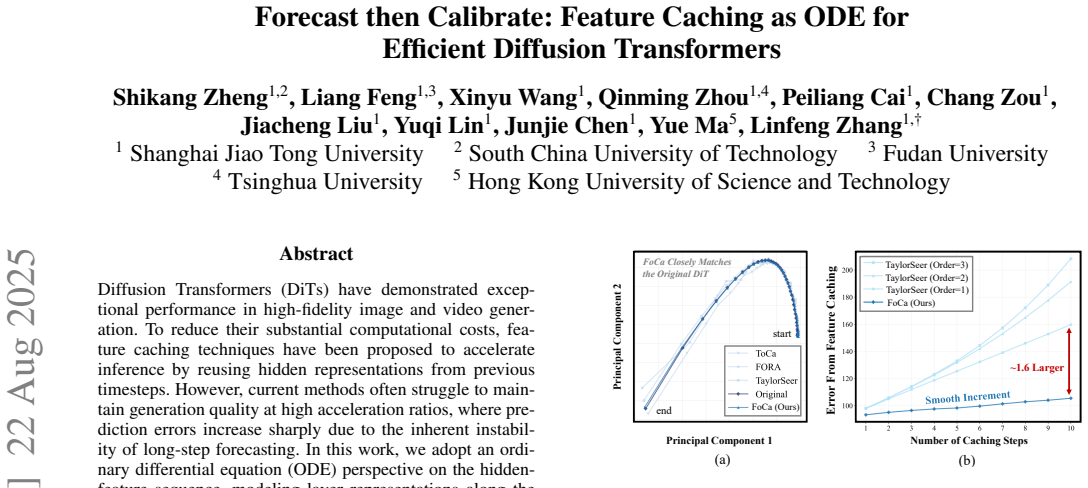
The central claim is that feature caching should be viewed as numerically integrating a feature-ODE, dF/dt = g_theta(F, t), along the reverse-time sampling grid. FoCa uses BDF2 to forecast the hidden state at a skipped timestep from the two most recent cached tensors, then applies a Heun corrector that mixes the forecast with the latest fully computed activation to damp overshoot. The paper reports near-lossless speedups of 5.50x on FLUX, 6.45x on HunyuanVideo, 3.17x on Inf-DiT, and 4.53x on DiT-XL/2, with better FID than prior caching baselines at equal FLOP budgets. The main contrast is with TaylorSeer, whose higher-order finite-difference forecasts the paper identifies as numerically unst
What carries the argument
The central object is the feature-ODE, an equation describing the evolution of a layer's hidden representation as a function of denoising time, derived via the chain rule from the probability-flow ODE. The method is a predictor-corrector: a second-order backward differentiation formula aggregates the two most recent cached feature tensors to forecast the next skipped state, and a Heun-style corrector averages the derivative at the latest fully computed step with the derivative at the forecast point to damp error. This lets FoCa use historical features directly without estimating high-order derivatives, which the paper identifies as the source of instability in prior forecasting methods.
Load-bearing premise
The load-bearing premise is that replacing the current-step slope in the Heun corrector with the slope from the most recent fully computed step remains both valid and stable; the paper asserts an error bound for this substitution but defers the proof to an appendix that is not present.
What would settle it
Implement the FoCa corrector using the exact derivative at the predicted point, as in standard Heun's method, and compare feature error and FID against the paper's Eq. 8 on DiT-XL/2 at N=5. If the standard version is no worse and the paper's version shows error growing roughly linearly with skip length, the claimed stability mechanism is not doing the work. Alternatively, measure the maximum feature deviation over many seeds across skip intervals and check whether it stays bounded as Proposition 1 claims.
If this is right
- FoCa can be dropped into pretrained diffusion transformers with no retraining and no architectural changes, so it applies to existing deployed models.
- At equal FLOP budgets, FoCa reports better FID and ImageReward scores than reuse-based baselines such as FORA, ToCa, DuCa, and TeaCache, and than forecast-based TaylorSeer.
- The 6.45x speedup on HunyuanVideo keeps the VBench score within about one point of the original sampler, indicating near-lossless video quality.
- The ablation shows the Heun corrector is load-bearing: BDF2-only forecasting degrades rapidly under large skip intervals, while FoCa stays stable.
- The feature-ODE perspective reframes caching design as a numerical integration problem, opening the same machinery to other multistep ODE solvers beyond BDF2-Heun.
Where Pith is reading between the lines
- The same predictor-corrector scheme could apply to other sequential inference settings where cached intermediate representations drift smoothly, such as autoregressive decoding or recurrent video generation, though the paper does not test these.
- The stiffness analysis suggests a fixed cache interval is suboptimal: error concentrates in a late stiff zone, so an adaptive schedule that caches more densely near the end of sampling could push speedups beyond the uniform intervals reported.
- Because FoCa is training-free and uses only cached tensors, it should stack multiplicatively with orthogonal accelerations such as step reduction (DDIM, DPM-Solver) and model compression, a combination the paper does not evaluate explicitly.
- The paper's stability guarantee rests on a nonstandard Heun corrector whose proof is deferred to a missing appendix; testing the error bound directly on feature trajectories would settle whether the claimed stability holds beyond the reported checkpoints.
Editorial analysis
A structured set of objections, weighed in public.
Referee Report
Summary. The manuscript proposes FoCa, a training-free feature-caching method for Diffusion Transformers. It reinterprets the sequence of hidden features across denoising timesteps as a solution to a feature ODE (Eq. 5), then predicts skipped features using a BDF2-style predictor (Eq. 7) followed by a Heun-style corrector (Eq. 8). Experiments on FLUX, HunyuanVideo, Inf-DiT, and DiT-XL/2 report large FLOPs reductions with small or no quality loss, and an ablation attributes stability to the corrector. The paper also includes a stiffness analysis and states Proposition 1 bounding the prediction error independently of skip length, with the proof deferred to a missing Appendix A.1.
Significance. If the reported results hold, FoCa would be a useful training-free accelerator: it applies across four architectures and tasks, preserves generation quality at aggressive caching ratios, and connects feature caching to numerical integration of an ODE. The breadth of evaluation and the simplicity of the predictor-corrector design are strengths. However, the theoretical guarantee is currently unverifiable because the proof is missing and the corrector as written deviates from standard Heun, and the headline 'speedups' are FLOPs reductions rather than measured latency. These issues are load-bearing for the central near-lossless-speedup claim and need to be resolved before the contribution can be assessed.
major comments (4)
- [Method, Eq. (8)] The corrector is not the standard Heun (explicit trapezoidal) method. Heun averages f(t_k, y_k) and f(t_{k+1}, y_pred) over [t_k, t_{k+1}]; Eq. (8) instead uses F^(1)(x_{k-N}) as the first slope and states that x_{k-N} is the latest fully computed step. If k is the current step, this slope is N steps stale; if k is the last full computation, the index should be x_k. Either way the formula is inconsistent with the text. Since Fig. 7 shows the corrector is essential for stability and Proposition 1 is the only theoretical support, please correct Eq. (8) or provide a dedicated error analysis for the stale-derivative update actually used.
- [Proposition 1 / Appendix A.1] The proof of Proposition 1 is deferred to Appendix A.1, but the submitted manuscript contains no appendix. Equation (9) introduces rho and tau_max without definitions and asserts a bound independent of k without stating the assumptions on F and the corrector. The authors' central robustness claim, and the claimed advantage over TaylorSeer and reuse methods, rests on this result. The proof, constant definitions, and regularity assumptions must be included in the manuscript.
- [Experiments, Tables 1-2 and Abstract/Conclusion] The abstract and conclusion report speedups of 5.50x on FLUX and 6.45x on HunyuanVideo, but these correspond to FLOPs reductions, not wall-clock latency. Table 1 FoCa N=7 shows 4.05x latency speedup vs 5.54x FLOPs; Table 2 FoCa N=7 shows 4.64x latency vs 6.45x FLOPs. User-visible speedup is determined by latency; FLOPs counts can overstate gains when memory access, attention overhead, and scheduling costs are significant. Please report measured latency speedups as the headline numbers, or clearly label the headline numbers as FLOPs reductions.
- [Analysis on stiffness] The paper claims the BDF2-Heun predictor-corrector is well-suited for stiff ODEs, but the implemented update is explicit (the Heun corrector is an explicit method, and the BDF2 formula is used only to generate a prediction, not as an implicit solver). Figure 8 introduces LTE and a Stiffness Index without defining either or describing how they are computed. As written, this supports the method selection only qualitatively. Please provide formal definitions and either a quantitative stiffness/stability analysis or soften the claim.
minor comments (5)
- [Notation, Eqs. (5)-(8)] The indexing of k and h_k is ambiguous: h_k appears in Eqs. (7)-(8) but the relationship between the caching interval N, the step size, and the indices k, k-N is not defined. Please clarify the grid and state whether steps are uniform.
- [Tables 1-3] Report standard deviations or confidence intervals for stochastic metrics such as FID. In particular, FoCa N=2 improving FID from 2.32 to 2.17 on ImageNet is likely within noise and should not be emphasized without repeated runs.
- [Appendix] The text says 'Please refer to Appendix for details' but the arXiv version has no appendix. Include the missing appendix with experiment settings, hyperparameters, and the proof of Proposition 1.
- [Abstract/Table 1] The abstract says 5.50x on FLUX while Table 1 reports 5.54x FLOPs speedup for FoCa N=7. Use consistent rounding and specify which measure is meant.
- [Table 4 caption] Typo: 'gene tative' should be 'generative'.
Circularity Check
No significant circularity: FoCa is a parameter-free predictor-corrector scheme; the speedups are empirical measurements against independent baselines, and the self-cited TaylorSeer/ToCa are comparisons, not premises.
full rationale
The derivation chain is not circular. Equation (5) introduces a feature-ODE by the chain rule, explicitly noting that g_theta is intractable; the subsequent BDF2 predictor (Eq. 7) and Heun corrector (Eq. 8) operate only on cached feature values and contain no fitted parameters tied to the reported FID, ImageReward, or VBench scores. The headline speedups are measured outcomes, not consequences forced by the ODE formalism. TaylorSeer and ToCa, which involve overlapping authors, are used as baselines in comparisons rather than as justification for FoCa's design, so these self-citations are not load-bearing. The ODE framing is partly definitional, but it does not reduce the prediction to its inputs: the predictor-corrector is a concrete numerical integration scheme whose behavior is ablated empirically in Fig. 7. The main substantive weakness is that Proposition 1's error bound is deferred to Appendix A.1, which is not present in v1; this is an omitted-proof concern, not a circularity, because the bound is claimed as a theorem rather than assumed as an input. Overall, no step in the paper's argument reconstructs its conclusion from its own premises by construction.
Axiom & Free-Parameter Ledger
free parameters (2)
- cache interval N =
5,7,8 on FLUX; 7 on HunyuanVideo; 3,5 on DiT; 5 on Inf-DiT
- stability constants rho, tau_max in Prop 1
axioms (3)
- domain assumption Hidden features along the reverse diffusion trajectory satisfy a smooth ODE with a tractable Lipschitz drift (Eq. 5)
- ad hoc to paper The future derivative F'(x^{k+1}) in the Heun corrector can be replaced by the derivative at the previous fully-computed step F'(x^{k-N})
- standard math Standard chain rule / differentiability of network blocks
Cite this review
Pith. "Pith review of Forecast then Calibrate: Feature Caching as ODE for Efficient Diffusion Transformers." pith.science (2026). https://pith.science/paper/WPF2XANG
@misc{pith2026250816211,
  author       = {Pith},
  title        = {Pith review of: Forecast then Calibrate: Feature Caching as ODE for Efficient Diffusion Transformers},
  year         = {2026},
  howpublished = {\url{https://pith.science/paper/WPF2XANG}},
  note         = {Machine review of arXiv:2508.16211}
}
read the original abstract
Diffusion Transformers (DiTs) have demonstrated exceptional performance in high-fidelity image and video generation. To reduce their substantial computational costs, feature caching techniques have been proposed to accelerate inference by reusing hidden representations from previous timesteps. However, current methods often struggle to maintain generation quality at high acceleration ratios, where prediction errors increase sharply due to the inherent instability of long-step forecasting. In this work, we adopt an ordinary differential equation (ODE) perspective on the hidden-feature sequence, modeling layer representations along the trajectory as a feature-ODE. We attribute the degradation of existing caching strategies to their inability to robustly integrate historical features under large skipping intervals. To address this, we propose FoCa (Forecast-then-Calibrate), which treats feature caching as a feature-ODE solving problem. Extensive experiments on image synthesis, video generation, and super-resolution tasks demonstrate the effectiveness of FoCa, especially under aggressive acceleration. Without additional training, FoCa achieves near-lossless speedups of 5.50 times on FLUX, 6.45 times on HunyuanVideo, 3.17 times on Inf-DiT, and maintains high quality with a 4.53 times speedup on DiT.
Figures


Forward citations
Cited by 4 Pith papers
-
SpecEdit: Training-Free Acceleration for Diffusion based Image Editing via Semantic Locking
SpecEdit accelerates diffusion-based image editing up to 10x by using a low-resolution draft to identify edit-relevant tokens via semantic discrepancies for selective high-resolution denoising.
-
Efficient Video Diffusion Models: Advancements and Challenges
A survey that groups efficient video diffusion methods into four paradigms—step distillation, efficient attention, model compression, and cache/trajectory optimization—and outlines open challenges for practical use.
-
ResilPhase: Plug-and-Play Phase Mapping and Noise-Resilient Macro-Trajectory Extrapolation for Diffusion Acceleration
ResilPhase accelerates DiT inference via stable ODE macro-trajectory extrapolation with derivative-free barycentric Lagrange extrapolator and bounded phase mapping, claiming SOTA fidelity at high acceleration ratios o...
-
Dynamic Video Generation: Shaping Video Generation Across Time and Space
DVG dynamically selects content-aware spatio-temporal acceleration strategies for diffusion-based video generation, delivering up to 7x speedup with near-lossless quality on models like HunyuanVideo.
Reference graph
Works this paper leans on
-
[2]
arXiv preprint arXiv:2303.17604
Token Merging for Fast Stable Diffusion. arXiv preprint arXiv:2303.17604. Chen, J.; Huang, Z.; Zhang, L.; Wang, J.; Li, J.; Li, X.; Liu, J.; and Chen, T
-
[3]
arXiv preprint arXiv:2310.00426
PixArt-alpha: Fast Training of Dif- fusion Transformer for High-Fidelity Text-to-Image Synthe- sis. arXiv preprint arXiv:2310.00426. Chen, J.; Huang, Z.; Zhang, L.; Wang, J.; Li, J.; Li, X.; Liu, J.; and Chen, T
-
[6]
arXiv preprint arXiv:2305.10924
Structural Pruning for Diffusion Models. arXiv preprint arXiv:2305.10924. Gu, S.; Lugmayr, A.; Danelljan, M.; Fritsche, M.; Lamour, J.; and Timofte, R
-
[11]
arXiv preprint arXiv:2311.17982
VBench: Comprehensive Benchmark Suite for Video Gen- erative Models. arXiv preprint arXiv:2311.17982. Kim, S.; Lee, H.; Cho, W.; Park, M.; and Ro, W. W
-
[12]
arXiv preprint arXiv:2501.11211
Ditto: Accelerating Diffusion Model via Temporal Value Similarity. arXiv preprint arXiv:2501.11211. Li, X.; Liu, Y .; Lian, L.; Yang, H.; Dong, Z.; Kang, D.; Zhang, S.; and Keutzer, K
-
[13]
arXiv preprint arXiv:2302.04304
Q-Diffusion: Quantizing Diffusion Models. arXiv preprint arXiv:2302.04304. Liu, J.; Zou, C.; Lyu, Y .; Chen, J.; and Zhang, L
-
[14]
From Reusing to Forecasting: Accelerating Diffusion Models with TaylorSeers. arXiv preprint arXiv:2403.06923. Liu, X.; Gong, C.; and Liu, Q
work page internal anchor Pith review Pith/arXiv arXiv
-
[16]
arXiv preprint arXiv:2206.00927
DPM-Solver: A Fast ODE Solver for Diffusion Probabilis- tic Model Sampling in Around 10 Steps. arXiv preprint arXiv:2206.00927. Ma, X.; Fang, G.; and Wang, X
-
[17]
arXiv preprint arXiv:2312.00858
DeepCache: Accelerating Diffusion Models for Free. arXiv preprint arXiv:2312.00858. Peebles, W.; and Xie, S
-
[18]
arXiv preprint arXiv:2212.09748
Scalable Diffusion Models with Transformers. arXiv preprint arXiv:2212.09748. Ronneberger, O.; Fischer, P.; and Brox, T
-
[20]
arXiv preprint arXiv:2205.11487
Photorealistic Text-to-Image Diffusion Models with Deep Language Understanding. arXiv preprint arXiv:2205.11487. Selvaraju, P.; Ding, T.; Chen, T.; Zharkov, I.; and Liang, L
-
[21]
arXiv preprint arXiv:2407.01425
FORA: Fast-Forward Caching in Diffusion Trans- former Acceleration. arXiv preprint arXiv:2407.01425. Sohl-Dickstein, J.; Weiss, E. A.; Maheswaranathan, N.; and Ganguli, S
-
[22]
arXiv preprint arXiv:1503.03585
Deep Unsupervised Learning using Nonequilibrium Thermodynamics. arXiv preprint arXiv:1503.03585. Song, J.; Meng, C.; and Ermon, S
-
[23]
arXiv preprint arXiv:2010.02502
Denoising Diffu- sion Implicit Models. arXiv preprint arXiv:2010.02502. Song, Y .; Dhariwal, P.; Chen, M.; and Sutskever, I
Pith/arXiv arXiv 2010
-
[24]
arXiv preprint arXiv:2303.01469
Consistency Models. arXiv preprint arXiv:2303.01469. Sun, X.; et al
-
[25]
arXiv preprint arXiv:2411.02265
Hunyuan-Large: An Open-Source MoE Model with 52 Billion Activated Parameters by Tencent. arXiv preprint arXiv:2411.02265. Wimbauer, F.; Wu, B.; Schoenfeld, E.; Dai, X.; Hou, J.; He, Z.; Sanakoyeu, A.; Zhang, P.; Tsai, S.; Kohler, J.; Rupprecht, C.; Cremers, D.; Vajda, P.; and Wang, J
-
[26]
arXiv preprint arXiv:2312.03209
Cache Me if You Can: Accelerating Diffusion Models through Block Caching. arXiv preprint arXiv:2312.03209. Xu, J.; Liu, X.; Wu, Y .; Tong, Y .; Li, Q.; Ding, M.; Tang, J.; and Dong, Y
-
[27]
Yang, Z.; Jiang, H.; Hong, W.; Teng, J.; Zheng, W.; Dong, Y .; Ding, M.; and Tang, J
ImageReward: Learning and Evaluat- ing Human Preferences for Text-to-Image Generation.arXiv preprint arXiv:2304.05977. Yang, Z.; Jiang, H.; Hong, W.; Teng, J.; Zheng, W.; Dong, Y .; Ding, M.; and Tang, J
-
[28]
Inf-DiT: Upsampling Any-Resolution Image with Memory-Efficient Diffusion Transformer
Inf-DiT: Upsampling Any- Resolution Image with Memory-Efficient Diffusion Trans- former. arXiv preprint arXiv:2405.04312. Yuan, Z.; Zhang, H.; Lu, P.; Ning, X.; Zhang, L.; Zhao, T.; Yan, S.; Dai, G.; and Wang, Y
work page internal anchor Pith review Pith/arXiv arXiv
-
[29]
arXiv preprint arXiv:2406.08552
DiTFastAttn: Atten- tion Compression for Diffusion Transformer Models. arXiv preprint arXiv:2406.08552. Zhang, E.; Tang, J.; Ning, X.; and Zhang, L
-
[30]
arXiv preprint arXiv:2408.12588
Real-Time Video Generation with Pyramid Attention Broadcast. arXiv preprint arXiv:2408.12588. Zheng, K.; Lu, C.; Chen, J.; and Zhu, J
-
[31]
arXiv preprint arXiv:2310.13268
DPM-Solver- v3: Improved Diffusion ODE Solver with Empirical Model Statistics. arXiv preprint arXiv:2310.13268. Zhu, H.; Tang, D.; Liu, J.; Lu, M.; Zheng, J.; Peng, J.; Li, D.; Wang, Y .; Jiang, F.; Tian, L.; Tiwari, S.; Sirasao, A.; Yong, J.-H.; Wang, B.; and Barsoum, E
-
[32]
DiP-GO: A Diffusion Pruner via Few-step Gradient Optimization
DiP-GO: A Dif- fusion Pruner via Few-step Gradient Optimization. arXiv preprint arXiv:2410.16942. Zou, C.; Liu, X.; Liu, T.; Huang, S.; and Zhang, L
work page internal anchor Pith review Pith/arXiv arXiv
-
[33]
arXiv preprint arXiv:2410.05317
Ac- celerating Diffusion Transformers with Token-wise Feature Caching. arXiv preprint arXiv:2410.05317
-
[2015]
arXiv preprint arXiv:1505.04597
U-Net: Convolutional Networks for Biomedical Image Segmenta- tion. arXiv preprint arXiv:1505.04597. Russakovsky, O.; Deng, J.; Su, H.; Krause, J.; Satheesh, S.; Ma, S.; Huang, Z.; Karpathy, A.; Khosla, A.; Bernstein, M. S.; Berg, A. C.; and Fei-Fei, L
-
[2017]
In Ad- vances in Neural Information Processing Systems 30 (NIPS 2017)
GANs Trained by a Two Time-Scale Update Rule Converge to a Local Nash Equilibrium. In Ad- vances in Neural Information Processing Systems 30 (NIPS 2017). Ho, J.; Jain, A.; and Abbeel, P
work page 2017
-
[2019]
In 2019 IEEE/CVF International Confer- ence on Computer Vision Workshop (ICCVW), 512–520
DIV8K: DIVerse 8K Resolution Image Dataset. In 2019 IEEE/CVF International Confer- ence on Computer Vision Workshop (ICCVW), 512–520. Hessel, J.; Holtzman, A.; Forbes, M.; Bras, R. L.; and Choi, Y
work page 2019
-
[2020]
arXiv preprint arXiv:2006.11239
Denoising Diffusion Probabilistic Models. arXiv preprint arXiv:2006.11239. hpcaitech
Pith/arXiv arXiv 2006
-
[2021]
arXiv preprint arXiv:2104.08718
CLIPScore: A Reference-free Evaluation Metric for Image Captioning. arXiv preprint arXiv:2104.08718. Heusel, M.; Ramsauer, H.; Unterthiner, T.; Nessler, B.; and Hochreiter, S
-
[2022]
arXiv preprint arXiv:2209.03003
Flow Straight and Fast: Learning to Generate and Transfer Data with Rectified Flow. arXiv preprint arXiv:2209.03003. Lu, C.; Zhou, Y .; Bao, F.; Chen, J.; Li, C.; and Zhu, J
-
[2023]
arXiv preprint arXiv:2311.15127
Stable Video Diffusion: Scaling Latent Video Diffusion Models to Large Datasets. arXiv preprint arXiv:2311.15127. Bolya, D.; and Hoffman, J
-
[2024]
Self-enhanced mobility enables vortex pattern formation in living matter
PixArt-Sigma: Scalable and Efficient Diffusion Transformer for High-Resolution Image Synthe- sis. arXiv preprint arXiv:2403.09068. Cheng, X.; Chen, Z.; and Jia, Z
work page internal anchor Pith review Pith/arXiv arXiv
-
[2025]
arXiv preprint arXiv:2502.00433
CAT Pruning: Cluster-Aware Token Pruning For Text-to-Image Diffusion Models. arXiv preprint arXiv:2502.00433. Fang, G.; Ma, X.; and Wang, X
This paper was first reviewed by deepseek-v4-flash on August 5, 2026.
discussion (0)
Sign in with ORCID, Apple, or X to comment. Anyone can read and Pith papers without signing in.