ACT-Era Constraints on Single-Field Inflation in f(T) Teleparallel Gravity
Pith reviewed 2026-05-18 21:19 UTC · model grok-4.3
The pith
Modest positive δ in f(T) teleparallel gravity suppresses the tensor-to-scalar ratio and revives sub-quadratic monomial and hilltop inflation models disfavored in GR under ACT data.
A machine-rendered reading of the paper's core claim, the machinery that carries it, and where it could break.
Core claim
For the specific f(T) = C T^{2δ+1} model, torsional corrections controlled by δ generically suppress r while keeping n_s near its slow-roll value. As a result, modest positive δ restores viability to sub-quadratic monomials and hilltop models that are disfavored in general relativity, whereas E-type plateaus remain compatible only for small δ; moderate δ drives the dynamics toward quadratic-like behavior and raises r. These predictions follow from the combined analytic and numerical treatment of the modified background and perturbation equations.
What carries the argument
The parameter δ in the torsional modification f(T) = C T^{2δ+1}, which introduces corrections that suppress the tensor-to-scalar ratio r while preserving the scalar spectral index near its slow-roll value.
If this is right
- Sub-quadratic monomial potentials become compatible with ACT constraints once δ is modestly positive.
- Hilltop models regain viability over a wider parameter range under the same torsional correction.
- E-type plateau models stay viable only for small δ; larger values increase r and spoil the fit.
- Improved B-mode data will discriminate among the potential classes and place quantitative upper bounds on δ.
Where Pith is reading between the lines
- Teleparallel corrections offer a single-parameter route to reconcile simple single-field potentials with current data without invoking extra fields.
- The selective suppression of r may help separate the effects of modified gravity from changes in the inflaton potential itself.
- Similar δ-dependent behavior could appear in other teleparallel or modified-gravity cosmologies and could be checked against the same ACT and future CMB datasets.
Load-bearing premise
That analytic approximations plus high-precision numerical calculations accurately capture the full dynamics for the chosen f(T) form without significant higher-order corrections or breakdown of the slow-roll regime.
What would settle it
A future CMB B-mode measurement that finds the tensor-to-scalar ratio for sub-quadratic or hilltop potentials remains as high as in GR even when δ is positive and modest.
Figures


read the original abstract
We reassess single-field slow-roll inflation in teleparallel gravity with $f(T)=C\,T^{2\delta+1}$, motivated by recent measurements from the Atacama Cosmology Telescope (ACT) that indicate a modest upward shift in the scalar spectral index $n_s$. Using analytic approximations together with high-precision numerical calculations, we compute primordial predictions for representative potentials: power-law monomials, hilltop models, and $E$-type plateaus. We find that torsional corrections controlled by $\delta$ generically suppress $r$ while keeping $n_s$ near its slow-roll value. As a result, modest positive $\delta$ can restore viability to sub-quadratic monomials and hilltop models that are disfavored in general relativity (GR), whereas $E$-type plateaus remain compatible only in a limited range of $\delta$: small $\delta$ may improve the fit but moderate $\delta$ drives the dynamics toward quadratic-like behaviour and increases $r$. These signatures are observationally testable: improved cosmic microwave background (CMB) B-mode measurements will further discriminate among potential classes and place quantitative bounds on torsional deviations from GR.
Editorial analysis
A structured set of objections, weighed in public.
Referee Report
Summary. The manuscript reassesses single-field slow-roll inflation in teleparallel gravity using the specific power-law form f(T)=C T^{2δ+1}. Analytic approximations combined with high-precision numerical calculations are employed to derive primordial observables n_s and r for power-law monomials, hilltop models, and E-type plateaus. The central result is that modest positive δ suppresses r while leaving n_s near its GR slow-roll value, thereby restoring viability to sub-quadratic monomials and hilltop potentials that are disfavored under ACT constraints in general relativity; E-type plateaus remain compatible only for a limited range of small δ.
Significance. If the reported shifts in the (n_s, r) plane hold under the chosen f(T) ansatz, the work supplies a concrete, observationally testable mechanism by which torsional corrections can reconcile a class of otherwise excluded inflationary models with recent ACT data on n_s. The combination of analytic insight into the modified slow-roll parameters with high-precision numerics is a methodological strength that allows both qualitative understanding and quantitative predictions for future B-mode constraints.
major comments (1)
- Abstract and the section describing the numerical integration: the claim that analytic approximations together with high-precision numerical calculations accurately capture the dynamics for δ ≃ 0.01–0.1 rests on the unverified assumption that higher-order corrections in δ remain negligible and that the slow-roll conditions ε, η ≪ 1 are preserved throughout the trajectory, including near the end of inflation. An explicit error budget, convergence tests against the full field equations, or direct comparison of the approximate versus exact background evolution for representative δ values would be required to substantiate the reported suppression of r.
minor comments (2)
- Clarify the precise range of δ values explored numerically and whether any priors or fitting procedures were applied when comparing to ACT constraints.
- Specify the exact definition of the slow-roll parameters used in the f(T) background (e.g., whether they are the standard GR expressions or the modified torsional versions) and provide the leading-order analytic expressions for ε and η in terms of δ.
Simulated Author's Rebuttal
We thank the referee for the constructive and detailed report. The single major comment identifies a legitimate need for stronger substantiation of the numerical and analytic methods. We address the point below and will revise the manuscript to incorporate the requested verification.
read point-by-point responses
-
Referee: Abstract and the section describing the numerical integration: the claim that analytic approximations together with high-precision numerical calculations accurately capture the dynamics for δ ≃ 0.01–0.1 rests on the unverified assumption that higher-order corrections in δ remain negligible and that the slow-roll conditions ε, η ≪ 1 are preserved throughout the trajectory, including near the end of inflation. An explicit error budget, convergence tests against the full field equations, or direct comparison of the approximate versus exact background evolution for representative δ values would be required to substantiate the reported suppression of r.
Authors: We agree that an explicit validation strengthens the claims. The high-precision numerical integrations solve the complete background equations obtained from the f(T) action, while the analytic expressions provide the leading-order modification to the slow-roll parameters. For the modest values δ ≃ 0.01–0.1 considered, the torsional correction remains perturbative and the slow-roll parameters ε and η stay well below unity until the end of inflation is reached (defined by ε = 1). Nevertheless, to remove any ambiguity we will add a dedicated appendix containing: (i) an error budget estimating the size of O(δ²) terms, (ii) convergence tests with respect to integrator tolerances, and (iii) direct side-by-side comparisons of the analytic slow-roll predictions against the full numerical background evolution for representative monomial, hilltop, and plateau potentials at δ = 0.05 and δ = 0.1. These additions will explicitly confirm the reported suppression of r. revision: yes
Circularity Check
No significant circularity in the derivation chain
full rationale
The paper treats δ as an independent free parameter in the chosen f(T) = C T^{2δ+1} form and computes n_s and r via analytic slow-roll expansions plus separate high-precision numerical integration of the background and perturbation equations for several fixed potentials. These outputs are then compared against external ACT and Planck data. No equation reduces a reported prediction to a fitted quantity defined from the target observables, no load-bearing premise rests on a self-citation chain, and no ansatz or uniqueness result is smuggled in from prior author work. The derivation therefore remains self-contained against external benchmarks.
Axiom & Free-Parameter Ledger
free parameters (2)
- δ
- C
axioms (2)
- domain assumption Slow-roll approximation remains valid for the modified dynamics
- ad hoc to paper The specific power-law form f(T)=C T^{2δ+1} captures the relevant deviation from GR
Lean theorems connected to this paper
-
IndisputableMonolith/Cost/FunctionalEquation.leanwashburn_uniqueness_aczel unclear?
unclearRelation between the paper passage and the cited Recognition theorem.
f(T)=C T^{2δ+1} ... ϵ1 ≃ C1 V,ϕ² / [2(1+2δ) V^{2(1+δ)/(1+2δ)}] ... cs²=1/(1+4δ)
-
IndisputableMonolith/Foundation/DimensionForcing.leanalexander_duality_circle_linking unclear?
unclearRelation between the paper passage and the cited Recognition theorem.
ns ≃ 1 - 2ϵ1(ϕ*) - ϵ2(ϕ*) ... r ≃ 16 cs³ ϵ1(ϕ*)
What do these tags mean?
- matches
- The paper's claim is directly supported by a theorem in the formal canon.
- supports
- The theorem supports part of the paper's argument, but the paper may add assumptions or extra steps.
- extends
- The paper goes beyond the formal theorem; the theorem is a base layer rather than the whole result.
- uses
- The paper appears to rely on the theorem as machinery.
- contradicts
- The paper's claim conflicts with a theorem or certificate in the canon.
- unclear
- Pith found a possible connection, but the passage is too broad, indirect, or ambiguous to say the theorem truly supports the claim.
Forward citations
Cited by 1 Pith paper
-
Harrison-Zeldovich attractor: From Planck to ACT results
Nonminimal derivative coupling realizes the Harrison-Zeldovich attractor for monomial, hilltop, and α-attractor E-models, pulling them to the scale-invariant spectrum suggested by ACT data.
Reference graph
Works this paper leans on
-
[1]
Small-field regime x∗ ≪ 1 (near the hilltop) In this regime we may expand (1 − xp)α ≃ 1 +α xp + · · ·. To leading order, Eqs. (31)–(33) give ϵ1 ≃ A x2p−2 ∗ , A ≡ C1 p2 2(1 + 2δ) µ−2 V 2δ 1+2δ 0 , (38) N∗ ≃ µ2 C1 p (p − 2) V 2δ 1+2δ 0 x 2−p ∗ (p > 2). (39) 9 Eliminating x∗ yields the compact relations ϵ2∗ ≃ 2(p − 1) (p − 2) 1 N∗ , (40) ϵ1∗ ≃ p xp ∗ 2(1 + 2...
-
[2]
Then V (ϕ) = V0[1 − (1 − ∆)p] = V0 p ∆ − p(p − 1) 2 ∆2 + O(∆3)
Near the edge x → 1− (“linear” vicinity) When x → 1−, write x = 1 − ∆ with 0 < ∆ ≪ 1. Then V (ϕ) = V0[1 − (1 − ∆)p] = V0 p ∆ − p(p − 1) 2 ∆2 + O(∆3) . (46) To leading order, the potential is linear in the displacement from the edge: V (ϕ) ≃ λ (µ − ϕ), λ ≡ p V0 µ , ∆ = µ − ϕ µ . (47) In this linear vicinity one has V,ϕ ≃ − λ and V,ϕϕ ≃ 0, so the inflationa...
-
[3]
Numerical Predictions and Observational Constraints As a representative example we take p = 4 and compute ( ns, r) using Eqs. (22) and (23). Fig. 2 displays the results for several values of the torsion parameter δ, together with the latest P–ACT–LB–BK18 constraints in the ( ns, r) plane. In the GR limit ( δ = 0), the case N∗ = 50 is excluded, while for N...
-
[4]
Plateau (large-field) limit: y∗ ≪ 1 (standard Starobinsky plateau) Horizon exit occurs on the plateau, y∗ ≡ e−Aϕ∗ ≪ 1, and the integral for N∗ is dominated by y ≳ y∗ (so the approximation V ≃ V0 is valid in the integrand). Expanding to leading order in y we obtain ϵ1∗ ≃ 2A2C1 1 + 2δ V 2δ 1+2δ 0 y2 ∗, (52) N∗ ≃ 1 2A2C1 V − 2δ 1+2δ 0 1 y∗ =⇒ y∗ ≃ 1 2A2C1 V ...
-
[5]
Small-field / quadratic limit: Aϕ∗ ≪ 1 (i.e. y∗ ≃ 1) Horizon exit occurs near the origin so that Aϕ∗ ≪ 1 and V (ϕ) ≃ V0(Aϕ)2 ≡eV ϕ 2, eV ≡ V0A2, i.e. the potential is well approximated by a quadratic monomial over the interval [ ϕ∗, ϕend]. For V =eV ϕ2 the slow-roll quantities become (exact-in-form) ϵ1(ϕ) = 2C1 1 + 2δ eV 2δ 1+2δ ϕ− 2 1+2δ , (64) N∗ ≃ 1 + ...
-
[6]
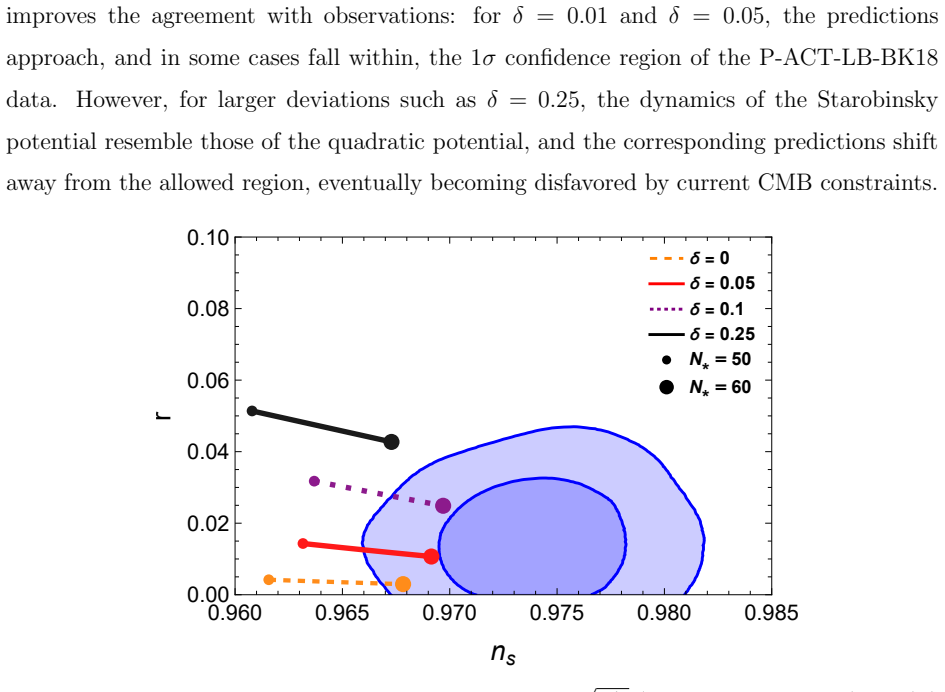
Numerical Predictions and Observational Constraints In Fig. 3 we present the numerical predictions of the E-model withA = p 2/3 (Starobinsky potential) within the f(T ) gravity framework, confronted with the latest CMB measurements (P-ACT-LB-BK18). For δ = 0, corresponding to the standard GR case, the Starobinsky model is found to lie almost entirely outs...
-
[7]
Starobinsky, Physics Letters B 91, 99 (1980)
A. Starobinsky, Physics Letters B 91, 99 (1980)
work page 1980
- [8]
-
[9]
A. H. Guth, Phys. Rev. D 23, 347 (1981)
work page 1981
- [10]
-
[11]
Y. Akrami et al. (Planck Collaboration), Astronomy & Astrophysics 641, A10 (2020)
work page 2020
-
[12]
P. A. R. Ade et al. (BICEP/Keck Collaboration), Phys. Rev. Lett. 127, 151301 (2021)
work page 2021
-
[13]
The Atacama Cosmology Telescope: DR6 Power Spectra, Likelihoods and $\Lambda$CDM Parameters
T. Louis et al., (2025), arXiv:2503.14452 [astro-ph.CO]
work page internal anchor Pith review Pith/arXiv arXiv 2025
-
[14]
The Atacama Cosmology Telescope: DR6 Constraints on Extended Cosmological Models
E. Calabrese et al., (2025), arXiv:2503.14454 [astro-ph.CO]
work page internal anchor Pith review Pith/arXiv arXiv 2025
-
[15]
Adame et al., Journal of Cosmology and Astroparticle Physics 2025 (04), 012
A. Adame et al., Journal of Cosmology and Astroparticle Physics 2025 (04), 012
work page 2025
-
[16]
Adame et al., Journal of Cosmology and Astroparticle Physics 2025 (02), 021
A. Adame et al., Journal of Cosmology and Astroparticle Physics 2025 (02), 021
work page 2025
-
[17]
Translation of Einstein's Attempt of a Unified Field Theory with Teleparallelism
A. Unzicker and T. Case, Translation of einstein’s attempt of a unified field theory with teleparallelism (2005), arXiv:physics/0503046 [physics.hist-ph]
work page internal anchor Pith review Pith/arXiv arXiv 2005
-
[18]
R. Ferraro and F. Fiorini, Physical Review D 75, 10.1103/physrevd.75.084031 (2007)
-
[19]
R. Ferraro and F. Fiorini, Physical Review D 78, 10.1103/physrevd.78.124019 (2008)
-
[20]
G. R. Bengochea and R. Ferraro, Physical Review D 79, 10.1103/physrevd.79.124019 (2009)
-
[21]
E. V. Linder, Phys. Rev. D 81, 127301 (2010)
work page 2010
- [22]
-
[23]
X. FU, P. WU, and H. YU, International Journal of Modern Physics D 20, 1301–1311 (2011)
work page 2011
-
[24]
Matter Bounce Cosmology with the f(T) Gravity
Y.-F. Cai, S.-H. Chen, J. B. Dent, S. Dutta, and E. N. Saridakis, Class. Quant. Grav. 28, 215011 (2011), arXiv:1104.4349 [astro-ph.CO]
work page internal anchor Pith review Pith/arXiv arXiv 2011
- [25]
-
[27]
C.-Q. Geng, C.-C. Lee, and E. N. Saridakis, Journal of Cosmology and Astroparticle Physics 2012 (01), 002
work page 2012
-
[28]
D. LIU, P. WU, and H. YU, International Journal of Modern Physics D 21, 1250074 (2012)
work page 2012
-
[30]
S. Basilakos, S. Capozziello, M. De Laurentis, A. Paliathanasis, and M. Tsamparlis, Phys. Rev. D 88, 103526 (2013)
work page 2013
-
[31]
S. Nesseris, S. Basilakos, E. N. Saridakis, and L. Perivolaropoulos, Physical Review D 88, 10.1103/physrevd.88.103010 (2013)
-
[32]
L. Iorio and E. N. Saridakis, Monthly Notices of the Royal Astronomical Society 427, 1555–1561 (2012)
work page 2012
-
[33]
Transition redshift in $f(T)$ cosmology and observational constraints
S. Capozziello, O. Luongo, and E. N. Saridakis, Transition redshift in f(t) cosmology and observational constraints (2015), arXiv:1503.02832 [gr-qc]
work page internal anchor Pith review Pith/arXiv arXiv 2015
-
[34]
R. C. Nunes, A. Bonilla, S. Pan, and E. N. Saridakis, The European Physical Journal C 77, 10.1140/epjc/s10052-017-4798-5 (2017)
-
[35]
S. Capozziello, G. Lambiase, and E. N. Saridakis, The European Physical Journal C 77, 10.1140/epjc/s10052-017-5143-8 (2017)
-
[36]
G. Otalora and M. J. Rebou¸ cas, The European Physical Journal C 77, 10.1140/epjc/s10052- 017-5367-7 (2017)
-
[37]
B. Xu, H. Yu, and P. Wu, Astrophys. J. 855, 89 (2018)
work page 2018
-
[38]
Y.-F. Cai, S. Capozziello, M. De Laurentis, and E. N. Saridakis, Reports on Progress in Physics 79, 106901 (2016)
work page 2016
-
[39]
S. Bahamonde, K. F. Dialektopoulos, C. Escamilla-Rivera, G. Farrugia, V. Gakis, M. Hendry, M. Hohmann, J. Levi Said, J. Mifsud, and E. Di Valentino, Reports on Progress in Physics 86, 026901 (2023)
work page 2023
-
[40]
H. A. Buchdahl, Mon. Not. Roy. Astron. Soc. 150, 1 (1970)
work page 1970
- [41]
-
[42]
P. Wu and H. Yu, The European Physical Journal C 71, 10.1140/epjc/s10052-011-1552-2 (2011)
- [43]
-
[44]
and, Research in Astronomy and Astrophysics 13, 757 (2013)
work page 2013
-
[45]
K. Karami, A. Abdolmaleki, S. Asadzadeh, and Z. Safari, The European Physical Journal C 73, 10.1140/epjc/s10052-013-2565-9 (2013)
-
[46]
K. Rezazadeh, A. Abdolmaleki, and K. Karami, Journal of High Energy Physics 2016, 10.1007/jhep01(2016)131 (2016)
-
[47]
K. Rezazadeh, A. Abdolmaleki, and K. Karami, The Astrophysical Journal 836, 228 (2017)
work page 2017
-
[48]
K. El Bourakadi, B. Asfour, Z. Sakhi, M. Bennai, and T. Ouali, The European Physical Journal C 82, 10.1140/epjc/s10052-022-10762-7 (2022)
- [49]
- [50]
-
[51]
A. D. Linde, Phys. Lett. B 129, 177 (1983)
work page 1983
-
[52]
L. Boubekeur and D. H. Lyth, Journal of Cosmology and Astroparticle Physics 2005 (07), 010–010
work page 2005
-
[53]
R. Kallosh and A. Linde, Journal of Cosmology and Astroparticle Physics 2013 (10), 033–033
work page 2013
-
[54]
J. J. M. Carrasco, R. Kallosh, and A. Linde, Physical Review D 92, 10.1103/phys- revd.92.063519 (2015). 19
discussion (0)
Sign in with ORCID, Apple, or X to comment. Anyone can read and Pith papers without signing in.