REVIEW 4 major objections 5 minor 21 references
Adaptive Variance-Penalized Continual Learning with Fisher Regularization
T0 review · 4 major / 5 minor · reviewed 2026-08-05 · deepseek-v4-flash
Pith's one-line read A Fisher-weighted asymmetric penalty on variational posterior variances can reduce catastrophic forgetting in continual learning.
desk verdict Small asymmetric variance tweak to EVCL, but the empirical support is thin and the Fisher-weighting mechanism is unvalidated. read the letter →
The pith
A machine-rendered reading of the paper's core claim, the machinery that carries it, and where it could break.
The reading
What carries the argument
The load-bearing mechanism is the asymmetric variance penalty, a piecewise regularizer applied to the diagonal of the variational posterior's covariance. For a parameter $j$, it compares the current variance $\sigma_j^2$ with the stored previous-task variance $\sigma_j^{2,\mathrm{prev}}$; an indicator function selects a quadratic penalty when variance decreases and a stronger linear penalty $kF_j\sigma_j^2$ when variance increases. Both branches are multiplied by the diagonal Fisher information $F_j$ from the previous task, which is intended to make the regularization concentrate on parameters that mattered before. The asymmetry is what distinguishes EVCLplus from EVCL and is the component c
What would settle it
Compare the ordering of Fisher weights computed at Algorithm line 18 (gradients with respect to weights $\theta_i$) with an alternative Fisher computed from gradients with respect to variational variances $\sigma_j^2$; if the orderings differ substantially, the variance penalty's weighting is not measuring what the paper claims. Alternatively, replace the asymmetric variance penalty with a symmetric quadratic penalty on variances under the same hyperparameters: if accuracy and retention do not degrade, the asymmetry is not what drives the reported gains.
Extended reading notes
Core claim
The central claim is that catastrophic forgetting is made worse when parameters important for earlier tasks become more uncertain, so a continual learning objective should penalize growth in posterior variance more harshly than shrinkage. EVCLplus adds two regularization terms to the VCL/EVCL loss: the standard EWC quadratic penalty on parameter means, $\frac{\lambda}{2}\sum_i F_i(\mu_i - \mu_i^{\mathrm{prev}})^2$, and an asymmetric variance penalty. For each variance component $j$, if $\|\sigma_j^2\| \le \|\sigma_j^{2,\mathrm{prev}}\|$, the penalty is $F_j(\sigma_j^2 - \sigma_j^{2,\mathrm{prev}})^2$; if variance increases, the penalty becomes $k F_j \sigma_j^2$. The paper argues that this t
Load-bearing premise
The load-bearing premise is that Fisher information computed from gradients with respect to the model weights also measures the importance of the variational variances, even though the penalty is applied to variances; if that transfer is invalid, the regularization may be weighting the wrong quantities.
Editorial extensions
If this is right
- If the claim is correct, a Bayesian continual learner can improve retention by regularizing the spread of its posterior, not just its location—so variance-level penalties are a viable complement to mean-level EWC penalties.
- Because EVCLplus stores no replay data, its reported parity or improvement over coreset-based VCL variants suggests that uncertainty regularization can cover some of the gap that memory buffers fill.
- The asymmetric design predicts that penalizing variance growth is more important than penalizing variance shrinkage; a symmetric variance penalty should be strictly worse on the reported retention metrics.
- The observed gains are largest on SplitFashionMNIST and smallest on SplitCIFAR-10, suggesting the benefit of the penalty depends on task difficulty and input complexity.
Reading between the lines
- The paper computes the Fisher information at Algorithm line 18 from gradients with respect to model weights $\theta_i$, while the variance branch of the penalty is supposed to weight the importance of variances $\sigma_j^2$; checking whether these two rankings agree is a direct test the paper leaves open.
- One could reinterpret the linear variance-growth penalty $kF_j\sigma_j^2$ as an improper prior that keeps precision high for important parameters; making that prior explicit would give a principled way to choose $k$ and to anneal it across tasks.
- The asymmetry suggests a testable extension in which the penalty strength $k$ is scaled by measured task similarity, a direction the paper itself names as future work.
Editorial analysis
A structured set of objections, weighed in public.
Referee Report
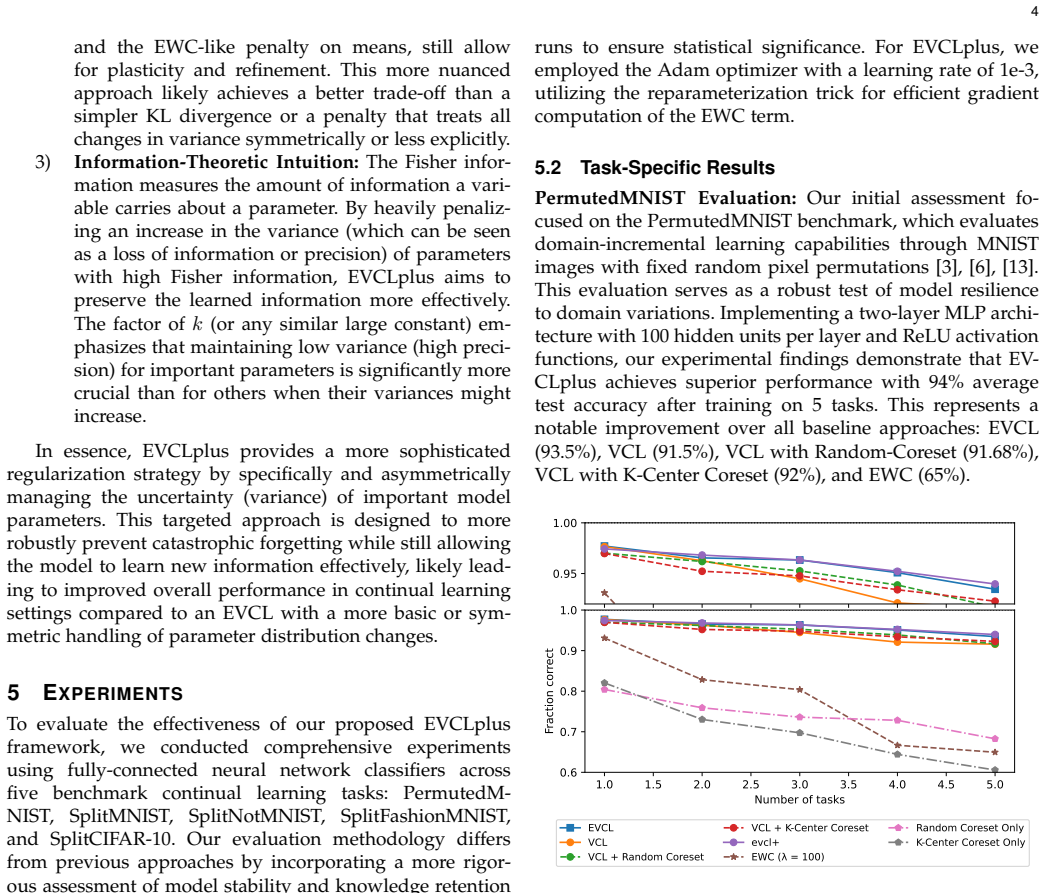
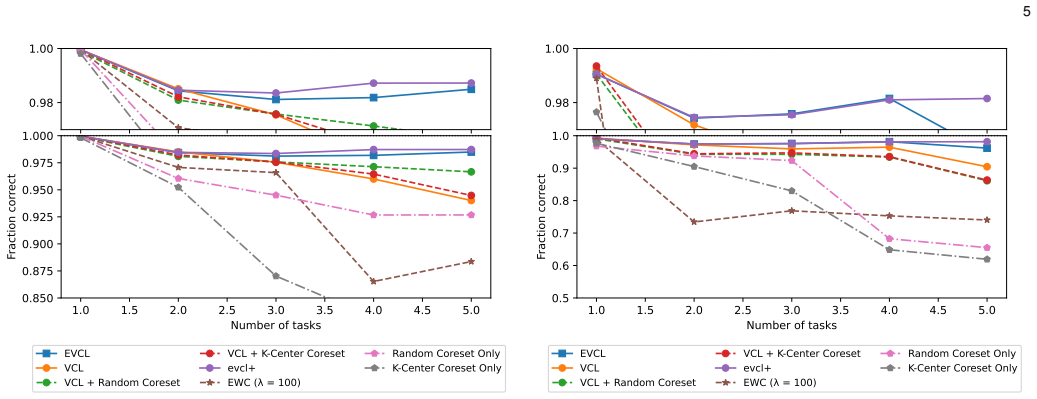
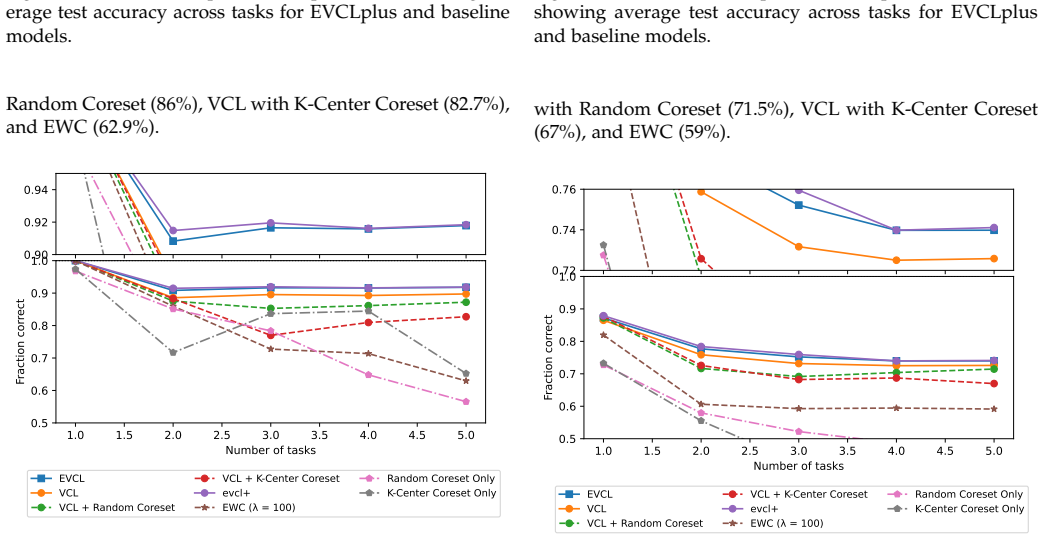
Summary. The paper proposes EVCLplus, an extension of the Elastic Variational Continual Learning (EVCL) framework that adds a Fisher-weighted asymmetric regularizer on the variances of a mean-field variational posterior: variance decreases are quadratically penalized, while variance increases receive a stronger, linear penalty scaled by a hyperparameter k. The method is evaluated on PermutedMNIST, SplitMNIST, SplitNotMNIST, SplitFashionMNIST, and SplitCIFAR-10 against EVCL, VCL, VCL with coresets, and EWC. The paper claims that EVCLplus consistently outperforms these baselines in average accuracy and forgetting measure, and that the asymmetric variance penalty improves the stability-plasticity trade-off. The experimental section reports only average accuracy numbers; no error bars, standard deviations, significance tests, or forgetting metrics are provided, and the gains over EVCL are small (0.1--2.1 percentage points) with ties on two benchmarks. A central methodological assumption, that weight-level Fisher information is the correct importance weight for penalizing variational variances, is stated without derivation or validation.
Significance. If the empirical claims were fully supported, the paper would make a modest but potentially useful contribution: the idea of treating variance increases and decreases asymmetrically for important parameters is interesting, and the algorithm is described clearly enough to re-implement. However, the current evidence is not sufficient to establish the claimed superiority. The absence of any variability measure makes the reported 0.1--0.3 percentage-point advantages over EVCL indistinguishable from run-to-run noise. Moreover, the core novelty---Fisher-weighted asymmetric variance regularization---rests on an unproven transfer of weight-level Fisher information to variational variance parameters. The paper does not provide code, and the EVCL baseline is cited to an apparently unverifiable arXiv placeholder. These issues are load-bearing because the central claim is that EVCLplus outperforms EVCL and other methods, and because the proposed mechanism is precisely what is supposed to explain that improvement.
major comments (4)
- [§5.1, §5.2] The protocol states that results are averaged over three independent runs to ensure statistical significance, but no standard deviations, confidence intervals, or significance tests are reported anywhere in Section 5. The reported advantages over EVCL are 0.1--0.3 percentage points on SplitMNIST and SplitCIFAR-10, and a tie on SplitNotMNIST. Without any measure of variability, these differences are consistent with run-to-run noise. The central claim of consistent superiority therefore lacks direct support. Please report per-run results or means with standard deviations, and perform a significance test or effect-size analysis.
- [§4.1 and Algorithm lines 18--19] The variance penalty in the displayed loss is weighted by F_j, but Algorithm line 18 computes F_i^t = E[(∂ log p(D_t|θ)/∂θ_i)^2] with respect to the network weights θ_i, not with respect to the variational variance parameters σ_j^2. In mean-field variational inference, σ_j^2 is a separate variational parameter, and the Fisher information with respect to σ_j^2 is not, in general, equal to the weight-level Fisher information. No derivation, approximation argument, or citation establishes this transfer. If the transfer is invalid, the penalty regularizes the wrong quantities: it penalizes variance increases for weights with high expected gradient curvature, which is not necessarily the same as penalizing uncertainty that destabilizes previously learned tasks. Because the claimed novelty and the attribution of empirical gains depend on this weighting, this gap is load-bearing. Please derive
- [§6, compared with §5] The Conclusion states that EVCLplus outperforms standard EVCL, VCL, and EWC 'in terms of average accuracy and forgetting measure.' The abstract and Section 5.3 similarly claim reduced knowledge degradation. However, Section 5 reports no forgetting measure at all: there is no average forgetting, backward transfer, or per-task accuracy retention over tasks. The figures show total average accuracy curves only. Without these metrics, the claim that the method specifically mitigates catastrophic forgetting is unsupported. Please add a standard forgetting/backward-transfer measurement to both tables and figures, or remove the corresponding claim from the abstract and conclusion.
- [§3.3, reference [10], §5.2] EVCL is the central baseline: EVCLplus is an extension of it and the comparison is made against it. Yet reference [10] is given as 'EVCL: Efficient variational continual learning,' arXiv:2401.00001 (2024). The arXiv identifier 2401.00001 is a placeholder-style identifier, and I could not verify this paper in the arXiv listing. No code or repository is provided, and the exact EVCL loss in Eq. (3) may not correspond to what the authors implemented. Since this baseline is the most direct competitor and the claimed gains are only 0.1--2.1 percentage points, the comparison must be reproducible. Please supply a verifiable reference or repository link, and provide a full specification of the EVCL implementation (architecture, optimizer schedule, hyperparameters, and any deviations from the cited description).
minor comments (5)
- [§4.3] This section is titled 'Theoretical Insights' and contains a narrative restatement of the design choices rather than a formal theorem or derivation. Section 6 itself lists 'exploring the theoretical properties of the asymmetric variance penalty' as future work, which confirms that no theoretical analysis is presented. Please relabel this section as 'Motivation' or 'Discussion' and either add formal statements or explicitly state that these are informal intuitions.
- [Abstract and §5.2] The abstract says 'substantial improvements,' but the largest gain over EVCL is 2.1 percentage points (SplitFashionMNIST) and two benchmarks tie within the reported precision (SplitNotMNIST and SplitCIFAR-10). Please make the language match the reported effect sizes, especially once uncertainty is reported.
- [Figures 1--5] The figures are described as 'average test accuracy across tasks,' but the text and conclusion mention forgetting measures. If forgetting metrics are added, they should also appear in the figures or in a separate table.
- [Notation, §4.1 and Algorithm] In the loss the variance penalty uses F_j, and the mean penalty uses F_i, but Algorithm line 18 computes a single F_i for all parameters. Make the indexing and the meaning of the Fisher computation consistent, and specify whether the same F is reused for both mean and variance penalties.
- [References] Some references appear incomplete or potentially unverifiable, notably [10] (arXiv:2401.00001) and possibly [7] and [14]. Please verify all entries against the official databases and provide full bibliographic details.
Circularity Check
No significant circularity: EVCLplus is an empirically evaluated loss modification; no claim reduces by construction to its inputs.
full rationale
The central claim of the paper is that EVCLplus improves average accuracy and reduces forgetting relative to EVCL, VCL, and EWC on five standard continual learning benchmarks. This claim is supported by external experimental comparisons in Section 5, not by a derivation from the loss definition. The loss function in Section 4.1 is an explicit construction, and the algorithm computes Fisher information from weight gradients and uses it in the penalty. No equation is shown to equal another by construction, and no fitted parameter is relabeled as a prediction. Section 4.3's qualitative 'theoretical insights' restate the penalty design (e.g., penalizing variance increases) but do not function as load-bearing derivations of the empirical results; they are interpretive narrative rather than a circular derivation chain. The discrepancy between the notation F_j for variance parameters and the algorithm's weight-level Fisher computation is a potential validity/correctness concern, but it is not a circularity because it does not make any result equivalent to its inputs by definition or by self-citation.
Assumptions & free parameters
free parameters (3)
- lambda (EWC regularization strength) =
100
- k (asymmetric variance penalty strength) =
5.0
- Fisher information sample count =
5000
assumptions (4)
- domain assumption Variational posterior q(theta) is a factorized Gaussian with mean mu and variance sigma^2, optimized via the reparameterization trick.
- ad hoc to paper The diagonal Fisher information of the model likelihood computed at the end of task t-1 correctly measures parameter importance for both mean shifts and variance changes.
- ad hoc to paper An increase in posterior variance for high-Fisher parameters is a primary mechanism of catastrophic forgetting, and penalizing it linearly improves the stability-plasticity trade-off.
- standard math ELBO objective and KL prior-posterior update in VCL are valid (standard variational inference).
Cite this review
Pith. "Pith review of Adaptive Variance-Penalized Continual Learning with Fisher Regularization." pith.science (2026). https://pith.science/paper/4KE6QKCU
@misc{pith2026250816632,
  author       = {Pith},
  title        = {Pith review of: Adaptive Variance-Penalized Continual Learning with Fisher Regularization},
  year         = {2026},
  howpublished = {\url{https://pith.science/paper/4KE6QKCU}},
  note         = {Machine review of arXiv:2508.16632}
}
read the original abstract
The persistent challenge of catastrophic forgetting in neural networks has motivated extensive research in continual learning . This work presents a novel continual learning framework that integrates Fisher-weighted asymmetric regularization of parameter variances within a variational learning paradigm. Our method dynamically modulates regularization intensity according to parameter uncertainty, achieving enhanced stability and performance. Comprehensive evaluations on standard continual learning benchmarks including SplitMNIST, PermutedMNIST, and SplitFashionMNIST demonstrate substantial improvements over existing approaches such as Variational Continual Learning and Elastic Weight Consolidation . The asymmetric variance penalty mechanism proves particularly effective in maintaining knowledge across sequential tasks while improving model accuracy. Experimental results show our approach not only boosts immediate task performance but also significantly mitigates knowledge degradation over time, effectively addressing the fundamental challenge of catastrophic forgetting in neural networks
Figures
Reference graph
Works this paper leans on
-
[10]
Evcl: Efficient variational continual learn- ing,
S. Batra and S. Yadav, “Evcl: Efficient variational continual learn- ing,” arXiv preprint arXiv:2401.00001, 2024
arXiv 2024
-
[1]
Continual lifelong learning with neural networks: A review,
G. I. Parisi, R. Kemker, J. L. Part, C. Kanan, and S. Wermter, “Continual lifelong learning with neural networks: A review,” Neural Networks, vol. 113, pp. 54–71, 2019
2019
-
[2]
Variational contin- ual learning,
C. V . Nguyen, Y. Li, T. D. Bui, and R. E. Turner, “Variational contin- ual learning,” in International Conference on Learning Representations (ICLR), 2018
work page 2018
-
[3]
Overcoming catastrophic forgetting in neural networks,
J. Kirkpatrick, R. Pascanu, N. Rabinowitz, J. Veness, G. Desjardins, A. A. Rusu, D. Milan, J. Quan, T. Ramalho, A. Grabska-Barwi ´nska et al. , “Overcoming catastrophic forgetting in neural networks,” Proceedings of the National Academy of Sciences , vol. 114, no. 13, pp. 3521–3526, 2017
work page 2017
-
[4]
Catastrophic interference in con- nectionist networks: The sequential learning problem,
M. McCloskey and N. J. Cohen, “Catastrophic interference in con- nectionist networks: The sequential learning problem,” Psychology of Learning and Motivation, vol. 24, pp. 109–165, 1989
work page 1989
-
[5]
R. Ratcliff, “Connectionist models of recognition memory: Con- straints imposed by learning and forgetting functions,” Psycholog- ical Review, vol. 97, no. 2, pp. 285–308, 1990
work page 1990
-
[6]
An empirical investigation of catastrophic forgetting in gradient- based neural networks,
I. J. Goodfellow, M. Mirza, D. Xiao, A. Courville, and Y. Bengio, “An empirical investigation of catastrophic forgetting in gradient- based neural networks,” arXiv preprint arXiv:1312.6211, 2013
arXiv 2013
-
[7]
Biological continual learning: A neuro- inspired approach,
S. Kumar and A. Sinha, “Biological continual learning: A neuro- inspired approach,” Frontiers in Neuroscience, vol. 16, p. 1234, 2022
work page 2022
Show all 21 references
-
[8]
Practical deep learning with bayesian principles,
K. Osawa, S. Swaroop, A. Jain, R. Eschenhagen, R. E. Turner, R. Yokota, and M. E. Khan, “Practical deep learning with bayesian principles,” arXiv preprint arXiv:1906.02506, 2019
1906 arXiv
-
[9]
Note on the quadratic penalties in elastic weight consolidation,
F. Husz ´ar, “Note on the quadratic penalties in elastic weight consolidation,” Proceedings of the National Academy of Sciences , vol. 115, no. 11, pp. E2496–E2497, 2018
2018
-
[11]
Three scenarios for continual learning,
G. M. van de Ven and A. S. Tolias, “Three scenarios for continual learning,” arXiv preprint arXiv:1904.07734, 2019
1904 arXiv
-
[12]
A continual learning survey: Defying forgetting in classification tasks,
M. Delange, R. Aljundi, M. Masana, S. Parisot, X. Jia, A. Leonardis, G. Slabaugh, and T. Tuytelaars, “A continual learning survey: Defying forgetting in classification tasks,” IEEE Transactions on Pattern Analysis and Machine Intelligence , vol. 44, no. 7, pp. 3366– 3385, 2021
2021
-
[13]
Continual learning through synaptic intelligence,
F. Zenke, B. Poole, and S. Ganguli, “Continual learning through synaptic intelligence,” arXiv preprint arXiv:1703.04200, 2017
2017 arXiv
-
[14]
Likelihood-based continual learning with fixed model structure,
J. Zhang and Y. Wang, “Likelihood-based continual learning with fixed model structure,” in Proceedings of the 35th International Conference on Machine Learning (ICML), 2018
2018
-
[15]
Experience replay for continual learning,
D. Rolnick, A. Ahuja, J. Schwarz, T. Lillicrap, and G. Wayne, “Experience replay for continual learning,” in Advances in Neural Information Processing Systems (NeurIPS), 2019
2019
-
[16]
Continual learning with deep generative replay,
H. Shin, J. K. Lee, J. Kim, and J. Kim, “Continual learning with deep generative replay,” arXiv preprint arXiv:1705.08690, 2017
2017 arXiv
-
[17]
Progress & compress: A scalable framework for continual learning,
J. Schwarz, W. M. Czarnecki, J. Luketina, A. Grabska-Barwi ´nska, Y. W. Teh, R. Pascanu, and R. Hadsell, “Progress & compress: A scalable framework for continual learning,” in Proceedings of the 35th International Conference on Machine Learning (ICML) , 2018
2018
-
[18]
Generalized variational continual learn- ing,
Y.-S. Loo and C.-M. Tan, “Generalized variational continual learn- ing,” arXiv preprint arXiv:2002.10671, 2020
2002 arXiv
-
[19]
Fashion-mnist: a novel image dataset for benchmarking machine learning algorithms,
H. Xiao, K. Rasul, and R. Vollgraf, “Fashion-mnist: a novel image dataset for benchmarking machine learning algorithms,” arXiv preprint arXiv:1708.07747, 2017
2017 arXiv
-
[20]
Learning multiple layers of fea- tures from tiny images,
A. Krizhevsky and G. Hinton, “Learning multiple layers of fea- tures from tiny images,” University of Toronto, Tech. Rep., 2009
2009
-
[21]
Orthogonal gradient descent for continual learning,
M. Farajtabar, N. Azizan, A. Mott, and A. Li, “Orthogonal gradient descent for continual learning,” in Proceedings of the 23rd Interna- tional Conference on Artificial Intelligence and Statistics (AISTATS) , 2020. 7 APPENDIX Algorithm 1 Elastic Variational Continual Learning w...
2020
Reviewed August 5, 2026 · model on record in the stance chip above.
Discussion (0). Continue with ORCID to comment.