REVIEW 4 major objections 5 minor 69 references
LLM agents cast as SAFe roles can carry out Agile project-management work and improve measured outcomes, the paper argues.
Reviewed by Pith at T0; open to challenge. T0 means a machine referee read the full paper against a public rubric. the ladder, T0–T4 →
LLM agents acting as Agile roles produced plausible project artifacts in simulation, but the claimed improvements over human teams are unsupported because no comparison or validated metrics are provided.
T0 review reviewed 2026-08-05 challenge →
load-bearing objection A plausible LLM-agent framework for Agile/SAFe that overclaims measurable gains in the abstract, then walks them back in its own conclusions; the empirical section is not interpretable as evidence. the 4 major comments →
Cognitive Agents Powered by Large Language Models for Agile Software Project Management
The pith
A machine-rendered reading of the paper's core claim, the machinery that carries it, and where it could break.
The reading
Core claim
The central claim is that a multi-agent system whose agents are backed by large language models can emulate the role structure of SAFe and, within simulation, measurably improve Agile project outcomes. The authors build this claim on the CogniSim platform, where each agent has an LLM core, a prompt-defined role, memory of past conversations, and selected tools, and where interactions are governed by a speaker-selection mechanism. Across six simulation runs that varied model type, iteration count, temperature, and included roles, the agents generated artifacts associated with real software work and showed higher diversity, completion, and sentiment-stability scores in some configurations. The
What carries the argument
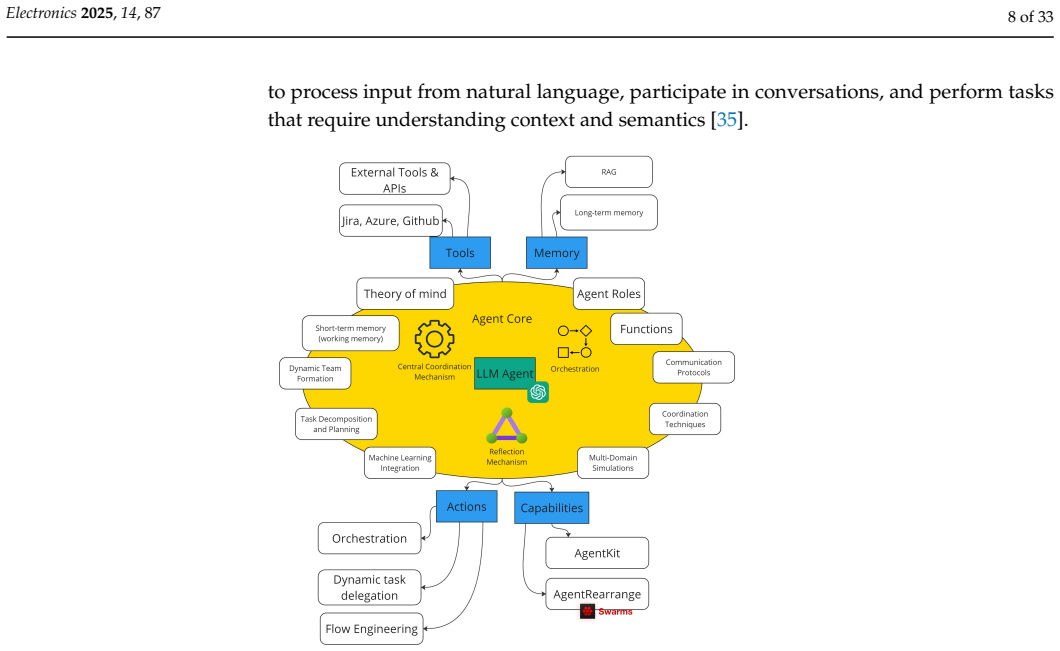
The central object is CogniSim, the paper's layered multi-agent architecture. At the bottom is a large-language-model foundation; above it sits a multi-agent layer that can connect to project tools; and at the top are role-specific cognitive agents grouped into Manager, Executor, Quality Checker, and Methodology Reviewer categories, mapped onto SAFe roles such as Product Owner, System Architect, and DevOps Engineer. The carrying mechanism is structured natural-language dialogue with memory and speaker selection, which lets agents negotiate priorities, surface dependencies, and produce project artifacts as deliverables.
Load-bearing premise
The entire result rests on the assumption that the simulation environment and its custom metrics—unique content percentage, diversity score, completion score, and sentiment stability—are faithful proxies for success in real Agile software projects.
What would settle it
Run a controlled experiment in which human teams and CogniSim agents receive the same backlog and SAFe phase objectives, then compare task completion time, defect rate, and stakeholder satisfaction; if human teams match or beat the agents on those measures, the claimed reduction in task completion time fails. A cheaper check: replace the LLM core with a scripted random responder while keeping the role prompts; if the reported metric patterns survive, the metrics are not measuring the LLM's contribution.
If this is right
- Routine SAFe ceremonies—PI Planning, Iteration Execution, and Inspect-and-Adapt—could be at least partially delegated to LLM agents, with humans concentrating on judgment calls and stakeholder relationships.
- Agent configurations such as model type, temperature, number of iterations, and role set become tuning knobs that project managers can set per phase, much like adjusting team composition.
- Because the framework logs every dialogue and decision, it could yield an automatic audit trail showing why a backlog item was prioritized or an architecture choice was made.
- The same role-based templates could be reused across projects, lowering the start-up cost of a new project once the agent definitions exist.
- Dedicated quality and methodology-reviewer agents could monitor adherence to Agile practices continuously, catching drift earlier than periodic retrospectives.
Where Pith is reading between the lines
- If the simulation results transfer to real settings, a natural next test is to replace the paper's ad hoc metrics with standard engineering measures such as defect density, cycle time, and stakeholder satisfaction, and run the same backlog with human and agent teams.
- The framework's dialogue logs could be turned into training data for smaller, cheaper models, letting teams run the same role structure without relying on large commercial models.
- A promising extension the paper leaves implicit is using the agent team as an interactive rehearsal environment where human project managers practice SAFe ceremonies and stress-test scenarios before committing resources.
- The mixed performance in Inspect-and-Adapt suggests that open-ended reflection tasks may need a different mechanism—such as external memory of past iterations or explicit retrospective templates—rather than the same planning dialogue.
Editorial analysis
A structured set of objections, weighed in public.
Referee Report
Summary. This paper describes CogniSim, a multi-agent framework in which LLM-based cognitive agents emulate Agile/SAFe roles (Product Owner, System Architect, etc.) to automate project management tasks in simulated software projects. The authors present a layered architecture, a Python/LangChain implementation, a case study of PI Planning and Iteration Execution, and a table of simulation results. The abstract and Section 6.3 claim measurable improvements, including significantly reduced task completion times relative to human-managed processes, but the experimental evidence consists of six simulation runs whose metrics are undefined, and Section 9.1 explicitly defers rigorous quantification and human-baseline comparisons to future work.
Significance. The framework addresses a timely topic—using LLM agents in Agile/SAFe project management—and the modular design with reproducible configurations is a useful starting point. If the claimed performance gains were properly validated, the work could be relevant; however, the current evidence is limited to illustrative simulations with no control condition, so the significance is mainly as a framework description rather than an empirical demonstration.
major comments (4)
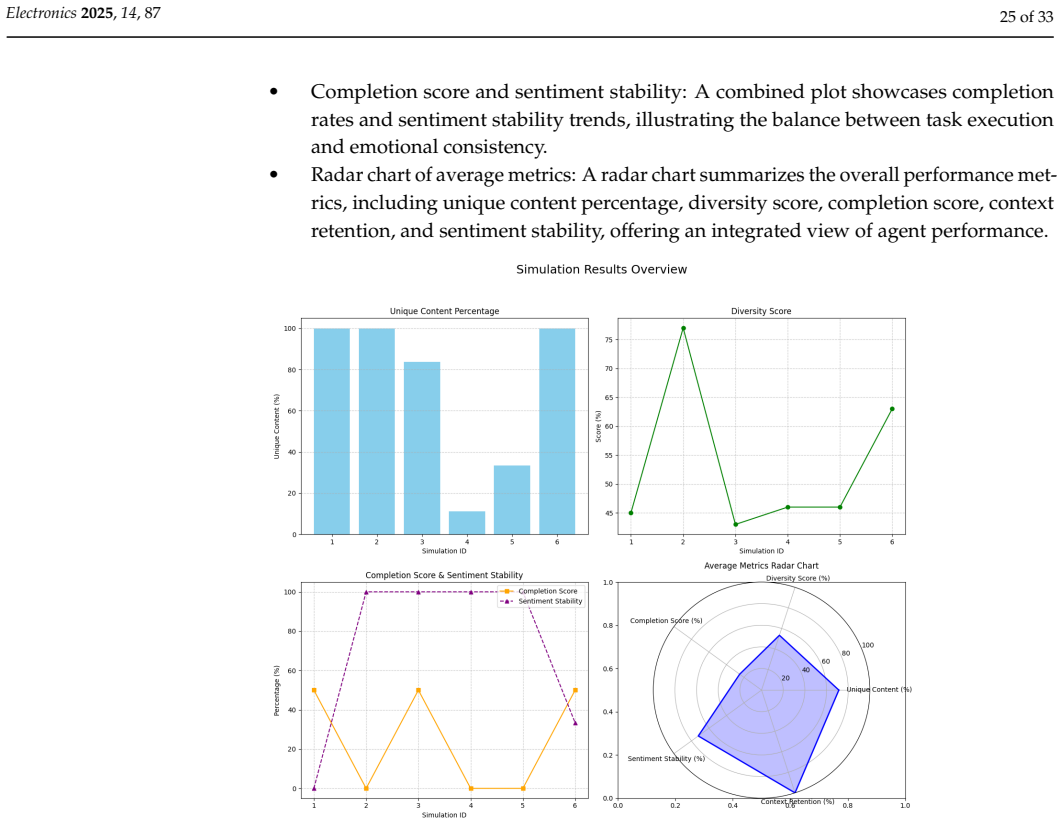
- [Table 5 / Section 7.2] The quantitative results are uninterpretable: the metrics 'Unique Content', 'Diversity Score', 'Completion Score', and 'Sentiment Stability' are never defined, no formulas or measurement procedures are given, and Section 7.3 describes a different set of metrics (Task Completion Time, Communication Efficiency, etc.) without linking them to Table 5. Readers cannot verify or reproduce these numbers.
- [Section 6.3 vs. Section 9.1] The central claim of significantly reduced task completion times compared to human-managed processes is unsupported: no human baseline or control group is presented anywhere, and Section 9.1 states that 'rigorous quantification of these gains or direct comparisons against human-led baselines are deferred to future research.' The abstract's 'measurable improvements' is thus contradicted by the authors' own stated limitations.
- [Section 7.1 / Table 5] The experimental design varies model type, iterations, temperature, and agent roles, but the six runs in Table 5 are not replicated and no statistical analysis is provided. Section 7.4's conclusion that 'adjusting independent variables allowed us to identify settings that optimize dependent variables' is not justified by the data. Moreover, no connection is made between the manipulated parameters and the reported metrics.
- [Section 1.6] The evaluation framework promises comparison against accepted best practices or human-generated baselines, but no such comparison is reported. Without a control condition, the claimed improvements cannot be attributed to the CogniSim framework rather than to the underlying LLMs or the simulation environment itself.
minor comments (5)
- [Section 5.3] 'Boxs' should be 'Boxes'.
- [Section 6.3/6.4] The terms 'astute agents' and 'perceptive agents' are used; use 'cognitive agents' consistently.
- [Figure 12] The figure lacks axis labels and units; the radar chart's additional metric 'context retention' is not defined in the text.
- [Section 7.3] Quality measures such as cyclomatic complexity and code coverage are listed but no such measurements are reported; clarify whether these were computed.
- [Data Availability] Consider adding a link to the code repository, if released, to support reproducibility.
Circularity Check
No circularity: the framework paper's empirical claims are under-supported and partly retracted, but no result is derived from its own inputs or from a load-bearing self-citation chain.
full rationale
This paper is a framework-and-simulation study, not a mathematical derivation. There is no fitted parameter that is later relabeled as a prediction, no uniqueness theorem imported from prior work by the same authors, and no ansatz smuggled in via citation. The earlier self-citations (e.g., refs. [17] and [52]) are used to describe the authors' own prior components and figures, but they do not carry the empirical conclusion; the claimed 'measurable improvements' rests, insecurely, on Table 5 and qualitative observations rather than on a self-citation chain. The most serious problems are evidentiary, not circular. Section 7.2 (Table 5) introduces 'Unique Content', 'Diversity Score', 'Completion Score', and 'Sentiment Stability' without defining formulas or validation, and the headline comparison in Section 6.3 ('task completion times being significantly reduced compared to human-managed processes') has no human-managed control in the paper. The authors themselves concede this: Section 1.6 says 'future work involves... incorporating benchmarking against human-driven baselines'; Section 6.4 calls for 'more extensive quantitative analyses and real-world field studies'; and Section 9.1 explicitly retracts: 'Rather than making definitive claims... we now present these as preliminary high-level opportunities' and 'rigorous quantification... or direct comparisons against human-led baselines are deferred to future research.' Those concessions undermine the abstract's claim of 'measurable improvements', but undermining an unsupported empirical claim is not the same as a circular derivation. Since no specific reduction of a claimed result to its own inputs or to an unverified self-citation can be quoted, the appropriate circularity score is 0.
Axiom & Free-Parameter Ledger
axioms (3)
- domain assumption SAFe phase definitions and role responsibilities are as described in the paper's references.
- ad hoc to paper LLM-generated outputs (code snippets, chat) can be scored meaningfully by the paper's ad hoc metrics.
- domain assumption The simulation environment faithfully emulates real-world software project management.
invented entities (1)
-
CogniSim platform
no independent evidence
Cite this review
Pith. "Pith review of Cognitive Agents Powered by Large Language Models for Agile Software Project Management." pith.science (2026). https://pith.science/paper/BUB7GQK2
@misc{pith2026250816678,
  author       = {Pith},
  title        = {Pith review of: Cognitive Agents Powered by Large Language Models for Agile Software Project Management},
  year         = {2026},
  howpublished = {\url{https://pith.science/paper/BUB7GQK2}},
  note         = {Machine review of arXiv:2508.16678}
}
read the original abstract
This paper investigates the integration of cognitive agents powered by Large Language Models (LLMs) within the Scaled Agile Framework (SAFe) to reinforce software project management. By deploying virtual agents in simulated software environments, this study explores their potential to fulfill fundamental roles in IT project development, thereby optimizing project outcomes through intelligent automation. Particular emphasis is placed on the adaptability of these agents to Agile methodologies and their transformative impact on decision-making, problem-solving, and collaboration dynamics. The research leverages the CogniSim ecosystem, a platform designed to simulate real-world software engineering challenges, such as aligning technical capabilities with business objectives, managing interdependencies, and maintaining project agility. Through iterative simulations, cognitive agents demonstrate advanced capabilities in task delegation, inter-agent communication, and project lifecycle management. By employing natural language processing to facilitate meaningful dialogues, these agents emulate human roles and improve the efficiency and precision of Agile practices. Key findings from this investigation highlight the ability of LLM-powered cognitive agents to deliver measurable improvements in various metrics, including task completion times, quality of deliverables, and communication coherence. These agents exhibit scalability and adaptability, ensuring their applicability across diverse and complex project environments. This study underscores the potential of integrating LLM-powered agents into Agile project management frameworks as a means of advancing software engineering practices. This integration not only refines the execution of project management tasks but also sets the stage for a paradigm shift in how teams collaborate and address emerging challenges.
Figures






Reference graph
Works this paper leans on
-
[1]
Agile Software Development Methods: Review and Analysis
Abrahamsson, P .; Salo, O.; Ronkainen, J.; Warsta, J. Agile Software Development Methods: Review and Analysis.arXiv 2017, arXiv:1709.08439
work page internal anchor Pith review Pith/arXiv arXiv 2017
-
[2]
Perkusich, M.; Chaves E Silva, L.; Costa, A.; Ramos, F.; Saraiva, R.; Freire, A.; Dilorenzo, E.; Dantas, E.; Santos, D.; Gorgônio, K.; et al. Intelligent software engineering in the context of agile software development: A systematic literature review. Inf. Softw. Technol. 2020, 119, 106241. [CrossRef]
work page 2020
-
[3]
A decade of agile methodologies: Towards explaining agile software development
Dingsøyr, T.; Nerur, S.; Balijepally, V .; Moe, N.B. A decade of agile methodologies: Towards explaining agile software development. J. Syst. Softw. 2012, 85, 1213–1221. [CrossRef]
work page 2012
-
[4]
The role of the project manager in agile software development projects
Shastri, Y.; Hoda, R.; Amor, R. The role of the project manager in agile software development projects. J. Syst. Softw. 2021, 173, 110871. [CrossRef]
work page 2021
-
[5]
Pressman, R.S.; Maxim, B.R. Software Engineering: A Practitioner’s Approach, 9th ed.; McGraw-Hill Education: New York, NY, USA, 2020
work page 2020
-
[6]
Rubin, K.S.; Cohn, M.; Jeffries, R. Essential Scrum: A Practical Guide to the Most Popular Agile Process; The Addison-Wesley Signature Series; Addison-Wesley: Upper Saddle River, NJ, USA; Boston, MA, USA; Indianapolis, Indiana; San Francisco, CA, USA; New York, NY, USA; Toronto, ON, Canada; Montreal, QC, Canada; London, UK; Munich, Germany; Paris, France;...
work page 2013
-
[7]
Scrum.org. Scrum Framework. Scrum.org. 2020. Available online: https://www.scrum.org (accessed on 24 December 2024)
work page 2020
-
[8]
Cruz, C.J.X. Transforming Competition into Collaboration: The Revolutionary Role of Multi-Agent Systems and Language Models in Modern Organizations. arXiv 2024, arXiv:2403.07769. [CrossRef]
work page internal anchor Pith review Pith/arXiv arXiv 2024
-
[9]
Engineering Multi-agent Systems with Statecharts: Theory and Practice
Spanoudakis, N.I. Engineering Multi-agent Systems with Statecharts: Theory and Practice. SN Comput. Sci. 2021, 2, 317. [CrossRef]
work page 2021
-
[10]
Evaluating Large Language Models: A Comprehensive Survey
Guo, Z.; Jin, R.; Liu, C.; Huang, Y.; Shi, D.; Supryadi.; Yu, L.; Liu, Y.; Li, J.; Xiong, B.; et al. Evaluating Large Language Models: A Comprehensive Survey. arXiv 2023, arXiv:2310.19736
Pith/arXiv arXiv 2023
-
[11]
Exploring Autonomous Agents through the Lens of Large Language Models: A Review
Barua, S. Exploring Autonomous Agents through the Lens of Large Language Models: A Review. arXiv 2024, arXiv:2404.04442. [CrossRef]
Pith/arXiv arXiv 2024
-
[12]
A Comparative Analysis of Large Language Models for Code Documentation Generation
Dvivedi, S.S.; Vijay, V .; Pujari, S.L.R.; Lodh, S.; Kumar, D. A Comparative Analysis of Large Language Models for Code Documentation Generation. arXiv 2024, arXiv:2312.10349. [CrossRef]
Pith/arXiv arXiv 2024
-
[13]
DebugBench: Evaluating Debugging Capability of Large Language Models
Tian, R.; Ye, Y.; Qin, Y.; Cong, X.; Lin, Y.; Pan, Y.; Wu, Y.; Hui, H.; Liu, W.; Liu, Z.; et al. DebugBench: Evaluating Debugging Capability of Large Language Models. arXiv 2024, arXiv:2401.04621. [CrossRef]
Pith/arXiv arXiv 2024
-
[14]
Yuan, S.T.; Yokoo, M.; Goos, G.; Hartmanis, J.; Van Leeuwen, J.; Carbonell, J.G.; Siekmann, J. (Eds.) Intelligent Agents: Specification, Modeling, and Applications: 4th Pacific Rim International Workshop on Multi-Agents, PRIMA 2001 Taipei, Taiwan, 28–29 July 2001 Proceedings; Lecture Notes in Computer Science; Springer: Berlin/Heidelberg, Germany, 2001; V...
work page 2001
-
[15]
Design process documentation template
IEEE Foundation for Intelligent Physical Agents (FIPA). Design process documentation template. In Manual SC00097B, IEEE FIP A DPDF Working Group, IEEE FIP A; Status: Standard tex.changelog: (Initial); Cossentino, M., Molesini, A., Omicini, A., Hilaire, V ., Fuentes, R., DeLoach, S., Migeon, F., Bonjean, N., Gleizes, M.P ., Maurel, C., et al., Eds.; FIPA: ...
work page 2012
-
[16]
Cognitive Architectures for Language Agents
Sumers, T.; Yao, S.; Narasimhan, K.; Griffiths, T. Cognitive Architectures for Language Agents. Transactions on Machine Learning Research. In Review. 2024. Available online: https://openreview.net/forum?id=1i6ZCvflQJ (accessed on 24 December 2024)
work page 2024
-
[17]
Towards LLM-augmented multiagent systems for agile software engineering
Cinkusz, K.; Chudziak, J.A. Towards LLM-augmented multiagent systems for agile software engineering. In Proceedings of the 39th IEEE/ACM International Conference on Automated Software Engineering, Sacramento, CA, USA, 27 October–1 November 2024; pp. 2476–2477. [CrossRef]
work page 2024
-
[18]
LLM-Based Multi-Agent Systems for Software Engineering: Vision and the Road Ahead
He, J.; Treude, C.; Lo, D. LLM-Based Multi-Agent Systems for Software Engineering: Vision and the Road Ahead. arXiv 2024, arXiv:2404.04834. [CrossRef]
Pith/arXiv arXiv 2024
-
[19]
AGILE: A Novel Reinforcement Learning Framework of LLM Agents
Feng, P .; He, Y.; Huang, G.; Lin, Y.; Zhang, H.; Zhang, Y.; Li, H. AGILE: A Novel Reinforcement Learning Framework of LLM Agents. arXiv 2024, arXiv:2405.14751. [CrossRef]
Pith/arXiv arXiv 2024
-
[20]
From LLMs to LLM-based Agents for Software Engineering: A Survey of Current, Challenges and Future
Jin, H.; Huang, L.; Cai, H.; Yan, J.; Li, B.; Chen, H. From LLMs to LLM-based Agents for Software Engineering: A Survey of Current, Challenges and Future. arXiv 2024, arXiv:2408.02479. [CrossRef]
Pith/arXiv arXiv 2024
-
[21]
CodePori: Large-Scale System for Autonomous Software Development Using Multi-Agent Technology
Rasheed, Z.; Sami, M.A.; Kemell, K.K.; Waseem, M.; Saari, M.; Systä, K.; Abrahamsson, P . CodePori: Large-Scale System for Autonomous Software Development Using Multi-Agent Technology. arXiv 2024, arXiv:2402.01411. [CrossRef]
Pith/arXiv arXiv 2024
-
[22]
Talebirad, Y.; Nadiri, A. Multi-Agent Collaboration: Harnessing the Power of Intelligent LLM Agents.arXiv 2023, arXiv:2306.03314. [CrossRef] Electronics 2025, 14, 87 32 of 33
Pith/arXiv arXiv 2023
-
[23]
Theory of Mind for Multi-Agent Collaboration via Large Language Models
Li, H.; Chong, Y.Q.; Stepputtis, S.; Campbell, J.; Hughes, D.; Lewis, M.; Sycara, K. Theory of Mind for Multi-Agent Collaboration via Large Language Models. In Proceedings of the 2023 Conference on Empirical Methods in Natural Language Processing, Singapore, 6–10 December 2023; pp. 180–192. [CrossRef]
work page 2023
-
[24]
Publisher Correction: Large language models encode clinical knowledge
Singhal, K.; Azizi, S.; Tu, T.; Mahdavi, S.S.; Wei, J.; Chung, H.W.; Scales, N.; Tanwani, A.; Cole-Lewis, H.; Pfohl, S.; et al. Publisher Correction: Large language models encode clinical knowledge. Nature 2023, 620, E19. [CrossRef]
work page 2023
-
[25]
SAFe 6.0 Framework; Scaled Agile, Inc.: Boulder, CO, USA, 2024
Scaled Agile, Inc. SAFe 6.0 Framework; Scaled Agile, Inc.: Boulder, CO, USA, 2024
work page 2024
-
[26]
Financial Statement Analysis with Large Language Models.arXiv 2024, arXiv:2407.17866
Kim, A.G.; Muhn, M.; Nikolaev, V .V . Financial Statement Analysis with Large Language Models.arXiv 2024, arXiv:2407.17866. [CrossRef]
Pith/arXiv arXiv 2024
-
[27]
Chiang, C.H.; Lee, H.y. Can Large Language Models Be an Alternative to Human Evaluations? In Proceedings of the 61st Annual Meeting of the Association for Computational Linguistics (Volume 1: Long Papers), Toronto, ON, Canada, 9–14 July 2023; pp. 15607–15631. [CrossRef]
work page 2023
-
[28]
Rocha, F.G.; Misra, S.; Soares, M.S. Guidelines for Future Agile Methodologies and Architecture Reconciliation for Software- Intensive Systems. Electronics 2023, 12, 1582. [CrossRef]
work page 2023
-
[29]
Highsmith, J.A. Agile Project Management: Creating Innovative Products , 2nd ed.; The Agile Software Development Series; Addison-Wesley: Upper Saddle River, NJ, USA, 2010
work page 2010
-
[30]
The Scrum Guide: The Definitive Guide to Scrum: The Rules of the Game
Schwaber, K.; Sutherland, J. The Scrum Guide: The Definitive Guide to Scrum: The Rules of the Game. Available online: https://scrumguides.org/scrum-guide.html (accessed on 24 December 2024)
work page 2024
-
[31]
Knaster, R.; Leffingwell, D. SAFe Distilled: SAFe 5.0: Achieving Business Agility with the Scaled Agile Framework; Addison-Wesley: Hoboken, NJ, USA, 2020
work page 2020
-
[32]
Ebert, C.; Paasivaara, M. Scaling agile. IEEE Softw. 2017, 34, 98–103. [CrossRef]
work page 2017
-
[33]
Russell, S.J.; Norvig, P . Artificial Intelligence: A Modern Approach , 4th ed.; Pearson Series in Artificial Intelligence; Pearson: Hoboken, NJ, USA, 2021
work page 2021
-
[34]
OpenAI.; Achiam, J.; Adler, S.; Agarwal, S.; Ahmad, L.; Akkaya, I.; Aleman, F.L.; Almeida, D.; Altenschmidt, J.; Altman, S.; et al. GPT-4 Technical Report. arXiv 2024, arXiv:2303.08774. [CrossRef]
Pith/arXiv arXiv 2024
-
[35]
Language Models are Few-Shot Learners
Brown, T.B.; Mann, B.; Ryder, N.; Subbiah, M.; Kaplan, J.; Dhariwal, P .; Neelakantan, A.; Shyam, P .; Sastry, G.; Askell, A.; et al. Language Models are Few-Shot Learners. arXiv 2020, arXiv:2005.14165
Pith/arXiv arXiv 2020
-
[36]
Evaluating Large Language Models Trained on Code
Chen, M.; Tworek, J.; Jun, H.; Yuan, Q.; Pinto, H.P .d.O.; Kaplan, J.; Edwards, H.; Burda, Y.; Joseph, N.; Brockman, G.; et al. Evaluating Large Language Models Trained on Code. arXiv 2021, arXiv:2107.03374
Pith/arXiv arXiv 2021
-
[37]
IntelliCode compose: Code generation using transformer
Svyatkovskiy, A.; Deng, S.K.; Fu, S.; Sundaresan, N. IntelliCode compose: Code generation using transformer. In Proceedings of the 28th ACM Joint Meeting on European Software Engineering Conference and Symposium on the Foundations of Software Engineering, Virtual, 17–18 November 2020; pp. 1433–1443. [CrossRef]
work page 2020
-
[38]
LLM-Powered Autonomous Agents; Online Resource, 2023
Weng, L. LLM-Powered Autonomous Agents; Online Resource, 2023. Available online: https://lilianweng.github.io/posts/2023 -06-23-agent/ (accessed on 24 December 2024)
work page 2023
-
[39]
MCQGen: A large language model-driven MCQ generator for personalized learning.IEEE Access Pract
Hang, C.N.; Wei Tan, C.; Yu, P .D. MCQGen: A large language model-driven MCQ generator for personalized learning.IEEE Access Pract. Innov. Open Solut. 2024, 12, 102261–102273. [CrossRef]
work page 2024
-
[40]
An Introduction to Multiagent Systems, 2nd ed.; Wiley: Chichester, UK, 2012
Wooldridge, M.J. An Introduction to Multiagent Systems, 2nd ed.; Wiley: Chichester, UK, 2012
work page 2012
-
[41]
Kostka, A.; Chudziak, J.A. Synergizing logical reasoning, long-term memory, and collaborative intelligence in multi-agent LLM systems. In Proceedings of the Pacific Asia Conference on Language, Information and Computation (PACLIC 38), Tokyo, Japan, 7–9 December 2024
work page 2024
-
[42]
ElliottAgents: A natural language-driven multi-agent system for stock market analysis and prediction
Chudziak, J.A.; Wawer, M. ElliottAgents: A natural language-driven multi-agent system for stock market analysis and prediction. In Proceedings of the 38th Pacific Asia Conference on Language, Information and Computation, Tokyo, Japan, 7–9 December
-
[43]
Trends in cooperative distributed problem solving.IEEE Trans
Durfee, E.; Lesser, V .; Corkill, D. Trends in cooperative distributed problem solving.IEEE Trans. Knowl. Data Eng. 1989, 1, 63–83. [CrossRef]
work page 1989
-
[44]
Tutorial on agent-based modelling and simulation
Macal, C.M.; North, M.J. Tutorial on agent-based modelling and simulation. J. Simul. 2010, 4, 151–162. [CrossRef]
work page 2010
-
[45]
Efficient resource management for Cloud computing environments
Younge, A.J.; von Laszewski, G.; Wang, L.; Lopez-Alarcon, S.; Carithers, W. Efficient resource management for Cloud computing environments. In Proceedings of the International Conference on Green Computing, Chicago, IL, USA, 15–18 August 2010; pp. 357–364. [CrossRef]
work page 2010
-
[46]
AgileCoder: Dynamic Collaborative Agents for Software Development based on Agile Methodology
Nguyen, M.H.; Chau, T.P .; Nguyen, P .X.; Bui, N.D.Q. AgileCoder: Dynamic Collaborative Agents for Software Development based on Agile Methodology. arXiv 2024, arXiv:2406.11912
Pith/arXiv arXiv 2024
-
[47]
On agent-based software engineering
Jennings, N.R. On agent-based software engineering. Artif. Intell. 2000, 117, 277–296. [CrossRef]
work page 2000
-
[48]
Weiss, G. (Ed.) Multiagent Systems, 2nd ed.; Intelligent Robotics and Autonomous Agents; The MIT Press: Cambridge, MA, USA; London, UK, 2013
work page 2013
-
[49]
Ferber, J.; Ferber, J. Multi-Agent Systems: An Introduction to Distributed Artificial Intelligence, 1st ed.; Addison-Wesley: Boston, MA, USA, 1999. Electronics 2025, 14, 87 33 of 33
work page 1999
-
[50]
ChatDev: Communicative Agents for Software Development
Qian, C.; Liu, W.; Liu, H.; Chen, N.; Dang, Y.; Li, J.; Yang, C.; Chen, W.; Su, Y.; Cong, X.; et al. ChatDev: Communicative Agents for Software Development. arXiv 2024, arXiv:2307.07924
Pith/arXiv arXiv 2024
-
[51]
Fenton, N.E.; Bieman, J. Software Metrics: A Rigorous and Practical Approach, 3rd ed.; Innovations in Software Engineering and Software Development; CRC Press: Boca Raton, FL, USA, 2015. [CrossRef]
work page 2015
-
[52]
Communicative agents for software project management and system development
Cinkusz, K.; Chudziak, J. Communicative agents for software project management and system development. In Proceedings of the 21th International Conference on Modeling Decisions for Artificial Intelligence MDAI 2024, Tokyo, Japan, 27–31 August 2024; Torra, V ., Narukawa, Y., Kikuchi, H., Eds.; ISBN 978-91-531-0238-0
work page 2024
-
[53]
TaskWeaver: A Code-First Agent Framework
Qiao, B.; Li, L.; Zhang, X.; He, S.; Kang, Y.; Zhang, C.; Yang, F.; Dong, H.; Zhang, J.; Wang, L.; et al. TaskWeaver: A Code-First Agent Framework. arXiv 2024, arXiv:2311.17541
Pith/arXiv arXiv 2024
-
[54]
Reflexion: Language Agents with Verbal Reinforcement Learning
Shinn, N.; Cassano, F.; Berman, E.; Gopinath, A.; Narasimhan, K.; Yao, S. Reflexion: Language Agents with Verbal Reinforcement Learning. arXiv 2023, arXiv:2303.11366
Pith/arXiv arXiv 2023
-
[55]
LangChain. Version 0.2. Introduction to LangChain. Online Resource. 2023. Available online: https://python.langchain.com/v0 .2/docs/introduction/ (accessed on 24 December 2024)
work page 2023
-
[56]
LangChain. Version 0.2. LangChain Core API Reference. Online Resource. 2023. Available online: https://python.langchain. com/v0.2/api_reference/core/index.html (accessed on 24 December 2024)
work page 2023
-
[57]
Is Temperature the Creativity Parameter of Large Language Models? arXiv 2024, arXiv:2405.00492
Peeperkorn, M.; Kouwenhoven, T.; Brown, D.; Jordanous, A. Is Temperature the Creativity Parameter of Large Language Models? arXiv 2024, arXiv:2405.00492
Pith/arXiv arXiv 2024
-
[58]
DataPerf: Benchmarks for Data-Centric AI Development
Mazumder, M.; Banbury, C.; Yao, X.; Karlaš, B.; Rojas, W.G.; Diamos, S.; Diamos, G.; He, L.; Parrish, A.; Kirk, H.R.; et al. DataPerf: Benchmarks for Data-Centric AI Development. arXiv 2023, arXiv:2207.10062
Pith/arXiv arXiv 2023
-
[59]
Communication management and its impact on successful IT program
Chudziak, J.; Cegielski, R.W.; Meyer, J. Communication management and its impact on successful IT program. IADIS Int. J. Comput. Sci. Inf. Syst. 2008, 1, 14–28
work page 2008
-
[60]
A survey of multi-agent organizational paradigms
Horling, B.; Lesser, V . A survey of multi-agent organizational paradigms. Knowl. Eng. Rev. 2004, 19, 281–316. [CrossRef]
work page 2004
-
[61]
Ontological Learning Assistant for Knowledge Discovery and Data Mining
Choinski, M.; Chudziak, J.A. Ontological Learning Assistant for Knowledge Discovery and Data Mining. In Proceedings of the 2009 International Multiconference on Computer Science and Information Technology, Mragowo, Poland, 12–14 October 2009; pp. 147–155. [CrossRef]
work page 2009
-
[62]
AI for Agile development: a Meta-Analysis
Cabrero-Daniel, B. AI for Agile development: A Meta-Analysis. arXiv 2023, arXiv:2305.08093
work page internal anchor Pith review Pith/arXiv arXiv 2023
-
[63]
Large Language Model based Multi-Agents: A Survey of Progress and Challenges
Guo, T.; Chen, X.; Wang, Y.; Chang, R.; Pei, S.; Chawla, N.V .; Wiest, O.; Zhang, X. Large Language Model based Multi-Agents: A Survey of Progress and Challenges. arXiv 2024, arXiv:2402.01680
Pith/arXiv arXiv 2024
-
[64]
Trust from Ethical Point of View: Exploring Dynamics Through Multiagent-Driven Cognitive Modeling
Tariverdi, A. Trust from Ethical Point of View: Exploring Dynamics Through Multiagent-Driven Cognitive Modeling. arXiv 2024, arXiv:2401.07255
work page internal anchor Pith review Pith/arXiv arXiv 2024
-
[65]
SOEN-101: Code Generation by Emulating Software Process Models Using Large Language Model Agents
Lin, F.; Kim, D.J.; Chen, T.-H. SOEN-101: Code Generation by Emulating Software Process Models Using Large Language Model Agents. arXiv 2024, arXiv:2403.15852
Pith/arXiv arXiv 2024
-
[66]
Dorri, A.; Kanhere, S.S.; Jurdak, R. Multi-Agent Systems: A Survey. IEEE Access 2018, 6, 28573–28593. [CrossRef]
work page 2018
-
[67]
Consensus in multi-agent systems: A review
Amirkhani, A.; Barshooi, A.H. Consensus in multi-agent systems: A review. Artif. Intell. Rev. 2022, 55, 3897–3935. [CrossRef]
work page 2022
-
[68]
Cognitive bias in decision-making with LLMs
Echterhoff, J.M.; Liu, Y.; Alessa, A.; McAuley, J.; He, Z. Cognitive bias in decision-making with LLMs. In Proceedings of the Findings of the Association for Computational Linguistics: EMNLP 2024, Miami, FL, USA, 12–16 November 2024; Al-Onaizan, Y., Bansal, M., Chen, Y.N., Eds.; Association for Computational Linguistics: Stroudsburg, PA, USA, 2024; pp. 12...
work page 2024
-
[69]
Scaled Agile, Inc. SAFe Scrum. Online Resource. 2024. Available online: https://scaledagileframework.com/safe-scrum/ (accessed on 24 December 2024). Disclaimer/Publisher’s Note: The statements, opinions and data contained in all publications are solely those of the individual author(s) and contributor(s) and not of MDPI and/or the editor(s). MDPI and/or t...
work page 2024
This paper was first reviewed by deepseek-v4-flash on August 5, 2026.
discussion (0)
Sign in with ORCID, Apple, or X to comment. Anyone can read and Pith papers without signing in.