Revisiting the adiabatic limit in ballistic multiterminal Josephson junctions
Pith reviewed 2026-05-18 21:40 UTC · model grok-4.3
The pith
In ballistic multiterminal Josephson junctions the relative number of quantum-correlated pairs from colliding Floquet-Kulik levels equals the inverse of the number of channels.
A machine-rendered reading of the paper's core claim, the machinery that carries it, and where it could break.
Core claim
The relative number of quantum-correlated pairs formed by colliding Floquet-Kulik quartet levels is equal to the inverse of the number of channels. This observation motivates a model for the intermediate regime in which the ballistic central two-dimensional normal metal is treated as a continuum under the adiabatic approximation, while Andreev modes propagate in a background of voltage- and flux-tunable nonequilibrium electronic populations. The model predicts characteristic voltage scales that govern the mesoscopic oscillations of the critical current.
What carries the argument
Adiabatic continuum treatment of the two-dimensional normal metal with Andreev modes propagating in voltage- and flux-tunable nonequilibrium electronic populations.
If this is right
- The model predicts characteristic voltage scales that govern mesoscopic oscillations of the critical current.
- These scales lie at the intersection of quartet, topology, and Floquet interpretations for multiterminal Josephson junction experiments.
- The continuum treatment addresses the intermediate regime where electrochemical potential becomes comparable to one-dimensional level spacing.
Where Pith is reading between the lines
- Varying channel number experimentally could directly test the inverse scaling of correlated pairs.
- The nonequilibrium populations may influence additional transport properties such as conductance.
- This approach could connect discrete-level descriptions in small devices to continuum models in larger ones.
Load-bearing premise
The ballistic central two-dimensional normal metal can be treated as a continuum under the adiabatic approximation while Andreev modes propagate in a background of voltage- and flux-tunable nonequilibrium electronic populations.
What would settle it
Measuring whether the relative number of quantum-correlated pairs equals the inverse of the number of channels in devices with controlled channel counts would confirm or refute the central claim.
Figures



read the original abstract
Motivated by recent experiments on multiterminal Josephson junctions (MJJs) that probe different ranges of the size and bias voltage parameters, we explore the regime of increasing bias voltage in large-scale devices, where the electrochemical potential becomes comparable to the 1D energy level spacing. We find that the relative number of quantum-correlated pairs formed by colliding Floquet--Kulik quartet levels is equal to the inverse of the number of channels. This observation motivates a model for the intermediate regime in which the ballistic central two-dimensional normal metal is treated as a continuum under the adiabatic approximation, while Andreev modes propagate in a background of voltage- and flux-tunable nonequilibrium electronic populations. The model predicts characteristic voltage scales that govern the mesoscopic oscillations of the critical current, and these scales are at the crossroads of interpreting experiments in all sectors of the MJJs: quartets, topology, and Floquet theory. Our model is specifically inspired by the recent Harvard and Penn State group experiments.
Editorial analysis
A structured set of objections, weighed in public.
Referee Report
Summary. The manuscript explores the regime of increasing bias voltage in large-scale ballistic multiterminal Josephson junctions where the electrochemical potential becomes comparable to the 1D energy level spacing. It reports that the relative number of quantum-correlated pairs formed by colliding Floquet-Kulik quartet levels equals the inverse of the number of channels. This observation is used to motivate a model in which the central ballistic 2D normal metal is treated as a continuum under the adiabatic approximation, while Andreev modes propagate against a background of voltage- and flux-tunable nonequilibrium electronic populations. The model predicts characteristic voltage scales that govern mesoscopic oscillations of the critical current and are relevant to interpreting experiments in the quartets, topology, and Floquet sectors.
Significance. If the pair-counting result holds and the continuum model is justified, the work would supply a practical bridge between microscopic quantum correlations and mesoscopic observables, offering voltage-scale predictions that could help unify interpretations across different experimental regimes of multiterminal Josephson junctions.
major comments (1)
- [paragraph on model motivation] Paragraph on model motivation: The claim that the relative number of quantum-correlated pairs formed by colliding Floquet-Kulik quartet levels equals 1/N_channels is invoked to justify treating the ballistic central 2D normal metal as a continuum under the adiabatic approximation. However, the explored regime is explicitly defined by an electrochemical potential comparable to the 1D level spacing, which is the regime in which discrete transverse modes and finite-size quantization are expected to produce corrections to any continuum integral. The adiabatic condition itself risks violation when nonequilibrium distributions vary on the scale of the level spacing rather than varying slowly, directly undermining the load-bearing approximation used to derive the characteristic voltage scales.
minor comments (2)
- [abstract] The abstract states that the model is 'specifically inspired by the recent Harvard and Penn State group experiments' but does not identify which specific data sets or voltage ranges are being addressed; adding a short sentence with the relevant experimental references would improve clarity.
- [abstract] Notation for the number of channels (N_channels) and the inverse relation is introduced without an explicit definition or reference to a prior equation; a brief parenthetical definition on first use would aid readability.
Simulated Author's Rebuttal
We thank the referee for their careful reading of the manuscript and for raising this important point about the regime of validity of the continuum adiabatic approximation. We address the concern directly below and propose revisions to clarify the connection between our discrete numerical results and the continuum model.
read point-by-point responses
-
Referee: Paragraph on model motivation: The claim that the relative number of quantum-correlated pairs formed by colliding Floquet-Kulik quartet levels equals 1/N_channels is invoked to justify treating the ballistic central 2D normal metal as a continuum under the adiabatic approximation. However, the explored regime is explicitly defined by an electrochemical potential comparable to the 1D level spacing, which is the regime in which discrete transverse modes and finite-size quantization are expected to produce corrections to any continuum integral. The adiabatic condition itself risks violation when nonequilibrium distributions vary on the scale of the level spacing rather than varying slowly, directly undermining the load-bearing approximation used to derive the characteristic voltage scales.
Authors: We appreciate the referee's identification of this potential tension. Our central numerical finding—that the fraction of quantum-correlated pairs is precisely 1/N_channels—is obtained from fully discrete multichannel calculations in the regime where the electrochemical potential is comparable to the level spacing. This exact scaling with channel number indicates that the correlated component remains a parametrically small fraction of the total spectrum even as discrete effects are retained; the remaining majority of modes can therefore be integrated over in a continuum description without altering the leading voltage scales. Regarding the adiabatic condition, the nonequilibrium populations are set by the applied bias voltages, whose energy variation occurs on the scale of eV. In the large-device limit relevant to the experiments we discuss, this scale is slow compared with the local transverse quantization energy once the 2D continuum limit is taken, preserving the adiabatic separation. We will add a dedicated paragraph in the revised manuscript that (i) explicitly states the regime of validity, (ii) shows how the 1/N result bridges the discrete numerics to the continuum model, and (iii) discusses the expected size of finite-N corrections to the predicted voltage scales. revision: yes
Circularity Check
No significant circularity; derivation proceeds from independent finding to motivated model
full rationale
The paper states it finds that the relative number of quantum-correlated pairs formed by colliding Floquet-Kulik quartet levels equals the inverse of the number of channels; this result is then used to motivate treating the ballistic 2D normal metal as a continuum under the adiabatic approximation with nonequilibrium populations. Characteristic voltage scales are subsequently predicted from the resulting model. No step reduces by construction to a fitted input, self-definition, or load-bearing self-citation; the initial counting result is presented as an output of analysis rather than an input assumption, and the continuum treatment is an explicit modeling choice justified by that result rather than presupposed. Questions of whether the continuum remains valid when electrochemical potential approaches 1D level spacing concern model applicability, not circularity in the logical chain.
Axiom & Free-Parameter Ledger
axioms (2)
- domain assumption The central 2D normal metal region can be treated as a continuum under the adiabatic approximation in the intermediate bias regime.
- domain assumption Andreev modes propagate in a background of voltage- and flux-tunable nonequilibrium electronic populations.
Lean theorems connected to this paper
-
IndisputableMonolith/Foundation/AlexanderDuality.leanalexander_duality_circle_linking unclear?
unclearRelation between the paper passage and the cited Recognition theorem.
the relative number of quantum-correlated pairs formed by colliding Floquet-Kulik quartet levels is equal to the inverse of the number of channels
-
IndisputableMonolith/Cost/FunctionalEquation.leanwashburn_uniqueness_aczel unclear?
unclearRelation between the paper passage and the cited Recognition theorem.
ballistic central two-dimensional normal metal is treated as a continuum under the adiabatic approximation
What do these tags mean?
- matches
- The paper's claim is directly supported by a theorem in the formal canon.
- supports
- The theorem supports part of the paper's argument, but the paper may add assumptions or extra steps.
- extends
- The paper goes beyond the formal theorem; the theorem is a base layer rather than the whole result.
- uses
- The paper appears to rely on the theorem as machinery.
- contradicts
- The paper's claim conflicts with a theorem or certificate in the canon.
- unclear
- Pith found a possible connection, but the passage is too broad, indirect, or ambiguous to say the theorem truly supports the claim.
Reference graph
Works this paper leans on
-
[1]
Three-terminal quartets In this subsubsection, we present the three-terminal quartet current-phase relations, see Ref. 7 and the Appendix B. In per- turbation theory in the tunneling amplitudes, the current-phase relations of the three-terminal quartets originate from two Cooper pairs emanating from the condensate of the grounded superconducting lead ST ....
-
[2]
Four-terminal split-quartets In this subsubsection, we provide the expression of the split-quartet current-phase relations, see Ref. 22 and the Ap- pendix B. Those complementary four-terminal split-quartets exchange partners among the single Cooper pairs coming from each of the grounded superconducting leads SR or SB. The resulting outgoing pairs are tran...
-
[3]
Phase-Andreev reflection in an Andreev interferometer In this subsubsection, we summarize recent results on a ballistic Andreev interferometer, see Refs. 36 and 63. We note that a general analogy holds with the two-fluid pic- ture of superconductivity, where the central- N quasiparti- cle electrochemical potential δ µN eV, Φ Φ0 parameterizes the dissipati...
-
[4]
Even-in-phase current-phase relation In this subsubsection, we calculate the quartet current- phase relations in the presence of a coupling to the back- ground nonequilibrium electronic populations. The latter are produced in the central- N simply by voltage-biasing in the presence of nonsymmetrical contact transparencies. We implement the simplifying ass...
-
[5]
Numerical results In this subsubsection, we present numerical calculations that illustrate the above theory. We first assume that the crit- ical current results from the following interference between both types of the even-in-phase quartets emitted by the con- tacts SR or by SB at the extremities of the grounded supercon- ducting loop: Iq,c (Φ, δ µN) = M...
-
[6]
We use the notations δ µN eV, Φ Φ0 = 0 = δ µ′ N − s0 (23) δ µN eV, Φ Φ0 = 1 2 = δ µ′ N + s0. (24) The critical currents are then parameterized by δ µ′ N, and they also depend on the strength s0 of the electroflux effect 70,71. The shift δ µ′ N ∝ V in the electrochemical potential is propor- tional to the bias voltageV in the presence of nonsymmetrical con...
-
[7]
8a for Φ Φ0 = 0 and for Φ Φ0 = 1 2
This is why the same colorcode is used on Fig. 8a for Φ Φ0 = 0 and for Φ Φ0 = 1 2. This panel confirms the oscillations in the quartet critical cur- rent as δ µ′ N is increased, or, equivalently, as the bias volt- age V is increased. Fig. 8c now shows the full Eq. (22) with Iq,3T,c = 1 and ic,R,L = 0.5, still with Isq,c = 0. This panel c reveals that Iq,c...
-
[8]
and the inversion (i.e. the critical cur- rent is smaller at Φ Φ0 = 0 than at Φ Φ0 = 1 2). VI. CONCLUSIONS In summary, we have presented a phenomenological ap- proach to understanding the emergence of characteristic low- bias voltages in intermediate-scale MJJs. The mesoscopic en- ergy associated with the contact separation was taken to be comparable to t...
-
[9]
Odd-in-phase/even-in-voltage three-terminal quartets We previously decomposed Eq. (A3) for ˆΣa,α ˆG+,− α,a into both terms ˆΣa,α ˆG+,− α,a S and ˆΣa,α ˆG+,− α,a N having the bare Keldysh Green’s function in the superconducting or normal leads, respectively. In this subsection, we now evaluate ˆΣa,α ˆG+,− α,a S in perturbation in the hopping amplitudes, an...
-
[10]
Even-in-phase/odd-in-voltage three-terminal quartets In this subsection, we consider the long-junction limit67–69, which hosts a discrete spectrum of ABS, at all energy scales with respect to the superconducting gap. We specifically cal- culate the corresponding quartet current as a function of both the quartet phase and the bias voltage. We focus on smal...
-
[11]
2, sustaining the process of the split-quartets
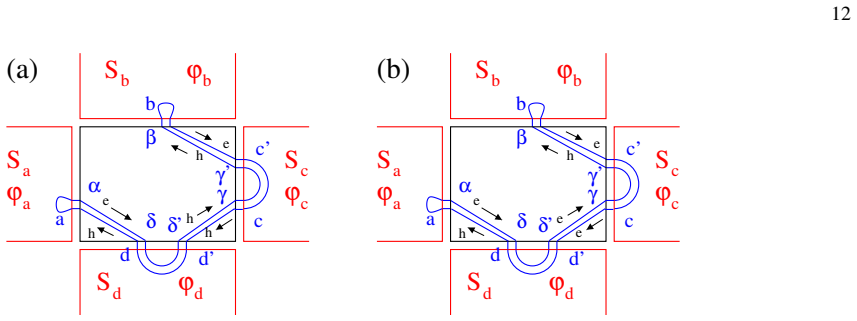
Odd-in-phase/even-in-voltage four-terminal split-quartets In this subsection, we go back to the short-junction limit and consider the four-terminal device in Fig. 2, sustaining the process of the split-quartets. Namely, the two incoming pairs 12 S a ϕa ϕbS b ’γ S ϕ S ϕ c c dd b β c c’ a e (a) e h hh α h γ d d’ δ ’δ S a ϕa ϕbS b ’γ S ϕ S ϕ c c dd b β c c’ ...
-
[12]
Even-in-phase/odd-in-voltage four-terminal split-quartets We first make the Nambu structure explicit in the first term of ˆΣa,α ˆGα,a (A),1,1 N , see Eq. (B27): ˆΣ1,1 a,α ˆg1,1 α,γ ˆΣ1,1 γ,c ˆg1,1 c,c′ ˆΣ1,1 c′,γ ′ ˆg1,1 γ ′,δ ′ ˆΣ1,1 δ ′,d′ ˆg1,2 d′,d ˆΣ2,2 d,δ ˆg2,2 δ ,β ˆΣ2,2 β ,b ˆg2,1 b,b = Σ2 aΣ2 bΣ2 cΣ2 c′Σ2 d′g2,1 a,ag2,1 b,bg1,1 c,c′g1,2 c′,c × g...
discussion (0)
Sign in with ORCID, Apple, or X to comment. Anyone can read and Pith papers without signing in.