REVIEW 6 major objections 7 minor 133 references
Spacer: Towards Engineered Scientific Inspiration
T0 review · 6 major / 7 minor · reviewed 2026-08-15 · deepseek-v4-flash
Pith's one-line read Spacer proposes that engineered scientific inspiration is achievable: strip knowledge to keywords, let a citation-weighted graph find promising new combinations, and have LLMs only elaborate and vet the results.
desk verdict Clever architecture and a genuinely useful reconstruction evaluation, but the core claim that Nuri's keyword sets are novel and high-potential is asserted rather than measured. read the letter →
The pith
A machine-rendered reading of the paper's core claim, the machinery that carries it, and where it could break.
The reading
What carries the argument
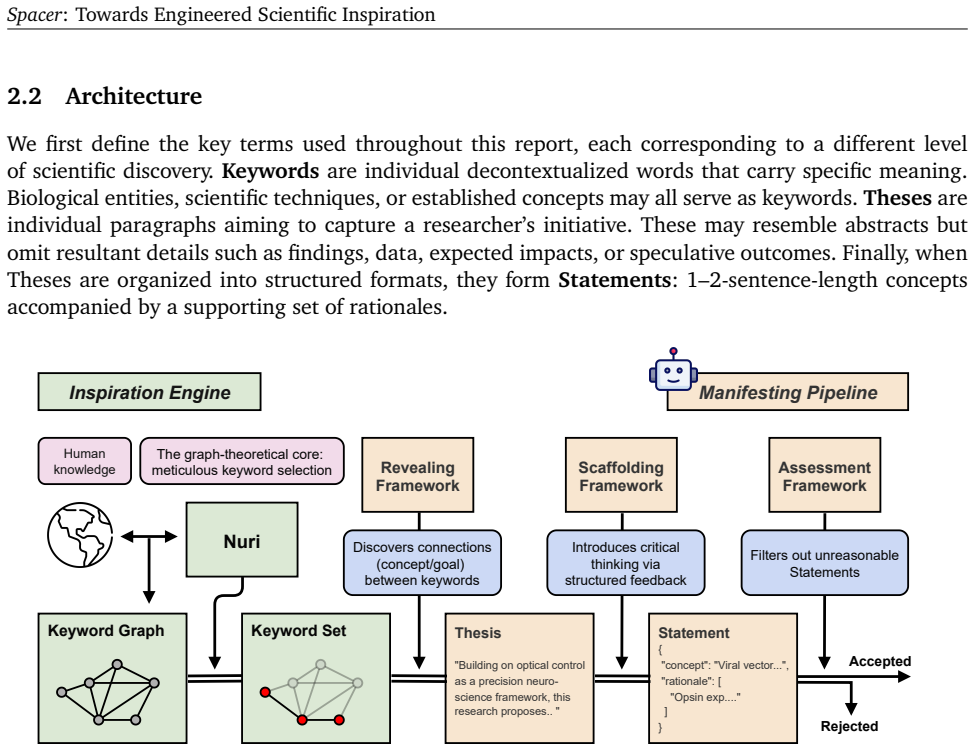
The central object is Nuri's keyword graph, $G(P)$: vertices are keywords appearing in any paper of $P$, and the edge weight between $u$ and $v$ is the sum over papers containing both of $\log_2(\mathrm{FWCI}(p)+1)/(|K(p)|-1)$, so high-weight edges mark terms whose co-occurrence has historically coincided with high citation impact. The evaluation function $f_P$ consumes a keyword set and emits $s \in [0,1]$, an estimate of the set's potential impact, and Nuri searches for high-scoring sets using only graph statistics and heuristics—no machine learning and no LLM. The other half is the Manifesting Pipeline: fine-tuned Weaver and Sketcher models that draw a research concept and goal from the keyword set, a Scaffolding Framework that converts the thesis into a typed logic graph and verifies each node against peer-reviewed literature, and an Assessment Framework that critiques Statements in two phases. The division of labor is the point: the creative act is the keyword selection; everything the LLMs do is elaboration, validation, and articulation.
What would settle it
Execute the calcium-modulation protocol that the paper's own Appendix B specifies for the first example Statement: expose HepG2 hepatocellular carcinoma cells to aperiodic extracellular-calcium fluctuations and measure whether oscillatory coherence (autocorrelation decay time of Fluo-4 signals) is restored while cell-cycle checkpoints re-engage; if coherence is not restored, that generated concept is not factually grounded. A companion check needs no wet lab: rebuild Nuri's graph with a hard cutoff date, emit its top-scoring keyword sets, and see whether post-cutoff papers whose keywords match those sets realize above-chance citation impact; if they do not, $f_P$ is selecting fluent-sounding combinations rather than high-potential ones.
Extended reading notes
Core claim
The paper sets out to establish that "engineered scientific inspiration" is achievable, meaning a system can generate original scientific concepts distinct from anything in its training data while staying factually grounded, without a human user proposing the idea. The mechanism is deliberate decontextualization: published knowledge is disassembled into keywords, and novelty is sought in the unexplored combinations among them. Nuri builds an undirected weighted graph whose vertices are keywords and whose edge weights accumulate $\log_2(\mathrm{FWCI}(p)+1)/(|K(p)|-1)$ over papers containing both endpoints, so an edge's weight reflects the joint citation impact of the two terms; an evaluation function $f_P$ then scores any keyword set $K \subset V(G(P))$ as a normalized estimate $s \in [0,1]$ of its potential impact. The Manifesting Pipeline takes a high-scoring set and, through the Revealing Framework (Weaver and Sketcher craft a concept and a goal), the Scaffolding Framework (the thesis is decomposed into a logic graph whose nodes are validated against retrieved literature), and the Assessment Framework (a two-phase reviewer/meta-reviewer critique), produces a Statement—a 1–2-sentence concept with supporting rationales and DOIs. The paper's evidence has three parts: $f_P$ distinguishes high-impact (FWCI $\geq 15$) from low-impact papers with AUROC $0.737$; Weaver reconstructs theses of 158 papers published after the models' knowledge cutoff, judged effectively identical in an "overall" sense in 85.44% of cases; and embedding-space analysis (PCA, LDA, energy distance) places Spacer's theses closer to published abstracts than those of five state-of-the-art LLMs.
Load-bearing premise
The load-bearing premise is that the score Nuri assigns to a keyword set genuinely estimates the set's future scientific impact rather than echoing past citation patterns, because if that score is not predictive the selected keyword sets are not high-potential and the Manifesting Pipeline merely turns arbitrary word lists into fluent prose.
Editorial extensions
If this is right
- Research ideation becomes cheap and parallelizable: a candidate scientific statement costs under $3, almost all of it LLM inference, since Nuri's graph search is effectively free.
- The same pipeline transfers to any field with a citation index, including physics, machine learning, and economics, by rebuilding the keyword graph over that literature.
- Because Nuri's estimator is built causally (only papers published before a target date inform its graph), its selections can be audited prospectively: keyword sets scoring high on $f_P$ should predict which combinations later yield highly cited work.
- If keyword sets really do capture a paper's initiative, then "inspiration" becomes a searchable object, and the reconstruction benchmark—recover a thesis from its keywords—offers a concrete yardstick for future ideation systems.
- LLM-only ideation appears to saturate: the embedding comparisons indicate that adding the decontextualized selection stage moves outputs measurably closer to expert-written abstracts than any of the five unmodified LLMs.
Reading between the lines
- My inference: the paper's own framing suggests a falsifiable design principle for any automated ideation system—separate the novelty-producing step from the language-producing step; if deliberately removing context before generation is what drives the measured gains, then systems that interleave creative and generative choices should underperform ones that strictly separate them, a testable archit
- My inference: the deepest open question the paper leaves implicit is whether $f_P$'s signal is novelty or fluency; an ablation that feeds Nuri deliberately uninformative keyword sets (random high-frequency terms) through the same Manifesting Pipeline would separate the contribution of the graph search from the contribution of LLM elaboration, and the paper does not report that control.
- My inference: the reconstruction results double as a benchmark proposal—evaluating ideation systems by how much of a held-out paper's thesis can be recovered from its keyword set alone would avoid the bias and variance of subjective novelty scoring that the paper itself criticizes.
- My inference: the paper concedes its approach is one of several routes to inspiration, so the strongest reading of the result is conditional: within LLM-driven discovery, decontextualization plus graph search outperforms pure prompting; whether it generalizes beyond LLM-driven methods is left open.
Signed reviews
Editorial analysis
A structured set of objections, weighed in public.
Referee Report
Summary. This paper describes Spacer, a two-stage system aimed at automated scientific ideation. Stage one, Nuri, builds an undirected weighted keyword graph from biology publications, with edge weights defined as sums of log2(FWCI+1)/(|K(p)|-1) over papers containing both keywords (Eqs. 1-2), and then proposes keyword sets using an evaluation function f_P (described only as outputting a normalized score s in [0,1]) together with undisclosed heuristics. Stage two, the Manifesting Pipeline, converts keyword sets into thesis paragraphs via the fine-tuned Weaver and Sketcher models, scaffolds them into Statements using logic graphs, and filters the Statements through an LLM-based Assessment Framework. The authors claim that Spacer produces original, creative, and factually grounded scientific concepts without external intervention, and they report three validations: an AUROC of 0.737 for f_P classifying high- versus low-FWCI published papers (Section 4.1); an approximately 85 percent 'overall' pass rate in reconstructing the theses of 158 post-cutoff papers from their extracted keywords (Section 4.2); and an embedding analysis in which Spacer theses are the closest to published top-journal theses among Spacer, five SOTA LLMs, and published papers (Section 4.3). The paper also reports a per-Statement cost below $3 and provides full prompts and an example experimental protocol in the appendices.
Significance. If established, the central claim would make Spacer a notable contribution to automated scientific ideation, and the architecture - separating a non-LLM combinatorial ideation stage from LLM-based elaboration - is a principled design that deserves attention. Strengths of the evaluation include a genuine temporal split in Section 4.1, a reconstruction corpus consisting of papers published after the knowledge cutoffs of the models involved (Section 4.2), an embedding comparison run with two independent style-normalization models (Section 4.3), and unusually complete disclosure of prompts in Appendix A. However, all three validation pillars are at one remove from the system actually claimed: f_P is never defined, Nuri-generated keyword sets are never directly scored or tested for novelty, the reconstruction test exercises only Weaver rather than the full Nuri-to-Statement path, and the embedding comparison is confounded by the Assessment Framework's filtering. The contribution is therefore conditional on substantial additional validation rather than established by the present evidence.
major comments (6)
- [Section 2.2 (Nuri paragraph, Eqs. 1-2)] The evaluation function f_P is never given a functional form. The text says only that f_P maps a Keyword Set K to a normalized score s in [0,1] 'representing the potential impact of the input keywords' and that 'Nuri uses f_P and applies various heuristics to create its final output set.' The reader cannot tell how the edge weights of Eq. (2) are aggregated, how normalization is performed, what the heuristics are, how the Keyword Sets K(p) are extracted from papers, or how the later 'keyword refinement engine' vets and replaces keywords. Because the claim that Nuri produces high-potential keyword sets rests entirely on this function and search procedure, the method is not reproducible as written, and the validation in Section 4.1 cannot be checked against the actual generator. The revision should supply the definition of f_P, the heuristics, and the extraction/refinement methods, or give exact pointers to code.
- [Section 4.1] The validation tests f_P as a discriminator on keyword sets of already-published papers (EVAL(p) = f_{P<p}(K(p)) against realized FWCI(p)), not as a generator of keyword sets. The AUROC of 0.737 +/- 0.025 is moderate, and the metric is partially self-referential: f_{P<p} aggregates FWCI-weighted co-occurrence of earlier papers, so a paper whose keywords match combination patterns of earlier high-FWCI papers will tend to score higher; the temporal split reduces but does not remove this field-level confound. The second check (AUC = 0.996 separating paper keyword sets from random sets, Figure 14) is close to tautological, since random words have near-zero co-occurrence under Eq. (2) by construction. The closing inference of Section 4.1 that 'the accuracy of f(.) directly translates into potential of the resulting Keyword Sets' is unsupported: no statistic is reported on the f_P values of keyword sets actually produced by Nuri. I recommend an ablation that sets all FWCI weights to 1 (to test what the citation weights add beyond raw co-occurrence) and a report of the f_P distribution over Nuri-generated sets compared with published sets.
- [Section 4.2] The reconstruction experiment feeds Weaver keyword sets extracted from published abstracts rather than keyword sets generated by Nuri, so it validates the Manifesting Pipeline in isolation and leaves the Nuri-to-Statement bridge untested. The task is also close to Weaver's fine-tuning objective ('pairs of Keyword Sets and their corresponding inspirational ideas,' Section 6.2), so the high pass rates may partly reflect training alignment rather than emergent inspiration. No baseline is reported; one needs, for example, the pass rates of a non-fine-tuned DeepSeek-R1 on the same inputs judged by the same o3 prompt. Additionally, the keyword-extraction method is unspecified, and Table 2 itself contains a reconstruction that undercuts the claim of precision: for the CAR T example, the original thesis's central innovation (localizing transgene expression to the tumor microenvironment via tumor-restricted endogenous genes such as NR4A2 and RGS16) is recast as 'CRISPR knock-in technology is employed to knock out the NR4A2 and RGS16 genes,' dropping the localization mechanism. This example indicates that the o3 criteria (Topic 100 percent, Logic 96.2 percent) can be satisfied by materially wrong reconstructions and that the 85.44 percent 'overall' rate overstates fidelity.
- [Abstract and Section 2; Sections 4.1-4.3] Novelty is asserted but never measured. The abstract and Section 2 claim that Nuri extracts 'novel, high-potential keyword sets' and that Spacer generates concepts 'distinct from those seen in its training datasets or search results,' yet no experiment quantifies novelty: the paper does not report the fraction of Nuri-generated keyword pairs that already co-occur in G(P) or in the pre-generation literature, nor does it compare Nuri outputs against random or marginal-frequency-matched baselines. Section 4.3's embedding analysis measures proximity to published top-journal theses, which is a similarity metric, not a novelty metric, and it sits in tension with the paper's own novelty claim. A concrete test would be to generate a large batch of Nuri keyword sets and report the fraction of pairs (u,v) with w(u,v) > 0 in the pre-generation graph, benchmarked against a matched-random baseline; without such a test the central novelty claim rests on assertion.
- [Section 2.2 (Assessment Framework)] The claim that 'in human-expert evaluations, the Assessment Framework achieved an 88.2% recall' appears without any accompanying methodology, dataset, definition of a 'latent flaw,' or number of judges anywhere in the manuscript. This number is load-bearing because the Assessment Framework is the component that filters Statements as 'scientifically sound and technologically feasible,' and the paper's factual-grounding claim depends on that filter. The revision should either report the full evaluation protocol (judge instructions, Statement sample, and the confusion-matrix component that yields the recall figure) or remove the claim.
- [Section 4.3] The end-to-end comparison is asymmetric. Spacer's 52 sampled theses have passed the Assessment Framework (plus whatever iteration and selection the pipeline performs), while the five SOTA LLM outputs are single, unfiltered generations prompted in one shot; the analysis therefore cannot separate the contribution of generation from the contribution of filtering. In addition, 'closest in embedding space to published top-journal theses' is interpreted as a quality signal, but it is equally consistent with Spacer's outputs being more generic or centrally located (lower variance) in the embedding space, and closeness to the published distribution is in tension with the paper's originality claim. I suggest two controls: (i) pass the SOTA LLM outputs through the same Assessment Framework before embedding and rerun the energy-distance analysis, and (ii) report per-sample distances and class variances, and check whether Spacer's closeness survives comparison against the corpus centroid.
minor comments (7)
- [Section 4 (opening)] The first sentence reads 'Invalidation,weexaminedthreecoreparts...'; this is presumably a typographical error and should read 'In validation, we examined...'.
- [Section 3.3] 'antimicrobial pepdite (AMP) secretion' should read 'antimicrobial peptide (AMP) secretion'.
- [Section 3.2] 'intergration of energy landscape' should read 'integration of energy landscape'.
- [Section 2.1] 'We adopt an hybrid approach' should read 'a hybrid approach'.
- [Eq. (3)] The Euclidean-norm expressions in the energy-distance formula contain formatting artifacts; the equation should be re-typeset and the notation defined (e.g., which norm is used in R^4096).
- [Section 4.1, Figures 12-14] The paper does not state how the reported confidence intervals (e.g., 0.737 +/- 0.025) were computed; the procedure (e.g., bootstrap over papers) should be stated, and the choice of the FWCI thresholds (high at least 15, low below 1) should be justified or accompanied by a sensitivity analysis.
- [Table 2] Reporting the o3 'overall' verdict for each displayed reconstruction row would help readers calibrate the pass-rate numbers, especially given the CAR T example discussed in Major Comment 3.
Circularity Check
One construction-driven sanity check inflates Nuri's validation, but the core AUROC and downstream tests are temporally split and independent.
-
self definitional
[Section 4.1 (Nuri validation), Eq. (2) and the 'further sanity check' paragraph; Figure 14]
"w(u,v) = \sum_{p \in P, u,v \in K(p)} \frac{\log_2(\mathrm{FWCI}(p)+1)}{|K(p)|-1}. ... As a further sanity check, we applied f_P to differentiate paper-originated Keyword Sets from randomly selected sets. The two groups displayed a marked divergence in their f_P values, where the AUC of this classification task reached 0.996±0.003, as shown in Figure 14."
For a paper p whose own keyword set K(p) is being scored, this sanity check applies f_P with P including p; no temporal exclusion to P_{<p} is stated, unlike the formal EVAL definition. By Eq. (2), every pair {u,v} ⊆ K(p) contributes a term from p itself, log2(FWCI(p)+1)/(|K(p)|−1), so the total score of a paper-originated set contains a positive component proportional to that paper's own log-FWCI. Random keyword sets, drawn independently of P, receive no such component. The AUC of 0.996 therefore largely measures the fact that each positive example's score was constructed from that example's label; it is not independent evidence that f_P identifies high-potential or novel combinations. This step is a sanity check rather than the central AUROC result, but it is circular by construction.
full rationale
The central derivation is not circular: Nuri's edge weights (Eq. 2) are built from FWCI values of the corpus, and the headline AUROC=0.737 is computed with a temporal split (EVAL(p)=f_{P<p}(K(p))), so the target paper's own FWCI does not enter its score. The Weaver reconstruction test uses post-cutoff abstracts with keyword sets extracted from those abstracts, and the embedding comparison is an external benchmark against published papers; neither reduces to the system's own outputs. The one concrete circular step is the 'further sanity check' in Section 4.1, where f_P applied to paper-originated keyword sets includes the paper's own FWCI term in the edge weights, making the 0.996 AUC partly a tautology. This step is not load-bearing for the main claim, which still has independent content. Separately, the paper leaves f_P's functional form and Nuri's 'various heuristics' unspecified, and it reports no statistic on whether Nuri-generated keyword sets are novel relative to the training graph or prior co-occurrence; those are completeness and correctness concerns rather than circularity. On balance, the paper earns a low-moderate circularity score because one validation is construction-driven while the core pipeline and its other benchmarks remain externally meaningful.
Assumptions & free parameters
free parameters (3)
- FWCI thresholds for high/low impact =
>=15 and <1
- Nuri heuristics =
unspecified
- Keyword extraction method =
unspecified
assumptions (4)
- domain assumption Significant scientific breakthroughs often emerge from unexpected connections between seemingly unrelated concepts.
- domain assumption Information can be decomposed into keywords without losing the essence needed for scientific inspiration.
- domain assumption Field-Weighted Citation Impact is a valid proxy for scientific impact.
- domain assumption Semantic similarity to recent high-quality published papers is a valid indicator of research idea quality.
Cite this review
Pith. "Pith review of Spacer: Towards Engineered Scientific Inspiration." pith.science (2026). https://pith.science/paper/UGZYI2EJ
@misc{pith2026250817661,
  author       = {Pith},
  title        = {Pith review of: Spacer: Towards Engineered Scientific Inspiration},
  year         = {2026},
  howpublished = {\url{https://pith.science/paper/UGZYI2EJ}},
  note         = {Machine review of arXiv:2508.17661}
}
read the original abstract
Recent advances in LLMs have made automated scientific research the next frontline in the path to artificial superintelligence. However, these systems are bound either to tasks of narrow scope or the limited creative capabilities of LLMs. We propose Spacer, a scientific discovery system that develops creative and factually grounded concepts without external intervention. Spacer attempts to achieve this via 'deliberate decontextualization,' an approach that disassembles information into atomic units - keywords - and draws creativity from unexplored connections between them. Spacer consists of (i) Nuri, an inspiration engine that builds keyword sets, and (ii) the Manifesting Pipeline that refines these sets into elaborate scientific statements. Nuri extracts novel, high-potential keyword sets from a keyword graph built with 180,000 academic publications in biological fields. The Manifesting Pipeline finds links between keywords, analyzes their logical structure, validates their plausibility, and ultimately drafts original scientific concepts. According to our experiments, the evaluation metric of Nuri accurately classifies high-impact publications with an AUROC score of 0.737. Our Manifesting Pipeline also successfully reconstructs core concepts from the latest top-journal articles solely from their keyword sets. An LLM-based scoring system estimates that this reconstruction was sound for over 85% of the cases. Finally, our embedding space analysis shows that outputs from Spacer are significantly more similar to leading publications compared with those from SOTA LLMs.
Figures


Figures from the paper (33 more)


Reference graph
Works this paper leans on
-
[1]
et al.Detecting emerging research fronts based on topological measures in citation networks of scientific publications
Shibata, N. et al.Detecting emerging research fronts based on topological measures in citation networks of scientific publications. en.Technovation28, 758–775 (Nov. 2008) (cit. on p. 3)
2008
-
[2]
et al.Atypical combinations and scientific impact
Uzzi, B. et al.Atypical combinations and scientific impact. en.Science342, 468–472 (Oct. 2013) (cit. on p. 3)
2013
-
[3]
Youn, H. et al. Invention as a combinatorial process: evidence from US patents. en.J. R. Soc. Interface 12, 20150272 (May 2015) (cit. on p. 3)
2015
-
[4]
et al.Science of science
Fortunato, S. et al.Science of science. en.Science 359, eaao0185 (Mar. 2018) (cit. on p. 3)
2018
-
[5]
Boyden, E. S. et al.Millisecond-timescale, genetically targeted optical control of neural activity. en. Nat. Neurosci.8, 1263–1268 (Sept. 2005) (cit. on p. 3)
2005
-
[6]
Optogenetics
Deisseroth, K. Optogenetics. en. Nat. Methods8, 26–29 (Jan. 2011) (cit. on p. 3)
2011
-
[7]
et al.Optogenetics in neural systems
Yizhar, O. et al.Optogenetics in neural systems. en.Neuron 71, 9–34 (July 2011) (cit. on p. 3)
2011
-
[8]
et al.A programmable dual-RNA-guided DNA endonuclease in adaptive bacterial im- munity
Jinek, M. et al.A programmable dual-RNA-guided DNA endonuclease in adaptive bacterial im- munity. en.Science 337, 816–821 (Aug. 2012) (cit. on p. 3)
2012
Show all 133 references
-
[9]
Qi, L. S. et al.Repurposing CRISPR as an RNA-guided platform for sequence-specific control of gene expression. en.Cell 152, 1173–1183 (Feb. 2013) (cit. on p. 3)
2013
-
[10]
Doudna, J. A. & Charpentier, E. Genome editing. The new frontier of genome engineering with CRISPR-Cas9. en.Science 346, 1258096 (Nov. 2014) (cit. on p. 3)
2014
-
[11]
Schneegans, T
S. Schneegans, T. S. & (eds), J. L.UNESCO Science Report: the Race Against Time for Smarter Development. 2021. https://www.unesco.org/reports/science/2021/en/statistics (cit. on p. 3)
2021
-
[12]
National Science Board, N. S. F.Publications Output: U.S. Trends and International Comparisons ScienceandEngineeringIndicators2024NSB-2023-33(NationalScienceBoard,NationalScience Foundation, Alexandria, VA, 2023).https://ncses.nsf.gov/pubs/nsb202333/ (cit. on p. 3)
2023
-
[13]
& Funk, R
Park, M., Leahey, E. & Funk, R. J. Papers and patents are becoming less disruptive over time. en. Nature 613, 138–144 (Jan. 2023) (cit. on p. 3)
2023
-
[14]
Rein, D. et al. GPQA: A Graduate-Level Google-Proof Q & A Benchmark2023. arXiv:2311.12022 [cs.AI]. https://arxiv.org/abs/2311.12022 (cit. on p. 3)
-
[15]
Hendrycks, D. et al. Measuring Massive Multitask Language Understanding2021. arXiv: 2009 . 03300 [cs.CY]. https://arxiv.org/abs/2009.03300 (cit. on p. 3)
2009 arXiv
-
[16]
Phan, L. et al. Humanity’s Last Exam2025. arXiv: 2501.14249 [cs.LG] . https://arxiv. org/abs/2501.14249 (cit. on p. 3)
-
[17]
Jimenez, C. E. et al. SWE-bench: Can Language Models Resolve Real-World GitHub Issues?2024. arXiv: 2310.06770 [cs.CL]. https://arxiv.org/abs/2310.06770 (cit. on p. 3)
2024 arXiv
-
[18]
Chen, M. et al. Evaluating Large Language Models Trained on Code2021. arXiv: 2107 . 03374 [cs.LG]. https://arxiv.org/abs/2107.03374 (cit. on p. 3). 25 Spacer: Towards Engineered Scientific Inspiration
-
[19]
Gottweis, J. et al. Towards an AI co-scientist2025. arXiv: 2502 . 18864 [cs.AI]. https : / / arxiv.org/abs/2502.18864 (cit. on p. 3)
-
[20]
Lu, C. et al. The AI Scientist: Towards Fully Automated Open-Ended Scientific Discovery2024. arXiv: 2408.06292 [cs.AI]. https://arxiv.org/abs/2408.06292 (cit. on p. 3)
-
[21]
etal.TheAIScientist-v2:Workshop-LevelAutomatedScientificDiscoveryviaAgenticTree Search 2025
Yamada,Y. etal.TheAIScientist-v2:Workshop-LevelAutomatedScientificDiscoveryviaAgenticTree Search 2025. arXiv: 2504.08066 [cs.AI]. https://arxiv.org/abs/2504.08066 (cit. on p. 3)
2025 arXiv
-
[22]
Ghareeb, A. E. et al. Robin: A multi-agent system for automating scientific discovery2025. arXiv: 2505.13400 [cs.AI]. https://arxiv.org/abs/2505.13400 (cit. on p. 3)
-
[23]
et al.Augmenting large language models with chemistry tools
M Bran, A. et al.Augmenting large language models with chemistry tools. en.Nat. Mach. Intell. 6, 525–535 (May 2024) (cit. on p. 3)
2024
-
[24]
et al.ChemOS 2.0: An orchestration architecture for chemical self-driving laboratories
Sim, M. et al.ChemOS 2.0: An orchestration architecture for chemical self-driving laboratories. en. Matter 7, 2959–2977 (Sept. 2024) (cit. on p. 3)
2024
-
[25]
Fehlis, Y. et al. Accelerating Drug Discovery Through Agentic AI: A Multi-Agent Approach to Labora- tory Automation in the DMTA Cycle2025. arXiv:2507.09023 [cs.SE]. https://arxiv.org/ abs/2507.09023 (cit. on p. 3)
-
[26]
Novikov, A. et al. AlphaEvolve: A coding agent for scientific and algorithmic discovery2025. arXiv: 2506.13131 [cs.AI]. https://arxiv.org/abs/2506.13131 (cit. on p. 3)
-
[27]
et al.The Virtual Lab of AI agents designs new SARS-CoV-2 nanobodies
Swanson, K. et al.The Virtual Lab of AI agents designs new SARS-CoV-2 nanobodies. en.Nature (July 2025) (cit. on p. 3)
2025
-
[28]
Kirk, R. et al. Understanding the Effects of RLHF on LLM Generalisation and Diversity2024. arXiv: 2310.06452 [cs.LG]. https://arxiv.org/abs/2310.06452 (cit. on p. 3)
-
[29]
Sharma, M. et al. Towards Understanding Sycophancy in Language Models2025. arXiv: 2310 . 13548 [cs.CL]. https://arxiv.org/abs/2310.13548 (cit. on p. 3)
-
[30]
Ian Hutchins, B. et al. Relative Citation Ratio (RCR): A new metric that uses citation rates to measure influence at the article level.bioRxiv.eprint: https://www.biorxiv.org/content/ early/2016/03/30/029629.full.pdf . https://www.biorxiv.org/content/early/ 2016/03/30/029629 (...
2016
-
[31]
Purkayastha, A. et al.Comparison of two article-level, field-independent citation metrics: Field- Weighted Citation Impact (FWCI) and Relative Citation Ratio (RCR).Journal of Informetrics13, 635–642. issn: 1751-1577. https://www.sciencedirect.com/science/article/pii/ S17511577...
2019
-
[32]
Sneyd, J. et al. On the dynamical structure of calcium oscillations.Proceedings of the National Academy of Sciences114, 1456–1461 (2017) (cit. on p. 10)
2017
-
[33]
Kapur, N., Mignery, G. A. & Banach, K. Cell cycle-dependent calcium oscillations in mouse embry- onic stem cells.American Journal of Physiology-Cell Physiology292,C1510–C1518 (2007) (cit. on p. 10). 26 Spacer: Towards Engineered Scientific Inspiration
2007
-
[34]
Kar, P. et al. Control of NFAT isoform activation and NFAT-dependent gene expression through two coincident and spatially segregated intracellular Ca2+ signals.Molecular cell64, 746–759 (2016) (cit. on p. 10)
2016
-
[35]
et al.Central role of IP3R2-mediated Ca2+ oscillation in self-renewal of liver cancer stem cells elucidated by high-signal ER sensor.Cell Death & Disease10, 396 (2019) (cit
Sun, C. et al.Central role of IP3R2-mediated Ca2+ oscillation in self-renewal of liver cancer stem cells elucidated by high-signal ER sensor.Cell Death & Disease10, 396 (2019) (cit. on p. 10)
2019
-
[36]
Tang, J. et al. CD147 reinforces [Ca2+] i oscillations and promotes oncogenic progression in hepatocellular carcinoma.Oncotarget 6, 34831 (2015) (cit. on p. 10)
2015
-
[37]
& Chen, H
Zhang, J., Liu, J. & Chen, H. Selective effects of noise by stochastic multi-resonance in coupled cells system. Science in China Series G: Physics, Mechanics and Astronomy51, 492–498 (2008) (cit. on p. 10)
2008
-
[38]
Li,H.,Hou,Z.&Xin,H.Internalnoisestochasticresonanceforintracellularcalciumoscillationsin a cell system.Physical Review E—Statistical, Nonlinear, and Soft Matter Physics71,061916 (2005) (cit. on p. 10)
2005
-
[39]
Gong, Y. et al.Non-Gaussian Noise-Induced Coherence Resonance of Calcium Oscillations in Bidi- rectionally Coupled Cells.International Journal of Bifurcation and Chaos20, 3709–3715 (2010) (cit. on p. 10)
2010
-
[40]
Lang, X. & Li, Q. Roles of external noise correlation in optimal intracellular calcium signaling. The Journal of chemical physics128 (2008) (cit. on p. 10)
2008
-
[41]
Ding, Y. et al.Förster resonance energy transfer-based biosensors for multiparameter ratiometric imaging of Ca2+ dynamics and caspase-3 activity in single cells.Analytical Chemistry83, 9687– 9693 (2011) (cit. on p. 11)
2011
-
[42]
Chang, T. C. et al.Parallel microfluidic chemosensitivity testing on individual slice cultures.Lab on a Chip14, 4540–4551 (2014) (cit. on p. 11)
2014
-
[43]
Komen,J. etal. Controlledpharmacokineticanti-cancerdrugconcentrationprofilesleadtogrowth inhibition of colorectal cancer cells in a microfluidic device.Lab on a Chip20, 3167–3178 (2020) (cit. on p. 11)
2020
-
[44]
et al.Cancer-specific therapy by artificial modulation of intracellular calcium concen- tration
Wang, C. et al.Cancer-specific therapy by artificial modulation of intracellular calcium concen- tration. Advanced Healthcare Materials8, 1900501 (2019) (cit. on p. 11)
2019
-
[45]
et al.Bioinspired Tumor Calcification-Guided Early Diagnosis and Eradication of Hepato- cellular Carcinoma.Advanced Materials36, 2310818 (2024) (cit
Bai, S. et al.Bioinspired Tumor Calcification-Guided Early Diagnosis and Eradication of Hepato- cellular Carcinoma.Advanced Materials36, 2310818 (2024) (cit. on p. 11)
2024
-
[46]
et al.Physical bioenergetics: Energy fluxes, budgets, and constraints in cells.Proceedings of the National Academy of Sciences118, e2026786118 (2021) (cit
Yang, X. et al.Physical bioenergetics: Energy fluxes, budgets, and constraints in cells.Proceedings of the National Academy of Sciences118, e2026786118 (2021) (cit. on p. 12)
2021
-
[47]
Mookerjee, S. A. et al.Quantifying intracellular rates of glycolytic and oxidative ATP production and consumption using extracellular flux measurements.Journal of Biological Chemistry292, 7189–7207 (2017) (cit. on p. 12)
2017
-
[48]
Lobas, M. A. et al.A genetically encoded single-wavelength sensor for imaging cytosolic and cell surface ATP.Nature communications10, 711 (2019) (cit. on p. 12). 27 Spacer: Towards Engineered Scientific Inspiration
2019
-
[49]
et al.Genetically Encoded Single-Wavelength Sensor with High Specificity for Imaging ATP in Living Cells.ACS sensors10, 1398–1406 (2025) (cit
Xiao, L. et al.Genetically Encoded Single-Wavelength Sensor with High Specificity for Imaging ATP in Living Cells.ACS sensors10, 1398–1406 (2025) (cit. on p. 12)
2025
-
[50]
& Reuss, M
Schaub, J., Mauch, K. & Reuss, M. Metabolic flux analysis in Escherichia coli by integrating iso- topic dynamic and isotopic stationary 13C labeling data.Biotechnology and bioengineering99, 1170–1185 (2008) (cit. on p. 12)
2008
-
[51]
et al.scGPT: toward building a foundation model for single-cell multi-omics using gener- ative AI.Nature methods21, 1470–1480 (2024) (cit
Cui, H. et al.scGPT: toward building a foundation model for single-cell multi-omics using gener- ative AI.Nature methods21, 1470–1480 (2024) (cit. on p. 12)
2024
-
[52]
Heimberg,G. etal. Acellatlasfoundationmodelforscalablesearchofsimilarhumancells. Nature 638, 1085–1094 (2025) (cit. on p. 12)
2025
-
[53]
et al.CellFM: a large-scale foundation model pre-trained on transcriptomics of 100 mil- lion human cells.Nature Communications16, 4679 (2025) (cit
Zeng, Y. et al.CellFM: a large-scale foundation model pre-trained on transcriptomics of 100 mil- lion human cells.Nature Communications16, 4679 (2025) (cit. on p. 12)
2025
-
[54]
et al.Predicting cellular responses to perturbation across diverse contexts with STATE
Adduri, A. et al.Predicting cellular responses to perturbation across diverse contexts with STATE. bioRxiv, 2025–06 (2025) (cit. on p. 12)
2025
-
[55]
Pluznick, J. L. et al.Olfactory receptor responding to gut microbiota-derived signals plays a role in renin secretion and blood pressure regulation.Proceedings of the National Academy of Sciences 110, 4410–4415 (2013) (cit. on p. 13)
2013
-
[56]
et al.OR31-3 role of a novel short chain fatty acid receptor OLFR78 in mediating gluco-metabolic hormone secretion.Journal of the Endocrine Society3, OR31–3 (2019) (cit
Lednovich, K. et al.OR31-3 role of a novel short chain fatty acid receptor OLFR78 in mediating gluco-metabolic hormone secretion.Journal of the Endocrine Society3, OR31–3 (2019) (cit. on p. 13)
2019
-
[57]
Yasi, E. A. et al.Rapid deorphanization of human olfactory receptors in yeast.Biochemistry 58, 2160–2166 (2019) (cit. on p. 13)
2019
-
[58]
et al.Activation of ectopic olfactory receptor 544 induces GLP-1 secretion and regulates gut inflammation.Gut Microbes13, 1987782 (2021) (cit
Wu, C. et al.Activation of ectopic olfactory receptor 544 induces GLP-1 secretion and regulates gut inflammation.Gut Microbes13, 1987782 (2021) (cit. on p. 13)
2021
-
[59]
et al.NAD activates olfactory receptor 1386 to regulate type I interferon responses in PlasmodiumyoeliiYMinfection
Peng, Y.-c. et al.NAD activates olfactory receptor 1386 to regulate type I interferon responses in PlasmodiumyoeliiYMinfection. ProceedingsoftheNationalAcademyofSciences 121,e2403796121 (2024) (cit. on p. 13)
2024
-
[60]
et al.TRIF signaling drives homeostatic intestinal epithelial antimicrobial peptide expression
Stockinger, S. et al.TRIF signaling drives homeostatic intestinal epithelial antimicrobial peptide expression. The Journal of Immunology193, 4223–4234 (2014) (cit. on p. 13)
2014
-
[61]
Polyak,S. etal. Identificationofadeno-associatedviralvectorssuitableforintestinalgenedelivery and modulation of experimental colitis.American Journal of Physiology-Gastrointestinal and Liver Physiology302, G296–G308 (2012) (cit. on p. 14)
2012
-
[62]
Chan, Y. K. et al.Engineering adeno-associated viral vectors to evade innate immune and inflam- matory responses.Science translational medicine13, eabd3438 (2021) (cit. on p. 14)
2021
-
[63]
Yuan,Z. etal. MitigatingtheimmunogenicityofAAV-mediatedgenetherapywithanimmunosup- pressive phosphoserine-containing zwitterionic peptide.Journal of the American Chemical Society 144, 20507–20513 (2022) (cit. on p. 14). 28 Spacer: Towards Engineered Scientific Inspiration
2022
-
[64]
Ruan, K. et al. LiveIdeaBench: Evaluating LLMs’ Divergent Thinking for Scientific Idea Generation with Minimal Context2025. arXiv: 2412.17596 [cs.CL]. https://arxiv.org/abs/2412. 17596 (cit. on p. 15)
-
[65]
Gao, X. et al. Graph of AI Ideas: Leveraging Knowledge Graphs and LLMs for AI Research Idea Gen- eration 2025. arXiv:2503.08549 [cs.AI]. https://arxiv.org/abs/2503.08549 (cit. on p. 15)
2025 arXiv
-
[66]
& Hashimoto, T.Can LLMs Generate Novel Research Ideas? A Large-Scale Human Study with 100+ NLP Researchers2024
Si, C., Yang, D. & Hashimoto, T.Can LLMs Generate Novel Research Ideas? A Large-Scale Human Study with 100+ NLP Researchers2024. arXiv:2409.04109 [cs.CL]. https://arxiv.org/ abs/2409.04109 (cit. on p. 15)
-
[67]
et al.AI AI Bias: Large Language Models Favor Their Own Generated Content.arXiv preprint arXiv:2407.12856(2024) (cit
Laurito, W. et al.AI AI Bias: Large Language Models Favor Their Own Generated Content.arXiv preprint arXiv:2407.12856(2024) (cit. on p. 15)
2024 arXiv
-
[68]
Chen, A. X. Y. et al. Rewiring endogenous genes in CAR T cells for tumour-restricted payload delivery. en.Nature (July 2025) (cit. on p. 18)
2025
-
[69]
et al.Nutrients activate distinct patterns of small-intestinal enteric neurons
Fung, C. et al.Nutrients activate distinct patterns of small-intestinal enteric neurons. en.Nature (July 2025) (cit. on p. 18)
2025
-
[70]
et al.Identification of proliferating neural progenitors in the adult human hippocam- pus
Dumitru, I. et al.Identification of proliferating neural progenitors in the adult human hippocam- pus. en.Science 389, 58–63 (July 2025) (cit. on p. 18)
2025
-
[71]
et al.Qwen3 Embedding: Advancing Text Embedding and Reranking Through Founda- tion Models.arXiv preprint arXiv:2506.05176(2025) (cit
Zhang, Y. et al.Qwen3 Embedding: Advancing Text Embedding and Reranking Through Founda- tion Models.arXiv preprint arXiv:2506.05176(2025) (cit. on p. 19)
2025 arXiv
-
[72]
Icard, B. et al. Embedding Style Beyond Topics: Analyzing Dispersion Effects Across Different Lan- guage Models2025. arXiv: 2501.00828 [cs.CL]. https://arxiv.org/abs/2501.00828 (cit. on p. 19)
-
[73]
A constant lower bound for the union-closed sets conjecture2022
Gilmer, J. A constant lower bound for the union-closed sets conjecture2022. arXiv: 2211.09055 [math.CO]. https://arxiv.org/abs/2211.09055 (cit. on p. 22)
-
[74]
Feier der Deutschen Chemischen Gesellschaft zu Ehren August Kekulé’s.Berichte der deutschen chemischen Gesellschaft 23, 1265–1312
Schultz, G. Feier der Deutschen Chemischen Gesellschaft zu Ehren August Kekulé’s.Berichte der deutschen chemischen Gesellschaft 23, 1265–1312. eprint: https : / / chemistry - europe . onlinelibrary . wiley . com / doi / pdf / 10 . 1002 / cber . 189002301204. https : / / chemis...
-
[75]
Introducing Grok 4https://x.ai/news/grok-4
xAI. Introducing Grok 4https://x.ai/news/grok-4. July 2025 (cit. on pp. 23, 24)
2025
-
[76]
& Orr, R.OpenAlex: A fully-open index of scholarly works, authors, venues, institutions, and concepts2022
Priem, J., Piwowar, H. & Orr, R.OpenAlex: A fully-open index of scholarly works, authors, venues, institutions, and concepts2022. arXiv: 2205.01833 [cs.DL] . https://arxiv.org/abs/ 2205.01833 (cit. on pp. 24, 48)
-
[77]
Introducting OpenAI o3 and o4-minihttps://openai.com/index/introducing- o3-and-o4-mini
OpenAI. Introducting OpenAI o3 and o4-minihttps://openai.com/index/introducing- o3-and-o4-mini. Apr. 2025 (cit. on p. 24)
2025
-
[78]
Gemini2.5:PushingtheFrontierwithAdvancedReasoning,Multimodality,Long Context, and Next Generation Agentic Capabilities.https : / / storage
GoogleDeepMind. Gemini2.5:PushingtheFrontierwithAdvancedReasoning,Multimodality,Long Context, and Next Generation Agentic Capabilities.https : / / storage . googleapis . com / deepmind-media/gemini/gemini_v2_5_report.pdf. June 2025 (cit. on p. 24). 29 Spacer: Towards Engineere...
2025
-
[79]
Introducing Claude 4https://www.anthropic.com/news/claude-4
Anthropic. Introducing Claude 4https://www.anthropic.com/news/claude-4. May 2025 (cit. on p. 24)
2025
-
[80]
DeepSeek-R1: Incentivizing Reasoning Capability in LLMs via Reinforcement Learning 2025
DeepSeek-AI et al. DeepSeek-R1: Incentivizing Reasoning Capability in LLMs via Reinforcement Learning 2025. arXiv: 2501 . 12948 [cs.CL]. https : / / arxiv . org / abs / 2501 . 12948 (cit. on p. 24)
2025
-
[81]
etal.Gemma3TechnicalReport 2025.arXiv: 2503.19786 [cs.CL]
Team,G. etal.Gemma3TechnicalReport 2025.arXiv: 2503.19786 [cs.CL]. https://arxiv. org/abs/2503.19786 (cit. on p. 24)
2025 arXiv
-
[82]
Yue, Y. et al. Does Reinforcement Learning Really Incentivize Reasoning Capacity in LLMs Beyond the Base Model?2025. arXiv:2504.13837 [cs.AI]. https://arxiv.org/abs/2504.13837 (cit. on p. 24)
2025 arXiv
-
[83]
Introducing GPT-4.1 in the APIhttps://openai.com/index/gpt-4-1
OpenAI. Introducing GPT-4.1 in the APIhttps://openai.com/index/gpt-4-1 . Apr. 2025 (cit. on p. 24)
2025
-
[84]
summary":
Karpitschka,S. etal. Dropletsmoveoverviscoelasticsubstratesbysurfingaridge. NatureCommu- nications 6, 7891. issn: 2041-1723. https://doi.org/10.1038/ncomms8891 (Aug. 2015) (cit. on p. 48). 30 Spacer: Towards Engineered Scientific Inspiration Contributions and Acknowledgments R...
2015 doi
-
[85]
Lead with the innovative approach from "concept"
-
[86]
rationale
Integrate "rationale" as supporting logic
-
[87]
Maintain mechanistic focus throughout
-
[88]
Conclude with testable predictions or implications
-
[89]
Figure 26: Full prompt for converting a Statement into an unstructured paragraph
Ensure each statement flows logically from the previous one, creating a coherent narrative chain ## Format Guidelines - Length: 100-150 words - Structure: - Present the innovative approach or methodology - Link the approach to testable predictions - Explain how this strategy a...
-
[90]
Identify the mechanistic question or knowledge gap
-
[91]
Extract the novel hypothesis or innovative approach
-
[92]
Convert specific results into testable predictions
-
[93]
Figure 27: Full prompt for converting published research abstracts into paragraph form
Preserve key scientific terminology ## Format Guidelines - Length: 100-150 words - Structure: - Present the innovative approach or methodology - Link the approach to testable predictions - Explain how this strategy addresses the mechanistic question - Voice: First-person plura...
-
[94]
The central mechanistic insight or hypothesis
-
[95]
The conceptual strategy to address it
-
[96]
Figure 28: Full prompt for rephrasing and summarizing research thesis paragraphs
The unique angle that distinguishes this research - Remove unnecessary details, background context, and procedural specifics - Preserve essential scientific specificity ## Writing Style - Integrate elements into a flowing statement - Use active, direct language - Eliminate qua...
-
[98]
yes" or
Only return "yes" or "no" without any additional text or explanation. ## First Idea {{first_idea}} ## Second Idea {{second_idea}} Figure 29: Full Prompt for the judge evaluating the reconstructed papers (Logic). Full Prompt for the Judge Evaluating the Reconstructed Papers (To...
-
[100]
yes" or
Only return "yes" or "no" without any additional text or explanation. ## First Idea {{first_idea}} ## Second Idea {{second_idea}} Figure 30: Full Prompt for the judge evaluating the reconstructed papers (Topic). 40 Spacer: Towards Engineered Scientific Inspiration Full Prompt ...
-
[102]
yes" or
Only return "yes" or "no" without any additional text or explanation. ## First Idea {{first_idea}} ## Second Idea {{second_idea}} Figure 31: Full Prompt for the judge evaluating the reconstructed papers (Objective). Full Prompt for the Judge Evaluating the Reconstructed Papers...
-
[104]
yes" or
Only return "yes" or "no" without any additional text or explanation. ## First Idea {{first_idea}} ## Second Idea {{second_idea}} Figure 32: Full Prompt for the judge evaluating the reconstructed papers (Approach). 41 Spacer: Towards Engineered Scientific Inspiration Full Prom...
-
[105]
Read the two provided ideas carefully
-
[106]
Compare them based on the elements listed above
-
[107]
yes" or
Only return "yes" or "no" without any additional text or explanation. ## First Idea {{first_idea}} ## Second Idea {{second_idea}} Figure 33: Full Prompt for the judge evaluating the reconstructed papers (Overall). 42 Spacer: Towards Engineered Scientific Inspiration A6 Prompt ...
-
[108]
Root experiments containing: - Rationale and biological question addressed - Detailed procedures with specific parameters - Required resources (cell lines, reagents, equipment) - Expected outcomes and most probable result - Conditional branches for follow-up experiments
-
[109]
Integration strategy explaining how experiments relate
-
[110]
Contingency plans for alternative approaches Constraints: - Focus on practical feasibility over theoretical possibilities - Base outcome predictions on established biological principles - Consider technical limitations and experimental challenges Figure 34: Simplified prompt f...
-
[111]
Seed primary human hepatocytes (normal) and HepG2 HCC cells at 5x10⁴ cells/well in 96-well plates coated with collagen I, culture in DMEM with 10% FBS at 37◦C, 5% CO2 for 24h
-
[112]
Load cells with 5𝜇M Fluo-4 AM calcium indicator dye for 30min at 37◦C, wash twice with HBSS (1.25mM CaCl2)
-
[113]
Perform live-cell confocal microscopy using a spinning-disk confocal system at 37◦C, acquiring images every 5s for 30min to capture spontaneous oscillations
-
[114]
Stimulate with 100nM ATP to induce oscillations if spontaneous activity is low
-
[115]
Analyze traces using ImageJ: quantify oscillation frequency (peaks/min), amplitude (fold-change from baseline), and coherence (autocorrelation function decay time constant, tau; lower tau indicates less coherence)
-
[116]
Replicate in 3 independent experiments, n=50 cells/group per experiment, analyze with unpaired t-tests (p<0.05 significance)
Include negative control (dye only, no cells) and positive control (ionomycin 1𝜇M for maximal calcium response). Replicate in 3 independent experiments, n=50 cells/group per experiment, analyze with unpaired t-tests (p<0.05 significance). **Required Resources:** - Cell lines/m...
-
[117]
Perform qRT-PCR on RNA from both cell types using primers for PMCA1/4 (plasma membrane Ca2+-ATPase), TRPV channels, and housekeeping gene GAPDH; normalize to normal cells
-
[118]
Western blot for PMCA proteins using anti-PMCA antibodies (Abcam, 1:1000 dilution, with beta-actin loading control)
-
[119]
Functional assay: Treat cells with PMCA inhibitor carboxyeosin (10 𝜇M) and repeat calcium imaging to confirm exacerbation of dysregulation
-
[120]
**Resources:** qRT-PCR kit (Qiagen); anti-PMCA antibodies (Abcam); carboxyeosin (Sigma, 10 𝜇M ); immunoblotting system
Analyze with ANOVA, n=3 replicates. **Resources:** qRT-PCR kit (Qiagen); anti-PMCA antibodies (Abcam); carboxyeosin (Sigma, 10 𝜇M ); immunoblotting system. **Expected Outcomes:** Lower PMCA expression/function in HCC; no differences; unexpected upregulation. **Most Probable:**...
-
[121]
Fabricate microfluidic device with perfusion channels (e.g., using soft lithography with PDMS) for rapid switching between solutions
-
[122]
Seed HepG2 and normal hepatocytes in device chambers, load with Fluo-4 AM as in Step 1
-
[123]
Perfuse with HBSS at 1.25mM CaCl2 baseline, then apply aperiodic modulation: switch to 0.8mM CaCl2 for pulse durations of 1-5s at frequencies 0.05-1Hz, using Poisson-distributed intervals for non-Gaussian noise (controlled via syringe pump with LabVIEW software); total exposure 30min
-
[124]
Image simultaneously with confocal microscopy, acquiring every 5s
-
[125]
Analyze coherence (tau from autocorrelation) pre- and post-modulation; compare to constant 1.25mM control and Gaussian noise control (regular pulses)
-
[126]
**Required Resources:** - Cell lines/models: Same as Step 1, for direct comparison
Replicate n=3 experiments, 30 cells/group, use paired t-tests. **Required Resources:** - Cell lines/models: Same as Step 1, for direct comparison. - Key reagents: Fluo-4 AM; HBSS with varying CaCl2 (0.8-1.25mM). - Equipment: Microfluidic fabrication setup (PDMS, Sylgard); syri...
-
[127]
Test ranges: frequencies 0.01-2Hz, amplitudes 0.5-1.5mM CaCl2, durations 0.5-10s, in a factorial design
-
[128]
noise intensity)
Repeat imaging and analysis, fit data to resonance curve (coherence vs. noise intensity)
-
[129]
**Resources:** Additional HBSS formulations; curve-fitting software (GraphPad Prism)
n=3 replicates. **Resources:** Additional HBSS formulations; curve-fitting software (GraphPad Prism). **Expected Outcomes:** Optimal parameters identified; no optimum found; resonance in normal cells too. **Most Probable:** Identification of a modest optimum (e.g., 0.1Hz, 2s p...
-
[130]
Post-modulation, fix cells and immunostain with anti-p65 ( NF−𝜅B, Cell Signaling, 1:200) and anti-NFAT (Abcam, 1:100), quantify nuclear translocation via confocal imaging (n=100 cells/group)
-
[131]
qRT-PCR for downstream targets p21 and cyclin D
-
[132]
**Resources:** Antibodies as specified; qRT-PCR kit; TNF𝛼 (Sigma)
Controls: TNF𝛼 (10ng/ml) for NF−𝜅B positive control. **Resources:** Antibodies as specified; qRT-PCR kit; TNF𝛼 (Sigma). **Expected Outcomes:** Increased p21, decreased cyclin D; no change; paradoxical activation. **Most Probable:** Mild increase in p21 (~1.5-fold) but inconsis...
-
[133]
Subject HepG2 and normal cells to optimized noise modulation (from Step 2) for 24h in microfluidic setup
-
[134]
Harvest, stain with propidium iodide ( 50𝜇g/ml) for cell cycle analysis via flow cytometry (FACSCalibur), quantify G1/S/G2 fractions
-
[135]
Parallel MTT assay (0.5mg/ml, 4h incubation) for proliferation, read absorbance at 570nm
-
[136]
Include controls: no modulation, constant low calcium (0.8mM), and doxorubicin ( 1𝜇M) as positive antiproliferative control
-
[137]
**Required Resources:** - Cell lines/models: Same as previous, for consistency
n=3 experiments, analyze with ANOVA. **Required Resources:** - Cell lines/models: Same as previous, for consistency. - Key reagents: Propidium iodide (Sigma, 50𝜇g/ml); MTT kit (Promega); Doxorubicin (Sigma, 1𝜇M). - Equipment: Flow cytometer (BD FACSCalibur); spectrophotometer....
Reviewed August 15, 2026 · model on record in the stance chip above.
Discussion (0). Continue with ORCID to comment.