A Unsupervised Framework for Identifying Diverse Quantum Phase Transitions Using Classical Shadow Tomography
Pith reviewed 2026-05-18 21:57 UTC · model grok-4.3
The pith
Unsupervised PCA on classical shadow data detects and classifies symmetry-breaking and topological quantum phase transitions without knowing the Hamiltonian.
A machine-rendered reading of the paper's core claim, the machinery that carries it, and where it could break.
Core claim
Integrating classical shadow representations with unsupervised principal component analysis enables the reliable detection and distinction of both symmetry-breaking and topological quantum phase transitions, along with their qualitative classification based on characteristic fluctuation patterns in the data, without requiring any knowledge of the Hamiltonian or explicit order parameters.
What carries the argument
Classical shadow tomography from random Pauli measurements processed by unsupervised principal component analysis to extract fluctuation patterns.
If this is right
- This approach can probe new quantum phases in systems where order parameters are unknown.
- It distinguishes symmetry-breaking transitions from topological ones via distinct data fluctuation patterns.
- The method applies to both one- and two-dimensional spin-1/2 models in a model-independent manner.
- It serves as a general tool for identifying quantum criticality across diverse Hamiltonians.
Where Pith is reading between the lines
- The characteristic fluctuation patterns might correspond to underlying physical mechanisms worth mapping to specific observables.
- This unsupervised framework could be tested on systems with mixed transition types or in three dimensions.
- Combining the PCA output with other measurement bases might sharpen the distinction between transition classes.
Load-bearing premise
The statistical patterns and fluctuations in the classical shadow data sampled from random Pauli measurements are sufficient to capture the distinct signatures of quantum criticality for both symmetry-breaking and topological transitions without any model-specific input or knowledge of the Hamiltonian.
What would settle it
If PCA on classical shadow data from the 2D transverse-field Ising model shows no clear principal-component shift at the known critical point, or if fluctuation patterns fail to separate symmetry-breaking from topological transitions in the tested models.
Figures



read the original abstract
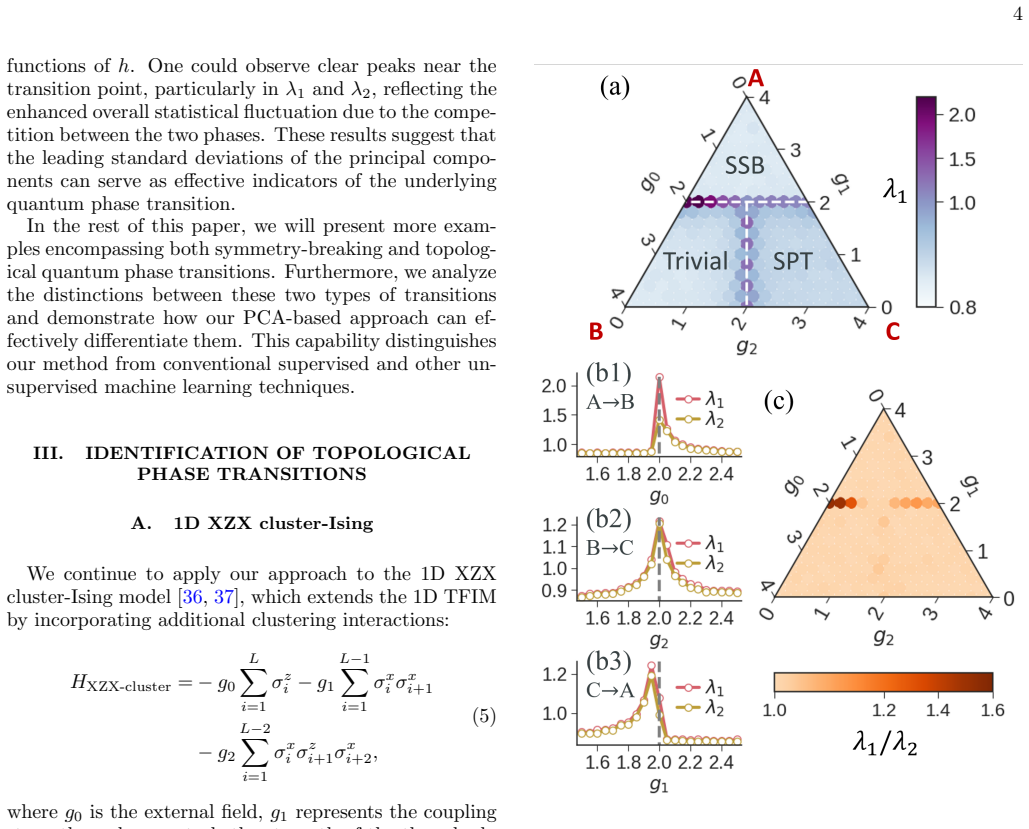
We provide a general machine learning methodology that integrates classical shadow representations with unsupervised principal component analysis (PCA) to explore various quantum phase transitions. By sampling spin configurations from random Pauli measurements, our approach can effectively analyze hidden statistical patterns in the data, thereby capturing the distinct signatures of quantum criticality through their fluctuations. We benchmark this approach across various spin-1/2 systems, including the 1D XZX cluster-Ising model, the 1D bond-alternating XXZ model, the 2D transverse-field Ising model, and the 2D Kitaev honeycomb model. We show that PCA not only reliably detects and distinguishes both symmetry-breaking and topological transitions, but also enables their qualitative classification based on characteristic fluctuation patterns. Our data-driven approach does not require any knowledge of the Hamiltonian or explicit order parameters, and can therefore be a general and applicable tool for probing new quantum phases.
Editorial analysis
A structured set of objections, weighed in public.
Referee Report
Summary. The manuscript proposes an unsupervised framework integrating classical shadow tomography with principal component analysis (PCA) to detect and classify quantum phase transitions. By sampling from random Pauli measurements and analyzing statistical fluctuations in the shadow data, the method claims to identify signatures of both symmetry-breaking and topological transitions across four benchmarked spin-1/2 models (1D XZX cluster-Ising, 1D bond-alternating XXZ, 2D transverse-field Ising, and 2D Kitaev honeycomb) without requiring Hamiltonian knowledge or explicit order parameters. The central result is that PCA reliably detects the transitions and enables qualitative classification via characteristic fluctuation patterns in the data.
Significance. If the central claims hold with added quantitative support, the work could provide a practical, model-agnostic tool for probing quantum criticality in systems lacking known order parameters. The use of classical shadows for efficient data acquisition combined with unsupervised PCA on multiple distinct models is a clear strength, offering a data-driven alternative to traditional diagnostics. The multi-model benchmarking demonstrates broad applicability within the tested class of systems.
major comments (2)
- [§4 (Benchmark Results)] The claim that PCA enables reliable qualitative classification of symmetry-breaking versus topological transitions (abstract and benchmarking results) rests on visual or descriptive identification of 'characteristic fluctuation patterns' in the leading principal components. No quantitative metric—such as inter-class distance between eigenvalue spectra, silhouette score for clustering, or cross-validation separability—is reported to establish that these patterns are distinct and reproducible rather than model-specific artifacts of the chosen Pauli sampling.
- [§3 (Methodology)] The unsupervised and model-independent nature of the classification is asserted, yet the interpretation of fluctuation patterns as diagnostic of transition type appears to rely on post-hoc comparison with the known physics of the four benchmark Hamiltonians. This leaves open whether the same signatures would emerge for an unseen model without prior labeling of the transition classes.
minor comments (2)
- Figure captions and axis labels in the PCA projection plots would benefit from explicit mention of the number of shadow snapshots and the variance explained by the displayed components to aid reproducibility.
- [Abstract] The abstract states 'reliable detection' but does not quantify success rates or false-positive rates across the models; adding a brief summary table of detection thresholds would improve clarity.
Simulated Author's Rebuttal
We thank the referee for the constructive comments on our manuscript. We address the major comments point by point below and have revised the manuscript accordingly to improve the quantitative support and clarify the unsupervised aspects.
read point-by-point responses
-
Referee: [§4 (Benchmark Results)] The claim that PCA enables reliable qualitative classification of symmetry-breaking versus topological transitions (abstract and benchmarking results) rests on visual or descriptive identification of 'characteristic fluctuation patterns' in the leading principal components. No quantitative metric—such as inter-class distance between eigenvalue spectra, silhouette score for clustering, or cross-validation separability—is reported to establish that these patterns are distinct and reproducible rather than model-specific artifacts of the chosen Pauli sampling.
Authors: We thank the referee for pointing this out. In the revised manuscript, we have incorporated quantitative metrics to support the classification. Specifically, we now report the silhouette scores for the clustering of the principal component fluctuations for symmetry-breaking and topological transitions across the models. Additionally, we include the inter-class distances in the space of the leading eigenvalues to demonstrate the separability of the patterns. These additions provide a more rigorous basis for the qualitative classification claim. revision: yes
-
Referee: [§3 (Methodology)] The unsupervised and model-independent nature of the classification is asserted, yet the interpretation of fluctuation patterns as diagnostic of transition type appears to rely on post-hoc comparison with the known physics of the four benchmark Hamiltonians. This leaves open whether the same signatures would emerge for an unseen model without prior labeling of the transition classes.
Authors: We clarify that the detection of phase transitions is entirely unsupervised and model-independent, as it relies solely on the statistical fluctuations in the shadow data without any Hamiltonian input. For the classification into symmetry-breaking or topological types, while we use the benchmark models to illustrate the distinct patterns, the patterns themselves (such as the specific structure in the principal components) are derived from the data. In the revision, we have added a section discussing how these patterns can be applied to new models by matching to the characteristic signatures observed in the benchmarks, without requiring prior knowledge of the new model's physics. We acknowledge that a complete validation on novel unseen models would benefit from additional numerical experiments, which we plan to pursue in future work. revision: partial
Circularity Check
No significant circularity; data-driven unsupervised PCA analysis is self-contained
full rationale
The paper presents a machine-learning methodology that applies PCA directly to classical shadow snapshots sampled from random Pauli measurements on spin systems. The detection of phase transitions and their qualitative classification into symmetry-breaking versus topological types emerges from post-hoc inspection of the leading principal components and fluctuation patterns in the data for four specific benchmark Hamiltonians. No equations or steps reduce a claimed prediction to a fitted parameter by construction, no self-definitional loops exist, and the central claims do not rest on load-bearing self-citations that presuppose the observed patterns. The method is explicitly model-independent and unsupervised, with benchmarks serving as empirical validation rather than circular input-output equivalence. The derivation chain is therefore independent of the target results.
Axiom & Free-Parameter Ledger
axioms (1)
- domain assumption Classical shadow representations from random Pauli measurements encode the necessary statistical fluctuations to reveal quantum criticality signatures.
Lean theorems connected to this paper
-
IndisputableMonolith/Foundation/AlexanderDuality.leanalexander_duality_circle_linking unclear?
unclearRelation between the paper passage and the cited Recognition theorem.
By sampling spin configurations from random Pauli measurements, our approach can effectively analyze hidden statistical patterns in the data, thereby capturing the distinct signatures of quantum criticality through their fluctuations... the ratio λ1/λ2 could be a useful signature for distinguishing symmetry-breaking and topological phase transitions
-
IndisputableMonolith/Foundation/ArithmeticFromLogic.leanembed_injective unclear?
unclearRelation between the paper passage and the cited Recognition theorem.
Our data-driven approach does not require any knowledge of the Hamiltonian or explicit order parameters
What do these tags mean?
- matches
- The paper's claim is directly supported by a theorem in the formal canon.
- supports
- The theorem supports part of the paper's argument, but the paper may add assumptions or extra steps.
- extends
- The paper goes beyond the formal theorem; the theorem is a base layer rather than the whole result.
- uses
- The paper appears to rely on the theorem as machinery.
- contradicts
- The paper's claim conflicts with a theorem or certificate in the canon.
- unclear
- Pith found a possible connection, but the passage is too broad, indirect, or ambiguous to say the theorem truly supports the claim.
Reference graph
Works this paper leans on
-
[1]
L. Savary and L. Balents, Quantum spin liquids: a re- view, Rep. Prog. Phys 80, 016502 (2016)
work page 2016
-
[2]
Y. Zhou, K. Kanoda, and T.-K. Ng, Quantum spin liquid states, Rev. Mod. Phys. 89, 025003 (2017)
work page 2017
-
[3]
B. A. Bernevig, Topological Insulators and Topological Superconductors (Princeton University Press, Princeton, 2013)
work page 2013
-
[4]
B. Vermersch, A. Elben, L. M. Sieberer, N. Y. Yao, and P. Zoller, Probing scrambling using statistical correla- tions between randomized measurements, Phys. Rev. X 9, 021061 (2019)
work page 2019
-
[5]
T. B. et al., Probing r´ enyi entanglement entropy via ran- domized measurements, Science 6, eaaz3666 (2020)
work page 2020
-
[6]
A. E. et al., Many-body topological invariants from ran- domized measurements in synthetic quantum matter, Sci. Adv. 6, eaaz3666 (2020)
work page 2020
-
[7]
S. Aaronson, Shadow tomography of quantum states, in Proceedings of the 50th annual ACM SIGACT sympo- sium on theory of computing (2018) pp. 325–338
work page 2018
- [8]
-
[9]
J. Carrasquilla and R. G. Melko, Machine learning phases of matter, Nat. Phys. 13, 431 (2017)
work page 2017
- [10]
-
[11]
C. Giannetti, B. Lucini, and D. Vadacchino, Machine learning as a universal tool for quantitative investigations of phase transitions, Nucl. Phys. B 944, 114639 (2019)
work page 2019
- [12]
-
[13]
E. P. L. van Nieuwenburg, Y.-H. Liu, and S. D. Huber, Learning phase transitions by confusion, Nat. Phys. 13, 435 (2017)
work page 2017
- [14]
-
[15]
B. S. Rem, N. K¨ aming, M. Tarnowski, L. Asteria, N. Fl¨ aschner, C. Becker, K. Sengstock, and C. Weiten- berg, Identifying quantum phase transitions using arti- ficial neural networks on experimental data, Nat. Phys. 15, 917 (2019)
work page 2019
-
[16]
X.-Y. Dong, F. Pollmann, and X.-F. Zhang, Machine learning of quantum phase transitions, Phys. Rev. B 99, 121104(R) (2019)
work page 2019
-
[17]
Wang, Discovering phase transitions with unsuper- vised learning, Phys
L. Wang, Discovering phase transitions with unsuper- vised learning, Phys. Rev. B 94, 195105 (2016)
work page 2016
-
[18]
S. J. Wetzel, Unsupervised learning of phase transitions: From principal component analysis to variational autoen- coders, Phys. Rev. E 96, 022140 (2017)
work page 2017
- [19]
- [20]
-
[21]
F. Sch¨ afer and N. L¨ orch, Vector field divergence of pre- dictive model output as indication of phase transitions, Phys. Rev. E 99, 062107 (2019)
work page 2019
-
[22]
A. Canabarro, F. F. Fanchini, A. L. Malvezzi, R. Pereira, and R. Chaves, Unveiling phase transitions with machine learning, Phys. Rev. B 100, 045129 (2019)
work page 2019
-
[23]
J. F. Rodriguez-Nieva and M. S. Scheurer, Identifying topological order through unsupervised machine learn- ing, Nat. Phys. 15, 790–795 (2019)
work page 2019
-
[24]
N. Walker, K.-M. Tam, and M. Jarrell, Deep learning on the 2-dimensional ising model to extract the crossover region with a variational autoencoder, Sci Rep 10, 13047 (2020)
work page 2020
-
[25]
M. S. Scheurer and R.-J. Slager, Unsupervised machine learning and band topology, Phys. Rev. Lett.124, 226401 (2020)
work page 2020
-
[26]
J. Wang, W. Zhang, T. Hua, and T.-C. Wei, Unsuper- vised learning of topological phase transitions using the calinski-harabaz index, Phys. Rev. Res.3, 013074 (2021)
work page 2021
-
[27]
T. Mendes-Santos, A. Angelone, A. Rodriguez, R. Fazio, and M. Dalmonte, Intrinsic dimension of path integrals: Data-mining quantum criticality and emergent simplic- ity, PRX Quantum 2, 030332 (2021)
work page 2021
-
[28]
N. K¨ aming, A. Dawid, K. Kottmann, M. Lewenstein, K. Sengstock, A. Dauphin, and C. Weitenberg, Unsuper- vised machine learning of topological phase transitions from experimental data, Mach. Learn.: Sci. Technol. 2, 035037 (2021)
work page 2021
-
[29]
A. Tirelli, D. O. Carvalho, L. A. Oliveira, J. P. de Lima, N. C. Costa, and R. R. dos Santos, Unsupervised ma- chine learning approaches to the q-state potts model, Eur. Phys. J. B 95, 013306 (2022)
work page 2022
-
[30]
K.-K. Ng and M.-F. Yang, Unsupervised learning of phase transitions via modified anomaly detection with autoencoders, Phys. Rev. B 108, 214428 (2023)
work page 2023
-
[31]
N. Sadoune, G. Giudici, K. Liu, and L. Pollet, Unsuper- vised interpretable learning of phases from many-qubit systems, Phys. Rev. Res. 5, 013082 (2023)
work page 2023
-
[32]
T. Mendes-Santos, X. Turkeshi, M. Dalmonte, and A. Ro- driguez, Unsupervised learning universal critical behav- ior via the intrinsic dimension, Phys. Rev. X 11, 011040 (2021)
work page 2021
-
[33]
C.-T. Ho and D.-W. Wang, Robust identification of topo- logical phase transition by self-supervised machine learn- ing approach, New J. Phys. 23, 083021 (2021)
work page 2021
-
[34]
C.-T. Ho and D.-W. Wang, Self-supervised ensemble learning: A universal method for phase transition classi- fication of many-body systems, Phys. Rev. Res.5, 043090 (2023)
work page 2023
-
[35]
K. P. F.R.S., Liii. on lines and planes of closest fit to systems of points in space, The London, Edinburgh, and Dublin Philosophical Magazine and Journal of Science 2, 559 (1901)
work page 1901
-
[36]
N. Tantivasadakarn, R. Thorngren, A. Vishwanath, and R. Verresen, Pivot hamiltonians as generators of symme- try and entanglement, Sci. Rep. 14, 012 (2023)
work page 2023
-
[37]
W. Choi, M. Knap, and F. Pollmann, Finite- temperature entanglement negativity of fermionic symmetry-protected topological phases and quantum critical points in one dimension, Phys. Rev. B 109, 115132 (2024)
work page 2024
-
[38]
T. Yu-Chin, D. Li, C. Ming-Chiang, L. Amico, and L.-C. Kwek, Entanglement convertibility by sweeping through the quantum phases of the alternating bonds xxz chain, Sci. Rep. 14, 012 (2023)
work page 2023
-
[39]
Kitaev, Anyons in an exactly solved model and be- yond, Ann
A. Kitaev, Anyons in an exactly solved model and be- yond, Ann. Phys 321, 2 (2006)
work page 2006
-
[40]
Sachdev, Quantum phase transitions, Physics world 12, 33 (1999)
S. Sachdev, Quantum phase transitions, Physics world 12, 33 (1999)
work page 1999
-
[41]
Giamarchi, Quantum physics in one dimension , Vol
T. Giamarchi, Quantum physics in one dimension , Vol. 121 (Clarendon press, 2003)
work page 2003
-
[42]
W. P. Su, J. R. Schrieffer, and A. J. Heeger, Solitons in polyacetylene, Phys. Rev. Lett. 42, 1698 (1979)
work page 1979
-
[43]
Z. Friedman, Ising model with a transverse field in two dimensions: Phase diagram and critical properties from a real-space renormalization group, Phys. Rev. B 17, 1429 (1978)
work page 1978
-
[44]
M. Fishman, S. R. White, and E. M. Stoudenmire, The itensor software library for tensor network calculations, SciPost Phys. Codebases , 4 (2022)
work page 2022
-
[45]
M. Fishman, S. R. White, and E. M. Stoudenmire, Code- base release 0.3 for itensor, SciPost Phys. Codebases , 4 (2022)
work page 2022
discussion (0)
Sign in with ORCID, Apple, or X to comment. Anyone can read and Pith papers without signing in.