Entanglement dynamics of monitored noninteracting fermions on graphics processing units
Pith reviewed 2026-05-18 20:46 UTC · model grok-4.3
The pith
Large-scale GPU simulations confirm no measurement-induced phase transition in one-dimensional monitored fermions until lattices reach order 10000 sites, while revealing one in two dimensions at finite monitoring rate.
A machine-rendered reading of the paper's core claim, the machinery that carries it, and where it could break.
Core claim
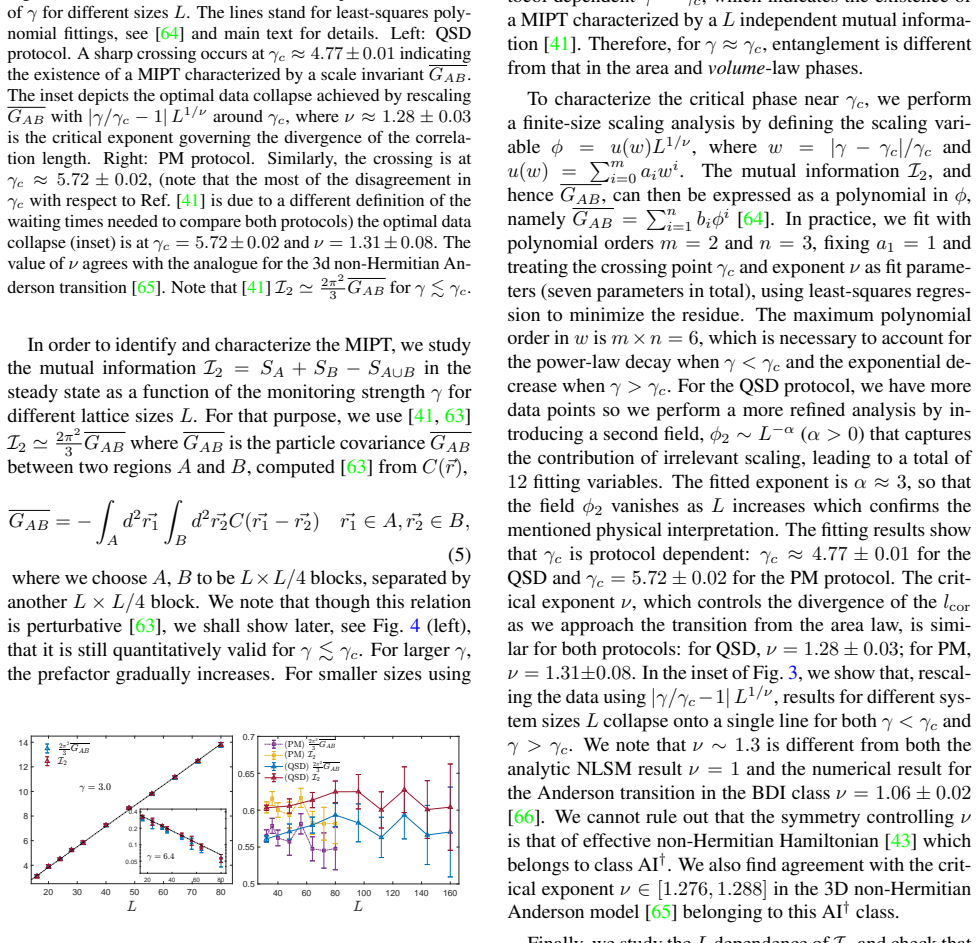
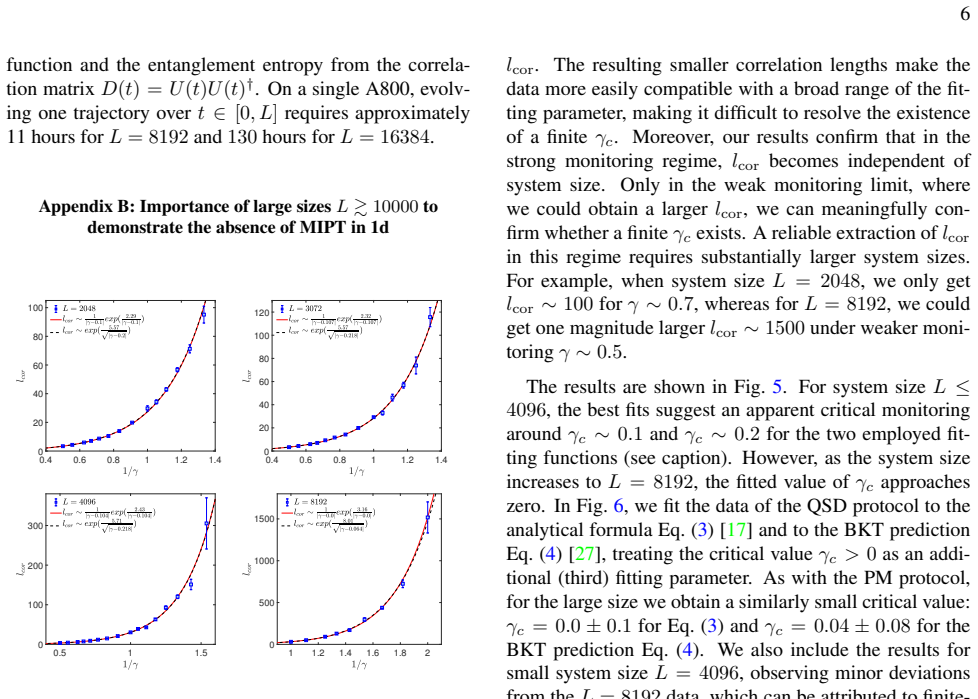
In one dimension, the absence of a measurement-induced phase transition for both projective and homodyne measurements requires reaching lattice sizes of order 10000 as predicted by the nonlinear sigma model. In two dimensions, a measurement-induced phase transition occurs at finite monitoring rate with scale-invariant mutual information and critical exponent nu approximately 1.3, but the critical monitoring strength is protocol-dependent and not correctly predicted by the nonlinear sigma model.
What carries the argument
GPU-accelerated exact simulation of monitored noninteracting fermion wavefunctions on large lattices, which resolves finite-size effects in the entanglement entropy and mutual information to test the nonlinear sigma model predictions for the thermodynamic limit.
If this is right
- In one dimension, studies limited to smaller lattices can produce misleading signatures of a measurement-induced phase transition that disappear at larger sizes.
- In two dimensions, the location of the transition shifts with the choice of projective versus homodyne monitoring, while the critical exponent remains similar.
- Mutual information provides a scale-invariant diagnostic that locates the two-dimensional transition.
- The nonlinear sigma model correctly forecasts the required system size in one dimension and the existence of a transition in two dimensions but fails to predict the protocol dependence of the critical monitoring strength.
- Quantitative characterization of entanglement dynamics in monitored systems demands system sizes where finite-size corrections are demonstrably under control.
Where Pith is reading between the lines
- Extending the same GPU approach to weakly interacting fermions would test whether interactions change the observed one- and two-dimensional phase structure.
- The protocol dependence of the two-dimensional critical point may inform which measurement schemes are easiest to realize experimentally.
- The results suggest that refinements to the nonlinear sigma model are needed to capture the precise value of the critical monitoring strength in two dimensions.
- Similar large-scale numerics could clarify the fate of measurement-induced transitions in other symmetry classes or in the presence of disorder.
Load-bearing premise
Lattice sizes of 16384 sites in one dimension and 160 by 160 in two dimensions, reached through the GPU implementation, are large enough to determine the true thermodynamic-limit behavior of the entanglement dynamics without being dominated by finite-size effects or numerical artifacts.
What would settle it
An independent simulation on lattices substantially larger than 16384 in one dimension that continues to display apparent measurement-induced phase transition signatures, or a 2D calculation that yields a critical exponent clearly different from 1.3.
Figures



read the original abstract
The description of the entanglement dynamics of monitored noninteracting fermions, including the existence of measurement-induced phase transitions (MIPTs), is a challenging problem with conflicting results in the literature. The mapping of the problem onto a non-linear sigma model (NLSM) indicates that relatively large lattice sizes are required to determine the nature of the entanglement entropy (EE) in the thermodynamics limit. Here we address this problem numerically for monitored noninteracting fermions with $U(1)$ symmetry. The use of graphics processing unit (GPU) techniques, even with outdated hardware, makes it possible to reach much larger lattice sizes ($L = 16384$ and $160\times160$ in one (1d) and two (2d) dimensions respectively) than in previous studies which enables us to characterize quantitatively the entanglement dynamics. In 1d, we show that in order to confirm the absence of a MIPT, for both projective and homodyne measurements, predicted by the NLSM it is necessary to reach $L \sim 10000$. In 2d, also as predicted by the NLSM, we observe for both protocols a MIPT at finite monitoring rate characterized by a scale invariant mutual information. The critical monitoring strength depends on the protocol while the critical exponent $\nu \approx 1.3$ governing the approach to the MIPT is similar in both cases. These features are not correctly predicted by the NLSM. Our results paves the way for a fully quantitative description of the entanglement dynamics of monitoring quantum systems.
Editorial analysis
A structured set of objections, weighed in public.
Referee Report
Summary. The manuscript presents large-scale GPU simulations of the entanglement dynamics of monitored noninteracting fermions with U(1) symmetry. It claims that in 1D, the absence of a measurement-induced phase transition (MIPT) for both projective and homodyne measurements requires reaching L ∼ 10000 to confirm the NLSM prediction of no transition in the thermodynamic limit. In 2D, a MIPT is observed at finite monitoring rate for both protocols, characterized by scale-invariant mutual information, with critical exponent ν ≈ 1.3 (protocol-independent) but critical monitoring strength that is protocol-dependent and not correctly predicted by the NLSM. The GPU approach enables lattice sizes up to L = 16384 (1D) and 160 × 160 (2D).
Significance. If the numerical results hold, the work provides important confirmation of NLSM predictions in 1D at the required large scales and identifies clear discrepancies in 2D regarding the location of the critical point. The technical achievement of GPU-accelerated evolution of the single-particle correlation matrix under stochastic measurements is a strength, as is the direct benchmarking against the NLSM and the extraction of a critical exponent. These results help resolve literature conflicts and support quantitative studies of monitored quantum systems.
major comments (2)
- Numerical methods section: the GPU implementation of the stochastic projective/homodyne updates to the correlation matrix and subsequent SVD for entanglement entropy lacks any reported checks for numerical stability (e.g., preservation of positive-semidefiniteness, accumulation of round-off error, or direct CPU cross-validation at moderate L). This is load-bearing for the central claim that saturation of EE at L = 16384 reflects the true thermodynamic behavior rather than an artifact, especially given the NLSM requirement of L ∼ 10000.
- 2D results and scaling analysis: the reported ν ≈ 1.3 and the claim of a finite critical monitoring rate rest on finite-size data up to 160 × 160; the manuscript must specify the fitting procedure, the range of sizes used for data collapse, the number of trajectories, and error bars on the extracted exponent and critical point. Without these, it is unclear whether strong finite-size corrections have been controlled.
minor comments (2)
- Abstract: the final sentence ('Our results paves the way...') contains a grammatical error ('paves' should be 'pave').
- Figure captions and text: ensure all panels explicitly label the measurement protocol (projective vs. homodyne) and the observable (EE vs. mutual information) to avoid ambiguity when comparing 1D and 2D data.
Simulated Author's Rebuttal
We thank the referee for the careful reading of our manuscript and for the constructive comments that help strengthen the presentation of our numerical results. We address each major comment below and will incorporate revisions to improve the documentation of numerical stability and scaling details.
read point-by-point responses
-
Referee: Numerical methods section: the GPU implementation of the stochastic projective/homodyne updates to the correlation matrix and subsequent SVD for entanglement entropy lacks any reported checks for numerical stability (e.g., preservation of positive-semidefiniteness, accumulation of round-off error, or direct CPU cross-validation at moderate L). This is load-bearing for the central claim that saturation of EE at L = 16384 reflects the true thermodynamic behavior rather than an artifact, especially given the NLSM requirement of L ∼ 10000.
Authors: We appreciate the referee pointing out the importance of explicit numerical validation. The original manuscript describes the GPU implementation but does not report dedicated stability tests. In the revised version we will add a new subsection to the Numerical Methods section that includes: (i) explicit verification that the correlation matrix eigenvalues remain in [0,1] after each stochastic update, (ii) monitoring of round-off accumulation by comparing single- and double-precision runs, and (iii) direct CPU-GPU cross-validation on systems up to L=256 showing agreement within statistical fluctuations. These checks support that the observed saturation at L=16384 is not an artifact. revision: yes
-
Referee: 2D results and scaling analysis: the reported ν ≈ 1.3 and the claim of a finite critical monitoring rate rest on finite-size data up to 160 × 160; the manuscript must specify the fitting procedure, the range of sizes used for data collapse, the number of trajectories, and error bars on the extracted exponent and critical point. Without these, it is unclear whether strong finite-size corrections have been controlled.
Authors: We agree that additional specification of the scaling procedure is needed. In the revised manuscript we will expand the 2D Results section to detail: the scaling form employed for mutual-information data collapse, the system sizes used (L=20 to L=160), the number of trajectories (200 for L≤80 and 50 for L=160), and the error analysis via bootstrap resampling that yields ν≈1.3 with uncertainties and the protocol-dependent critical monitoring rate. This will make the control of finite-size corrections transparent. revision: yes
Circularity Check
Numerical simulations directly benchmark NLSM predictions with no self-referential reductions
full rationale
The paper's central results follow from direct large-scale GPU simulations of the single-particle correlation matrix under stochastic projective and homodyne monitoring updates, reaching L=16384 in 1D and 160x160 in 2D. These sizes allow observation of saturation or scale-invariant mutual information, which are reported as confirming or partially differing from the pre-existing NLSM predictions in the literature. No equations or claims reduce by construction to fitted inputs, self-citations, or ansatzes internal to the present work; the numerical protocol is independent of the target thermodynamic-limit conclusions and does not rename or smuggle prior results as new derivations.
Axiom & Free-Parameter Ledger
free parameters (1)
- critical monitoring strength
axioms (1)
- domain assumption The nonlinear sigma model mapping accurately captures the long-wavelength entanglement dynamics of monitored noninteracting fermions.
Forward citations
Cited by 2 Pith papers
-
Absence of measurement- and unraveling-induced entanglement transitions in continuously monitored one-dimensional free fermions
Replica Keldysh analysis shows monitored 1D free fermions exhibit area-law entanglement beyond an exponentially large scale ln(l_φ,*) ~ J/[γ cos(φ)], with no genuine measurement- or unraveling-induced entanglement tra...
-
Quantum dynamics of monitored free fermions: Evolution of quantum correlations and scaling at measurement-induced phase transition
Monitored free fermions are mapped to a nonlinear sigma model whose finite-time evolution and quasi-1D long-time scaling are used to locate the measurement-induced transition and extract the correlation-length exponen...
Reference graph
Works this paper leans on
-
[1]
Y . Li, X. Chen, and M. P. A. Fisher, Quantum Zeno effect and the many-body entanglement transition, Phys. Rev. B 98, 205136 (2018)
work page 2018
-
[2]
B. Skinner, J. Ruhman, and A. Nahum, Measurement- induced phase transitions in the dynamics of entanglement, Phys. Rev. X9, 031009 (2019)
work page 2019
- [3]
-
[4]
M. Ippoliti, M. J. Gullans, S. Gopalakrishnan, D. A. Huse, and V . Khemani, Entanglement phase transitions in measurement-only dynamics, Phys. Rev. X11, 011030 (2021)
work page 2021
-
[5]
Y . Li, X. Chen, and M. P. A. Fisher, Measurement-driven entanglement transition in hybrid quantum circuits, Phys. Rev. B100, 134306 (2019)
work page 2019
-
[6]
C. Carisch, A. Romito, and O. Zilberberg, Quantifying measurement-induced quantum-to-classical crossover using an open-system entanglement measure, Phys. Rev. Res.5, L042031 (2023)
work page 2023
-
[7]
M. Szyniszewski, A. Romito, and H. Schomerus, Entangle- ment transition from variable-strength weak measurements, Phys. Rev. B100, 064204 (2019)
work page 2019
-
[8]
M. Szyniszewski, A. Romito, and H. Schomerus, Universal- ity of entanglement transitions from stroboscopic to contin- uous measurements, Phys. Rev. Lett.125, 210602 (2020)
work page 2020
-
[9]
X. Turkeshi, R. Fazio, and M. Dalmonte, Measurement- induced criticality in(2 + 1)-dimensional hybrid quantum circuits, Phys. Rev. B102, 014315 (2020)
work page 2020
-
[10]
X. Turkeshi, A. Biella, R. Fazio, M. Dalmonte, and M. Schir `o, Measurement-induced entanglement transitions in the quantum Ising chain: From infinite to zero clicks, Phys. Rev. B103, 224210 (2021)
work page 2021
-
[11]
X. Turkeshi, M. Dalmonte, R. Fazio, and M. Schir `o, En- tanglement transitions from stochastic resetting of non- Hermitian quasiparticles, Phys. Rev. B105, L241114 (2022)
work page 2022
-
[12]
Y . L. Gal, X. Turkeshi, and M. Schir`o, V olume-to-area law entanglement transition in a non-Hermitian free fermionic chain, SciPost Phys.14, 138 (2023)
work page 2023
- [13]
-
[14]
E. Starchl, M. H. Fischer, and L. M. Sieberer, Generalized zeno effect and entanglement dynamics induced by fermion counting, PRX Quantum6, 030302 (2025)
work page 2025
-
[15]
C. Noel, P. Niroula, D. Zhu, A. Risinger, L. Egan, D. Biswas, M. Cetina, A. V . Gorshkov, M. J. Gullans, D. A. Huse, and C. Monroe, Measurement-induced quan- tum phases realized in a trapped-ion quantum computer, Nat. Phys.18, 760 (2022)
work page 2022
-
[16]
J. M. Koh, S.-N. Sun, M. Motta, and A. J. Minnich, Measurement-induced entanglement phase transition on a superconducting quantum processor with mid-circuit read- out, Nat. Phys.19, 1314 (2023)
work page 2023
-
[17]
I. Poboiko, P. P ¨opperl, I. V . Gornyi, and A. D. Mirlin, Theory of free fermions under random projective measure- ments, Phys. Rev. X13, 041046 (2023)
work page 2023
-
[18]
M. Fava, L. Piroli, D. Bernard, and A. Nahum, Monitored fermions with conservedu(1)charge, Phys. Rev. Res.6, 043246 (2024)
work page 2024
-
[19]
F. Wegner, The mobility edge problem: continuous symme- try and a conjecture, Zeitschrift f¨ur Physik B35, 207 (1979)
work page 1979
-
[20]
D. K. K.B. Efetov, A.I. Larkin, Interaction of diffusion modes in the theory of localization, Sov. Phys. JETP52, 568 (1980)
work page 1980
-
[21]
M. Fava, L. Piroli, T. Swann, D. Bernard, and A. Nahum, Nonlinear sigma models for monitored dynamics of free fermions, Phys. Rev. X13, 041045 (2023)
work page 2023
-
[22]
H. M. Wiseman and G. J. Milburn, Quantum theory of op- tical feedback via homodyne detection, Phys. Rev. Lett.70, 548 (1993)
work page 1993
-
[23]
M. Collett, R. Loudon, and C. G. and, Quantum theory of optical homodyne and heterodyne detection, Journal of Modern Optics34, 881 (1987)
work page 1987
-
[24]
H. M. Wiseman and G. J. Milburn,Quantum Measurement and Control(Cambridge University Press, 2014)
work page 2014
-
[25]
M. Fuwa, S. Takeda, M. Zwierz, H. M. Wiseman, and A. Fu- rusawa, Experimental proof of nonlocal wavefunction col- lapse for a single particle using homodyne measurements, Nature Communications6, 10.1038/ncomms7665 (2015)
-
[26]
X. Cao, A. Tilloy, and A. De Luca, Entanglement in a fermion chain under continuous monitoring, SciPost Phys. 7, 024 (2019)
work page 2019
-
[27]
O. Alberton, M. Buchhold, and S. Diehl, Entanglement tran- sition in a monitored free-fermion chain: From extended criticality to area law, Phys. Rev. Lett.126, 170602 (2021)
work page 2021
-
[28]
B. Ladewig, S. Diehl, and M. Buchhold, Monitored open fermion dynamics: Exploring the interplay of measurement, decoherence, and free Hamiltonian evolution, Phys. Rev. Research4, 033001 (2022)
work page 2022
-
[29]
P. W. Anderson, Absence of diffusion in certain random lat- tices, Phys. Rev.109, 1492 (1958)
work page 1958
-
[30]
E. Abrahams, P. W. Anderson, D. C. Licciardello, and T. V . Ramakrishnan, Scaling theory of localization: Absence of quantum diffusion in two dimensions, Phys. Rev. Lett.42, 673 (1979)
work page 1979
- [31]
-
[32]
J. Dalibard, Y . Castin, and K. Mølmer, Wave-function ap- proach to dissipative processes in quantum optics, Phys. Rev. Lett.68, 580 (1992)
work page 1992
-
[33]
R. Dum, P. Zoller, and H. Ritsch, Monte carlo simulation of the atomic master equation for spontaneous emission, Phys. Rev. A45, 4879 (1992)
work page 1992
-
[34]
A. J. Daley, Quantum trajectories and open many-body quantum systems, Advances in Physics63, 77 (2014)
work page 2014
-
[35]
M. Buchhold, Y . Minoguchi, A. Altland, and S. Diehl, Ef- fective theory for the measurement-induced phase transition of Dirac fermions, Phys. Rev. X11, 041004 (2021)
work page 2021
-
[36]
W. Nagourney, J. Sandberg, and H. Dehmelt, Shelved op- tical electron amplifier: Observation of quantum jumps, Phys. Rev. Lett.56, 2797 (1986)
work page 1986
- [37]
-
[38]
S. Gleyzes, S. Kuhr, C. Guerlin, J. Bernu, S. Del ´eglise, U. Busk Hoff, M. Brune, J.-M. Raimond, and S. Haroche, Quantum jumps of light recording the birth and death of a photon in a cavity, Nature446, 297–300 (2007)
work page 2007
- [39]
-
[40]
M. B. Plenio and P. L. Knight, The quantum-jump approach to dissipative dynamics in quantum optics, Rev. Mod. Phys. 8 70, 101 (1998)
work page 1998
-
[41]
I. Poboiko, I. V . Gornyi, and A. D. Mirlin, Measurement- induced phase transition for free fermions above one dimen- sion, Phys. Rev. Lett.132, 110403 (2024)
work page 2024
-
[42]
K. Chahine and M. Buchhold, Entanglement phases, local- ization, and multifractality of monitored free fermions in two dimensions, Phys. Rev. B110, 054313 (2024)
work page 2024
-
[43]
Z. Xiao and K. Kawabata, Topology of monitored quantum dynamics (2025), arXiv:2412.06133 [cond-mat.stat-mech]
- [44]
-
[45]
C.-M. Jian, B. Bauer, A. Keselman, and A. W. W. Ludwig, Criticality and entanglement in nonunitary quantum circuits and tensor networks of noninteracting fermions, Phys. Rev. B106, 134206 (2022)
work page 2022
-
[46]
G. Passarelli, X. Turkeshi, A. Russomanno, P. Lucignano, M. Schir`o, and R. Fazio, Many-body dynamics in monitored atomic gases without postselection barrier, Phys. Rev. Lett. 132, 163401 (2024)
work page 2024
-
[47]
I. Poboiko, P. P ¨opperl, I. V . Gornyi, and A. D. Mirlin, Measurement-induced transitions for interacting fermions, Phys. Rev. B111, 024204 (2025)
work page 2025
- [48]
- [49]
-
[50]
T. M ¨uller, M. Buchhold, and S. Diehl, Monitored interacting dirac fermions, Phys. Rev. B111, 174201 (2025)
work page 2025
- [51]
- [52]
-
[53]
Iadanza, Physical Review B102, 10.1103/Phys- RevB.102.245404 (2020)
T. Muller, S. Diehl, and M. Buchhold, Measurement- induced dark state phase transitions in long-ranged fermion systems, Physical Review Letters128, 10.1103/phys- revlett.128.010605 (2022)
-
[54]
Y . Fuji and Y . Ashida, Measurement-induced quantum criti- cality under continuous monitoring, Physical Review B102, 054302 (2020)
work page 2020
-
[55]
M. Szyniszewski, O. Lunt, and A. Pal, Disordered moni- tored free fermions, Phys. Rev. B108, 165126 (2023)
work page 2023
-
[56]
P. P ¨opperl, I. V . Gornyi, D. B. Saakian, and O. M. Yev- tushenko, Localization, fractality, and ergodicity in a moni- tored qubit, Phys. Rev. Res.6, 013313 (2024)
work page 2024
-
[57]
I. Poboiko, I. V . Gornyi, and A. D. Mirlin, Mesoscopic fluctuations and multifractality at and across measurement- induced phase transition (2025), arXiv:2507.11312 [quant- ph]
-
[58]
A. MacKinnon and B. Kramer, The scaling theory of elec- trons in disordered solids: Additional numerical results, Zeitschrift fur Physik B Condensed Matter53, 1 (1983)
work page 1983
- [59]
-
[60]
M. Schreiber and H. Grussbach, Multifractal wave functions at the anderson transition, Phys. Rev. Lett.67, 607 (1991)
work page 1991
-
[61]
A. M. Garc ´ıa-Garc´ıa and E. Cuevas, Dimensional depen- dence of the metal-insulator transition, Phys. Rev. B75, 174203 (2007)
work page 2007
-
[62]
A. Rodriguez, L. J. Vasquez, K. Slevin, and R. A. R ¨omer, Multifractal finite-size scaling and universality at the ander- son transition, Phys. Rev. B84, 134209 (2011)
work page 2011
-
[63]
I. Klich and L. Levitov, Quantum noise as an entanglement meter, Phys. Rev. Lett.102, 100502 (2009)
work page 2009
-
[64]
K. Slevin and T. Ohtsuki, Critical exponent for the anderson transition in the three-dimensional orthogonal universality class, New Journal of Physics16, 015012 (2014)
work page 2014
-
[65]
X. Luo, T. Ohtsuki, and R. Shindou, Transfer matrix study of the anderson transition in non-hermitian systems, Phys. Rev. B104, 104203 (2021)
work page 2021
-
[66]
T. Wang, T. Ohtsuki, and R. Shindou, Universality classes of the anderson transition in the three-dimensional symmetry classes AIII, BDI, C, D, and CI, Physical Review B104, 014206 (2021)
work page 2021
discussion (0)
Sign in with ORCID, Apple, or X to comment. Anyone can read and Pith papers without signing in.