REVIEW 5 major objections 4 minor 6 cited by
Bistatic Target Detection by Exploiting Both Deterministic Pilots and Unknown Random Data Payloads
T0 review · 5 major / 4 minor · reviewed 2026-08-05 · deepseek-v4-flash
Pith's one-line read The paper derives a GLRT detector that exploits both known pilots and the statistical structure of unknown random data payloads in bistatic ISAC, giving closed-form false alarm and detection probabilities that simulations show stay accurate
desk verdict New hybrid-signal GLRT with closed-form FAP/DP, but the H1 covariance model silently drops target–clutter cross terms; worth refereeing if that approximation gets justified. read the letter →
The pith
A machine-rendered reading of the paper's core claim, the machinery that carries it, and where it could break.
The reading
What carries the argument
The central object is the asymptotic test statistic under H0 and H1, obtained by approximating the ML amplitude estimate Q† by 1/(L^{-1}|bar λp|^2 bar β), then taking first-order Taylor expansions of g(Γ) = (ρd+ρp)Γ/(1+ρdΓ) and h(Γ)=log(1+ρdΓ) around the mean of Γ=|γ|^2. This turns the GLRT statistic into a linear function of a Gamma (H0) or noncentral chi-square (H1) variable, so FAP and DP follow from exponential and Marcum-Q tails. The machinery is the statistical concentration of the projected data ||µ||^2/β and Γ around their means, established in Lemmas 2–5.
What would settle it
Run Monte Carlo simulations of the exact received model (7) with the target echo and clutter echo driven by the same random data matrix Sd, over a range of clutter CNR values, and compare empirical threshold-FAP and ROC curves to (41) and (56); a growing mismatch with increasing clutter CNR would refute the covariance approximation on which the closed forms rest.
Extended reading notes
Core claim
On the paper's own terms, the central claim is that target detection in a bistatic ISAC system should not treat the data payload as nuisance or require backhauling the transmitted symbols. Under the model (7)–(10), the unknown target amplitude α causes a coupled change in mean and covariance: deterministic pilots produce the mean shift through λp and random payloads produce a rank-one covariance increase through |λd|^2. The GLRT replaces α by the cubic-equation maximum-likelihood estimate Q†γ, and in the large-L regime the test statistic collapses to a linear function of the Gamma-distributed squared statistic |γ|^2. That reduction yields closed-form FAP (41) and DP (56), with DP a Marcum-Q
Load-bearing premise
The load-bearing premise is that under target present, the received signal is modeled as Gaussian with a covariance that simply adds a target term to the clutter-plus-noise covariance, leaving out the cross-terms between the target echo and the clutter echo; all the closed-form results stand or fall on that approximation.
Editorial extensions
If this is right
- Setting the detection threshold via (45) achieves a fixed FAP using only the deterministic-to-random power ratio and frame length L, with no data-symbol knowledge at the sensing receiver.
- Pilot-only processing is a strict performance benchmark: it gives the lowest possible FAP and an upper bound on DP, so the gain from data-payload exploitation shows up as a gap against these bounds at small L.
- The random payload power has two opposing effects—raising effective target energy and raising statistical uncertainty—so for fixed total power and a required FAP, the ratio |bar λd|^2/|bar λp|^2 and L can be tuned to trade communication rate against sensing reliability.
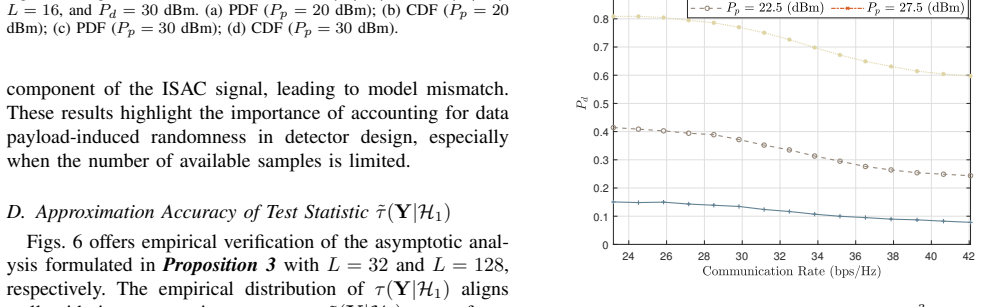
- The closed forms remain accurate at short frame lengths in the simulations (distribution match at L=16 and FAP match around L=4), so performance prediction does not require asymptotically long blocks.
- Because the detector uses only the statistical characteristics of the random component, it can be applied in collaborative sensing without a dedicated backhaul link for forwarding transmitted data symbols.
Reading between the lines
- A direct extension is to replace the Gaussian data model with finite-alphabet constellations such as QAM or PSK; the Gamma and noncentral-chi-square statistics would change, but the same GLRT template and threshold formula should carry over, with correction terms appearing in the closed forms.
- The covariance approximation in (9)–(10) omits cross-terms between the target echo and clutter that share the same data symbols; a Monte Carlo check at high clutter CNR would show whether the closed forms are conservative or optimistic and where the large-L regime begins.
- The threshold-setting formula suggests an online resource allocator: choose Lp, Ld, and the precoders to satisfy a sensing FAP budget while maximizing communication rate, using (45) as the constraint.
- Because the detector does not need the data symbols, it can run before decoding in the same ISAC frame, enabling early target alerts or sensing-aided scheduling with lower latency than backhaul-based forwarding; this latency benefit is not discussed in the paper.
Editorial analysis
A structured set of objections, weighed in public.
Referee Report
Summary. The paper considers a bistatic ISAC setup in which the transmit waveform is a superposition of known deterministic pilots and unknown random data payloads. The received signal is modeled under a binary hypothesis test: H0 (clutter plus noise) versus H1 (target echo plus clutter plus noise). The authors derive a GLRT detector in which the unknown complex target amplitude is estimated by maximizing the likelihood; the optimizer is expressed through the solution of a cubic equation (Lemma 1). Because exact performance analysis is intractable, the paper studies the asymptotic regime L→∞ and provides closed-form approximations for the false alarm probability (Corollary 1, Eq. (41)) and detection probability (Corollary 3, Eq. (56)), together with a closed-form threshold for a target FAP (Corollary 2, Eq. (45)). Simulations are presented to show that the asymptotic formulas are accurate even for small L and that the proposed detector outperforms a pilot-only detector. The central conceptual claim is that both the deterministic and random signal components contribute to detection, but the random component also introduces statistical uncertainty that can degrade performance.
Significance. If the modeling issue identified below is resolved, the paper would make a useful contribution to ISAC detection: it targets a realistic hybrid waveform with known pilots and unknown random data, derives a GLRT with no fitted constants, and provides closed-form FAP/DP expressions from which thresholds can be set directly. The paper also supplies a clean comparison benchmark (pilot-only detector) and a clear physical trade-off between exploiting random payload energy and the added statistical uncertainty. These are tangible strengths. However, the current derivation relies on an unstated Gaussian approximation that drops target–clutter cross terms; until that gap is closed or explicitly assumed, the closed-form performance predictions cannot be taken as characterizing the stated system model in Eq. (7).
major comments (5)
- [Sec. V, simulation setup] The Gaussian model under H1 is not the exact covariance model implied by Eq. (7). From Y = (α a_t b_t^H + H_e)X + N and X_d = F_d S_d with S_d having i.i.d. CN(0,1) entries, the exact covariance of the random part under H1 is L_d (α a_t b_t^H + H_e)F_d F_d^H (α a_t b_t^H + H_e)^H + Lσ²I. Expanding gives L_d[|α|²|λ_d|² a_t a_t^H + α a_t b_t^H F_d F_d^H H_e^H + α* H_e F_d F_d^H b_t a_t^H + H_e F_d F_d^H H_e^H] + Lσ²I. Eq. (10) retains only the first and last terms, silently dropping the two cross terms. No justification is given (e.g., approximate orthogonality b_t^H F_d F_d^H H_e^H ≈ 0), and Remark 4 assumes large clutter CNR, precisely the regime in which H_e is large and the dropped terms can dominate. Since the GLRT (25)–(26), Propositions 2–3, and Corollaries 1–3 all depend on this covariance, the derived FAP/DP formulas characterize the approximate model, not necessarily the model in
- [Appendix A, Eq. (62)] The simulation section does not state whether the received data are generated from the exact model (7) or from the approximate Gaussian model (8)–(10). This is load-bearing: if the data are generated from (7), the empirical distributions in Figs. 4–7 test the detector under a model different from the one used for derivation; if generated from (8)–(10), the agreement between empirical and theoretical curves is partly circular. The text should specify the data-generation model explicitly and, ideally, report both cases to show robustness of the closed forms to the unmodeled cross terms.
- [Sec. IV, Corollary 3 / Eq. (56)] Lemma 1 hinges on the claim that the cubic equation aQ³ + bQ² + cQ + d = 0 with d = −1 and real coefficients has a unique real-valued solution. This is not generally true: a cubic with real coefficients can have three real roots. The proof in Appendix A does not establish uniqueness, and no discriminant analysis or parameter-regime restriction is provided. Since Q† is used to define the GLRT statistic, if the cubic has multiple real roots the likelihood must be maximized over all candidates rather than taking the Cardano root. This needs a rigorous argument or a clearly stated condition under which uniqueness holds.
- [Sec. IV, Remark 4] The detection probability formula depends on the non-central chi-square distribution of |γ|² under H1. The mean and variance in Lemma 5 are computed under the approximate Gaussian model of (8)–(10), not under the exact model (7). In particular, γ involves a_t^H Σ^{-1}(Y−U), and under the exact model the covariance of Y is not Σ+ΔΣ as given in (10). Thus the non-centrality parameter a_d and the argument b_d in Corollary 3 inherit the unmodeled cross-term issue. This is not a separate error but a direct consequence of the first major comment; it underscores that the closed-form DP cannot be claimed for the original system model without additional justification.
- [Sec. V, simulation setup] Remark 4 uses the approximation ¯β ≈ σ²∥P_{V_d^⊥} a_t∥² under large clutter CNR to argue that increasing |¯λ_d|² improves detection through b_d. But at large CNR the dropped cross terms α a_t b_t^H F_d F_d^H H_e^H + c.c. scale with H_e and are not negligible relative to the retained term |α|²|λ_d|² a_t a_t^H. The physical interpretation of the random component's effect is therefore not supported in the regime singled out by the remark.
minor comments (4)
- [Throughout] There are several typographical errors: 'hyperthesis' (Sec. IV.A), 'proability' (Introduction), 'theoritical' (Remark 5), 'adusting' (Corollary 2), 'pathes' (Simulation setup), and 'exploited' in the abstract. The introduction refers to 'Section VII' but the conclusion is Section VI.
- [References] Reference [11] (Fuhrmann, Kelly, Nitzberg) is a duplicate of Reference [8]; the titles and authors are essentially identical. Please consolidate.
- [Figs. 3 and 6] Fig. 3's caption says 'Pd = 30 dBm' while the text uses P_d for data power and P_p for pilot power; this is confusing because P_d is also used for detection probability. In Fig. 6, the caption states L = 16 in the text but the subfigures are described with L = 32 and L = 128 in the body; please reconcile.
- [Sec. V.C] The sentence 'the proposed detector significantly outperforms the pilot-only detector in terms of FAP' is misleading: a lower FAP for the same threshold is not an unqualified advantage, since the random component also changes the detection probability. The subsequent discussion of threshold adjustment is important and should be reflected in this sentence.
Circularity Check
No significant circularity: closed-form FAP/DP are analytic, not fitted; self-citations are contextual; the H1 covariance omission is a model-mismatch concern, not a circular reduction.
full rationale
The paper's central claims are the GLRT in (26) and the asymptotic FAP/DP closed forms (41) and (56). These are derived from the Gaussian hypothesis model (8)-(10) via likelihood ratios, asymptotic Taylor expansions, and the Marcum-Q distribution; no constant in (41), (45), or (56) is tuned to simulation, and the pilot-only detector provides an external benchmark. The self-citations that appear ([6], [24], [27], [30]) support background statements or the frame-structure notation (1); none is used as a load-bearing uniqueness theorem or to justify the detector derivation. The one substantive concern is that the H1 covariance in (10) drops the target-clutter cross terms that are present in the exact model (7); if true, this is a modeling mismatch that could affect validity of the closed forms, but it is not a circular step because the formulas do not reduce by construction to the simulation data or to the model assumptions. The paper's own statements that the analysis is asymptotic and approximate (Section IV) are explicit limitation statements, not hidden circularity. Overall, the derivation chain is self-contained against external benchmarks and no fitted parameter is renamed as a prediction.
Assumptions & free parameters
assumptions (7)
- domain assumption Clutter-plus-noise covariance Sigma is known a priori to the sensing receiver (footnote 2); no estimation error is modeled.
- domain assumption Data symbols [Sd]_{i,j} are i.i.d. CN(0,1) and independent of noise and target amplitude alpha (Section II.A).
- domain assumption Constant-modulus pilots |s_{s,l}| = 1 (Section II.A).
- ad hoc to paper Under H1, Y ~ CN(U + Delta U, Sigma + Delta Sigma) with Delta Sigma = Ld|alpha|^2|lambda_d|^2 a_t a_t^H (Eqs. 8-10); cross terms alpha a_t b_t^H Fd Fd^H He^H + c.c. from the full model (7) are dropped without stated justification.
- ad hoc to paper The cubic (62) has a unique real root Q-dagger (Appendix A).
- domain assumption Asymptotic surrogate eQ-dagger = 1/(L^{-1}|lambda_p|^2 beta) and first-order Taylor truncations of tau (Props. 1-3, Appendices D, E, H) capture the statistic up to O(L^{-1}) fluctuations.
- domain assumption |lambda_d|/|lambda_p| is in (0, infinity), excluding the pilot-only and data-only degenerate cases (Section III).
Cite this review
Pith. "Pith review of Bistatic Target Detection by Exploiting Both Deterministic Pilots and Unknown Random Data Payloads." pith.science (2026). https://pith.science/paper/OLYEJGYT
@misc{pith2026250818728,
  author       = {Pith},
  title        = {Pith review of: Bistatic Target Detection by Exploiting Both Deterministic Pilots and Unknown Random Data Payloads},
  year         = {2026},
  howpublished = {\url{https://pith.science/paper/OLYEJGYT}},
  note         = {Machine review of arXiv:2508.18728}
}
read the original abstract
Integrated sensing and communication (ISAC) plays a crucial role in 6G, to enable innovative applications such as drone surveillance, urban air mobility, and low-altitude logistics. However, the hybrid ISAC signal, which comprises deterministic pilot and random data payload components, poses challenges for target detection due to two reasons: 1) these two components cause coupled shifts in both the mean and variance of the received signal, and 2) the random data payloads are typically unknown to the sensing receiver in the bistatic setting. Unfortunately, these challenges could not be tackled by existing target detection algorithms. In this paper, a generalized likelihood ratio test (GLRT)-based detector is derived, by leveraging the known deterministic pilots and the statistical characteristics of the unknown random data payloads. Due to the analytical intractability of exact performance characterization, we perform an asymptotic analysis for the false alarm probability and detection probability of the proposed detector. The results highlight a critical trade-off: both deterministic and random components improve detection reliability, but the latter also brings statistical uncertainty that hinders detection performance. Simulations validate the theoretical findings and demonstrate the effectiveness of the proposed detector, which highlights the necessity of designing a dedicated detector to fully exploited the signaling resources assigned to random data payloads.
Figures


Figures from the paper (3 more)


Forward citations
Cited by 6 Pith papers
-
Sensing-Assisted Channel Estimation for Flexible-Antenna Systems: A Unified Framework
A unified sensing-assisted framework reduces CSI acquisition overhead in flexible-antenna systems to a two-stage process of DOA sensing from uplink data followed by minimal pilot calibration of path gains, using SOC-N...
-
MIMO OFDM-Enabled ISAC for Low-Altitude Non-Cooperative UAV Surveillance: A Survey
The paper delivers the first comprehensive survey of MIMO OFDM-based ISAC for low-altitude non-cooperative UAV surveillance, covering system modeling, detection and tracking, identification methods, experimental valid...
-
Fundamental Performance Limits of Non-Coherent ISAC: A Data-Aided Sensing Perspective
In non-coherent bistatic MIMO ISAC, data-aided sensing yields a strict 3 dB effective SNR improvement at low SNR and faster performance scaling at high SNR versus pilot sensing, via closed-form random matrix theory as...
-
Human Thinking under Plural LLM Assistance: Mathematical Problem Solving and Open-Ended Writing
Two controlled experiments show multi-agent LLM configurations with both tutors and peers deliver higher learning gains and less homogeneous outputs than single-LLM tutoring in math problem-solving and essay writing.
-
Integrated Sensing and Communications for Low-Altitude Economy with Deterministic Sensing and Gaussian Information Signals
An NP-based detector jointly using deterministic sensing and Gaussian information signals in UAV ISAC improves worst-case detection probability while meeting SINR constraints via SDR and SCA beamforming.
-
Human Thinking under Plural LLM Assistance: Mathematical Problem Solving and Open-Ended Writing
Plural LLM setups (expert+peer in math; role-specialized pair in writing) improve post-task math performance and preserve writing idea diversity better than single-assistant or no-AI baselines.
Reference graph
Works this paper leans on
-
[1]
E. Yaacoub and M.-S. Alouini, “A key 6g challenge and opportu- nity—connecting the base of the pyramid: A survey on rural connectiv- ity,” Proceedings of the IEEE , vol. 108, no. 4, pp. 533–582, 2020
work page 2020
-
[2]
W. Yuan, Y . Cui, J. Wang, F. Liu, G. Sun, T. Xiang, J. Xu, S. Jin, D. Niy- ato, S. Coleri et al. , “From ground to sky: Architectures, applications, and challenges shaping low-altitude wireless networks,” arXiv preprint arXiv:2506.12308, 2025
arXiv 2025
-
[3]
Integrated sensing and communication for low altitude economy: Opportunities and challenges,
Y . Jiang, X. Li, G. Zhu, H. Li, J. Deng, K. Han, C. Shen, Q. Shi, and R. Zhang, “Integrated sensing and communication for low altitude economy: Opportunities and challenges,” IEEE Commun. Mag. , 2025
work page 2025
-
[4]
Joint radar and communication design: Applications, state-of-the-art, and the road ahead,
F. Liu, C. Masouros, A. P. Petropulu, H. Griffiths, and L. Hanzo, “Joint radar and communication design: Applications, state-of-the-art, and the road ahead,” IEEE Trans. Commun., vol. 68, no. 6, pp. 3834–3862, 2020
work page 2020
-
[5]
Integrating sensing and communi- cations for ubiquitous iot: Applications, trends, and challenges,
Y . Cui, F. Liu, X. Jing, and J. Mu, “Integrating sensing and communi- cations for ubiquitous iot: Applications, trends, and challenges,” IEEE network, vol. 35, no. 5, pp. 158–167, 2021
work page 2021
-
[6]
Collaborative sensing in perceptive mobile networks: Opportunities and challenges,
L. Xie, S. Song, Y . C. Eldar, and K. B. Letaief, “Collaborative sensing in perceptive mobile networks: Opportunities and challenges,” IEEE Wireless Commun., vol. 30, no. 1, pp. 16–23, 2023
work page 2023
-
[7]
5G; NR; physical channels and modulation,
3GPP, “5G; NR; physical channels and modulation,” 3rd Generation Partnership Project (3GPP), Technical Specification (TS) 38.211, Jul. 2023, version 17.5.0. [Online]. Available: http://www.3gpp.org/ DynaReport/38211.htm
work page 2023
-
[8]
A cfar adaptive matched filter detector,
F. Robey, D. Fuhrmann, E. Kelly, and R. Nitzberg, “A cfar adaptive matched filter detector,”IEEE Trans. Aerosp. electro. syst., vol. 28, no. 1, pp. 208–216, 1992
work page 1992
Show all 35 references
-
[9]
Detection of a spatially distributed target in white noise,
K. Gerlach, M. Steiner, and F. C. Lin, “Detection of a spatially distributed target in white noise,” IEEE signal processing letters, vol. 4, no. 7, pp. 198–200, 1997
1997
-
[10]
Glrt-based adaptive detection algorithms for range-spread targets,
E. Conte, A. De Maio, and G. Ricci, “Glrt-based adaptive detection algorithms for range-spread targets,” IEEE Trans. Signal Process. , vol. 49, no. 7, pp. 1336–1348, 2002
2002
-
[11]
A cfar adaptive matched filter detector,
D. R. Fuhrmann, E. J. Kelly, and R. Nitzberg, “A cfar adaptive matched filter detector,” IEEE Trans. Aerosp. Electron. Syst. , vol. 28, no. 1, pp. 208–216, 1992
1992
-
[12]
Vector subspace detection in compound-gaussian clutter. part i: Survey and new results,
F. Gini and A. Farina, “Vector subspace detection in compound-gaussian clutter. part i: Survey and new results,” IEEE Trans. Aerosp. Electron. Syst., vol. 38, no. 4, pp. 1295–1311, 2003
2003
-
[13]
Adaptive radar detection of distributed targets in homogeneous and partially homoge- neous noise plus subspace interference,
F. Bandiera, A. De Maio, A. S. Greco, and G. Ricci, “Adaptive radar detection of distributed targets in homogeneous and partially homoge- neous noise plus subspace interference,” IEEE Trans. Signal Process. , vol. 55, no. 4, pp. 1223–1237, 2007
2007
-
[14]
Glrt-based direction detectors in homogeneous noise and subspace interference,
F. Bandiera, O. Besson, D. Orlando, G. Ricci, and L. L. Scharf, “Glrt-based direction detectors in homogeneous noise and subspace interference,” IEEE Trans. Signal Process. , vol. 55, no. 6, pp. 2386– 2394, 2007
2007
-
[15]
A unifying framework for adaptive radar detection in homogeneous plus structured interfer- ence—part i: On the maximal invariant statistic,
D. Ciuonzo, A. De Maio, and D. Orlando, “A unifying framework for adaptive radar detection in homogeneous plus structured interfer- ence—part i: On the maximal invariant statistic,” IEEE Trans. Signal Process., vol. 64, no. 11, pp. 2894–2906, 2016
2016
-
[16]
A unifying framework for adaptive radar detection in homo- geneous plus structured interference—part ii: Detectors design,
——, “A unifying framework for adaptive radar detection in homo- geneous plus structured interference—part ii: Detectors design,” IEEE Trans. Signal Process., vol. 64, no. 11, pp. 2907–2919, 2016
2016
-
[17]
Adaptive radar detection of extended gaussian targets,
G. Ricci, L. L. Scharf et al. , “Adaptive radar detection of extended gaussian targets,” in Proc. 12th Annu. Adaptive Sensor Array Process. Workshop, vol. 1, 2004, pp. 16–18
2004
-
[18]
Generalized likelihood ratio test for detection of gaussian rank-one signals in gaussian noise with unknown statistics,
O. Besson, A. Coluccia, E. Chaumette, G. Ricci, and F. Vincent, “Generalized likelihood ratio test for detection of gaussian rank-one signals in gaussian noise with unknown statistics,” IEEE Trans. Signal Process., vol. 65, no. 4, pp. 1082–1092, 2016
2016
-
[19]
A unified theory of adaptive subspace detection part i: Detector designs,
D. Orlando, G. Ricci, and L. L. Scharf, “A unified theory of adaptive subspace detection part i: Detector designs,” IEEE Trans. Signal Pro- cess., vol. 70, pp. 4925–4938, 2022
2022
-
[20]
A unified theory of adaptive subspace detection part ii: Numerical examples,
P. Addabbo, D. Orlando, G. Ricci, and L. L. Scharf, “A unified theory of adaptive subspace detection part ii: Numerical examples,” IEEE Trans. Signal Process., vol. 70, pp. 4939–4950, 2022
2022
-
[21]
Design of robust radar detectors through random perturbation of the target signature,
A. Coluccia, G. Ricci, and O. Besson, “Design of robust radar detectors through random perturbation of the target signature,” IEEE Trans. Signal Process., vol. 67, no. 19, pp. 5118–5129, 2019
2019
-
[22]
Blind and topological interference managements for bistatic integrated sensing and communi- cation,
J. Liu, K. Wan, X. Yi, R. C. Qiu, and G. Caire, “Blind and topological interference managements for bistatic integrated sensing and communi- cation,” arXiv preprint arXiv:2412.03956 , 2024
2024 arXiv
-
[23]
Target detection with imperfect waveform separation in distributed mimo radar,
P. Wang and H. Li, “Target detection with imperfect waveform separation in distributed mimo radar,” IEEE Trans. Signal Process. , vol. 68, pp. 793–807, 2020
2020
-
[24]
Perceptive mobile network with distributed target monitoring terminals: Leaking communication energy for sensing,
L. Xie, P. Wang, S. Song, and K. B. Letaief, “Perceptive mobile network with distributed target monitoring terminals: Leaking communication energy for sensing,” IEEE Trans. Wireless Commun. , vol. 21, no. 12, pp. 10 193–10 207, 2022
2022
-
[25]
On the fundamental tradeoff of integrated sensing and communications under Gaussian channels,
Y . Xiong, F. Liu, Y . Cui, W. Yuan, T. X. Han, and G. Caire, “On the fundamental tradeoff of integrated sensing and communications under Gaussian channels,” IEEE Trans. Inf. Theory , 2023
2023
-
[26]
Random isac signals deserve dedicated precoding,
S. Lu, F. Liu, F. Dong, Y . Xiong, J. Xu, Y .-F. Liu, and S. Jin, “Random isac signals deserve dedicated precoding,” IEEE Trans. Signal Process., vol. 72, pp. 3453–3469, 2024
2024
-
[27]
Sensing mutual information with random signals in gaussian channels,
L. Xie, F. Liu, J. Luo, and S. Song, “Sensing mutual information with random signals in gaussian channels,” IEEE Transactions on Communications, Early Access, 2025
2025
-
[28]
Cp-ofdm achieves the lowest average ranging sidelobe under qam/psk constellations,
F. Liu, Y . Zhang, Y . Xiong, S. Li, W. Yuan, F. Gao, S. Jin, and G. Caire, “Cp-ofdm achieves the lowest average ranging sidelobe under qam/psk constellations,” IEEE Trans. Inf. Theory , pp. 1–1, 2025
2025
-
[29]
Optimal placement of training for frequency-selective block-fading channels,
S. Adireddy, L. Tong, and H. Viswanathan, “Optimal placement of training for frequency-selective block-fading channels,” IEEE Trans. Inf. Theory, vol. 48, no. 8, pp. 2338–2353, 2002
2002
-
[30]
Exploiting both pilots and data payloads for integrated sensing and communications,
C. Xu, X. Yu, F. Liu, and S. Jin, “Exploiting both pilots and data payloads for integrated sensing and communications,” 2025. [Online]. Available: https://arxiv.org/abs/2506.15998
2025 arXiv
-
[31]
Compressed channel estimation for intelligent reflecting surface-assisted millimeter wave systems,
P. Wang, J. Fang, H. Duan, and H. Li, “Compressed channel estimation for intelligent reflecting surface-assisted millimeter wave systems,”IEEE Signal Processing Letters , vol. 27, pp. 905–909, 2020
2020
-
[32]
Optimized design for irs-assisted integrated sensing and communication systems in clutter environments,
C. Liao, F. Wang, and V . K. Lau, “Optimized design for irs-assisted integrated sensing and communication systems in clutter environments,” IEEE Trans. Commun. , vol. 71, no. 8, pp. 4721–4734, 2023
2023
-
[33]
Integrated sensing and communications in clutter environment,
H. Luo, Y . Wang, D. Luo, J. Zhao, H. Wu, S. Ma, and F. Gao, “Integrated sensing and communications in clutter environment,” IEEE Trans. Wireless Commun., vol. 23, no. 9, pp. 10 941–10 956, 2024
2024
-
[34]
Analysis and design of optimum sparse array configurations for adaptive beamforming,
X. Wang, M. Amin, and X. Cao, “Analysis and design of optimum sparse array configurations for adaptive beamforming,” IEEE Trans. Signal Process., vol. 66, no. 2, pp. 340–351, 2017
2017
-
[35]
Millimeter wave channel modeling and cellular capacity evaluation,
M. R. Akdeniz, Y . Liu, M. K. Samimi, S. Sun, S. Rangan, T. S. Rappaport, and E. Erkip, “Millimeter wave channel modeling and cellular capacity evaluation,”IEEE J. Sel. Areas Commun., vol. 32, no. 6, pp. 1164–1179, 2014
2014
Reviewed August 5, 2026 · model on record in the stance chip above.
Discussion (0). Sign in to comment.