REVIEW 3 major objections 4 minor 1 cited by
Self-similarity in creeping salt crystallization
T0 review · 3 major / 4 minor · reviewed 2026-08-05 · deepseek-v4-flash
Pith's one-line read Table-salt crusts are self-similar hierarchical porous media whose final height is set by the initial salt mass, not by capillary-viscous competition.
desk verdict The halving rule for NaCl efflorescence is a real, useful observation; the mass-limited height claim is plausible but rests on an untested no-subflorescence assumption. read the letter →
The pith
A machine-rendered reading of the paper's core claim, the machinery that carries it, and where it could break.
The reading
What carries the argument
The load-bearing object is the halving hierarchy: in layer i, cubic crystals have side di = di−1/2 and slit pores have aperture ai = ai−1/2. This scaling lets the model sum viscous pressure drops across layers using the cubic-law permeability ki = 2^i a_i^3/(12 d1), compare them with the Young-Laplace capillary pressure Pce(n) = 2^n cosθ γ/a1, and then compute the mass-balance height through the efflorescence porosity εe.
What would settle it
Run the same sandstone experiment to completion, then dissolve or section the stone and measure the salt left inside; if a substantial fraction of the initial salt remains as subflorescence, Eq. (6) overpredicts the crust height. Alternatively, vary the initial salt mass per unit surface area and check that final crust height follows the linear relation of Eq. (6) independent of evaporation rate.
Extended reading notes
Core claim
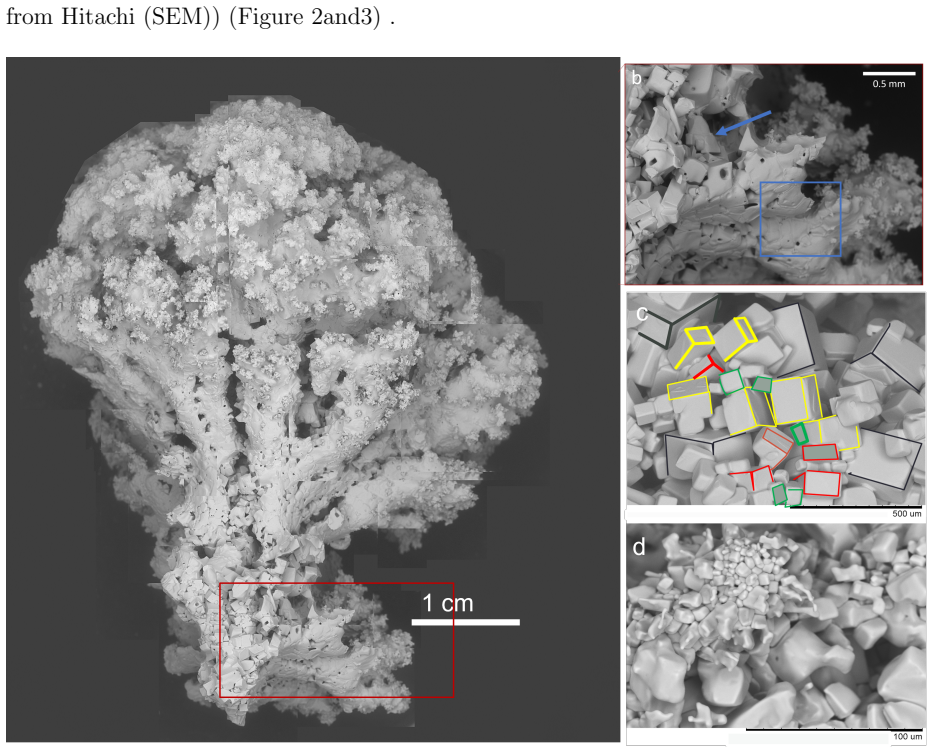
NaCl efflorescence and creep pillars are self-similar porous media: large cubic crystals form first, leaving pores in which smaller crystals nucleate, and so on. Feret diameters show crystal and pore sizes roughly halve per layer, pores about a quarter of cube size (~20% porosity). Box-counting gives fractal dimensions 1.71 ± 0.03 (2D) and ~2.56 (3D). Summing viscous pressure drops via the cubic law and comparing with Young-Laplace capillary pressure shows capillary-viscous competition is not the height limit. Equating initial dissolved salt with crust salt gives he = ρlC0ε(V/A)/(ρcr(1−εe)+ρlCsatεe), matching observed heights.
Load-bearing premise
The height prediction assumes every gram of salt that started dissolved in the porous stone ends up in the external crust, with none precipitating inside the stone or being lost elsewhere.
Editorial extensions
If this is right
- The final efflorescence height should scale with the initial salt inventory per unit surface area, so adding more salt solution produces proportionally taller crusts.
- Changing the evaporation rate should not change the ultimate height, because the model finds capillary-viscous competition is not the limiting factor.
- The halving rule supplies a recursive structural description: each layer's crystal and pore sizes are determined by the previous layer, so a layer-by-layer 3D model can reproduce the cauliflower morphology.
- The outer skin, with the smallest pores, generates the highest capillary suction, keeping the crust wet and sustaining the self-amplifying precipitation.
- Fractal dimensions near 1.7 (2D) and 2.5 (3D) imply a large internal surface area, which amplifies evaporation and the creeping process.
Reading between the lines
- An untested consequence of the mass-balance claim is that crust height should be linear in C0 V/A and insensitive to evaporation rate; a dedicated matrix of experiments varying those two factors separately would confirm or refute mass control.
- The halving rule suggests a simple generative algorithm: recursively place cubes of half size into each pore, then compare predicted pore-size distributions directly with SEM data beyond the three layers shown.
- Because the measured fractal dimension sits close to diffusion-limited aggregation values, ion diffusion through the finest pore layer may control the precipitation rate; measuring concentration profiles just beneath the crust would test this.
- In conservation practice, if height is mass-limited, salt-damage risk maps could be built from salt inventory and porosity instead of evaporation-rate models.
Editorial analysis
A structured set of objections, weighed in public.
Referee Report
Summary. The manuscript reports SEM and micro-CT observations of NaCl efflorescence grown both from bulk brine and from brine-saturated sandstone cones. It claims that the deposits are hierarchical and self-similar: cubic crystal sizes and pore apertures approximately halve from layer to layer, giving fractal dimensions D2D ≈ 1.71 and D3D ≈ 2.56. On this basis, the authors construct a layered slit-pore model to argue that capillary–viscous competition does not set the maximum efflorescence height. They instead equate the initial dissolved salt mass in the stone (Eq. 4) to the salt contained in the external crust (Eq. 5), yielding the height formula Eq. (6), and report order-of-magnitude agreement with their measured heights.
Significance. If the central claim holds, the paper would shift the understanding of efflorescence growth from a capillary-transport-limited process to a source-limited one, with practical implications for salt damage and natural salt structures. The imaging evidence for a self-similar halving cascade is direct and appears robust across the presented experiments; the mass-balance height formula contains no fitted parameter for the height itself, which is a strength. However, the quantitative height claim currently rests on an unstated assumption about the fate of all dissolved salt and on an idealized model of the capillary-viscous limit, so the degree of support is lower than the abstract suggests.
major comments (3)
- [Eqs. (4)–(6), 'To investigate the hypothesis…'] The mass balance equates the salt initially dissolved in the sandstone, ms = ρl C0 ε V, to the salt present only in the external efflorescence, ms = A he(ρcr(1−εe)+ρl Csat εe). This assumes zero subflorescence and no dissolved salt left in the stone at the time of measurement. For the 1.7 M NaCl experiments on 30%-porosity sandstone, subflorescence is a known possibility (the authors' own ref. 19 concerns subflorescence formation), yet no residual-salt measurement is reported. If a fraction f of the initial salt remains in the stone, Eq. (6) overestimates he by 1/(1−f). The order-of-magnitude agreement in Fig. 5d therefore does not discriminate between the mass-balance mechanism and an upper bound. Please measure or estimate the residual salt in the sandstone, or explicitly bound f and discuss the sensitivity of the central claim to it.
- [Eq. (3) and Fig. 5c] The conclusion that capillary-viscous competition does not limit height relies on an idealized representation: each layer is a set of parallel slit pores of aperture ai, with permeability from the cubic law and with prescribed ratios di=di−1/2, ai=ai−1/2, α=2, and h1=0.1 mm. No sensitivity analysis is given, and the retention-curve calculation below Eq. (2) uses porosity ε=0.28 and grain size d=100 μm, inconsistent with the experimental values reported earlier (ε=30%, average pore diameter 30 μm). Because the viscous term in Eq. (3) grows roughly as 4n while the available capillary pressure grows as 2n, the ratio Pc(he)/Pcmax is sensitive to these choices. Please provide a sensitivity analysis or direct measurements of permeability/capillary pressure for the observed hierarchy, and reconcile the substrate parameters.
- [Fig. 5d and Abstract] The validation of Eq. (6) is based on a single initial concentration (1.7 M) and a single sandstone-cone geometry, and the agreement is described only as 'order of magnitude.' To support the abstract's claim that the ultimate height is 'primarily determined by the initial mass of salt,' the paper should either vary C0, V/A, or the total salt mass and test the predicted scaling, or explicitly restrict the claim to the conditions studied. As written, the data do not establish the general source-limited mechanism independently of the subflorescence assumption.
minor comments (4)
- [Line following 'From Darcy's law…'] The formula for permeability appears garbled in the text: 'ki = 2i a3 i 12d1' should be displayed as k_i = 2^i a_i^3/(12 d_1). Please use display math and define d_1 and a_1 before Eq. (1)–(3).
- [Fig. 2d caption] The caption reads 'average Feret diameter of the pores per layer and the diameter of the pores per layer'; the second quantity is presumably the crystal/cube size. Please clarify the wording.
- [Experimental section] Minor typos: 'Péclets' should be 'Péclet'; 'self-organized strucutre' in the introduction should be 'structure'; and the panel callouts for Fig. 1(c,d) should be checked for consistency.
- [Eq. (5)] If the final efflorescence height is measured after complete drying, the term ρl Csat εe (dissolved salt in the efflorescence pores) should be omitted or justified; if measured during growth, the timing should be stated explicitly.
Circularity Check
No significant circularity: the self-similar hierarchy is empirical, the capillary-pressure check uses independent parameters, and the height model is a mass balance compared with—not fitted to—measured heights.
full rationale
The claimed derivation chain is not circular. The self-similar halving relationship (Fig. 2d: di = di−1/2 and ai = ai−1/2) is an empirical SEM/Feret observation, not an input re-derived as an output. The hierarchical pressure model (Eq. 3) substitutes these observed scalings into standard Darcy/cubic-law/Young-Laplace equations and uses retention-curve parameters (Eq. 2) from Hidri et al.; although M. Prat is a co-author of that paper, the retention-curve parameters (Sc=0.1, n=10, Pcref from porosity/grain size) are independent of the present target quantity (efflorescence height) and are not fitted to it, so this is legitimate independent support rather than a load-bearing self-citation. The height formula (Eqs. 4-6) is a salt-conservation balance: it equates the initial dissolved salt to the salt held in the external crust, with no free parameter fitted to the observed heights; the prediction is tested against the order of magnitude of measured heights. The principal weakness is the unstated assumption that all salt ends up in the external efflorescence and none remains as subflorescence in the sandstone (Eq. 5 has no subflorescence term); if false, Eq. (6) would overestimate heights. This is a real correctness/assumption concern, but it is not circularity: the mass balance is not equivalent to its inputs by construction, and the inputs (C0, ε, V, A, εe, ρcr, Csat) are measured independently of he. Self-citations in the paper (e.g., refs. 7, 13, 17-19, 29) are used as background or for independent parameters, not as an unverified uniqueness argument, so they do not raise the circularity score.
Assumptions & free parameters
free parameters (4)
- α (layer thickness growth factor) =
2
- h1 (height of first layer) =
0.1 mm
- d1 and a1 (largest cube size and largest pore aperture) =
not stated in text
- εe (efflorescence porosity) =
~0.2
assumptions (4)
- standard math Darcy's law applies to steady flow through the hierarchical efflorescence
- domain assumption Cubic law gives the permeability of each level's slit pores
- domain assumption Retention curve of Hidri et al. describes capillary pressure in the underlying sandstone
- domain assumption All initial salt mass is incorporated into the external efflorescence
Cite this review
Pith. "Pith review of Self-similarity in creeping salt crystallization." pith.science (2026). https://pith.science/paper/NBFCSPAA
@misc{pith2026250818779,
  author       = {Pith},
  title        = {Pith review of: Self-similarity in creeping salt crystallization},
  year         = {2026},
  howpublished = {\url{https://pith.science/paper/NBFCSPAA}},
  note         = {Machine review of arXiv:2508.18779}
}
read the original abstract
The self-amplifying creeping of salts can produce striking macroscopic structures, such as desert roses in arid regions and salt pillars near saline lakes. While these formations are visually remarkable, salt crystallization, often seen as efflorescence on surfaces, also poses significant challenges for cultural heritage conservation, materials science, and soil management. In this study, we investigate the mechanisms underlying self-organized crystallization within efflorescence deposits. Our findings reveal that these porous salt deposits exhibit pronounced self-similarity, with the crystallization process recurring at multiple length scales. This results in smaller replicas of the overall structure nested within larger ones, creating fractal geometries similar to those found in cauliflower and broccoli. By performing controlled evaporation experiments and microscale analysis using advanced imaging techniques combined with fractal dimension analysis, we uncover the hierarchical and size-controlled precipitation of cubic microcrystals within the porous efflorescence. Furthermore, we develop a hierarchical growth model demonstrating that the ultimate height of the macroscopic salt deposit is primarily determined by the initial mass of salt, rather than by the interplay of capillary and viscous forces when salt solution flows within the porous salt structure.
Figures


Figures from the paper (2 more)


Forward citations
Cited by 1 Pith paper
-
Hygroscopic hysteresis drives intermittent salt creeping
Hysteresis between deliquescence and efflorescence is sufficient to turn steady confined evaporation of salt solutions into intermittent salt creeping via episodic imbibition.
Reference graph
Works this paper leans on
-
[1]
Pitman, M. G.; L \"a uchli, A. Global impact of salinity and agricultural ecosystems. Salinity: environment-plants-molecules 2002, 3, 20
work page 2002
-
[2]
Cooke, R. Salt weathering in deserts. Proceedings of the Geologists' Association 1981, 92, 1--16
work page 1981
-
[3]
Damage in porous media due to salt crystallization
Shahidzadeh-Bonn, N.; Desarnaud, J.; Bertrand, F.; Chateau, X.; Bonn, D. Damage in porous media due to salt crystallization. Physical Review E 2010, 81, 066110
work page 2010
-
[4]
Washburn, E. R. The creeping of solutions. The Journal of Physical Chemistry 2002, 31, 1246--1248
work page 2002
-
[5]
Creeping-film phenomenon of potassium chloride solution
Huang, B.-J.; Huang, J.-C. Creeping-film phenomenon of potassium chloride solution. Nature 1976, 261, 36--38
work page 1976
-
[6]
Hird, R.; Bolton, M. D. Migration of sodium chloride in dry porous materials. Proceedings of the Royal Society A: Mathematical, Physical and Engineering Sciences 2016, 472, 20150710
work page 2016
-
[7]
Salt creeping as a self-amplifying crystallization process
Qazi, M.; Salim, H.; Doorman, C.; Jambon-Puillet, E.; Shahidzadeh, N. Salt creeping as a self-amplifying crystallization process. Science advances 2019, 5, eaax1853
work page 2019
-
[8]
Qazi, M. J.; Bonn, D.; Shahidzadeh, N. Drying of salt solutions from porous media: Effect of surfactants. Transport in Porous Media 2019, 128, 881--894
work page 2019
Show all 32 references
-
[9]
Drying of salt contaminated porous media: Effect of primary and secondary nucleation
Desarnaud, J.; Derluyn, H.; Molari, L.; de Miranda, S.; Cnudde, V.; Shahidzadeh, N. Drying of salt contaminated porous media: Effect of primary and secondary nucleation. Journal of Applied Physics 2015, 118, 114901
2015
-
[10]
Discrete salt crystallization at the surface of a porous medium
Veran-Tissoires, S.; Marcoux, M.; Prat, M. Discrete salt crystallization at the surface of a porous medium. Physical review letters 2012, 108, 054502
2012
-
[11]
A.; Abdelfattah, M
Shahid, S. A.; Abdelfattah, M. A. Gypsum polymorphism in the desert environment of Abu Dhabi Emirate. European Journal of Scientific Research 2009, 29, 237--248
2009
-
[12]
Corrosion and climatic effects in electronics; VTT Technical Research Centre of Finland, 2000
Hienonen, R.; Lahtinen, R. Corrosion and climatic effects in electronics; VTT Technical Research Centre of Finland, 2000
2000
-
[13]
B.; Prat, M
Eloukabi, H.; Sghaier, N.; Nasrallah, S. B.; Prat, M. Experimental study of the effect of sodium chloride on drying of porous media: The crusty--patchy efflorescence transition. International Journal of Heat and Mass Transfer 2013, 56, 80--93
2013
-
[14]
Evaporation of a sodium chloride solution from a saturated porous medium with efflorescence formation
Veran-Tissoires, S.; Prat, M. Evaporation of a sodium chloride solution from a saturated porous medium with efflorescence formation. Journal of fluid mechanics 2014, 749, 701--749
2014
-
[15]
Evaporation of NaCl solution from porous media with mixed wettability
Bergstad, M.; Shokri, N. Evaporation of NaCl solution from porous media with mixed wettability. Geophysical research letters 2016, 43, 4426--4432
2016
-
[16]
Salt crystallization during evaporation: impact of interfacial properties
Shahidzadeh-Bonn, N.; Rafa , S.; Bonn, D.; Wegdam, G. Salt crystallization during evaporation: impact of interfacial properties. Langmuir 2008, 24, 8599--8605
2008
-
[17]
Effect of efflorescence formation on drying kinetics of porous media
Sghaier, N.; Prat, M. Effect of efflorescence formation on drying kinetics of porous media. Transport in Porous Media 2009, 80, 441--454
2009
-
[18]
Combined wicking and evaporation of NaCl solution with efflorescence formation: The efflorescence exclusion zone
Lazhar, R.; Najjari, M.; Prat, M. Combined wicking and evaporation of NaCl solution with efflorescence formation: The efflorescence exclusion zone. Physics of Fluids 2020, 32
2020
-
[19]
Effect of evaporative surface area on salt efflorescence and subflorescence formation in a given porous material
Wijnhorst, R.; Van der Sloot, F.; Pel, L.; Shahidzadeh, N. Effect of evaporative surface area on salt efflorescence and subflorescence formation in a given porous material. Physical Review Applied 2024, 21, 064055
2024
-
[20]
B.; Mandelbrot, B
Mandelbrot, B. B.; Mandelbrot, B. B. The fractal geometry of nature; WH freeman New York, 1982; Vol. 1
1982
-
[21]
Fractal dimensions of a green broccoli and a white cauliflower
Kim, S.-H. Fractal dimensions of a green broccoli and a white cauliflower. arXiv preprint cond-mat/0411597 2004,
2004 arXiv
-
[22]
A.; Sander, L
Witten, T. A.; Sander, L. M. Diffusion-limited aggregation. Physical review B 1983, 27, 5686
1983
-
[23]
Halsey, T. C. Diffusion-limited aggregation: A model for pattern formation. Physics Today 2000, 53, 36--41
2000
-
[24]
Evaporatively controlled growth of salt trees
Du, R.; Stone, H. Evaporatively controlled growth of salt trees. Physical Review E 1996, 53, 1994
1996
-
[25]
P.; Prat, M.; Pel, L.; Kopinga, K
Gupta, S.; Huinink, H. P.; Prat, M.; Pel, L.; Kopinga, K. Paradoxical drying of a fired-clay brick due to salt crystallization. Chemical Engineering Science 2014, 109, 204--211
2014
-
[26]
W.; Bodvarsson, G
Zimmerman, R. W.; Bodvarsson, G. S. Hydraulic conductivity of rock fractures. Transport in porous media 1996, 23, 1--30
1996
-
[27]
Gennes, P.-G.; Brochard-Wyart, F.; Qu \'e r \'e , D.; others Capillarity and wetting phenomena: drops, bubbles, pearls, waves; Springer, 2004
2004
-
[28]
Molecular dynamics simulation of the surface tension of aqueous sodium chloride: from dilute to highly supersaturated solutions and molten salt
Wang, X.; Chen, C.; Binder, K.; Kuhn, U.; P \"o schl, U.; Su, H.; Cheng, Y. Molecular dynamics simulation of the surface tension of aqueous sodium chloride: from dilute to highly supersaturated solutions and molten salt. Atmospheric Chemistry and Physics 2018, 18, 17077--17086
2018
-
[29]
Hidri, F.; Sghaier, N.; Eloukabi, H.; Prat, M.; Nasrallah, S. B. Porous medium coffee ring effect and other factors affecting the first crystallisation time of sodium chloride at the surface of a drying porous medium. Physics of Fluids 2013, 25, 127101
2013
-
[30]
A.; Zarcone, C.; Macdonald, I
Dullien, F. A.; Zarcone, C.; Macdonald, I. F.; Collins, A.; Bochard, R. D. The effects of surface roughness on the capillary pressure curves and the heights of capillary rise in glass bead packs. Journal of Colloid and Interface Science 1989, 127, 362--372
1989
-
[31]
A.; Srivastava, P
Dodds, J. A.; Srivastava, P. Capillary pressure curves of sphere packings: correlation of experimental results and comparison with predictions from a network model of pore space. Particle & Particle Systems Characterization 2006, 23, 29--39
2006
-
[32]
n ̈87/܌ ( <^h F =?ɳl:( «md MѴAWa4]ޯ4> 8z Y, 듬d Վfv5 s0C e Ͷe,ЉPT s n4gn Kk|a/0:O: -ڊMߠ ؔҮk_ Fd ZX tCs nᐉ Ib i4M-ڬ6 H6 wA7mT Y- wì7ɦ
Smith, D. Thermal conductivity of halite using a pulsed laser; 1976 mcitethebibliography improved.tex0000664000000000000000000011014415053264452012134 0ustar rootroot [journal=jacsat,manuscript=article] achemso [version=3] mhchem amsmath * [1] #1 R.J. Wijnhorst [University of ...
1976
Reviewed August 5, 2026 · model on record in the stance chip above.
Discussion (0). Sign in to comment.