REVIEW 5 major objections 5 minor 45 references
EMind: A Foundation Model for Multi-task Electromagnetic Signals Understanding
T0 review · 5 major / 5 minor · reviewed 2026-08-05 · deepseek-v4-flash
Pith's one-line read EMind is a single pretrained transformer that handles seven electromagnetic-signal tasks, from modulation classification to blind source separation, using one 110-million-parameter backbone.
desk verdict A workmanlike EM foundation model with a genuinely large pretraining corpus and useful packing/masking engineering; the broad transfer results are plausible but post hoc checkpoint selection and an overbroad SOTA claim need hardening before the story is fully convincing. read the letter →
The pith
A machine-rendered reading of the paper's core claim, the machinery that carries it, and where it could break.
The reading
What carries the argument
The load-bearing mechanism is masked autoencoding on IQ patches with three EM-specific devices: a sampling-rate token that is never masked, per-sample masking inside packed multi-signal sequences, and dataset-adaptive sampling weights during pretraining. The IQ tokenizer patches the complex baseband stream, concatenates an embedded sampling-rate token, and feeds a one-dimensional temporal transformer; a 75% mask ratio forces reconstruction of missing waveform content. The packing strategy concatenates variable-length samples of 128 to 4,096 points into fixed-length sequences without zero-padding, while per-sample masking keeps the effective mask ratio uniform across samples of different leng
What would settle it
Measure downstream accuracy on a held-out low-SNR set, such as RML2018.01A at -20 dB, using pretraining checkpoints from every epoch and with the SNR greater than 6 dB pretraining filter removed. If accuracy at low SNR does not track the checkpoint curve, or collapses when the filter is changed, the broad generalization claim is an artifact of checkpoint selection or the clean-data filter.
Extended reading notes
Core claim
On the paper's own terms, the central discovery is that masked autoencoding on raw IQ waveforms, combined with length-adaptive multi-signal packing, per-sample masking, and an always-visible sampling-rate token, produces a shared representation space that transfers across electromagnetic-signal tasks without task-specific architecture changes. The authors report best published accuracy on the AMC benchmarks RML2016.10B and RML2016.04C, 99.87% accuracy on the ADS-B RF-fingerprinting dataset, large gains over a Transformer baseline on their EM-AIS emitter dataset, best results on two wireless-interference identification tasks, and substantially lower mean absolute error on joint radar waveform
Load-bearing premise
Everything rests on the assumption that features learned from clean high-SNR samples (SNR above 6 dB) transfer to much noisier downstream data and to signal families never seen in pretraining, and that this transfer is real rather than an artifact of the particular checkpoint picked at epoch 3.6.
Editorial extensions
If this is right
- One frozen backbone plus a linear head can serve modulation classification, fingerprinting, and interference identification, reducing the cost of adapting to new radio tasks.
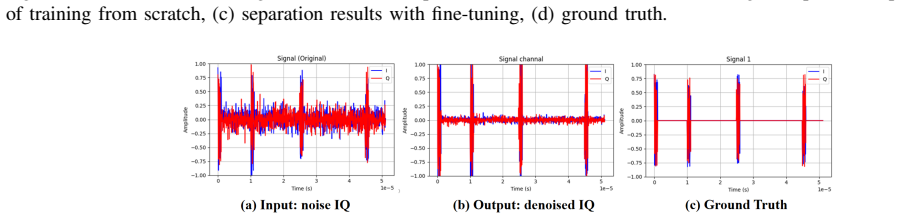
- Pretrained weights help reconstruction-oriented tasks such as blind source separation and denoising, not just discriminative tasks, extending the reach of the pretrain-finetune paradigm.
- The sampling-rate token and length-adaptive packing allow inference on signals of arbitrary length up to 6,000 samples, matching the variability of real-world IQ captures.
- Because linearly separable features emerge by the 3.6th pretraining epoch, large-scale pretraining may need far fewer epochs than a naive schedule suggests.
- Pretraining on clean high-SNR samples (SNR above 6 dB) can transfer to downstream signals at SNR as low as -20 dB, implying that reconstruction on high-quality data is a viable pretraining strategy.
Reading between the lines
- If transfer saturates so early, a deliberately smaller pretraining corpus or a much shorter schedule may be enough; ablating dataset volume and epoch count would map the minimum viable pretraining budget.
- The SNR greater than 6 dB pretraining filter is a stated modeling choice, not a tested one; varying that threshold while measuring downstream low-SNR accuracy would show whether clean-data pretraining is necessary or merely convenient.
- A fixed patch size of 8 may limit performance on very high-bandwidth signals; testing adaptive or multi-scale patch sizes could extend the same architecture to wider-band electromagnetic environments.
- The packing and per-sample masking design could transfer to other non-stationary time-series domains with heterogeneous sample lengths and intrinsic metadata, though the paper itself does not make that claim.
Editorial analysis
A structured set of objections, weighed in public.
Referee Report
Summary. The paper introduces EMind, a 110M-parameter masked-autoencoder transformer pretrained on 81,117,525 IQ samples from 14 datasets (10 public, 4 self-constructed), with length-adaptive multi-signal packing, per-sample masking, a sampling-rate token, and dataset-adaptive weighting. Pretraining uses only samples with SNR > 6 dB, and the released checkpoint is taken at epoch 3.6. The same backbone is then fine-tuned on AMC, RWC/RPE, WII, RFFI, BSS, and signal denoising. The authors report strong or state-of-the-art results across these tasks, including linear-probe accuracy comparable to full fine-tuning, and conclude that a unified electromagnetic-signal foundation model is feasible.
Significance. If the empirical claims hold, this is a useful step toward a general EM-signal foundation model: the pretraining corpus is the largest reported in this line of work, the code is released, and the downstream evaluation includes public benchmarks that are not literally in the pretraining corpus (RML2016.x, RadChar). The internal arithmetic of Table I is consistent, and the breadth of task families is commendable. However, several load-bearing evidential gaps currently outrun the claims: the checkpoint and SNR-filter choices are not ablated, the BSS experiment lacks a from-scratch quantitative baseline, the SOTA claim is contradicted by Table V on one dataset, and the independence of the downstream ADS-B RFFI set from the pretraining ADS-B data is not established.
major comments (5)
- [VI-A.1, VI-A.2, Fig. 10] The pretraining recipe contains two unvalidated choices. Only samples with SNR > 6 dB are used for pretraining, yet downstream evaluation is reported down to -20 dB (VI-B); no ablation varies this cutoff. The released checkpoint is selected from 'the checkpoint at the end of the 3.6-th epoch, due to its empirically observed training stability and generalization performance' (VI-A.1), which is a post hoc choice. No checkpoint sweep, no multiple seeds, and no variance estimates are reported. Figure 10 shows linear-probe saturation only for AMC; it does not cover BSS, denoising, RFFI, WII, or regression. Since all downstream results rely on this single checkpoint, please add a checkpoint sweep (e.g., epochs 1, 2, 3, 3.6, 5, 10) and an SNR-cutoff ablation, with at least three seeds, on at least one discriminative task and one generative task.
- [VI-B.1, Table V] The text states that EMind 'achieves state-of-the-art performance across Automatic Modulation Classification (AMC), Radio Frequency Fingerprint Identification (RFFI), and Wireless Interference Identification (WII).' This is contradicted by Table V on RML2016.10A, where SpectrumFM obtains 63.72 and EMind obtains 62.51. The claimed advantages on RML2016.10B (65.45 vs 65.35) and RML2016.04C (74.34 vs 73.37) are small and no confidence intervals or multiple-seed results are provided, so the 'surpassing all competing approaches' claim is not robustly supported. Please correct the SOTA claim and add variance estimates.
- [VI-B.3, Table VIII] The BSS experiment is central to the claim that pretrained weights help generative tasks, but Table VIII compares only Linear Probe and Fine-tune. There is no quantitative comparison to training from scratch or to any existing BSS method; Figure 12 shows a from-scratch separation failure only qualitatively. Additionally, EM-Radar-Mix contains both paired and single-source mixtures (Section VI-B.3), while the model uses a fixed K=2 latent structure (Section VI-B.3, Table VII). The paper does not state how single-source samples are handled under K=2 and permutation-invariant training. Please add from-scratch quantitative results, an external BSS baseline if available, and a precise description of the K=2 treatment for single-source inputs.
- [VI-B, Table IV vs Table I] The paper states that the downstream datasets are 'completely independent from the pretraining datasets,' but the pretraining corpus includes Mono Receiver [29], an ADS-B dataset, while the downstream RFFI set is ADS-B [37]. These may be different collections, but at the signal-family level the independence claim is not clean. Please clarify whether any pretraining samples, transmitter IDs, or recording sessions overlap with the downstream ADS-B dataset, and discuss the potential for domain leakage in the reported 99.87% ADS-B accuracy.
- [VI-B.2, Table VI] For the RadChar RWC/RPE experiment, the 'all' SNR column (-20 to 20 dB) is reported only for EMind; the baseline methods CNN1D, CNN2D, IQST-S, and IQST-L have no 'all' entries. The claim that EMind 'substantially outperforms the state-of-the-art' across the entire SNR range is therefore not directly supported by the table. Please provide the corresponding all-SNR metrics for the baselines and identify explicitly which published methods are the SOTA being compared against.
minor comments (5)
- [Eq. (2)] In Eq. (2), the sequence is indexed by n = 0,1,...,N-1, but the text says 'Here, n represents the length of the sequence.' This should refer to N, not n.
- [Throughout] Typos and wording issues: 'volumn' (Tables I and II), 'cosntruction' (Fig. 4), 'shwon' (Section VI-B), 'UA V' (Section IV-D), 'complicity' (Fig. 3). Please copyedit.
- [Figures 9 and 10] Figures 9 and 10 do not report numerical values. Since the claim of linear-probe performance 'comparable to full fine-tuning' is load-bearing, please provide a table with exact accuracies for from-scratch, full fine-tuning, and linear probing on all four RML datasets.
- [Table II] The SpectrumFM row is ambiguous: the data volume entries '8-10 million * + 25 GB †' and the footnotes are confusing. Please clarify the exact sample count or storage size and whether the 25 GB is included in the 8-10 million estimate.
- [VI-A.2] The phrase 'eager attention' is used without definition. If it refers to standard full attention without sparse/flash variants, say so; otherwise define it.
Circularity Check
No significant circularity: EMind's central transfer claims rest on independent public benchmarks and externally defined downstream tasks.
full rationale
The claimed derivation chain is: build a large standardized pretraining corpus, pretrain a masked-autoencoder transformer on raw IQ, then fine-tune on downstream tasks. The paper explicitly states that the downstream evaluation datasets are 'completely independent from the pretraining datasets' (Section VI-B), and the key generalization evidence is on public benchmarks (RML2016.10A/B/04C, RML2018.01A, RadChar, ADS-B) that are not in the pretraining corpus. No load-bearing step defines the predicted quantity in terms of the fitted input, no fitted parameter is renamed as a prediction, and no claim is justified by a self-citation chain or an imported uniqueness theorem. The 3.6-epoch checkpoint selection and the SNR>6 pretraining filter are post hoc training choices that raise robustness concerns, but they are not circular: the downstream comparisons are against external baselines on held-out public data, and the reported results are not constructed to equal the pretraining objective. The BSS/denoising tasks use self-built datasets, but the pretraining objective is masked reconstruction of individual signals while downstream BSS/denoising are different tasks on different inputs (mixtures/noisy signals), so no reduction-by-construction is present. Overall, the paper's conclusions have independent content and the core evaluation is self-contained against external benchmarks.
Assumptions & free parameters
free parameters (8)
- Dataset-adaptive sampling weights =
1:0.5:1:1:0.5:0.5:1:1:1:1:1:1:0.5:0.5 (final, across 14 datasets)
- Pretraining checkpoint epoch =
3.6 of 10 epochs
- Mask ratio =
75%
- Patch size =
8 IQ samples
- SNR threshold for pretraining inclusion =
> 6 dB
- Packed sequence capacity =
6000 tokens
- BSS latent structure =
K=2 channels, 16 dims each; linear layers 4096/2048/1536/1024
- BSS L2 regularization coefficient =
not reported
assumptions (5)
- domain assumption Joint MAE pretraining on 14 heterogeneous IQ datasets yields a shared, transferable representation space
- domain assumption Absolute-magnitude normalization IQ/(max(|IQ|)) preserves the physical features needed across all tasks
- domain assumption A 75% masking reconstruction objective with a visible sampling-rate token produces linearly separable task features
- domain assumption Downstream datasets are genuinely out-of-distribution relative to pretraining
- ad hoc to paper Blind source separation is solvable with a fixed K=2 latent while the source count varies between 1 and 2 in EM-Radar-Mix
Cite this review
Pith. "Pith review of EMind: A Foundation Model for Multi-task Electromagnetic Signals Understanding." pith.science (2026). https://pith.science/paper/VAXBG4ZM
@misc{pith2026250818785,
  author       = {Pith},
  title        = {Pith review of: EMind: A Foundation Model for Multi-task Electromagnetic Signals Understanding},
  year         = {2026},
  howpublished = {\url{https://pith.science/paper/VAXBG4ZM}},
  note         = {Machine review of arXiv:2508.18785}
}
read the original abstract
Deep understanding of electromagnetic signals is fundamental to dynamic spectrum management, intelligent transportation, autonomous driving and unmanned vehicle perception. The field faces challenges because electromagnetic signals differ greatly from text and images, showing high heterogeneity, strong background noise and complex joint time frequency structure, which prevents existing general models from direct use. Electromagnetic communication and sensing tasks are diverse, current methods lack cross task generalization and transfer efficiency, and the scarcity of large high quality datasets blocks the creation of a truly general multitask learning framework. To overcome these issue, we introduce EMind, an electromagnetic signals foundation model that bridges large scale pretraining and the unique nature of this modality. We build the first unified and largest standardized electromagnetic signal dataset covering multiple signal types and tasks. By exploiting the physical properties of electromagnetic signals, we devise a length adaptive multi-signal packing method and a hardware-aware training strategy that enable efficient use and representation learning from heterogeneous multi-source signals. Experiments show that EMind achieves strong performance and broad generalization across many downstream tasks, moving decisively from task specific models to a unified framework for electromagnetic intelligence. The code is available at: https://github.com/GabrielleTse/EMind.
Figures


Figures from the paper (12 more)


Reference graph
Works this paper leans on
-
[29]
Zero-bias deep learning for accurate identification of internet-of-things (iot) devices
Yongxin Liu, Jian Wang, Jianqiang Li, Houbing Song, Thomas Yang, Shuteng Niu, and Zhong Ming. Zero-bias deep learning for accurate identification of internet-of-things (iot) devices. IEEE Internet of Things Journal, 8(4):2627–2634, 2020
work page 2020
-
[37]
Large-scale real-world radio signal recognition with deep learning
TU Ya, LIN Yun, ZHA Haoran, W ANG Yu, GUI Guan, MAO Shiwen, et al. Large-scale real-world radio signal recognition with deep learning. Chinese Journal of Aeronautics , 35(9):35–48, 2022
work page 2022
-
[1]
Contrastive self-supervised clustering for specific emitter identification
Xiaoyang Hao, Zhixi Feng, Ruoyu Liu, Shuyuan Yang, Licheng Jiao, and Rong Luo. Contrastive self-supervised clustering for specific emitter identification. IEEE Internet of Things Journal, 10(23):20803– 20818, 2023
work page 2023
-
[2]
A self-supervised learning-based channel estimation for irs-aided communication without ground truth
Zhengming Zhang, Taotao Ji, Haoqing Shi, Chunguo Li, Yongming Huang, and Luxi Yang. A self-supervised learning-based channel estimation for irs-aided communication without ground truth. IEEE Transactions on Wireless Communications , 22(8):5446–5460, 2023
work page 2023
-
[3]
Self-supervised visual feature learning with deep neural networks: A survey
Longlong Jing and Yingli Tian. Self-supervised visual feature learning with deep neural networks: A survey. IEEE transactions on pattern analysis and machine intelligence , 43(11):4037–4058, 2020
work page 2020
-
[4]
A comprehensive survey on pretrained foundation models: A history from bert to chatgpt
Ce Zhou, Qian Li, Chen Li, Jun Yu, Yixin Liu, Guangjing Wang, Kai Zhang, Cheng Ji, Qiben Yan, Lifang He, et al. A comprehensive survey on pretrained foundation models: A history from bert to chatgpt. International Journal of Machine Learning and Cybernetics , pages 1–65, 2024
work page 2024
-
[5]
Towards a wireless physical-layer foundation model: Challenges and strategies
Jaron Fontaine, Adnan Shahid, and Eli De Poorter. Towards a wireless physical-layer foundation model: Challenges and strategies. In 2024 IEEE International Conference on Communications Workshops (ICC Workshops), pages 1–7. IEEE, 2024
work page 2024
-
[6]
A wireless foundation model for multi-task prediction
Yucheng Sheng, Jiacheng Wang, Xingyu Zhou, Le Liang, Hao Ye, Shi Jin, and Geoffrey Ye Li. A wireless foundation model for multi-task prediction. arXiv preprint arXiv:2507.05938 , 2025
arXiv 2025
Show all 45 references
-
[7]
Foundation models for time series analysis: A tutorial and survey
Yuxuan Liang, Haomin Wen, Yuqi Nie, Yushan Jiang, Ming Jin, Dongjin Song, Shirui Pan, and Qingsong Wen. Foundation models for time series analysis: A tutorial and survey. In Proceedings of the 30th ACM SIGKDD conference on knowledge discovery and data mining, pages 6555–6565, 2024
2024
-
[8]
Deep learning in mobile and wireless networking: A survey
Chaoyun Zhang, Paul Patras, and Hamed Haddadi. Deep learning in mobile and wireless networking: A survey. IEEE Communications surveys & tutorials , 21(3):2224–2287, 2019
2019
-
[9]
A multi-task foundation model for wireless channel representation using contrastive and masked autoencoder learning
Berkay Guler, Giovanni Geraci, and Hamid Jafarkhani. A multi-task foundation model for wireless channel representation using contrastive and masked autoencoder learning. arXiv preprint arXiv:2505.09160 , 2025
2025
-
[10]
Wirelessgpt: A generative pre-trained multi-task learning framework for wireless communication
Tingting Yang, Ping Zhang, Mengfan Zheng, Yuxuan Shi, Liwen Jing, Jianbo Huang, and Nan Li. Wirelessgpt: A generative pre-trained multi-task learning framework for wireless communication. IEEE Network, 2025
2025
-
[11]
Sionna: An open-source library for next-generation physical layer research
Jakob Hoydis, Sebastian Cammerer, Fayçal Ait Aoudia, Avinash Vem, Nikolaus Binder, Guillermo Marcus, and Alexander Keller. Sionna: An open-source library for next-generation physical layer research. arXiv preprint arXiv:2203.11854 , 2022
2022 arXiv
-
[12]
Deepmimo: A generic deep learning dataset for millimeter wave and massive mimo applications
Ahmed Alkhateeb. Deepmimo: A generic deep learning dataset for millimeter wave and massive mimo applications. arXiv preprint arXiv:1902.06435, 2019
1902 arXiv
-
[13]
6g wavesfm: A foundation model for sensing, communication, and localization
Ahmed Aboulfotouh, Elsayed Mohammed, and Hatem Abou-Zeid. 6g wavesfm: A foundation model for sensing, communication, and localization. arXiv preprint arXiv:2504.14100 , 2025
2025 arXiv
-
[14]
Spec- trumfm: A foundation model for intelligent spectrum management
Fuhui Zhou, Chunyu Liu, Hao Zhang, Wei Wu, Qihui Wu, Derrick Wing Kwan Ng, Tony QS Quek, and Chan-Byoung Chae. Spec- trumfm: A foundation model for intelligent spectrum management. arXiv preprint arXiv:2505.06256 , 2025
2025
-
[15]
Over- the-air deep learning based radio signal classification
Timothy James O’Shea, Tamoghna Roy, and T Charles Clancy. Over- the-air deep learning based radio signal classification. IEEE Journal of Selected Topics in Signal Processing , 12(1):168–179, 2018
2018
-
[16]
Towards low- complexity wireless technology classification across multiple environ- ments
Jaron Fontaine, Erika Fonseca, Adnan Shahid, Maicon Kist, Luiz A DaSilva, Ingrid Moerman, and Eli De Poorter. Towards low- complexity wireless technology classification across multiple environ- ments. Ad Hoc Networks , 91:101881, 2019
2019
-
[17]
Foundation models defining a new era in vision: a survey and outlook
Muhammad Awais, Muzammal Naseer, Salman Khan, Rao Muham- mad Anwer, Hisham Cholakkal, Mubarak Shah, Ming-Hsuan Yang, and Fahad Shahbaz Khan. Foundation models defining a new era in vision: a survey and outlook. IEEE Transactions on Pattern Analysis and Machine Intelligence , 2025
2025
-
[18]
Foun- dation models in electrocardiogram: A review
Yu Han, Xiaofeng Liu, Xiang Zhang, and Cheng Ding. Foun- dation models in electrocardiogram: A review. arXiv preprint arXiv:2410.19877, 2024
2024
-
[19]
Spectralgpt: Spectral remote sensing foundation model
Danfeng Hong, Bing Zhang, Xuyang Li, Yuxuan Li, Chenyu Li, Jing Yao, Naoto Yokoya, Hao Li, Pedram Ghamisi, Xiuping Jia, et al. Spectralgpt: Spectral remote sensing foundation model. arXiv preprint arXiv:2311.07113, 2023
2023 arXiv
-
[20]
Attention is all you need
Ashish Vaswani, Noam Shazeer, Niki Parmar, Jakob Uszkoreit, Llion Jones, Aidan N Gomez, Łukasz Kaiser, and Illia Polosukhin. Attention is all you need. Advances in neural information processing systems , 30, 2017
2017
-
[21]
Hisarmod: A new challenging modulated signals dataset
K Tekbıyık, C Keçeci, AR Ekti, A Görçin, and G Kurt. Hisarmod: A new challenging modulated signals dataset. IEEE Dataport, 2019
2019
-
[22]
Classification of radio signals and hf transmission modes with deep learning
Stefan Scholl. Classification of radio signals and hf transmission modes with deep learning. arXiv preprint arXiv:1906.04459 , 2019
1906 arXiv
-
[23]
Dataset for modulation classi- fication and signal type classification for multi-task and single task learning
Anu Jagannath and Jithin Jagannath. Dataset for modulation classi- fication and signal type classification for multi-task and single task learning. Computer Networks, 199:108441, 2021
2021
-
[24]
Wisig: A large-scale wifi signal dataset for receiver and channel agnostic rf fingerprinting
Samer Hanna, Samurdhi Karunaratne, and Danijela Cabric. Wisig: A large-scale wifi signal dataset for receiver and channel agnostic rf fingerprinting. IEEE Access, 10:22808–22818, 2022
2022
-
[25]
Exposing the fingerprint: Dissecting the impact of the wireless channel on radio fingerprinting
Amani Al-Shawabka, Francesco Restuccia, Salvatore D’Oro, Tong Jian, Bruno Costa Rendon, Nasim Soltani, Jennifer Dy, Stratis Ioan- nidis, Kaushik Chowdhury, and Tommaso Melodia. Exposing the fingerprint: Dissecting the impact of the wireless channel on radio fingerprinting. In ...
2020
-
[26]
Trust in 5g open rans through machine learning: Rf fingerprinting on the powder pawr platform
Guillem Reus-Muns, Dheryta Jaisinghani, Kunal Sankhe, and Kaushik R Chowdhury. Trust in 5g open rans through machine learning: Rf fingerprinting on the powder pawr platform. In GLOBE- COM 2020-2020 IEEE Global Communications Conference , pages 1–
2020
-
[27]
Transmitter classification with supervised deep learning
Cyrille Morin, Leonardo S Cardoso, Jakob Hoydis, Jean-Marie Gorce, and Thibaud Vial. Transmitter classification with supervised deep learning. In International Conference on Cognitive Radio Oriented Wireless Networks, pages 73–86. Springer, 2019
2019
-
[28]
Lora device finger- printing in the wild: Disclosing rf data-driven fingerprint sensitivity to deployment variability
Abdurrahman Elmaghbub and Bechir Hamdaoui. Lora device finger- printing in the wild: Disclosing rf data-driven fingerprint sensitivity to deployment variability. IEEE Access, 9:142893–142909, 2021
2021
-
[30]
Dronerfa: A large-scale dataset of drone radio frequency signals for detecting low-altitude drones
Ninging Yu, Shengjian Mao, Chengwei Zhou, Guowei Sun, Zhiguo Shi, and Jiming Chen. Dronerfa: A large-scale dataset of drone radio frequency signals for detecting low-altitude drones. Journal of Electronics & Information Technology , 46(4):1147–1156, 2024
2024
-
[31]
Rf-diffusion: Radio signal generation via time-frequency diffusion
Guoxuan Chi, Zheng Yang, Chenshu Wu, Jingao Xu, Yuchong Gao, Yunhao Liu, and Tony Xiao Han. Rf-diffusion: Radio signal generation via time-frequency diffusion. In Proceedings of the 30th Annual In- ternational Conference on Mobile Computing and Networking , pages 77–92, 2024
2024
-
[32]
A generative self-supervised framework for cognitive radio leveraging time-frequency features and attention-based fusion
Shuai Chen, Zhixi Feng, Shuyuan Yang, Yue Ma, Jun Liu, and Zhuoyue Qi. A generative self-supervised framework for cognitive radio leveraging time-frequency features and attention-based fusion. IEEE Transactions on Wireless Communications , 2024
2024
-
[33]
Radiollm: Introducing large language model into cognitive ra- dio via hybrid prompt and token reprogrammings
Shuai Chen, Yong Zu, Zhixi Feng, Shuyuan Yang, and Mengchang Li. Radiollm: Introducing large language model into cognitive ra- dio via hybrid prompt and token reprogrammings. arXiv preprint arXiv:2501.17888, 2025
2025 arXiv
-
[34]
Radio machine learning dataset generation with gnu radio
Timothy J O’shea and Nathan West. Radio machine learning dataset generation with gnu radio. In Proceedings of the GNU radio confer- ence, volume 1, 2016
2016
-
[35]
Con- volutional radio modulation recognition networks
Timothy J O’Shea, Johnathan Corgan, and T Charles Clancy. Con- volutional radio modulation recognition networks. In International conference on engineering applications of neural networks, pages 213–
-
[36]
Multi-task learning for radar signal characterisation
Zi Huang, Akila Pemasiri, Simon Denman, Clinton Fookes, and Terrence Martin. Multi-task learning for radar signal characterisation. In 2023 IEEE International Conference on Acoustics, Speech, and Signal Processing Workshops (ICASSPW) , pages 1–5. IEEE, 2023
2023
-
[38]
Deep residual learning for image recognition
Kaiming He, Xiangyu Zhang, Shaoqing Ren, and Jian Sun. Deep residual learning for image recognition. In Proceedings of the IEEE conference on computer vision and pattern recognition , pages 770– 778, 2016
2016
-
[39]
Mcnet: An efficient cnn architecture for robust automatic modulation classification
Thien Huynh-The, Cam-Hao Hua, Quoc-Viet Pham, and Dong-Seong Kim. Mcnet: An efficient cnn architecture for robust automatic modulation classification. IEEE Communications Letters , 24(4):811– 815, 2020
2020
-
[40]
Automatic modulation classification using recurrent neural networks
Dehua Hong, Zilong Zhang, and Xiaodong Xu. Automatic modulation classification using recurrent neural networks. In 2017 3rd IEEE international conference on computer and communications (ICCC) , pages 695–700. IEEE, 2017
2017
-
[41]
Real-time radio technology and modulation classification via an lstm auto-encoder
Ziqi Ke and Haris Vikalo. Real-time radio technology and modulation classification via an lstm auto-encoder. IEEE Transactions on Wireless Communications, 21(1):370–382, 2021
2021
-
[42]
Cgdnet: Efficient hybrid deep learning model for robust automatic modulation recognition
Judith Nkechinyere Njoku, Manuel Eugenio Morocho-Cayamcela, and Wansu Lim. Cgdnet: Efficient hybrid deep learning model for robust automatic modulation recognition. IEEE Networking Letters, 3(2):47– 51, 2021
2021
-
[43]
A novel automatic modulation classification scheme based on multi- scale networks
Hao Zhang, Fuhui Zhou, Qihui Wu, Wei Wu, and Rose Qingyang Hu. A novel automatic modulation classification scheme based on multi- scale networks. IEEE Transactions on Cognitive Communications and Networking, 8(1):97–110, 2021
2021
-
[44]
Amc- net: An effective network for automatic modulation classification
Jiawei Zhang, Tiantian Wang, Zhixi Feng, and Shuyuan Yang. Amc- net: An effective network for automatic modulation classification. In ICASSP 2023-2023 IEEE International Conference on Acoustics, Speech and Signal Processing (ICASSP) , pages 1–5. IEEE, 2023
2023
-
[45]
Performance measurement in blind audio source separation
Emmanuel Vincent, Rémi Gribonval, and Cédric Févotte. Performance measurement in blind audio source separation. IEEE transactions on audio, speech, and language processing , 14(4):1462–1469, 2006
2006
Reviewed August 5, 2026 · model on record in the stance chip above.
Discussion (0). Sign in to comment.