REVIEW 3 major objections 4 minor 70 references
Temperature-Aware Recurrent Neural Operator for Temperature-Dependent Anisotropic Plasticity in HCP Materials
T0 review · 3 major / 4 minor · reviewed 2026-08-05 · deepseek-v4-flash
Pith's one-line read The paper introduces the Temperature-Aware Recurrent Neural Operator (TRNO), a network built like an internal-variable plasticity model, and claims it accurately predicts the temperature-dependent, anisotropic plastic response of polycrysta
desk verdict Solid surrogate-modeling paper with real results; the abstract overstates temperature generalization, which actually requires transfer learning. read the letter →
The pith
A machine-rendered reading of the paper's core claim, the machinery that carries it, and where it could break.
The reading
What carries the argument
The central object is the temperature-aware recurrent neural operator: a pair of fully connected networks, G and F, that parameterize an internal-variable model through an evolution equation for a latent state and a stress-output equation, integrated in time by forward Euler, with separate branches for deviatoric and hydrostatic stress. Its defining property is Markovianity: the learned latent state is supposed to encode all history relevant to the current stress, so no gating or long-memory mechanism is needed. This carries the argument because it yields resolution independence, local element-wise evaluation in finite-element codes, and a small number of learned internal variables (about 15
What would settle it
Train the TRNO on random thermal histories exactly as in the paper, then evaluate it on isothermal stress-strain paths at 25, 125, and 250 C without transfer learning. The paper reports about 25% test error in this setting, so reproducing that gap lets a reader check whether the architecture's generalization claim holds; if the error remains large on constant-temperature paths, the random thermal training measure is not representative and the surrogate needs target-distribution fine-tuning to be usable.
Extended reading notes
Core claim
On the paper's own terms, the central discovery is that a recurrent neural operator built on Markovian internal variables can serve as an accurate, time-resolution-independent surrogate for a complex temperature-dependent crystal-plasticity model of magnesium. Instead of learning the history-dependent stress map directly, as gated recurrent networks do, TRNO learns two maps: one that gives the rate of change of a learned internal state, and one that gives the stress as a function of the current deformation, temperature, and internal state. Stress updates are then obtained by forward-Euler integration, which is why the same trained network works at different time-step sizes. The authors repor
Load-bearing premise
The load-bearing premise is that the random zig-zag temperature and deformation paths used for training cover the thermo-mechanical histories the model must predict; the paper itself shows this premise fails for constant-temperature paths, which produce about 25% test error until a small isothermal dataset is used to fine-tune the network.
Editorial extensions
If this is right
- The trained TRNO can replace the crystal-plasticity model at material points in explicit finite-element impact simulations, with reported speedups of about 1,300x over a single-core explicit solver and 835x over an implicit solver.
- Trained at one temporal resolution, the TRNO predicts at coarser and finer resolutions without retraining, while GRU and LSTM models degrade sharply away from their training resolution.
- The number of learned internal variables needed (about 15 for isothermal paths) is of the same order as the physical internal variables, and non-isothermal paths require more, indicating a genuine thermal-path memory.
- The hydrostatic stress is learned to be essentially history-independent, consistent with conventional plasticity assumptions, while the deviatoric stress carries the path dependence.
- The TRNO captures anisotropic, temperature-dependent features including twin-induced reorientation stiffening, direction-dependent tension-compression asymmetry, and the Bauschinger effect across 25-250 C.
Reading between the lines
- If resolution independence proves robust beyond the tested ranges, TRNO-style surrogates could be coupled with adaptive time-stepping solvers and changing discretizations without retraining, a capability gated recurrent surrogates lack.
- The constant-temperature generalization gap implies that the random zig-zag thermal training paths under-represent isothermal service loads; in practice, target-load fine-tuning with a small dataset will likely be needed before deployment.
- The same Markovian operator architecture should transfer to other hexagonal-close-packed metals or to models that include texture evolution, though the paper does not demonstrate those cases.
- Because the TRNO discovers a compact learned state whose dimension tracks the physical model's internal variables, it offers a data-driven route to identifying reduced-order state descriptions of complex constitutive laws.
Editorial analysis
A structured set of objections, weighed in public.
Referee Report
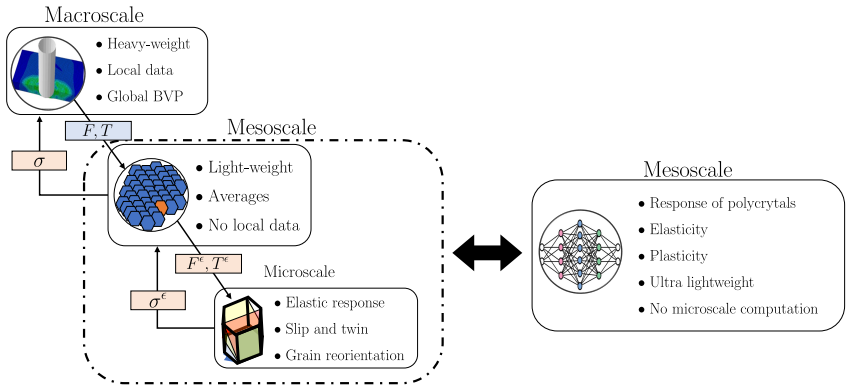
Summary. The paper introduces a Temperature-Aware Recurrent Neural Operator (TRNO) as a surrogate for a temperature-dependent crystal-plasticity model of polycrystalline magnesium. The architecture approximates a Markovian internal-variable model: deviatoric and hydrostatic stresses are outputs of neural networks F and H, while internal variables ξ evolve through learned rate functions G and I integrated by forward Euler. Training data are generated from a Taylor-type polycrystal CP model under Rademacher random-walk deformation and temperature histories (Eqs. (36)–(37)). The paper reports test errors around 6% on the training distribution, claims time-resolution independence, reports improved accuracy and training efficiency over GRU/LSTM baselines, uses transfer learning to mitigate poor isothermal generalization, and demonstrates the surrogate in Abaqus/Explicit for Taylor anvil and plate impact simulations, with speedups over the CP model of roughly three orders of magnitude.
Significance. If the central claims held, the TRNO would be a useful contribution to surrogate constitutive modeling for complex, temperature-dependent anisotropic plasticity, especially because the architecture is Markovian, interpretable through internal variables, and designed for variable time stepping. The paper deserves credit for directly comparing against GRU/LSTM with a fixed parameter budget, for honestly reporting the isothermal transfer-learning failure, and for demonstrating a working Abaqus implementation. However, the abstract's generalization claim is substantially stronger than what Section 4.1 demonstrates: the as-trained model fails on constant-temperature paths until transfer learning is applied. The internal-variable identification and resolution-independence analyses are suggestive but not fully quantified. These limitations are fixable but currently weaken the paper's central narrative.
major comments (3)
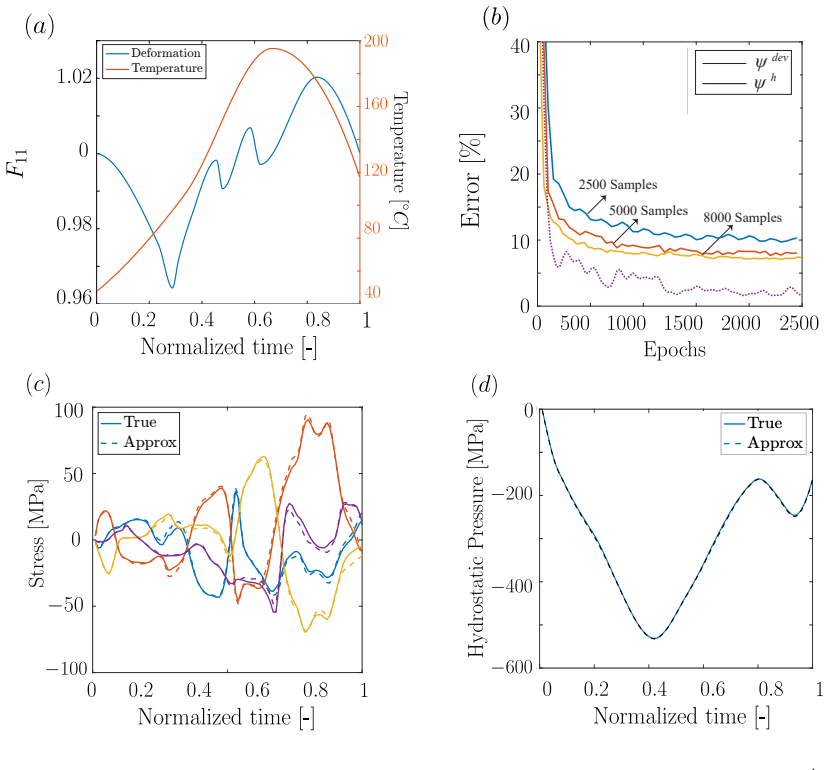
- [§4.1, Fig. 5; Abstract] The abstract claims the TRNO 'generalizes effectively across diverse loading cases, temperatures, and time resolutions.' Section 4.1 shows that a TRNO trained on random thermal histories has about 25% test error on constant-temperature paths and only reaches about 10% after 100 transfer-learning samples. Isothermal paths are a subset of thermo-mechanical histories, and a correctly learned Markovian internal-variable state should transfer to them; the large error indicates the model has fitted the statistics of the random-walk training distribution rather than the underlying constitutive map. This directly undercuts the stated generalization claim. The FE demonstrations in Section 5 use the transfer-learned model, so they cannot rescue the as-trained claim. The paper should either retrain with a training set that includes isothermal/constant-temperature histories or substantially qualify
- [§4.3, Fig. 7(a)] The number of internal variables k and m is selected by inspecting the test-error plateau in Fig. 7(a). This makes the internal-variable dimension a hyperparameter chosen from the test set, not a quantity learned from data. Moreover, the loss in Eq. (38) contains no supervision on ξ, so the learned internal variables are non-unique and cannot be directly compared with the physical internal variables (ϵ, λ). The conclusion that 'the number of state variables required by the TRNO is of the same order as the number of internal variables of the physical model' is therefore not established; the comparison is only phenomenological. The authors should clarify that Fig. 7(a) is a model-selection curve and avoid the language of identification.
- [§4.4, Fig. 8(b)] The resolution-independence claim, a central advantage of the architecture, is not fully quantified. The text says 'the trained TRNO ψr at a resolution of 100 time steps,' but training data were generated at N = 10^4 time steps (Section 3.3), and it is unclear what 'resolution of 100 time steps' means. The figure axis is not labeled, and no error bars or numerical values are provided. Please specify the training resolution, the procedure for generating test paths at different resolutions (whether the same physical path is resampled), and report the actual errors. This is important because the claimed zero-shot super-resolution is load-bearing for the multiscale applications.
minor comments (4)
- [§2.7 / §3.3 / §5.3] The time-step numbers are inconsistent. Section 2.7 states Δt = 10^-3; Section 3.3 defines N = 10^4 and t_max = 100 s, giving Δt = 10^-2; Section 5.3 reports 100,000 steps at Δt = 10^-3 for the same 100 s. Please harmonize these definitions.
- [§5.1 / §5.2 / §5.3] The FE demonstrations use 'the trained TRNOs with transfer learning,' but the paper does not specify how many transfer-learning samples (100, 1000, or 2000) were used, which temperatures were included, or whether the same model was used for all FE runs. This information is needed for reproducibility.
- [Table 3] The runtime comparison mixes hardware platforms (MacBook vs. HPC cluster) and different time-step counts. The reported speedup of 1321× is therefore not a controlled benchmark. Even with the implicit CP comparison (835×), the hardware and solver differences should be stated more prominently, and ideally a same-hardware comparison should be provided.
- [§4.2, text after Fig. 6] Typo: 'at abound 7% strain' should read 'at about 7% strain.' Also, in several places (e.g., Fig. 5 caption and Fig. 8), axes lack units or labels (stress in MPa, strain, time steps), which hampers interpretation.
Circularity Check
No significant circularity: TRNO is a surrogate trained on and evaluated against an externally calibrated crystal-plasticity model; reported limitations are generalization gaps, not circular reductions.
full rationale
The paper's central claims are empirical: the TRNO is trained on stress histories generated by a previously published, experimentally calibrated crystal-plasticity model (Hollenweger & Kochmann 2022, cited as [11]) and evaluated on held-out paths from the same model. None of the predicted outputs (deviatoric/hydrostatic stress, state-variable evolution) is defined in terms of the fitted TRNO parameters; the loss (38) is a standard relative L2 error on unseen paths. Choosing the number of internal variables by observing the test-error plateau (Fig. 7a) is hyperparameter/model selection, not a fitted quantity renamed as a prediction. The resolution-independence claim follows from the continuous-time ODE formulation in (33)-(35) and is additionally demonstrated empirically in Fig. 8b; although the test paths share the Rademacher distribution of (36)-(37), that is a distributional limitation, not circularity. The self-citations [11], [28], [30] provide the generating model and the RNO architecture, but the CP model is calibrated to external experimental data (Kelley & Hosford, Chapuis & Driver, etc.) and the architecture's equations are stated in full, so these are not unverified premises imported by citation. Section 4.1 honestly reports that the as-trained TRNO generalizes poorly to isothermal paths (~25% error) and requires transfer learning; this weakens the abstract's generalization claim but is a performance gap, not a circular derivation. No step in the paper reduces by construction to its own inputs, so the appropriate finding is no significant circularity.
Assumptions & free parameters
free parameters (3)
- Deviatoric internal-variable dimension k =
15 (m = 35 in Fig. 4 experiments)
- Network width and depth =
4 fully-connected layers of 300 nodes for F and G
- Path sampling bounds epsilon_max, theta_max =
0.1 and 150
assumptions (5)
- domain assumption The crystal-plasticity model of Hollenweger and Kochmann [11] accurately captures the temperature-dependent plastic response of pure Mg, including slip and twinning.
- domain assumption The Taylor (isostrain) homogenization provides a sufficient polycrystal response for surrogate training.
- ad hoc to paper Random Rademacher paths (36)-(37) are representative of the loading and temperature histories of interest.
- domain assumption There exists a finite-dimensional Markovian internal-variable representation of the constitutive map.
- standard math Euler-forward integration with the training time step is an accurate discretization of the CP evolution equations.
Cite this review
Pith. "Pith review of Temperature-Aware Recurrent Neural Operator for Temperature-Dependent Anisotropic Plasticity in HCP Materials." pith.science (2026). https://pith.science/paper/HONJC556
@misc{pith2026250818806,
  author       = {Pith},
  title        = {Pith review of: Temperature-Aware Recurrent Neural Operator for Temperature-Dependent Anisotropic Plasticity in HCP Materials},
  year         = {2026},
  howpublished = {\url{https://pith.science/paper/HONJC556}},
  note         = {Machine review of arXiv:2508.18806}
}
read the original abstract
Neural network surrogate models for constitutive laws in computational mechanics have been in use for some time. In plasticity, these models often rely on gated recurrent units (GRUs) or long short-term memory (LSTM) cells, which excel at capturing path-dependent phenomena. However, they suffer from long training times and time-resolution-dependent predictions that extrapolate poorly. Moreover, most existing surrogates for macro- or mesoscopic plasticity handle only relatively simple material behavior. To overcome these limitations, we introduce the Temperature-Aware Recurrent Neural Operator (TRNO), a time-resolution-independent neural architecture. We apply the TRNO to model the temperature-dependent plastic response of polycrystalline magnesium, which shows strong plastic anisotropy and thermal sensitivity. The TRNO achieves high predictive accuracy and generalizes effectively across diverse loading cases, temperatures, and time resolutions. It also outperforms conventional GRU and LSTM models in training efficiency and predictive performance. Finally, we demonstrate multiscale simulations with the TRNO, yielding a speedup of at least three orders of magnitude over traditional constitutive models.
Figures


Figures from the paper (7 more)


Reference graph
Works this paper leans on
-
[1]
S. R. Kalidindi, Incorporation of Deformation Twinning in Models, International Journal of Plasticity 46 (1998) 267–290
work page 1998
- [2]
-
[3]
A. Staroselsky, L. Anand, A constitutive model for hcp materials deforming by slip and twinning: application to magnesium alloy az31b, International journal of Plasticity 19 (2003) 1843–1864
work page 2003
-
[4]
C. Liu, P. Shanthraj, J. D. Robson, M. Diehl, S. Dong, J. Dong, W. Ding, D. Raabe, On the interaction of precipitates and tensile twins in magnesium alloys, Acta Materialia 178 (2019) 146–162
work page 2019
- [5]
- [6]
-
[7]
M. Ardeljan, I. J. Beyerlein, B. A. McWilliams, M. Knezevic, Strain rate and temperature sensitive multi-level crystal plasticity model for large plastic deformation behavior: Application to AZ31 magnesium alloy, International Journal of Plasticity 83 (2016) 90–109
work page 2016
-
[8]
C. N. Tom´ e, R. A. Lebensohn, U. F. Kocks, A model for texture development dominated by deformation twinning: Application to zirconium alloys, Acta Metallurgica Et Materialia 39 (1991) 2667–2680
work page 1991
Show all 70 references
-
[9]
I. J. Beyerlein, C. N. Tom´ e, Analytical modeling of material flow in equal channel angular extrusion (ECAE), Materials Science and Engineering A 380 (2004) 171–190
2004
-
[10]
A. D. Tutcuoglu, A. Vidyasagar, K. Bhattacharya, D. M. Kochmann, Stochastic modeling of discontinuous dynamic recrystallization at finite strains in hcp metals, Journal of the Mechanics and Physics of Solids 122 (2019) 590–612
2019
-
[11]
Hollenweger, D
Y. Hollenweger, D. M. Kochmann, An efficient temperature-dependent crystal plasticity framework for pure magnesium with emphasis on the competition between slip and twinning, International Journal of Plasticity (2022) 103448
2022
-
[12]
Chang, J
Y. Chang, J. T. Lloyd, R. Becker, D. M. Kochmann, Modeling microstructure evolution in magnesium: Comparison of detailed and reduced-order kinematic models, Mechanics of Materials 108 (2017) 40–57
2017
-
[13]
Becker, J
R. Becker, J. T. Lloyd, A reduced-order crystal model for HCP metals: Application to Mg, Mechanics of Materials 98 (2016) 98–110
2016
-
[14]
Zhang, D
A. Zhang, D. Mohr, Using neural networks to represent von mises plasticity with isotropic hardening, International Journal of Plasticity 132 (2020) 102732
2020
-
[15]
M. B. Gorji, M. Mozaffar, J. N. Heidenreich, J. Cao, D. Mohr, On the potential of recurrent neural networks for modeling path dependent plasticity, Journal of the Mechanics and Physics of Solids 143 (2020) 103972
2020
-
[16]
Ibragimova, A
O. Ibragimova, A. Brahme, W. Muhammad, J. Levesque, K. Inal, A new ann based crystal plasticity model for fcc materials and its application to non-monotonic strain paths, International Journal of Plasticity 144 (2021) 103059
2021
-
[17]
X. Sun, H. Li, M. Zhan, J. Zhou, J. Zhang, J. Gao, Cross-scale prediction from rve to component, International Journal of Plasticity 140 (2021) 102973
2021
-
[18]
Al-Haik, M
M. Al-Haik, M. Hussaini, H. Garmestani, Prediction of nonlinear viscoelastic behavior of polymeric composites using an artificial neural network, International journal of plasticity 22 (2006) 1367–1392
2006
-
[19]
Hochreiter, J
S. Hochreiter, J. Schmidhuber, Long short-term memory, Neural computation 9 (1997) 1735–1780
1997
-
[20]
Chung, C
J. Chung, C. Gulcehre, K. Cho, Y. Bengio, Empirical evaluation of gated recurrent neural networks on sequence modeling, arXiv preprint arXiv:1412.3555 (2014). 25
2014 arXiv
-
[21]
Mozaffar, R
M. Mozaffar, R. Bostanabad, W. Chen, K. Ehmann, J. Cao, M. Bessa, Deep learning predicts path-dependent plasticity, Proceedings of the National Academy of Sciences 116 (2019) 26414–26420
2019
-
[22]
Z. Yu, C. Han, H. Yang, Y. Wang, S. Tang, X. Guo, Elastoplastic constitutive modeling under the complex loading driven by gru and small-amount data, Theoretical and Applied Mechanics Letters 12 (2022) 100363
2022
-
[23]
D. W. Abueidda, S. Koric, N. A. Sobh, H. Sehitoglu, Deep learning for plasticity and thermo-viscoplasticity, International Journal of Plasticity 136 (2021) 102852
2021
-
[24]
Ghavamian, A
F. Ghavamian, A. Simone, Accelerating multiscale finite element simulations of history-dependent materials using a recurrent neural network, Computer Methods in Applied Mechanics and Engineering 357 (2019) 112594
2019
-
[25]
Bonatti, D
C. Bonatti, D. Mohr, One for all: Universal material model based on minimal state-space neural networks, Science Advances 7 (2021) eabf3658
2021
-
[26]
Bonatti, B
C. Bonatti, B. Berisha, D. Mohr, From cp-fft to cp-rnn: Recurrent neural network surrogate model of crystal plasticity, International Journal of Plasticity 158 (2022) 103430
2022
-
[27]
Bonatti, D
C. Bonatti, D. Mohr, On the importance of self-consistency in recurrent neural network models representing elasto-plastic solids, Journal of the Mechanics and Physics of Solids 158 (2022) 104697
2022
-
[28]
Bhattacharya, B
K. Bhattacharya, B. Liu, A. Stuart, M. Trautner, Learning markovian homogenized models in viscoelasticity, arXiv preprint arXiv:2205.14139 (2022)
2022 arXiv
-
[29]
J. R. Rice, Inelastic constitutive relations for solids: an internal-variable theory and its application to metal plasticity, Journal of the Mechanics and Physics of Solids 19 (1971) 433–455
1971
-
[30]
B. Liu, N. Kovachki, Z. Li, K. Azizzadenesheli, A. Anandkumar, A. M. Stuart, K. Bhattacharya, A learning-based multiscale method and its application to inelastic impact problems, Journal of the Mechanics and Physics of Solids 158 (2022) 104668
2022
-
[31]
J. F. Nie, K. S. Shin, Z. R. Zeng, Microstructure, Deformation, and Property of Wrought Magnesium Alloys, volume 51, Springer US, 2020. URL: https://doi.org/10.1007/s11661-020-05974-z . doi:10.1007/s11661-020-05974-z
2020 doi
-
[32]
J. F. Nie, Precipitation and hardening in magnesium alloys, Metallurgical and Materials Transactions A: Physical Metallurgy and Materials Science 43 (2012) 3891–3939
2012
-
[33]
A. Jain, S. Agnew, Modeling the temperature dependent effect of twinning on the behavior of magnesium alloy az31b sheet, Materials Science and Engineering: A 462 (2007) 29–36
2007
-
[34]
A. Roy, E. S. Nani, A. Lahiri, M. P. Gururajan, Interfacial free energy anisotropy driven faceting of precipitates, Philo- sophical Magazine 97 (2017) 2705–2735
2017
-
[35]
Eswarappa Prameela, P
S. Eswarappa Prameela, P. Yi, Y. Hollenweger, B. Liu, J. Chen, L. Kecskes, D. M. Kochmann, M. Falk, T. P. Weihs, Strengthening magnesium by design: integrating alloying and dynamic processing, arXiv e-prints (2021) arXiv–2105
2021
-
[36]
S. R. Agnew, ¨O. Duygulu, Plastic anisotropy and the role of non-basal slip in magnesium alloy az31b, International Journal of plasticity 21 (2005) 1161–1193
2005
-
[37]
Kelley, W
E. Kelley, W. Hosford, Kelley and Hosford.pdf, Ph.D. thesis, University of Michigan, 1967
1967
-
[38]
Akhtar, E
A. Akhtar, E. Teghtsoonian, Solid solution strengthening of magnesium single crystals-ii the effect of solute on the ease of prismatic slip, Acta Metallurgica 17 (1969) 1351–1356
1969
-
[39]
M. Yoo, C. Wei, Slip modes of hexagonal-close-packed metals, Journal of Applied Physics 38 (1967) 4317–4322
1967
-
[40]
M. Yoo, J. Morris, K. Ho, S. Agnew, Nonbasal deformation modes of hcp metals and alloys: role of dislocation source and mobility, Metallurgical and Materials Transactions A 33 (2002) 813–822
2002
-
[41]
Yoshinaga, R
H. Yoshinaga, R. Horiuchi, On the nonbasal slip in magnesium crystals, Transactions of the Japan Institute of Metals 5 (1964) 14–21
1964
-
[42]
Sandl¨ obes, S
S. Sandl¨ obes, S. Zaefferer, I. Schestakow, S. Yi, R. Gonzalez-Martinez, On the role of non-basal deformation mechanisms for the ductility of mg and mg–y alloys, Acta Materialia 59 (2011) 429–439
2011
-
[43]
Agnew, M
S. Agnew, M. Yoo, C. Tome, Application of texture simulation to understanding mechanical behavior of mg and solid solution alloys containing li or y, Acta materialia 49 (2001) 4277–4289
2001
-
[44]
Lilleodden, Microcompression study of mg (0 0 0 1) single crystal, Scripta Materialia 62 (2010) 532–535
E. Lilleodden, Microcompression study of mg (0 0 0 1) single crystal, Scripta Materialia 62 (2010) 532–535
2010
-
[45]
G. I. Taylor, Plastic strain in metals, J. Inst. Metals 62 (1938) 307–324
1938
-
[46]
Chapuis, J
A. Chapuis, J. H. Driver, Temperature dependency of slip and twinning in plane strain compressed magnesium single crystals, Acta Materialia 59 (2011) 1986–1994
2011
-
[47]
B. C. Wonsiewicz, W. A. Backofen, Plasticity of Magnesium Single Crystals, Trans Metall Soc AIME 239 (1967) 1422–1431
1967
-
[48]
M. H. Yoo, Slip, twinning, and fracture in hexagonal close-packed metals, Metallurgical Transactions A 12 (1981) 409–418
1981
-
[49]
R. J. Asaro, J. Rice, Strain localization in ductile single crystals, Journal of the Mechanics and Physics of Solids 25 (1977) 309–338
1977
-
[50]
J. W. Christian, S. Mahajan, Deformation twinning, Progress in materials science 39 (1995) 1–157
1995
-
[51]
Chang, D
Y. Chang, D. M. Kochmann, A variational constitutive model for slip-twinning interactions in hcp metals: Application to single- and polycrystalline magnesium, International Journal of Plasticity 73 (2015) 39–61
2015
-
[52]
S. Ando, N. Harada, M. Tsushida, H. Kitahara, H. Tonda, Temperature dependence of deformation behavior in magnesium and magnesium alloy single crystals, in: Key Engineering Materials, volume 345, Trans Tech Publ, 2007, pp. 101–104
2007
-
[53]
Q. Liu, A. Roy, V. V. Silberschmidt, Temperature-dependent crystal-plasticity model for magnesium: A bottom-up approach, Mechanics of Materials 113 (2017) 44–56
2017
-
[54]
W. Wang, J. Liu, A. K. Soh, Crystal plasticity modeling of strain rate and temperature sensitivities in magnesium, Acta Mechanica 230 (2019) 2071–2086
2019
-
[55]
Vidyasagar, A
A. Vidyasagar, A. D. Tutcuoglu, D. M. Kochmann, Deformation patterning in finite-strain crystal plasticity by spectral homogenization with application to magnesium, Computer Methods in Applied Mechanics and Engineering 335 (2018) 584–609. 26
2018
-
[56]
P. P. Indurkar, S. Baweja, R. Perez, S. P. Joshi, Predicting textural variability effects in the anisotropic plasticity and stability of hexagonal metals: Application to magnesium and its alloys, International Journal of Plasticity (2020)
2020
-
[57]
Moulinec, P
H. Moulinec, P. Suquet, A numerical method for computing the overall response of nonlinear composites with complex microstructure, Computer Methods in Applied Mechanics and Engineering 157 (1998) 69–94
1998
-
[58]
P. Zhao, T. Song En Low, Y. Wang, S. R. Niezgoda, An integrated full-field model of concurrent plastic deformation and microstructure evolution: Application to 3D simulation of dynamic recrystallization in polycrystalline copper, International Journal of Plasticity 80 (2016) 38–55
2016
-
[59]
B. Liu, M. Trautner, A. M. Stuart, K. Bhattacharya, Learning macroscopic internal variables and history dependence from microscopic models, arXiv preprint arXiv:2210.17443 (2022)
2022 arXiv
-
[60]
Kovachki, Z
N. Kovachki, Z. Li, B. Liu, K. Azizzadenesheli, K. Bhattacharya, A. Stuart, A. Anandkumar, Neural operator: Learning maps between function spaces, arXiv preprint arXiv:2108.08481 (2021)
2021 arXiv
-
[61]
Klambauer, T
G. Klambauer, T. Unterthiner, A. Mayr, S. Hochreiter, Self-normalizing neural networks, Advances in neural information processing systems 30 (2017)
2017
-
[62]
Paszke, S
A. Paszke, S. Gross, S. Chintala, G. Chanan, E. Yang, Z. DeVito, Z. Lin, A. Desmaison, L. Antiga, A. Lerer, Automatic differentiation in pytorch (2017)
2017
-
[63]
D. P. Kingma, J. Ba, Adam: A method for stochastic optimization, 2017. arXiv:1412.6980
2017 arXiv
-
[64]
Bozinovski, A
S. Bozinovski, A. Fulgosi, The influence of pattern similarity and transfer learning upon training of a base perceptron b2, in: Proceedings of Symposium Informatica, volume 3, 1976, pp. 121–126
1976
-
[65]
Torrey, J
L. Torrey, J. Shavlik, Transfer learning, in: Handbook of research on machine learning applications and trends: algorithms, methods, and techniques, IGI global, 2010, pp. 242–264
2010
-
[66]
URL:https://www.3ds.com/ products-services/simulia/products/abaqus/, version 2025
Dassault Syst` emes Simulia Corp., Abaqus Finite Element Analysis Software, Software, 1978. URL:https://www.3ds.com/ products-services/simulia/products/abaqus/, version 2025
1978
-
[67]
N. Ono, R. Nowak, S. Miura, Effect of deformation temperature on Hall-Petch relationship registered for polycrystalline magnesium, Materials Letters 58 (2004) 39–43
2004
-
[68]
Ravindran, Z
S. Ravindran, Z. Lovinger, V. Gandhi, M. Mello, G. Ravichandran, Strength of magnesium at high pressures and strain rates, Extreme Mechanics Letters 41 (2020) 101044
2020
-
[69]
Ghosh, O
D. Ghosh, O. T. Kingstedt, G. Ravichandran, Plastic work to heat conversion during high-strain rate deformation of mg and mg alloy, Metallurgical and Materials Transactions A 48 (2017) 14–19
2017
-
[70]
S. E. Grunschel, Pressure-shear plate impact experiments on high-purity aluminum at temperatures approaching melt, Ph.D. thesis, Brown University, 2009. 27
2009
Reviewed August 5, 2026 · model on record in the stance chip above.
Discussion (0). Continue with ORCID to comment.