REVIEW 3 major objections 5 minor 15 references
SWiFT: Soft-Mask Weight Fine-tuning for Bias Mitigation
T0 review · 3 major / 5 minor · reviewed 2026-08-05 · deepseek-v4-flash
Pith's one-line read SWiFT claims that fine-tuning a pretrained medical classifier with a per-weight soft mask, using only a small external dataset and a few epochs, can reduce bias while preserving or improving diagnostic accuracy and out-of-distribution perfo
desk verdict Solid extension of BMFT with a useful soft-mask mechanism and strong experiments, but the abstract overclaims consistency and a load-bearing fixed-mask assumption is untested. read the letter →
The pith
A machine-rendered reading of the paper's core claim, the machinery that carries it, and where it could break.
The reading
What carries the argument
The per-weight soft mask Mi=|tanh(Norm(I_b,i)/Norm(I_l,i))|, built from diagonal Fisher-information estimates of each parameter's importance to a bias objective (Ib) and to the prediction loss (Il). It acts as a continuous per-parameter learning-rate gate during the first fine-tuning step, and its value on classification-head weights decides which weights are zero-reinitialized in the second step. The two-step schedule itself is the other mechanism: masked, bias-focused fine-tuning of the feature extractor, then partial head reset followed by prediction-focused fine-tuning of the head.
What would settle it
Train a classifier where a synthetic spurious feature is injected so it perfectly predicts the label in training but is absent at test time, apply SWiFT on a small balanced external set, and check whether the mask concentrates on weights that an oracle causal intervention identifies as encoding that feature, and whether test accuracy on feature-free inputs rises while accuracy on feature-present inputs stays intact. If the mask misses the injected feature or the accuracy gap persists, the central claim is refuted.
Extended reading notes
Core claim
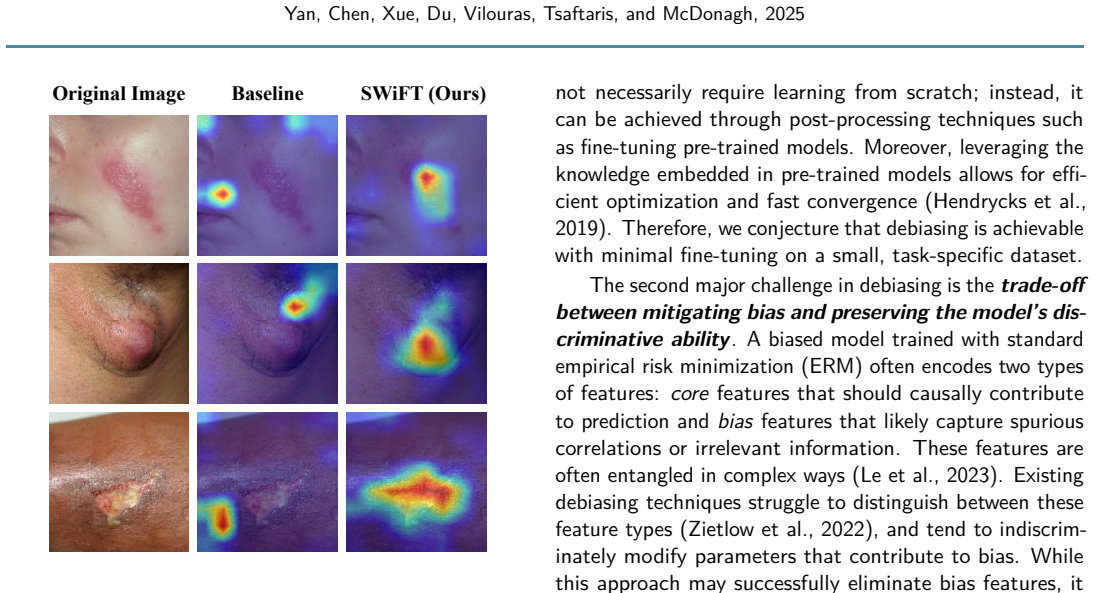
The central claim is that bias in a pretrained classifier is not spread uniformly across its weights: each parameter has a measurable relative importance for bias versus prediction, and updating exactly the bias-dominant parameters removes spurious correlations without eroding the core features needed for diagnosis. SWiFT computes this for every weight as the normalized ratio of two diagonal Fisher-information values, one for an equalized-odds bias objective and one for a weighted cross-entropy loss, then uses the resulting soft mask in two steps. First it fine-tunes the feature extractor under a bias-heavy loss while masking the gradients so prediction-critical weights move little. Then it
Load-bearing premise
The load-bearing premise is that the per-weight ratio of bias-importance to prediction-importance, estimated once from gradient-based Fisher information on a small group-balanced external dataset, marks the weights that encode bias rather than core features, and that this ranking stays valid across the few fine-tuning epochs.
Editorial extensions
If this is right
- Debiasing becomes a post-training patch: a small group-balanced external dataset and roughly 10% of the original training epochs suffice, so models already deployed can be updated without retraining or original-data access.
- Fairness gains need not come at the cost of accuracy; in the reported experiments the debiased model is competitive or better on AUC and also generalizes better to out-of-distribution test sets.
- Because bias is treated as two separate problems, feature entanglement in the extractor and biased feature composition in the head, any effective debiasing tool likely needs both a masked update step and a head-reset step.
- Continuous soft masks remove the threshold-search burden of binary masking and outperform both hard-mask and random-mask controls in the paper's ablations.
- The method is architecture-agnostic in the tested settings, working across ResNet-50, EfficientNet-B3, and DenseNet-121 for skin tone, gender, and age attributes.
Reading between the lines
- The same importance-ratio machinery could target non-demographic spurious correlations, such as hospital site, scanner, or lesion framing artifacts, turning SWiFT into a general shortcut-removal tool; the paper does not test this.
- The fixed-mask assumption, which the paper flags in its limitations, implies that recomputing the mask periodically would be a natural extension for longer fine-tuning runs and could also serve as a direct test of whether the importance ranking stays stable.
- If only a small labeled sample is available, SWiFT could in principle debias models that cannot be retrained on their original data, a deployment scenario the paper does not claim.
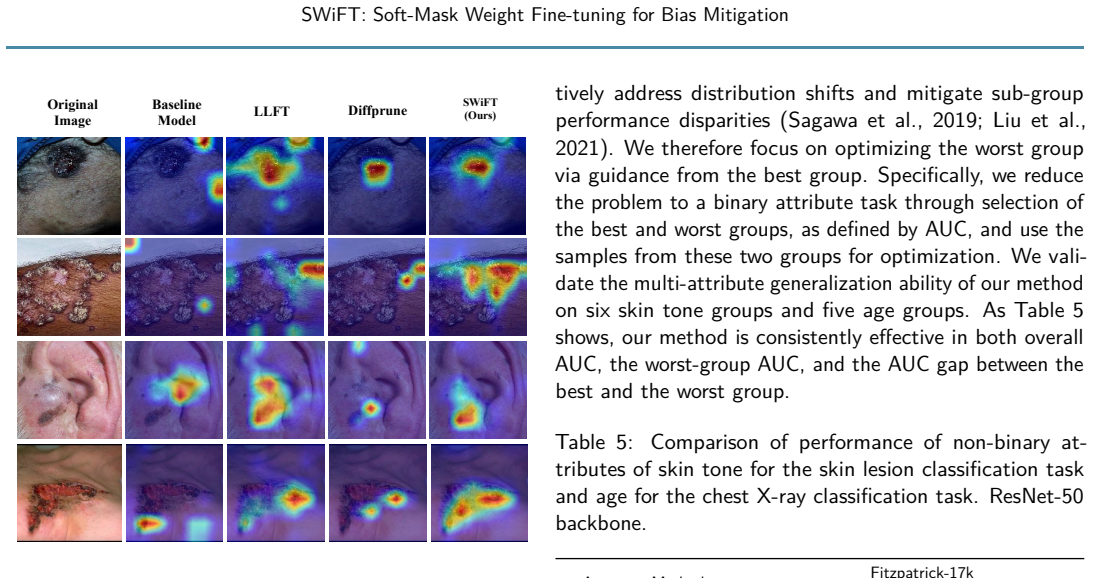
- The paper's best-versus-worst-group reduction for non-binary attributes is an initial probe; stress-testing it in multi-class tasks with several protected groups would show whether the two-step schedule keeps its edge when group and label interactions are denser.
Editorial analysis
A structured set of objections, weighed in public.
Referee Report
Summary. The paper proposes SWiFT, a post-hoc debiasing framework that fine-tunes a pre-trained model using a soft mask computed from per-parameter Fisher information estimates. The mask is designed to identify parameters that contribute more to bias than to predictive performance, so that fine-tuning updates can preferentially modify bias-related parameters while preserving prediction-critical ones. The method consists of two stages: a soft-mask-guided fine-tuning of the feature extractor, and a partial re-initialization followed by fine-tuning of the classification head. Experiments are reported on skin lesion and chest X-ray classification, using multiple sensitive attributes (skin tone, gender, age), three architectures, and several out-of-distribution test sets, with comparisons to nine baselines. The paper claims that SWiFT consistently reduces model bias while preserving or improving diagnostic accuracy, using only a small external dataset and a few fine-tuning epochs.
Significance. If the claims are sustained, SWiFT would be a practically attractive contribution: a post-training debiasing method that avoids access to original training data and full retraining, with code released and evaluations across multiple architectures and datasets. The paper's strengths include five-fold cross-validation with standard deviations, ablation studies for mask type, normalization, re-initialization, external dataset size, and multi-attribute extension. However, the significance is moderated by two concerns: the paper selects a key hyperparameter on the OOD test sets (Section 4.4), which can inflate reported performance, and the central claim of consistent bias reduction is contradicted by the paper's own tables in several settings. The fixed-mask stability assumption is acknowledged but not empirically tested.
major comments (3)
- [§4.4, Fig. 4] The number of fine-tuning epochs is selected by evaluating performance on Fitzpatrick-17k and Chexpert (Fig. 4), which are the same OOD datasets later used for evaluation in Tables 1–4. This is test-set leakage: the reported results for SWiFT are obtained with hyperparameters chosen on the test distribution, giving an unfair advantage over baselines. The epoch count should be selected using a separate validation split, or at minimum justified on the external validation dataset used for mask construction, and the final test results should be reported with that fixed choice.
- [Abstract and Tables 3–4] The abstract states that SWiFT 'can consistently reduce model bias', but Tables 3 and 4 show multiple cases where SPD increases relative to the baseline: Table 3, NIH Gender, ResNet-50 (SPD 0.031→0.040); Table 4, NIH Gender, DenseNet-121 (SPD 0.030→0.039); Table 2, PAD Gender, EfficientNet-B3 (SPD 0.009→0.015). These outcomes are not discussed in the text, which only acknowledges an AUC decrease in one setting. The consistency claim should be qualified, and the failure cases should be analyzed.
- [§3.3, Eq. (11), and §6] The soft mask is computed once on the pre-update model and used throughout both fine-tuning stages. Section 6 acknowledges this as an assumption: 'relative importance remains largely stable.' This assumption is load-bearing for the efficiency claim: if the importance ranking shifts substantially after a few masked updates, later epochs are updating parameters chosen for a stale model. No experiment measures mask stability or compares fixed against periodically recomputed masks. Please add such an experiment (e.g., correlation of mask values before/after fine-tuning, or an ablation with mask recomputation every k epochs) to support the central mechanism.
minor comments (5)
- [Table 4, Age/NIH header] The column header for Age under NIH reads 'SPD↑' but should be 'SPD↓' (lower SPD is better, as in the other columns).
- [§5.1.1, Table 1] The text reports SWiFT reductions of 36.1% and 37.6% compared to Baseline's 0.144 and 0.101 on Fitzpatrick-17k. In Table 1, the Fitzpatrick-17k Baseline EOdds is 0.159, not 0.101; 0.101 is the DDI SPD. The reported numbers mix different dataset columns and should be corrected.
- [Table 3, Age row] The BMFT row in the Age block is cited as '(Marcinkevics et al., 2022)', but BMFT is from Xue et al. (2024). The citation should be corrected.
- [Eq. (9)] Per-layer min–max normalization can divide by zero when a layer has constant importance values; this case is not discussed. A small epsilon or percentile-based normalization would avoid the ambiguity.
- [§3.1] The requirement that the external dataset 'must contain samples both with and without biased features' is somewhat circular: whether a feature is 'biased' is exactly what the method aims to identify. Consider clarifying that this means samples from both sensitive-attribute groups.
Circularity Check
No significant circularity: SWiFT's debiasing claims are supported by external OOD evaluation and ablations, not by construction or self-citation.
full rationale
The paper's derivation chain is self-contained against external benchmarks. The soft-mask (Eq. 9) is defined as the normalized ratio of diagonal Fisher information for the bias function and prediction loss; this definition makes statements like 'higher mask value means higher relative bias importance' true by construction, but the paper does not present such definitional statements as empirical predictions. The central claims are that SWiFT reduces bias and preserves accuracy, and these are tested on held-out OOD datasets (Fitzpatrick-17k, DDI, Atlas, PAD, CheXpert, NIH) against nine baselines, with ablations on mask strategy, normalization, two-step fine-tuning, re-initialization, and external dataset size. No fitted parameters are renamed as predictions: hyperparameters (epochs, beta, threshold gamma) are selected on validation and disclosed, and test performance is not used for model selection. The self-citations (BMFT, WBCE) are not load-bearing: WBCE is a standard weighted cross-entropy and BMFT is used as a baseline, not as a justification for the method's validity. The acknowledged fixed-mask assumption in Section 6 ('our current implementation uses a fixed soft-mask... based on the assumption that... relative importance remains largely stable') is a stability assumption about the method's mechanism rather than a circular derivation; it is explicitly flagged as a limitation and does not make the reported results equivalent to the inputs. Overall, the derivation and evaluation are not circular.
Assumptions & free parameters
free parameters (4)
- Fine-tuning epoch count =
20 (skin), 10 (chest X-ray)
- Loss balancing epsilon (β) =
not specified
- Mask normalization choice =
per-layer min-max
- Re-initialization threshold γ =
mean of head soft-mask
assumptions (6)
- domain assumption Model is decomposable into a feature extractor E and a classification head C.
- domain assumption Diagonal Fisher information approximates per-parameter importance to prediction and bias.
- domain assumption A small group-balanced external dataset reveals the model's bias parameters.
- domain assumption Bias originates from feature-extractor entanglement and head composition, addressed by two steps.
- domain assumption Zero-initialization of bias-important head parameters is safe.
- ad hoc to paper The computed soft-mask remains stable over fine-tuning epochs.
Cite this review
Pith. "Pith review of SWiFT: Soft-Mask Weight Fine-tuning for Bias Mitigation." pith.science (2026). https://pith.science/paper/CTU3E5BW
@misc{pith2026250818826,
  author       = {Pith},
  title        = {Pith review of: SWiFT: Soft-Mask Weight Fine-tuning for Bias Mitigation},
  year         = {2026},
  howpublished = {\url{https://pith.science/paper/CTU3E5BW}},
  note         = {Machine review of arXiv:2508.18826}
}
read the original abstract
Recent studies have shown that Machine Learning (ML) models can exhibit bias in real-world scenarios, posing significant challenges in ethically sensitive domains such as healthcare. Such bias can negatively affect model fairness, model generalization abilities and further risks amplifying social discrimination. There is a need to remove biases from trained models. Existing debiasing approaches often necessitate access to original training data and need extensive model retraining; they also typically exhibit trade-offs between model fairness and discriminative performance. To address these challenges, we propose Soft-Mask Weight Fine-Tuning (SWiFT), a debiasing framework that efficiently improves fairness while preserving discriminative performance with much less debiasing costs. Notably, SWiFT requires only a small external dataset and only a few epochs of model fine-tuning. The idea behind SWiFT is to first find the relative, and yet distinct, contributions of model parameters to both bias and predictive performance. Then, a two-step fine-tuning process updates each parameter with different gradient flows defined by its contribution. Extensive experiments with three bias sensitive attributes (gender, skin tone, and age) across four dermatological and two chest X-ray datasets demonstrate that SWiFT can consistently reduce model bias while achieving competitive or even superior diagnostic accuracy under common fairness and accuracy metrics, compared to the state-of-the-art. Specifically, we demonstrate improved model generalization ability as evidenced by superior performance on several out-of-distribution (OOD) datasets.
Figures


Figures from the paper (5 more)



Reference graph
Works this paper leans on
-
[5]
Mimic-cxr-jpg, a large publicly available database of labeled chest radiographs
Alistair EW Johnson, Tom J Pollard, Nathaniel R Green- baum, Matthew P Lungren, Chih-ying Deng, Yifan Peng, Zhiyong Lu, Roger G Mark, Seth J Berkowitz, and Steven Horng. Mimic-cxr-jpg, a large publicly available database of labeled chest radiographs. arXiv preprint arXiv:1901.07042,
arXiv 1901
-
[6]
Re-weighting based group fairness regulariza- tion via classwise robust optimization
Sangwon Jung, Taeeon Park, Sanghyuk Chun, and Taesup Moon. Re-weighting based group fairness regulariza- tion via classwise robust optimization. In 11th Inter- national Conference on Learning Representations, ICLR 2023,
work page 2023
-
[8]
Last-layer fairness fine-tuning is simple and effective for neural networks
Yuzhen Mao, Zhun Deng, Huaxiu Yao, Kenji Kawaguchi, and James Zou. Last-layer fairness fine-tuning is simple and effective for neural networks. In ICML 2023 Workshop on Spurious Correlations, Invariance, and Stability ,
work page 2023
-
[9]
A comparative study of fairness in medical machine learn- ing
Tochi Oguguo, Ghada Zamzmi, Sivaramakrishnan Rajara- man, Feng Yang, Zhiyun Xue, and Sameer Antani. A comparative study of fairness in medical machine learn- ing. In 2023 IEEE 20th International Symposium on Biomedical Imaging (ISBI) , pages 1–5. IEEE,
work page 2023
-
[10]
Esther Puyol-Ant ´on, Bram Ruijsink, Stefan K Piechnik, Stefan Neubauer, et al. Fairness in cardiac MR image analysis: an investigation of bias due to data imbalance in deep learning based segmentation. In Medical Image Computing and Computer Assisted Intervention–MICCAI 2021, September 27–October 1, 2021, Proceedings, Part III 24 , pages 413–423. Springer,
work page 2021
-
[11]
Shiori Sagawa, Pang Wei Koh, Tatsunori B Hashimoto, and Percy Liang. Distributionally robust neural net- works for group shifts: On the importance of regu- larization for worst-case generalization. arXiv preprint arXiv:1911.08731,
arXiv 1911
-
[12]
Chexclusion: Fairness gaps in deep chest x-ray classifiers
Laleh Seyyed-Kalantari, Guanxiong Liu, Matthew McDer- mott, Irene Y Chen, and Marzyeh Ghassemi. Chexclusion: Fairness gaps in deep chest x-ray classifiers. In BIOCOM- PUTING 2021: proceedings of the Pacific symposium , pages 232–243. World Scientific,
work page 2021
-
[2016]
Leveling down in com- puter vision: Pareto inefficiencies in fair deep classifiers
Dominik Zietlow, Michael Lohaus, Guha Balakrish- nan, Matthaeus Kleindessner, Francesco Locatello, B Scholkopf, and Chris Russell. Leveling down in com- puter vision: Pareto inefficiencies in fair deep classifiers. in 2022 ieee. In CVF Conference on Computer Vision and Pattern Recognition (CVPR) , pages 10400–10411,
work page 2022
Show all 15 references
-
[2017]
FairPrune: Achieving fairness through pruning for derma- tological disease diagnosis
365 Yan, Chen, Xue, Du, Vilouras, Tsaftaris, and McDonagh, 2025 Yawen Wu, Dewen Zeng, Xiaowei Xu, and Jingtong Hu. FairPrune: Achieving fairness through pruning for derma- tological disease diagnosis. In International Conference on Medical Image Computing and Computer-Assisted...
2025
-
[2018]
Chestx-ray8: Hospital-scale chest x-ray database and benchmarks on weakly-supervised classification and localization of com- mon thorax diseases
Xiaosong Wang, Yifan Peng, Le Lu, Zhiyong Lu, Moham- madhadi Bagheri, and Ronald M Summers. Chestx-ray8: Hospital-scale chest x-ray database and benchmarks on weakly-supervised classification and localization of com- mon thorax diseases. In Proceedings of the IEEE confer- ence...
-
[2019]
Noel CF Codella, David Gutman, M Emre Celebi, Brian Helba, Michael A Marchetti, Stephen W Dusza, Aadi Kalloo, et al. Skin lesion analysis toward melanoma de- tection: A challenge at the 2017 international symposium on biomedical imaging (ISBI), hosted by the international skin...
2017
-
[2021]
Skin lesion analysis toward melanoma detection 2018: A challenge hosted by the international skin imaging collaboration (ISIC)
Noel Codella, Veronica Rotemberg, Philipp Tschandl, M Emre Celebi, et al. Skin lesion analysis toward melanoma detection 2018: A challenge hosted by the international skin imaging collaboration (ISIC). arXiv preprint arXiv:1902.03368,
2018 arXiv
-
[2022]
Debias- ing skin lesion datasets and models? not so fast
Alceu Bissoto, Eduardo Valle, and Sandra Avila. Debias- ing skin lesion datasets and models? not so fast. In Proceedings of the IEEE/CVF Conference on Computer 363 Yan, Chen, Xue, Du, Vilouras, Tsaftaris, and McDonagh, 2025 Vision and Pattern Recognition Workshops , pages 740– 741,
2025
-
[2023]
Is last layer re-training truly sufficient for robustness to spurious correlations? arXiv preprint arXiv:2308.00473,
364 SWiFT: Soft-Mask Weight Fine-tuning for Bias Mitigation Phuong Quynh Le, J ¨org Schl¨otterer, and Christin Seifert. Is last layer re-training truly sufficient for robustness to spurious correlations? arXiv preprint arXiv:2308.00473,
-
[2024]
Technical chal- lenges for training fair neural networks
Valeriia Cherepanova, Vedant Nanda, Micah Goldblum, John P Dickerson, and Tom Goldstein. Technical chal- lenges for training fair neural networks. arXiv preprint arXiv:2102.06764,
Reviewed August 5, 2026 · model on record in the stance chip above.
Discussion (0). Sign in to comment.